USA
Designed twin-engined STOL light passenger/cargo aircraft in 1962. Prototype Evangel 4500-300 first flew in June 1964, having rugged structure and intended for bush operations/missionary work. Manufacture ceased in 1974 after seven production aircraft were built.
Post WW2
EAC / Etudes Aeronautiques et Commerciales SARL
France
Etudes Aeronautiques et Commerciales SARL was formed in 1960 to build modified versions of Jodel lightweight monoplanes. Also offered kits for amateur construction.
Eshelman Chestonal E.F.100 Winglet
A low-wing monoplane in which a tubular steel spar formed the fuel tank. Revived after the war.
Eshelman Chestonal Co
USA
Formed 1942. Made several experimental types, notably FW-5 (“The Wing”), having center section built integrally with the fuselage, and a low-wing monoplane in which a tubular steel spar formed the fuel tank. Latter type revived after the war as E.F.100 Winglet.
Erickson Air-Crane Co LLC
USA
Founded 1972 to operate Sikorsky S-64s as heavy-lift helicopters. Developed Helitanker system for S-64 to permit firefighting role. Purchased Type Certificate and production rights for S-64 from Sikorsky in 1992, and can construct new examples to improved Erickson S-64 Aircrane standard. Also developed modifications for ex-U.S. Army CH-54s to bring them up to Aircrane standard.
ERCO (Engineering Research Corp.)
USA
Established 1930, Henry Berliner was the founder of Berliner Aircraft Company, and founder of Engineering Research Corporation, Riverdale, Maryland- producer of the Ercoupe.
After making important components for other aircraft, designed and built the novel Ercoupe monoplane, developed from the original Weick “easy-to-fly” type and first flown in October 1937. Fred E. Weick was the company’s chief engineer. The type was notable for its control system, which eliminated rudder pedals, and was first marketed in 1940. Production ceased on U.S. entry into Second World War, when company was fully engaged in defense contracts. Difficulty of obtaining duralumin led to redesigned Ercoupe of composite construction in 1941. In August 1941 one was used to demonstrate benefits of jet-assisted take-off (JATO) compared with conventionally- powered aircraft. Two examples were bought by U.S. Army as experimental radio-controlled targets. After the war civil Ercoupe production was resumed.
Equator Aircraft Turbo Equator / Poeschel P.300 Equator
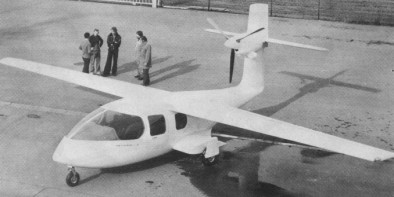
An eight place, high wing, fiberglass am¬phibious single with a 400 hp Allison 250 turbo¬prop mounted near the top of the vertical stabilizer. Intended to be amphibious, the main gear retracts into sponsons that stabilise the hull on water.
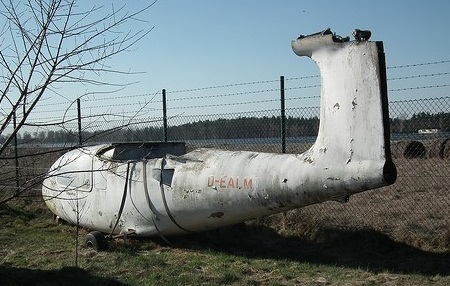
Equator Aircraft Gesellschaft Für Flugzeugbau Mbh Ulm / Pöschel Aircraft GmbH
Pöschel Aircraft GmbH was a small company which built P-300 Equator six-seat STOL amphibian (first flown 1970). Its single Lycoming engine drove a pusher propeller at the end of the fuselage, behind the T-tail. A turboprop version, the P.400 Turbo Equator, suffered an accident during tests in 1977, the company had been renamed Equator in 1974, and work continued into 1980s.
Eole 2000 Skyline / Super Skyline

The first Skyline were imported by Eole 2000 from England around 1978-79.
From 1983 it was manufactured in France by Eole 2000, called “Super Skyline” and was a little different, faster in particular.
Eole 2000 Super Skyline
Wing area: 15.5 m²
Wing span: 10 m
Aspect ratio: 6.4
Hang glider weight: 20 kg
Eole 2000 Super Skyline
Wing area: 16.1 m²
Wing span: 10.5 m
Aspect ratio: 6.8
Hang glider weight: 22 kg
Eole 2000 Super Skyline
Wing area: 18 m²
Wing span: 10.5 m
Aspect ratio: 6.1
Hang glider weight: 24 kg
Entwicklungsring Sud Arbeitsgemeinschaft / EWR VJ-101C
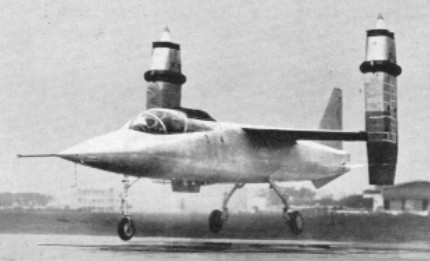
In 1959 the design teams of the German companies Bolkow, Heinkel and Messerschmitt were formed into a consortium named Entwicklungsring Sud to develop a Mach 2 VTOL interceptor for the Federal German defence ministry. Heinkel left the consortium in 1964 and in the following year it was re-formed as a company with the title Entwicklungsring Sud GmbH, EWR.
115 foreign companies’ participed including 35 in England, 60 in the US and 20 in France. A test rig built had three 2200 lb thrust Rolls-Royce engines installed in the same geometric arrangement as the VJ-101. Latter two 2759 lb thrust Rolls-Royce RB 145s in each of the two wing tip pods plus another two installed vertically in the fuselage were installed.
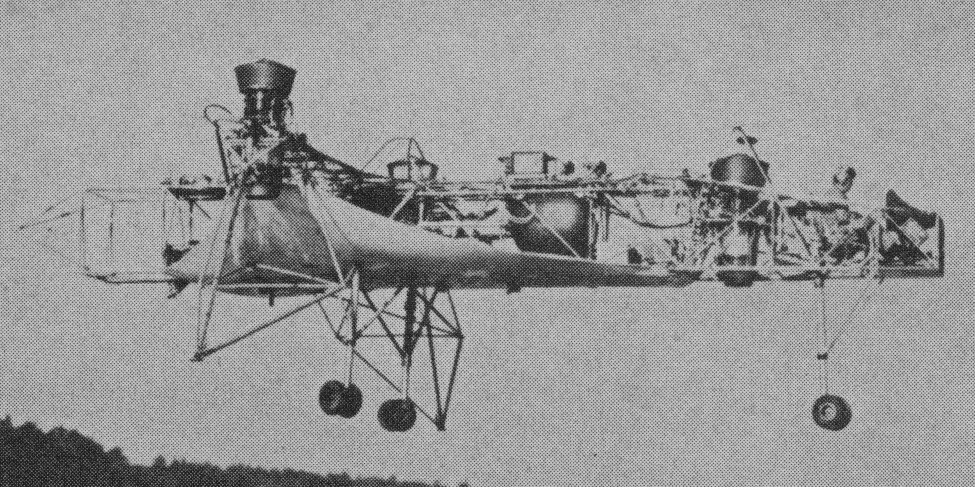
Two prototypes of the EWR VJ 101C single-seat experimental VTOL aircraft were built. Generally similar, they were both of high-wing monoplane configuration, primarily of light alloy construction, had retractable tricycle landing gear and accommodated the pilot in a pressurised cockpit, seated on a Martin-Baker ejection seat. Powerplant comprised six 2750-lb (1247-kg) thrust RB.145 turbojets, developed jointly by Rolls-Royce and MAN-Turbomotoren, with two mounted vertically in the fuselage, immediately aft of the cockpit, and two in a swivelling pod at each wingtip.
Those in the fuselage were used only for VTOL and low-speed flight, those in the wingtip pods for VTOL, low speed, transition from vertical to horizontal flight, and high-speed flight. Control of the aircraft in flight had been explored by a hovering rig powered by three Rolls-Royce RB.108 lift-jets, and by May 1963 this had made a total of 70 flights.
The VJ 101C X-1 prototype was flown for the first time in free hovering flight on 10 April 1963. It had exceeded a speed of Mach 1 several times before it crashed, following a vertical take-off, on 14 September 1964.
Flying the EWR VJ-101C Article
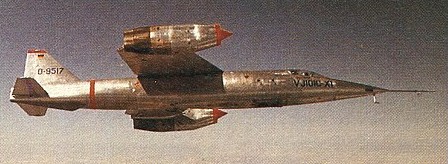
The VJ 101C X-2 differed by having afterburning engines in the wingtip pods, providing greater power (3550-lb / 1610-kg) for take-off and landing, and this made its first hovering flight on 12 June 1965. Four months later, on 22 October, the X-2 achieved the first full transitions from vertical to horizontal flight and vice versa, but development was discontinued soon after.
In absence of support by US Defence department or private manufacturers, the German government indicated in 1964 it won’t continue with a production version. Flight tests of the VJ.101C, including low supersonic advancement with afterburners fitted to the RB.145 engines, was continuing.
Production of a single-seat interceptor was planned, under the designation EWR VJ 101D, but this would have differed considerably from the research prototypes. VTOL lift would have been retained by a battery of Rolls-Royce/ MAN RB.162 lift-jets in the fuselage, but primary propulsion would have come from two Rolls-Royce/MAN RB.153 turbofans mounted in the rear fuselage, these relying upon thrust deflection for control purposes. None of these aircraft was built.
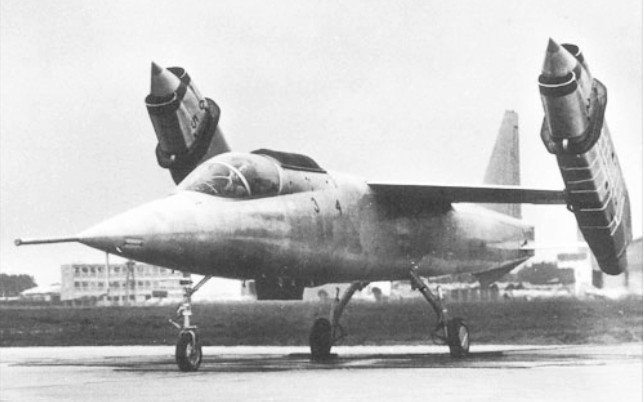
EWR VJ 101C X-1
Engines; 6 x Rolls-Royce/MAN RB.145, 1247kg / 2750-lb
Max take-off weight; 6000 kg / 13228 lb
Wingspan; 6.61 m / 21 ft 8 in
Length; 15.70 m / 51 ft 6 in
Height; 4.13 m / 13 ft 7 in
Max. speed; 1.08M
Crew; 1
 All Aero