Experimentalnii Zavod Sportivnoi Aviatsii Oshkinis BRO-11 Zile / BRO-16 / BRO-17U Utochka

The BRO-11 Zile (or Acorn) single-seat basic training glider is a rather smaller Russian version of the EoN Primary/Dagling/SG 38 formula, and first flew in 1954; it has since been built in large numbers for use by the DOSAAF as an elementary training glider. It was designed by B. Oshkinis and among the factories building it was the Experimentalnii Zavod Sportivnoi Aviatsii (or Experimental Sports Aviation Factory) where B. Oshkinis was one of the designers and which started production of the type in 1969; this later became the LAK organisation, which created the LAK-9 Lietuva and continues to produce the BRO-11. A modified version known as the BRO-
11-M was later produced, and a biplane seaplane version, the BRO-16, made its first flight in August 1973. Another, shorter-span version, which may be experimental, is the BRO-17U Utochka. The BRO-11 is a strut-braced high wing monoplane of fabric and ply-covered wooden construction, with the pilot sitting on an elongated beam which forms the fuselage and which has a semi-recessed monowheel for landing; there is a towing hook under the nose and a bumper at the end of the boom to act as a tailskid. The tail unit is carried on a framework of metal tubing and wire bracing, and the flaps are similar in appearance to the Miles high-lift auxiliary flaps fitted to the Aerovan and Gemini.

BRO-11
Span: 23 ft 10.5 in
Length: 16 ft 11.5 in
Wing area: 113.0 sqft
Aspect ratio: 5.05
Empty weight: 128 lb
Max weight : 260 lb
Stalling speed: 19 mph
Min sinking speed: 3.28 ft/sec
Excalibur Aviation Co.

Ed Swearingen returned to airplanes in 1959 by forming his own company, Excalibur Aviation, to produce the Swearingen Excalibur. This was a cleaned up, re engined modification of the Beech Twin Bonanza, and it was followed by Queen Air conversions and then the popular turboprop Merlin series.

In October 1960 Excalibur Aviation acquired all rights for conversion program (for which it already had responsibility) of Beechcraft Queen Air and Twin-Bonanza marketed by Swearingen Aircraft. Continues production at San Antonio, Texas. New company has adopted the name Queenaire 800 for former Swearingen 800.

Everson Evo III

The Everson brothers went on to build several aircraft, including one with a single-seat twin-engined design called Evo III. This aircraft, in which the pilot’s head was inches away from the propeller tips, was initially condemned by the authorities. Nevertheless it remains the only twin-engined homebuilt aircraft made in New Zealand.

Evans VP-2

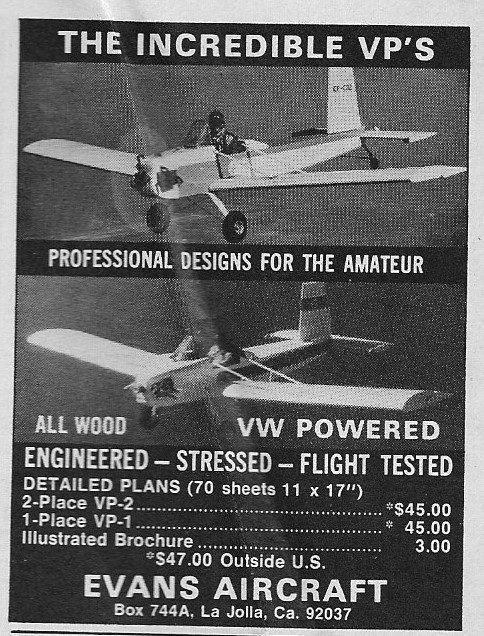
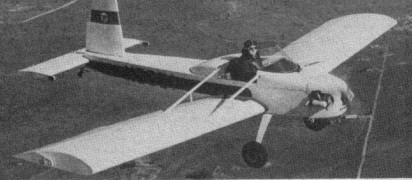
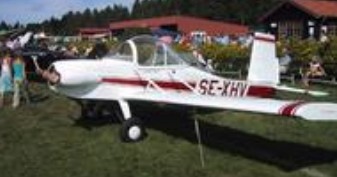
Following the success of the Volksplane VP-1, Evans designed the VP-2, capable of carrying two persons side by side. Construction is generally similar to the VP-1. The fuselage is of rectangular cross-section and consists of four wooden longerons, bulkheads and plywood skin. A fibreglass fairing is located behind the open cockpit. The fuselage width at the cockpit is approximately 35 inches. The wing is made up of two solid spruce spars. wooden ribs, compression struts and internal wire bracing. Each wing panel is fabric covered and externally braced to the fuselage with streamline steel tube struts. No flaps are fitted. The airfoil section is NACA 4415. The rudder consists of wooden ribs clamped to an aluminium tube mounted vertically in the rear fuselage. The all moving tailplane is a wooden cantilever structure, consisting of a simple box spar to which are glued wooden ribs. Both tailplane and rudder are fabric covered. The main wheels are carried on bent wire braced 2024-T3 aluminium alloy legs which are bolted to the fuselage. Shock absorption is taken by low pressure 600 x 6” tyres. Fuel is carried in a moulded II Imperial gallon fibreglass fuel tank aft of the firewall. VW engines up to 65 h.p. (2100cc) may be installed. The VP-2 with a passenger aboard is designed for “normal category” use, which allows non-aerobatic operation and all maneuvers incident to normal flying. Without a passenger, Utility category use is permitted, which includes stalls, lazy eights, chandelles and steep turns with a bank angle of more than 60 degrees. Aerobatics are not approved in either the VP-1 or VP-2.

Feb 1974

For a super-quick build some builders fly the primary structure alone; no cowls, canopy, turtleback, fairings, etc. Then they design and build lines at their leisure.

Engine Volkswagen (1834 cc), 60-hp.
Gross Wt. 1040 lb.
Empty Wt. 640 lb.
Fuel capacity 14 USG.
Wingspan 27 ft.
Wing Area: l30 sq.ft.
Wing Loading: 8.0 lb/sq.ft.
Length 19 ft.
Wing area: 130 sq.ft.
Top speed: 95 mph.
Cruise: 75 mph.
Stall: 45 mph.
Climb rate 500 fpm.
Ceiling 10,000 ft.
Takeoff run 700 ft.
Landing roll 400 ft.
Range 200 miles.
Seats: 2

Evans VP-1

The Volksplane VP-1 is a single seat aircraft designed by W.S. Evans, and first flown in 1968. The bare angular look is due to the designer’s aim to build a simple aeroplane where appearance and performance were of secondary importance. The wings consist of two solid spruce spars, band sawn ¼ inch plywood ribs, internal wire bracing and fabric covering. The wing is made in two separate panels, bolted to the fuselage at the inboard end and externally braced by streamline tubular steel struts. The airfoil section is NACA 4412. The fuselage is a square wooden 3-bulkhead box structure, plywood covered. A single tube over the windscreen serves as an overturn bar. The empennage consists of a wooden all-flying tailplane, to which is fitted an anti-servo tab and a single all-moving rudder. Both the rudder and tailplane are fabric covered. No fin is fitted. The undercarriage is made up of bent 3/8” 2024-T3 aluminium alloy plate wire braced and bolted to the fuselage. Shock absorption is taken by the two 600 x 6 tyres. A 6½ Imperial gallon moulded fibreglass fuel tank is installed behind the firewall. Engines up to 50 h.p. may be fitted. The only welding in the entire airplane is in the control stick assembly, the flying struts and the stabilator horn. Both the VP-1 and VP-2 can be stowed at home and require no trailer for highway towing. Aerobatics are not approved in either the VP-1 or VP-2.

Evans VP-1 Article

For a super-quick build some builders fly the primary structure alone; no cowls, canopy, turtleback, fairings, etc. Then they design and build lines at their leisure.

Feb 1974

Gallery

Engine: VW, 50 hp.
Length: 18 ft.
Wing span: 24 ft.
Wing area: 100 sq.ft.
Fuel cap: 8 USG.
Weight empty: 475 lbs.
Gross: 685 lbs.
Speed max: 90 mph.
Cruise: 75 mph.
Range: 200 sm.
Stall: 45 mph.
ROC: 600 fpm.
Take-off dist: 500 ft.
Landing dist: 400 ft.
Service ceiling: 10,000 ft.
Seats: 1.
Landing gear: tail wheel.

Engine: 40 hp VW.
Span: 24’0”.
Length: l8’0”.
Wing Area: 100 sq. ft.
Empty Weight: 350 lb.
Loaded Weight VP-1: 740 lb.
Loaded Weight VP-1/A: 800 lb.
Wing Loading VP-1/A: 8.0 lb/sq.ft.
Max Speed: 85 mph.
Cruise Speed: 70 mph.
Stall Speed: 46 mph.
Climb: 400 fpm.
Range: 200 miles.

Evangel 4500 STOL         

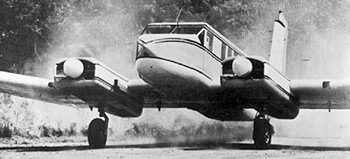
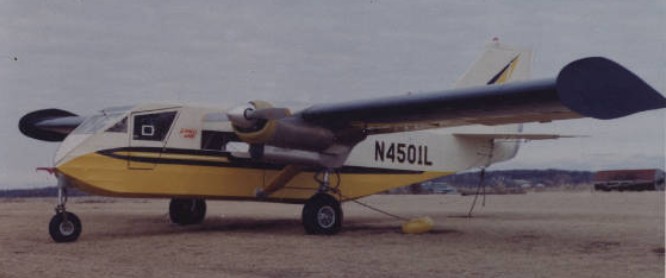
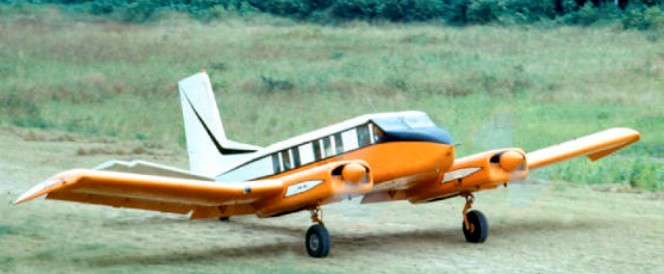
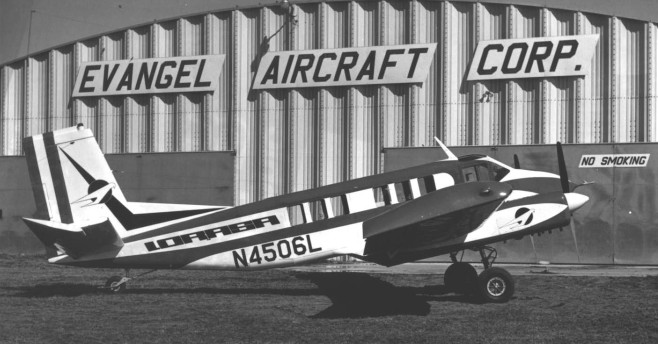
The Evangel Aircraft Corporation was established to design and build a bush aircraft particularly for use by missionary groups. For work in South America it had to have STOL capability and be simple to operate and maintain. The aircraft that was designed was designated the Evangel 4500-300 and was a twin-engined monoplane.

By 1963, Carl Mortenson had created a high wing strut-braced, twin engine plane with a fabric over metal tubing fuselage and a metal wing. At that time it was a fixed gear tricycle design.

Evangel 4500

The prototype Evangel 4500-300 first flew in June 1964 and the first production aircraft in January 1969. The aircraft needs a very short take-off run and can achieve a take-off to 50 ft (15m) within 375yds (343m).

With a planned first production run of 12, only a total of 8 were built (a 9th was never completed). The unit cost was US$70,500 in 1971 but manufacture ceased in 1974 after seven production aircraft were built.

Evangel Aircraft Corp 4500 STOL Brouchure

Gallery

Variants:

4500
The sole prototype, with a high strut braced wing and tricycle undercarriage.

4500-300
Production variant

4500-300-II
Used to identify aircraft fitted with turbochargers.

Specifications:
Engines: 2 × Avco Lycoming IO-540-K1B5, 300 hp (224 kW) each
Wingspan: 41 ft 3 in (12.57 m)
Length: 31 ft 6 in (9.60 m)
Height: 9 ft 6 in (2.90 m)
Wing area: 251 sq.ft (23.32 sq.m)
Empty weight: 3,455 lb (1,567 kg)
Gross weight: 5,500 lb (2,495 kg)
Fuel capacity: 111 Usgals
Maximum speed: 230 mph (370 km/h)
Cruise speed: 175 mph (282 km/h)
Stall speed: 67 mph
Range: 700 miles (1,126 km)
Service ceiling: 21,030 ft (6410 m)
Rate of climb: 1,500 ft/min (7.6 m/s)
Takeoff distance (50 ft.): 1,125 ft
Landing distance (50 ft.): 1,140 ft.
Crew: 1
Capacity: 8 passengers