The AV-48 was conceived from 1960, with a glass fibre structure and a laminar profile Wortmann FX-66H159. A fire in the workshop in which this hang-glider was to be built suspended the development of this project, which then continued with some modifications. In particular an increased scale of about sixty cm (to 16,70 m). Charles Fauvel was unable to continue the development of this machine before his death in 1979.
Wing span: 16.04 m Length: 3.85 m Wing area: 18.1 sq.m Airfoil: Wortmann FX-66H159 Empty weight: 250 kg Max. gross weight: 380 kg Max. L/D: 34:1 Min. sink rate: 0.68 m/s
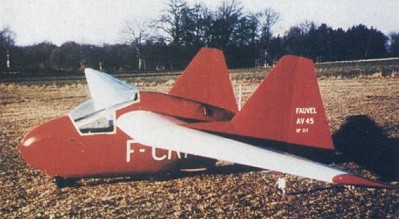
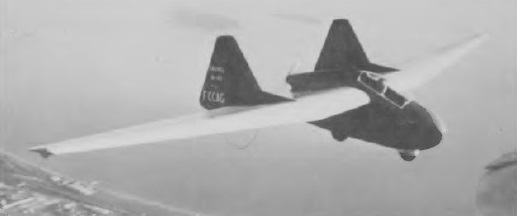
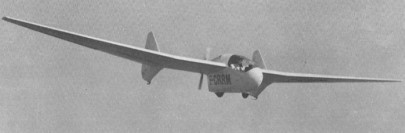
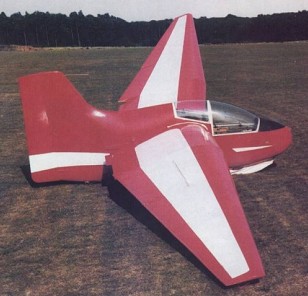
Inspired by two previous German experiences of motorizing the AV-36, and greatly motivated by the concept of the motorglider, Charles Fauvel flew the new AV-45 on May 4, 1960, an AV-36 very modified and powered by a pusher Nelson motor of 37 hp driving a two blade propeller. Later a 45hp Nelson engine was fitted. The second improved prototype, built by the SAN (Société Aéronautique Normande) in Bernay, took off with Charles Fauvel in command in 1962. This copy was equipped with a Solo engine of 23 hp that permitted, in spite of its low power output, enough power to take off in less than 100 ms and to climb at up to 3 m/sec.
This second prototype was representative of production AV 45s, which are intended for amateur construction, and it incorporated several changes, including the introduction of additional windows under the cockpit canopy, moving the pilot’s seat 2.4in further forward, lengthening the fuselage by 3.5 in, and fitting larger vertical tail surfaces carrying at the bottom small steerable skids which replace the underwing curved wire ‘bumpers’ of the first prototype. Hoerner wing tips were also successfully tried on the AV 45, and the original two-blade fixed-pitch airscrew was later replaced by an automatically feathering prop.
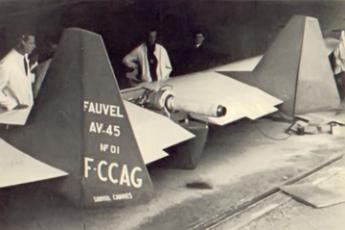
Microturbo was anxious to test this 78 Kp turbojet on a glider and Fauvel made available AV45 # 1. In 1967, the Nelson H 59A motor was replaced by a Microturbo Eclair 012-01 turbojet of 68 Kg / 150 lb of thrust in the summer of 1967. It was equipped with an electric starter and battery (NiCd 9.5 kg) for a self-starting it (both in the ground and in the air). The installation was characterized by the need to have a very long nozzle to allow ejection of the jet behind the fuselage.
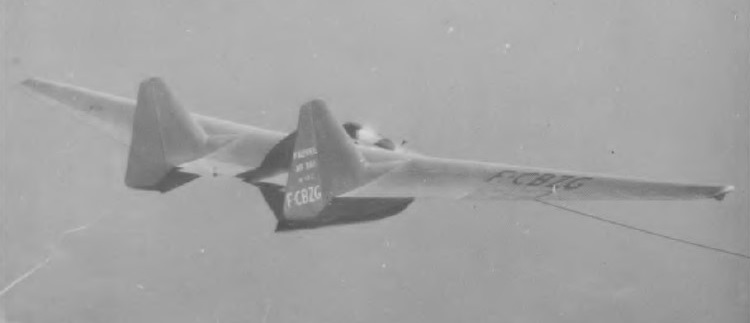
Fauvel AV45-01R Microturbo Éclair
The first flight was by Charles Fauvel, and the second he was joined by Jacques Hemet Stampe as a photographer filming the event. In this form the prototype was redesignated AV 45-01R and the Eclair gave it a maximum level speed of over 140mph at 2,625ft and the maximum rate of climb 990ft/min, the time to 10,000ft being 15min. The Eclair’s battery permitted repeated restarts in flight as well as ground starting, and this turbojet was also seen as a possible powerplant for two other Fauvel tailless powered glider projects.
The prohibitive price of this jet engine did not allow its use for practical reasons. The prototype was later fitted with a 30hp Rockwell-JLO engine by an amateur builder. The standard engine recommended for production aircraft is the 40-55hp modified Hirth 0-280R ‘flat four’, there being integral wooden fuel tanks in the wing leading edges.
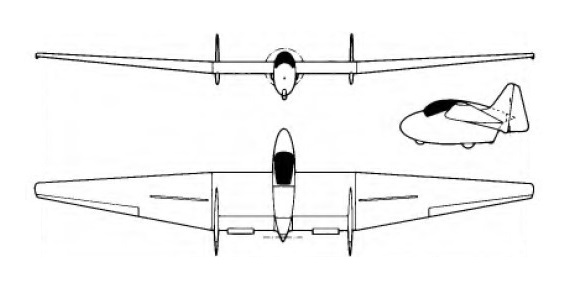
AV45
The first AV-45 motorglider of amateur construction, equipped with a Solo engine, was constructed in Japan and flew in South Africa (with Hirth Solo engine), while several copies were begun in the United States, in Finland, Germany and Spain. A French homebuilt AV 45 was flying with a Nelson engine. In France alone, even though some copies were constructed by amateurs, most glider pilots remained for the most part unconvinced of the charms of this motorglider. In early 1978 11 more AV45s were being built by amateur constructors, four in France, three in the USA, and one each in Finland, Germany, Martinique and Spain, the German one having a Solo engine. Like the AV 361, the AV 45 can be fitted with a wing of Wortmann laminar flow section, which gives an improved best glide ratio of 30:1.
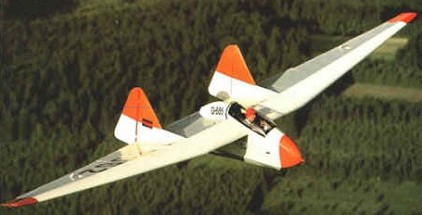
Not discouraged, Charles Fauvel further improved the motorglider with the AV-451 version. This ship had its span extended to 15 m (49ft 2.5 in), incorporated a new airfoil design from Wortmann : the Laminar FX 66-H 159, a new fuselage shape obtained by using an existing glass canopy design (the one on the Grob Astir glider). The nose is more tapered, the wheel fairings more streamlined, and the vertical tail surfaces are of Wortmann symmetrical section. The propeller was automatically folded rearward by airflow effect when the engine was stopped.
The Gross (Fauvel) AV 451, actually the first AV 451, was designed and built by Mons Francois Gross with his son’s help and is a modification of AV45 F-CCRM with the 15m wing span and new Wortmann wing section of the AV451, a longer fuselage modified in the cockpit area to take the canopy from a Grob Astir, and with a 38hp Rotax 642 two-cylinder two-stroke engine aft of the cockpit, driving a two-blade Hoffmann pusher propeller. It made its first flight in the beginning of September 1978. The cantilever shoulder wings are of Fz 17% thickness/chord ratio section or Wortmann profile, with no dihedral on the centre section and 5° 13′ on the outer wings. The wings are single-spar wooden structures, with a plywood leading edge torsion box and fabric covering aft of the spar; there are conventional ailerons and the elevators are in the trailing edge of the centre wing, with a large trim tab in the port one. Schempp-Hirth air brakes are fitted in the upper and lower surfaces of each outer wing, just outboard of the fins. The fuselage consists of a short wooden nacelle with glassfibre covering, the pilot sitting under a sideways-hinged blown plastic canopy. The wooden twin fins and rudders are inset at the junctions of the centre section and the outer wings, there being no tailplane; the fins are plywood-covered and the rudders fabric-covered. The undercarriage consists of two wheels in tandem, a steerable front wheel and a rear wheel with mechanical brake, supplemented by small steerable skids at the bottom of the vertical tail surfaces. Endowed with a L/D of 32:1, the AV-451 was the last flying wing of Fauvel. An entirely fibreglas composite version (AV-48) had been considered, but a fire at the shop where the prototype was to be constructed put an end to this adventure.
AV.451
The death of Charles Fauvel explains in part the fact that the AV-451 didn’t attain the success of the AV-36 and AV-361.
AV 45 second prototype Span: 45 ft 1 in Length: 11 ft 9 in Height: 6 ft 0 in Wing area: 171.7 sqft Aspect ratio: 11.84 Empty weight: 476 lb Max weight: 772 lb Economical cruising speed: 80 mph Min sinking speed: 2.62 ft/sec at 43.5 mph Best glide ratio: 27:1 at 53 mph Rate of climb at sea level: 550 ft/min Take-off run: 492 ft
AV.45 Wing span: 13.75 m Length: 3.6 m Wing area: 14.80 sq.m Airfoil: Fauvel F4 17% Aspect ratio: 10.8 Empty weight: 219 kg Maximum gross weight: 350 kg Glide ratio: 26:1 Min sink rate: 0.82 m/sec
AV.45 Engine: Hirth O-280R, 30-41 kW / 40-55 hp Wing span: 13.74 m / 45 ft 1 in Length: 3.59 m / 11 ft 9 in Wing area: 15.95 sq.m / 171.7 sq.ft Wing section: F2 17% Aspect ratio: 11.84 Empty weight: 216 kg / 476 lb Max weight: 350 kg / 772 lb Water ballast: None Max wing loading: 21.94 kg/sq.m / 4.49 lb/sq ft Max speed: 77 kt / 142 km/h Min sinking speed: 0.8 m/sec / 2.62 ft/sec at 37.5 kt / 70 km/h Best glide ratio: 27 at 45.5 kt / 85 km/h T-O run: 493 ft / 150m Rate of climb: 168 m/min / 550 ft/min
AV45-01R Engine: Microturbo Éclair, 68 kg thrust Best glide: 29 @ 85 Km / h Min rate of descent: 0.78 m / s Performances tinkering usage provisioning engine Rate of climb: 240 m / min @ 120 Km / h Maximum speed (800 m): 225 km / h Time to 3000 m: 15 min Fuel capacity: 31 lt Endurance: 22 min
AV.451 Wing span: 15.0 m Length: 3.84 m Wing area: 16.68 sq.m Airfoil: Wortmann FX-66 H 159 Aspect ratio: 13.5 Empty weight: 250 kg Maximum gross weight: 380 kg Glide ratio: 32:1 Min sink rate: 0.72 m/sec
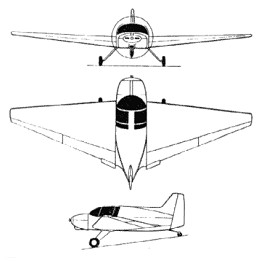
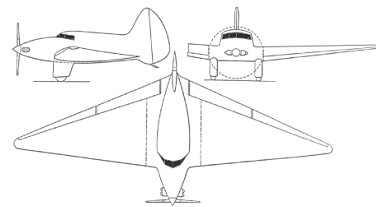
This all-wood side by side two-seater or three-seater tailess monoplane was a direct development of the AV-10 aircraft which flew in 1935. The AV-44 could be powered by a variety of engines in the 90-130 hp range, and was considered as a Short Take-Off and Landings (STOL) aircraft. Alternativelly, it could be powered by two engines mounted in the nose and driving two co-axial propellers. Plans were available for amateur construction, and a scale model was built in France by Mr Fermaut. Five AV-44 were under construction in 1978, but none were completed after Charles Fauvel’s death.
Wing span: 10.7 m Length: 5.0 m Wing area: 19.8 sq.m Airfoil: Fauvel F4 17% Aspect ratio: 5.8 Empty weight: 340 kg Gross weight: 604 kg Max. speed: 210 km/h
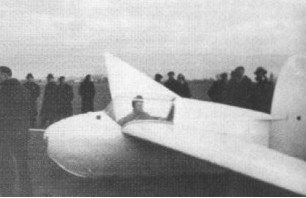
Encouraged by his experience with the acceptance of his previous glider prototypes, Charles Fauvel created the AV-36 in 1951. This retained the characteristic silhouette further improved with the fuselage reduced to a minimal profile (limited almost to the pilot’s cockpit), with a short wing span (11.95 meters) and a diminutive empty weight (120 kg). The AV-36 wing as originally designed could not be disassembled. The wing was constructed of only one piece and transporting the AV-36 by road could be done merely by folding the two rudders against the trailing edge and removing the nose of the fuselage. The AV-36 could then be put on a trailer, the resulting width of 2.38 meters not being more than the allowable road width. Furthermore, this compactness made for a very strong structure and the wing was calculated not to fail until exceeding 12 G’s at 215 kg.
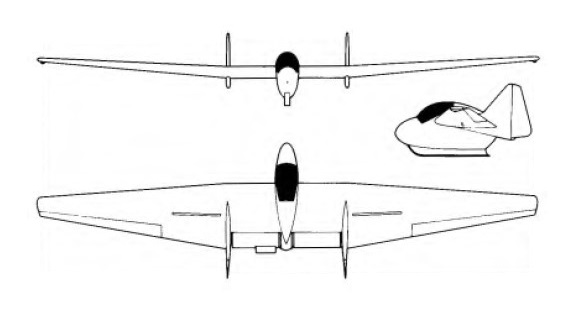
The cantilever shoulder wing is of fabric-covered wooden construction and has no sweep-back because, in a tailless sailplane, the problem of eg range can be neglected since there is no changing load to cater for, and the wing can be designed to obtain the lowest value of induced drag. The elevators are in the trailing edge of the wing centre section, since there is no tailplane, the fins and rudders being carried on two short stublike fairings projecting from the wing; the rudders can be folded forward to reduce overall length for transportation on a trailer. There are Schempp-Hirth retractable air brakes above and below each outer wing, and there is a large trim tab in the port elevator. The fuselage is a short nacelle of wooden construction, with the pilot seated under a sidewaysopening blown Plexiglas canopy; there is provision for oxygen and radio. The nose can be hinged upwards to reduce length when the aircraft is transported sideways on a trailer. The landing gear consists of a flexible rubber-sprung skid, although a monowheel and rear skid can be fitted as an alternative, and there are curved wire ‘bumpers’ under the wing tips.
The prototype of the AV-36, constructed by Charles Fauvel and his son, made its first flight December 31, 1951 demonstrating its outstanding flight qualities immediately along with excellent longitudinal stability. The aircraft earned its French Navigability Certificate quickly, then shortly after came the Canadian certificate and the German certificate (the last officially allowing simple acrobatics). Some fifty examples were constructed by the Wassmer society, in Issoire. This establishment offered subsets (called kits today) for the receiving aeroclubs to assemble. Several were constructed under license in Germany, and many more built not only by amateurs in France, but also in Canada, England, Germany, Brazil and in Italy.
The AV-36 had performance very comparable to other gliders of the era with the advantage of being structurally simpler, stronger and less costly. Many pilots achieved roundtrip distance flights of 500 kilometers. In June 1954, Eric Nessler, the very famous French glider pilot who was a strong supporter of the Fauvel type, participated in the Paris-Biarritz race flying the AV-36. In 1957, Claude Visse earned his FAI Gold Badge in the AV-36.
The AV-36 flew in 16 countries. Fifty or so were built in France as “kits” (parts furnished by the Wassmer works, assembly carried out by the aero-clubs) and about twice that many were built from plans by amateur builders. It was later replaced by an improved model, the AV 36 Mk II, officially designated the AV-361.
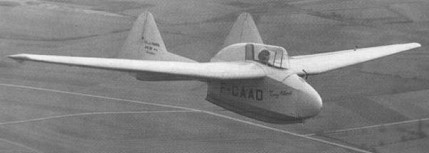
AV.361
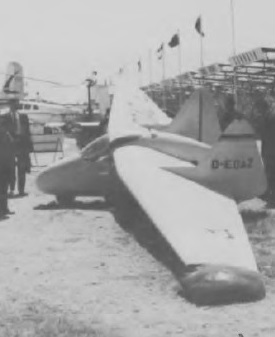
In spite of strong criticism from detractors of the Fauvel flying wing formula, based more on prejudices rather than on the real facts, there existed in 1966 about a hundred AV-36 and AV-361 gliders. The AV-361 whose prototype flew in 1960 was an improvement of the AV-36. This version distinguished itself with a longer wing span (12.78 meters), aerodynamic wing improvements (of Hoerner type), reworked vertical surfaces and installation of perforated Schempp-Hirth type air brakes on top and bottom of the wing. The fuselage was made with a more oval, comfortable shape and a plexiglas bubble canopy permitted a more panoramic view. A nose tow hook replaced the two tow line attachments under the wings. Finally, control input had been modified for more aileron differential, providing better control harmony and less adverse yaw during turns. These changes resulted in an increased glide ratio (L/D) of 2 points, and a reduction in the sink rate of 6 cm/sec. Many of the AV-36’s built were equipped with the improvements that were later incorporated in the model AV-361, notably in Germany. Some German amateur builders went even farther by motorizing the AV-36 with the addition of a small pusher 2-cycle engine and a folding propellor at the rear of the short fuselage located between the dual rudders.
The last perfecting of this design version was the changing of the wing airfoil to the Wortmann Laminar FX-66 HS 159 instead the original Fauvel F4. The result was a glide ratio (L/D) of 30 at 85 km/h.
AV.361
Today, there are still some active AV-36 and AV-361 flying wing gliders in France. It is interesting to note that at least one of them has been transformed into an ultralight motorglider (ULM in France) by the addition of a Koenig 2-cycle pusher engine of 24 Horsepower (like the German versions and the model AV-45) and a tricycle landing gear. In February 1971 Mons Fauvel decided to cease commerical production of his sailplanes, but plans for the AV 361 and other designs are still available for construction by gliding clubs or homebuilders. In Canada, Falconar Avia Inc. of Edmonton, Alberta still sells plans for the AV-361 (English version) as well as some parts as a kit for amateur builders. In France, neither plans nor kits have been available since the death of Charles Fauvel in 1979.
Fauvel AV 361
On June 30, 2019, Falconar Avia Inc closed for business and assets dissolved. The Master Sets (Original Drawings, Plans, Info Kits, Documentation) sold included the Fauvel AV-36 / 361 to Excogitare LLC
AV-36 Wing span: 11.95 m Length: 3.17 m Wing area: 14.2 sq.m Airfoil: Fauvel F4 17% Aspect ratio: 10.04 Empty weight: 120 kg Max. gross weight: 225 kg Stall speed: 58 km/h Max. speed: 180 km/h Glide ratio: 26:1 at 83 km/h Sink rate: 0.87 m/sec
Fauvel AV 36 CR Aile Volante Glider, France, 1951 Length: 10.4 ft / 3.17 m Wingspan : 39.37 ft / 12.0 m Max take off weight : 496.1 lb / 225.0 kg Weight empty : 275.6 lb / 125.0 kg Landing speed : 13 kts / 24 km/h Cruising speed : 44 kts / 82 km/h Glide ratio : 25.0 Crew : 1
AV-361 Wing span: 12.78 m / 41 ft 10.5 in Length: 3.24 m / 10 ft 8 in Length folded: 8ft 1 in Wing area: 14.6 sq.m / 157.2 sq.ft Airfoil: F2 17% / Wortmann FX-66 H 159 (optional) Aspect ratio: 11.4 Empty weight: 134 kg / 265 lb Max gross weight: 258 kg / 570 lb Water ballast: None Max speed rough air: 180 km/h / 135 mph Max speed: 119 kt / 220 km/h Cruise: 50 mph Stall: 30 mph / 31 kt / 58 km/h Best glide ratio: 26 at 45 kt / 83 km/h Glide ratio: 30:1 at 85 km/h / 53mph (laminar flow section) Sink rate: 0.74 m/sec / 2.5 ft/sec / 156 fpm at 35 kt / 65 km/h Seats: 1 Landing gear: single wheel.
AV-29C2 Wing span: 12.48 m Length: 5.92 m Wing area: 25.90 sq.m Empty weight: 2035 kg Max. gross weight: 3231 kg Max. speed: 634 km/h Cruise speed: 570 km/h
AV-29M Wing span: 10.96 m Length: 4.44 m Wing area: 19.96 sq.m Empty weight: 786 kg Max. gross weight: 1143 kg Max. speed: 330 km/h Cruise speed: 295 km/h Min. speed: 92 km/h Climb speed: 8.8 m/s Max. altitude: 9300 m
From the development to the birth of the AV-22 was an extremely long time. In 1946, Charles Fauvel had exhibited during an aviation convention in Paris a tandem two-seat glider project, under the title “glider for multiple uses”. This project was based on a survey from 1938, that foresaw the possiblity of transforming a two-seat glider to a single-seater able to takeoff by itself using a small front fuselage-mounted engine, and an economical two-seat side-by-side motorglider that would use the same wings but a different fuselage equipped with a heavier, more powerful tractor engine. The project was not approved and it had been necessary to wait until 1956 for the AV-22 to see the light of day, thanks to funds brought in by the sales of the AV-36 produced by Wassmer. ..The craft had its first flight on April 5, 1956, and was proposed to the official government services immediately, where it was put in competition with the glider Bréguet 902. The following year, the second prototype continued tests. It was equipped with very efficient Schempp-Hirth type air brakes and had a tow hook in the nose of the fuselage, mounted in a high location so as to maintain a better axis in towed flight. The landing gear was composed of a retractable center wheel and a fixed skid. The wing was removable in two parts, the spars capable of being quickly installed using lever actuated attach pins. The top of the fuselage, as well as the nose, were achieved in fiberglas, while the plexiglas canopy was moulded by Sud-Aviation in Marignane (now known as Matra-Aérospatiale). The AV-22 had a ventilator pickup located in its nose and ventilation was completed by exiting through side windows in the canopy. Four AV-22’s were constructed, the first made its first flight to Cannes on March 26, 1959. It was delivered to the aeroclub of St Auban on April 14. It is interesting to note that the exhibition at the rally of LeBourget on June 15, 1959 featured the AV-22 performing aerobatics. Towed to 1000 meters, Charles Fauvel demonstrated multiple loops and wingovers, finishing with a low pass at 22O km/h. The AV-22 had good flight qualities and a very good glide ratio (L/D) compared to other well respected gliders of its time. It demonstrated good air penetration and excellent maneuverability. It was however not the winner chosen by an official group supervising the competition to pick a new glider for aeroclubs. Instead, the “Bijave”, an existing glider design produced by the Wassmer Company, was chosen mainly because of two reasons : it was a more classic glider design and the Wassmer company had the ability and capacity to build it in larger numbers.
Wing span: 15.2 m Length: 5.07 m Wing area: 21.75 sq.m Airfoil: Fauvel F4 17% Aspect ratio: 11.7 Empty weight: 220 kg Stall speed: 58 km/h Max. speed: 170 km/h Best glide ratio: 26:1 Sink rate: 0.83 m/s Seats: 2
As a result of his experience with the AV-3, Charles Fauvel began to think about a new improved prototype. World War II didn’t immediately allow him to realize his objective, but once the conflict was over, he resumed his quest at the Société Aéronautique du Rhône, near Bourg-lès-Valence with his newest prototype, the AV-17. The aircraft was destroyed in its first flights. According to Charles Fauvel, the glider had not been constructed correctly; as the cause of the accident was neither the fault of the pilot nor did it discourage Fauvel in pursuit of his flying wing design formula. Fauvel, having raised serious doubts about the AV-17’s construction, was convinced that the blame for the crash should be placed upon the Société Aéronautique du Rhône, the constructor. Although the AV-17 never flew again, the experience gained was a great contribution to the development of later designs by Charles Fauvel.
The single-place AV.17, commonly called “la godasse” (the “shoe”) on the flying fields, was primarily a light machine intended for amateur construction. Its success was certainly due to the fact that almost 300 sets of plans were sent to more than 16 countries and it is reasonable to imagine that about 150 machines have flown.
Wing span: 15.0 m Length: 4.75 m Wing area: 17.3 sq.m Airfoil: Fauvel Aspect ratio: 13.0 Empty weight: 195 kg Glide ratio: 27:1 Sink rate: 0.6 m/sec
This project was designed as a successor to the AV-10. Many improvements were incorporated into this new design. But the war stopped the development of this machine and it remained a project on the drawing board. The construction of an improved version, the AV-141, was studied in 1947 and a construction started at Estang-Aviation, in Marseilles, in July 1949. But this construction was never completed.
 All Aero