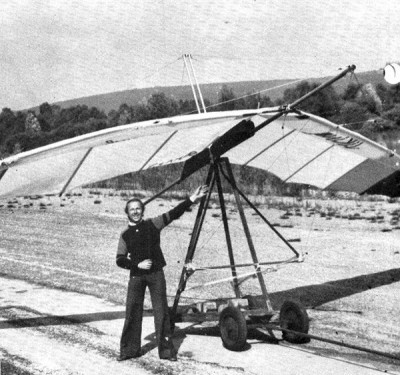
Wing area: 17 m²
Wing span: 10.6 m
Aspect ratio: 6.6
Hang glider weight: 25 kg
Minimum pilot weight: 60 kg
Maximum pilot weight: 85 kg
Packed length: 6.2 m
Number of battens: 10
Nose angle: 120°
Wing area: 17 m²
Wing span: 10.6 m
Aspect ratio: 6.6
Hang glider weight: 25 kg
Minimum pilot weight: 60 kg
Maximum pilot weight: 85 kg
Packed length: 6.2 m
Number of battens: 10
Nose angle: 120°
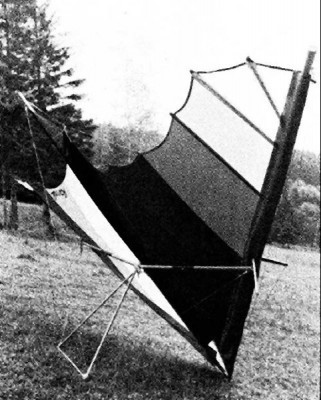
Star
Wing area: 16.3 m²
Wing span: 8.85 m
Aspect ratio: 4.9
Hang glider weight: 23 kg
Minimum pilot weight: 80 kg
Maximum pilot weight: 80 kg
Packed length: 5.9 m
Packed length short: 3.7 m
Number of battens: 10
Nose angle: 108°
Star HR
Wing area: 16.3 m²
Wing span: 8.85 m
Aspect ratio: 4.9
Hang glider weight: 25 kg
Minimum pilot weight: 65 kg
Maximum pilot weight: 65 kg
Packed length: 5.9 m
Packed length short: 3.7 m
Number of battens: 10
Nose angle: 108°
A more affordable version of the crossbar-less Gryphon. Much lighter handling and easier to rig up. However, no bar pressure at all. Easy to reach 80km/h, but reported as very scary indeed.
The first models had a keel pocket, and then Favul reduced this pocket. It was a wing in bowsprit, but easier. The result was missed. This delta was very delicate to fly, and the landings were perilous.
Wing area: 17 m²
Wing span: 9 m
Aspect ratio: 4.9
Hang glider weight: 19 kg
Minimum pilot weight: 55 kg
Maximum pilot weight: 80 kg
Packed length: 5.2 m
Number of battens: 10
Nose angle: 118°
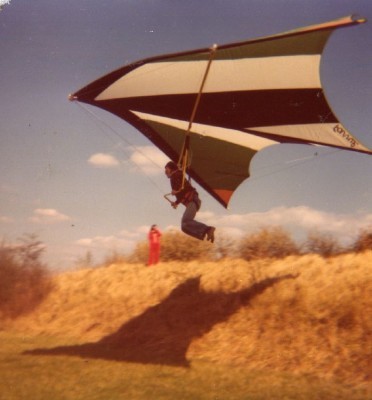
Manufacture by SA Favul in 1974, the Goeland was nicknamed “big and slow”. Wonderful for the time.
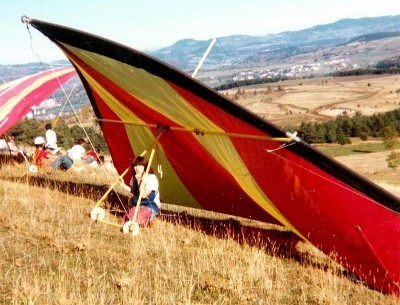
Wing area: 21 m²
The builder and creator of Favul was Yves Andriot who lived in Burgundy.
He practiced the profession of Teacher of Technology before taking an active retirement.
Builder of hang gliders.
M Fauvel developed the Pygmee in collaboration with E. de Coucy because he had been unable to find an entirely suitable engine for powering his tailless types, and this motor was also to power the AV 46. Bench testing of the Pygmee began early in 1967 and it was hoped that a large industrial concern would eventually produce the engine, but this did not in the end happen.
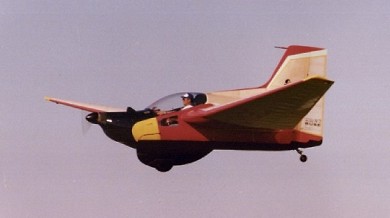
After having designed and flown the AV-221, Charles Fauvel developed a version for amateur construction, the AV-222. Lighter and of a less complex structure, this flying wing could be disassembled into three sections (the center section had no dihedral). It had a laminar airfoil (optional, or the more conventional Fauvel airfoil), and could be equipped with a choice of a classic landing gear or a mono-gear – a non-retractable monowheel from a Piper Cub in a large under-fuselage fairing supplemented by outrigger wheels under the wings and a small steerable tailwheel. Tthe last being the recommended one because it is lighter, more economical to fabricate and easier to install, and a single fin and rudder. The craft mounted either a Rectimo engine (40 HP), Limbach (60 HP) of Volkswagen origin, or the 2-cycle Rotax. The Rectimo and Limbach engines drive a two-blade fixed-pitch wooden propeller of 3ft 5.25in diameter. Fuel tanks could contain up to 30 liters (with 45 as an option).
The AV 222 was fitted with a conventional landing gear with twin main wheels to improve handling over rough ground; this new undercarriage consisted of cantilever self sprung laminated glassfibre legs and Duruble wheels with hydraulic brakes and streamlined wheel fairings. With the new undercarriage a larger dorsal fin was fitted to compensate for the smaller side area of the spats compared to the monowheel fairing.
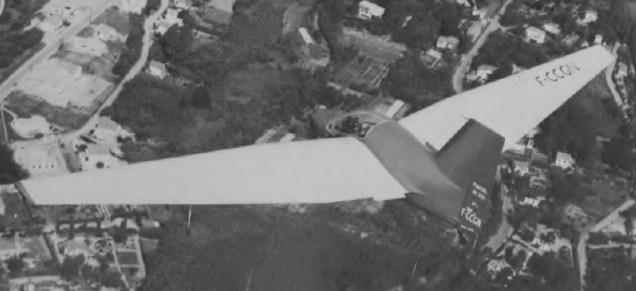
In February 1971 M Fauvel decided to end the commercial production of his sailplanes, but plans of the AV 222 were available for amateur constructors, who were building examples of this version in France, Germany, Italy, the UK and the USA.
Several sets of AV-222 plans were sold in France, Germany, Italy, Sweden, United Kingdom and in the United States. The first AV-222 flying wing, constructed by Hans Martinson and registered SE-XSL, flew in Sweden in May 1992, while several other construction projects are pursued in France, Germany and in the United States.
AV 222
Engine: Limbach, 45 kW / 60 hp
Span: 53 ft 9.75 in / 16.4 m
Length: 17 ft 1.5 in / 4.95 m
Wing area: 247.6 sq ft / 23.05 sq.m
Airfoil: Fauvel F2 17%
Aspect ratio: 12
Empty weight: 716 lb / 350 kg
Max weight: 1,212 lb / 650 kg
Water ballast: None
Max wing loading: 23.91 kg/sq.m / 4.89 lb/sq ft
Min sinking speed: 2.85 ft/sec / 0.87 m/sec at 46 mph / 40 kt / 74 km/h
Best glide ratio: 26:1 at 53 mph / 46 kt / 85 km/h
Max. speed: 210 km/h
Stalling speed: 40 kt / 74 km/h
Take-off run: 361 ft / 110m
Rate of climb at sea level: 591 ft/min / 180 m/min
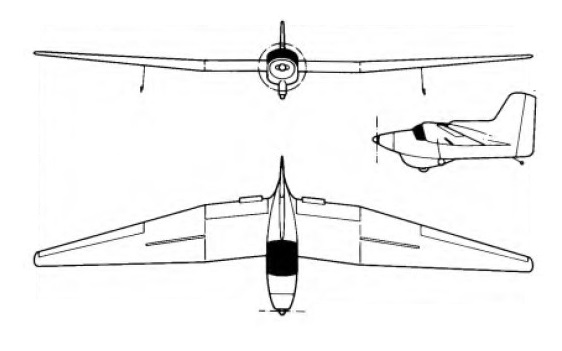
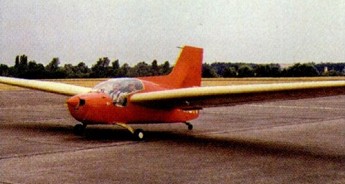
This motorglider was a new derivative of the side-by-side two-seater AV-22 and flew for the first time on April 8, 1965. It was exhibited in August of that same year to the 18th national gathering of the amateur builders of Montluçon. This motorglider was a two-seater side-by-side that was equipped with a Rectimo 4 AR 1200 39 hp engine (Volkswagen aircraft conversion) mounted on the nose, driving a fixed-pitch fully feathering wooden propeller. The prototype originally had a single glider-style main landing gear and was later changed to a more classic main landing gear of two wheels with hoop-style fiberglass gear legs. The wing was copied directly from the AV-22, but the fuselage was an entirely new structure in order to accommodate the new two-man crew requirements and addition of the engine and a single fin and rudder.
First shown in model form at the 1964 Cannes air show, the AV 221 has a short fuselage, mid-set cantilever wooden wings with slight forward sweep and built in three sections, a large fin and rudder with no tailplane and in its original form – a non-retractable monowheel from a Piper Cub in a large under-fuselage fairing supplemented by outrigger wheels under the wings and a small steerable tailwheel.
The prototype had completed six crossings of the Alps by mid-June 1966.
Later, the AV-221 was re-engined with a Survol – De Coucy “Pygmée”, a 4-cycle engine of 40 Horsepower that had the advantage of being very light compared to the Volkswagen. This lighter weight caused a lengthening of the AV-221 fuselage and was newly designated as AV-221 B. But the AV-221 never flew with this engine.
Production AV221s would have been powered by the 61hp Rectimo 4 AR 1600 version of the Volkswagen engine or in AV 221B form – by the 40hp or 50hp Fauvel Pygmee four-stroke ‘flat four’ engine; both these version would have had the wing span increased by 3ft to 53ft 9.5 in, with Hoerner wing tips, and the AV221B was 16.5 in longer than the prototype at 17ft 1.5in.
The AV 221 prototype was later fitted with a conventional landing gear with twin main wheels to improve handling over rough ground; this new undercarriage consisted of cantilever selfsprung laminated glassfibre legs and Duruble wheels with hydraulic brakes and streamlined wheel fairings. This replaces the former fixed monowheel in its large fairing and the two outrigger wheels under the wings, but for amateur construction the monowheel landing gear is recommended as being lighter, cheaper and easier to install. With the new undercarriage a larger dorsal fin was fitted to compensate for the smaller side area of the spats compared to the monowheel fairing.
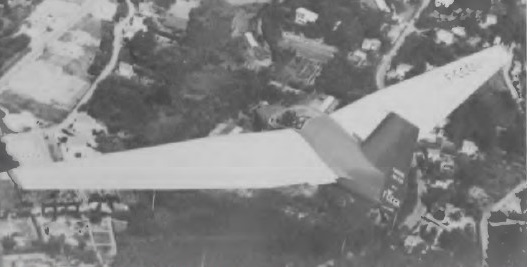
Another variable of the AV-221, was the result of a reconstruction project on the prototype by Serge Chaintri, of Liévin, after it had been damaged in an accident. It was equipped with a Volkswagen aircraft conversion of 1600 cc. which resulted in greatly improved performance under power over the original and is still flying in 1999. It is registered as F-CRON under the CNRP (French navigability certificate for amateur-built gliders and motorgliders).
The AV221 was followed a few years later by a lighter and simplified version designated AV 222.
Wing span: 15.48 m
Length: 5.22 m
Wing area: 21.75 sq.m
Airfoil: Fauvel F4 17%
Aspect ratio: 10.6
Empty weight: 325 kg
Max gross weight: 530 kg
Max. speed: 160 km/h
Best glide ratio: 23:1
Min. sink rate: 0.87 m/sec
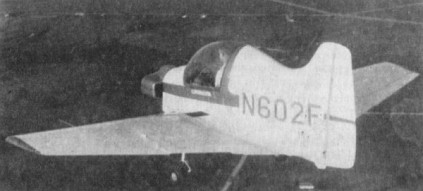
This small one-seater airplane, comparable to the Jodel D-9 bébé or to the Druine Turbulent, was designed specifically for amateur builders. The prototype was constructed by Leonard D. Wolff (assisted by his friend Davidson) at Houston, Texas in the United States. The AV-60 made its first flight on July 14, 1963, piloted by Davidson, when it actually became airborne during a “planned high speed taxi run”. The plane was exhibited at the National Air Show in Texas on November 3, 1963, where it was a big success.
Christened as Leprechaun (the imp of Irish folklore), the AV-60 had been developed by Charles Fauvel in collaboration with G. Jacquemin, an aeronautical engineer working in Canada. The construction plans were produced in English. It is a low aspect ratio flying wing, with a nose-mounted Volkswagen engine (converted for aircraft use) of 1300 cc, weighing 48 kg and developing 40 Horsepower at 3500 RPM. A formed plexiglas bubble canopy covers the cockpit which is located over the low wing. The most remarkable characteristic is the absence of a long conventional fuselage structure with a laminated wood shell structure comprising the vertical stabilizer and the rudder attach beam being further braced by a triangular tubular beam from the wing itself. The prototype was equipped with a standard fixed tricycle landing gear, based on that of the TIPPSY Nipper.
Wing Span: 7 m
Length: 4 m
Empty Weight: 220 kg
Max Gross Weight: 350 kg
Maximum Speed: 157 km/h
Cruise speed: 128 km/h
Takeoff Distance: 180 m
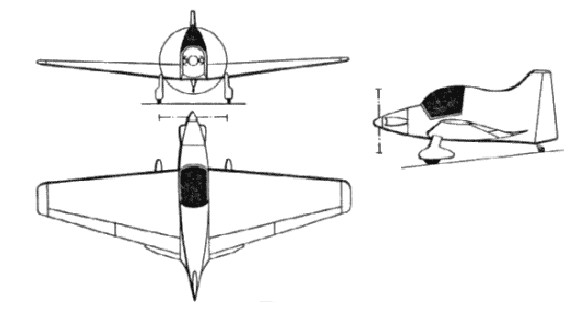
The AV-61 “Lutin”, also known as the AV-50, was a single-seater all-wood light aircraft of tailless configuration. Its wing section could be either the original Fauvel or a Wortmann FX 66-H 159 laminar airfoil. Predecessor of the AV-61 was the AV-60 “Leprechaun”, which was built and flown in the USA. Suitable power plants included modified Volkswagen engines, developing 40 to 67 hp, and the 40 hp Rotax or Hirth two-stroke engines. A tandem wheel, tailwheel or tricycle landing gear could be fitted. One prototype was constructed in Australia, its wing section, originally intended to be thinner, retained the thickness of the Fauvel section. The construction principles were the same as the AV-60, excepted a few details. Some control components were identical to those of the AV-45 motorglider. No other AV-61 were completed.
AV.61
Wing span: 7.5 m
Length (with VW engine): 4.1 m
Wing area: 10.6 sq.m
Airfoil: Fauvel or Wortmann
Aspect ratio: 5.2
Empty weight: 190 kg
Gross weight: 329 kg
Max. speed (tailwheel gear): 205 km/h
 All Aero