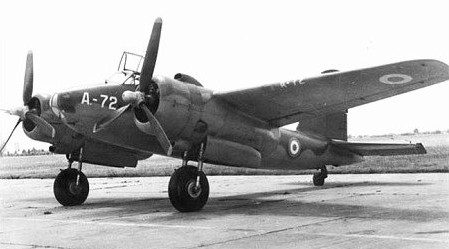
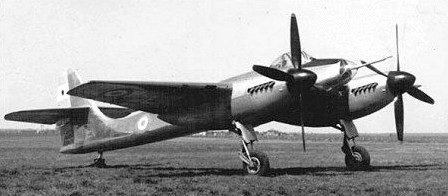
FMA I.A.30 Nancu

  1. One prototype only.

Engine; 2 x 850hp Rolls-Royce Merlin 604
Wingspan; 15.00 m / 49 ft 3 in
Length; 11.52 m / 38 ft 10 in
Height; 5.16 m / 17 ft 11 in
Wing area; 35.32 sq.m / 380.18 sq ft
Max take-off weight; 7600 kg / 16755 lb
Empty weight; 6208 kg / 13686 lb
Max. speed; 740 km/h / 460 mph
Cruise speed; 500 km/h / 311 mph
Ceiling; 8000 m / 26250 ft
Range; 2700 km / 1678 miles
Crew; 1
Armament; 6 x 20mm cannon, 250kg of bombs

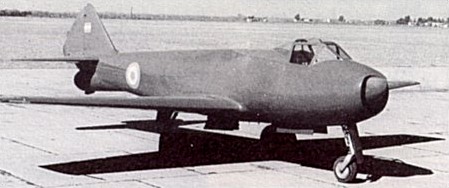
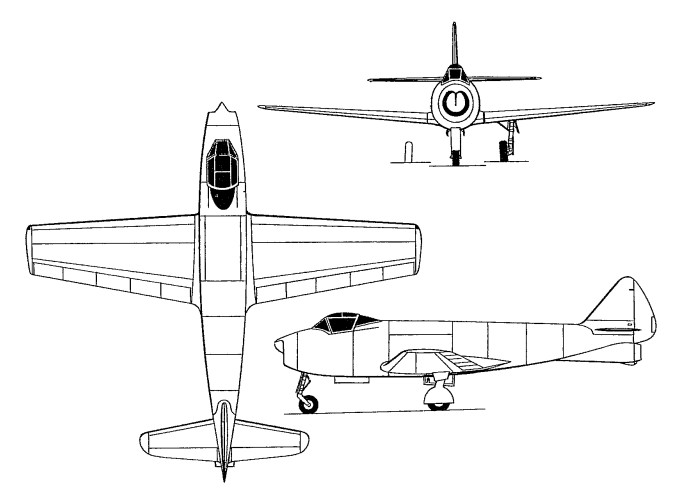
FMA IA.27 Pulqui

Designed by Emile Dewoitine, the I.Ae.27 Pulqui (Arrow) was the first single-seat fighter to be designed in Argentina as well as the first turbojet-powered aircraft to be built and flown in Argentina.

FMA IA.27 Pulqui Article

A cantilever low-wing monoplane of all-metal construction, the Pulqui had a conventional tail unit, retractable tricycle landing gear, and accommodation for the pilot well forward on the fuselage beneath a jettisonable canopy. Power was provided by a Rolls-Royce Derwent turbojet mounted in the aft fuselage.
First flown on 9 August 1947, the Pulqui performance was well below estimates and development was abandoned.

I.Ae.27
Engine; 1 x Rolls-Royce Derwent, 1633kg
Wingspan; 11.25 m / 36 ft 11 in
Length; 9.69 m / 31 ft 9 in
Height; 3.39 m / 11 ft 1 in
Wing area; 19.70 sq.m / 212.05 sq ft
Max take-off weight; 3600 kg / 7937 lb
Empty weight; 2358 kg / 5199 lb
Max. speed; 720 km/h / 447 mph
Ceiling; 15500 m / 50850 ft
Range; 900 km / 559 miles
Crew; 1
Armament; 1 x 20mm cannon

FMA I.Ae.24 Calquin

1946

Engine; 2 x 1050hp Pratt & Whitney R-1830-G Twin Wasp
Wingspan; 16.30 m / 54 ft 6 in
Length; 12.00 m / 39 ft 4 in
Height; 3.62 m / 12 ft 11 in
Wing area; 38.12 sq.m / 410.32 sq ft
Max take-off weight; 7200 kg / 15873 lb
Empty weight; 5340 kg / 11773 lb
Max. speed; 440 km/h / 273 mph
Cruise speed; 410 km/h / 255 mph
Ceiling; 10000 m / 32800 ft
Range; 1200 km / 746 miles
Armament; 4 x 12.7mm machine-guns or 4 x 20mm cannon, 800kg of bombs
Crew; 2

FMA / Fabrica Militar de Aviones / Aerotecnico / DINFIA / LMMASA

Originally founded in 1927 as the Fabrica Militar de Aviones SA (FMA), for aeronautical research and production at Cordoba.

The biggest aeronautical development and production center in Argentina was the Fábrica Militar de Aviones in Córdoba, an inland city 700 kilometers from Buenos Aires. The company first built airplaces (1929) and engines (1930) under license and later began building its own planes the Ae.C.1, a three-seated passenger plane with a covered cockpit.

Redesignated Institute Aerotecnico 20 October 1943.
As Industrias Aeronauticas y Mecanicas del Estado (IAME) formed March 28,1952 to take over State activities concerning military and civil aircraft, and incorporating the Institute Aerotecnico (formerly Fabrica Militar de Aviones). I.A.35 was twin-engined multipurpose monoplane; I.A.33 Pulqui II (first flown February 1951) a swept-wing jet fighter designed by Kurt Tank. Six Pulqui built 1955/56.
Nationalized 1957, with aircraft works at the Fabrica Militar de Aviones at Cordoba, under DINFIA (Direccion Nacional de Fabricaciones e Investigaciones Aeronauticas) name. Began with design and construction of IA 46 light aircraft, twin-engined transports IA 35, IA 45, the IA 38 four-engined tailless transport designed by Dr. Reimar Horten, and the IA 37, a small delta-wing aircraft. In 1966 began license construction of Cessna 182 and indigenous light turboprop and piston-engined transports.
Reverted to name FMA in 1968, becoming part of Area de Materiel Cordoba division of the Argentine Air Force.
December 1994 agreement between the Government of Argentina and Lockheed Aircraft Service Company to privatize FMA aircraft factory and maintenance depot at Cordoba, with Lockheed operating as the management organization from July 1995.
License-production 1927-1943 included Avro 504R, Dewoitine D.21 C, Bristol F.2B, Focke-Wulf Fw 44J, Curtiss Hawk 75. Indigenous designs included Ae.C-1 three-seat monoplane, Ae.C-2 trainer of 1932, Ae.T-1 fiveseater of 1933, Ae.C-3 light aircraft of 1934, and Ae.M- 01 built for Argentine Army. El Boyero two-seater built 1939-1940. Production of the IA.58 Pucara twin-turboprop COIN aircraft for Argentine Air Force ended in 1986. First flight of IA.63 Pampa advanced and weapon training jet trainer, and also for light attack, took place in October 1984.

In 1995 FMA was closed and privatized in 1995 to Lockheed Martin Corporation.

F&FW Diamant / Swiss Federal Institute of Technology Ka-Bi-Vo / HBV Diamant

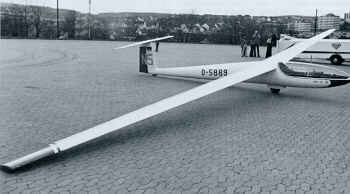
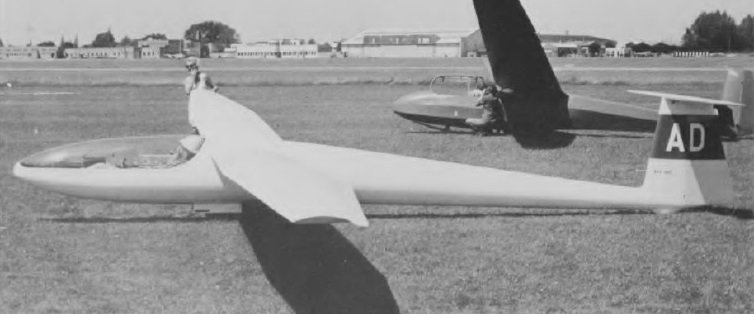
Diamant 18

The ideal of an all-glassfibre sailplane was achieved in several stages, the first being development of the fuselage and tail unit designed by Thomas Bircher and J von Voornveld at the Swiss Federal Institute of Technology in Zurich under the direction of Professor Rauscher. A prototype fuselage was built in 1962 and was flown with the plywood and fabric wings of a Schleicher Ka 6CR, the resulting aircraft being designated Ka-Bi-Vo.

The Diamant’s development was now gradually taken over by Plug- und Fahrzeugwerke AG FFA, and the next stage was the HBV-Diamant 15 which used the 15m span Hutter H-30TS wings of the Glasflugel H 301 Libelle. This first flew on 5 September 1964 and 13 of this variant were subsequently built; the Libelle’s wings being glassfibre balsa sandwich shells without ribs, featuring ailerons that gave partial downward movement when the flaps were lowered, and there were glassfibre dive brakes forward of the flaps.

The HBV-Diamant 15 was followed by the generally similar Diamant 16.5, with wings of increased span (16.5m) designed and built by FFA; a total of 41 of this variant were built. This was the first all glass fiber production sailplane, not using balsa or other wood sandwiched between the fiberglass layers.

1967

The Diamant 18 is an 18 m development of the 16.5, first flying in February 1968, with extended inboard wing and flap sections and a new wingtip cap. like the Diamant 16.5, water ballast an be carried in the wing roots. The monocoque fuselage is an epoxy-glassfibre sandwich with foam inserts, and the tail unit is of the same construction, the allmoving one-piece tailplane being mounted on top of the fin. As well as a small tailwheel (a tailskid is optional) there is a manually-retractable monowheel with a brake, and another feature is a glassfibre ring spring shock absorber; the tow release retracts with the landing gear. The pilot sits in a semi-reclining position under a long forward sliding one-piece canopy, and there is provision for radio and oxygen.

At least one Diamant 18 was substantially modified by Dan Pierson of Los Angeles, CA to have a 19.0 m / 62.3 ft wing carrying 145 kg / 320 lb of water ballast bringing the gross weight up to 673 kg/ 1,480 lb.

The HBV Diamant and Diamant 16.5 are ATC, while the Diamant 18 is EXP.

A powered version of the Diamant 18 known as the EFF Prometheus 1 made its first flight on 21 June 1971, powered by a 176lb st Microturbo Eclair II turbojet mounted behind the cockpit. The Prometheus was developed by EFF – Entwicklungsgemeinschaft fur Flugzeugbau der Akademischen Fluggruppe, and it was later converted back to a standard Diamant 18.

Variant:
EEF Prometheus 1

Diamant 16.5M
Wing span: 16.5m / 54.2ft
Wing area: 12.2sq.m / 143sq.ft
Empty Weight: 270kg / 595lb
Payload: 138kg / 305lb
Gross Weight: 408kg / 900lb
Wing Load: 30.91kg/sq.m / 6.29lb/sq.ft
Water Ballast: 0
No. of Seats: 1
No. Built: 43
L/DMax: 42 100 kph / 54 kt / 62 mph
MinSink: 0.55 m/s / 1.80 fps / 1.0 kt
Aspect ratio: 20.5
Airfoil: Wortmann FX-62-Z-153

Diamant 18
Wing span: 18.0 m / 59 ft 0 in
Wing area: 14.28 sq.m / 153 sq.ft
Airfoil: Wotmann FX-62-Z-153 mod.
Length: 7.72 m / 25 ft 4 in
Height: 1.35 m / 4 ft 5 in
Empty Weight: 280 kg / 617 lb
Payload: 160 kg / 353 lb
Gross Weight: 440 kg / 970 lb
Water ballast: None
Wing Load: 30.8 kg/sq.m / 6.34 lb/sq.ft
Max speed: 149 mph / 129 kt / 240 km/h
Max rough air speed: 108 kt / 200 km/h
Stalling speed: 32.5 kt / 60 km/h
MinSink: 0.52 m/s / 1.71 fps / 1.01 kt at 45 mph / 39 kt / 72 km/h
L/DMax: 45 at 100 kph /54 kt / 62 mph
Aspect ratio: 22.7
No. of Seats: 1

Florov 4302

By 1944 Dushkin, who was working on the NII-1 of the NKAP, created a new version of the RD-2MZV reactive engine. This new power plant used a fuel pumping system, consisting of kerosene and nitric acid. Its main feature was the presence of two chambers, a large 1,100 kg thrust and a small 300 kg.

This allowed taking off and reaching the maximum height with the two chambers and then using the force of the small one in horizontal flight. This was able to save fuel and achieve a considerable increase in engine operating time.

Initially it decided to install this engine in the interceptor “Malyutka” of NN Polikarpov, which was projected in 1944, but his sudden death did not allow the builder to finish the job.

During state tests of the RD-2MZV, developed in May 1945, a joint thrust force of 1500 kg was achieved at take-off, 1250 kg as normal thrust and 500 kg as minimum thrust. Working only the small chamber, a thrust of 300 kg was achieved and the minimum thrust was 100 kg. The weight of the engine with all its aggregates reached 224 kg. The production of 30 power sets was approved with the delivery of the first on March 10 and the last on August 10, 1946.

Factory No. 165 was selected as the engine manufacturer, which was to work closely with other plants. Assembly and control tests were entrusted to the NII-1.

At that time, the experimental aircraft with a liquid reactive engine designed by IF Florov was already being built in the NII-1. This aircraft had begun to be projected two years ago, when by GOKO resolution No. 5201 issued on February 18, 1944, the Reactive Technique Institute (NII-1), transferred to the NKAP, was given the task of dedicating itself to the development of reactive engines. The leadership of the NII-1 was assigned to the head of the NII VVS PI Fiodorov and as his replacement was appointed VF Boljovitinov.

The new managers of the NII-1 enjoyed aeronautical construction. For this reason, in parallel to the main tasks of the institute, linked to the creation of reactive engines by the Isayev and Dushkin collectives and turbojets by AM Lyulka, it was decided to build an experimental aircraft from a project developed by Boljovitinov and Florov. This task was approved by the 18 Principal Directorate of NKAP, responsible for the reactive technique.

It was proposed to build two variants of the aircraft: one with an Isayev powerplant, which was named “4302” and another with the Dushkin engine, which was named 4303.

According to the project, the “4302” should have a flying weight of 2320 kg. The maximum speed at sea level had to reach 1010 km / h (M = 0.82), 1015 km / h (М = 0.88) at 5000 meters and 1050 km / h (М = 0.99) at 15000 meters. The ascent time at 15,000 meters was calculated at 2 minutes 22 seconds and the practical ceiling at 18,850 meters. The expected flight time was 46 minutes.

Both projects were conceived to test the powerplant itself, as well as the aerodynamic characteristics of flying at high speeds. Another primary objective was the study of the pressure distribution laws by the wing profile and the calculation of overloads in flight, especially in turbulence generation areas.

It was planned to build a total of six copies of which the first two would be used for the preparation of the flight personnel and the rest for the development of the experiments.

The institute’s productive capacities were scarce, so the construction was contracted to Factory No.21 named in honor of Sergo Ordzhonikidze and located in Gorky city.

Working drawings were ready on 1 January 1946 and once delivered the factory started production. The first two were ready for delivery in March.

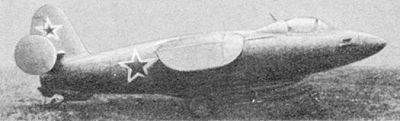
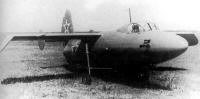
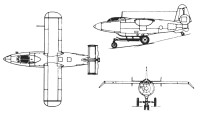
The “4302” was designed as an experimental all-metal monoplane. The wing design was straight, with a constant section throughout the span. In order to improve directional stability and reduce the effect of turbulence at high speeds, the wingtips were angled 45º downwards. The wing profile used was the TsAGI 13145 with laminar flow and thickness of 13%.

The fuselage, also metallic, had a cigar shape with a circular cross section, with a diameter of 1,150 mm at its widest part. At the bottom of the nose was the towing hook.

The tail unit was cantilever type and terminated in vertical washer-like surfaces. The empennage was constructively integrated into the fuselage. All the coating, including the rudders and ailerons, was metallic.

The landing gear was one of the most complex elements. For the first flights a fixed gear with three wheels obtained from a Lavochkin La-5 was used. Later, the “4302” was equipped with a retractable ski for landing and took off using an ejectable forklift. The landing ski was constructed of stainless steel and featured a hydraulic release system. In the middle portion of the ski profile were two grooves to fix the trolley, which was constructed of steel tubes.

The main 650x200mm wheels featured disc brakes. The 400x150mm double wheel front unit had a hydraulic damper. To reduce the lift of the truck once it was separated from the plane, the braking system was activated automatically after release. When the truck was detached, the ski was retracted.

By this time the leadership of NKAP had changed (instead of AI Shajurin, MV Jrunichev had been appointed) and this structure became the Ministry of Aviation Industry (MAP). The new MAP managers had a negative reception towards the plane, considering that the NII-1 had “meddled” in a task that was not within its competence. For this reason, as of February 1946, all financing for this project was withdrawn.

The new director Ya. L. Bibikov and VF Boljovitinov wrote directly to Stalin, explaining that at 1 April of 1941 the first issue of flight he was at 70% completion and continue the work the prototype would be ready for state tests for the month of July.

The vice-president of the Council of Ministers of the USSR, NA Bosniecienski, who after Malenkov’s departure, attended the aviation, ordered Khrunichev and Vershinin to seek a solution to the dilemma. Reluctantly, Khrunichev was forced to give in.

The new VVS chief, Marshal Vershinin reacted differently. On the one hand, he appreciated scientific work, especially in the field of military aviation, but on the other hand he was offended, since the experimental production plan was approved by the NKAP during the period of his taking office, he decided to support the NII-1.

Together with the new VVS chief engineer, IV Markov issued a communication in which he recognized the great value that an interceptor with these features would have for the VVS and requested that state tests be carried out in 1946.

In response, Khrunichev replied that the data presented by the NII-1 should be subject to a review and created a ministerial commission to do so.

The commission was chaired by Professor IV Ostoslavski and included the main builder of OKB-155, AI Mikoyan, the head of department of TsAGI VN Matvieyev, the group head of the 7th MAP Directorate, IV Loktiev and the head of the (Directorate of the MAP, VV Yakolievsky The result of the commission, presented in June 1946, yielded the following results:

“… the maximum speed of the plane will be between 900 and 950 km / h instead of 1000 – 1100 km / h and the ceiling will be limited to 12000 – 13000 meters instead of 20 000 m, due to the absence in the airplane from a sealed cabin. The duration of the flight presented in the letter is 46 minutes. The commission considers that the maximum flight autonomy will be 5 minutes. “

The commission’s results were based on the results obtained with the straight-wing Bisnovat 5, which had been unable to obtain the proposed speed. Florov replied that his aircraft had been designed with the latest strength requirements in mind and with the correct wing selection recommended by TsAGI.

Despite the commission’s report the MAP was instructed to finish and test the experimental specimen “4302”.

In response to the MAP meeting in September 1946, Khrunichev severely criticized the NII-1 leadership and demanded to reorganize the institute’s activity on a purely scientific and not practical profile. The minister ordered to separate the group of builders from the institute and give them a constructive base to continue their activity.

As the new director of the NII-1, MV Keldysh was appointed and in its new structure were three collectives: OKB-1 from LS Dushkin, OKB-2 from AM Isayev and OKB-3 from MM Bondaryuk and a department of gunpowder accelerators.

Jrunichev decision of the bureau of buildings Florov was renovated. The personnel and the productive base were placed under the direction of Bisnovat. Under these conditions, NII-1 survived one more year, until in 1948 it was absorbed by TsIAM. The Dushkin and Bondaryuk groups passed to this institute. Isayev’s group would go to NII-8 of the Ministry of Armaments, dedicating itself to the construction of reactive rocket engines.

By the fall of 1946 one in glider configuration without an engine) was ready for testing and was sent to the LII. Another Isayev-powered example was in the completion phase. Under pressure from the military, the MAP was forced to continue the construction of this copy to deliver it to the LII. With so much pressure, the works on the “4302” could not be carried out to the expected magnitude. It is stated that three examples were completed.

The flights were started in 1947. In total, 20 flights were executed, of which 19 were carried out in the version without an engine. The Isayev jet engine flight was executed by test pilot AK Pajomov in August. This flight started smoothly, but towards the end of the engine work pieces were damaged and nitric acid fumes filled the cabin.

Pajomov managed to land the plane. After this flight, the jet engine aircraft development program was closed. By then, significant progress had been made in the development of turbojet engines capable of high thrust.

After this Ilya Florov went on to dedicate himself to scientific activity, defended his candidacy thesis and later his doctorate, going on to direct a scientific group. He would never design airplanes again.

4302
Powerplant: A 1,100 kg thrust AM Isayev liquid reactive engine
Wingspan: 6,932 m
Wing area: 2 m²
Length: 7.152 m
Height: 3.06 m
Maximum takeoff weight: 2398 kg
Maximum speed achieved: 520 km / h
Calculated top speed: 950 km / h
Accommodation: 1
Florov, Ilya Florentievich

Ilya Florentievich Florov (Russian: Илья Флорентьевич Флоров) was born on 5 August of 1908 in Novocherkassk, son of a military engineer who reached colonel in the Russian Army and participated in the Russo-Japanese War.

His father disappeared during the civil war and mother, with her children, moved to Yekaterinodar. In this city Florov completed high school and in 1926 he entered the mechanics department of the Novocherkask Aviation Institute, graduating in 1931.

After graduating he began working at Gorky Aviation Factory No.21 in the construction and drawing department (ChKO), dedicated to meeting the needs of the factory’s series production. At that time Factory No.21 was mass-producing the Polikarpov I-5 fighter and the VVS urgently needed a new training aircraft for this fighter.

For this purpose, a new group was created at the factory, led by engineer BV Kupryanov, including Ilya Florov and Alexei Borovkov . The new model was known as UTI-1 and about 20 copies were built. This was Florov’s first serious aircraft construction work. Later he would participate in the development of several versions of training aircraft on the I-16 fighter known as UTI-2, 3 and 4.

In 1936 the ChKO was divided into two independent departments: The Special Construction Bureau (BOK) and the Mass Production Monitoring Bureau. The BOK soon became known as the Experimental Construction Bureau (OKO), after the acronym for Opitni Konstruktorskoye Biuró. 43 BOK technicians and specialists and another 10 from Moscow were integrated into this organization. IF Florov was appointed as head of the OKO and therefore replacement for Nikolai Polikarpov,.

In 1935 Florov, together with AA Borovkov, developed a compact biplane fighter with no connection between the planes. The VVS management decided to support this initiative and a new OKB was soon created at Factory No.207 for the development of this project. In 1937 the first example of this aircraft was created with an 800 hp M-85 engine that would lead to the I-207. Various configurations were tested until the beginning of the Great Patriotic War.

From 1941 Florov began to work in Bolkhovitinov’s OKB as head of department and substitute for the main constructor, participating in the creation of the first reactive interceptor of the USSR, the Bereznyak / Isayev BI.

Starting in 1944, Florov developed in the NII-1 a group of investigations on the development prospects of aviation with different types of power plants. Here under his direction a reactive powerplant aircraft designed to use an AM Isayev engine (Airplane No.4302) or an LS Dushkin engine (Airplane No.4303) was created and tested. These works were continued until 1948, when the aviation sector of the NII-1 was closed.

In 1948 the NII-1 was absorbed by the TsIAM and under the direction of Florov these works were continued in the aviation department of this institution, directed by him until 1952 and then between 1957 and 1982.

Florov received two Order of the Red Banner of Labor and the Order of the October Revolution.

Ilya Florentievich Florov died in Moscow in 1983. In December 2003 a plaque was unveiled in Moscow in memory of Ilya Florov.

Flight Engineers Ltd

New Zealand
Flight Engineers Ltd was a joint company formed by agricultural operator Barr Brothers and Marine Helicopters Ltd. to maintain own fleets, but also undertook license-assembly of Transavia PL-12 Airtruk agricultural aircraft from 1973. T320 version powered by Continental Tiara engine introduced 1977. Production ended 1980.