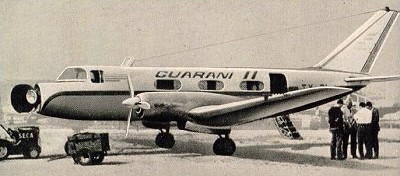
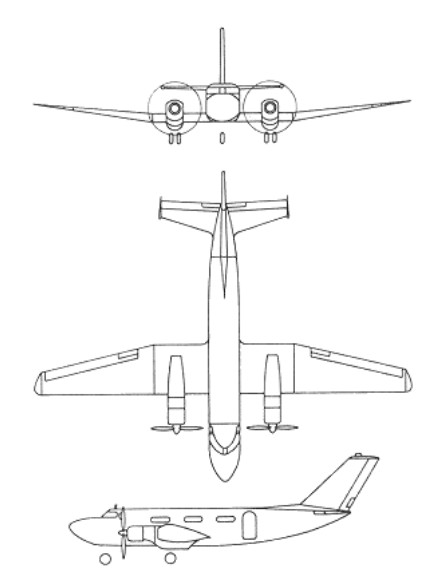
The Guarani I light transport first flew in prototype form on 6 February 1962 and utilised about 20% of the structural components of the IA.35 Huanquero. Power was provided by two 633kW Turbomeca Bastan IIIA turboprop engines. The Guarani II was developed from it and the prototype flew for the first time on 23 April 1963. It was placed in production for the Argentinian Air Force for communications, photographic (with the Military Geographic Institute) and executive transport duties, while the Navy received one as a staff transport. A total of 41 G.IIs were built.
Engines; 2 x Turbomeca Bastan IVA Wingspan; 19.6 m / 64 ft 4 in Length; 15.3 m / 50 ft 2 in Height; 5.6 m / 18 ft 4 in Wing area; 41.8 sq.m / 449.93 sq ft Max take-off weight; 6500 kg / 14330 lb Empty weight; 4000 kg / 8819 lb Max. speed; 490 km/h / 304 mph Cruise speed; 485 km/h / 301 mph Ceiling; 3100 m / 10150 ft Range w/max.fuel; 2500 km / 1553 miles Range w/max.payload; 2000 km / 1243 miles Crew; 1 Passengers; 10-15
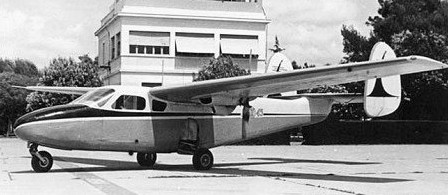
Under DINFIA (Direccion Nacional de Fabricaciones e Investigaciones Aeronauticas) name, design and construction of the IA 46 light aircraft began. Adaptable as a three-seat tourer, the IA 46 Ranquel first flew on 23 December 1957.
A pre-production series of 14 was completed early in 1960, subsequent contracts calling for production of 150.
A development version, the IA 51, flew for the first time on 16 March 1963 and production was initiated. The IA 51 has metal skinning for the wing in place of the fabric of the IA 46, increased flap area, a redesigned rear fuselage, a variable-incidence tailplane, and a 180 hp Lycoming O-360-A1A.
The IA 53 is a derivative of the IA 51 with a nose wheel undercarriage and swept vertical tail.
A quick install and jettisonable 88 ImpG / 400 lt belly tank for agricultural chemicals could be attached.
Model 46 Ranquel Engine: Lycoming O-320-A2B, 150 hp Wingspan: 38 ft 1.5 in / 11.62 m Length: 24 ft 5 in / 7.45 m Empty weight Tourer: 1390 lb / 630 kg Empty weight Agricultural: 1520 lb / 690 kg MTOW Tourer: 2115 lb / 960 kg MTOW Agricultural: 2555 lb / 1160 kg Max speed: 112 mph Max cruise 75%: 83 kt / 96 mph / 155 kph ROC SL: 530 fpm Service ceiling: 13,125 ft / 4000 m Max Range 75%: 351 nm / 405 mi / 650 km Front seating: 1 Rear seating: 2
IA 51 Super Ranquel Engine: Lycoming O-360-A2A, 180 hp Max speed: 119 mph Max cruise 75%: 109 mph ROC SL: 710 fpm Service ceiling: 14,750 ft
IA.45B Engines; 2 x 180hp Lycoming O-360 Wingspan; 13.75 m / 45 ft 1 in Length; 8.92 m / 29 ft 3 in Height; 2.80 m / 9 ft 2 in Wing area; 19.30 sq.m / 207.74 sq ft Take-off weight; 1800 kg / 3968 lb Empty weight; 1170 kg / 2579 lb Max. speed; 275 km/h / 171 mph Cruise speed; 245 km/h / 152 mph Ceiling; 7500 m / 24600 ft Rate of climb; 420 m/min / 1400 ft/min Range; 684 km / 425 miles Crew; 1-2 Passengers; 5
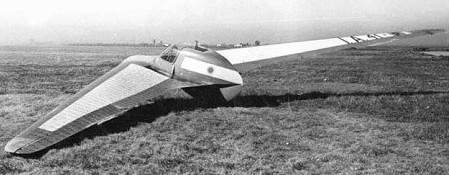
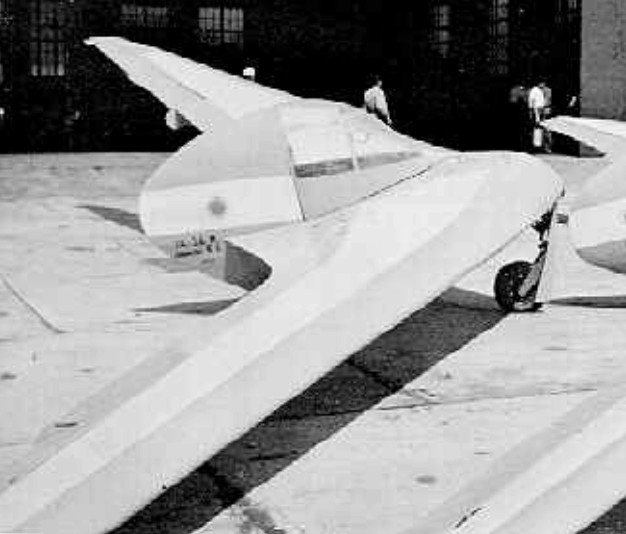
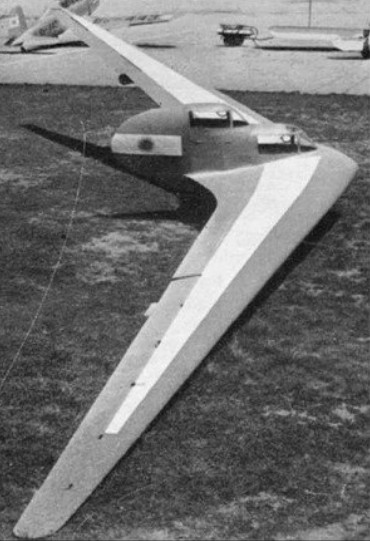
Wingspan; 18.00 m / 59 ft 1 in Length; 4.40 m / 14 ft 5 in Height; 1.90 m / 6 ft 3 in Wing area; 28.00 sq.m / 301.39 sq ft Length; 4.40 m / 14 ft 5 in Height; 1.90 m / 6 ft 3 in Max. speed; 180 km/h / 112 mph Empty weight; 250 kg / 551 lb Max. speed; 180 km/h / 112 mph Crew; 1
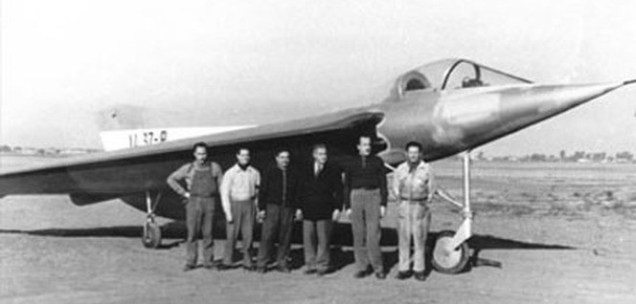
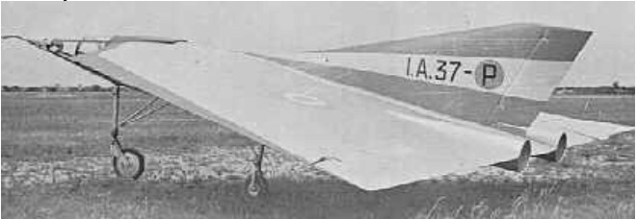
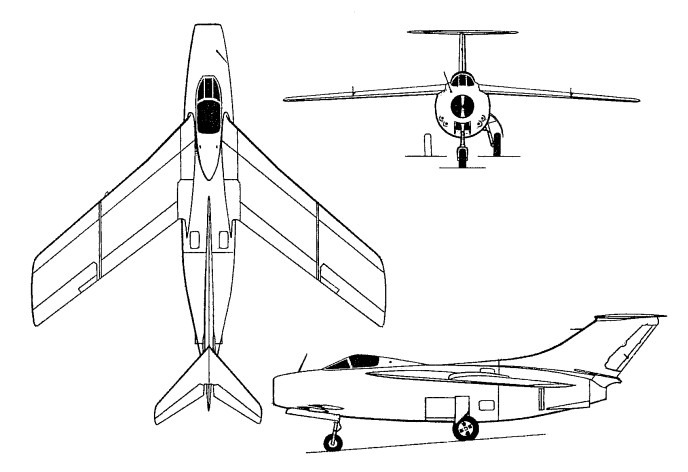
The FMA I.Ae. 37 was a prototype jet fighter developed in Argentina during the 1950s.
It never flew and was cancelled in 1960.
I. Ae. 37P
Engine; 1 x 1832kg Rolls-Royce Derwent 5 turbojet Wingspan; 9.78 m / 32 ft 1 in Length; 11.00 m / 36 ft 1 in Height; 3.98 m / 13 ft 1 in Max take-off weight; 4800 kg / 10582 lb Empty weight; 3300 kg / 7275 lb Max. speed; 902 km/h / 560 mph Ceiling; 12000 m / 39350 ft Range; 1000 km / 621 miles Crew; 1
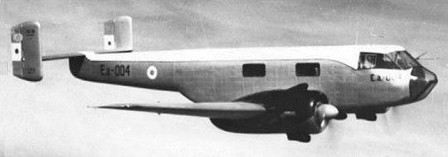
The I.A.35 was twin-engined multi-purpose monoplane of 1953. The Huanquero was designed for a variety of roles and for each role a different version was built.
The 35IA was an advanced trainer for IFR flight, short range and long range navigation. Other versions are the 35IU (bomber trainer), 35II (light transport), 35III (photo aircraft).
I.A.35-II Engines; 2 x 620hp IA 19R El Indio Wingspan; 19.60 m / 64 ft 4 in Length; 13.98 m / 46 ft 10 in Height; 4.90 m / 16 ft 1 in Wing area; 42.00 sq.m / 452.08 sq ft Max take-off weight; 5700 kg / 12566 lb Empty weight; 3500 kg / 7716 lb Max. speed; 360 km/h / 224 mph Cruise speed; 320 km/h / 199 mph Ceiling; 6400 m / 21000 ft Range; 1570 km / 976 miles Crew; 3 Passengers; 7 Armament; 2 x 12.7mm machine-guns
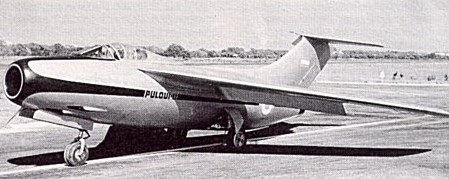
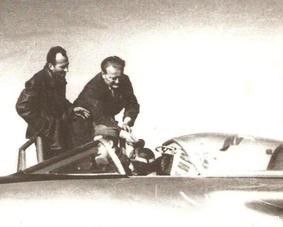
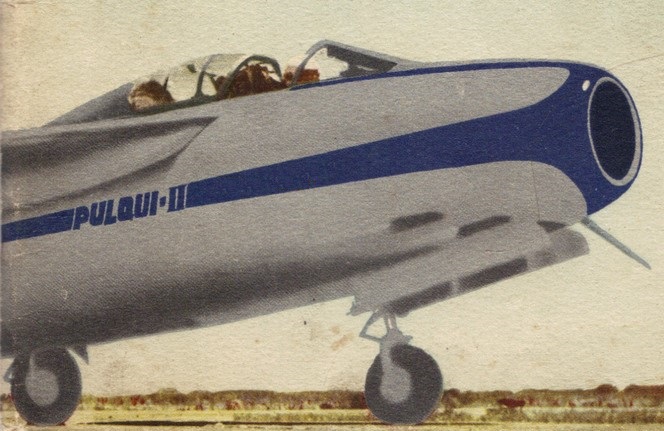
Intended to replace the Gloster Meteor F.Mk 4s in service with the Argentine air force, the I.Ae.33 Pulqui II (Arrow II) was designed by a team headed by Dr Kurt Tank, roughly inspired by the Ta 183. Tank arrived in Argentina in 1947, not speaking Spanish but with the plans for the German project TA-83 from the factory Focke Wulf. The first plane that Tank made in Argentina was a copy of the TA-83 which was his starting point.
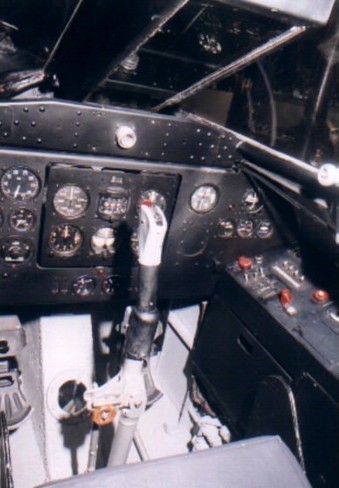
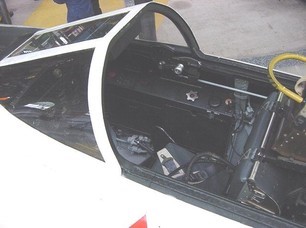
It embodied some of the results of the advanced research carried out in Germany during World War II, incorporating a shoulder-mounted wing with 40deg of sweep-back, and a T-tail with all-swept surfaces. Landing gear was retractable tricycle-type and power provided by a Rolls-Royce Nene turbojet mounted in the rear fuselage. The pilot was accommodated on an ejection-seat in a pressurised cockpit, protected by armour and a bulletproof windscreen, and a sliding canopy that could be jettisoned in emergency, and auto pilot.
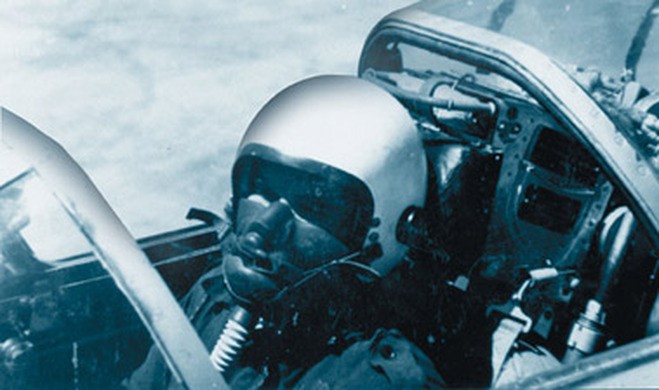
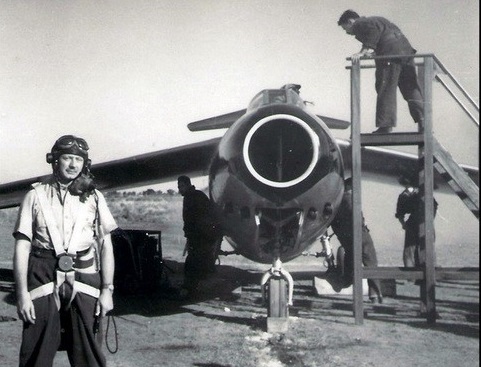
By 1950 the first prototype of the Pulqui II was ready for testing. It was piloted for the first time by Captain Edmundo Weiss on June 27, 1950.
Captain Edmundo Weiss is with the Pulqui II
It had its official debut on February 8, 1951. Tank called Peron in Buenos Aires from Cordoba and advised him that the airplane would arrive to the airport before the President himself. Sure enough, he was correct. During the presentation ceremony Peron expressed his admiration and gratitude for Tank.
The Pulqui II’s first tragedy occurred in May of that year after 28 test flights when a defect caused the death of Captain Vedania Mannuwal, a fighter pilot. This led to the third prototype and many more test flights. Two days before the newest version was to be presented to Peron in October of 1952, another crash cost the life of Otto Behrens who was an important part of the entire process. (Otto Behrens, the test pilot died; a few days before his death he said that the airplane was “the worst he had ever experienced as a test pilot”). His death was mourned by the entire country, especially the Germans now working in Argentina. By 1953 the fourth prototype was ready for testing. It was not until 18 September 1959 that the last was flown.
Unfortunately, just when the project was ready to bear fruit, a coup turned the country upside down. Many of the scientist and engineers associated with the project were forced from the country, including Kurt Tank. The new government showed little interest in keeping the project alive, although those who remained struggled to make it work. In a desperate attempt to change momentum, FMA planned a high profile test flight from Cordoba to Moron back to Cordoba including three quick rounds over the Buenos Aires airport, without supplementary fuel tanks. The pilot, Captain Rogelio Balado, was able to make the entire trip, but a fault in the system caused a lack of oxygen for him and he crashed on landing in Cordoba.
In 1954 a world tour was planned to exhibit the airplane to possible buyers. FMA also received visitors from the USSR, US (from the company that manufactured the P-86 Sabre) and Egypt who were interested in the airplane.
Brigadier Ahrens from the Argentina Air Force approached FMA requesting an estimate on the fabrication of 100 Pulquis. He was advised that 10 could be available immediately and that number 100 would be finished within 5 years. Ahrens decided to give the contract to the Americans for 100 F-86 Sabres because they would be available immediately. This basically ruined FMA’s future possibilities to export the Pulqui II.
In the intervening period the Dr Tank and his team had left Argentina. These factors, coupled with serious financial problems, meant that development was initially halted in 1953, and finally cancelled with the fall of Peron in 1955.
I.Ae.33 Engine; 1 x Rolls-Royce Nene, 2268kg Wingspan; 10.60 m / 34 ft 9 in Length; 11.68 m / 38 ft 4 in Height; 3.50 m / 11 ft 6 in Wing area; 25.10 sq.m / 270.17 sq ft Max take-off weight; 5550 kg / 12236 lb Empty weight; 3600 kg / 7937 lb Max. speed; 1050 km/h / 652 mph Ceiling; 15000 m / 49200 ft Crew; 1 Armament; 4 x 20mm cannon
Engine; 1 x 155hp Blackburn Cirrus Major Wingspan; 10.70 m / 35 ft 1 in Length; 8.12 m / 27 ft 8 in Height; 2.18 m / 7 ft 2 in Wing area; 16.50 sq.m / 177.60 sq ft Max take-off weight; 981 kg / 2163 lb Empty weight; 750 kg / 1653 lb Max. speed; 230 km/h / 143 mph Cruise speed; 195 km/h / 121 mph Ceiling; 5180 m / 17000 ft Range; 1570 km / 976 miles Crew; 2





 All Aero