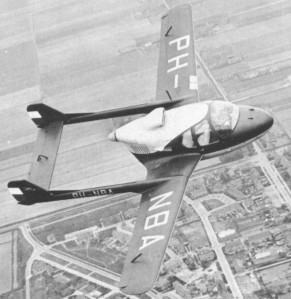
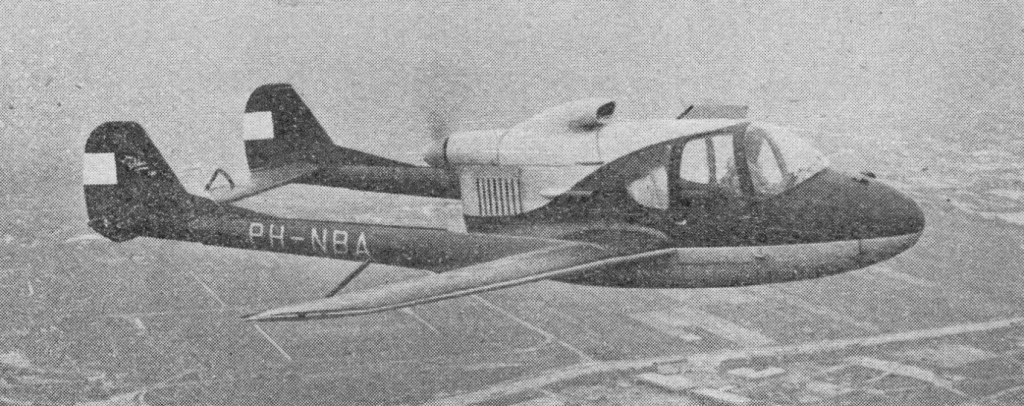
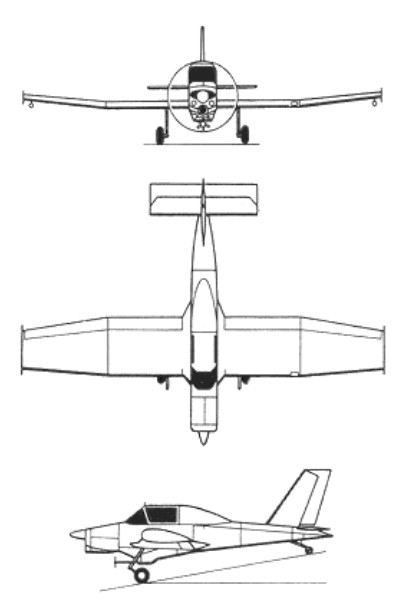
The F.25 Promotor business aircraft, of which 100 were ordered by Frits Diepen on May 16th 1946 for his air taxi company and sales purposes. was exhibited at the first post war Paris Air Show in November 1946 and, after modification to improve its performance, made a demonstration tour of Europe. The press praised the aircraft, but the sales were disappointing. The F.25 received its Certificate of Airworthiness in 1947, but only 21 were built, and not all of these flew. This four seat business aircraft was designed to the order of Diepen, who acquired the worldwide selling rights. On October 20th, the prototype F.25 Pro¬motor made its maiden flight. Six where sold to a Spanish air-taxi firm. Due to never quite totally solved vibration problems with the lengthened propshaft, they achieved limited success and were soon taking out of service. The production version had elongated tailplanes and a higher air intake.
1948
Although 20 F.25 aircraft were constructed, sales were disappointing as it could not compete in cost with thousands of surplus aircraft on the market following the war.
Engine: Lycoming O-435 190 hp Wingspan 12.00 m Length 8.50 m Max. speed 227 km/h Max take off weight 1.425 kg
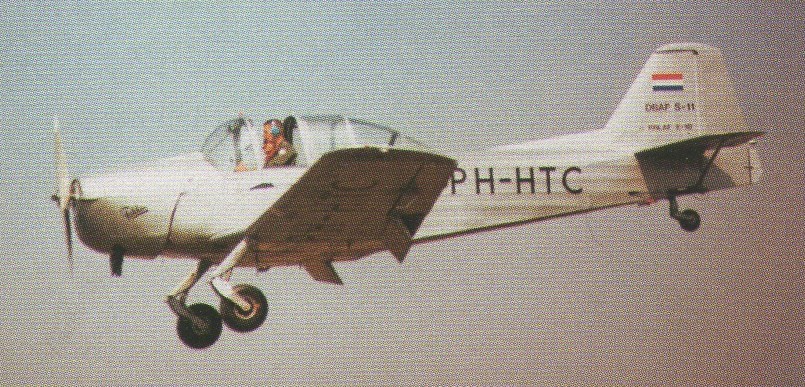
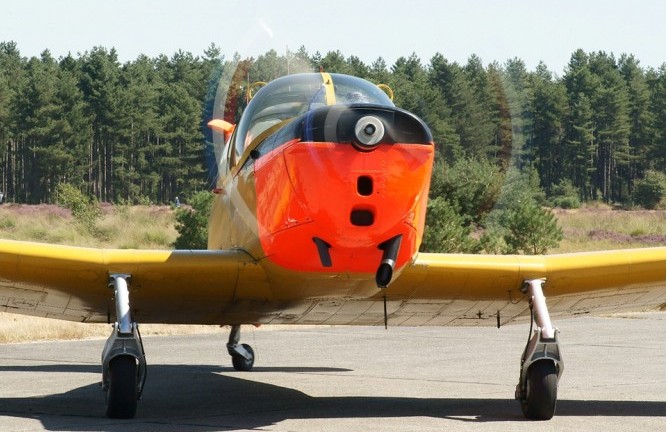
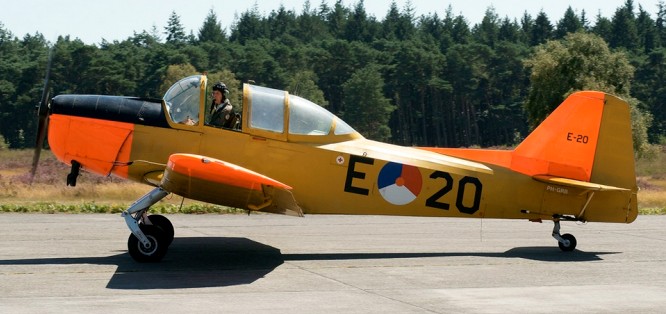
In 1946, just after World War II, Fokker started design studies for a lowwing primairy trainer with a fixed tailwheel undercarriage. Soon the Luchtstrijdkrachten (LSK) and Frits Diepen participated in the development of the Fokker S-11. On 8 October 1946, Frits Diepen Vliegtuig NV (FDV.NV) ordered 100 aircraft of the type for resale. 41 went to the Israeli Air Force. On 18 December 1947, the prototype of the Fokker S.11 (PH-NBE c/n 6187) flew first, powered by a 190 hp Lycoming O-435-A six-cylinder air-cooled engine. On 12 March 1948, the second prototype of the Fokker S-11 (PH-NBF c/n 6188) flew first. During testing it was found that some aerodynamic changes had to be made to improve the handling of the aircraft. Both prototypes were modified in 1948 and were used as demonstrators until PH-NBF crashed in Sweden on 16 June 1949. After the loss of the second prototype, the first prototype was broken up and the registration was cancelled on 10 May 1950.
The construction of the Fokker S-11 was improved and the aircraft entered production. The LSK ordered 39 aircraft and in 1950 the first Fokker S.11-1 Instructors entered service with the Koninklijke Luchtmacht (former LSK). The Fokker S.11-1 served with the Koninklijke Luchtmacht (Royal Netherlands Air Force) first with the EVO at Woensdrecht AFB. In 1968 the EVO (Elementaire Vlieger Opleiding) moved to Gilze-Rijen AFB. Next to the Royal Netherlands Air Force, the Fokker S.11 was delivered to the air arms of Brazil, Israel and Italy. Until production of the Fokker S-11 in the Netherlands ended in 1953 a total of 101 aircraft were built.
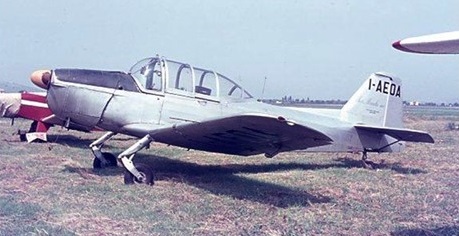
Next to the Dutch production, the Fokker S.11 was manufactured under licence by Aermacchi in Italy as the Macchi M.416 and by Fokker Industria Aeronautica SA / Fabrica do Galeao in in Rio de Janeiro, Brazil, designated T.21. Macchi, together with IMAM, built 180 of them. 100 were constructed for the Brazilian Air Force.
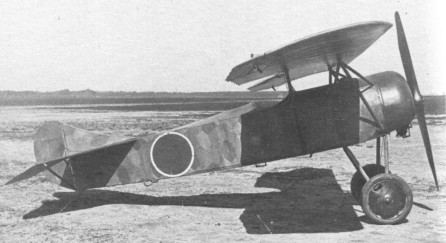
A smaller version of the D.VIII fighter was the V.39 post war sports aircraft. Some V.39 had a 110h.p. LeRhone engine, but lighter engines were also installed.
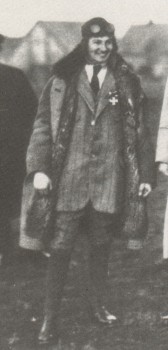
Antony Fokker was born on 6 April 1890 on the island of Java in the Dutch East Indies, but came with his family to the Netherlands four years later. In his youth, Fokker showed a greater disposition toward design and invention than toward formal schooling. During his adolescence he acquired a passion for cars, inventing a tire that could not be punctured, and then discovered aviation. His real desire was to learn to fly, but as his parents opposed this course most vehemently, the young Fokker contented himself initially with model planes built of wood and paper.
Anthony Fokker Article
Enrolling in an engineering school, after his military service had been cut short by an accident, the young Fokker finally obtained the structured educational basis which finally allowed him to construct his first plane, the Spin, in 1910.
After gaining his pilot’s license in 1911, Fokker moved to Germany, which he saw as a nation more likely than the Netherlands to take aviation to its bosom. Registered originally Fokker Aviatik GmbH, on 22 February 1912, Antony Fokker’s first company operated under Fokker Aeroplanbau GMBH at Berlin-Johannisthal then, moved to Schwerin, Mecklenberg, in 1913. Name changed later to Fokker Flugzeugwerke.
In 1912 Fokker sold his first plane to the German army, but the two years before the outbreak of the First World War were a distinct uphill struggle for the young Dutchman in financial terms. All this changed with the beginning of the war. Fokker accepted all commissions placed with him by the Imperial German air service, despite the fact that he might not be able to honour all of them. During the course of the war the Fokker company grew very considerably, producing for Germany many aircraft types both indifferent and good. Indifferent types included the Eindecker series of armed monoplanes that nevertheless ushered in the concept of the true fighter, while good types included the classic Dr 1, DVII and D VIII fighters. The Fokker company was also notable for the development of the world’s first effective synchronizer gear to allow a fixed fuselage-mounted machine gun to fire directly forward without shooting off the propeller blades.
Some civil aeroplanes were built at Schwerin in 1918 under the supervision of Platz, but production soon ended, and the Fok¬ker Aeroplane Works, where some 3,350 aeroplanes had been built during the War, was liquidated. It became Schwerin Indus¬trial Works Ltd, producing yachts, motor¬boats, canoes and, later, bedsteads and scales. The defeat of Germany and the revolutionary fever that swept the country toward the end of 1918 persuaded Fokker to beat a precipitate retreat to the Netherlands during November. The company was liquidated following Fokker’s return to Holland after the First World War. Here Fokker rebuilt his aviation empire, on 21 July 1919, founding the NV Koninklijke Nederlandse Vliegtuigenfabriek Fokker with factory at Veere, Zeeland, assembly at Amsterdam, with a series of important warplanes and a family of monoplane transports, including the classic F VII.
Fokker rented the Witteman-Lewis aircraft factory at Teterboro, together with the adjoining airfield at Hasbrouck Heights, New Jersey, USA, as the Netherlands Aircraft Manufacturing Company. In May 1924 a new company was formed, the Atlantic Corporation, with Lorillard Spencer as President and Robert B. C. Noorduyn as General Manager. Later named the Fokker Aircraft Corporation of America and, under the overall ownership of the General Motors Corporation in 1930, the General Aviation Corporation. Often known as “The Flying Dutchman”, Fokker died on 23 December 1939 but his name survives as the manufacturer of some of the world’s most important short-haul airliners. Production during Occupation included Arado Ar 196 floatplanes, Bucker Bu 181 Bestmann trainers and Dornier Do 24 flying-boats. Postwar activity included conversion of military Dakotas and Skymasters for civil use, license-production of various types including 24 Hawker Sea Furies, 460 Hunter F.4, and F.6 fighters; final assembly and parts manufacture of 350 Lockheed F.104Gs; share in European manufacturing program for F-16 fighter; associate member of Airbus Industrie On February 1st, 1947 an agreement was signed between Fokker, Aviolanda and De Schelde’s aviation department by which the long awaited merger was achieved. The name of the new conglomerate was “United Netherlands Aircraft Factories ¬Fokker”. To commemorate Fokker’s thirty years of aircraft manufacture in the Netherlands, they were granted the title “Royal Dutch Aircraft Manufacturer Fokker” on 21 July 1949. On April 1st, 1949 it became apparent that the merger between Fokker, Aviolanda and De Schelde had failed, and the con¬trolling body appointed Messrs. Vos, Beel¬ing, and During directors of the Fokker factory. A new factory at Schiphol was opened in 1951. On February 16th, 1954 Avio Diepen ¬became a subsidiary of Fokker. The aircraft construction department of the Royal Company De Schelde, joined Fokker on May lst, 1954.
Around 1960 Fokker was looking for and American partner. Lockheed turned down the proposal because they thought it could not be profitable, but Northrop agreed to by a twenty-one percent share.
Formed a joint company with Vereinigte Flugzeugtechnische Werke in 1969. VFW and Fokker joined in 1970 to form VFW-Fokker. In the 1970s German interest in general aviation was maintained by one or two smaller companies, but there has also been quite a large R&D investment by Rhein Flugzeugbau, a subsidi¬ary of VFW Fokker, in ducted fan propulsion for a new generation of lightplanes represent¬ed by its revolutionary Fanliner. By 1995 Fokker was a member of the Daimler-Benz Aerospace group. In March 1996 company filed for bankruptcy, but Stork Group bought Fokker Aviation to continue as Fokker Aircraft BV for product support, electronic systems and components, aerostructures, and special products. Several attempts to purchase the aircraft manufacturing business by foreign companies came to little, leading to the end of all aircraft production in May 1997 (latterly under trustees). Until production ended after Fokker collapsed due to financial problems on 15 March 1996, Fokker have developed and constructed over 100 different types of aircraft, both for military and civil aviation.
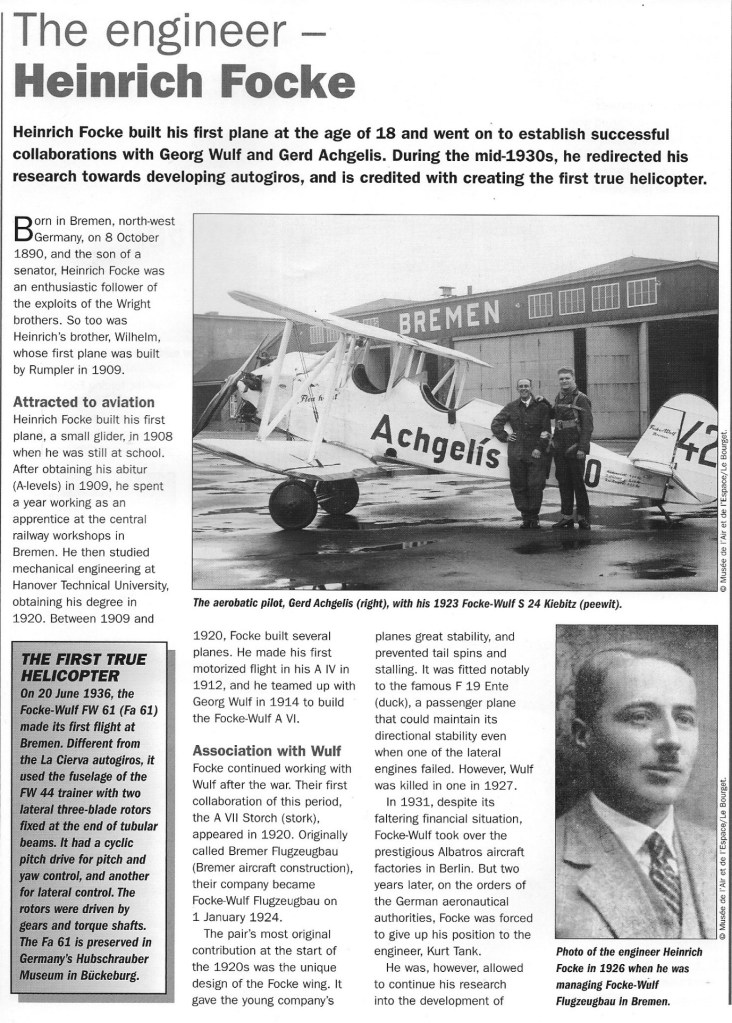
An association between Heinrich Focke and Georg Wulf was formalized January 1,1924 with formation of Focke-Wulf Flugzeugbau AG. at Bremen. Financial support followed success of A 7 Storch two-seater, flown November 1921. First company design was A16 three/four-seat commercial transport, followed by the eight/nine-seat A17, the more powerful 650 hp BMW Vl-powered A 29 and the three-crew/ten-passenger A 38 airliners. In 1931 acquired license to build Cierva C.19 Mk IV autogiro. Focke concentrated on rotary-wing activities, fixed-wing design was entrusted to Kurt Tank, formerly of BFW and of Rohrbach Metallflugzeug GmbH. Albatros Flugzeugwerke GmbH, Berlin, amalgamated with Focke- Wulf. On Focke’s resignation to form Focke-Achgelis, Tank appointed technical director. Reorganized June 1936 as GmbH under control of AEG. Ceased operations 1945, reformed 1951 and combined with Weser Flugzeugbau to form Vereinigte Flugzeugtechnische Werke. S 24 Kiebitz two-seat trainer won 1931 German Aerobatic Championship flown by Gerd Achgelis, who conducted maiden flight of Fw 44 Stieglitz trainer late summer 1932, widely used by embryo Luftwaffe and in European and South American countries. First Tank design produced in any numbers (approximately 1,000) was Fw 56 Stosser fighter/dive-bomber advanced trainer, followed in 1935 by Fw 58 Weihe communications aircraft/crew trainer and in 1938 by Fw 189 reconnaissance aircraft. Fw 200 Condor airliner flown July 1937, developed into Fw 200C long-range reconnaissance aircraft. With production total of more than 19,000, Fw 190 fighter was the most notable of Focke-Wulf’s designs; after the first flight on June 1,1939, entered squadron service August 1941. High-altitude version, with revised high aspect ratio wing, designated Ta 152. Focke-Wulf joined VFW in 1964.
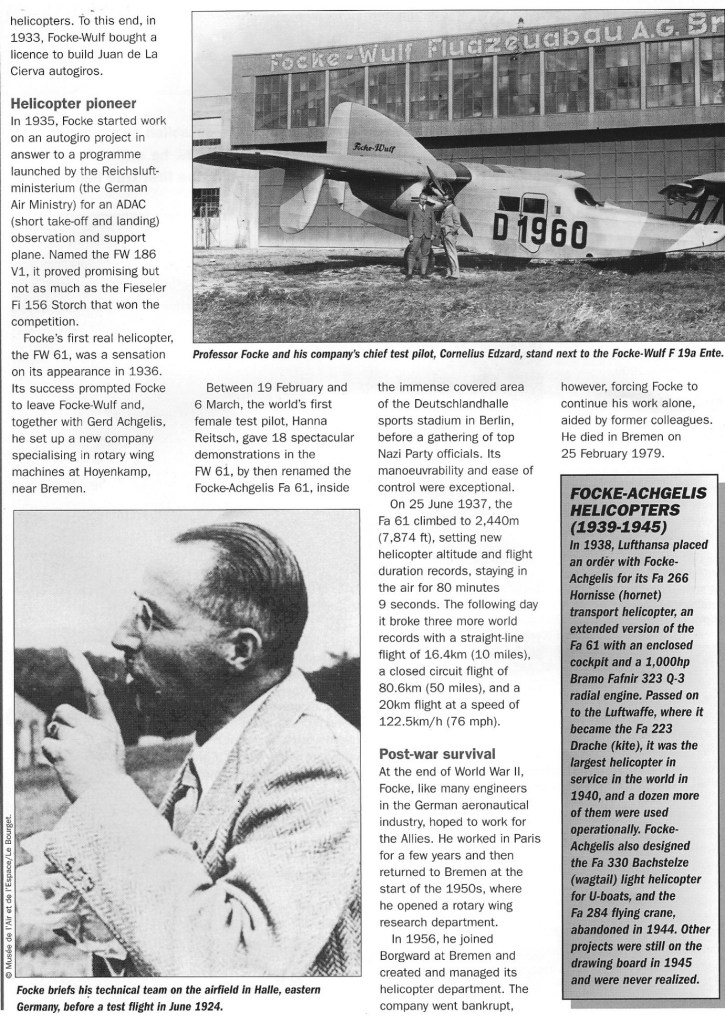
Experimental Helicopter, Germany, 1958 The automobile manufaturer Borgward in Bremen tried to expand its operations with helicopters and the Kolibri was designed together with Prof. Heinrich Focke. The project was shut down because of economical problems of the Borgward factories.
Engine: Lycoming, 237 hp Rotor diameter: 30.84 ft / 9.4 m Max take off weight: 2646.0 lb / 1200.0 kg Crew: 1+2
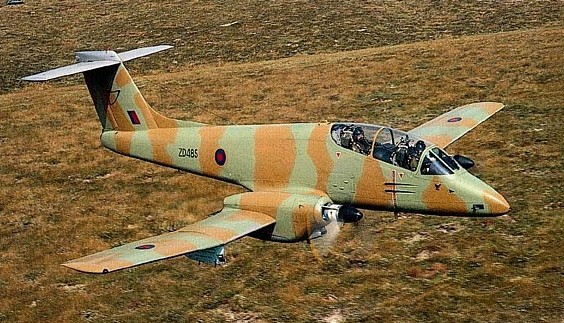
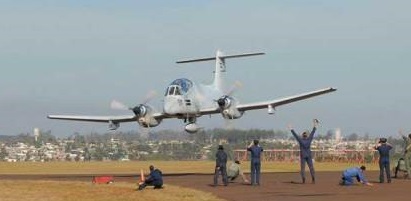
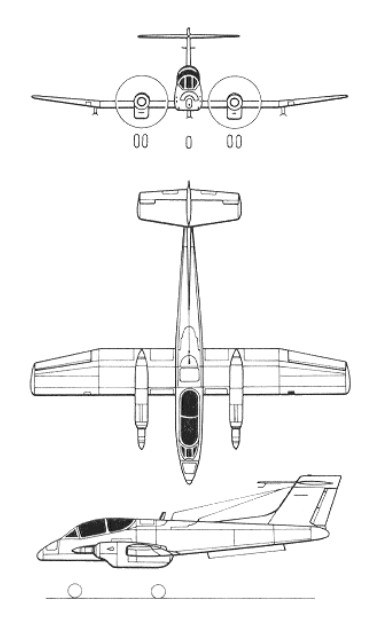
In the mid 1960s the Argentine government issued a requirement to Fabrica Militar de Aviones (FMA), for a new combat aircraft suitable for the COIN, CAS and recce roles. Development of the FMA IA 58 Pucara ground-attack aircraft began in August 1966 and led to the flight of an unpowered aerodynamic test vehicle on 26 December 1967. The first powered prototype, by then known as the AX-2 Delfin, and with two 674kW Garrett TPE3311/U-303 turboprop engines installed, was flown for the first time on 20 August 1969. Subsequent prototypes were powered by Turbo-meca Astazou XVIG engines and fitted to all production aircraft.
A cantilever low-wing monoplane of all-metal construction, the Pucara has a T-tail, a retractable tricycle landing gear, and accommodation for a pilot and copilot in tandem on Martin-Baker ejection seats beneath a large transparent canopy. It has narrow fuselage and tail section and a tandem seat cockpit with a steep sloping nose. Because of the steep nose the pilot has excellent forward visibility. Although heavily armed the weapons are unguided and visually aimed by the crew. The IA 58 only needs a minimum of ground support to operate, it is able to operate from unprepared rough terrains. More prototypes were produced and on 8 November 1974 the first of 60 IA 58A production aircraft for the Argentinian Air Force made its maiden flight. The initial production version, the IA 58A, flew for the first time on 8 November 1974 and first deliveries of 108 ordered for the Argentine air force began early in 1976 and continued until 1986. Six were also ordered for the air force of Uruguay. Forty improved IA 58B Pucara Bravos with advanced avionics and more powerful armament (30mm instead of 20mm cannon) were ordered for the Argentine air force in 1980 but were completed as IA 58As following the Falklands campaign. A single IA 66, a Pucara with more-powerful 746kW Garrett TPE331 engines, began its flight test programme in 1980 but did not proceed any further. Pucara production ended with a batch of 40 IA 58As built from 1986 onwards but no further sales were subsequently announced and they are believed to be in store as ‘white tails’.
Argentine IA58 Pucara
About 3 aircraft were captured by the United Kingdom during the Falkland War, they are now preserved by the RAF. First flown on December 30, 1985, the single-seat IA.58C is a developed version of the earlier IA.58A, in which the forward cockpit is replaced by a new nose section housing a 30mm Defa cannon with 270 rounds, in addition to the usual armament of two 20mm cannon and four 7.62mm machine-guns. The Astazou engines of the IA.58A are retained, but feature self-starters and modified exhausts to reduce their infrared signature. The IA.58C incorporates a complete avionics upgrade, including an Omega/VLF navigation system, Hud, IFF, and radar warning receiver, together with a Saab RGS-2 lead-computing sight for air-to-air or air-to-ground use. The IA 58A is also operated by Colombia, Sri Lanka and Uruguay but only in small numbers. In December 1989, Argentina delivered three Pucaras to Colombia on loan for use against drug manufacturers and smugglers.
IA.58A Engines: 2 x Turbomeca Astazou XVIG, 760kW / 988 shp Max take-off weight: 6800 kg / 14992 lb Empty weight: 4037 kg / 8900 lb Wingspan: 14.5 m / 47 ft 7 in Length: 14.3 m / 46 ft 11 in Height: 5.4 m / 17 ft 9 in Wing area: 30.3 sq.m / 326.15 sq ft Max. speed 3.000m (9,840 ft): Mach 0.48 / 500 km/h / 311 mph Cruise speed: 500 km/h / 311 mph Ceiling: 10000 m / 32800 ft Initial ROC: 1080 m / min. Range w/max.fuel: 3400 km / 2113 miles Combat radius hi-lo-hi: 350 km. T/O run: 300 m. Ldg run: 200 m. Fuel internal: 1280 lt. Air refuel: No. Warload: 1500 kg. Armament: two Hispano HS804 20mm cannons with 270 rounds per gun, four FN Browning 7.62mm guns with 900 rounds per gun; up tp 1500 kg (3,307 lb) of free fall load. Hard points: 3. Crew: 2
IA 66 Engines: 2 x 1,000-shp Garrett TPE331-11-601W turboprop Wingspan: 14.5 m / 47 ft 7 in Length: 14.3 m / 46 ft 11 in Height: 5.4 m / 17 ft 9 in Wing area: 30.3 sq.m / 326.15 sq ft Crew: 2
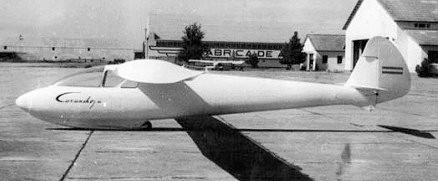
In October 1963 the Argentine state aircraft factory DINFIA began construction of the prototype IA 54 two-seat research sailplane intended to test a new 19m (62ft 3.5in) span wing; the fuselage was based on that of a Schleicher Condor 4 and the all-wood wing, of 18% thickness/chord ratio, had down-turned wing tips, Frise ailerons, unslotted flaps and – inboard of the flaps – metal trailing edge air brakes.
Wingspan; 19.00 m / 62 ft 4 in Length; 8.00 m / 26 ft 3 in Wing area; 29.00 sq.m / 312.15 sq ft Max take-off weight; 548 kg / 1208 lb Max. speed; 240 km/h / 149 mph Crew; 2
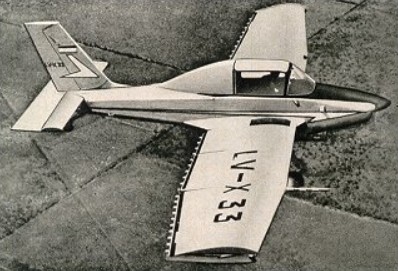
Engine; 1 x Cont. O-470-R, 170kW or Lyc. O-540-B2 B5, 175kW Wingspan; 11.6 m / 38 ft 1 in Length; 8.4 m / 27 ft 7 in Height; 2.8 m / 9 ft 2 in Wing area; 21.5 sq.m / 231.42 sq ft Max take-off weight; 1525 kg / 3362 lb Empty weight; 880 kg / 1940 lb Max. speed; 185 km/h / 115 mph Cruise speed; 160 km/h / 99 mph Ceiling; 4300 m / 14100 ft Range w/max.fuel; 750 km / 466 miles Crew; 1 Passengers; 1

 All Aero