USA
Forney Manufacturing Company acquired production rights for Engineering and Research Corporation’s Ercoupe 415 two-seat light aircraft in April 1955. First production F-1 Aircoupe flew on September 1956. Offered later as Fornaire Execta, Explorer, and Expediter. Rights sold in 1960 to the city of Carlsbad, New Mexico.
Post WW2
Folland Fo.144 Gnat
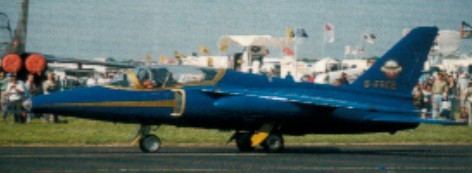
Although the RAF had not selected the Fo 141 Gnat for service in a front-line role, it did have a requirement for an unarmed, two-seat advanced trainer to replace the de Havilland Vampire T.Mk 11. Folland had already considered a training version of the Gnat as a private venture, and this was shown to be able to meet Air Ministry requirements including a 100 knot (185 kph) landing speed.
To make the Gnat a two-seater, it was necessary to remove the standard fixed gun armament of two 30 mm ADEN cannon located in the cheek intake fairings, and relocate the fuel tanks, but no major structural alterations were required. The most significant change was a new wing, increased in area by 3.72sq.m and with additional fuel capacity, which reduced the fuel storage requirement in the fuselage, making room for additional equipment. The forward fuselage was increased slightly in length, the tail surfaces enlarged, and outboard ailerons and conventional inboard flaps replaced the inboard ailerons of the fighter version. Power was to be supplied by a 1919kg thrust Orpheus 100.
Follands had already designed and built a new wing for a proposed development of the Gnat fighter for naval use, with improved low speed performance. By adopting the simpler and more efficient construction of this wing, which was reduced in thickness from the eight per cent t/c ratio of the original Gnat, to a mean value of seven per cent, while retaining the symmetrical R.A.E. 102 (mod.) section, Follands were able to offer a larger area for the trainer to give the necessary reduction in landing speed without a major weight penalty. It had the additional facility of increased fuel capacity.
A Ministry of Supply design study contract was awarded to Specification T.185D in the autumn of 1956 and a prototype contract was negotiated during 1957.
Apart from performance, one of the main requirements was for the inclusion of an advanced level of equipment, comparable to that in operational aircraft under development although not then in service. This included new flight and navigational instrument presentation to OR.946, provision of engine anti icing, centralised failure warning system, installation of liquid oxygen facilities and many other very advanced items.
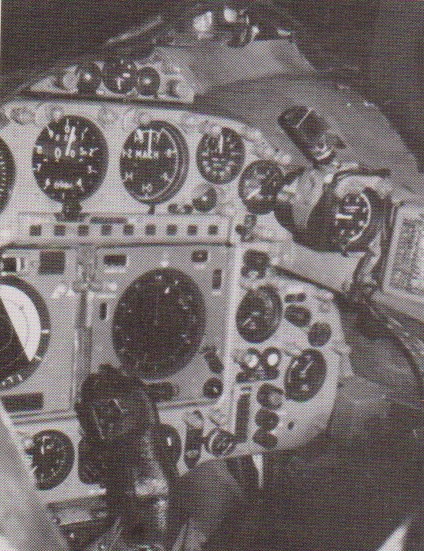
The OR.946 flight instrumentation occupied space on the instrument panel than in the earlier Gnat by the deletion of the gun sight and bullet proof windscreen framing. OR.946 concentrates all essential flight information on two display units occupying the entire centre of the panel. On the left is the roller blind F.4 attitude indicator, which takes the place of the normal artificial horizon, and provides a non toppling reference in all flight conditions, while on the right is the Mk.1 display unit for TACAN and other navigational equipment.
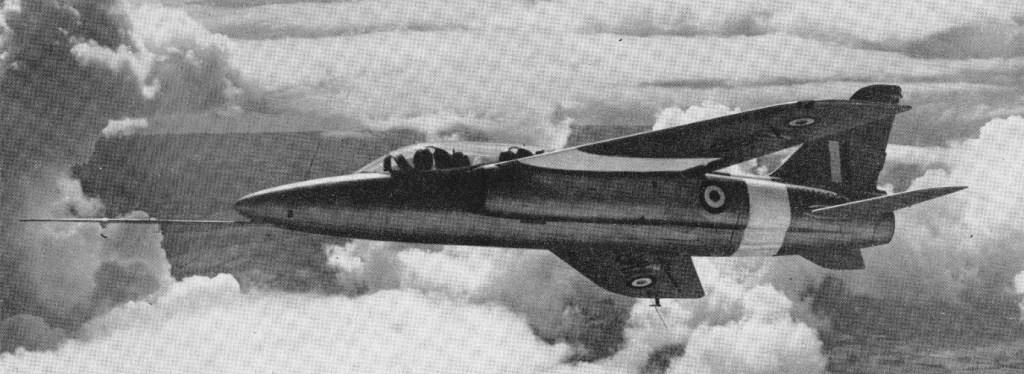
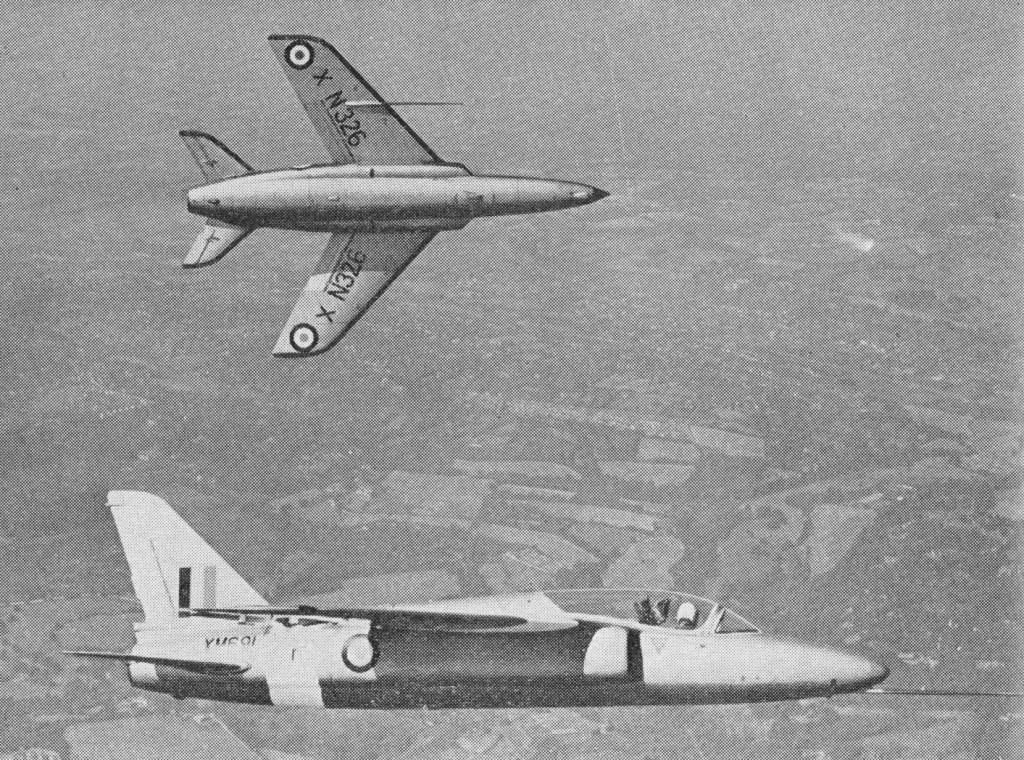
Additional space for the “black boxes” making up the Gnat T.l’s sophisticated equipment, including TACAN, ILS and the Air Data Computer, was found by enlarging the spine fairing of the original fighter behind the cockpit canopy. The canopy itself, as well as the windscreen, was completely new, the former being of the aft hinged clamshell type, blown from a single piece of Perspex. To protect the rear occupant in case of canopy jettison, the Gnat trainer has an additional internal windscreen over the duplicated instrument panel.
An ejection escape system was developed specially for the trainer by Folland, using two of the company’s own lightweight seats. Work on these was started by Folland in 1953, using a SAAB type seat layout as the original basis, but development had since continued entirely independently. The Mk. 4GT1 (front) and 4GT2 (rear) ejection seats in the Gnat have 80 ft/sec (24.4 m/sec) telescopic guns for adequate fin clearance at all airspeeds, and are cleared for use down to runway level at speeds of 90 650 knots (106 1204 km/h). They are used in conjunction with GQ Mk 35 back type parachutes, plus Type X personal survival packs in the seat pans, and have 6 ft (1.82 m) diameter drogues for man stabilisation if ejection takes place above 10,000 ft (3050 m). An extractor ‘chute on the seat helps immediate separation, with a drogue sock pulled off by a static line as the seat leaves the aircraft. After initiation by face blind or seat pan handle, operation of the seats is fully automatic.
Engine installation was not changed from the original Gnat except that a slightly de rated Bristol Siddeley Orpheus was adopted in the interests of improved fuel economy and longer overhaul times. Secondary modifications provided intake anti¬-icing from hot air tapped from the engine compressor through to the entry guide vanes and bullet, and drive for a larger electric generator. In its standard RAF form, the Gnat trainer was powered by an Orpheus 101 developing 4230 lb (1920 kg) thrust for take off, but it is offered in addition with the higher powered (4,720 lb (2135 kg) Orpheus 501 if extra altitude performance is required. A Gnat trainer (XM698) has also flown with the fighter engine, which is the Orpheus 701, with a similar thrust to the 500 series.
Following the finalisation of the design, a contract for fourteen development aircraft to spec T.185P was placed 7 January 1958, and the first prototype Fo.144 Gnat trainer made its initial flight in the hands of Sqdn. Ldr. E. A. Termant on August 31, 1959 from Chilbolton airfield. The first eight of these aircraft were mainly employed for per¬formance testing and development of the various systems, including improved longitudinal control. The Ministry did not at first place a production order as they were concerned about the size and ability of the company to take on a large order. Following the take-over of Folland by Hawker Siddeley Aviation (becoming the Hamble division), after successful evaluation by the various official bodies concerned, a production order was placed in July 1960 for thirty aircraft for use as advanced trainers, and an additional twenty were ordered a year later. A further order for forty one followed in March, 1962. These were being turned out at the requested rate of four per month. The last Gnat T.1 for the RAF was delivered in May 1965.The Gnat trainer was then being offered on the overseas sales market.
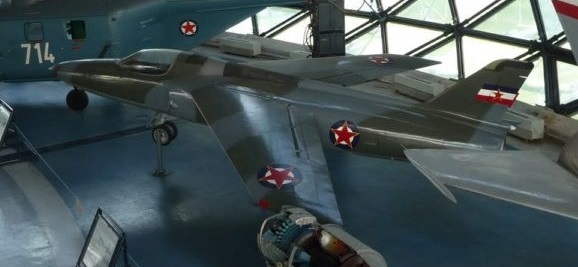
Yugoslavia ordered two Gnat F.1s for evaluation; the first aircraft flew on 7 June 1958 and both were delivered to Yugoslavia by rail. The aircraft were flown by the flight test centre but no further aircraft were ordered. One aircraft was destroyed in a crash in October 1958 while the other is preserved and on display in Serbia.
Hydraulic power is used as the primary means of operating ailerons and the all flying tailplane, with manual reversion in case of failure of the hydraulic system. Compared with the original Gnat, which had combined inboard ailerons and flaps, the trainer has a conventional flap and outboard aileron arrangement. The ailerons have automatic control stops which just about halve their range of movement to eight per cent at speeds above 150 knots IAS (278 km/h) to limit the rate of roll and prevent inertia coupling.
Effective longitudinal control results from the hydraulic¬ally powered flying tailplane, which like the ailerons has spring¬feel. A “Q” gearing mechanism reduces the amount of tailplane movement for a given stick displacement as speed increases, which improves handling at high indicated airspeeds, but the stick force per g is still very light above 400 knots (741 km/h). Tailplane trimming is via an electric actuator and thumb switch on the control column. In the event of hydraulic failure, the rear portion of the tailplane may be unlocked to act as elevators, with tailplane trimming still available from a stand by electric motor in the Hobson unit. Stick forces in manual are apparently not heavy, but because of the small size of the elevators, their effectiveness is only about one fifth of that of the tailplane. Speed is then restricted to 400 knots (741 kph) or M0.85.
The Orpheus 101 was up rated to 4,400 lb (1995 kg.) thrust to improve the high altitude performance.
With its simple and rugged structure designed for a minimum fatigue life of 5,000 hours and characterised by the absence of complicated castings and forgings, the Gnat is not difficult to build or maintain.
It became clear, however, that no production order would be placed while Folland remained outside the major manufacturing groupings which the government favoured; thus the company was taken over by Hawker Siddeley Aviation, becoming its Hamble Division.
Contracts for 30, 20 and 41 aircraft were awarded in February 1960, July 1961 and March 1962 respectively.
The last production Gnat T.Mk 1 flew on 9 April 1965 and was delivered to the RAF on 14 May, in the all-red scheme of the Red Arrows team. The Central Flying School, then at Little Rissington, first introduced the type in February 1962 but the major operator was No. 4 Flying Training School at Valley, which took its first aircraft on strength in November 1962 and which, in 1964, introduced the Gnat to the formation aerobatic scene, operating five all-yellow Gnats known as the Yellowjacks.
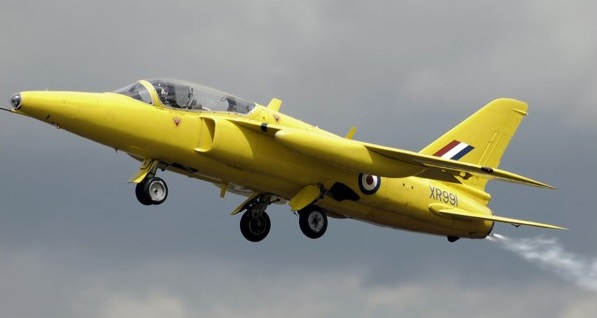
The team reformed as the Red Arrows in 1965, under the control of the Central Flying School, and its Gnats were withdrawn finally at the end of the 1979 display season, to be replaced in 1980 by the British Aerospace Hawk T.Mk 1. No. 4 FTS retired its Gnats on 24 November 1978.
Once pilots graduated from basic training on the BAC Jet Provost and gained their wings they were selected for one of three streams: fast jet, multi-engined, or helicopter. Those selected for fast jets were posted to RAF Valley for advanced training on the Gnat T.1, typically 70 hours of flying. Students would then move on to operational training using the Hawker Hunter, followed by a posting to an operational conversion unit for the type of aircraft to be flown.
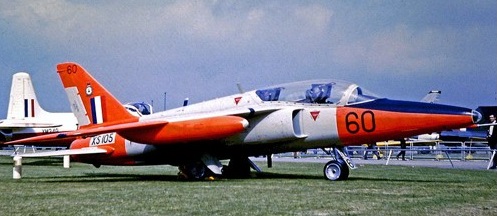
Following the introduction of the Hawker Siddeley Hawk into the training role as a replacement the Gnats were withdrawn from service. The largest operator 4 FTS retired its last Gnat in November 1978. Most of the retired Gnats were delivered to No. 1 School of Technical Training at RAF Halton and other training establishments to be used as ground training airframes. When the RAF had no need for the Gnats as training airframes they were sold off. Many were bought by private operators and are still flying in 2014.
Including licence built models, India received 238 plus 79 similar Ajeets. The first 13 aircraft for the Indian Air Force (IAF) were assembled at Hamble-le-Rice, they were followed by partly completed aircraft and then sub-assemblies as Hindustan Aircraft slowly took over first assembly, and then production of the aircraft. The first flight of an Indian Air Force Gnat was in the United Kingdom on 11 January 1958, it was delivered to India in the hold of a C-119, and accepted by the Air Force on 30 January 1958. The first Gnat squadron was the No. 23 (Cheetah), which converted from Vampire FB.52 on 18 March 1960 using six Folland-built Gnats. The first aircraft built from Indian-built parts first flew in May 1962. The last Indian-built Gnat F.1 was delivered on 31 January 1974.
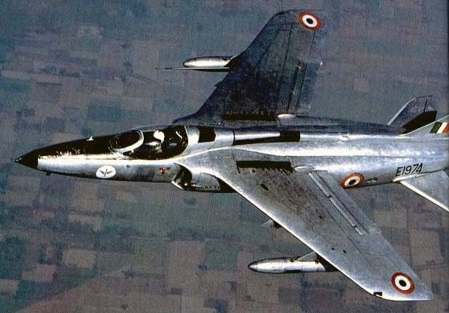
The Gnat is credited by many independent and Indian sources as having shot down seven Pakistani Canadair Sabres in the 1965 war, while two Gnats were downed by PAF fighters. During the initial phase of the 1965 war, an IAF Gnat, piloted by Squadron Leader Brij Pal Singh Sikand, mistakenly landed at an abandoned Pakistani airstrip at Pasrur and was captured by the PAF. Two Lockheed F-104 Starfighters claimed to have forced the Gnat down. This Gnat is displayed as a war trophy in the Pakistan Air Force Museum, Karachi. After the ceasefire, one Pakistani Cessna O-1 was shot down on 16 December 1965 by a Gnat.
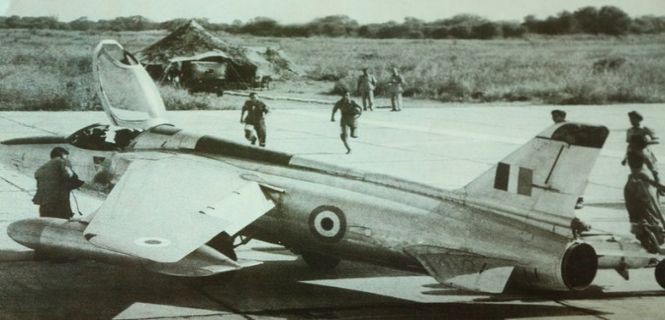
The Gnats were used again by India in the Indo-Pakistani War of 1971 against Pakistan. The most notable action was the Battle of Boyra where the first dogfights over East Pakistan (Bangladesh) took place. The Indian Air Force (IAF) Gnats downed two PAF Canadair Sabres in minutes and badly damaged one. The Pakistan Air Force claims that one Gnat was shot down, which was proved incorrect. Another notable dogfight involving a Gnat was over Srinagar airfield where a lone Indian pilot held out against six Sabres, scoring hits on two of the Sabres in the process, before being shot down. Gnat pilot Nirmal Jit Singh Sekhon was posthumously honoured with the Param Vir Chakra (India’s highest gallantry award), becoming the only member of the IAF to be given the award.
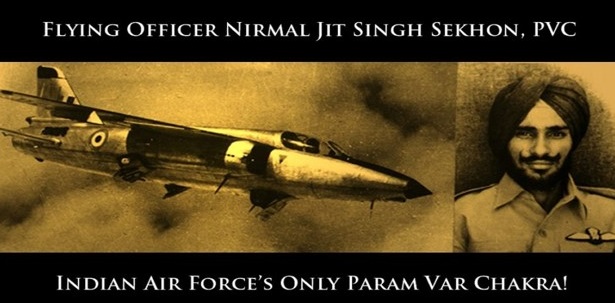
By the end of 1971, the Gnat proved to be a frustrating opponent for the larger, heavier and older Sabre. The Gnat was referred to as a “Sabre Slayer” by the IAF since most of its combat “kills” during the two wars were against Sabres. The Canadair Sabre Mk 6 was widely regarded as the best dogfighter of its era. Tactics called for Gnats taking on the Sabres in the vertical arena, where the Sabres were at a disadvantage. As the Gnat was lightweight and compact in shape, it was hard to see, especially at the low levels where most dogfights took place. Apart from air defence operations, they performed multiple roles in the Bangladesh Liberation War, including anti-shipping operations, ground attack, bomber/transport escort and close air support.
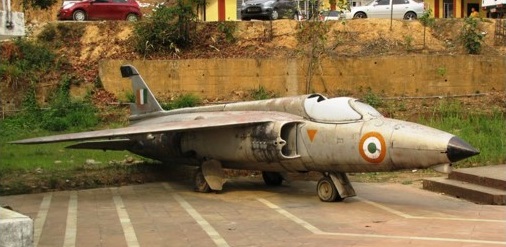
The IAF was impressed by the Gnat’s performance in the two wars, but the aircraft had problems including hydraulics and unreliable control systems. To address these issues, the IAF issued a requirement for an improved “Gnat II” in 1972, at first specifying that the new version was to be optimized as an interceptor, but then expanding the specification to include the ground-attack role. Over 175 of the Hindustan Aeronautics Limited-built licensed version, the Ajeet (“Unconquerable”), were produced in Bangalore. Several Gnats remain in use in private hands. Some IAF Gnats, one of which had participated in the 1971 war in East Pakistan (present day Bangladesh), were presented to the Bangladesh Air Force.
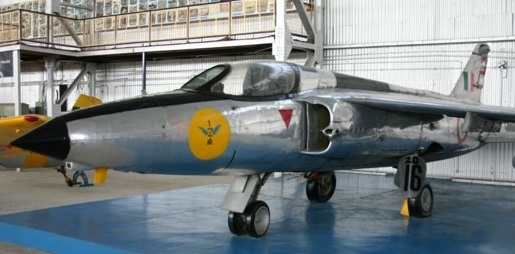
Folland Gnat Mk. 1
Engine: 1 x 4,230 lbs.t. (1919 kgp) Bristol Siddeley Orpheus 101
Wingspan, 24 ft. (7.33 m)
Length, 31 ft. 9 in. (9.7 m)
Height, 10 ft. (3.06 m)
Wing area, 175 sq. ft. (16.26 sq m)
Empty weight, 5,639 lb. (2 559 kg)
Crew weight, 360 lb. (163 kg)
Internal fuel, 265 Imp.ga1 (1200 litres)
AVTAG, 2,040 lb. (926 kg)
Gross weight, clean, 8,039 lb. (3 648 kg)
External fuel tanks, 118 gal. (536 litres), 908 lb. (412 kg)
Overload gross weight, 9,107 lb. (4 133 kg)
Max level speed: 610 kts EAS (1130 km/h) at sea level (Mach 0.93).
Max speed, 36,000 ft. (11 000 m), M= 0.95
Max speed, 636 mph (1024 kph) at 31,000ft (9 500 m)
Max dive speed, M 1.15
Cruise, 470 mph (756 kph)
Initial climb, 7,620 fpm (38.7 m/sec)
Climb to 26,000 ft. (8 000 m), 4 min. 40 sec.
Climb to 40,000 ft (12,000 m), 7 min 30 sec.
Service ceiling, 48,000 ft (14 600m)
Stalling speed, 115 mph (185 kph)
Take off distance to 50 ft (15 m), 2,550 ft (775 m)
Landing distance from 50 ft (15 m), brake parachute, dry surface, 2,210 ft (705 m)
Max range, internal fuel, 600 nm (1100 km)
Range with external fuel, 1,000 nm (1 850 km).
Armament: 2 x 30mm Aden cannon.
Crew: 1-2
Folland Fo.141 Gnat
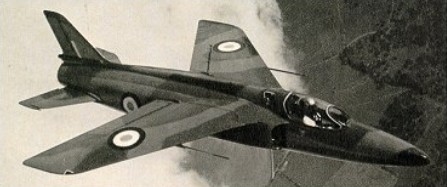
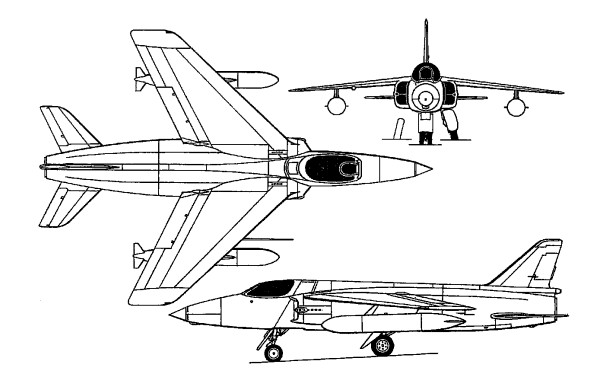
Developed from the Fo 139 Midge, the Fo 141 Gnat was designed as a light fighter. The shoulder wing is swept back at 40 degrees. All tail surfaces are swept with a one-piece tailplane low-set on the fuselage. Ailerons are on the inner wings and can be drooped to act as flaps. The wheel fairing doors act as air-brakes when the undercarriage is partially lowered in flight. The tricycle undercarriage has single main wheels and twin nose wheels, all retracting rearwards into the fuselage.
The private-venture prototype Gnat G-39-2, piloted by Folland’s chief test pilot, Squadron Leader E. A. Tennant, first flew at the Airplane & Armament Experimental Establishment at Boscombe Down on 18 July 1955. The aircraft was powered by a newly developed 1490kg thrust Bristol Orpheus turbojet.
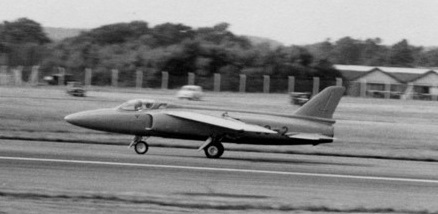
The Gnat, being developed in parallel with the Midge, was an improved version of the original fighter design, differentiated by larger air intakes for the Bristol Orpheus engine (the Midge had an Armstrong Siddeley Viper engine), a slightly larger wing, and provision for a 30 mm ADEN cannon in each intake lip.
A more powerful version, rated at 1814kg thrust, was installed on 30 August for the Gnat’s debut at that year’s SBAC flying display and exhibition at Farnborough.
Six development aircraft were ordered by the Ministry of Supply in August 1955, the first flying on 26 May 1956, and these were used for a variety of trials at Boscombe Down, including firing of the 30mm ADEN cannon, one of which was fitted in the lip of each intake. Evaluation in the ground-attack role was undertaken in Aden, in competition with a modified Hawker Hunter.
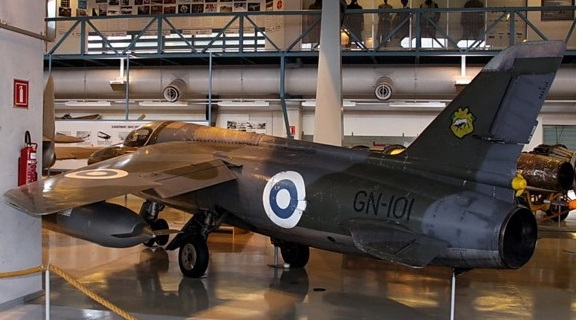
Although the Royal Air Force had lost interest in the Gnat as a fighter, the Finnish air force took delivery of 13 aircraft in 1958-59. The Finnish Air Force received the first of its 13 Gnats (11 fighters and 2 photo-reconnaissance planes) on 30 July 1958. It was soon found to be a problematic aircraft in service and required a lot of ground maintenance. In early 1957 a licence agreement was reached to allow Valmet to build the Gnat at Tampere in Finland, although in the end none was built.
On 31 July 1958, the Finnish Air Force Major Lauri Pekuri, a World War II fighter ace, broke the sound barrier for the first time in Finland at Lake Luonetjärvi with a Folland Gnat.
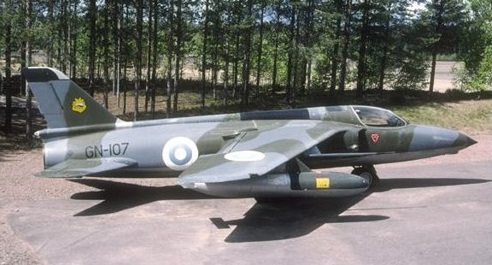
Gnat F.1 proved initially problematic in the Finnish harsh conditions. Finland was the first operational user of Gnat F.1, and the plane had still many issues yet unresolved. All Gnats were grounded for half a year on 26 August 1958 after the destruction of GN-102 due to a technical design error on hydraulic system, and the aircraft soon became the subject of severe criticism. Three other aircraft were also destroyed in other accidents, with two pilots ejecting and one being killed. Once the initial problems were ironed out, the plane proved to be extremely manouevreable and have good performance in the air, but also to be very maintenance intensive. The availability of spare parts was always an issue, and its maintenance a challenge to the conscript mechanics. The Gnats were removed from active service in 1972 when the Häme Wing moved to Rovaniemi, and when the new Saab 35 Drakens were brought into use.
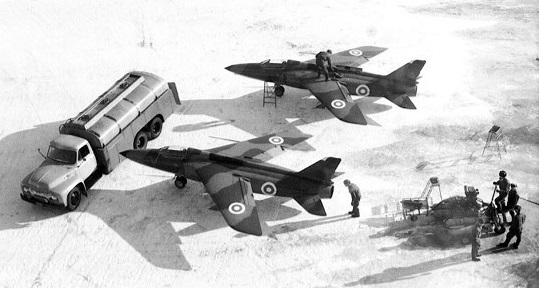
The Finnish Air Force serial codes for Folland Gnat were GN-100 to GN-113 and its usual nickname Nutikka (“Stubby”). Several Finnish Gnat F.1s still survive either as museum pieces or memorials. One airframe, GN-113, is in private ownership.
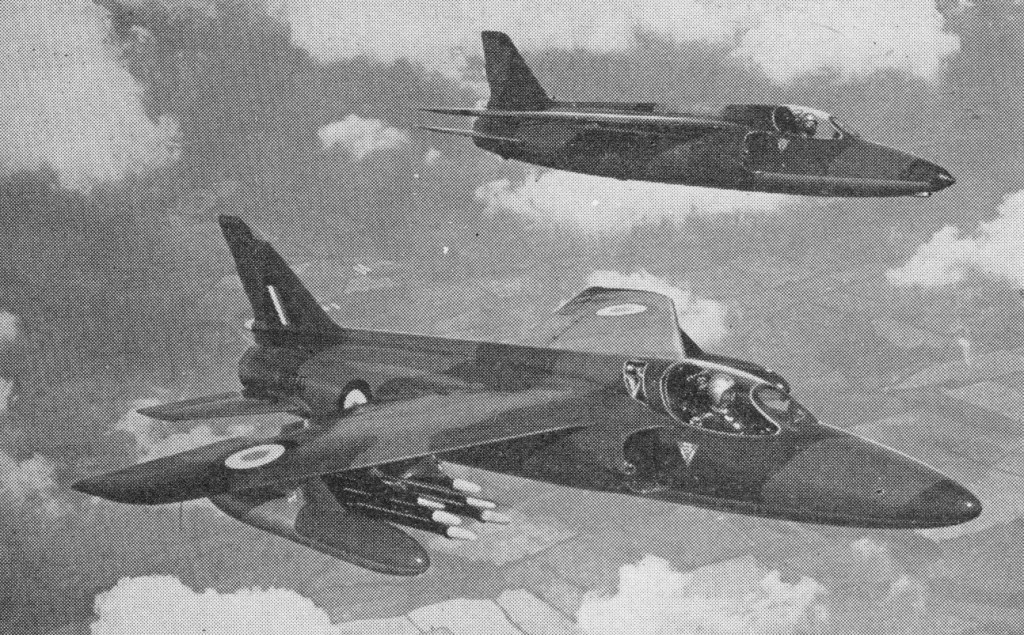
The Yugoslav government also bought two but the major export order was from India: 40 airframes in various stages of completion were supplied from the UK, and licence-production was undertaken by Hindustan Aeronautics Ltd at Bangalore, local production accounting for 175 aircraft. The Gnat entered Indian Air Force service in the spring of 1958, when the Gnat Handling Flight was first formed, and ultimately eight squadrons were equipped.
The Indian Air Force (IAF) operated the Folland Gnat jet fighter from 1958, with over 200 aircraft being license built by Hindustan Aeronautics Limited (HAL). The aircraft proved successful in combat in both the 1965 and the 1971 War with Pakistan, both in the low-level air superiority role and for short range ground attack missions, while being inexpensive to build and operate, came to be called the Gnat Mk 2.
In the words of Late Air Cmde Jasjit Singh, “The Gnat was a very unforgiving aircraft and had the poorest safety track record in the IAF, despite having only Average plus pilots posted to it.” In his book, Indian Air Force: The Case for Indigenisation, Air Cmde Singh said, “It is not surprising the RAF never used it.”
The Gnat aircraft had a peculiar design with the ailerons also doubling as flaps, drooping 15 degrees from a normal aileron position with undercarriage in down position. The raising and lowering of the undercarriage made the ailerons (flaps) go up and down from their normal position. This involved excessive change in attitude and required proper handling by the pilot. All the pilots were briefed repeatedly on this aspect to control the excessive pitch-up after raising of the undercarriage after take-off. Not surprisingly, there were a few incidents because of this peculiar nature of the aircraft.
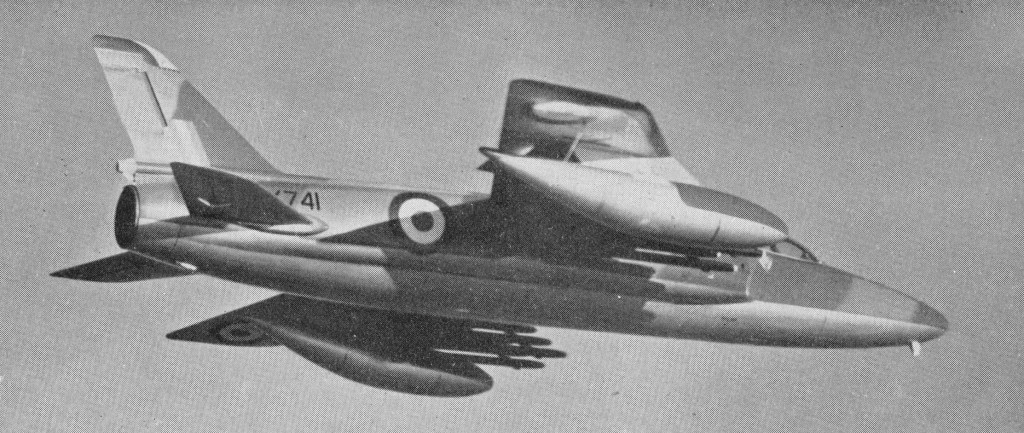
Although the RAF had not selected the Gnat for service in a front-line role, it did have a requirement for an unarmed, two-seat advanced trainer to replace the de Havilland Vampire T.Mk 11 and to follow the Hunting Jet Provost sections of the all-through jet training programme. Folland undertook a private-venture investigation of the changes necessary to install a second seat and to bring the landing speed down to less than 185km/h. The most significant of these changes was a new wing, increased in area by 3.72sq.m and with additional fuel capacity, which reduced the fuel storage requirement in the fuselage, making room for additional equipment. This became the Folland Fo 144 Gnat
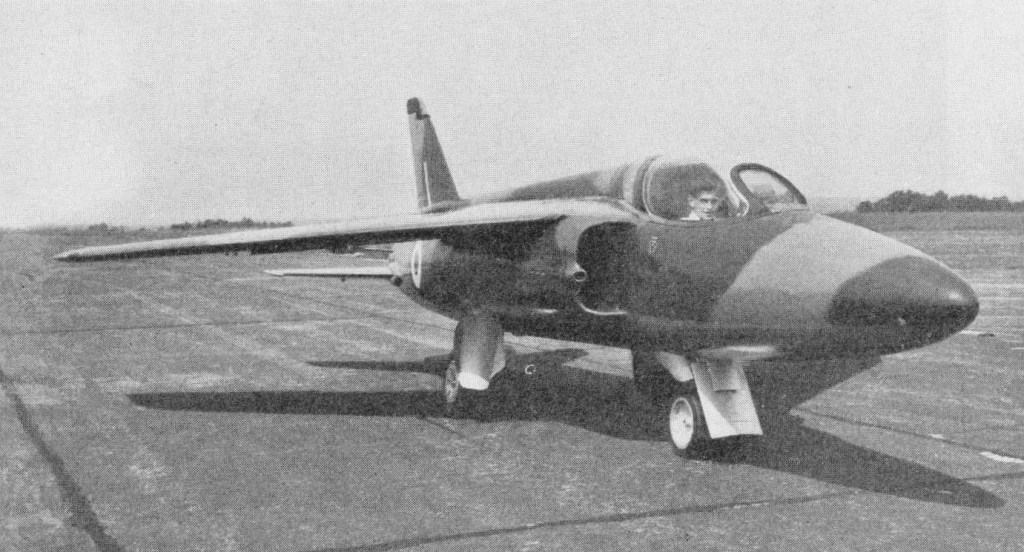
Fo 141
Engine: Bristol Siddeley Orpheus 701, 4520 lb
Wing span: 22 ft 2 in
Wing area: 135.5 sq.ft
Length: 29 ft 9 in
Height: 8 ft 10 in
MTOW: 8885 lb
Fuel capacity: 300 gal
External fuel: 2 x 66 gal drop tanks
Wheel track: 4 ft 1 in
Wheelbase: 7 ft 9 in
Max speed: 695 mph / M0.98 at 20,000 ft
Max ROC: 20,000 fpm
Service ceiling: 50,000 ft +
Max endurance: 2 hr 30 min
Armament: 2 x 30mm Aden cannon
Bombload: 2 x 500 lb bomb or 12 air-ground rockets
Folland Fo.139 Midge
The Midge and Gnat were designed by W.E.W. “Teddy” Petter. Petter had grown suspicious of the trend towards bigger and more expensive combat aircraft, and he felt that a small, simple fighter would offer the advantages of low purchase and operational costs. New lightweight turbojet engines were being developed that would be able to power such small fighters.
Petter became managing director of Folland Aircraft and in 1951, using company funds, he began work on his lightweight fighter concept, which was designated the “Fo-141 Gnat”. The Gnat was to be powered by a Bristol BE-22 Saturn turbojet with 3,800 lbf (16.9 kN 1,724 kgp) thrust. However, the Saturn was cancelled, and so Petter’s unarmed proof-of-concept demonstrator for the Gnat was powered by the less powerful Armstrong Siddeley Viper 101 with 1,640 lbf (7.3 kN / 744 kgp) thrust.
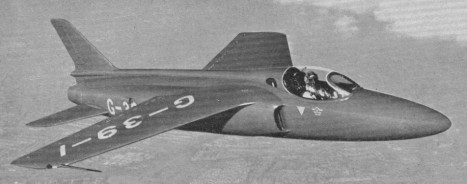
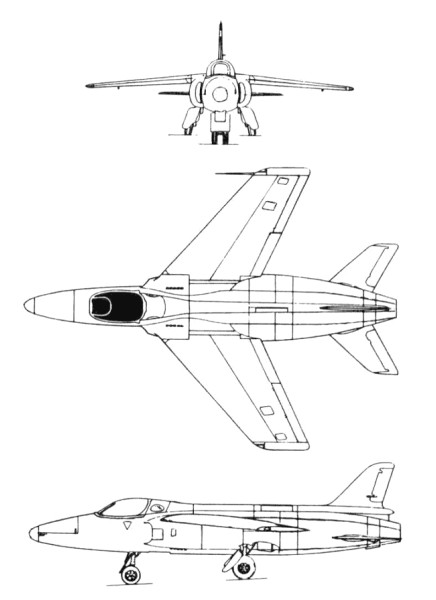
The Midge features hydraulically powered “flaperons”, main gear that could be used as airbrakes, and a one-piece canopy that hinged over an inner armoured windscreen.
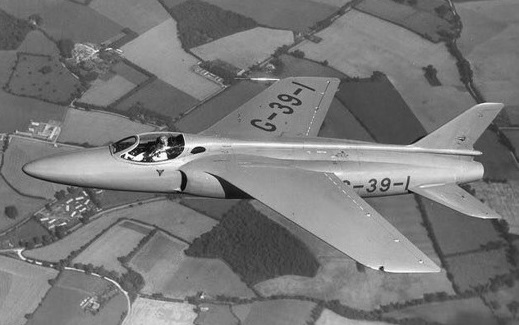
The demonstrator was designated Fo-139 “Midge”. The Midge, serial number G-39-1, first flew on 11 August 1954 from Boscombe Down, Wiltshire, with Teddy Tennant at the controls.
Despite the low powered engine, the little jet could break Mach 1 in a dive and was very agile. The wings contains no guns, undercarriage or fuel tanks.
The Midge was evaluated by pilots from Canada, India, Jordan, New Zealand, and the US Air Force, and had performed a total of 220 flights when it was destroyed in a fatal crash on 26 September 1955, with a Swiss pilot at the controls. However, the Midge had demonstrated that Petter’s lightweight fighter concept had much going for it. Folland went on to develop a full-scale Gnat prototype, also using company funds.
Original film footage of the Midge can be seen in the 1956 British science fiction film “Satellite in the Sky”. The Midge portrays a fictional jet fighter used to test an experimental rocket fuel.
Fo.139
Engine: 1 x Armstrong Siddeley Viper 101, 1,640 lbf / 744kg
Max take-off weight: 2041 kg / 4500 lb
Wingspan: 6.3 m / 20 ft 8 in
Length: 8.76 m / 28 ft 9 in
Height: 2.82 m / 9 ft 3 in
Wing area: 11.61 sq.m / 124.97 sq ft
Sweep back: 40 deg
Aspect ratio 3.3.
Undercarriage track: 5 ft.1 in.
Max. speed: 966 km/h / 600 mph
Service ceiling: 12190 m / 40000 ft
Crew: 1
Folland
Folland Aircraft Ltd had its foundations in February 1936 at Hamble, Hampshire, when British Marine Aircraft Ltd was formed with the intention of producing the Sikorsky S-42A flying-boat under licence. This scheme came to nothing and in May 1937 the company underwent a complete reorganisation and change of name. H. P. Folland, formerly chief designer of the Gloster Aircraft Company, became managing director, and the firm initially undertook sub-contract work.
Undertook subcontract work on Bristol Blenheim and Beaufort, de Havilland Mosquito and Hornet, Short Sunderland and Supermarine Spitfire, among others.
Henry Folland, Gloster’s chief designer, would leave Gloster when it was taken over by Hawker to form
Folland Aircraft. His most successful aircraft design of all time, the Folland Gnat jet trainer (449 built).
First original design was Fo 108 engine testbed aircraft, 12 built to Specification 43/37. Further subcontract participation in Comet, Sea Vixen, Britannia, Hunter, and HS 748 programs.
Lightweight fighter designed by W. E. W. Petter flown initially as Fo 139 Midge, then as Fo 141 Gnat with Bristol Orpheus engine. Sold to Finnish and Indian Air Forces as fighter aircraft and developed as Fo 144 Gnat T.1 trainer for the RAF.
Became Hamble Division, Hawker Siddeley Aviation, in 1959.
Avro, de Havilland and Folland joined Hawker Siddeley Aviation in 1965.
Fokker F-28 Fellowship
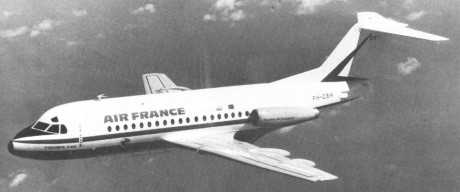
First details of the new Fokker F28 Fellowship were released in April 1962, and, with financial backing from the Netherlands government and risk-sharing support from MBB in West Germany and Shorts in the UK, a decision was made in 1964 to begin development and production of this new airliner.
Fokker F-28 Fellowship Article
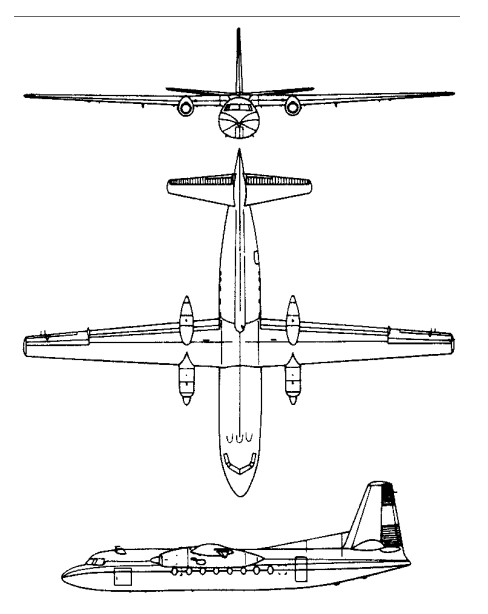
A cantilever low/mid-wing monoplane configuration with a circular-section fuselage, a T-tail unit with swept surfaces and retractable tricycle landing gear, the F28 was designed for two Rolls-Royce RB183 turbofan engines.
Highly manoeuvrable in flight, it is designed for STOL with a wing sweepback of only 16 degrees for good handling at low speed, leading-edge slats and double-slotted flaps. There are no thrust-reversers; instead, the F 28 has powerful air brakes which, uniquely, form the tail end of the fuselage, and highly effective wheel brakes.
The first of three prototypes made its maiden flight on 9 May 1967, and certification and delivery of the first production aircraft was achieved on 24 February 1969. This initial F28 Mk 1000 short-fuselage version could seat 55 to 65 passengers and was powered by two 4468kg thrust RB183-2 Mk 555-15 turbofans. It was available optionally as the F28 Mk 1000C for all-cargo or mixed passenger/cargo operations with a large cargo door incorporated in the port side of the forward fuselage, aft of the standard passenger door.
Production was shared by Fokker-VFW of the Netherlands in association with MBB and VFW Fokker in Germany and Short Brothers in Great Britain. Shorts of Belfast designed the rear fuselage, MBB of West Germany the pods for the Rolls-Royce Spey turbofan engines, and Fokker’s German partner VFW, the tail and other fuselage sections.
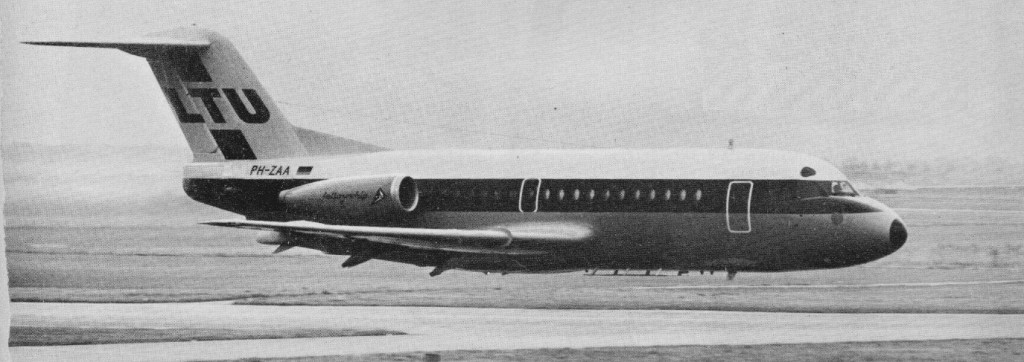
The fourth built, the first to be delivered, Fellowship A-4, went to Lufttransport Unternehmen L.T.U. of Dusseldorf, Germany.
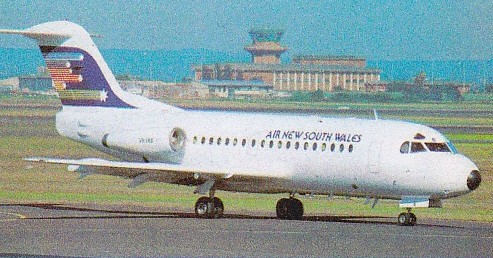
This aircraft can take off from 6,000-foot long runways, or at altitudes as high as 15,000 feet. The generally similar F28 Mk 2000 differed only in having the fuselage lengthened by 2.21m to accommodate a maximum of 79 passengers. Later production versions were the F28 Mk 3000 and F28 Mk 4000 with the fuselage lengths of the Mks 1000 and 2000 respectively.
The Mk 3000 is similar to the Mk 4000 with a short fuselage and seating for 65. The Mk 4000 is a long-fuselage version with high-density seating for up to 85. The F28 Mk 3000 was offered with a 15-seat executive interior, and the F28 Mk 4000 has maximum seating capacity for 85 passengers. Sales reached 241 before the Fellowship gave way to the Fokker 100 on the production line in 1987.
The Mk 6000 is a long version with slatted wings and seating for up to 79 passengers.
In mid-1991 Fokker stated that over 200 F28s were still in service and at least half of these were expected to be hush-kitted to Category 3 standard beginning in 1994, enabling them to continue in service for another 15 years.
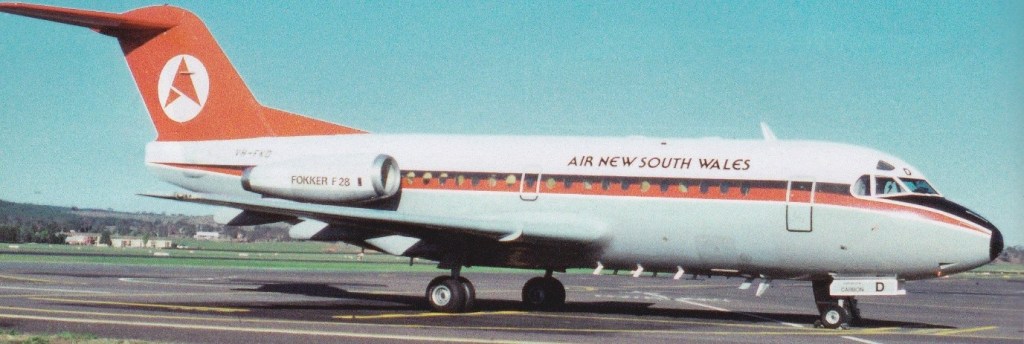
Engine: 2 x Rolls-Royce “Spey 555-15”, 43.8kN
Max take-off weight: 24720 kg / 54499 lb
Empty weight: 14100 kg / 31085 lb
Wingspan: 23.6 m / 77 ft 5 in
Length: 27.4 m / 89 ft 11 in
Height: 8.5 m / 27 ft 11 in
Wing area: 76.5 sq.m / 823.44 sq ft
Max. speed: M0.76
Cruise speed: 849 km/h / 528 mph
Range w/max.fuel: 1990 km / 1237 miles
Range w/max.payload: 1043 km / 648 miles
Crew: 2
Passengers: 40-65
Fokker F 28 Fellowship Mk. 4000
Engine : 2 x Rolls Royce RB 183-2 Spey Mk 555-15H, 43851 N / 4470 kp
Length : 97.146 ft / 29.61 m
Height: 27.789 ft / 8.47 m
Wingspan : 82.251 ft / 25.07 m
Wing area : 850.356 sq.ft / 79.0 sq.m
Max take off weight : 71001.0 lb / 32200.0 kg
Weight empty : 37743.0 lb / 17117.0 kg
Fuel capacity: 2,558–3,430 gals
Cruising speed : 423 kts / 783 km/h
Cruising altitude : 31988 ft / 9750 m
Service ceiling: 35,000 ft
Wing loading : 83.64 lb/sq.ft / 408.0 kg/sq.m
Range : 2230 nm / 4130 km
Range (max. weight) : 1010 nm / 1870 km
Takeoff distance: 5,217 ft.
Landing distance: 3,166 ft.
Threshold speed: 127 mph;
Crew : 2
Payload : 85 Pax.
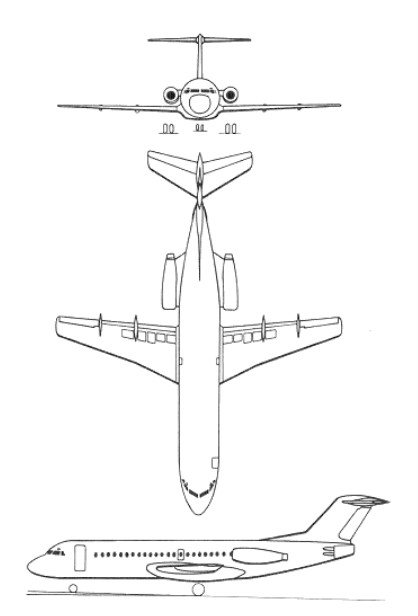
Fokker F-27 Friendship / Fairchild Hiller FH.27 / Fairchild Hiller FH.227
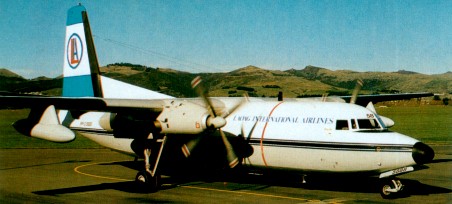
The company’s design study of 1950 was for a 32-seat transport to be powered by two Rolls-Royce Dart turboprop engines. Known as the P.275 project, it was enlarged slightly and modified to incorporate a circular-section pressurised fuselage by 1952, when Dutch government backing was sought for its construction and development.
Fokker F-27 Friendship Article
The type was then designated Fokker F27, and the first of two prototypes made its maiden flight on 24 November 1955 from Schiphol, powered by two Dart 507 turboprops. At the controls was Fokker’s chief test pilot, Mr H.V.B. Burgerhout, for the 34 minute flight. The first prototype did not have a pressurised cabin. For its first trials the prototype F.27 was powered by Rolls Royce Dart Mk. 507 engines, and in March 1956 these were replaced by Dart Mk. 511 engines.
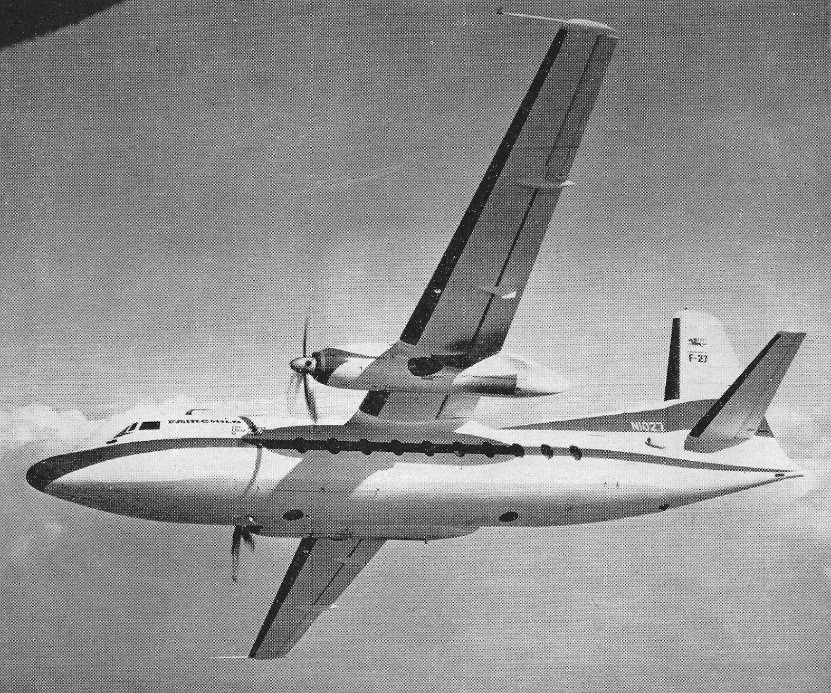
Two of the prototypes never flew at all, as they were used to investigate fatigue, wing loading and pressurisation problems (submerged in a water tank). Fokker installed a pneumatic system for the retractable undercarriage, because air is cheap, fast and non combustible. A high-wing monoplane, the F27 has a pressurised fuselage, retractable tricycle landing gear and accommodation for 28 passengers. The second prototype, with Dart Mk 511 engines and its fuselage lengthened by 0.91m to seat 32 passengers, was flown on 31 January 1957.
Between the initial flights of these two prototypes, On April 26th 1956 it was announced that Fokker had concluded an agreement with the Fairchild Engine and Airplane Corporation for the manufacture and marketing of the F27 in North America, where it was known as the Fairchild F-27.
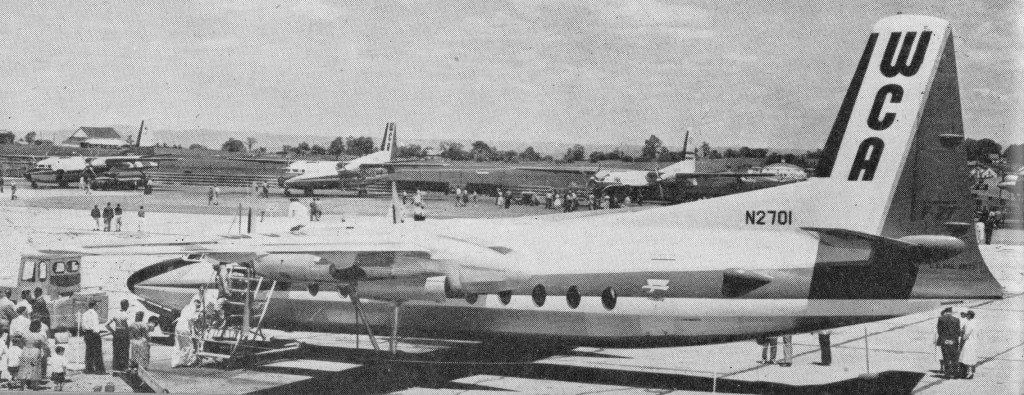
By April 1956 orders had come in for 30 aircraft.
On March 23rd, 1958, the first production F.27 EI AKA for Aer Lingus, made its ¬maiden flight, to be followed on 12 April by the first American built F.27, for Pied¬mont Airlines.
Fokker’s first F27 Friendship entered service with Aer Lingus in December 1958, but Fairchild had been a little quicker off the mark, its F-27 entering service with West Coast Airlines three months earlier.
The American company had modified the interior layout to seat 40, increased the fuel capacity and made provision for weather radar in a lengthened nose; Fokker adopted similar improvements at a later date.
The initial Dutch production version was designated F27 Mk 100 (Fairchild F-27), and was powered by two 1279kW Rolls-Royce Dart RDa.6 Mk 514-7 turboprops.
A total of eighty-five Series 100 were built.
It was followed by the similar F27 Mk 200 (Fairchild F-27A) with 1529kW Dart RDa.7 Mk 532-7 engines. Both airliners had standard accommodation for 40 passengers, but a high-density arrangement made it possible to seat 52. An executive version of the Mk 200 was available with the interior design to customer requirements.
Subsequent versions include the F27 Mk 300 Combiplane (Fairchild F-27B), a passenger/cargo aircraft with Mk 100 powerplant, a reinforced cabin floor, cargo tie-down rings and a large cargo door forward of the wing on the port side. A similar Combiplane version of the Mk 200 had the designation F27 Mk 400, but no equivalent version was produced by Fairchild in America.
Friendship Bulletin February 1961
In 1964 the Sudanese air force ordered four F-27s for paratrooper and medical evacuation missions, incorporating upward-hinging cargo door forward and two sliding doors near the rear. They can carry 45 in canvas seats, 24 litters, or 13,000 lb of cargo. Nine F-27M Troopships were in service with the Netherlands air force.
In 1964 Fairchild was to start a production line again to produce 15 F-27s ordered by Ozark Airlines. Priced at $995,000 each, engines were to be Rolls Royce Dart 7s and the MTOW 42,000 lb.
The Mk.400M flew in April 1965. It can carry 6,000kg of cargo, 46 paratroops, or 24 stretchers and nine attendants. A number of civilian-standard F.27 Friendships, some with VIP inte¬riors, were sold to military operators. Formerly known as the Troopship, the Mk.400 military version was ordered for the Royal Thai Air Force. These aircraft, deliv¬ered in 1986 and early 1987, were multirole aircraft equipped for transport, target towing, and SAR duties.
Fokker next developed a lengthened fuselage (by 1.50m) variant of the Mk 200. Designated F27 Mk 500, this failed to appeal initially to airline operators, but 15 were acquired by the French government for service with the nation’s Postale de Nuit. Friendship Mk 500s in service with airlines have standard accommodation for 52 passengers, with high-density seating for 60. Fairchild in America produced its own stretched variant, the FH-227.
The FH-227 differed from the standard F27 by having a fuselage ‘stretch’ of 1.83m to provide accommodation for a maximum of 52 passengers, with increased baggage and cargo space, and by the installation of 1678kW Rolls-Royce Dart RDa.7 Mk 532-7 turboprop engines. The first of two FH-227 prototypes made its initial flight on 27 January 1966. Production of FH-227s and their variants had reached 79 when production ended. When the Fairchild Hiller FH.227 production line closed down more than 200 aircraft had been sold.
Fairchild Stratos Corp. demon¬strated its F 27G variant in 1963, incorporating the refinements developed by Fairchild in the F 27F, and also has a large cargo door in the front fuselage, as used in the F 27B. It is intended for both military and civil use.
The last production version was the F27 Mk 600, combining the Mk 200 fuselage without the reinforced cabin floor but with the cargo door of the Mk 300/400 Combiplanes. The F27 Mk 600 introduced an optional roller-track quick-change interior so that the type could be used for passenger/cargo services. Other versions included the F27 Mk 400M and F27 Mk 500M military aircraft, an F27 Mk 400M aerial-survey version and an F27 Maritime suitable for coastal patrol, fishery protection, and search and rescue. Late production aircraft had an updated flight deck and cabin interior. Manufacture was shared by Dassault-Breguet (France), MBB (Germany) and SABCA (Belgium). When production was terminated in 1986 in favour of the Fokker 50, the company had sold 581 F27s alongside 205 Fairchild-built F-27/FH-227 variants. In mid-1991 Fokker stated that around 450 F27s were still in service and that the highest-time aircraft had made some 80,000 flights.
About 30 FH-227s of different marks remained in airline service in 1991.
The Fokker F.27 Maritime prototype (PH FCX), a conversion from an ex airline F.27, was flown for the first time on 25 March 1976. This medium range maritime patrol aircraft was equipped for this role by the installation of adv¬anced avionics, including search radar and long range inertial navigation. Operated by a crew of up to six, the F.27 Maritime can carry fuel for an endurance of 10 to 12 hours or range of 3,107 miles (5000 km).
A total of 17 of the Dart engined F.27 Maritimes was sold to seven customers. The four delivered to the Royal Thai Navy have a weapons capability, but are not equipped to full Enforcer standard.
F-27
Engines: 2 x Rolls-Royce Dart 7 535-7R, 1835 shp.
Props: Dowty-Rotol 4-blade, 106-in.
Seats: 56.
Length: 82.3 ft.
Height: 28.7 ft.
Wingspan: 95.2 ft.
Wing area: 754 sq.ft.
Wing aspect ratio: 12.1.
Maximum ramp weight: 45,200 lbs.
Maximum takeoff weight: 45,000 lbs.
Standard empty weight: 27,400 lbs.
Maximum useful load: 17,800 lbs.
Zero-fuel weight: 39,500 lbs.
Maximum landing weight: 43,500 lbs.
Wing loading: 59.7 lbs/sq.ft.
Power loading: 12.3 lbs/hp.
Maximum usable fuel: 9090 lbs.
Best rate of climb: 1250 fpm.
Certificated ceiling: 20,000 ft.
Max pressurisation differential: 4.2 psi.
8000 ft cabin alt @: 20,000 ft.
Maximum single-engine rate of climb: 413 fpm @ 150 kts.
Single-engine climb gradient: 165 ft/nm.
Single-engine ceiling: 9500 ft.
Maximum speed: 259 kts.
Normal cruise @ 20,000ft: 259 kts.
Fuel flow @ normal cruise: 1542 pph.
Endurance at normal cruise: 5.4 hrs:
Stalling speed clean: 98 kts.
Stalling speed gear/flaps down: 78 kts.
Turbulent-air penetration speed: 183 kts.
Fokker F27 Mk 200
Engines: 2 x Rolls-Royce Dart Mk 536-7R turboprops, 1730kW
Max take-off weight: 20410 kg / 44997 lb
Loaded weight: 12148 kg / 26782 lb
Wingspan: 29.0 m / 95 ft 2 in
Length: 23.56 m / 77 ft 4 in
Height: 8.5 m / 27 ft 11 in
Wing area: 70.0 sq.m / 753.47 sq ft
Cruise speed: 480 km/h / 298 mph
Ceiling: 8990 m / 29500 ft
Range: 1926 km / 1197 miles
F-27-400M
Engine: 2 x R-R Dart turboprop.
Installed pwr: 3590 kW.
Span: 29 m.
Length: 23.6 m.
Wing area: 70 sq.m.
Empty wt: 11,436 kg.
MTOW: 21,545 kg.
Payload: 6485 kg.
Cruise speed: 430 kph.
Initial ROC: 380 m / min.
Ceiling: 7620 m.
T/O run: 1020 m.
Ldg run: 530 m.
Fuel internal: 5900 kg (+1535 kg).
Range/payload: 1300 km with 4765 kg.
Capacity: 48 pax.
F27-500
Engines: 2 x RR Dart -7, 2050 shp.
Seats: max 52.
Wing span: 95 ft 2 in (29 m).
Length: 82 ft 0.5 in (25.01 m).
Height: 27 ft 11 in (8.5 m).
Max TO wt: 43,500 lb (19,730 kg).
Max level speed: 292 mph ( 470 kph).
F27 Mk 600
Seats: 44 plus crew
Gross weight: 45,000 lbs
Empty weight: 22,786 lbs
Fuel capacity: 1,357–2,463 gal
Engines: two 2,140 shp Rolls-Royce Dart turboprops
Cruise speed: 298 mph
Initial climb rate: 1,480 fpm
Service ceiling: 29,500 ft
Takeoff distance: 2,310 ft
Landing distance: 3,290 ft.
F-27 MPA Maritime
Engines: 2 x R-R Dart 532-7 turboprop, 2210 shp.
Fokker S.14
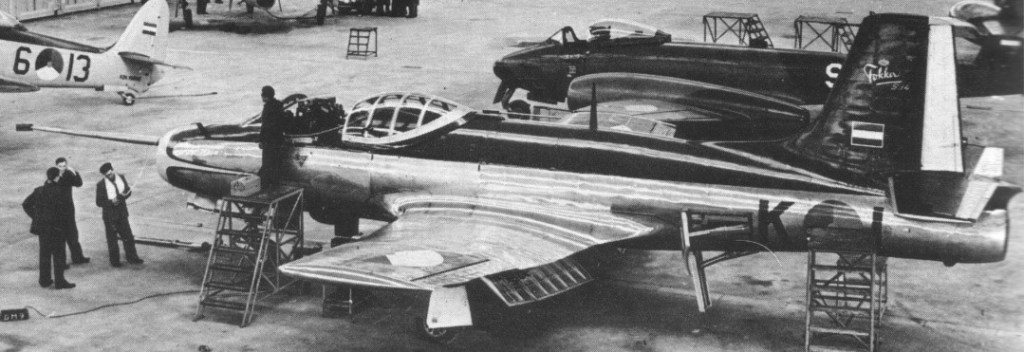
The Fokker S.14 Mach-Trainer secured its place in aviation history by being the first Fokker-designed jet aircraft, the first jet-propelled trainer designed as such, and the first aircraft of its type to enter production.
The low-wing all-metal S.14 was powered by a Rolls-Royce Derwent turbojet with a bifurcated inlet in the nose. The outlet was in the extreme tail, aft of the horizontal tail surfaces, which were set somewhat aft of the fin and rudder. The nosewheel of the tricycle landing gear retracted forwards into the underside of the nose while the main units retracted inwards into the undersides of the wings. Pupil and instructor were seated side-by-side under a short, broad raised canopy set well forward on the circular-section fuselage. Martin-Baker ejector seats were standard.
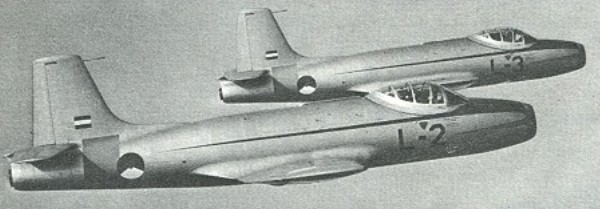
Test pilot Gerben Sonderman made the first test flight on 19 May 1951 from Schiphol. On a second flight during the same day the landing gear failed and the prototype was damaged in the subsequent belly-landing. However, the aircraft was repaired and displayed at the 1951 Paris Salon in June of that year.
A series of 20 S.14s was ordered by the Royal Dutch air arm, the Koninklike Luchtmacht, the first being flown initially on 15 January 1955. The prototype bore the serial K-1 and was powered by a Derwent V engine, while the production machines were serialled from L-1 to L-20 and had Derwent VIIIs. The S.14s served at four air stations: Twenthe, Ypenburg, Gilze-Rijen and Soesterberg. Aircraft L-4 was demonstrated in the USA during 1955, but crashed on 20 October that year at Hagerstown, Maryland, killing Gerben Sonderman. Aircraft L-8 took part in the London-Paris air race, known as the Arch to Arc since it started at Marble Arch and ended at the Arc de Triomphe. The last two S.14s were withdrawn from Dutch service on 29 March 1965. Serialled L-17 and L-19, they are preserved at the Museums at Schiphol and Soesterberg respectively.
The original K-1 prototype was re-engined with a 2313kg thrust Rolls-Royce Nene 3 engine in 1953 and given the specially selected civil registration PH-XIV on 24 October 1960. It was then used by the Lucht en Ruuimtevaart Laboratorium (Dutch National Aeronautical and Space Laboratory) until scrapped on 4 March 1966.
S.14 was a promising aircraft, and the American Fairchild factory bought the rights for licensed production, but as a result of the MDAP military aid programme many countries were provided with the Lockheed T.33, a two seat version of the F. 80 jet fighter.
Fifty S.14s were to be built in Brazil, but production was cancelled.
Engine: 1 x Rolls-Royce Derwent VIII turbojet, 1575kg / 3,470 lbst
Max take-off weight: 5350 kg / 11795 lb
Loaded weight: 3765 kg / 8300 lb
Wingspan: 12.00 m / 39 ft 4 in
Length: 13.30 m / 43 ft 8 in
Height: 4.70 m / 15 ft 5 in
Wing area: 31.80 sq.m / 342.29 sq ft
Max. speed: 730 km/h / 454 mph
Cruise speed: 570 km/h / 354 mph
Ceiling: 11200 m / 36750 ft
Range: 965 km / 600 miles
Fokker S.13
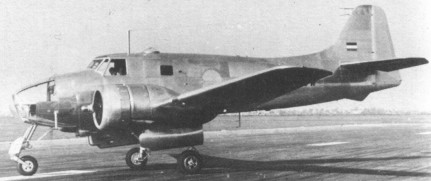
Development of the S.13 was started in 1947. This versatile aircraft could be used to train advanced pilots, navigators, bomb aimers, radio telegraphers and observers. It was also suitable for the training of paratroopers and for aerial mapping. Test pilot Burgerhout made the first flight of the S.13 at Schiphol on March 13th, 1950. An intended order from KLM did not materialise owing to a gift of Beechcraft aeroplanes from America. The sole prototype was used during the flood disaster of February 1953 to photograph the inundated areas.
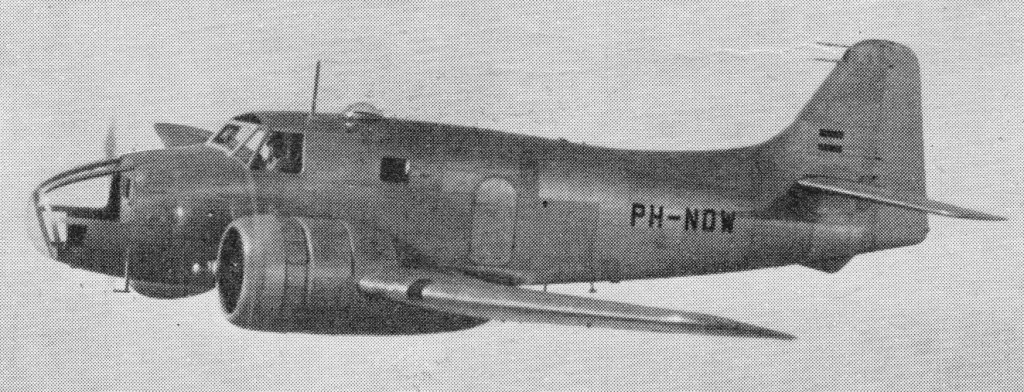
Engines: 2 x Pratt & Whitney Wasp
Fokker S.12 / T.22
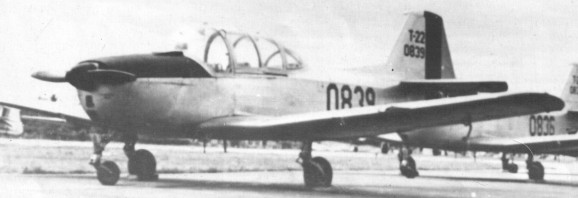
Development of a version of the S.11 with nosewheel under carriage, designated S.12, was started in 1947, but was not produced in Holland, but the Brazilian Fokker factory delivered 50 to the Brazilian Air Force. Later the factory was taken over by the Brazilian government. The military designation of the Brazilian built S.12 was T 22.
 All Aero