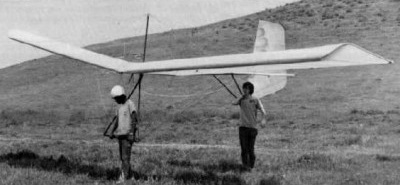
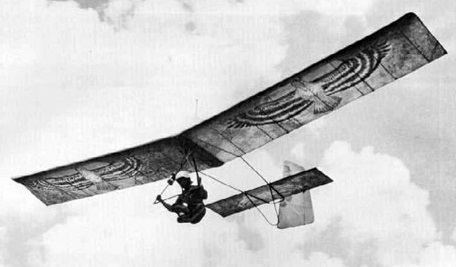
The Pacific I is a high performance glider designed by Doug Fronius and built by John Lasko. The basic goals were that is should offer competitive performance at the Icarus V level while being much simpler and less expensive to buid.
The glider was first conceived in late summer/early fall of 1974. An important design goal was that a Quicksilver’s basic structure (everything but the sail and wing ribs) could be converted into a Pacific I with very few modifications. A Quicksilver would need a better airfoil for more lift and better streamlining. More lift was provided by a modified Liebck section from the Icarus V. A rear spar was put at the trailing edge and eliminate the use of any secondary structures. The 1in trailing edge could be put in latter with foam, paper, or whatever.
To reduce the drag, all surfaces were covered on both sides with 1.8oz dacron glued and shrunk in place. Gussets and pop rivets relace bolts and machined fittings. The only machied parts ae standard bar corner fittings. The calculated desin weight was 48 lb however some larger tubin increased the weight by about 4 lb. The completed machine came in at 53 lb.
It has no turnbuckles, as it has a homemade threaded expandable kingpost to take up the rigging slack after assembly. It can be assembled by one person in under 5 minutes.
The wing ribs are made out of 1.2lb foam with spruce capstrips and weigh 3 oz each. Foam blocks are glued between the ribs to the high point of the airfoil, covered by a thin layer of cardboard under the dacron.
The rigging uses double leading and trailing edge wires top and bottom, and a set of extra tail brace wires running from the stabiliser leading edge bolt to the first compression member on the wing.
The prototype Pacific I cost about $225 to build.
The only major changes to the prototype was the pilots suspension system to allow supine flying. It was flown to 3rd place in the rigid wing class at the 1975 Tellurise Championships.
There was a need for better roll control and/or glide path control.
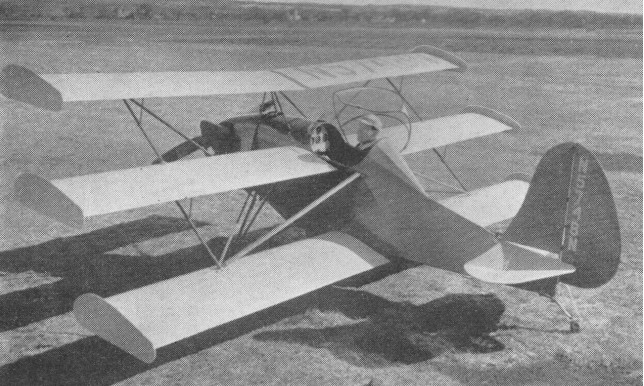
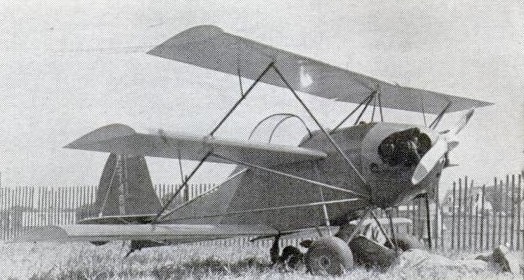
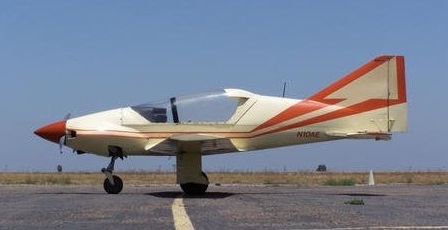
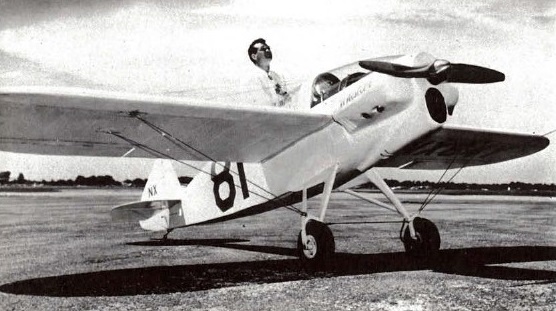
Fred Smith, president of Frederick-Ames Research Corporation at Novi, Michigan, USA, designed a small single-seat sporting aircraft called the EOS (after the Greek goddess of the dawn) N10AE, which first appeared in an incomplete form at the 1973 EAA Fly-in at Oshkosh.
Type: Single-seat light sporting aircraft. Wings: Cantilever tapered low-wing monoplane. Wing section NACA 651212. Light alloy all-metal structure, except for glass fiber wing fillets, pop riveted and epoxy resin bonded. Fuselage: Conventional light alloy semi-monocoque structure, pop riveted and epoxy resin bonded. Glass fiber engine cowling and 7 in (178 mm) prop extension shaft with Mooney 201 spinner. Tail unit: Cantilever light alloy structure, comprising triangular fin, integral with rear fuselage, rudder, and all-moving tail plane with projecting balance arms at roots. Tail plane actuated via servo tabs. Landing gear: Manually-retractable tricycle type. Main units retract inwards. Fully castoring and steerable nose wheel. Rubber-in-compression shock-absorption. Disc brakes. Accommodation: Single glass fiber seat under large transparent canopy. Systems: Electrical system includes 45A alternator and starter.
On its maiden flight on April 25, 1974, the 55 hp Hirth 650 cc engine seized and the aircraft crash landed, causing extensive damage. Despite some restoration work, the aircraft was abandoned through lack of finance.
In early 1978 the project was revived, with a modified Volkswagen motor car engine in place of the original engine. First flight of the reworked aircraft was in mid-1978, piloted by Robert Bishop. By August 1978 the EOS had completed about ten flying hours, and further modifications to the aircraft had been made. Eventually the release of plans and/or kits was never realized, and the prototype remains the only example ever built.
Power plant: Volkswagen 1,834 cc, 70 hp Propeller: Rand Robinson three-blade ground-adjustable Propeller diameter: 4 ft 2 in (1.27 m) Span: 26 ft 0 in (7.92 m) Wing area: 75 sq.ft (6.97 sq.m) Wing aspect ratio: 9 Length: 16 ft 7 in (5.05 m) Height: 6 ft 6 in (1.98 m) Empty weight: 670 lb (304 kg) Loaded weight: 975 lb (442 kg) Fuel capacity 15 gal (56.75 l) Max speed: 200 mph (322 kmh) Cruise speed: 175 mph (281 kmh) at 5,000 ft (1,525 m) Stall speed: 57 mph (92 kmh) at 4,500 ft (1,370 m) Climb: 1,000 ft (305 m)/min Take off run: 1,000 ft (305 m)
Reported in 1964, the Frazer-Walker Gyrojet four-place VTOL amphibian to be built by Handley Page Ltd, London, sold in the US by Frazer-Walker Aircraft Corp, New York, has a 250hp Lycoming engine mounted aft driving a two-bladed pusher propeller. Lift is from a three-blade rotor fitted with mechanical “spin-up” device for short takeoff and a tip-jet powered system for use when a vertical takeoff is desired. The fuselage is of fibreglass. Royor blades are uncoupled from the engine in flight and rotate under aerodynamic forces.
Engine: 250hp Lycoming Useful load: 1070 lb Gross weight: 3000 lb Top speed: 145 mph Range: 750 mi
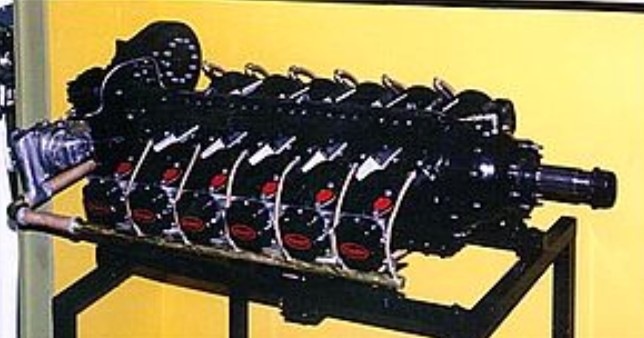
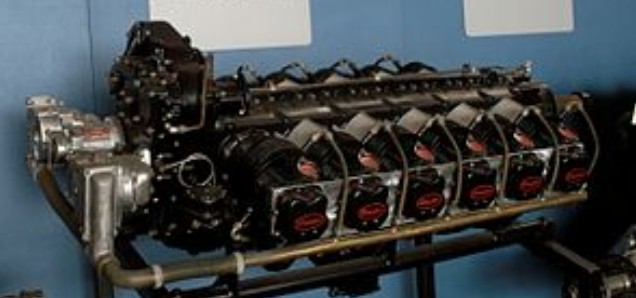
The Franklin 12 series of 12-cylinder air-cooled horizontally opposed aircraft engines produced in the 1940s and 50s, (US military designation O-805 was applied to the 12AC-806, 12ACG-806 and 12ACGSA-806).
The Franklin O-805 was to be used in radio-controlled pilotless drones that were to be guided from an accompanying control plane. Due to project requirement changes and cancellations the engine was not produced.
Apparently the engine had no civil application and only a limited military use, as the O-805 in Interstate XBQ-5/XTD2R.
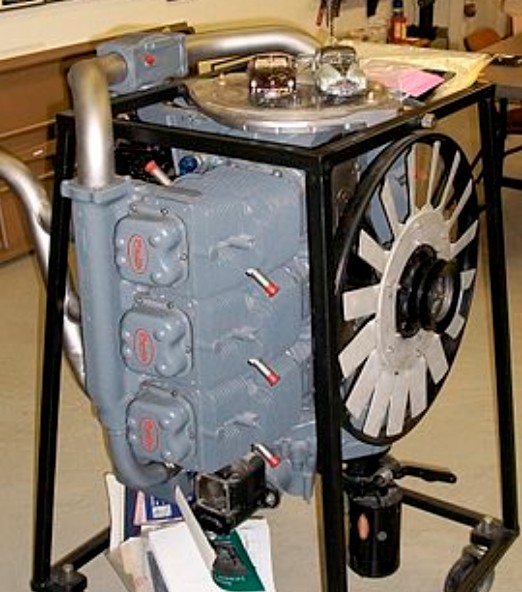
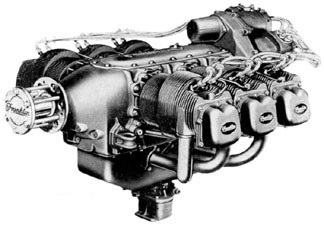
The Franklin O-335 (Company designations variations on 6A4) was a series of air-cooled aircraft engines of flat-six configuration.
These engines were commonly vertically mounted and used to power many early helicopters in the United States. They were closely related to the 2A4 and 4A4 2- and 4-cylinder engines. In various subtypes, the 6A4 remained in continuous production from 1945 to the time Franklin’s United States operations ceased in 1975, with versions continuing in Polish production into the 1990s. 6AC ATC 222, 225
In 1947 this engine was modified into a water-cooled version by the Tucker Car Corporation for use in the 1948 Tucker Sedan. Tucker liked the engine so much that he purchased the Aircooled Motors/Franklin Engine Company and it remained under the ownership of the Tucker family until 1961.
Variants:
O-335 Military designation
6A4-124 6 cyl 334ci
6A4-130 6 cyl 334ci
6A4-135 6 cyl 334ci
6A4-140 6 cyl 334ci
6A4-145 6 cyl 334ci
6A4-150 6 cyl 334ci
6A4-165 6 cyl 334ci
6A4-178 6 cyl 334ci
6A4-1854 6 cyl 334ci
6A4-200 6 cyl 334ci
6A4-300 6 cyl 334ci
O-335 6 cyl 334ci
6A-335 180 hp (134.2 kW) at 2,800rpm, 200 hp@3100 rpm 1963-1976
 All Aero