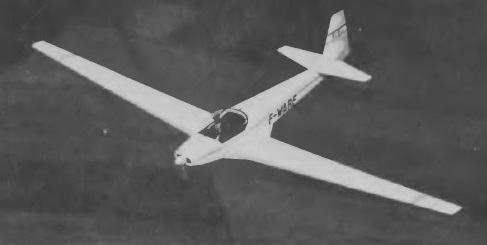
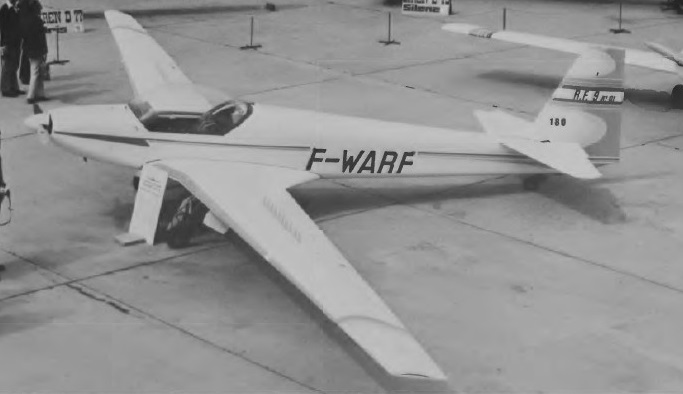
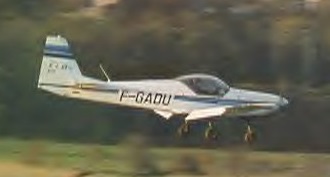
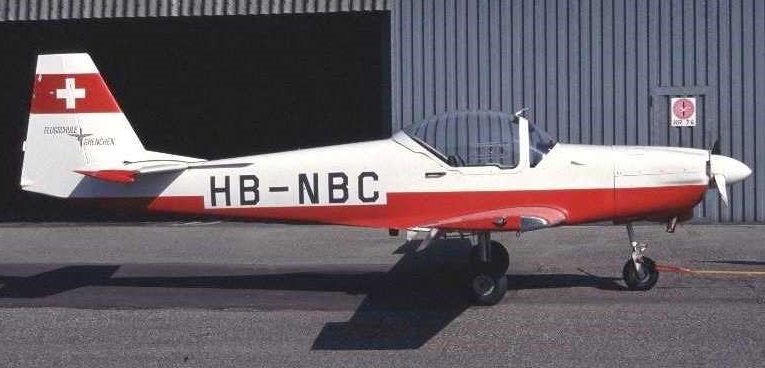
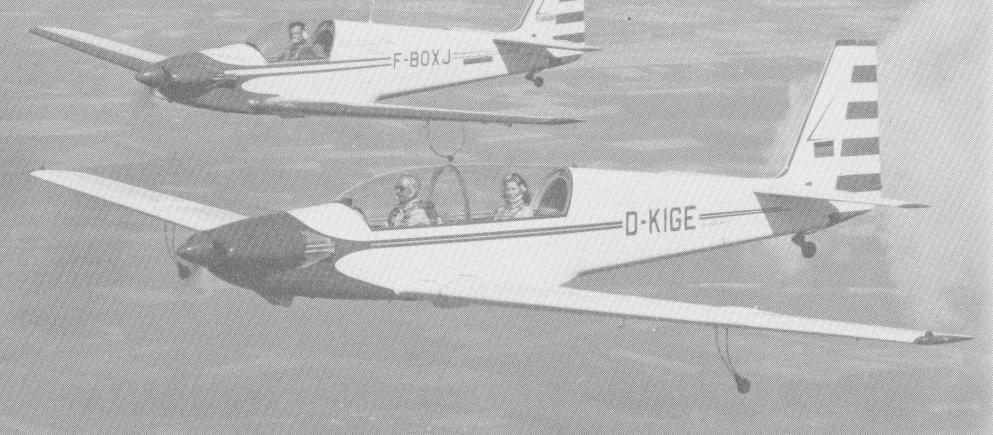
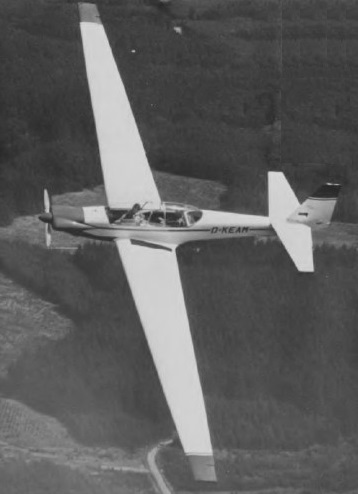
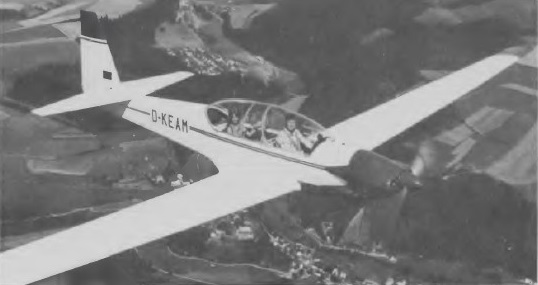
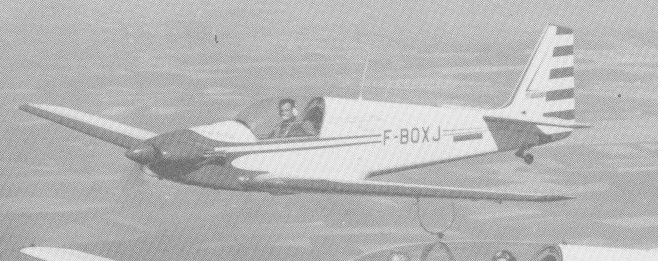
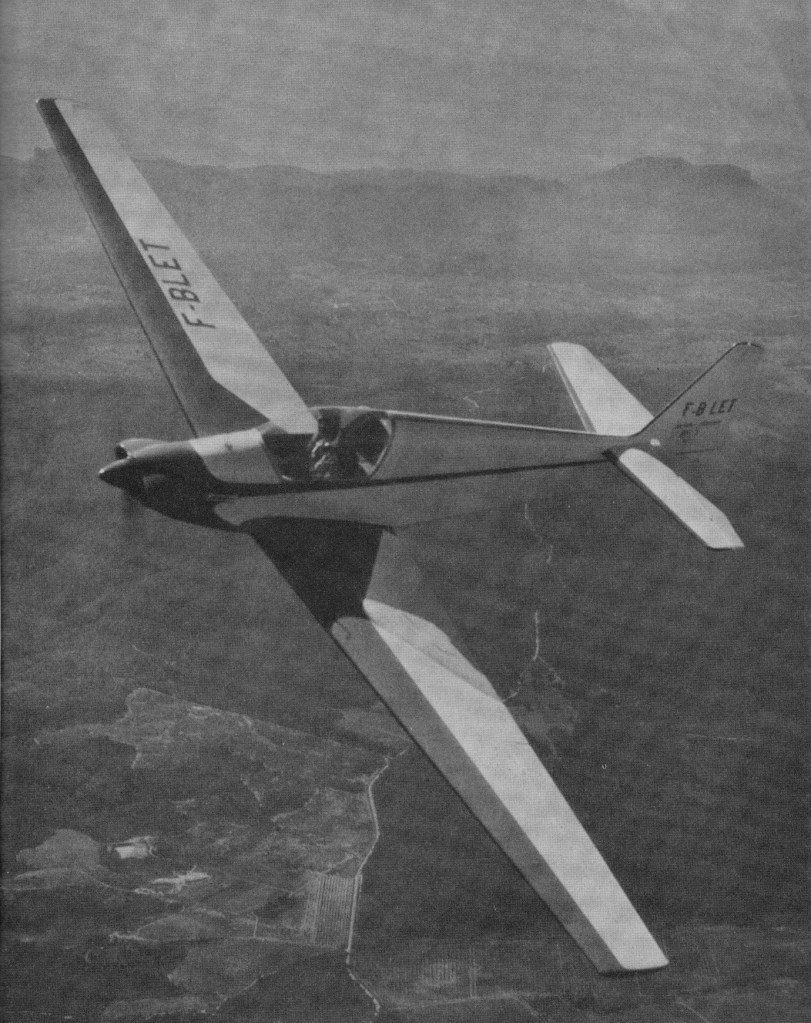
Designed by M Rene Fournier, the RF-9 is basically a side-by-side two-seater development of his earlier Avion-Planeur RF4D and RF5 which were manufactured in Germany under licence by Sportavia Pützer. Sportavia Pützer went bankrupt in 1977 not long after the first prototype RF-9 had made its maiden flight on 20 January that year, and while the first production aircraft was being built. The second prototype, which is representative of production aircraft, has a lighter undercarriage, new air brakes and trailing edge flaps.
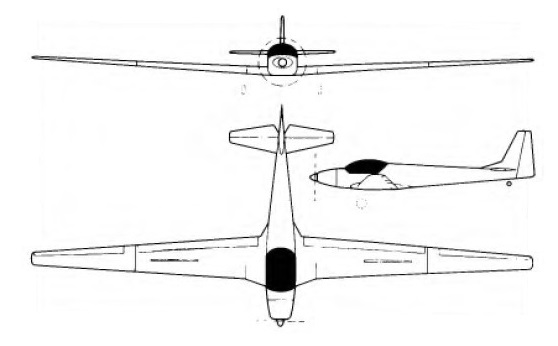
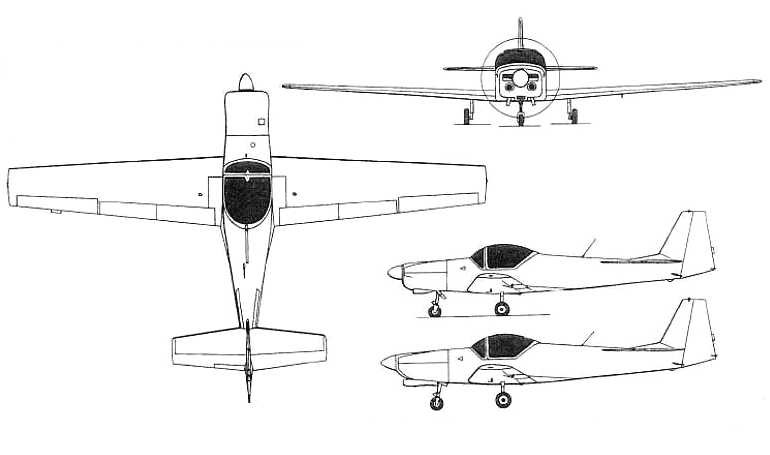
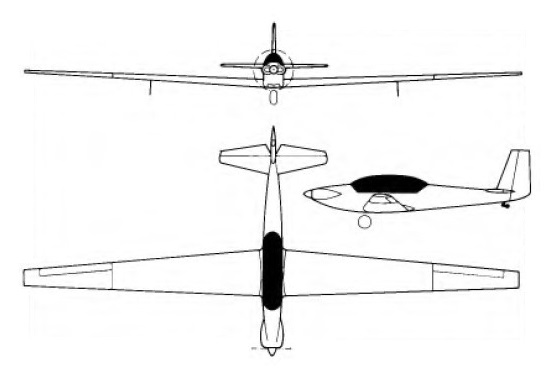
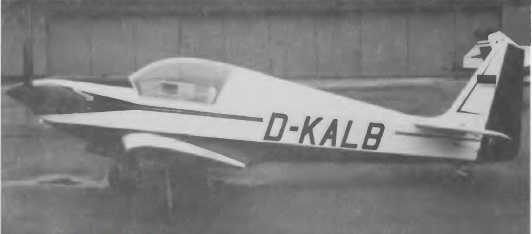
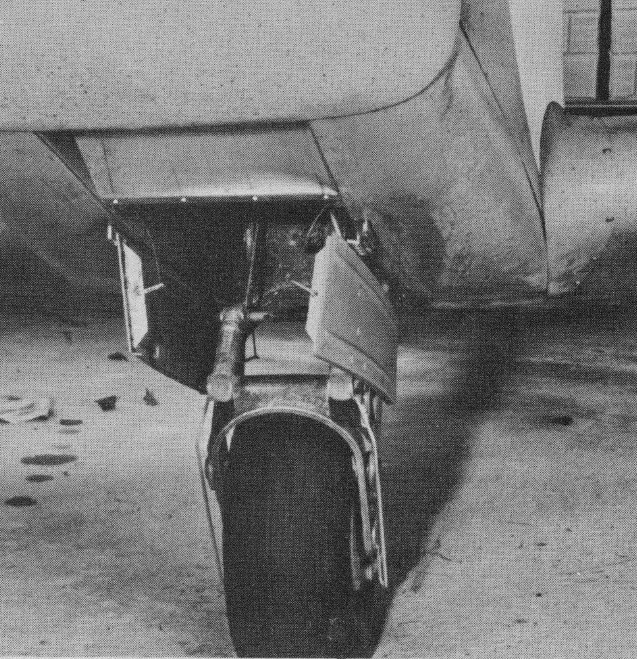
The RF-9 motor glider is intended for training and is of conventional all-wood construction; the cantilever low wings have dihedral from the roots and on the prototype differ from the RF4D’s and RF5’s in having electrically-actuated trailing edge flaps as well as air brakes in the upper surfaces. The outer part of each wing can be folded inward for easier hangarage, and has connect/disconnect aileron controls. The semi-monocoque fuselage is broadly similar to the RF4D’s with a polyester skin, but it is cut down behind the one piece cockpit canopy, which opens upwards and rearwards and gives exceptional visibility. Full dual control is provided. The tail unit is similar to the RF4D’s, with a small dorsal fin. Instead of the monowheel and outriggers of the RF4D and RF5, the RF-9 has a conventional inwards-retracting under-carriage and a steerable tailwheel, also retractable.
The engine is a 68hp Limbach SL 1700E ‘flat four’ driving a Hoffmann two-blade fixed-pitch propeller; a variable-pitch prop from the same manufacturer can be fitted if required, as can VHF radio and oxygen equipment. The fuel capacity is 6.6 Imp gallons.
Engine: Sportavia Limbach SL 1700E, 50 kW / 68 hp Prop: Hoffmann two-blade variable-pitch Span: 17.0 m / 55 ft 9.5 in Length: 7.86 m / 25 ft 3 in Height: 6 ft 0 in Wing area: 18.0 sq.m / 193.75 sq ft Wing section: NACA 643618 Aspect ratio: 16.0 Empty weight: 530 kg / 1,168 lb Max weight: 750 kg / 1,653 lb Fuel capacity: 30 litres / 6.6. Imp Gal Water ballast: None Max wing loading: 38.8 kg/sq.m / 7.59 lb/sq ft Max speed SL: 119 mph / 102 kt / 190 km/h Stalling speed: 35.5 kt / 65 km/h Max cruising speed: 99 mph Min sinking speed: 0.80 m/sec / 2.56 ft/sec at 50 mph / 43.5 kt / 80 km/h Best glide ratio: 28:1 at 62 mph Take-off run: 100 m / 328 ft Range: 600 km / 324 miles
A later development of the RF4D was the Avion-Planeur RF7 which was very similar to it except for a wing span reduced to 30ft 10in, an increased tailplane span and a more powerful engine very similar to the RF5’s.
Construction of the prototype RF7 began in July 1969 and it first flew on 5 March 1970.
Powerplant is a 68hp Sportavia-Limbach SL 1700D dual ignition ‘flat four’ engine driving a Hoffman two-blade fixed pitch metal propeller of 4ft 9.75in diameter, and the RF7 has 8.4 Imp gallons of fuel, with a 5.5 Imp gallons auxiliary tank optional. Wing area is now 108sq ft and aspect ratio is 8.8; the maximum cruising speed at sea level is now 137mph.
At the end of the 1960s, many touring four-seater were produced in Europe and Sportavia in West Germany believed the need for a three-four-seater. A prototype was ordered from René Fournier in 1969, with the prospect of financial support from the German federal government.
Significantly departing from the motor gliders designed by René Fournier, the new aircraft was a wooden monoplane with a low cantilever wing and fixed tricycle undercarriage, with a Continental O-200 engine of 100 hp. The hoped-for federal aid will not materialize.
A prototype (D-EHTD) was built anyway, with the first flight taking place in 1973, but it was too late to launch a new aircraft on the market.
In addition to the RF-6, the production of a two-seater side-by-side school RF-6B version was planned, René Fournier considering that it was possible to offer an alternative to the Cessna 150. Built in wood, with load factors allowing elementary aerobatics (+ 6G / -3G). The flight test for certification specifies that “the rate of climb is rather disappointing and that the sequences in aerobatics lead to a systematic loss of altitude”. The prototype took to the air in 1974 and 50 production units were built in France until 1980.
Fournier constructed a facto¬ry in a wood across the runway from his workshop and launched series production of the side by side, two seat aerobatic trainer, which has the very classic appearance and flying qualities typical of his work.
M. Fournier established subsequently Avions Fournier at Nitray, near Montlouis, to develop a revised version of his RF-6 Sportsman, designated RF-6B; first flown March 12, 1974. The prototype was powered by a 90-hp (67-kW) Rolls-Royce 0-200-E engine driving a fixed-pitch metal propeller, and certification was achieved in April 1975 as the RF-6B.
On 4 March 1976 the first of five pre-production aircraft flew for the first time, powered by a 100-hp (75-kW) Rolls-Royce Continental 0-200-A engine with a fixed-pitch wooden propeller, as adopted for all subsequent production examples.
Certification of the 120 hp version of the RF 6B was obtained in France on 7 November 1980 and Vickers-Slingsby embarked on production of a batch of 10 under licence. The prototype was RF 6B number 44, the previous 43 powered by the 100 hp O-200-A engine.
Production ceased after 45 RF-6Bs had been built, the last of these being a development aircraft with a 118-hp (88-kW) AVCO Lycoming O-235 and production has been taken over by Slingsby Engineering in the UK, and the first British-built RF-6B was scheduled to fly in May 1981. A small batch of wooden aircraft was followed by a glass fibre version.
The rights were sold to Slingsby in Great Britain which produced a version in composite materials, the Slingsby T67 Firefly.
The RF-5C four-seater evolution of the RF-6, produced in 1973 by Fournier in collaboration with Manfred Schliwa at the request of Sportavia, who still believed they could place a European aircraft on the German market. Four RF-6C (c/n 6001/6004) were built by Sportavia before the Lycoming 125 hp engine was replaced by a 180 hp O-360. They had a fiberglass covering, bubble canopy and fixed tricycle gear. It is a conventional side by side design, cross country, trainer and fully aerobat¬ic, a 200 mph airplane.
The Sportavia RS-180 was the standard version of the RF-6C with a Lycoming 180 hp engine. Only 18 examples were built (c / n 6004/6022).
RF-6B Engine: Rolls-Royce Continental 0-200-A, 100-hp (75-kW) Span: 34 ft 5 ½ in (10.56 m) Wing area: 139.9 sq ft (12.60 m²) Length: 22 ft 11 ¾ in (7.19 m) Height: 8 ft 3 in (2.37 m); Empty weight: 1,102 lb (500 kg) Maximum take-off 1,653 lb (750 kg) Fuel capacity: 80 lt Maximum speed: 124 mph (200 km/h) at sea level Cruising speed: 112 mph (180 km/h) at 4000 m VNE: 257 km / h Stall: 74 km / h ROC: 3.5 m / s Range max fuel: 404 miles (650 km) Take-off distance: 455 m Landing roll: 415 m Seats: 2
Fournier’s plant in central France was shut down as unable to compete with the French Government. Fournier’s motorgliders were still being manufactured in Germany.
The RF5 is basically a tandem two-seater version of the RF4D and RF3, differing from them mainly in having wings of increased span, with folding outer sections to facilitate hangar storage, and a more powerful engine. The wood and fabric, two in tandem RF5 is a sailplane with a single main wheel, and tip outriggers. The wings fold inboard at their halfway points to reduce hangar space; the locking pins for the wing fold are easily checked from the cockpit. There are glider style spoilers and a five piece snap in harness, to encourage aerobatics. Dual controls are fitted, the pupil sitting in the forward seat when under instruction, this seat being occupied by the pilot when the aircraft is flown solo. The pilot and pupil or passenger sit under a one-piece sideways-hinged Plexiglas canopy, with a small baggage space aft of the rear seat; rudder pedals are adjustable and the canopy can be jettisoned in emergency.
The wings are very similar structurally to the RF4D’s with slightly less dihedral (3° 15′) at the main spar centre-line; the outer wing panels fold inwards, and the same type of metal-skinned spoilers are fitted in the upper surfaces. The wooden oval-section fuselage is made up of bulkheads and stringers, and is ply and fabric covered. The cantilever wooden tail unit is similarly covered, and has a fixed-incidence tailplane with a Flettner trim tab in the port elevator; the entire tail can be removed for transportation. Landing gear is similar to the RF4D’s, the single Tost mainwheel having twin oleo-pneumatic shock absorbers and a manually-operated brake and retracting forward with spring assistance; there is a steerable tailwheel with oleo-pneumatic shock absorber, and small outrigger wheels under each wing, just inboard of the fold line. The powerplant is a 68hp Sportavia-Limbach SL 1700E Comet ‘flat four’ engine with a maximum continuous rating of 63hp and driving a Hoffman two-blade fixed-pitch metal propeller of 4ft 9.75in diameter. Two metal fuel tanks in the wing root leading edges give a total capacity of 13.8 Imp gallons. The converted 68 horsepower Volkswagen engine has single ignition, despite which the Fourniers are generally certificated throughout Europe; the FAA alone won’t approve it.
RF5 (RF4D behind)
Construction of the prototype RF5, registered D-KOLT, was started in the summer of 1967, and it first flew in January 1968. The RF5 received its German domestic type certification in the powered sailplane category in March 1969. Production started late 1968, and a total of 145 RF5s had been delivered by the end of 1978; production ended in the spring of 1979.
The RF5’s maximum cruise is 102 knots. Consumption is about four gallons per hour, for an endurance of four hours and a range of about 410 nautical miles. Best glide ratio is 22/1, and minimum sink is 4.6 feet per second: not bad, considering the fixed pitch non-feathering prop. The RF-5 has an electric starter.
Aerobatics are glider like but it’s hard not to exceed the 145 knot redline. The approach is best flown as a sailplane: leave the power alone and control your descent with the spoilers. The spoilers reduce lift as well as increasing drag and should be all the way out as you cross the fence; deployng them fully just as you round out can knock the tailwheel off or jam the main so it won’t retract.
Some 150 RF5s have been built by Sportavia, a company partly owned by VFW Fokker. Their production includes the RF5B Sperber.
The RF5B Sperber (or Sparrowhawk) is an improved version of the RF5 differing from it chiefly in having the wing span increased by 10ft 9in and the rear fuselage cut down to give improved rearward visibility from the new bulged sideways-opening cockpit canopy, and to reduce the side area. The wing is an all-wood single-spar structure with plywood and fabric covering. The RF-5B outer wing sections fold to reduce the span to 11.3 m/ 37 ft for hangers, and features outrigger wheels for taxiing, spoilers and a full electrical system and a shorter fuselage. There is space for 5 kg (11 lb) of baggage behind the rear seat. The fuselage is an all-wood oval section structure of bulkheads and stringers covered with a plywood skin and the two pilots sit in tandem beneath a one-piece Plexiglas canopy hinged sideways. Powered by a 50.7 kW (68 hp) Sportavia Limbach SL 1700E Comet engine it has a choice of two types of Hoffmann propeller: a 1.45 m (57 in) diameter two-blade fixed-pitch, or a 1.5 m (59 in) diameter two-blade three-position variable pitch propeller. Fuel is carried in wing-root leading edge metal tanks with a total capacity of 38 litres (8.4 Imp gal).
Construction of the prototype began in early 1971 and it first flew in May of that year. The RF5B received German certification in the motor glider category in March 1972, and by the spring of 1977 a total of 80 RF-5Bs had been delivered; from 1979 it was only available to a firm order.
Sportavia RF5B Sperber
In 1973 several modifications were introduced on production aircraft including an improved cabin heating system; an engine muffler to decrease exterior and cabin noise levels; an adjustable ventilation system; optional disc brakes and a wider range of instrument and equipment optional ‘extras’, which included an artificial horizon, electric compass and a flight data computer. The same 68hp Sportavia-Limbach SL 1700E Comet engine as on the RF5 is fitted, although the SL 1700E1 of the same horsepower could be fitted optionally, this variant being equipped to drive the Hoffman HO-V62R two-blade three position variable-pitch propeller that was available as an alternative to the fixed-pitch prop. All fuel was then contained in a single fuselage fuel tank of 8.6 Imp gallons capacity.
The RF55, which first flew in 1972, was a modified version of the RF5B fitted with a slightly-modified 60hp Franklin 2A-120-A engine to meet overseas certification requirements; an electric fuel pump was featured, as well as a larger fuel tank; this version did not go into production.
The RF5D is an improved 1974 model of the RF5 incorporating the full range of improvements introduced on the RF5B Sperber in 1973, and with a more powerful (74hp) Sportavia-Limbach SL 1700ED engine.
RF-5 Engine: 59 kw/80hp Limbach L 2000 EOI Wing span: 13.74 m / 45 ft 1 in Wing area: 15.12 sq.m / 162.8 sq.ft Length: 7.80 m / 25 ft 7.25 in Height: 6 ft 5 in Empty Weight: 420 kg / 926 lb MTOW aerobatic: 660 kg / 1333 lb MTOW utility: 650 kg / 1455 lb Wing Load: 42.8kg/sq.m / 8.77lb/sq.ft Water Ballast: 0kg / 0lb Aspect ratio: 12.25 Min sinking speed: 4.59 ft/sec Best glide ratio: 22:1 Airfoil: NACA 23015 @ root, 23012 @ tip. Max level speed: 124 mph at sea level Max cruising speed: 118 mph / 102 kt / 190 kph Service ceiling: 19,675 ft / 6000 m Take-off run: 655 ft Range with max fuel: 472 miles / 410 nm / 760 km No. of Seats: 2 Baggage capacity: 22 lb / 10 kg
Sportavia RF5B Sperber Engine: Limbach SL 1700E, 51kW/68 bhp Span: 17.02m / 55 ft 10 in Length: 7.71 m / 25 ft 3.25 in Height: 1.96 m / 6 ft 5 in Wing area: 19 sq.m / 204.5 sq ft Aspect ratio: 15.25 Airfoil: NACA 23015/23012 Folded span: 35.8ft. Empty weight: 470kg /1036lb Max weight: 680kg /1499lb Payload: 210kg /463lb Wing Load: 35.7kg/sq.m /7.31lb/sq.ft Max level speed: 118 mph / 102 kt / 190 km/h Max cruising speed: 112 mph Stall speed: 37 kt / 68 km/h L/DMax: 26 at 98 kph / 53 kt / 61 mph Min sinking speed: 0.89 m/s / 2.92 ft/sec / 1.73 kt at 46.5 mph / 40.5 kt / 75 km/h Max rate of climb at S/L: 180 m/ min / 590 ft/min Take-off run: 187 m / 615 ft Range with max fuel: 261 miles / 420 km / 227 nm No. of Seats: 2
After the second prototype, the RF-02, and the original production version the 3, the German firm of Sporta-via Putzer GmbH took over manufacture of the single seater, and of a two seat development of it, the RF5; Fournier became dissatisfied with “ces Allemands” and struck out on his own.
The RF4 is a short wing aerobatic single seat edition of the Fournier design, the SFS 31 Milan is the same plane but with the long soaring wing. Although very similar in appearance to the Alpavia Avion-Planeur RF3, the RF4 has been completely redesigned and restressed to make it fully acrobatic, with a safety factor of 13 at full loading.
All plywood covering is of Finnish birch, the Frise-type fabric covered ailerons are aerodynamically compensated, the underside of the fuselage is now rounded instead of flat as on the RF3, and the wing/fuselage junction has been improved. Other differences from the RF3 include revised exhaust silencing and capacity of the single fuel tank in the fuselage increased to 8.4 Imp gallons, with a 5.5 Imp gallons auxiliary tank optional.
Three prototype RF4s were built in France by Alpavia SA but in 1966 the letter’s director, Comte Antoine d’Assche, formed Sportavia-Putzer GmbH und Co K.G. with Alfons Putzer to take over manufacture of the Avion-Planeur series form Alpavia, and production of the RF4 started at Dahlemer Binz in Germany. One hundred and sixty were built by Sportavia but production continued of RF-4D fuselages for SF5 31 Milan.
1967
Structurally the RF4D entire tail unit can now be detached for transportation, and the three-section spoilers in each wing upper surface are metal-skinned. The landing gear is very similar, with the addition of a parking brake, and a ski landing gear was offered as an optional installation. The pilot’s canopy opens sideways to starboard, and there is a baggage space aft of his seat; VHF radio and an oxygen system was optional.
By the spring of 1971 a total of 160 RF4Ds had been built and exported to a number of countries, this being the production version with a main spar of laminated pine, giving increased structural strength for aerobatics.
The engine is a 40hp Rectimo 4 AR 1200 converted 1,200cc Volkswagen ‘flat four’ car engine driving a Hoffman two-blade fixed-pitch wooden propeller of 4ft 4in diameter; as on the RF3, this can be stopped and restarted in flight.
A distributor in Ohio, USA, assembled the Fournier RF4 motorgliders, which arrived in crates from Europe; the airplanes then received an experimental category certificate of airworthiness. The airplane was unique: an excellent performer; and, at that time, the closest one could come to an airplane and a sailplane in a single ship. It stimulated a good deal of interest. The RF4’s Volkswagen engine ran well, but the FAA would not grant a standard certificate to an airplane with a single ignition.
A notable flight was made by M. J. Slovak in RF4D N1700, who crossed the Atlantic in May 1969 in 175hr 42min 7.11sec to win the Evening News £1,000 prize for the best performance in that year’s Daily Mail air race by a light aircraft of under 5,000lb weight.
Sportavia Avion-Planeur RF4D Engine: Rectimo 4 AR 1200, 40hp Span: 36 ft 11.25 in Length: 19 ft 1.25 in Height: 5 ft 1.75 in Wing area: 121.7 sqft Aspect ratio: 11.2 Empty weight: 584 lb Max weight: 859 lb Max level speed: 122 mph Max cruising speed: 112 mph Min sinking speed: 4.27 ft/sec Best glide ratio: 20:1 Take-off run to 50ft: 875 ft Range with max fuel: 422 miles
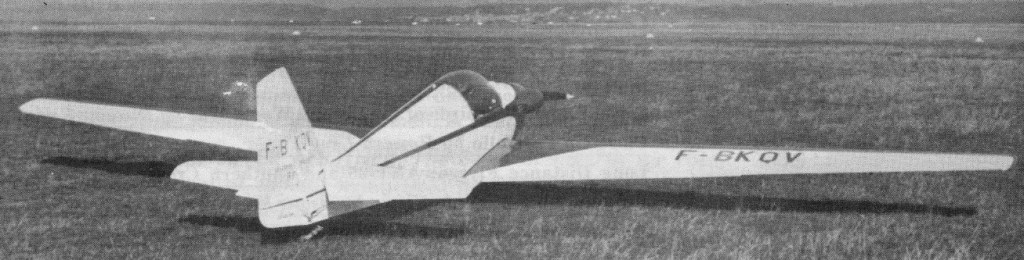
This single-seater low wing motor glider was the first of a series of such types designed by M Rene Fournier to go into production, and to be built by several different companies in France and Germany.
The RF3 was developed from the prototype Avion-Planeur, known as the Fournier RF01, which first flew on 6 July 1960. It proved to be so successful that the French Government helped to finance the building of two RF2 pre-production prototypes, the first of which flew in June 1962, and later ordered six of the production version, the RF3, with 34 hp Rectimo-VW engine, for national flying clubs; the first RF3 made its maiden flight in March 1963 and received its Cof A on7 June that year.
A second prototype of the RF-01 was built, and then Fournier entered into partnership with Antoine d’Assche, who was then producing Jodel two-seaters in a hangar at Gap in the French Alps under the trade name of Alpavia. They produced quite a number of the little airplanes, which were not exactly powered sailplanes but airplanes with an unusually shallow angle of glide; successive improvements brought about the RF4 (the second prototype having been the 2, and the original production version the 3 with Volkswagen engine). The production RF-3 differed only slightly from the prototype RF-01.
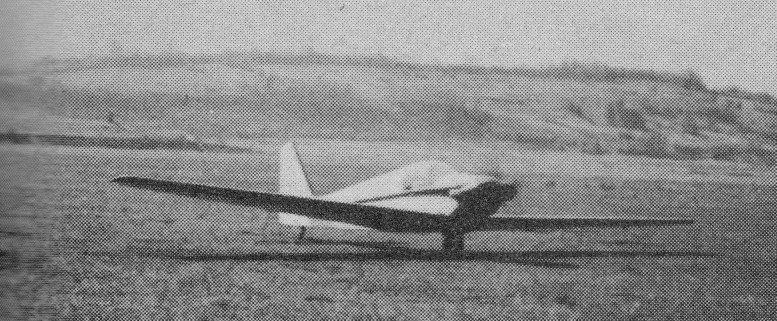
The RF-3 is a true airplane-glider and can operate as a conventional airplane, giving very economical flight at low power settings. It can also cruise at higher speeds with very acceptable cross-country performance. The RF-3 also has semi-aerobatic performance both power-on and off.
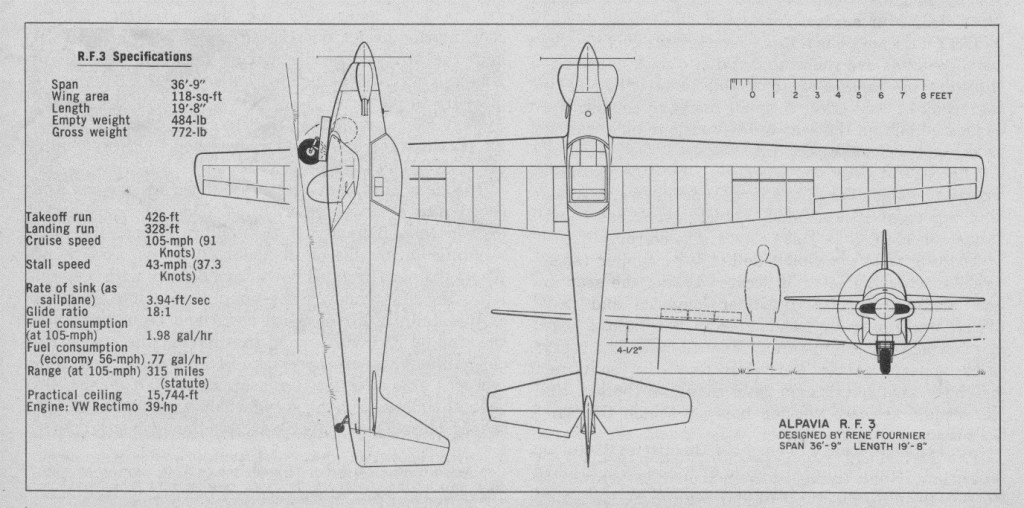
Of all-wood construction, the RF3 has a single spar one-piece wing with D-section leading edge, with 4° dihedral and plywood and fabric covering, attached to the fuselage by four bolts. The ailerons are fabric-covered and there are no flaps, but instead a three-section air brake in the upper surface of each wing inboard of the ailerons. The wooden fuselage, having typical strip longerons, cross-members, spars, ribs, is plywood-covered, fabric covering is used on the rear portion of the wing behind the main spar. Airfoil is NACA 23015 section and aspect ratio is 11:1. The pilot sitting under a moulded one-piece canopy; radio and oxygen equipment are among the optional ‘extras’.
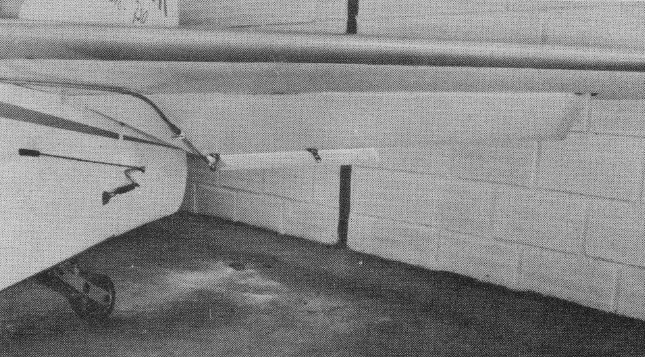
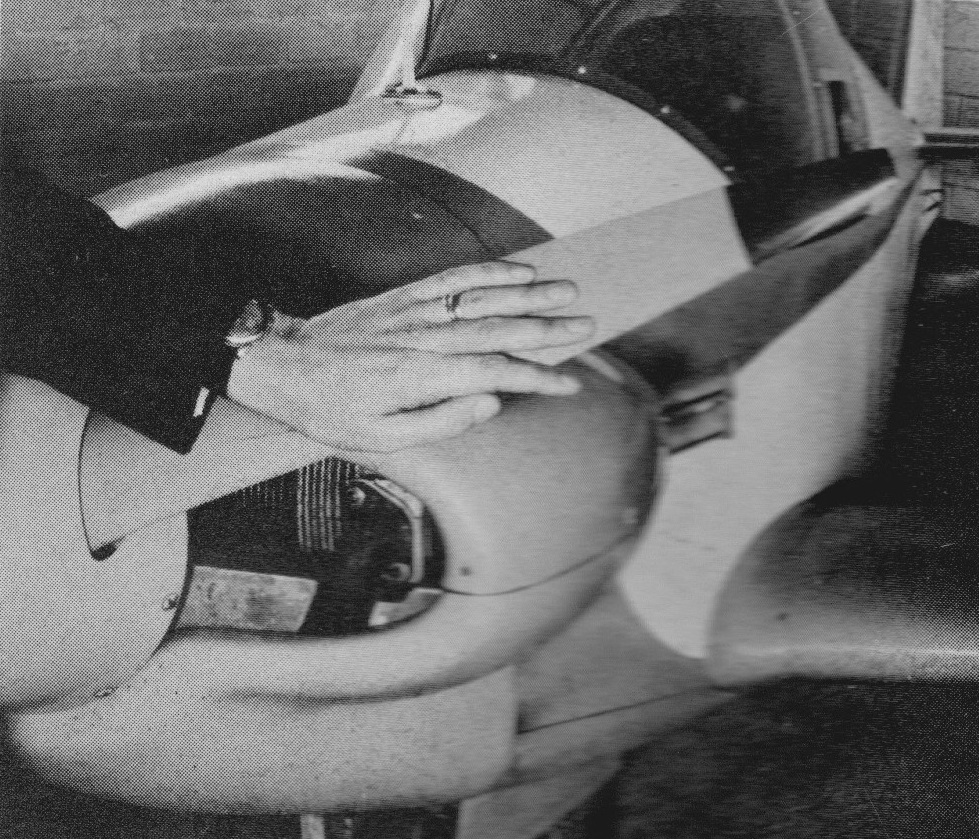
The monowheel has rubber chord shock absorption and retracts forward manually into a glassfibre cowling; it has a manually-operated brake and is supplemented by a hoop-shaped balancer skid of 6mm steel wire under each wing. The mono-wheel gear gives no problems in maneuvering with ground turning radius about half the wingspan. There is also a steerable tailwheel. Retracting the wheel is by pulling the lever full back and up-lock is automatic.
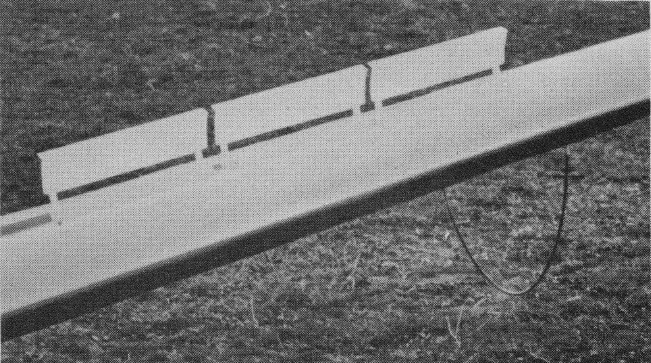
The cantilever wooden tail unit has a trim tab in the rudder. The RF-3 vertical tail has gentle sweep back not employed on previous aircraft in the series. Sailplane type retractable spoilers (speed brakes) are fitted to upper wing surfaces.
Rene Fournier has designed a comfortable, well laid-out cockpit with excellent pilot visibility. The large Plexiglas canopy is one-piece bubble type with ample head and shoulder-room forward and to the sides. Canopy making was entrusted to a molding specialist able to produce distortion-free surfaces. A sliding window-vent is fitted in canopy left side. The right canopy side is hinged along the top longeron for opening. A strap prevents canopy from flopping completely over against fuselage side.
The pilot’s seat has a thick comfortable cushion. Seat back cushions are removable and two back cushions of different thicknesses are available to suit the size and leg reach of any pilot. A small baggage compartment is located behind the seat in the fuselage bulkhead and is accessible from the cockpit.
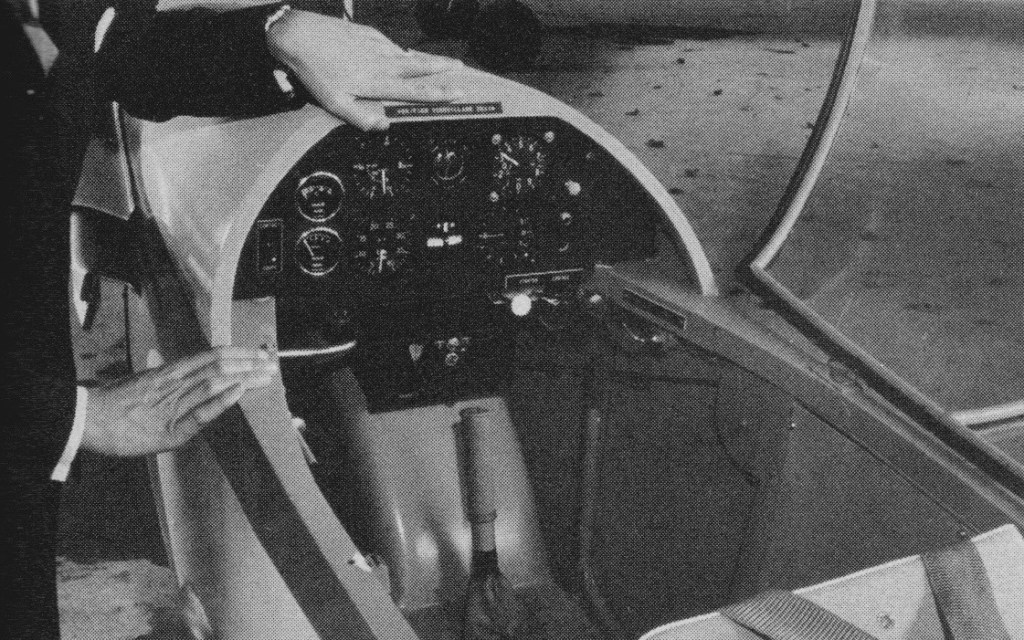
The cockpit floor has wheel well housing extending upward between the pilot’s legs. Wheel retraction lever is along right cockpit side. Fournier has provided a recess in the left cockpit side for the brake handle when released. This keeps it out of the pilot’s way during flight. Elevator trim tab control is also on right side just below top longeron.
Turning to left cockpit side the wing spoiler (speed-brake) actuating lever is located beside the seat and the push-pull throttle is under longeron and panel.
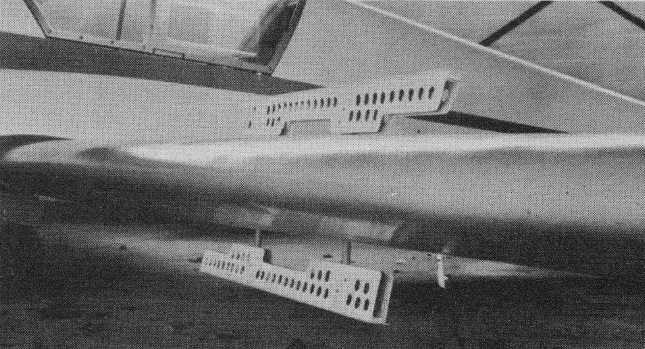
The unperforated speed brakes extend 5.75 inches above the upper wing surface and retracts flush with the wing surface.
Wheel braking is by hand lever in floor. Hand brake is of same type used in small French cars. The control stick appears rather short but top is at convenient height so that pilot’s arm rests easily on the leg. Rudder pedals are two wooden bars on which the whole foot rests.
The instrument panel, though simple, has all the essentials. Blind flying gyro instruments are not included. A red stall warning light is flashlight battery powered (has test switch) since the RF-3 has neither battery nor generator. Starter and fuel cut-off knobs are at right lower panel edge. Production aircraft have engine cut-off and restarter system installed. This consists of a simple de-compression device which pushes on the exhaust valve rocker arms. With prop windmilling, the engine re-starts easily, even at very low airspeeds. A prop brake is also provided which stops the blades horizontally, covering the cowl air inlets, thus reducing drag to nearly that of a feathered prop.
Rene Fournier entered into partnership with Comte Antoine d’Assche of Alpavia SA, which had been building Jodel D117s, and this firm took on the production of the RF3, building a total of 95 in all; deliveries started in November 1963. Alpavia was turning out one RF-3 per week with delivery time of about 8 months in 1964. The RF-3 export price was $4,300 (21,500 Fr.) in 1964. Alpavia produced 95 in total before production ended.
Although the engine can be stopped and restarted in flight and the RF3 is capable of prolonged soaring flights – many such flights of up to five hours have been made – the type should not be regarded as just a powered sailplane, as it has a high performance and is capable of all simple aerobatic manoeuvres such as stall turns, loops, half-rolls, slow rolls and spins.
Starting at 97 Knots the RF-3 goes up smoothly for a loop to inverted position at 43 Knots, and gently completes the downward curve to level flight. A hammerhead stall is done at the same starting speed, with near stall speed at the top turn downward. The spilt “S” requires higher starting speed, 113 Knots, for the half-roll. Pull out is at 118 Knots. The slow roll in the RF-3 somewhat difficult to perform well, probably because of the long wing span. The snap roll is easy by comparison. The RF-3 spins with no bad habits. The turning rate is rather slow, but spin recovery is easily achieved. Rudder response is very sensitive and the ailerons produce practically no inverse yaw.
The stall characteristics, with stick full back, the stall warning light comes on at about 40 Knots, then at 36 knots the nose drops downward cleanly with a slight left wing low tendency. By simply releasing the stick at the stall, the RF-3 noses down and recovers from the stall on its own.
Fuel consumption is an economical low 1.98 gal/hr with cruising speed of 105-mph (91 Knots). This gives 4-hour endurance, without reserve, and a maximum no-wind range of 420 statute miles (364 nautical miles). Allowance for wind would reduce this range to a practical 315 s.mi. (270 n.m.). With economy cruise throttle setting, consumption drops to low-low .77 gal/hr. at 56-mph. If one cared to chug along at this speed, range would be over500 miles—48.6 Knots and over 400 n.m.
Airborne at 48.5 knots after a takeoff roll of a bit over 400-ft. In the pattern at 59 Knots, using the speedbrakes and throttle, unlocking the gear release, the wheel extends under its own weight. Simply push the gear full forward at the end of its travel to lock the gear down. With an approach at 48.5 Knots and, after rounding out, the RF-3 touches down gently with no difficulty at 37.7 Knots. The roll-out is about 300-ft.
This performance was soon being proved in service, one notable flight in the winter of 1963-64 being made by an RF3 pilot over St Auban in the Basses-Alpes region, who climbed to 19,700ft after stopping his engine at 6,500ft. Another RF3 was successfully operated in the French Alps with a mono-ski landing gear replacing the retractable monowheel. The engine is a 39hp modified version of the Volkswagen 1,200cc ‘flat four’ car engine, converted by the Rectimo Co of Chambery. The only modifications are the fitting of a special Zenith carburettor, a propeller shaft and a Bendix magneto of the type used on the 65hp Continental engine. For restarting in flight, an optional mechanical system pushes the four exhaust valves in simultaneously, enabling the propeller to start the engine during a dive at 90mph; a two-blade wooden prop made by Evra or Helice Legere is fitted, and there is a single 6.5 Imp gallon fuel tank in the fuselage. The fuel tank is located between instrument panel and firewall with a Cub-style internal float gauge has graduated wire rod protruding through the filler cap. Pilot has a clear view of this fuel gauge on cowl top.
Alpavia RF-3 Engine: Rectimo, 39-hp Prop: Fixed pitch 4’5.5” diameter Span: 36 ft 9 in Length: 19 ft 8 in Wing area: 118.0 sqft Aspect ratio: 11.0 Airfoil: NACA 23015 section Empty weight: 529 lb Max weight: 772 lb Fuel capacity: 7.9 USG / 30 lt Max level speed: 118 mph Max cruising speed: 112 mph Min sinking speed: 3.94 ft/sec Service ceiling: 15,000-ft Rate of climb: 689 fpm at 53.9 kt Glide ratio: 18:1 Take-off run to 50ft: 875 ft Range with max fuel: 310 miles
A second prototype of the RF-01 was built, and then Four¬nier entered into partnership with Antoine d’Assche, who was then producing Jodel two-seaters in a hangar at Gap in the French Alps under the trade name of Alpavia. They produced quite a number of the little airplanes, which were not exactly powered sailplanes but airplanes with an unusually shallow angle of glide; successive improvements brought about the RF4 (the second prototype having been the 2, with 34 hp Rectimo-VW engine, and the original production version the 3). Government assistance was provided for development of the improved RF-2, subsequently produced by Alpavia as RF-3, with slightly uprated engine, first flown March 1963.
The RF-2 had perforated wing spoilers that extended from both upper and lower surfaces of the wing. They retracted vertically flush with the wing surface.
Rene Fournier was a ceramist by trade, and started off as a homebuilder with a design he called the RF 01 Avion Planeur (airplane glider). A single-seat light aircraft/powered sailplane with modified Volkswagen engine, first flown July 6, 1960. The aircraft caught the fancy of someone in the French Government, which provides grants-in aid to projects it considers worthwhile. A second prototype was built, and then Fournier entered into partnership with Antoine d’Assche, who was then producing Jodel two-seaters in a hangar at Gap in the French Alps under the trade name of Alpavia. They produced quite a number of the little airplanes, which were not exactly powered sailplanes but airplanes with an unusually shallow angle of glide; successive improvements brought about the RF4 (the second prototype having been the 2, and the original production version the 3).
Rene Fournier was a ceramist by trade, and started off as a homebuilder with a design he called the RF 01 Avion Planeur (airplane glider). The RF.01 was a single-seat light aircraft/powered sailplane with modified Volkswagen engine, first flown July 6,1960. Government assistance for development of improved RF-2, with 34 hp Rectimo-VW engine, subsequently produced by Alpavia as RF-3, with slightly uprated engine, first flown March 1963. M. Fournier designed a series of light aircraft of similar configuration for Sportavia-Putzer and Indraero. Established subsequently Avions Fournier to develop revised version of his RF-6 Sportsman, designated RF-6B; first flown March 12, 1974. Produced RF-9 motorglider 1982.
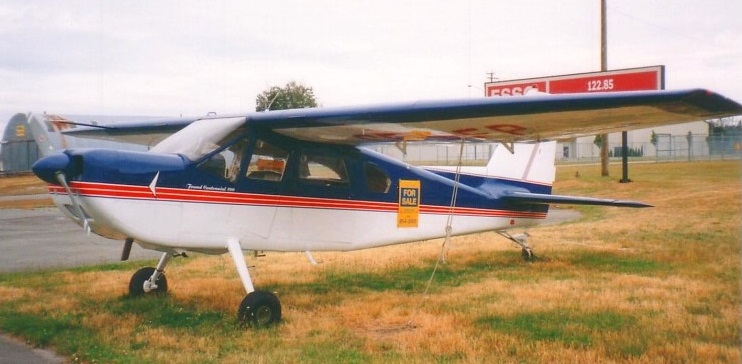
The Centennial 100 was developed as an improved version of the Found FBA-2. Design work started in October 1966 and the prototype first flew on 7 April 1967.
The aircraft is powered by a 290 hp (216 kW) Avco Lycoming IO-540-G1D5 engine.
Three prototypes and two production aircraft were built and were used to gain certification for the type in July 1968. No further aircraft were built as the company went out of business.
Engine: 1 × Avco Lycoming IO-540-G1D5, 290 hp (220 kW) Propeller: 2-bladed Hatzell metal constant speed propeller, 7 ft 4 in (2.24 m) diameter Wingspan: 39 ft 0 in (11.89 m) Wing area: 196.6 sq ft (18.26 sq.m) Aspect ratio: 7.2:1 Airfoil: NACA 23016 at root, NACA 23012 at tip Length: 26 ft 6 in (8.08 m) Height: 8 ft 4 in (2.54 m) Empty weight: 2,000 lb (907 kg) Max takeoff weight: 3,500 lb (1,588 kg) Fuel capacity: 50.5 imp gal (60.6 US gal; 230 L) Maximum speed: 162 mph (261 km/h, 141 kn) at sea level Cruise speed: 140 mph (230 km/h, 120 kn) (Econ. cruise, 65% power) Stall speed: 55 mph (89 km/h, 48 kn) (flaps down) Range: 700 mi (1,100 km, 610 nmi) Service ceiling: 18,000 ft (5,500 m) Rate of climb: 1,250 ft/min (6.4 m/s) Takeoff run to 50 ft (15 m): 1,020 ft (310 m) Landing run from 50 ft (15 m): 950 ft (290 m) Crew: 1 Capacity: 5 passengers



 All Aero