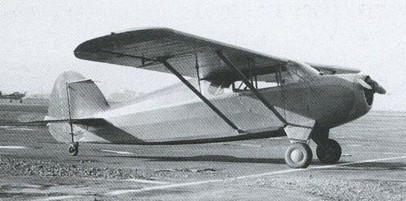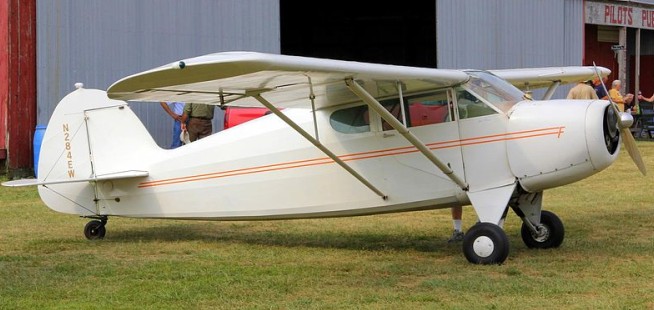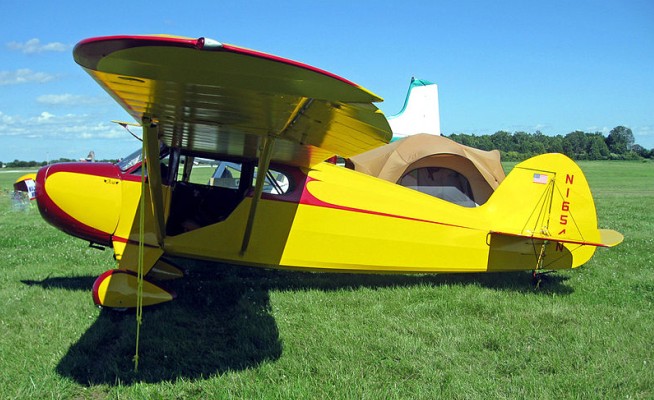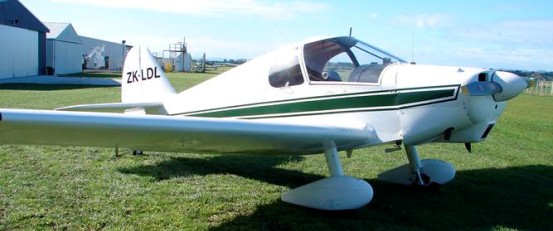
Gardan GY-20 Minicab / GY-201 / GY-30 Supercab

GY.20

M. Yves Gardan designed the GY 201 Minicab in 1949 as a two seater with side by side seating and dual control, which first flew in 1949. The fuselage is a wooden open girder structure; the forward part around the cockpit being plywood lined, the remainder fabric covered. The fin is built integral with the fuselage. The tailplane is a single piece plywood covered structure, and the elevator and rudder have fabric covered wooden frames. The wing section is NACA 23015 at the root and 23010 at the tip. The wing structure consists of a laminated spruce and plywood main box spar, a diagonal drag spar and a rear false spar, with lattice type ribs. Forward of the main spar is plywood covered to form a torsion box, the remainder of the wing being fabric covered. Split flaps are installed. The two main undercarriage legs are mounted on the main spar with rubber in compression springing. An 11 Imp. gallon fuel tank is fitted just behind the firewall.

The GY-20 Minicab first flew in February 1949.

In 1949 his GY 20 Minicab won the world record for speed and distance in a straight line for an aircraft of less than 1102 lb (500kg) maximum gross weight, flying from Paris to Rabat in 10h of flight, 1135 mile being covered at 109mph average (1826km at 185kph) with a Continental 65hp motor. More than 100 Minicabs were made and it is still being built by US homebuilders under the name of Cavalier in 1983.

In 1952, the 90hp version of the Minicab appeared, with retractable undercarriage and called the Super Cab.
Continental engines from 65 to 100 h.p. may be installed.
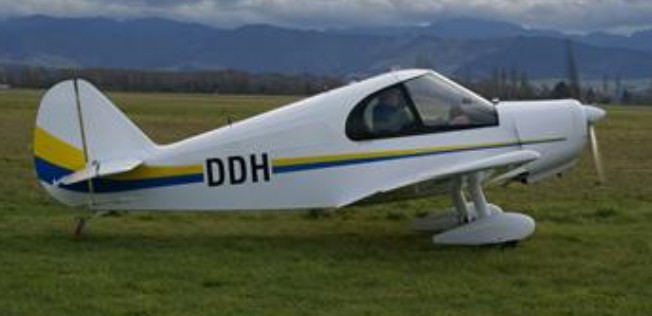
GY.20

Production was entrusted to the Constructions Aernautiques du Bearn, which delivered the first aircraft in 1952, and support for this light type subsequently passed to SIPA (the Société Industrielle Pour l’Aeronautique). There were two production variants of the Minicab, the GY.20 and GY.201, these differing from each other only in details of equipment and other small features.
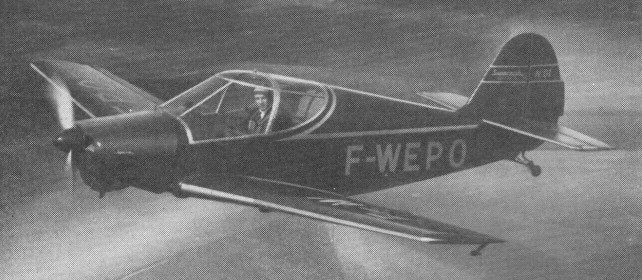
GY-30

The GY-30 Supercab first flew in February 1954 with refinements including retractable undercarriage, fixed tip tanks and 90 hp Continental C-90. Two of a pre-production batch of five were ordered for evaluation by the Service de l’Aviation Legeres et Sportive.
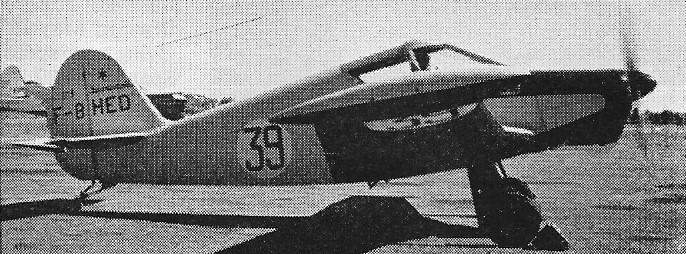
GY-30 Supercab

One of the French G.A.B. Supercabs was undergoing fully-instrumented test flying at Villacoublay; Jacques Noetinger is the pilot.

Produced in limited numbers between 1952 and 1958, the design was acquired by A.W. Ord-Hume in Britain, who anglicised the plans. Adjusted them for home builders, the aircraft has subesequently proved extremely popular. The aircraft is marketed in North America as the Hawk BM.4 by Miranda Aircraft of Canada.

Variation:
Barritault JB.01

Gallery

GY-20
Engine: Continental A65-8, 65 hp
Wingspan: 24 ft 11 in
Length: 17 ft 10.5 in
Height: 5 ft 5 in
Wing area: 107.6 sq.ft
Empty weight: 595 lb
Loaded weight: 1069 lb
Max speed: 124 mph
Cruise: 112 mph
ROC: 680 fpm
Range: 466 mi

Engine: l x Continental A65-8, 48.5kW (65hp).
Span: 7.59m (24ft 11 in).
Length: 5.45m (17 ft 10.5 in).
Max T/O weight: 485 kg (1,069 lb).
Max speed: 124 mph at sea level.
Operational range: 466 miles.
Seats: 2

Engine: Continental, 90 h.p.
Span: 25 ft 0 in.
Length: 17 ft 0 in.
Wing Area: 107 sq. ft.
Empty Weight: 750 lb.
Loaded Weight: 1235 lb.
Wing Loading: 11.5 lb/sq. ft.
Max. Speed: 124 mph.
Cruise Speed: 110 mph.
Stall Speed: 50mph.
Initial Climb: 680 fpm.
Range: 360 miles.

Engine: Continental O-200A, 100 h.p.
Cruise: 120 mph
ROC: 1000 fpm.
Span: 25ft
Length: l7ft l0in
Empty weight: 800lb
Gross weight: 1234 lb

Engine: Revmaster VW, 65 hp. Stall: 38 kt / 43 mph / 70 kmh
Cruise: 97 kt / 112 mph / 180 kmh
VNE: 107 kt / 123 mph / 198 kmh
Empty Weight: 270 kg / 595 lbs
MTOW Weight: 485 kg / 1069 lbs
Climb Ratio: 600 ft/min / 3 m/s
Take-off distance (50ft obstacle): 1150 ft / 350 m
Landing distance (50ft obstacle): 1080 ft / 330 m

GY-30 Supercab
Engine: Continental C90, 90 hp
Max speed: 170 mph
Cruise: 146 mph
ROC: 767 fpm
Service ceiling: 16,400 ft
Range: 746 mi
Empty weight: 880 lb
Loaded weight: 1348 lb
Wingspan: 26 ft 10 in
Length: 18 ft
Height: 5 ft 5 in
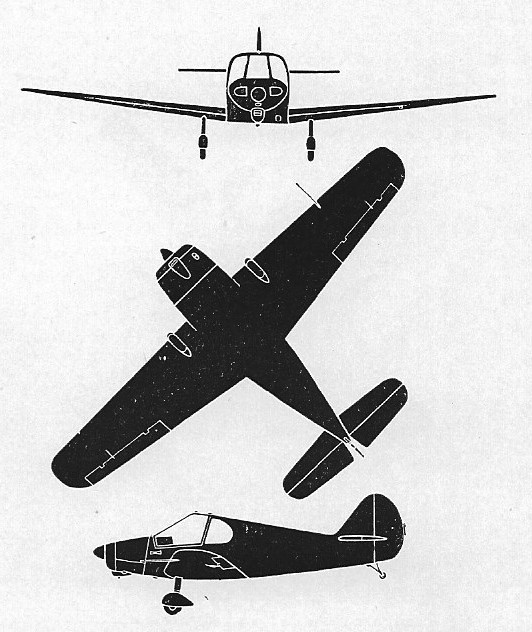
GY.20

Gardan / Societe des Avions Yves Gardan

Light aircraft designer responsible for the CAB Minicab, Supercab, and Sipa 200 and 300. Designed four-seat, allmetal lightplane, the GY-80 Horizon, which flew in July 1960 with 150 hp Lycoming engine. Horizon subsequently entered quantity production with Sud Aviation under an agreement signed in 1962.
1983: Societe des Avions Yves Gardan, 580 rue Helene-Boucher, Zone Industrielle, 78530 Buc, France.

Galaxie XRG-65 Glaticopter / G-100

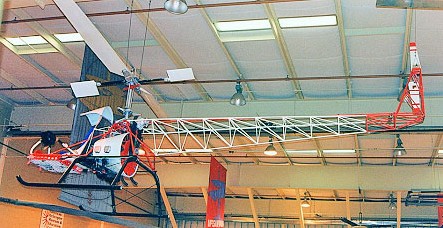
The XRG-65 Glaticopter is a one-of-a-kind research helicopter intended to evaluate new ideas in rotor control and drive systems. The fuselage is of welded steel tube construction with an aluminum bucket seat forward of the main rotor shaft.
In 1968 the XRG-65 was modified into G-100 helicopter with a 65hp Continental A-65 engine. There was also a two-seat version G-100A with 100hp Continentel O-200-A.

XRG-65 Glaticopter
Rotor diameter: 7.82m
Fuselage length: 6.1m
Max speed: 120km/h
Cruising speed: 105km/h

Funk FK-3 / VFW-Fokker FK-3

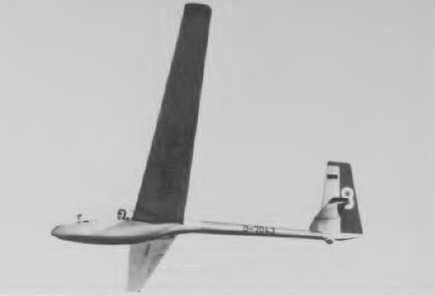
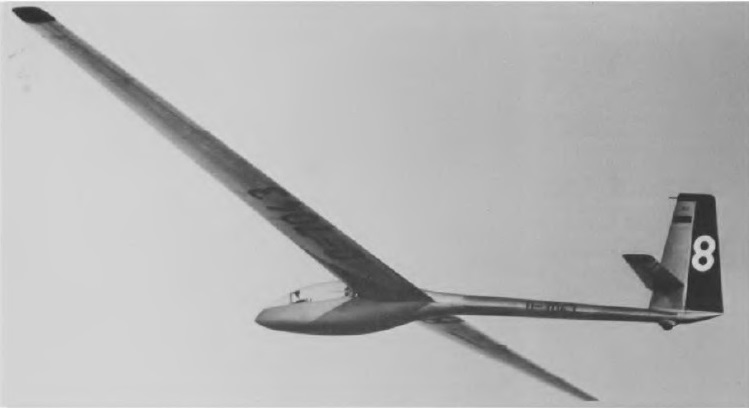
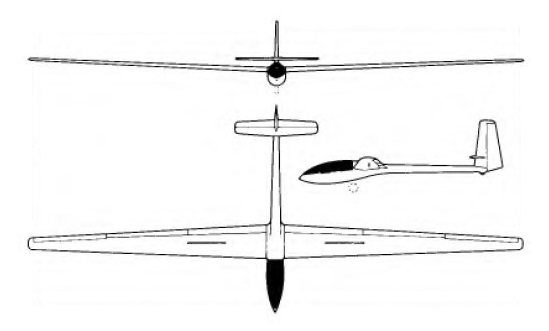
Designed by Dipl-lng Otto Funk especially for weak thermal conditions, the FK-3 is distinguished by a pod-and-boom fuselage and a very tall fin and rudder. The cantilever shoulder wings have a thickness/chord ratio of 15.3% and are of an unusual metal and foamed honeycomb construction, bending loads being carried by a single metal spar which tapers from a T-section to a U profile, and drag and torsion loads being carried by a light alloy nose spar which transmits these loads to the fuselage fittings. The wing ribs are of light alloy and plastic foam sandwich construction, spaced at intervals of approximately 4ft 7in, and supporting a 0.5mm thick light alloy skin. Between the ribs a foamed honeycomb known as Conticell 60 gives additional support to protect the skin from minor damage, and the overall wing finish is very smooth. The camber-changing flaps are divided into inner and outer sections and Schempp-Hirth air brakes are fitted. Up to 110lb of water ballast can be carried if desired in two rubber tanks in the wings with the dump valve positioned in the fuselage aft of the retractable monowheel. The fuselage nose section is of steel tube construction covered with a glassfibre-reinforced shell, and the tail boom, of small cross section, is built of riveted light metal sheet without frames or stringers, the lower part incorporating a rubbing strip to minimise damage in a rough landing. The tail unit is similar in construction to the wings, the rudder being fabric covered. The monowheel is manually-retracted and has a drum brake; there is also a tailwheel. The pilot sits in a semi-reclining position on an adjustable seat and has adjustable rudder pedals; the long onepiece Plexiglas canopy is removable, except for a small front portion.

A high performance Open Class single-seater, the prototype was built by apprentices at VFW-Fokker’s Speyer plant in Germany in the course of their regular training.

It first flew on 24 April 1968 and production started in January 1969, soon building up to a rate of three or four per month. In its first competition, flown by Dr Rolf Spa’nig, the prototype won the Open Class in the 1968 Italian Championships, and two FK-3s later gained first and second places in the Austrian Championships.

FK-3
Span: 17.4m / 57 ft 1 in
Wing area: 13.8 sq.m / 148.54 sq ft
Length: 7.2 m / 23 ft 7.5 in
Empty Weight: 260 kg / 529 lb
Height over tailplane: 5 ft 11 in
Gross Weight: 400 kg / 882 lb
Water ballast: 50 kg / 110 lb
Wing Load: 29.0 kg/sq.m / 5.94 lb/sq ft
Max speed: 168 mph / 146 kt / 270 km/h
Max aero-tow speed: 87 mph
Max rough air speed: 146 kt / 270 km/h
Stalling speed: 27-30 kt / 50-55 km/h
MinSink: 0.50 m/s / 1.64 ft/sec at 34.5 kt / 64 kph / 40 mph
L/DMax: 42 at 47.5 kt / 88 kph / 55 mph
Aspect ratio: 21.9
Airfoil: Wortmann FX 61-K-153
Seats: 1
No. Built: 11

Funk F-23

A developments of the Fairchild M-62s appeared in the 1960s, the Funk F-23 built at Broken Arrow in Oklahoma and first flown in 1962. Eleven production aircraft were built around the PT-19 fuselage and powered by the 240-hp W670M Continental. A further three were built with 275-hp R-755 Jacobs engines.
In May 1970 Cosmic Aircraft Corp acquired all rights in manufacture of F-23 single-seat agricultural monoplane, produced previously by D. D. Funk Aviation Company Inc. Two models: F-23A (Continental radial) and F-23B (Jacobs radial). Production ceased 1975.

Funk A / Funk B / Akron Aircraft Co Model B

Funk B

The first plane or Funk model ‘A’ was powered by and inverted and converted flat head four cylinder ingine.

The Funk Model B was a 1930s American two-seat cabin monoplane designed by Howard and Joe Funk. Originally built by the Akron Aircraft Company later renamed Funk Aircraft Company.

The Model B was the first powered aircraft designed by brothers Howard and Joe Funk, whose previous experience was in homebuilt gliders and sailplanes. Similar in appearance to a Piper Cub, their Model B was a strut-braced high-wing monoplane with a conventional tail unit and fixed tailwheel landing gear. The design uses mixed construction with fabric covered wooden wings and a welded steel-tube fuselage. The aircraft was powered by the brothers’ own Model E engine developed from a Ford “B” motor-car engine. The prototype first flew in late 1933.

When the test flights proved to be successful the brothers formed the Akron Aircraft Company in 1939 to build the Funk B. After production began, the engine was changed to a 75hp (56 kW) Lycoming GO-145-C2 horizontally-opposed four-cylinder engine and was re-designated the Model B-75-L.

Funk B75L

In 1941 the company moved from Akron to Kansas and the company was renamed the Funk Aircraft Company. Production was stopped during the Second World War and one aircraft was impressed into service in 1942 with the United States Army Air Corps as the UC-92.

After the war in 1946 production was resumed using a Continental C85-12 engine and the aircraft was redesignated the Model B-85-C and named the Bee. It did not sell well and production was halted in 1948. 380 aircraft of all variants had been built.

Funk B85C

Variants:
Model B
Prototype and initial production aircraft with Funk E engine.

Model B-75-L
Pre-war production aircraft with a 75hp (56 kW) Lycoming GO-145-C2 piston engine.

Model B-85-C Bee
Post-war production aircraft with a Continental C85-12 engine.

UC-92
Army designation for one impressed Model B-75-L (s/n 42-79548).

Specifications:
B-85-C
Engine: 1 × Continental C85-12, 85 hp (63 kW)
Propeller: 2-bladed Lewis fixed pitch
Wingspan: 35 ft 0 in (10.67 m)
Length: 20 ft 1 in (6.12 m)
Height: 6 ft 1 in (1.85 m)
Wing area: 169 sq ft (15.7 sq.m)
Airfoil: NACA 4412
Empty weight: 890 lb (404 kg)
Gross weight: 1,350 lb (612 kg)
Fuel capacity: 20 US gal (76 l; 17 imp gal)
Maximum speed: 115 mph (185 km/h; 100 kn) at sea level
Cruise speed: 100 mph (87 kn; 161 km/h)
Range: 350 mi (304 nmi; 563 km) with 30 minutes reserve
Service ceiling: 15,000 ft (4,572 m)
Rate of climb: 800 ft/min (4.1 m/s)
Take-off run: 348 ft (107 m)
Crew: 2