Garrett YJ93 / 7E

YJ93-GE-3

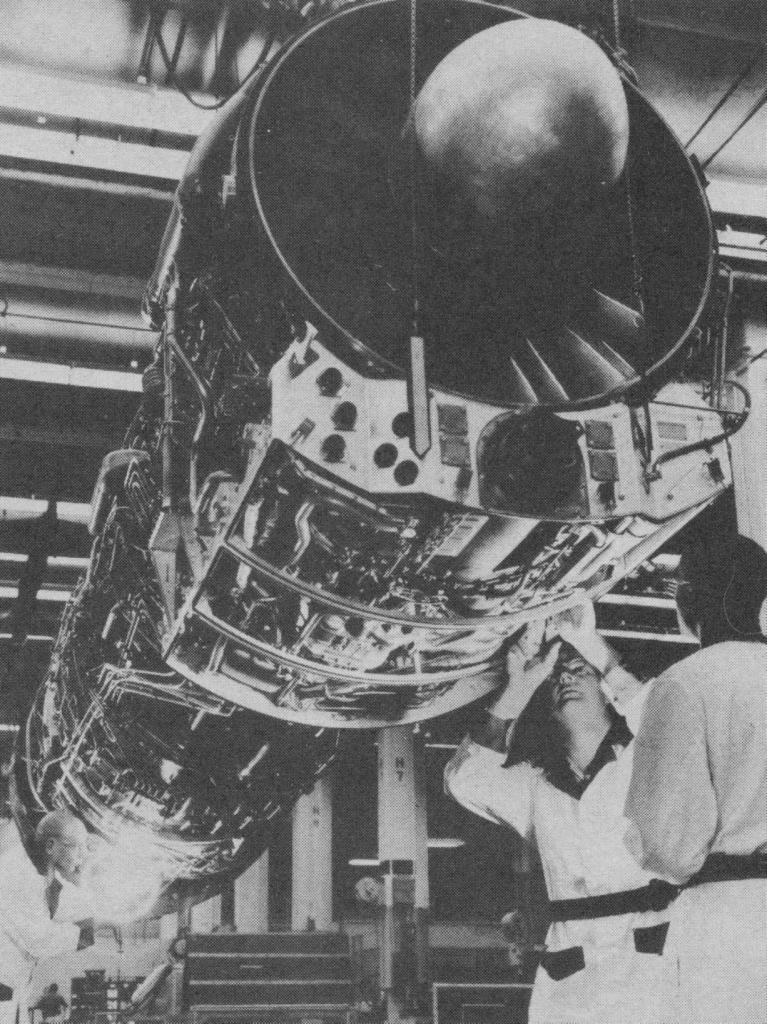
The General Electric YJ93 turbojet engine was designed as the powerplant for both the North American XB-70 Valkyrie bomber and the North American XF-108 Rapier interceptor. The YJ93 was a single-shaft axial-flow turbojet with a variable-stator compressor and a fully variable convergent/divergent exhaust nozzle. The maximum sea-level thrust was 28,800 lbf (128 kN).

The YJ93 started as the General Electric X275, an enlarged version of the J79 turbojet. This evolved to the X279 when Mach 3 cruise became a requirement, and ultimately became the YJ93.

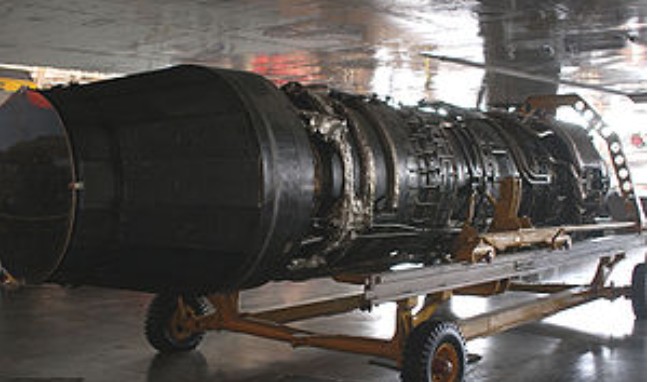
The YJ93 produced nearly twice the thrust of the J79 but was only 1500 lb heavier and very little larger.

Top – J79, Bottom – YJ93

The engine used a special high-temperature JP-6 fuel. The six YJ93 engines in the XB-70 Valkyrie were capable of producing a thrust to weight ratio of 5, allowing for a speed of 2,000 mph (3,200 km/h) (approximately Mach 3) at an altitude of 70,000 feet (21,000 m).

The XF-108 interceptor was cancelled outright and the B-70 project was reoriented to a research project only.

GE4/J5P
Type: Turbojet
Length: 6.2 m (237 in)
Diameter: 1.33 m (52.5 in)
Dry weight:
Compressor: 11-stage axial
Turbine: Two-stage axial
Fuel type: Special high-temperature JP-6 Fuel
Maximum thrust: 19,000 lbf (85 kN) / (28,800 lbf (128 kN) with afterburner)
Specific fuel consumption: 0.700 lb/(h·lbf) or 19.8 g/(s·kN) / (1.800 lb/(h·lbf) or 51.0 g/(s·kN) with afterburner)

Garrett TFE731 / AlliedSignal TFE731 / Honeywell TFE731

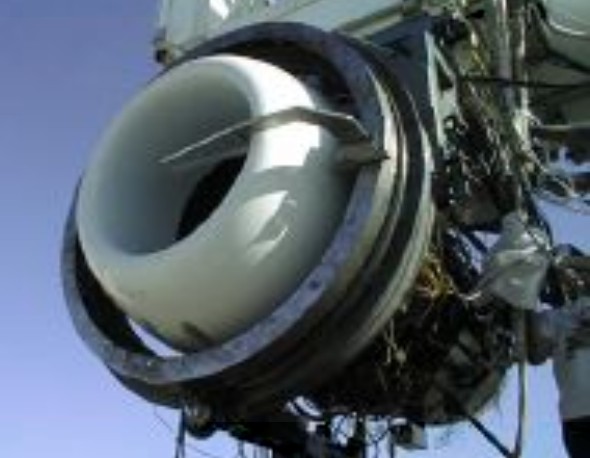
Honeywell TFE731-60

The Honeywell TFE731 is a family of geared turbofan engines commonly used on business jet aircraft. The engine was originally designed and built by Garrett AiResearch, and due to mergers was later produced by AlliedSignal and then Honeywell Aerospace.

The TFE731 was based on the core of the TSCP700, which was specifically developed for use as the auxiliary power unit (APU) on the McDonnell Douglas DC-10. The design featured two important factors: low fuel consumption, and low noise profiles that met the newly established U.S. noise abatement regulations.

The first test run of the TFE731 occurred in 1970 at Garrett’s plant in Torrance, California. The first production model, the TFE731-2, began rolling off the assembly line in August, 1972, and was used on the Learjet 35/36 and Dassault Falcon 10, both of which entered production in 1973.

The TFE731-60 has an inlet diameter of 0.787 m. The fan consists of 22 fan blades, 52 exit-guide vanes, and ten struts, and is driven by a gearbox. The five-stage compressor has four axial (LP) stages and one radial or centrifugal (HP) stage.

The TFE731-3 was developed for use in the Lockheed JetStar re-engining program, and subsequent versions of it have been used on a number of aircraft, including the Learjet 55.

At mid-1977, production of the geared two-shaft 3,500 lb TFE731-2 turbofan and the 3,700 lb TFE731-3 was running at 30-35 units per month. By September, such was the US and overseas demand for the engine, Garrett decided to increase shipments of the TFE731 (and the ATF3) to a total of around 550 units a year by 1980. Mid-1977 saw delivery of the 5,000th TPE331, and total flight time reached 11 million hours. The engine powered 44 types of aircraft. The Cessna 700 Citation III was to be the first application for the 4,000 lb-thrust TFE731-4.

In 1975, the TFE731 was named Aviation Product of the Year by Ziff-Davis Publishing Company.

The -5 model was certified in 1982, and a decade later, an engine utilizing the TFE731-5 power section and a TFE731-3 fan was built and designated the TFE731-4, intended to power the Cessna Citation 650 Citation VII aircraft.

The TFE731-50 version, based on the -60 used on the Falcon 900DX, underwent its flight test program in 2005. Honeywell has developed this engine complete with nacelle as a candidate to retrofit a number of aircraft equipped with older engines.

Since the engine was introduced in 1972, over 11,000 engines have been built, flying over 100 million flight-hours.

Variants

TFE731-2
AIDC AT-3
CASA C-101
Dassault Falcon 10
FMA IA 63 Pampa
Hongdu JL-8
Learjet 31
Learjet 35/Learjet C-21

TFE731-3
Boeing Skyfox
British Aerospace BAe 125 Series 700
Cessna Citation III
Cessna Citation VI
Dassault Falcon 50
Learjet 55
Lockheed 731 Jetstar/Jetstar II
IAI 1124 Westwind I
Hawker HS125 series

TFE731-4
Aero L-139 (prototype only)
Cessna Citation VII

TFE731-5
Hawker 800/850XP
Dassault Falcon 20 (retrofit)

TFE731-20
Learjet 40
Learjet 45

TFE731-40
Gulfstream G100/G150 (formerly IAI 1125 Astra SPX)
C-38 Courier
FMA IA 63 Pampa

TFE731-50
Hawker 900XP

TFE731-60
Dassault Falcon 900DX

TFE731-1100
IAI 1124A Westwind II

Specifications:

TFE731-2
Type: Turbofan
Length: 50 in (127 cm)
Diameter: 39 in (100 cm)
Dry weight: 734 lb (333 kg)
Compressor: 1 stage fan, 4 axial high pressure compressor stages, 1 centrifugal high pressure compressor stage
Combustors: Annular
Turbine: 1 stage high pressure turbine, 3 stage low pressure turbine
Maximum thrust: 3500 lbf (15.6 kN)
Overall pressure ratio: 13:1
Specific fuel consumption: 0.5 lb/lbf-hr
Thrust-to-weight ratio: 4.7:1

TFE731-3
Single-stage geared fan
Four-stage l-p compressor
Single-stage centrifugal h-p compressor
Annular reverse-flow combustor
Single-stage h-p turbine
Three-stage l-p turbine
Take-off pwr: 3,700 lb
Bypass ratio: 2-79:1
Pressure ratio: 14-6:1
Mass flow: 120-3 lb/sec
Length: 49-73in
Width: 34-20in
Height: 39-36in
Weight: 736 lb

Garrett ATF3 / F104 / Honeywell ATF3 / F104

The Garrett ATF3 (US military designation F104) is a 3-spool turbofan engine developed at the California division of Garrett AiResearch. Due to mergers it was supported by Honeywell Aerospace.

First run in 1968, the engine is unusual as the core flow path is twice reversed 180 deg. Aft of the fan, the axial compressor has five stages, after which the gas path progresses to the aft end of the engine. There, it is reversed 180 deg and flows through a centrifugal compressor stage, the combustors and then the turbine stages. Beyond this, the flow is then reversed 180 deg again to exit in the fan bypass duct. All engine accessories are mounted on the aft end of the engine under an engine tail-cone.

The engine was first flown in the Teledyne Ryan YQM-98 Compass Cope R high altitude UAV, as the YF104-GA-100. The engine proved to have a very low infrared signature, as the hot turbine was not externally visible and the core exhaust mixed with the bypass air before exiting the engine. The pilots of U-2 high altitude chase planes reported being unable pick up the YQM-98A with either radar or IR sensors. It was later used in the Northrop Tacit Blue stealth demonstrator because of these characteristics.

Certification of the Garrett ATF 3 was obtained in mid-May 1981. With initial production committed to the Guardian, the 5450 lb / 2468 kg ATF-3-6 was not available for commercial models until 1983.

The most significant application of the engine was on the Dassault HU-25 Guardian, developed for the US Coast Guard. It was also used on the Dassault Falcon 20G and Dassault Falcon 200.

The ATF3 was “selected by North American Rockwell for its new Series 60 Sabreliner business jet. . . . however, the ATF3 developed engineering and production problems. Delivery schedules were not met. North American Rockwell brought a $60 million suit against Garrett. . . . The suit was settled out of court for less than $5 million cash. The engine was ultimately selected for a version of the Dassault Falcon ordered by the U.S. Coast Guard for offshore surveillance”.

Applications:
Dassault Falcon 20G
Dassault Falcon 200
Dassault HU-25 Guardian
Northrop Tacit Blue
Ryan YQM-98 Compass Cope R
Vought ATLAS Lightweight Fighter series (projected baseline powerplant [ATF3-6 variant])

Specifications:
Type: Three shaft axial-flow turbofan
Length: 102.0 in (2,591 mm)
Diameter: 33.6 in (853 mm)
Dry weight: 1,125 lb (510 kg
Compressor: Single Stage Low Pressure Fan, 5 stage intermediate pressure axial compressor and single stage high pressure centrifugal compressor
Combustors: Reverse flow annular type
Turbine: 3 stage: single stage High Pressure, three stage intermediate pressure and two stage Low Pressure
Maximum thrust: 5,440 lbf (24.20 kN) – Take off, 1,055 lbf (4.69 kN) Cruise

Garrett TPE331 / TSE331 / T76 / Honeywell TPE331 / AlliedSignal TPE-331

TPE331-14

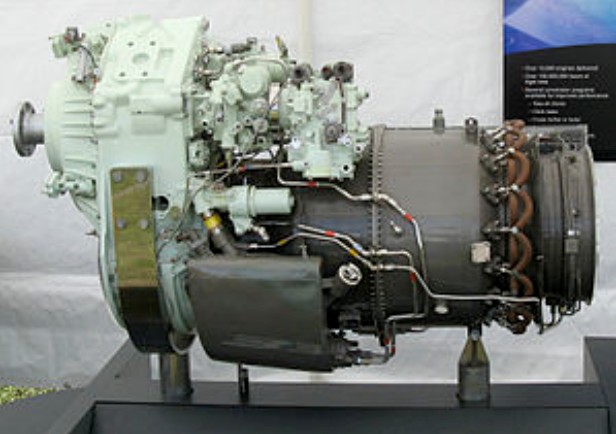
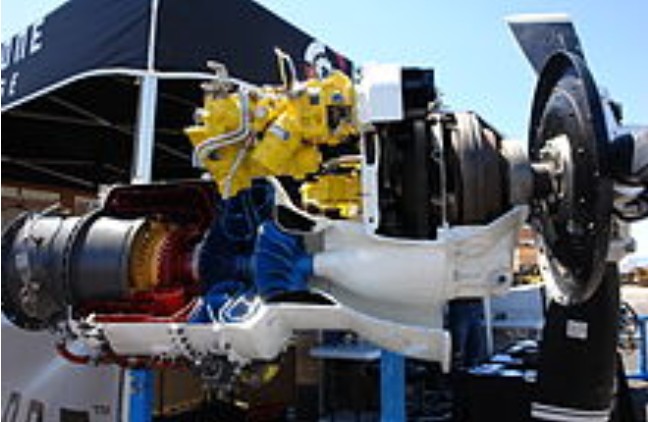
The Garrett AiResearch TPE331 is a turboprop engine originally designed by Garrett AiResearch, and produced under their new name Honeywell Aerospace since 1999.

The TPE331 originated in 1961 as a gas turbine (the “331”) to power helicopters. It first went into production in 1963. More than 700 had been shipped by the end of 1973. It was designed to be both a turboshaft (TSE331) and a turboprop (TPE331), but the turboshaft version never went into production. Over 14,000 TPE331s have been sold since the first engine was produced in 1963, installed on the Aero Commander in 1964 and put into production on the Aero Commander Turbo Commander in June 1965.

The TPE331 family includes 18 models and 106 configurations, the engines range from 575 shaft horsepower to 1650 shp The military version is designated the T76.

The T76 single-shaft military turboprop derivative of the TSE331 turboshaft of the early 1960s has only one application in the Rockwell OV-10 Bronco counter-insurgency aircraft. Some OV-10A, B and C variants have been built with the T76-G-10 and -12 (handed for clockwise and anti-clockwise rotation).

In October 1976 the OV-10D Night Observation Surveillance (NOS) variant of the OV-10A made its first flight, re-engined with the1,040 s.h.p. T76-G-420 and -421. A further 32 OV-10E and-10F Broncos were also ordered.

The configuration of the T76 is the same as that of the civil TPE331 except for the use of a chin intake rather than an above-the-gearbox inlet.

Applications:

Aero/Rockwell Turbo Commander 680/690/840/960/1000
Antonov An-38
Ayres Thrush
BAe Jetstream 31/32
BAe Jetstream 41
Beech Model 18
Beech King Air B100
CASA C-212 Aviocar
Cessna 441 Conquest II
Cessna Skymaster
Comp Air 9
Conroy Stolifter
de Havilland Dove
Dornier Do 228
Epic Escape
Fairchild Swearingen Metroliner
FMA IA 58 Pucará
General Atomics MQ-9 Reaper
Grumman Ag Cat
Grumman S-2 Tracker
Handley Page Jetstream
Marsh S-2F3AT Turbo Tracker
Mitsubishi MU-2
North American Rockwell OV-10 Bronco
PAC Fletcher
Pilatus/Fairchild PC-6C Turbo-Porter
Piper Cheyenne 400
RUAG Do 228NG
Short SC.7 Skyvan
Short Tucano
Swearingen Merlin
Volpar Model 4000

Specifications:

TPE331-43A
Type: Single-shaft turboprop with integral gearbox
Length: 46 in (1168 mm),
Diameter: 21 in (533 mm)
Dry weight: 336 lb (153 kg)
Compressor: Two-stage centrifugal
Combustors: Reverse annular
Turbine: Three-stage axial
Maximum power output: 575 hp (429 kW)

Garrett AiResearch / AiResearch

Aircraft Tool and Supply Company
Garrett Supply Company
AiResearch Manufacturing Company
AiResearch
PW-je-tp

John Clifford “Cliff” Garrett founded a company in Los Angeles in 1936 which came to be known as Garrett AiResearch or simply AiResearch. Already operating his Garrett Supply and Airsupply businesses, in 1939 Cliff Garrett established a small research laboratory to conduct “air research” on the development of pressurized flight for passenger aircraft. “[AiResearch’s] first ‘lab’ was a small store building on Melrose Avenue in Los Angeles”.

In 1939 Garrett incorporated the “Garrett Corporation” and the three operating companies became divisions: Airsupply Division, Garrett Supply Division, and AiResearch Manufacturing Division. Needing additional space, they built their own manufacturing facility in Glendale, California, and thereby established the name AiResearch Manufacturing Company.

By 1941, AiResearch needed new space, and on April 28, 1941 moved from Glendale to what until then had been a beanfield on Sepulveda Boulevard, at the corner of Century Boulevard near Mines Field, which later became Los Angeles Airport. In 1942, the Army Air Force concluded that vital cabin pressurization manufacturing facilities should be relocated inland from the coast, and AiResearch set up the AiResearch Phoenix Division in Phoenix, Arizona. For this purpose, AiResearch Manufacturing Company of Arizona was established as a wholly owned subsidiary.

The Company’s first major product was an oil cooler for military aircraft. Garrett designed and produced oil coolers for the Douglas DB-7. Boeing’s B-17 bombers were outfitted with Garrett intercoolers, as was the B-25. The Company developed and produced the cabin pressure system for the B-29 bomber, the first production bomber pressurized for high altitude flying. By the end of World War II, AiResearch engineers had developed air expansion cooling turbines for America’s first jet aircraft, the Lockheed P-80 Shooting Star. In all during World War II, Garrett AiResearch sold $112 million in military equipment and had as many as 5,000 employees at peak.

Having to scale back its workforce to just 600 employees at the end of the war stimulated Garrett to look for new income sources. “He found them in the small turbines which patient Engineer [Walter] Ramsaur had been perfecting since 1943. So that jet pilots could endure the heat generated by air friction at supersonic speeds, a way had to be found to cool their cockpits. Ramsaur’s turbine provided the answer; by putting an engine’s heat to work turning the turbine, it cooled the air by expanding it, shot the air into the cockpit. As rearmament got under way, Garrett began turning out a total of 700 accessory products. With the Navy order for an on-board engine self-starter, by 1951 Garrett Corp. had a $120 million backlog, enough to keep 5,500 workers on three shifts busy for at least the next three years”.

By the end of the 1940s, Garrett Corporation was listed on the New York Stock Exchange. “In the late 1940s and early 1950s, Garrett was heavily committed to the design of small gas turbine engines from 20 – 90 horse power (15 – 67 kW). The engineers had developed a good background in the metallurgy of housings, high speed seals, radial inflow turbines, and centrifugal compressors”.

By 1949, the Sepulveda Blvd. property was increasingly constrained by the demand for development of commercial space near the fast-growing Los Angeles International Airport (LAX). At that time, 2000 people worked at the facility “and Garrett was ranked one of the top three aircraft accessory manufacturers in the world”. In 1959 ground was broken for construction of an additional facility at 190th Street and Crenshaw Boulevard in Torrance, California. Part of that facility was occupied a year later. “By 1962, 1000 employees were working at the Torrance location and by 1972, 3000 employees were based there”. After a gradual series of moves, the Sepulveda facility was closed in 1990.
During the 1950s AiResearch initiated activities in the field of aircraft electronics, “first with an angle-of-attack computer to eliminate gunfire error and then with its first delivery of a complete centralized air data system”. In the 1950s and 1960s Garrett diversified and expanded. Garrett AiResearch designed and produced a wide range of military and industrial products for aerospace and general industry. It focused on fluid controls and hydraulics, avionics, turbochargers, aircraft engines, and environmental control systems for aircraft and spacecraft. “By 1960 Garrett gas turbines, cabin pressurization systems, air conditioners, and flight control systems were aboard the Convair 880, Lockheed Super Constellation, Vickers Viscount, Sud Aviation Caravelle, Douglas DC-8, and Boeing 707. The company had also developed the first inflatable airliner evacuation slides”.
In the 1950s and 1960s Garrett pioneered the development of foil bearings, which were first installed as original equipment on the McDonnell-Douglas DC-10 in 1969 and then became standard equipment on all U.S. military aircraft. In the 1960s, AiResearch Environmental Control Systems provided the life supporting atmosphere for American astronauts in the projects Mercury, Gemini, Apollo, and Skylab.
Garrett AiResearch is credited with inventing one of the first complete microprocessors, when it developed the Central Air Data Computer for the US Navy’s F-14 Tomcat fighter in 1968-1970.

In the 1970s Garrett’s expanding industrial and other non-military applications had changed the basic sources of income. “At the start of the decade sales to the military accounted for 70 percent of the company’s business. At the end of the ten years, largely because of turbochargers and general aviation products, the situation was reversed. Commercial sales made up 70 percent; military had dropped to 30 percent”. Also by the end of the decade “sales had reached $1.3 billion; backlog was $1.9 billion”.

To avoid a hostile takeover of Garrett’s assets by Curtiss-Wright following Cliff Garrett’s death in 1963, Garrett Corporation merged with Signal Oil and Gas Company in 1964. In 1968, the combined company adopted The Signal Companies as its corporate name. In 1985, Signal merged with Allied Corp., becoming Allied-Signal. The company acquired Honeywell Aerospace in 1999. Although AlliedSignal was much larger than Honeywell, it was decided to adopt the Honeywell name because of its greater public recognition.

Part of the original Garrett AiResearch became known as the Garrett Turbine Engine Company from 1979, and became the Garrett Engine Division of AlliedSignal in 1985. In 1994, AlliedSignal acquired the Lycoming Turbine Engine Division of Textron, merging it with Garrett Engine to become the AlliedSignal Engines Division of AlliedSignal Aerospace Company.

The Garrett Aviation Division (“Garrett Aviation”), which mainly services aircraft, was sold to General Electric in 1997 and later renamed Landmark Aviation after a 2004 merger. It became StandardAero after a further merger in 2007 and it was owned by Dubai Aerospace Enterprise, but subsequently purchased by another owner.
Garland-Bianchi Aircraft Co

UK
Garland-Bianchi Aircraft Co was formed in 1955, by P. A. T. Garland and D. E. Bianchi, to license-build the Piel CP.301 Emeraude two-seat light aircraft (subsequently renamed Linnet). Built two aircraft before a new company, Fairtravel Ltd., was formed by AVM Don Bennett to take over production. Fairtravel Ltd. built three more Linnets, the last being delivered in 1965.

Gardner Cumulus

A single-seat light-wind sailplane designed and built by L. Gardner at Dunstable, Bedfordshire, in 1949. Conventional wooden construction but very lightly built as it was designed to soar in light winds only.

It resembled the R.F.D. 2 sailplane but with angular fuselage nose and tail surfaces.

The one test-flight was carried out in ‘rather a strong wind’ by Mr Gardner, but the Cumulus was blown into the top of the Dunstable Downs and was wrecked.

Gardan GY-80 / SOCATA GY.80 Horizon

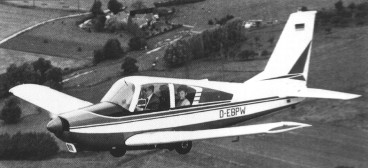
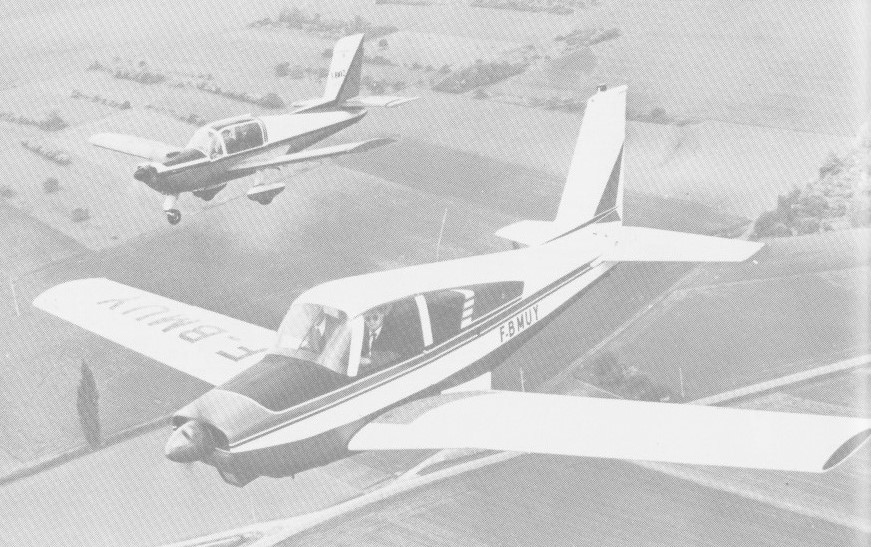
In 1960 the GY 80 Horizon 180hp tourer appeared. This single engined machine won the Cannes International Grand Prix in 1966, beating the highest performance twins of the time by covering in 23 h of flight a distance of 3443 mile at 152 mph average (5540 km at 245 kph).

The Horizon had a run of 270 in France, Aerospatiale having ac¬quired the production licence, but its succes¬sor the GY 100 in 1969 was never produced commercially.

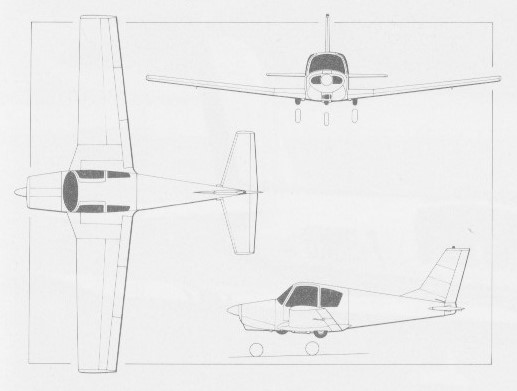
One of SOCATA’s first products was the four-seat GY.80 Horizon under licence. The type first flew in July 1960 and is of all-metal construction with standard low-wing monoplane configuration and full span Fowler-type flaps and Frise-type ailerons. All three tricycle landing gear units retract to the rear and leave their wheels partially exposed.

The GY-80 was built in four basic versions. Standard versions have 160 hp or 180 hp engine and fixed pitch propeller. A constant speed propeller was available optionally with either engine.

The first 75 aircraft have the 119-kW (160 hp) O-320-D engine driving a fixed-pitch two-blade wooden propeller, later aircraft having more power and a constant speed three-blade propeller.

Production of 260 aircraft last to 1969.

GY.80-150

GY.80-180 Horizon
Engine: l x Avco Lycoming O-360-A, 134kW (180hp).
Span: 9.70m (31 ft 9.75in).
Length: 6.64m (21ft9.5in).
Max T/O weight: 1150kg (2,535lb).
Max speed: 155 mph at sea level.
Operational range: 777 miles.

SOCATA GY-80 Horizon
Engine: Lycoming O-320-D, 160 hp
Prop: fixed pitch
Wing span: 31 ft 10 in / 9.70 m
Length: 21 ft 9.5 in / 6.64 m
Cabin length: 7 ft 2.5 in / 2.20 m
Cabin width: 3 ft 7 in / 1.10 m
Cabin height: 4 ft 1 in / 1.25 m
Empty weight equipped: 1334 lb / 605 kg
MTOW: 2315 lb / 1050 kg
Max cruise 75% 8200ft / 2500m: 124 kt / 143 mph / 230 kph
ROC SL: 660 fpm / 201 m/min
Service ceiling: 13,450 ft / 4100 m
Range 44 ImpGal / 200 lt fuel: 512 nm / 590 mi / 950 km
Seats: 4
Baggage capacity: 88 lb / 40 kg

SOCATA GY-80 Horizon
Engine: Lycoming O-360-A, 180 hp
Prop: fixed pitch
Wing span: 31 ft 10 in / 9.70 m
Length: 21 ft 9.5 in / 6.64 m
Cabin length: 7 ft 2.5 in / 2.20 m
Cabin width: 3 ft 7 in / 1.10 m
Cabin height: 4 ft 1 in / 1.25 m
Empty weight equipped: 1360 lb / 617 kg
MTOW: 2535 lb / 1150 kg
Max cruise 75% 8200ft / 2500m: 130 kt / 150 mph / 240 kph
ROC SL: 850 fpm / 258 m/min
Service ceiling: 14,800 ft / 4500 m
Range 44 ImpGal / 200 lt fuel: 674 nm / 777 mi / 1250 km
Seats: 4
Baggage capacity: 88 lb / 40 kg

SOCATA GY-80 Horizon