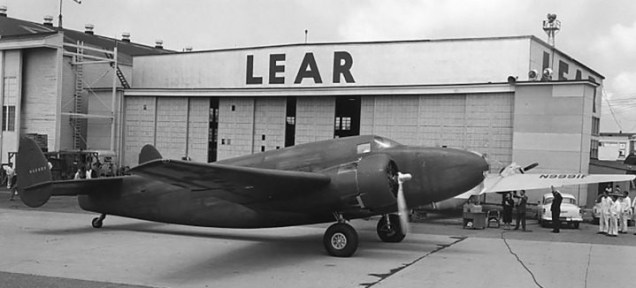
Shortly after World War II, Bill Lear bought a fleet of Lodestars. In 1953, Gordon Israel signed on with William Lear to redesign the Lockheed Lodestar into the Learstar executive transport. Lear tinkered with their noses and streamlined the fuselages. He added fairings to the landing gear and beefed up the horsepower. Lear’s new plane was one of the first truly executive aircraft, and Lear guaranteed a 300 mph cruise speed for businessmen who were in a hurry.
When the Learstar was finished, it was 52 knots faster than the stock Lockheed, and Lear eventually sold 72 of the big long range twins, one of them going to the Krupps of Germany on a delivery flight that went from Santa Monica to Dosseldorf, Germany with only one stop, at Frobisher.
Swiss American Aviation Corporation Gates Learjet Corporation Learjet Inc
William P. Lear founded the Swiss American Aviation Corporation in 1960 to build a twin-jet executive aircraft, originally designated SAAC-23. Tooling was completed in Europe but moved to Wichita, Kansas, in 1962, when the company became known as Lear Jet Corporation. By 1964 all work had been transferred to USA. In 1967, Bill Lear sold his 60 percent interest in the company to Gates Rubber Corporation, and in 1970 the name was changed to Gates Learjet Corporation. Became Learjet Inc. in 1987. Lear Jet Inc becoming a division of Bombardier in 1990, offering the 11-seat light Learjet 31A (first flown May 1987), 11 -seat mid-size Learjet 45 (first flown October 1995), and 12-seat transcontinental Learjet 60 (first flown October 1990).
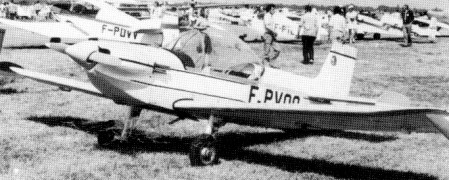
M. Albert Gatard’s Poussin (chick) has excellent aerobatic qualities with 20 seconds of inverted flying possible. Several are under construction around the world, including one in Zaire. The control system uses a unique, variable-incidence lifting tailplane of large area. The pilot lowers full-span slotted aileron/flaps and adjusts the tailplane to maintain pitching equilibrium. Aircraft is single-seat wooden low-winger, fixed gear. Development continued into the 1970s.
Engine modified 24 hp VW, 1200cc. Gross weight 617 lbs. Empty weight 375 lbs. Wingspan 21 ft. Length 14 ft 10.5 in. Wing area: 66 sq.ft. Cruise speed 89 mph. Climb rate 435 fpm.
M. Albert Gatard, 52 route de Jonzac, 17130-Montendre, France. M. Albert Gatard designed and built several light monoplanes in mid-1950s with a new control system using a variable-incidence large-area tailplane. AG 01 Alouette was a two-seater, AG 02 Poussin a single-seater, and AG 03 Hirondelle two-seat side-by-side. Development of all three aircraft continued into the 1970s.
A single-seat helicopter powered by Irbit two-cylinder motorcycle engine, from the spring of 1961. The aircraft is said to have gone into production for flying clubs following successful tests at Kirovograd in the Ukraine.
USSR Designed the G-1, a single-seat helicopter powered by Irbit two-cylinder motorcycle engine, in the spring of 1961. The aircraft is said to have gone into production for flying clubs following successful tests at Kirovograd in the Ukraine.
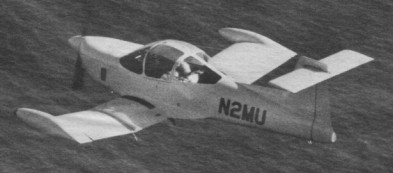
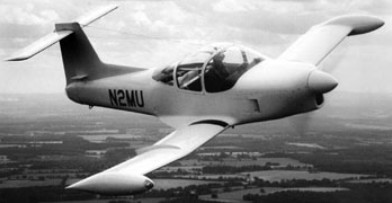
The Melmoth first flew in 1973 and was developed by Peter Garrison from the British Practavia Sprite (also partly a Garrison project). The Melmoth represented considerably more work than the average homebuild and was more of a research prototype than a backyard project. The Melmoth was conceived and designed as an exercise in extreme efficiency in all aspects of flight. It carried an unusually large amount of fuel for an aircraft of its size with a 41-gallon main tank and two 35-gallon tip tanks on each wing, which yielded the exceptional range. Some of the Melmoth’s extras included double-slotted flaps, adjustable incidence ailerons, autopilot, and retractable landing gear. Melmoth weighs 1,500 pounds empty, seating three, and carrying 940 pounds of fuel in wing and tip tanks. The area of the 23 foot wing is only 92 square feet. No additional fuel is used for ocean flights, the standard tankage providing a range of about 3,000 nm.
Double slotted Fowler flaps keep the stalling speed within reason; wing mounted spoiler/airbrakes provide sudden drops and other surprises. The approach speeds and the ride resemble those of a medium twin, but the control forces and responses are more what you would expect from a small, short-coupled airplane. The roll rate, for instance, is about 100 degrees per second, and the airplane is stressed for aerobatics. High cruise at normal weights is 170 to 175 knots, but flight plan 160 block to block, at about nine gallons an hour. Melmoth carries full IFR equipment, with Collins Micro Line and Narco avionies, Silver Fuel Guard, Safe Flight angle of attack indicator, Edo Aire Mitchell Century 1 autopilot, Sanyo stereo radio and cassette player and a Sunair H F radio for ocean flights. There is also a homemade electronic gadget that automatically switches fuel tanks every five minutes. The retractable tricycle landing gear, flaps and airbrakes are all hydraulically operated by an electric pump. The flying qualities are generally good, but some areas need improvement. Melmoth yaws excessively in turbulence, and neutral lateral stability makes it a poor instrument airplane without the aid of the wing leveler. The cabin, though very roomy, is noisy, and the seats are not comfortable on long flights; the rear seat, furthermore, is not only uncomfortable but also hard to get into and out of.
The high approach speeds and the potential for excessive sink rates with full flaps take pilots new to the airplane by surprise, though with practice and planning Melmoth can be satisfactorily operated on 2,000 foot unpaved run¬ways
The aircraft was destroyed on 16 July 1982 in a highly unusual accident in which a landing aircraft struck Melmoth while waiting on the ground at the end of a runway. Garrison was holding short of Runway 19R at Orange County Airport for takeoff clearance when he was hit broadside by a Cessna 210 that was approaching to land.
Garrison survived the accident and proceeded to design and construct a replacement.
Engine Continental IO-360-A, 195-hp. Wingspan 23 ft Length 21 ft 6 in Gross Wt. 2950 lb. Empty Wt. 1500 lb. Fuel capacity 154 USG. Top speed 209 mph. Cruise speed 201 mph Stall 80 mph. Climb rate 1800 fpm. Takeoff distance (50’) 2500 ft. Landing distance (50’) 2500 ft. Range 3400sm. Seats: 2-3.
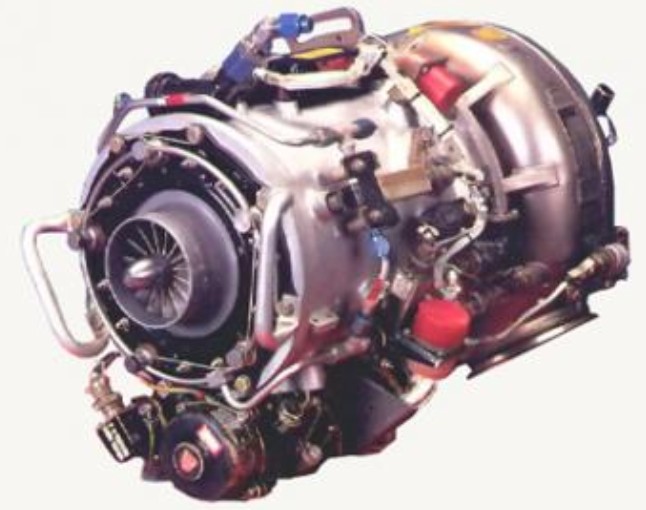
Originally the JFS-100 was a starter motor designed and produced by Garrett. It was used, among others, on A7, F16 and F15, but also in non-aviation applications such as power generators.
It provided a power of 90 hp at 72,000 rev / min for a specific fuel consumption of 1.2 lbs / hp / hr.
JFS-100 turbojet has been converted for propulsion of cars, kart and motorcycle.
Aviation conversions include:
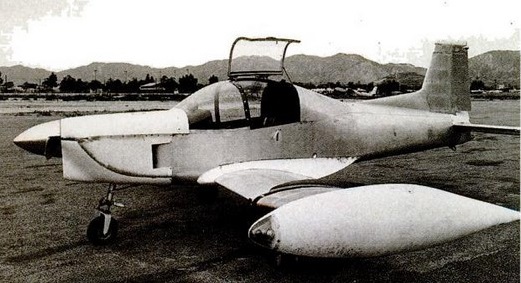
Mitchell B-10 of Jim Gordon Bede BD-5J of Bill Brooks
The Mitchell B-10J is a package available from Jim Gordon’s Micro Aviation. The US$5200 package includes a Garrett JFS100-13 originally used as a starter for the TF-41 engine in the A-7 Corsair. Including throttle package, lubrication and tailpipe assembly, the engine weight is 53 lb, and replaces the Zenoah.

 All Aero