Goodyear Tyre & Rubber Co.

Airship work started at the Akron, Ohio, plant of the company in 1910, when engineer P. W. Litchfield began developing the specialised techniques required for the manufacture of rubberised fabric. After visiting Europe to see the latest airships flying at the time, he returned to America to start the construction of the company’s first envelope, which was completed in July 1911. With a total capacity of 375,000 cu ft, it was made for Melvin Vaniman’s ill fated airship “Akron” which attempted to fly across the Atlantic in July 1912.
As a result of negotiations, which began in 1922 between Goodyear and Luftschiffbau Zeppelin, the Goodyear-Zeppelin Corporation was formed on December 14, 1923. From then on, Goodyear’s major effort was directed towards the design of rigid airships for naval and commercial use, but it was to be several years before an airship of this type was laid down by the, new company.

“GZ” stands for Goodyear-Zeppelin, stemming from the partnership Goodyear had with the German company when both were building airships together. However these models came many years after this partnership had dissolved during the start of World War II. The GZ-1 was the USS Akron (ZRS-4), the U.S. Navy’s fourth rigid airship used for several tests including as a flying “aircraft carrier”.

Total airship production by the company up to 1923 was 37, of which 26 were for the U.S. Navy, 7 for the U.S. Army, and 4 commercial.
On December 5, 1939, to reflect the company’s growing interest in other fields of aeronautical work, the corporate name was changed again, this time to the Goodyear Air¬craft Corporation. With America’s entry into WW II, a great expansion began of the U.S. Navy’s airship service, with 200 airships being authorised in June, 1942. Between September, 1941 and April, 1944, Goodyear delivered 130 K Class, 10 L Class, 7 G Class, and 4 M Class airships to the Navy. These joined 4 K, 3 L, 1 G, and two ex Army ships already in service, plus five Goodyear fleet ships, to make the largest airship fleet ever assembled by any nation. They were used extensively along the eastern and western seaboards of the United States, in Central and South American waters, and from 1944 in the Mediterranean area. The ZP squadrons, the first being commissioned at Lakehurst on January 2, 1942, (ZP 12), were organised into Fleet Airship Wings, of which there were five.
As recently as 1967, Goodyear carried out an evaluation programme for the U.S. Naval Air Development Center in which a series of rigid and non rigid designs were examined for operational cost and performance potential. Amongst the designs considered were 45 million cubic feet rigids operating at speeds up to 210 m.p.h., which were found to be totally practical from a technical point of view.
As a further reflection of Goodyear’s expanding interest in aeronautics and space research, the company name was changed once more on July 1, 1963, to become the Goodyear Aerospace Corporation. With this change, airship operations were transferred to Goodyear Tire & Rubber public relations, with Aerospace being responsible for engineering, maintenance and development of the fleet. During this period the company were operating two airships, namely, the Type GZ 19As “Mayflower”, based at Miami, Florida, and “Columbia” at Los Angeles, California, during the winter months, both airships going on nationwide tour each summer. These ships were of 147,000 cu.ft. capacity and powered by two 175 h.p. Continental engines.
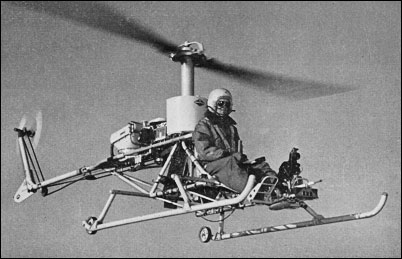
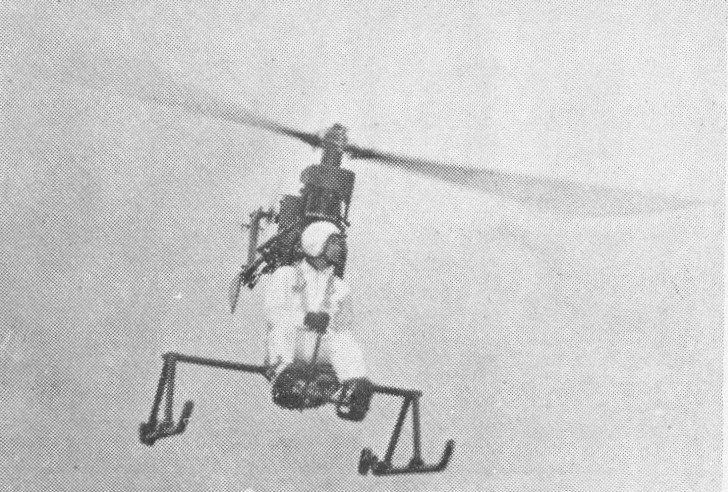
Goodyear GA-400R Gizmo

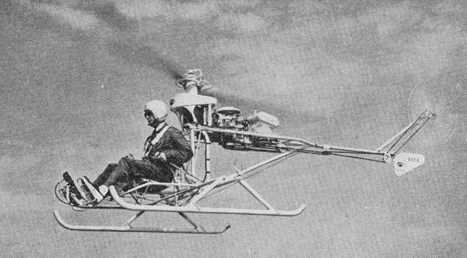
In 1954 Goodyear Aircraft Corporation produced a single-seater helicopter intended for the tactical requirements of transporting one man only. This single-seater open-frame ultra-light helicopter, designed by Paul Ziegler, is powered by a water-cooled, two-cycle engine driving the rotors through a belt and pulley arrangement. The main rotor consists of two laminated blades balanced about the feather axes and mounted in a steel hub underslung from a teetering hinge. The airframe is constructed from welded tubing, and the landing gear is formed of parallel aluminium skids.

The first flight took place on 9 May 1954 (N62N).

Designed by Paul Ziegler, this prototype was designated GA-400R Gizmo, with the pilot seat on the forward frame, a narrow tailboom with a tail rotor and the 32hp Mercury 55 engine mounted amidships and driving a two-blade main rotor. It was followed by the GA-400R-2 and GA-400R-3 (N69N and N53A) which were powered by a 38hp Johnson two-stroke engine. The GA-400R did not progress beyond prototype stage.

Gallery

Engine: 25 h.p. Johnson
Rotors: 2-blade main; 2-blade tail.
Loaded weight: 400 lb
Seats: 1.

GA-400R
Engine (outboard): Marine and MFG Big Twin, 31hp
Main rotor diameter: 5.49m
Length: 4.83m
Length with rotor: 6.77m
Height: 2.29m
Empty weight: 106kg
Take-off weight: 197kg
Max ceiling: 3660m
Cruising speed: 74km/h
Endurance: 45 min

Goodyear GA-22 Duck

In 1950, a revised four-seat variant of the Goodyear GA-2, the GA-22 Drake was flown, followed in 1953 by the GA-22A Drake (with a revised hull); only one of each was built.

The GA-22A Drake was powered by a 225 hp (167 kW) Continental E-225-8 and converted into a flying boat with a revised hull; first flight in 1953.

The last aircraft built, the GA-22A Drake registered N5516M, is stored by the EAA Air Venture Museum

Goodyear Aircraft Corp

Formed 1940 to take over the Goodyear Zeppelin Corporation. Served as aircraft manufacturer and subcontractor to numerous companies during Second World War, including complete construction of the FG-1 Corsair, a Chance Vought design. Reverted to lighter-than-air craft postwar, but built a few GA-2 Duck three-seat experimental amphibians in 1947-8. GA-400R light single-seat helicopter flown in May 1954. Produced the Goodyear Inflatable Aircraft with an inflatable wing in mid-1950s.

Gnome-Rhône 14N / SNECMA-GR 14N

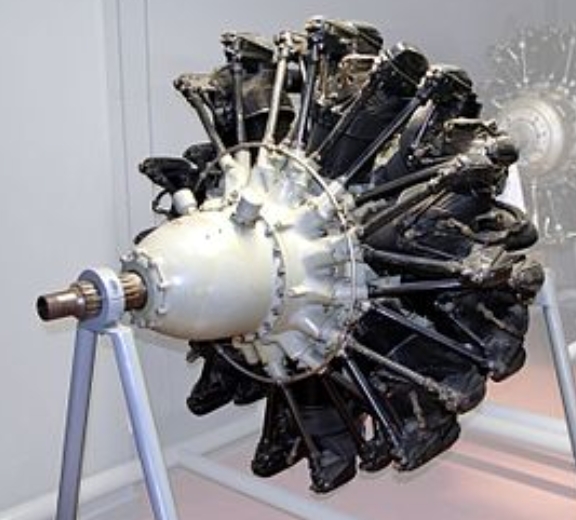
The 14N was a 14-cylinder two-row air-cooled radial engine designed and manufactured by Gnome-Rhône. A development of the pre-war Gnome-Rhône 14K, the 14N was used on several French and German aircraft of World War II.

Facing criticisms over the 14K’s reliability, Gnome-Rhône undertook a major upgrade of its 14-cylinder design, using different materials for the pistons and valves, and enlarging cooling surfaces by 39%.

The new 14N was introduced in 1937 and was quickly adopted on several aircraft models. In 1939, minor improvements allowed Gnome-Rhône to increase the compression ratio from 6.1:1 to 6.8:1, which resulted in increased power for wartime production aircraft.

The 14N was further developed into the Gnome-Rhône 14R featuring a 2-stage supercharger, but this type was not widely used until after World War II as production of improved engines was prohibited by the terms of the armistice with Germany.

Applications:
Amiot 351
Amiot 354
Bloch MB.131
Bloch MB.151
Bloch MB.152
Bloch MB.155
Bloch 174
Bloch 175
Bloch MB.210
Breguet 891R Mars (2 × 14R)
Farman F.222
Latécoère 611
Lioré et Olivier LeO 45
Sud-Est SE.161 Languedoc
Messerschmitt Me 323
Koolhoven F.K.58
PZL P.24
PZL.43 Karaś

Specifications:
14N 48/49
Type: Fourteen-cylinder two-row air-cooled piston engine
Bore: 146 mm (5.74 in)
Stroke: 165 mm (6.49 in)
Displacement: 38.67 L (2,360 in³)
Length: 1.48 m (66 in)
Diameter: 1.29 m (50.8 in)
Height: 1,289 mm (50.75 in)
Dry weight: 620 kg (1,370 lb)
Valvetrain: Two inlet and two exhaust overhead valves per cylinder
Supercharger: Single-stage single-speed centrifugal type supercharger
Fuel system: Stromberg carburetor
Fuel type: 87 octane rating gasoline
Cooling system: Air-cooled
Power output:
868 kW (1,164 hp) at 2,650 rpm for takeoff
728 kW (976 hp) at 2,400 rpm at sea level
780 kW (1,045 hp) at 2,400 rpm at 4,800 m (15,750 ft)
Specific power: 22.45 kW/l (0.49 hp/in³)
Compression ratio: 6.8:1
Power-to-weight ratio: 1.4 kW/kg (0.85 hp/lb)

Gluhareff MEG-3X

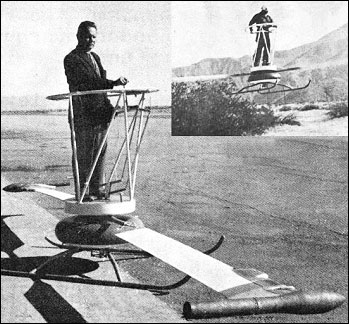
Mr. Gluhareff pioneered the use of liquid propane as a fuel for jet engines and a series of ultra-light portable one-man-helicopters, MEG-1X, MEG-2X and MEG-3X which were designed and built by his own company, Gluhareff Helicopters Corporation. All of which were powered by the G8-2 Pressure Jet Engine on the blade tip and test flown by Eugene M. Gluhareff.
Eugene Gluhareffs tip-mounted G8-2 engine MEG-3X was based on a dish-shaped platform on which the pilot would stand and a two-blade rotor revolving underneath the platform. No commercial development was undertaken.

Gluhareff MEG-2X

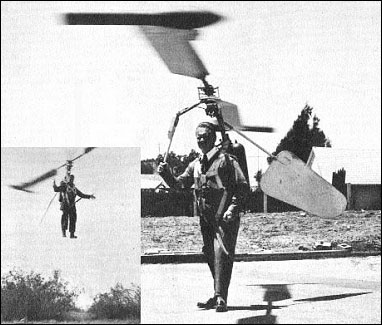
Mr. Gluhareff pioneered the use of liquid propane as a fuel for jet engines and a series of ultra-light portable one-man-helicopters, MEG-1X, MEG-2X and MEG-3X which were designed and built by his own company, Gluhareff Helicopters Corporation. All of which were powered by the G8-2 Pressure Jet Engine on the blade tip and test flown by Eugene M. Gluhareff.
The MEG-1X personal strap-on helicopter rig with a tip-mounted G8-2 engine was followed by the MEG-2X which had a two-blade rotor. No commercial development was undertaken.

Gluhareff MEG-1X

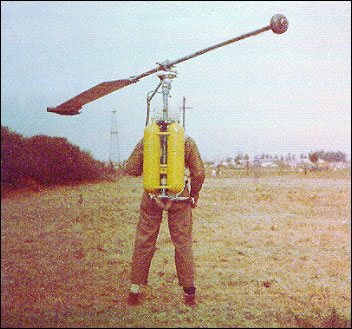
Eugene Gluhareff established a development company in 1952 to carry out research into pressure-jet powered light helicopters. Mr. Gluhareff pioneered the use of liquid propane as a fuel for jet engines and a series of ultra-light portable one-man-helicopters, MEG-1X, MEG-2X and MEG-3X which were designed and built by his own company, Gluhareff Helicopters Corporation. All of which were powered by the G8-2 Pressure Jet Engine on the blade tip and test flown by Eugene M. Gluhareff.
He built the MEG-1X personal strap-on helicopter rig which used a single-blade rotor with a tip-mounted G8-2 engine and followed this with the MEG-2X which had a two-blade rotor. No commercial development was undertaken.

MEG-1x
Take-off weight: 104kg
Max speed: 88.5km/h
Hovering ceiling: 1500m
Endurance: 14-18min

Gluhareff

Eugene M. Gluhareff was born in St. Petersburg, Russia in 1916 immigrating to the United States with his family via Finland in the early 1920’s.
An Aeronautical Engineer graduate of Rensselaer Polytechnic Institute in Troy, New York, he is a jet engine and helicopter designer and inventor. His extensive experience was acquired over many years of association with leading companies in the fields of design, research and development.
He has been a part of helicopter development since its beginning in 1940 with Sikorsky Aircraft Corporation in Bridgeport, Connecticut as a primary design engineer and project engineer. He worked directly under Mr. Igor I. Sikorsky and Mr. Igor A. Sikorsky, Chief of Aerodynamics. It was there he invented and developed the Pulse Jet Engine, a one-man single bladed jet helicopter which he test flew himself and also a Delta Wing Convertiplane for the United States Airforce.
In 1950 he moved to California and joined the American Helicopter Company in Manhattan Beach as a project engineer on a pulse jet powered helicopter (Top Sergeant). He was promoted to Chief of Preliminary Design and there designed the XH-26 One-Man-Jet Helicopter for the U.S.A.F.. Following this term with American Helicopter, he worked with Rotorcraft Corporation in Glendale, California as Design Engineer and was engaged in the redesign of a rocket powered one-man-helicopter for the U.S. Navy.
Eugene Gluhareff established a development company in 1952 to carry out research into pressure-jet powered light helicopters.
It was during this time that Mr. Gluhareff pioneered the use of liquid propane as a fuel for jet engines and a series of ultra-light portable one-man-helicopters, MEG-1X, MEG-2X and MEG-3X which were designed and built by his own company, Gluhareff Helicopters Corporation. All of which were powered by the G8-2 Pressure Jet Engine on the blade tip and test flown by himself.
In the early sixties, he was employed by the U.S. Navy at the Naval Ordinance Test Station in China Lake, California as an Aerospace Engineer FS-14 and Project Engineer on Rotary Drones. In 1964 he joined the Douglas Aricraft Company, Missile and Space Division as Design Engineer Scientist on the S-4 stage of the Saturn Rocket used on NASA’s Apollo Project. During this time he participated in the launching of four Saturns. Later he worked at McDonnel Douglas Aircraft in Long Beach, California as a Senior Design Engineer in Advanced System for Special Projects researching and testing rocket engines. There he became a specialist in the design of rocket stabilization systems for ejection seats and capsules.
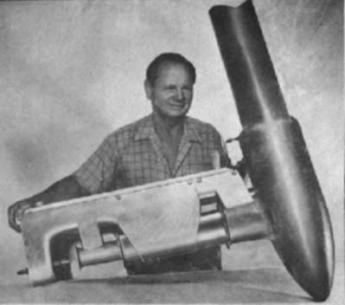
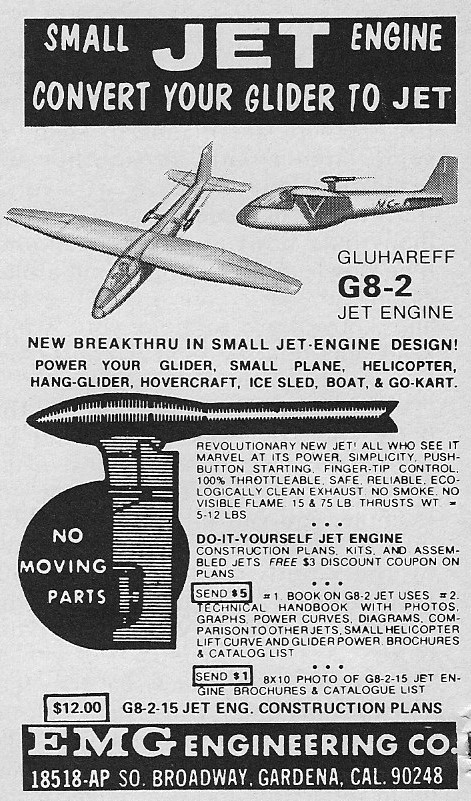
In 1972 Mr. Gluhareff returned to research and design under his own company name of EMG Engineering in Gardena, California. There he continued his work on the G8-2 Pressure Jet Engines which ranged from five pounds of thrust to 700 pounds of thrust. To further promote the study of aerodynamics and jet propulsion, Mr. Gluhareff designed and placed in universities throughout the country the Gluhareff GTS-15 Teaching Stand. He also had the G8-2 Pressure Jet Engine displayed as a working exhibit in the California Museum of Science and Industry in Los Angeles. The G8-2 Jet Engine had the honor of gracing the cover of Mechanics Illustrated in May of 1973 and again in January 1975 in the Jet Powered Go-Kart.
Mr. Gluhareff designed, built and tested his own one-man tip jet helicopter, the EMG-300 in the early 90’s. Its successful test flight marked the realization of Mr. Gluhareff’s lifelong dream to design what he called a “Flying Motorcycle”. He had several patents issued and applied for, for his inventions. Some of which are the G8-2 Jet, Valveless Pulse Jet, Portable and One-Man Helicopters, Flying Platform, Rotorcar, Convertiplane, Rocket Stabilization Unit and others.