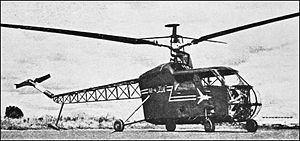
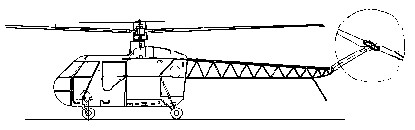
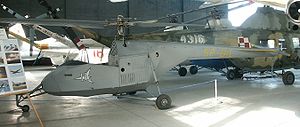
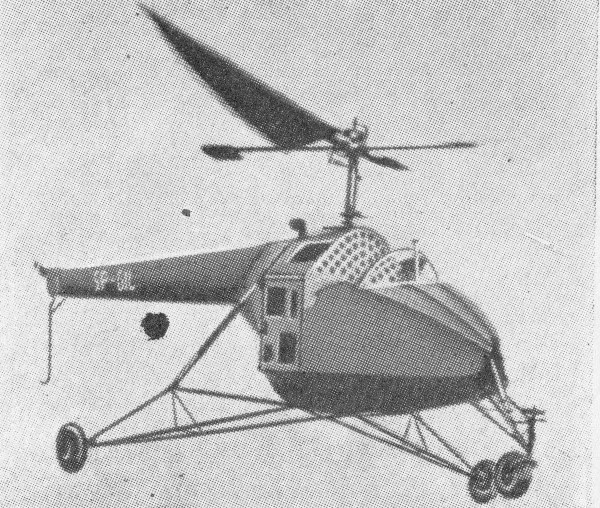
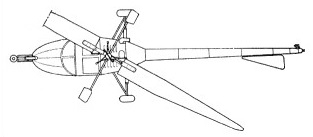
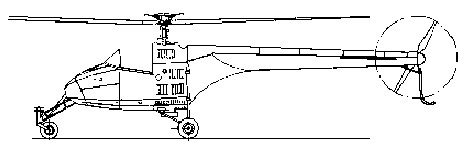
Work on the BŻ-4 Żuk began at the research institute Główny Instytut Lotnictwa – Main Aviation Institute in Warsaw in 1953, under the leadership of Dipl. Ing. Bronisław Żurakowski, who had earlier designed the experimental BŻ-1 GIL helicopter. Due to the delicate political situation in postwar Poland (Soviet influences and centrally planned economy), progress was slow. The main object was to produce a simple and inexpensive general use light helicopter. Its purpose was also to develop and test the novel rotor and transmission system, which eliminates vibration and improves control. Initially it was designated GIL-4. The BŻ-4 Żuk was based on a single main three-blade rotor powered by an indigenous one 320 hp Narkiewicz WN-4 piston engine in a fuselage made of a steel frame, behind a cabin section. It had an open frame rear boom structure and a fixed four-wheel undercarriage. Main rotor was atypical, for it had a smaller upper steering rotor and was fitted with an automatic stabilization system, of the Hiller principle. The cabin had four doors with two front seats and a rear bench. There were two fuel tanks, 220 litre in total. Four main variants were planned: a passenger version accommodating a pilot and three passengers, an ambulance variant carrying pilot, one stretchers and an attendant, an agricultural variant carrying pilot and spraying or dusting equipment and a dual control trainer. The first prototype of the BŻ-4 Żuk four-seat helicopter was manufactured and displayed publicly in the Polish Aviation Day Exhibition in August 1956. Due to a long program of ground testing and fixing faults, it flew first only on 10 February 1959 and completed 17 flights for a total of 3 hrs, 40 minutes. The Żuk was still in the development stage when further work was cancelled in favor of the licence production of the Mil Mi-1, that had already started in WSK PZL-Świdnik. The prototype was damaged during landing on 31 August 1959, and despite being repaired, it was not used again. Two additional prototypes were not completed. One damaged and incomplete prototype is preserved in the Polish Aviation Museum in Kraków.
Powerplant: 1× Narkiewicz WN-4 7-cylinder air cooled radial engine, 320 shp (237 kW) Fuselage length: 10.55 m Rotor diameter: 12 m (39 ft 4.5 in) Height: 2.8 m Empty weight: 1,050 kg (2,313 lb) Loaded weight: 1,500 kg (3,307 lb) Useful load: 450 kg Maximum speed: 156 km/h (97 mph) Range: 260 km (161 miles) Service ceiling: 3000 m Rate of climb: 4.6 m/s, 276 m/min Crew: one, pilot Capacity: three passengers
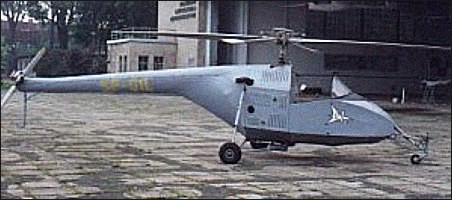
The BŻ-1 was designed at the research institute Główny Instytut Lotnictwa – Main Aviation Institute in Warsaw, from an initiative of Zbigniew Brzoska. The Polish aviation industry was destroyed after World War II, and in addition, the principal of the Institute was the only person who had seen a helicopter (Sikorsky R-4 in England). Despite severe material shortages, work on the experimental design started in 1948, and the main designer became Bronisław Żurakowski (brother of test pilot Janusz Żurakowski), who designed the helicopter rotor and the control system. It used simpler Hiller rotor type, with two auxiliary blades. The structure of the fuselage, tail boom, auxiliary rotor and tricycle undercarriage were designed by Tadeusz Chyliński. The power unit and final drive were designed by Zbigniew Brzoska. The design utilized some components left by the Germans, like a piston engine Hirth HM 504 (configured for vertical use) and wheels from a glider’s landing gear. Initially, the helicopter had no name. It only received the registration SP-GIL, from the Institute abbreviation, and soon it became known as GIL (gil also means bullfinch in Polish). Later it was also given the designation BŻ-1, from Żurakowski’s initials. The helicopter was completed by the end of 1949. During the first flight trial on 15 January 1950, it was overturned by a wind gust and had to be repaired. The test pilot was Bronisław Żurakowski, who taught himself fly a helicopter. The helicopter first flew on 4 April 1950, restrained on tethers by two men for a measure of safety. During 1950-1953, it underwent a test program and was often modified. At first it had elastic rotor blades. In 1950, it was fitted with rigid blades and an efficient simple custom designed resonant vibration eliminator. During tests, for different reasons, it crashed or was damaged without casualties, at least seven times and was repaired each time.
On 20 July 1952, the BŻ-1 GIL was first displayed to the public, during an air show at Okęcie airfield (it was one of first public helicopter presentations in the Eastern Bloc). On 16 November 1953 the helicopter was damaged when the main rotor was bent by the wind and cut off the rear pylon, thus ending the test program. By then, the prototype had completed 169 flights, 20 hours 21 minutes in total.
In 1956, the helicopter was repaired and used for training flights by helicopter pilots. On 28 June 1957, a tail rotor gear (originally from a World war II Zündapp motorcycle) broke and it could not be replaced, consequently, the helicopter never flew again, being written off in 1960. During 1956–1957 it had completed 185 flights, for a total of 12.5 hours. Currently, the sole BŻ-1 GIL prototype is preserved in the Polish Aviation Museum in Kraków.
Powerplant: 1× Hirth HM 504, 105 hp Length: 8.5 m Rotor diameter: 8.8 m / 28 ft. 11 in Rotors: 2-blade main; 2-blade tail Height: 2.29 m Disc area: 60.8 sq.m Empty weight: 380 kg Loaded weight: 610 kg / 1,276 lb Maximum speed: 140 km/h / 87 m.p.h Cruise speed: 120 kph Service ceiling: 2000 m Absolute ceiling: 3000m / 9,840 ft Range: 275km / 112 miles at 73 m.p.h. Rate of climb: 4.5 m/s Seats: 2
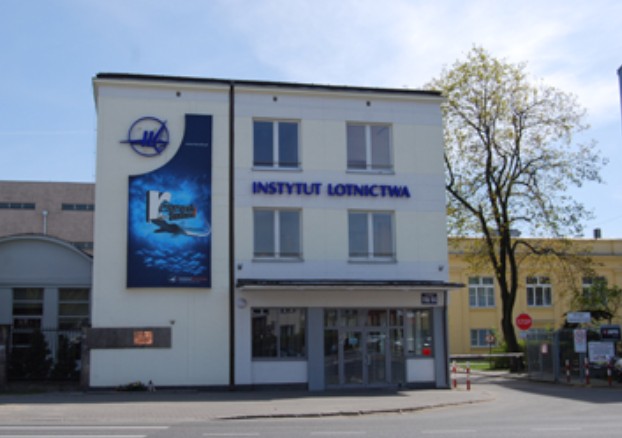
Technical Research Institute of Aviation Institute of Aviation
Institute of Aviation al. al. Krakowska 110/114 Krakow 110/114 02-256 Warszawa 02-256 Warsaw Poland
Aviation History of the Institute goes back to the beginnings of Polish independence, but the official start date of the Institute is 1 August 1926. In the initial phase of its operation, acted as the Institute of Technical Research Institute of Aviation. This name survived to the beginning of World War II. Activity in the period 1926-1939 focused primarily on testing and certification of aircraft. All the pre-war Polish military aircraft were tested and certified at the Institute, including the PZL P.11 , PZL.23 Karas , PZL.37 Moose , PZL.38 , and PZL.44 Wind.
In 1948 the Institute changed its name to the Central Institute of Aviation, and 1952 was named Institute of Aviation. In the post war period, constructors dealt mainly with the design and manufacture of licensed Po-2 and MiG-15. The Institute developed pulse motors and jets. In the early years of its operation activities of the Institute focused on the study of equipment derived from the Soviet Union and placed on the license production.
In 1946, the LWD Szpak , a year later, the first glider IS-1 Vulture , after which they were SZD-6 Bat , SZD-8 Swallow , SZD-9 Bocian , Marshmallow SZD-19 , SZD-24 Foka . The Institute of Tadeusz Sołtyk designed the PZL TS-8 Bies and the first Polish jet aircraft TS-11 Iskra , the engine designed in the Institute
Institute engineers also designed the first helicopter: BZ-1 GIL, BZ-4 Zuk and JK-1 Bumblebee. The Institute also, in 1972, designed and built a flying laboratory, the Lala-1. It was a heavily modified aircraft An-2 , which later tested technologies used in the construction of the PZL M-15 (Belphegor) .
In addition to aircraft construction facility began to specialize in designing and testing flying objects such as rockets and flying targets, including the Meteor 1 meteorological rocket project. Subsequent years of the Institute was developing a training-combat aircraft for the military, which resulted in the I-22 Iryda. The institute designed a four-seat, composite passenger aircraft, the I-23 Manager (flown in October 1998, for deliveries from 1999), two-seater trainer, the I-25 ace, two-seater helicopter patrol trainer IS-2 and a rescue patrol-hovercraft, the PRP-560 Ranger.
Proposed the Kobra 2000 in 1993 for air – to- ground combat operations in the next century, but abandoned.
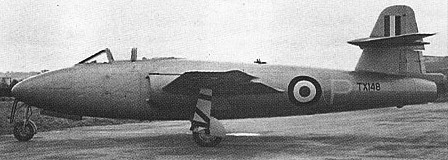
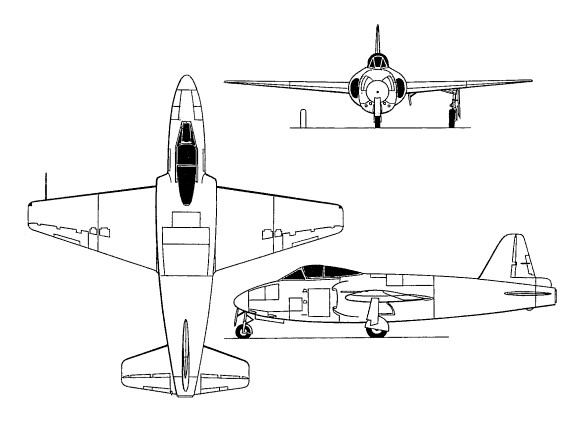
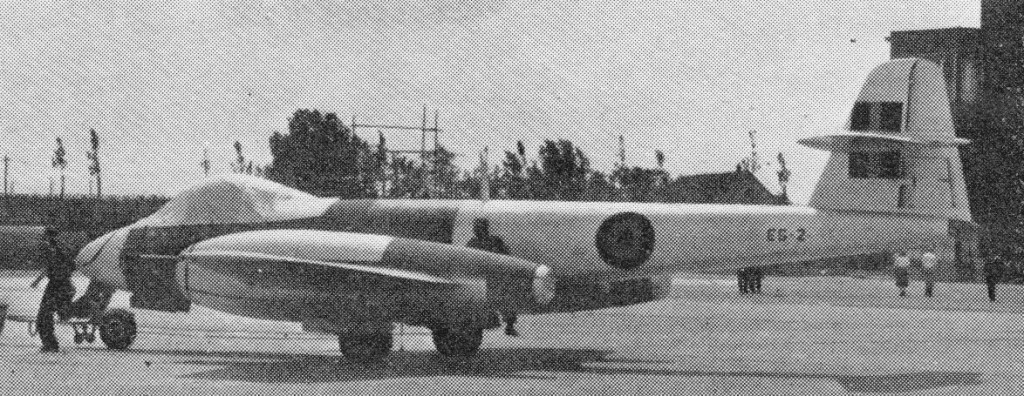
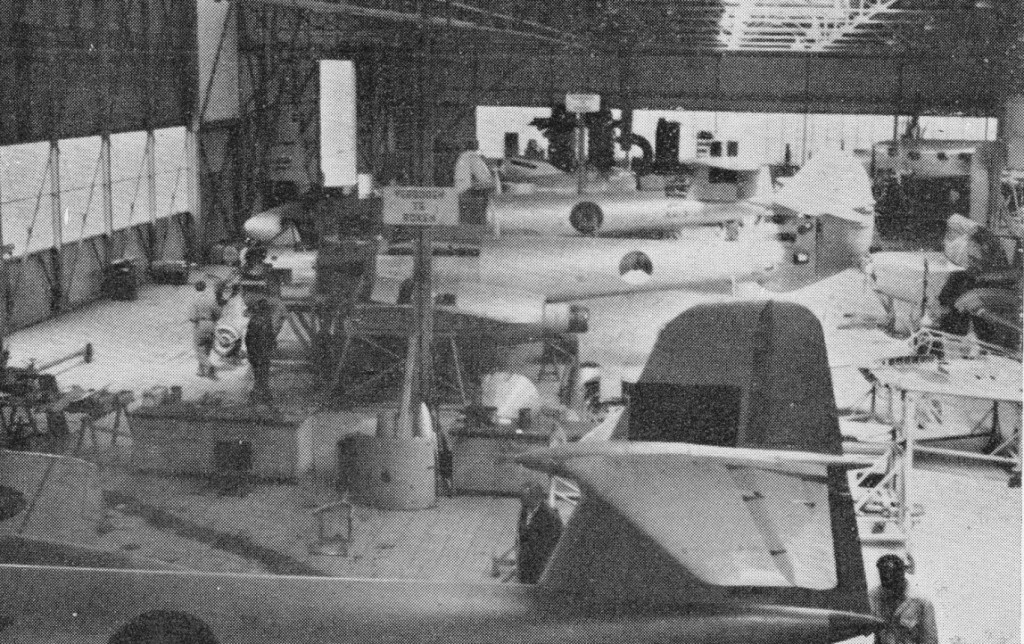
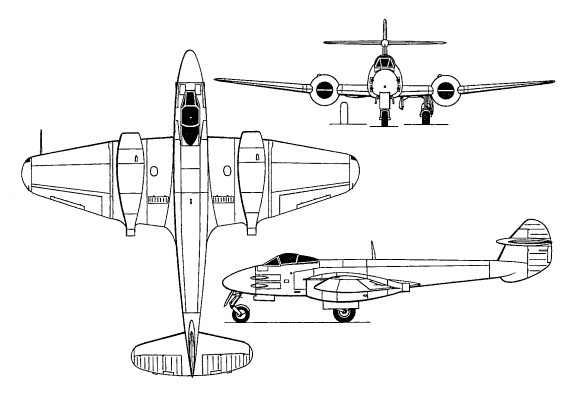
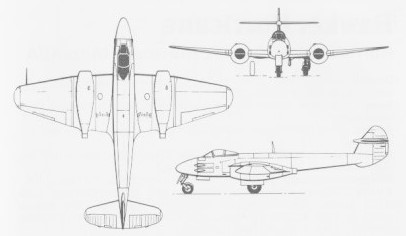
Late in 1944, Gloster began construction of an all-metal single-seat fighter designed around the RB.41 centrifugal-flow turbojet being developed by Rolls-Royce and to emerge as the Nene. To the requirements of Specification E.1/44, the first prototype was completed in July 1947, but suffered irreparable damage when the vehicle transporting it to the A&AEE was involved in an accident. A second prototype was completed and flown on 9 March 1948, this being powered by a 2268kg Nene 2 turbojet and having provision for four 20mm Hispano cannon. After initial flight testing the tail assembly was redesigned to improve handling. A third prototype was flown in 1949, and a fourth was nearing completion when it was decided that the single-engined fighter lacked the development potential of the twin-engined Meteor, further work being discontinued.
Max take-off weight: 5203 kg / 11471 lb Empty weight: 3747 kg / 8261 lb Wingspan: 10.97 m / 35 ft 12 in Length: 11.58 m / 37 ft 12 in Height: 3.55 m / 11 ft 8 in Wing area: 23.60 sq.m / 254.03 sq ft Max. speed: 998 km/h / 620 mph
The Gloster Meteor was an important development platform for many jet related technologies including early engine design, this is highlighted by the fact that the eight Meteor F9/40’s were powered by no less than four entirely different engine designs with only two powered by the same engine (The W2/B 23’s of DG205 & DG208).
In many ways the Meteor contributed more at the end of their service life which is seen for the first time with F Mk I Meteor EE227.
Rolls-Royce began to develop the experimental Trent in May 1944, using as the basis of the engine the centrifugal-flow Derwent turbojet which was to power the F.3 and later marks of the Meteor.
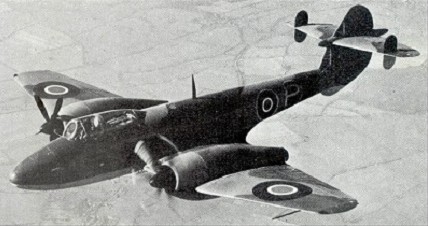
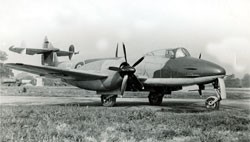
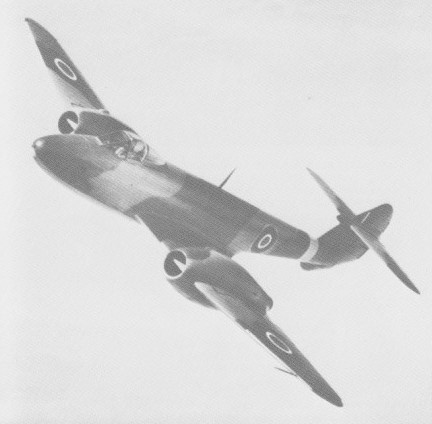
EE227 was originally issued to 616 squadron but after just 80 hours was retired from service in favour of the improved Meteor F. Mk III. Initially sent to RAE Farnborough it soon moved to Rolls Royce at Hucknell in March 1945 where its Derwent Turbojets were exchanged for a pair of Rolls Royce RB50 turboprops.
Fitted with 7ft 11 inch Rotol propellors and reduction gear the combination produced 750 shp and 1,000 lbs of jet pipe thrust. Other modifications included a six inch undercarriage extension for better propellor clearance and ballast in place of its cannons. It first flew from Church Broughton on the 20th September 1945 with Eric Greenwood at the controls.
Initial trials showed that the aircraft was directionally unstable which was improved by the addition of small fins on the horizontal stabilizer fitted in May 1946. Later the propellors were reduced in size to 4ft 10.5 inches which had the effect of reducing shaft horsepower to 350 although jet thrust increased to 1,400 lbs. In April 1948 the aircraft spent time at Boscombe Down in simulated deck-landing trials. In total it accumulated 47 hours of flight time in a successful program which would lead to the Rolls Royce Dart turboprop. After having its engines removed in October 1948 it ended its days as a standard F Mk I in fire destruction tests at Farnborough.
Engines: 2 x Rolls-Royce R.B.50 Trent turboprops, 1305kW Wingspan: 13.12 m / 43 ft 1 in Length: 12.57 m / 41 ft 3 in Height: 3.96 m / 12 ft 12 in Wing area: 34.75 sq.m / 374.05 sq ft Crew: 1
Designed by George Carter, the Gloster Meteor began life in response to Specification F 9/40, which called for a single-seat interceptor. The jet engine was still very much in its infancy when this project got under way and the low thrust available from early powerplants of this type necessitated the adoption of twin-engine layout from the outset. Under the impetus of war, design progress was swift and was rewarded with a contract for 12 prototypes in February 1941, although only eight of these prototypes were eventully completed.
The eight original F.9/40 airframes were used to test several different types of British gas turbines including the Rover-built Power Jets W2B, the parent design of the Rolls-Royce Welland with which the Meteor I was fitted; the Metropolitan Vickers F.2/1, the first British axial-flow unit to fly (13 November 1943); the Halford H.1, the predecessor to the de Havilland Goblin; and the Rolls-Royce Trent, the first turboshaft engine to fly. Actually the 6530kg Halford-engined F.9/40 was the first version of the Meteor to fly (on 5 March 1943) as the W2B engines (4360kg) installed in another F.9/40 in July 1942 were not ready for flying until June 1943.
The eight prototypes built (DG202 – DG209) were used for both airframe and powerplant development trials. Due to difficulties with supplies of the first jet engines the first flights of the prototypes were spread over several years with the last of them flying after the first F.Mk I’s were in service with the RAF.
Developmental aircraft –
DG202 First Flight: 24th July 1943 Rover W.2B/23 turbojets.
DG203 First Flight: November 1943 First flown in 1943 with two Power Jets W.2/500’s. Its next flight was almost a year later in October 1944 with more powerful W.2/700’s.
DG204 First Flight: 13th November 1943 Metropolitan-Vickers F.2, Axial-Flow turbojets, crashed 1st April 1944 after just 3 hours 9 minutes flying time.
DG205 First Flight: 12th June 1943 Rover W.2B/23’s, second to fly.
DG206 First Flight: 5th March, 1943 First to fly. de Havilland Halford H.1 turbojets (2,700 lbs thrust).
DG207 (prototype Meteor Mk II) First Flight: 24th July 1945 de Havilland H.1 Goblin, later became the prototype F. Mk II.
DG208 First Flight: 20th January 1944 First to be fitted with dive brakes and Rolls Royce W.2B/23 engines. Modified fin and rudder
DG209 First Flight: 18th April 1944 Early version of W.2B/37 Derwent I.
Although the first flight of a Meteor was with the de Havillands turbojet, production Meteors were powered by engines developed by Rover and later Rolls-Royce W.2B/23 Welland 1 reverse-flow turbojets with centrifugal-flow compressors, with the de Havilland engines allocated entirely to Vampire production which entered service shortly after the end of WW II. Trials with the Metropolitan-Vickers engines also were not wasted despite being cut short by the crash of DG204 and plagued by early problems as the F.2 developed into the successful Beryl turbojet and led directly to the Armstrong Siddeley Sapphire two of which were fitted to a Meteor making it the most powerful ever to fly.
The first of these began taxi trials with four types of engine in June 1942 but it was not until 5 March 1943 that the type took to the air for the first time, this maiden flight being made by the fifth prototype. By then, the Meteor had been ordered into production.
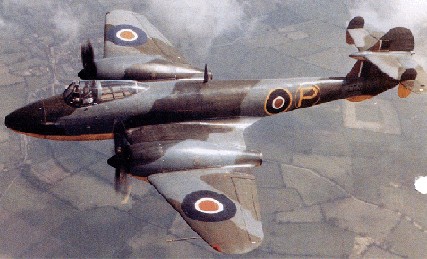
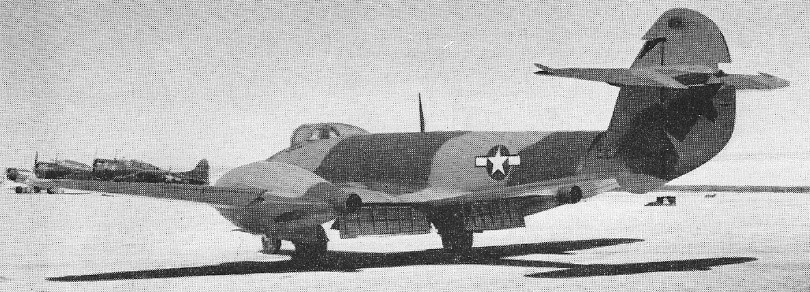
Only twenty Mk I’s were built, sixteen of them serving with RAF. Two of the three prototype Mk I’s EE211 & EE212 were delivered to RAE Farnborough for trials and design development, while the first EE210 (First flight 12th January 1944) was delivered to Muroc AFB in exchange for an example of the Bell X59 Airacomet.
Gloster Meteor I EE210/G first production model at Muroc, Spring 1944
The /G (guard at all times) and prototype designation on the fuselage are still carried by DG202 at Cosford today. EE211/G was the second production Meteor, an F.Mk 1. Armed with four 20-mm cannon andpowered by two Wellan d I turbojets, it could reach a speed of 668 km/h (415 mph). Meteors provided good training for American bomber crews now faced with attacks from Me 262s.
616 Squadron at Cultrihead took delivery of the next ten EE213 – EE222 and the four aircraft EE224 – EE227 in July 1944. The last two deliveries EE228 & EE229 being attrition replacements for EE224 & EE226 with the latter crashing just two days after delivery. The first took delivery of the Meteors at Culmhead on the 12th July 1944 moving shortly afterwards to Manston in Kent where they started operations against the V1 flying bombs.
The squadron then moved to Manston where they would later take the Meteor into Europe although they were prohibited from flying over enemy lines because of the secrecy of the materials used in the engines. At 2.30pm on Thursday 27 July 1944, an RAF Gloster Meteor of No.616 (South Yorkshire) Squadron left its airbase at Manston, Kent, to make its first anti-V-1 patrol flight over the Channel, but it met no flying bombs. Shortly after, two more Meteors took off, and Sqn.Ldr. Watts saw a V-1, overtook it near Ashford, and pressed the firing button; but the guns jammed and the V-1 got away
On 4 August 1944 Meteor III won its first aerial victory, when Flt.Lt. P.J. Dean met a V-1 flying bomb about 3.5 miles south of Tonbridge, Kent. His Meteor cannon jammed repeatedly, so he knocked the flying bomb off course with his wings and made it crash. Several minutes later a second Meteor pilot, Fl.Off. J.K. Roger, reported that he too had downed a V-1 near Tenterden, Kent. Starting 11 August, 616 kept two Meteors on patrol duty throughout the day; each pair would patrol for 30 minutes while two more waited to take off and replace them. The squadron later moved to Belgium where it was joined by No. 504 Squadron with Meteor Mk III aircraft, also with Welland engines, but fitted with sliding hoods.
Meteor F.III EE245 No.15 Sqn Derwent engines
A Meteor was also used in the first tests of a ground level ejection seat. The production Meteor F.1 was powered by two 7400kg Rolls-Royce Welland 1 turbojet engines and had a cockpit canopy that was side-hinged.
Meteor F.I of 616 Sqn July 1944
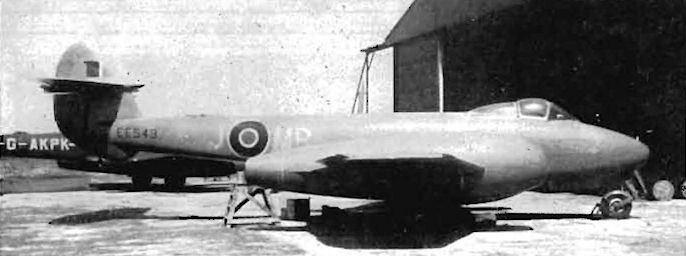
At RAE Farnborough EE211 was fitted with a pair of Powerjets W2/700’s and long cord engine nacelles which improved its high speed performance while at Rolls Royce EE223 in addition to being the first Mk 1 to have a pressure cabin for high altitude flight was also fitted with the more powerful W2B/37 Derwent I’s. The most interesting developmental Mk I was EE227, on its retirement by 616 Squadron in favour of the Meteor Mk III it became the world’s first turboprop, powered by a pair of Rolls Royce Trent’s.
The only Meteor F Mk II was the prototype based on DG207, also designated the G.41B it was powered by two DH Halford H.1 engines but did not enter production because its H1 engines (later known as the Goblin) were instead allocated to DH Vampire production following greater success with the W2/B Welland & Derwent designs after Rolls Royce became involved in engine production.
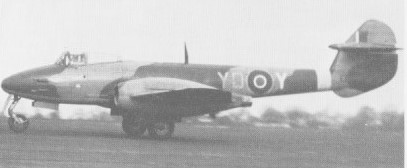
The first volume production version of the Meteor was the Mk III (G.41C) with a total of 210 aircraft built. Similar to the MK I except for the new sliding Malcolm canopy and slotted airbrakes it had a strengthened airframe to absorb the additional power from the 2,000 lb thrust Derwent I engines. Due to production difficulties the first 15 had to make do with W.2B/23 Welland engines although some of these aircraft may have been retrofitted later once sufficient engines were available. These early aircraft almost all operated by 616 Squadron can be distinquished from the Derwent powered Meteors due to their slightly longer jet-pipe which protruded from the rear of the nacelle to a greater extent.
The Meteor F.Mk III saw operational service with 504 Squadron as well, being mainly em¬ployed in ground attack duties, but only a few of the 280 Meteor F.Mk IIIs built had entered service by VE-Day. Many of the first Meteor F. Mk III deliveries were painted white. This may have been an effort to prevent the Meteor from being mis¬taken for a German jet, as was the only No.616 Sqn Meteor F. Mk 1 to be shot at in the first three months (by a Spitfire).
The standard engines were two 8720kg Rolls-Royce Derwent Is, although the first 15 Mk 3s were fitted with Wellands. Sliding cockpit hoods were standard and provision was made for a long-range fuselage drop tank. The last 15 F.3s were fitted with the lengthened engine nacelles standardised on the Mk 4.
Many F Mk III’s were used in aviation research either directly from the Gloster production line or after squadron service including EE416 which went to Martin-Baker for ejection seat trials. Two others were fitted with strengthened undercarriage and a V Frame arrestor hook for deck landing trials on HMS Immplacable.
One of the thirty F Mk. III’s allocated for tests and trials showed the benefit of increasing the chord (length) of the engine nacelles. With the longer nacelles there was less compressibility buffetting at high speeds leading to an increase in the redline speed at 30,000 ft of 75 mph. As a result of these tests the last fifteen F Mk. III’s were delivered with longer nacelles. The increased power of the Derwent engine and this performance improvement led directly to the Meteor F4 and its successful attempt at the world absolute air speed record.
Two F Mk III’s were evaluated by foreign air forces with Mk III, EE311 going to the RCAF although it didn’t last long, running out of fuel and being ditched in June 1946. The second aircraft was operated for some years by the RNZAF. Re-serialled NZ6001 it was demonstrated throughout New Zealand from late in 1945 and eventually purchased for £5,000. It later became an instructional airframe and was scrapped in 1957.
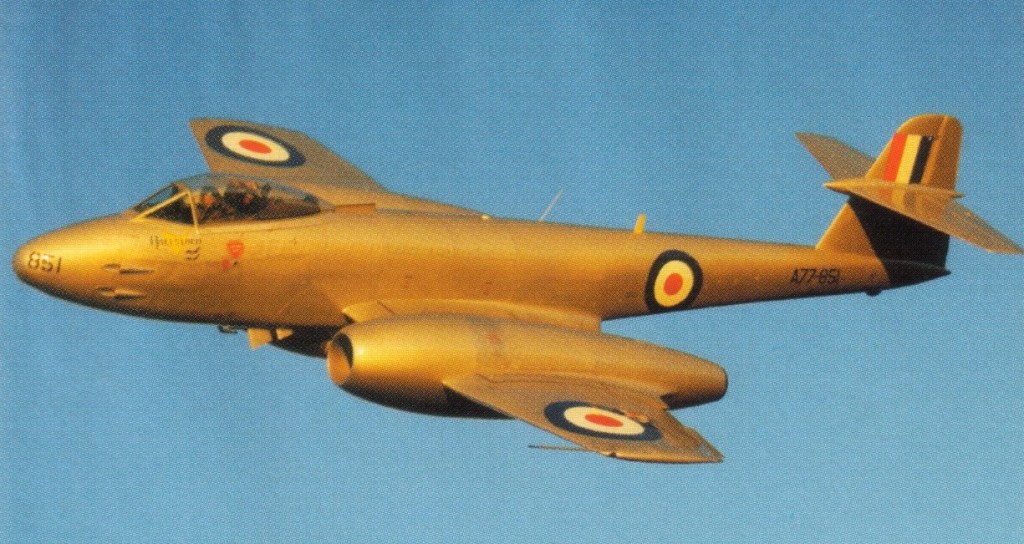
In May 1946 a F.3 Meteor was taken on charge by the Royal Australian Air Force, becoming the first RAAF jet fighter. It was not until 1951 that Meteors entered regular service with the RAAF and then they did so with a true “baptism of fire”. Meteor F.8 aircraft were taken into action by 77 Squadron RAAF, in Korea, against the Mig-15.
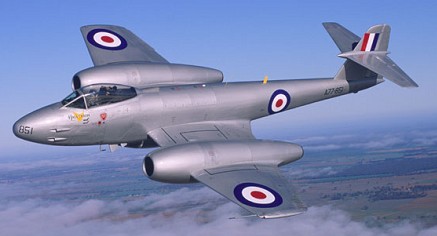
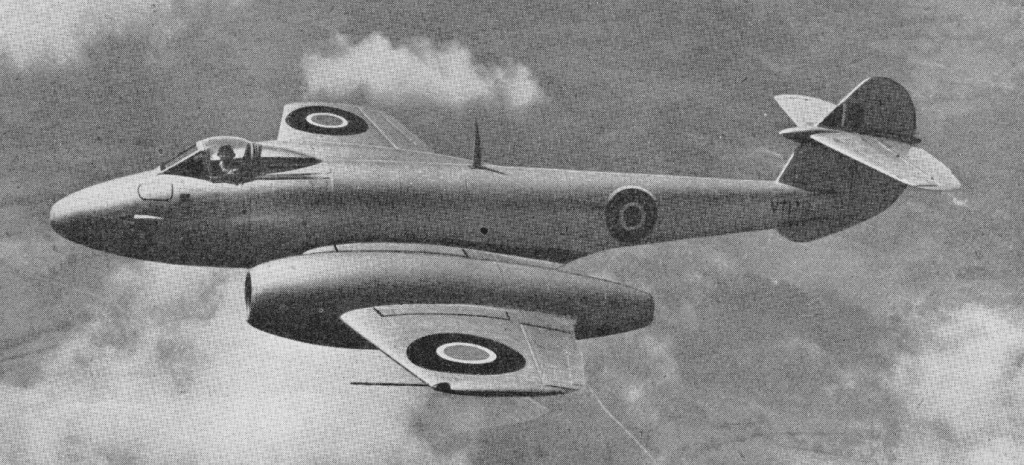
Production then switched to the Meteor F.Mk 4 with much more powerful engines, 583 being built be-tween 1945 and 1950.The first example flying on 12 April 1945. Power was provided by two Derwent 5 engines and the wing span was reduced to 11.33m to improve the rate of roll. Other features included long engine nacelles, pressure cabin, and fittings for bombs and rocket projectiles. An aircraft of this version set up world speed records on 7 November 1945 and 7 September 1946, flown by Group Captain E. M. Donaldson, of 975km/h and 991km/h respectively.
The Meteor 4 once used by Air Chief Marshal Sir James Robbs as his personal aircraft.
The private venture Meteor T.7 was a two-seat training version of the Mk 4, with the forward fuselage lengthened by 0.76m to accommodate tandem cockpits under a continuous canopy. No armament was carried. The first T.7 flew on 19 March 1948 and over 600 were built.
In the markings of the Brazilian Air Force, Meteor 7s were used in Britain to train Brazilian pilots. Brazil purchased 70 Meteor fighters and trainers.
Brazilian Gloster Meteor 7s
The F.8 was the most built of all Meteors with 1,522 being produced, first flown on 12 October 1948.
F.8
The F.8 differed in having a lengthened fuselage, redesigned cockpit and tail assembly.
The F.8 established international point-to-point records on London-Copenhagen, Copenhagen-London and London-Copenhagen-London in 1950 and in the following year set up a new international speed record over a 1,000km closed circuit of 822.2km/h.
The FR.9 and PR.10 were fighter-reconnaissance and unarmed photo- reconnaissance variants, the PR.10 having a similar nose and cockpit to the FR.9 but a 43 ft wingspan and an F.4 tail.
By 1950 the Meteor F.Mk 8 was well established in service, this model also being built under licence in Belgium and the Netherlands, embracing powerful Derwent engines, modified cockpit and canopy. 1090 F.8s were built.
Other single-seater variants included the Meteor FR.Mk 9 fighter-reconnaissance version of the Mk 8, and Meteor PR.Mk 10 unarmed version for high-altitude reconnaissance aircraft.
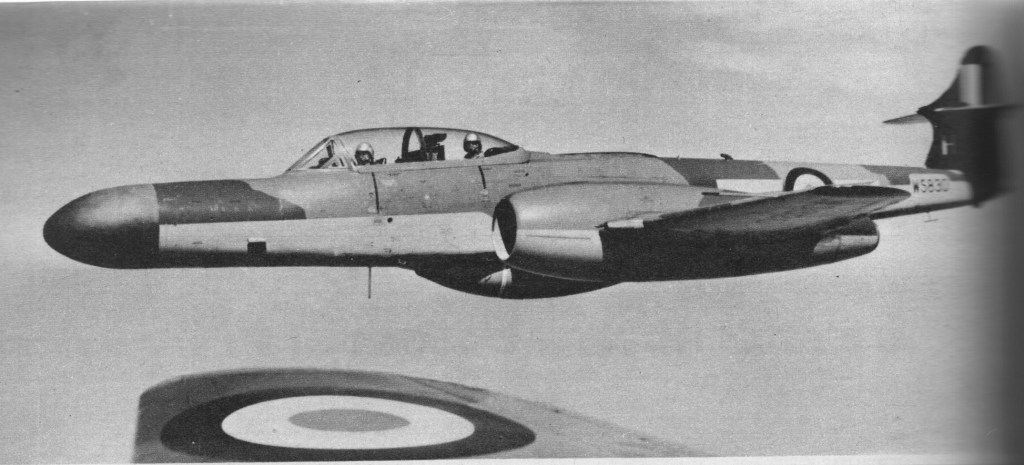
In addition to seeing widespread service as a day fighter, the Meteor also successfully adapted to night-fighter tasks, albeit as a two-seater. The initial variant engaged in this mission was the Meteor NF.Mk 11, the design of which was undertaken by Armstrong Whitworth was first flown in May 1950. The NF.11 had the longer span wing of the photo-reconnaissance Meteor, a lengthened nose to house the radar, tandem cockpits, and the tail of the F.8 day fighter. The four 20mm guns were transferred outboard of the nacelles. The NF.11 weighed about 14 ton at MAUW which included 700 gallons of fuel, two integral tanks of 375 gallons, an external ventral of 175 gallon, usually permanently fitted and two 100 gallon wing tanks. The NF.11 being succeeded by the Meteor NF.Mk 12 of April 1953 had a lengthened nose and improved radar, and a faired tail bullet which effectively increased fin area with a different radar, the NF.Mk 13 with tropical equipment, and the Meteor NF.Mk 14 was tested late in 1953 with a clear-vision canopy and other refinements.
The Meteor NF.14 Night Fighter was the last major development of the line. The NF.14 was a two-seat, twin-engined monoplane, powered by two Rolls-Royce Derwent 8 turbojets, each delivering 3,600 lb thrust. The service ceiling was 40,000 feet and the maximum speed was 579 mph. Its range, with ventral and underwing tanks, was approximately 950 miles at altitude. A ventral fuel tank was normally carried and two under-wing tanks of 100 Imp.Gal. were optional.
Meteor night-fighters were used for experimental launching of guided missiles.
Night-fighter production by Armstrong Whitworth totalling 547 aircraft.
Production of night-fighter variants eventually totalled 578, some later being modified for target towing duty as the Meteor TT.Mk 20 whilst many single-seaters served as Meteor U.Mk 15, Meteor U.Mk 16 and Meteor U.Mk 21 drones developed by Flight Refuelling Ltd.
The Meteor proved a success and over a thousand of the new fighters were built to re-equip twenty Fighter Command squadrons and ten squadrons of the Royal Auxiliary Air Force.
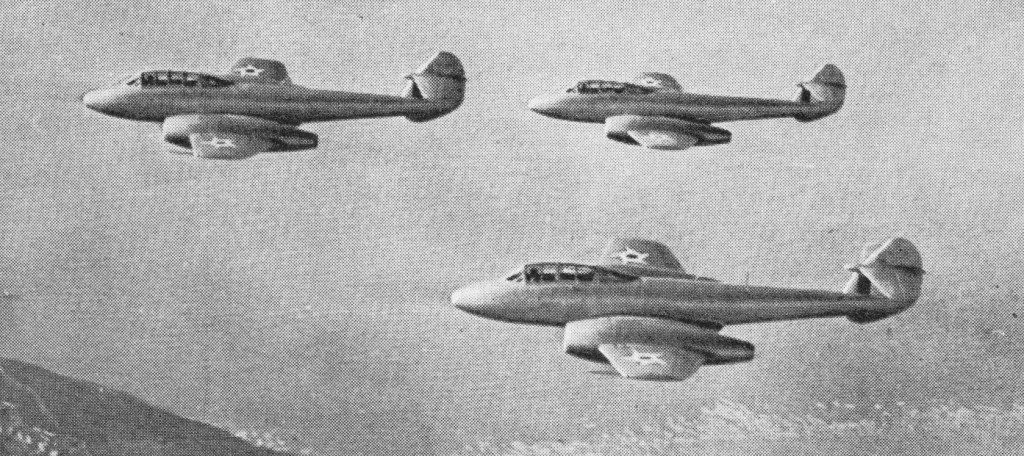
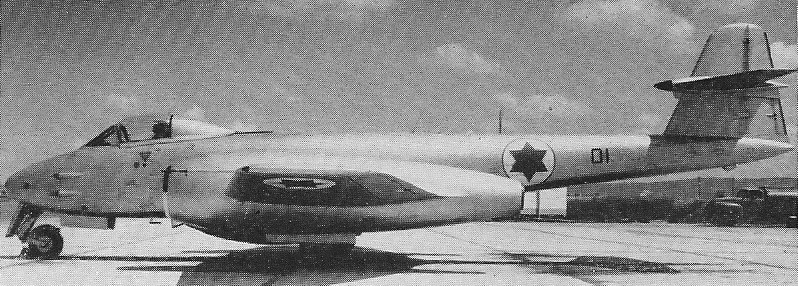
A total of 3,545 Meteors was produced by Gloster and Armstrong Whitworth., more than 1,100 of which were F.8s. Meteors were also exported in considerable numbers for service with the armed forces of Argentina, Australia, Belgium, Brazil, Denmark, Ecuador, Egypt, France, Israel, the Netherlands and Syria.
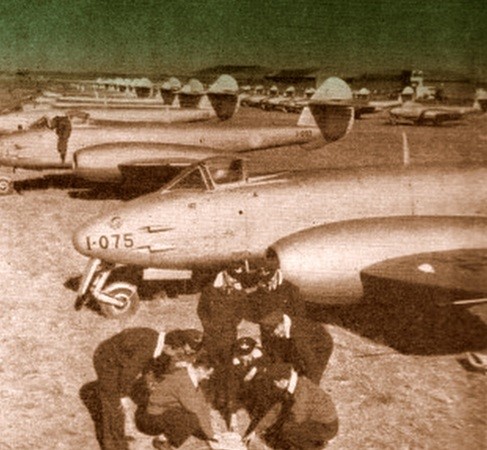
Argentine Meteors
Part of the group of Gloster Meteors that Argentina bought from England in the beginning of the 1950s to serve as interceptors. The Air Force ordered 100 F4, 50 were ex-RAF, 50 were new. It was due to a large debt that England owed to Argentina that the airplanes were acquired. England could not pay the debt outright so arrangements were made for the airplanes.
The Fokker assembled Meteor 8 (the first from British parts) were powered by Rolls-Royce Derwent 8s built in Belgium.
First Fokker assembled Meteor 8
By July 1950 production of 300 Meteor 8, to be evenly divided between the Dutch and Belgian Air Forces was underway at Fokker.
Two Belgian Meteor 8 and a Dutch Meteor 4 at Schiphol
To investigate a prone piloting position a Meteor F.8 was converted by Armstrong Whitworth circa 1955 to feature a prone position in a special elongated nose. Aft is a normal cockpit with a safety pilot. The prone-pilot Meteor was flown extensively from Baginton and Farnborough.
G.41 Meteor F. I Engines: two 771-kg (1,700-lb) thrust Rolls-Royce Welland 1 turbojets Maximum speed: 668 km/h (415 mph) at 3050 m (10,000ft) Service ceiling: 12190 m (40,000 ft) Empty weight: 3692 kg (8,140 lb) Maximum take-off weight: 6257 kg (13,795 lb) Wingspan: 13.11 m (43 ft 0 in) Length: 12.57 m (41 ft 3 in) Height: 3.96 m (13 ft 0 in.) Wing area: 34.74 sq.m (374.0 sq ft) Armament: four nose-mounted 20-mm Hispano cannon (provision for six) Crew: 1
Gloster G. 41 Meteor F.I Engines: 2 x Rolls Royce W.2B/23C Welland, 7564 N / 771 kp Length: 41.24 ft / 12.57 m Height: 12.992 ft / 3.96 m Wingspan: 43.012 ft / 13.11 m Wing area: 373.941 sq.ft / 34.74 sq.m Max take off weight: 13796.7 lb / 6257.0 kg Weight empty: 8140.9 lb / 3692.0 kg Max. speed: 361 kts / 668 km/h Service ceiling: 39993 ft / 12190 m Wing loading: 36.9 lb/sq.ft / 180.0 kg/sq.m Range: 1164 nm / 2156 km Crew: 1 Armament: 4x 20mm MG
Meteor F.III Engines: 2 x 2,000lb Rolls Royce Derwent IV Turbojets Span: 43ft Length: 41ft 3in. MAUW: 14,750 lb Maximum speed: 415mph at 30,000ft Service Ceiling: 40,000ft Rate of Climb: 3,300ft/min Range: 510 miles Armament: 4 x 20mm Hispano cannon
F.4 Engines: 2 x Rolls-Royce Welland, 1700 lb. Wing span: 37 ft 2 in (11.33 m). Length: 41 ft 4 in (12.6 m). Height: 13 ft 0 in (3.96 m). Max TO wt: 15,175 lb (6883 kg). Max level speed: 585 mph ( 941 kph).
F.8 Engines: 2 x 1633-kg (3,600-lb) thrust Rolls-Royce Derwent RD.8 turbojets. Wingspan 11.33 m (37 ft 2 in) Wing area 32.52 sq.m (350 sq ft) Length 13.26 m (42 ft 6 in) Height 4.22 m (13 ft l0 in) Empty weight 4846 kg(10,684 lb) Maximum take-off 7836 kg (17,275 lb) Fuselage Tank Capacity: 330 Imp Gal / 1,500 lt / 396 U.S. Gallons Ventral Tank Capacity: 175 Imperial Gallons / 796 Litres / 210 U.S.Gallons Maximum speed 953 km/h (592 mph) at sea level Initial climb rate 2134 m (7,000 ft) per minute Service ceiling 13410 m (44,000 ft) Range, clean 1110 km (690 miles) Range: 767 mi at 40,000 ft Armament: four 20-mm Hispano Mk V cannon / Two 1000lb (455 kg) bombs or eight 60 lb (27.3 kg) air to ground rockets. Wheel track: 19 ft 5 in Wheelbase: 13 ft 4 in
PR.10 Engines: 2 x Rolls-Royce Derwent R.D.8, 3600 lb Wingspan: 43 ft Length: 43 ft 6 in Height: 13 ft 10 in Wing area: 350 sq ft
NF.11 Engine: 2 x Rolls-Royce Derwent, 3500 lb. Fuel cap: 375 internal (+375 external) Imp.Gal. Armament: 4 x 20mm Hispano cannon. Max speed: 520 kts (430 kts with wing tanks).
Meteor NF.14 Engines: 2 x Rolls-Royce Dewent Span: 43 ft Length: 49 ft 11 in MAUW: 20,000 lb approx Max speed: 590 mph approx
Formed in 1917 as the Gloucestershire Aircraft Company Ltd. to take over subcontract work from the Aircraft Manufacturing Company and H. H. Martyn & Co Ltd. of Cheltenham. D.H.4 and D.H.6 fuselages had been built by Martyn, and by the end of the war the company had supplied 461 Bristol Fighters and 165 RAF F.E.2bs, as well as Nieuport Nighthawks and other fuselages. Fifty Nighthawks, renamed Sparrowhawks, were built for Japan to a 1920 order, and were shortly followed by the first true Gloucester aircraft, the Bamel single-seat racing biplane, designed and built in less than four weeks. H. P. Folland, joined the company soon after the Bamel’s completion. A line of biplane fighters followed, the Grebe and Gamecock being notable successes, and in 1926 the company was renamed Gloster Aircraft Company Ltd. moving its main factory to Hucclecote, Gloucester. Up to 1930, all but one of their machines had been single-engined, the exception being the A.S.31, which was not originally a Gloster design but based on the de Havilland DH.67B.
Joining the Hawker Siddeley Group in 1934, Gloster continued fighter production with the Gauntlet and Gladiator, the latter being the RAF’s last biplane fighter. Henry Folland, Gloster’s chief designer, would leave Gloster when it was taken over by Hawker in 1937.
During the Second World War Gloster built 2,750 Hurricanes and 3,330 Typhoons, and produced Britain’s first jet aircraft to specification E.28/39, the first of two single-jet prototypes flying in 1941 and leading to the twin-jet Meteor of 1944. A total of 3,545 Meteors was produced by Gloster and Armstrong Whitworth. Gloster’s final production aircraft was the twin-jet delta-wing Javelin all-weather interceptor, flown in 1951, of which 435 were produced for the RAF. Gloster ceased aircraft production in 1956. Gloster, Armstrong Whitworth and Avro joined Hawker Siddeley Aviation in 1965.
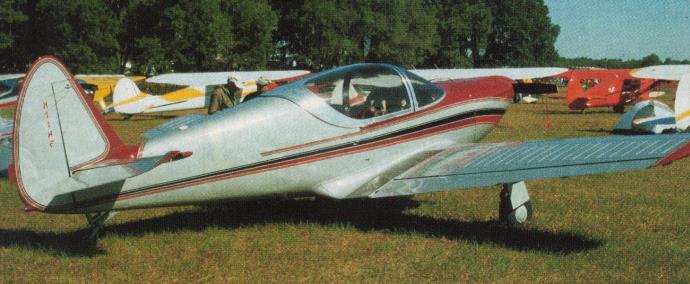
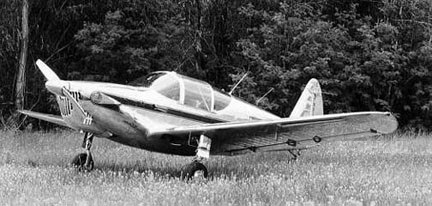
These all-metal side-by-side two seaters had retractable undercarriage and offered a ‘fighter-like” aircraft yet was powered by a small engine. Globe Swifts were priced at $2,995.
Texas Engineering & Manufacturing Co built 329 Globe Swifts under licence before Globe went bankrupt in August 1947, when it acquired rights in this aircraft. Temco priced the Swift at $3,250-3,750.
Temco GC-1B Swift
Including Globe production 1,093 were built from 1946 to 1951.
In 1989 Piper planned to produce the “sexy, spirited” SwiftFury, a 200 hp Lycoming powered 200 mph plus cruise update of the two seat Globe Swift designed in the late 1940s. Piper advised that some 350 SwiftFury orders have been placed with the 1989 price being US$118,900.00.
Formed originally as the Bennett Aircraft Corporation to manufacture aircraft from Duraloid, a new type of bonded plywood. Produced twin-engine eight-seat monoplane, the BTC-1, about 1940. Company reorganized and renamed Globe Aircraft Corporation in 1941. First design under new name was the GC-1 Swift, a two-seat light monoplane with retractable landing gear and Continental engine. Development stopped by war, but produced postwar from 1945. Company built also Beech 18s for U.S. Government during Second World War.
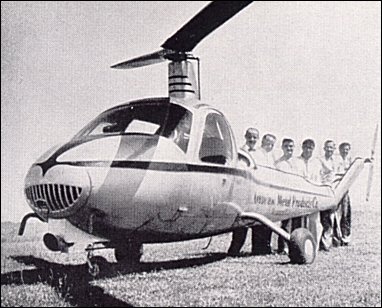
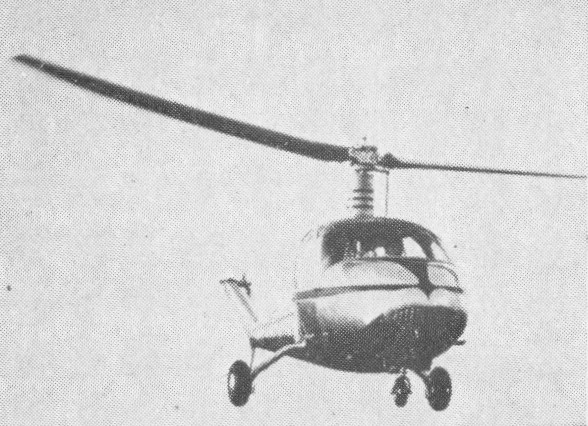
The two-seat ‘Humming Bird’ was originally designed by William E. Hunt. It was developed in 1947 by Frontline Helicopter Corp. as the ‘Flyride’ and the prototype (N544A) made its first flight in January 1948. It was a streamlined all-metal monocoque helicopter with an automobile-style forward fuselage and forward-swept rotor pylon. Power was provided by a 125hp Lycoming engine. The engine is in the aircraft’s nose, but instead of the five controls common to conventional aircraft, the Flyride has only two primary control units: a stick with a motorcycle grip, and a throttle. The stick, which rests on an arm between the two seats, governs all movements on the horizontal plane: an accelerator of the type used in motor vehicles controls upward and downward movement by means of a governor geared to the engine, and the pitch of the blades is regulated by the engine’s output in terms of revolutions per minute.
Since the cyclic control system is replaced by a fully tilting head, the rotor has no hunting hinges or drag hinges.
Frontline Helicopter was acquired by Glenview Metal Products and the machine became the GMP-1 Flyride. Glenview Metal Products Aircraft Division includes Robert Mattox, who was formerly aircraft designer with the Pitcairn Aviation Corporation and works manager with Piasecki Helicopter Corporation. In 1954 Glenview revived the prototype helicopter designed by William E. Hunt, with Hunt himself as consulting engineer. It was upgraded with a 135hp Lycoming in 1953 and was advertised to the public as the ideal personal helicopter.
GMP.I Flyride Number of seats: 2 Engine: Lycoming, 135hp Rotor diameter: 9.3m / 30 ft. 6 in Rotors: 2-blade main; 2-blade tail. Length: 10.82m Height: 2.62m Weight fully loaded: 750kg / 1,655 lb Empty weight: 522kg Cruising speed: 144km/h Inclined climb: 366m/min Absolute ceiling: 3810m Range: 448km Typical range: 280 miles at 90 m.p.h.

 All Aero