Government Aircraft Factories / GAF N22 Nomad

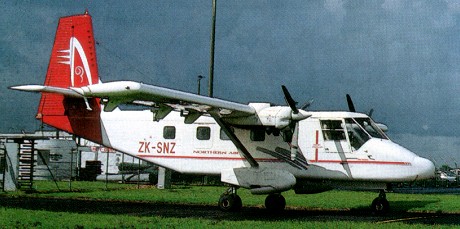
In 1965 design studies were started by GAF to find a follow-on production commitment. Interest expressed from commercial operators lead to a twin engined utility transport. Production commenced on the prototypes in January 1970 with flight testing beginning in 1971.


GAF Nomad N22 Article

Conversion to N.22A allowed an increase in AUW.

The final version, launched in May 1985, was the N22C, aimed at the commuter airline market and offering an increased all-up weight of 4,060kg. The N22C was a post-production variant with increased weights, strengthened undercarriage, improved tail structural design and other modifications. Most Nomads delivered from storage after production ended were to this standard and some earlier aircraft were modified.


Three military variants of the N22/N24 Nomad, the utility Missionmaster, the coastal surveillance Searchmaster B with 1200 scan Bendix radar, and the Searchmaster L with 3600 scan Litton radar, were built for five customers.

The Nomad is designed and built by the Government Aircraft Factories in Australia in two models. These are the short-takeoff-and-landing (STOL) Nomad N22B and the Nomad N24A commuter aircraft. Variations on the basic aircraft include the Mission Master, the Search Master for maritime surveillance work, and a photographic and mapping model. The aircraft have proven successful in many countries, often flying over rugged terrain in climates ranging from tropical to subarctic. Its STOL capability, originally developed for Australian military use, has made it ideal for operations in rugged areas such as the highlands of Papua, New Guinea. The N22B, capable of carrying up to 12 passengers, can take off in only 800 feet. The larger N24A is a later development of the basic aircraft capable of carrying more passengers and cargo.

The Nomad is characterized by simplicity of construction and systems, which contribute to its economy of operation. Its two Allison 250-B17C turboprops are rated at 420 shp, producing more than two horsepower per pound of engine weight. The B17C offers an improved single-engine high-altitude performance capability and a more rugged gearbox.

The Royal Thai Air Force received 20 N22B Missionmasters.
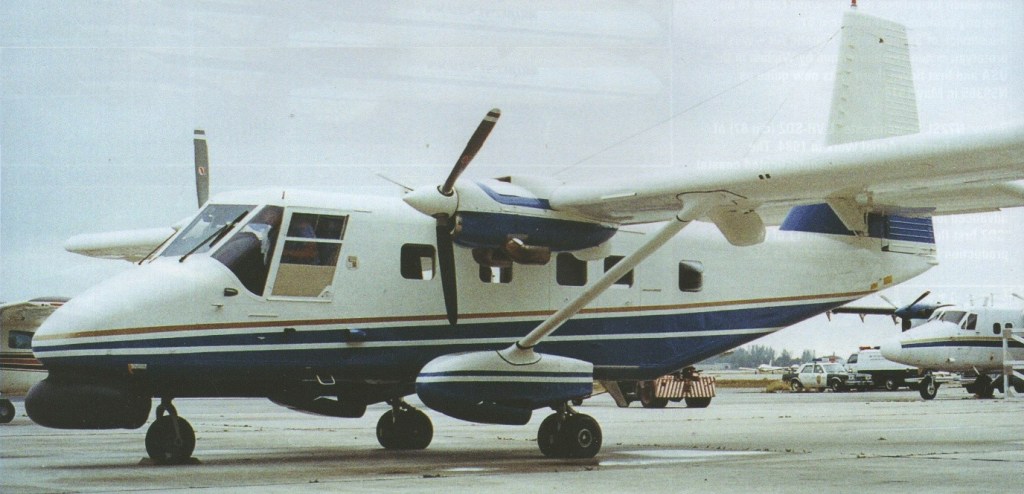
US Customs Service received 7 Searchmaster Ls from storage including VH-HTG cn160 becoming N6305U in December 1989

Gallery

N22B
Engines: 2 x Allison 250-B17, 416 shp.
Props: Hartzell 3 blade reversible 7 ft 6 in.
Fuel cap: 1030 lt.
Wing span: 54.0 ft (16.46 m).
Length: 41.2 ft (12.57 m).
Height (tail section): 18.12 ft (5.52m).
Main wheel track: 10.6 ft (3.23m).
Wheel base: 12 ft (3.66 m).
Propeller ground clearance: 4 ft (1.22m).
Wing area: 324 sq.ft (30.2 sq.m).
Wing loading at max. gross weight: 26.2 lbsft) 127.9 kg/ sq.m).
Power loading at max. gross weight: 10.2 lbs eshp (4.64 kg eshp).
(Excluding flight deck) – Cabin length: 17.5ft (5.34m).
Cabin height: 5.13ft (1.57m).
Cabin volume: 360 cu.ft (10.2 cu.m).
Cabin door size: 4.06 ft x 4.33 ft (1.24 m x 1.32m).
Baggage compartment volume (nose): 28 cu.ft ( 0.79 cu.m).
Baggage compartment volume (rear): 30 cu.ft (0.85 cu.m).
Take of pwr: 416 eshp (400shp).
Maximum continuous: 400 eshp (385 shp).
Maximum cruise: 380 eshp (366 shp).
Normal internal fuel tanks (usable): 227 Imp gals (1030 lt, 268 U S gals).
Maximum take-off: 8500 lbs (3856 kg).
Maximum landing: 8500 lbs (3856 kg).
Typical operating empty (including commercial interior and avionics): 4730 lbs (2146 kg).
Max fuel capacity (usable): 1793 lbs (813.5 kg).
Tyre size – Nosewheel: 35 p.s i. (241.1 KPa).
Mainwheels (dual): 29 p s i. (199.8 KPa).
All performance quoted at 8500 lbs (3856 kg) TO weight – STOL
Ground roll: 600 ft (183 m).
Distance over 50 ft: 1050 ft (320 m).
FAR 23 Ground roll: 800 ft (244 m).
Distance over 50 ft: 1360 ft (415 m).
STOL Ground roll: 250 ft (76 m).
Distance over 50 ft: 635 ft (194 m).
FAR 23 (no reverse thrust) Ground roll: 655 ft (200 m).
Distance over 50 ft: 1150 ft (351 m).
Stalling Flaps retracted: 68 knots EAS.
Flaps extended: 49 knots EAS.
ROC take-off rating: 1440 fpm (439 m/min).
ROC max. cruise rating: 1260 fpm (384 m/min).
ROC Single engine wax. continuous: 220 fpm (67 m/min).
Service ceiling: 22,500 ft (6858m).
Single engine max continuous rating service ceiling: 10,000 ft (3050 m).
Max. cruise speed — ISA, 5000 ft (1 525 m): 169 kt.
Cruise speed 90% power ISA 5000 ft: 165 kt.
Long range cruise speed 145 kts
TAS: 50 NM wth 3300 lbs (1496kg) payload; 860nm wth 1617lb (733kg).
Max cruise speed (168 knots TAS) range: 50nm wth 3280 lbs (1470 kg) payload; 730nm wth 1617 lbs (733 kg) payload.

N22C Nomad
Engine: 2 x Allison 250.
Installed pwr: 630 kW.
Span: 16.5 m.
Length: 12.6 m.
Wing area: 30 sq.m.
Empty wt: 2092 kg.
MTOW: 4060 kg.
Payload: 1630 kg.
Vne: 200 kts.
Cruise speed: 304 kph.
Initial ROC: 445 m / min.
Ceiling: 7620 m.
T/O run (to 15m): 400 m.
Ldg run (from 15m): 385 m.
Fuel internal: 1018 (+335) lt.
Range (std fuel): 1460 km.
Capacity: 13 pax.
Government Aircraft Factories / GAF

Department of Aircraft Production / DAP renamed GAF.
Aircraft production at Australian Government-owned factories began during Second World War with Bristol Beauforts and Beaufighters, and later included Lancasters and Lincolns (see Department of Aircraft production). Designed and produced Jindivik target aircraft, flown in 1952, after a piloted version, Pika, had flown in 1950. Built Mirage fighters and trainers for the RAAF in 1960s-1970s. Produced Nomad twin-engine STOL transport, first flown in July 1971
Aerospace Technologies of Australia Pty Ltd (ASTA) was founded 1987 to replace former Government Aircraft Factories (GAF) and Aircraft Technologies of Australia. Undertook aircraft maintenance, repair, and modification, including Airbus and Boeing airliners. Sold 1994 as part of Government privatization program, with Rockwell Australia Ltd. buying Commonwealth’s shareholding of ASTA Components, Defence and Engineering divisions; currently ASTA Components division of Boeing Australia Ltd. with new programs including work on an AEW&C aircraft under Project WedgetaiI.

Gossamer Albatross

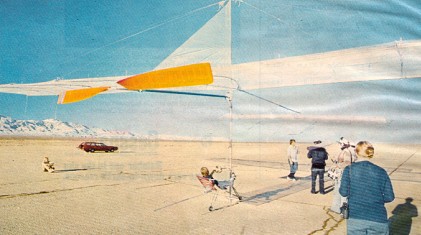
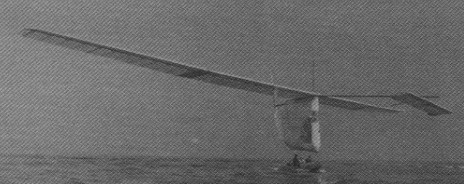
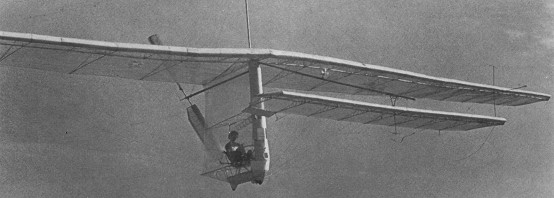
The Albatross had grown out of the Condor’s success but it is in a number of ways a very different craft — utilising carbon fibre reinforced plastic tubing for wing spars, bowsprit and gondola to produce a light, strong structure. The fuselage gondola and flying surfaces are covered by a Mylar plastic film, attached by double-sided adhesive tape with wing ribs cut from expanded polystyrene foam. Its 28.3¬m (93 ft) wing could be broken down into four sections for ease of transport, and had instruments an airspeed sensor driven by a tiny propeller mounted on the foreplane bowsprit, and an ‘altimeter’ developed from the automatic focusing device of a Polaroid camera.
Control of-the aircraft is effected by an all-moving canard and by wing-warping.
This 75 lb aircraft, flown and powered by 140 lb Bryan Allen, conquered the English Channel in 2 hours 49 minutes at a speed of some 11 knots in June 1979. Instrumentation is down to the basics of an airspeed indicator and an altimeter — neither of which proved essential when, in the latter half of the Channel-crossing, flat batteries mean a loss of readings.

Wing span: 93 ft 10 in.

Gossamer Condor II

After the Condor, a new design went together at Shafter, a new base in Central Valley. It was called number two because it represented a major change in some ways. Paul MacCready kept the basic wire-braced tube-structure concept, but aspect ratio was increased from 8.3 to 12.8 and the wing loading raised from 0.22 to 0.26 lbs/sq.ft. A thick, double-surface airfoil was computer-designed and only a single tube along the centre of pressure was used for the spar. By eliminating the rear spar, enough weight was saved to permit use of more closely-spaced ribs and a cardboard leading edge. The pilot’s seat and chain-wheels were enclosed by a streamlined plastic envelope.
The result was that Greg Miller and Tyler MacCready almost immediately doubled their duration times. But making a turn and control of the new machine in bank had yet to be accomplished. Beyond a quarter turn the drag was too high creating reversal at low speeds.
Opposite-action wing warp was one of the final keys to success. The drag of the inner wing (due to its increased angle of attack) swings that wing back, but also adds just enough lift to keep it from dropping. The result – a perfect turn. The pilot just clicks a lever into the notch and the wings are held in a twist for a turn with no other action necessary until the ship is straightened. Then he lifts the lever into neutral and goes his way. The Condor can turn about in only 180 feet. The wings were slightly swept back to aid stability, and the foreplane could be banked and its angle of incidence in¬creased to start a turn, with the innermost wing warped to provide additional lift and thus balance the turn and prevent that damaging slip into the ground which had wrecked previous man powered aircraft.
By the summer of 1977 the Gossamer Condor had made more than 430 flights and had accumulated more time in the air than all previous man powered aircraft com¬bined.
On 23rd August 1977, for the 223rd flight, in ideal conditions with a windspeed of less than 2 knots, Bryan Allen made a 30ft take-off run toward the north pylon on Shafter Airport runway. After a 500ft cruise Bryan cleared the Tee bar on the start line and observer Bill Richardson clicked his stopwatch. Bryan was soon into the first, right turn after 250 more feet and he made a 425ft diameter 180 degree sweep around the marker to head for the south pylon, 2,640ft away. It was a smooth cruise of almost three minutes, then another sweeping left turn to re-trace his course back northwards. As he neared the original take-off point, eager followers yelled encouragement and with one last effort Bryan took the Condor over the Tee bar to finish at precisely 6:22.5. He had traced an almost perfect figure eight, the flightpaths 9ft 7in. apart on the start/finish line and met all the conditions of the famous contest.
On 31st December 1977, Gossamer Condor was aired for the last time before moving across the USA to be hung in the Smithsonian Institute at Washington DC. Rough weather over Christmas almost prevented this ‘last fling’ but fate decreed a dead calm end to the momentous year.
Less than a month after the Gossamer Condor’s record-setting flight, the manpowered airplane was flown by Maude Oldershaw whose husband was the Condor’s mechanic.
The Gossamer Condor, winner of the Kremer Prize for man-powered flight, in 1978 was being moved to the National Air and Space Museum, in Washington, D.C.

Aspect ratio 12.8.
Height 18 ft.
Length 30 ft.
Span: 96 ft.
Wing area: 760 sq.ft.
Canard area: 93 sq.ft.

Gossamer Condor I

In 1976 Paul MacCready was thinking about trying for the £50,000 Kremer Prize for manpowered flight. The wing loading would be very light and that it would operate a lift coefficient of only .9 (compared to 1.4, or better, for previous MPAs). This meant a single-surface airfoil would have low drag.
Construction began in the Rose Parade float shed down in the Arroyo Seco not far from Pasadena. Two inch diameter .035in. thick alloy tubes in 12ft sections that were joined to make an 88ft span wing.
On 9th October 1976, though the lightly misting rain added a lot of weight, the craft acted more like a balloon than an airplane. They walked with it at 5 mph; it lifted easily and strained at the ropes attached to all corners. Nothing broke. The structural idea was reasonable.
The 96ft span craft was moved to Mojave Airport soon after the tubing was chemically milled down from 22 thousandths at the centre to 14 thousandths of an inch at the outer sections of the wing.
First flights with Paul’s son Tyler (a hang glider pilot) on board were promising. Tyler pedalled rather easily making 45-second flights with a push start. Greg Miller, a new rider of racing cyclist championship quality could take off on his own and, after a good deal of flying practice, made a tremendously encouraging flight of two-and-a-half minutes while covering over a thousand foot distance.

The next time, MacCready measured and marked the one-mile figure-eight course, practised taking off and flying over the 10 ft barrier, and called out the officials. After several trials, Greg’s best flight was 2 minutes and 30 seconds. It had to stay up three times longer, and the matter of control was even more critical – a full turn had yet to be made. Winds of 2 to 4 mph and the slightest gustiness would limit flights to only 30 or 40 seconds. Thin, single-surface airfbils have low drag at only one angle of attack. For the Condor, a low-drag spike occurred at about 8.2 mph. Above or below that speed, the drag rose impossibly high.
The Condor I conducted 332 flights.

With budgetary problems NASA was having trying to keep its space program alive and well, NASA/ Dryden Flight Research Center established a NASA test program is to study the unusual aerodynamic performance, stability and control characteristics of large but very lightly-loaded and slow-flying aircraft. Data acquired will be used in the design of future aircraft for extremely low-speed flight at any altitude, and particularly for low-power flight in very low densities at high altitudes up to 100,000 feet. Not that they expect Bryan to crank his way into the stratosphere – they just wonder what it would be like to f ly a homebuilt aircraft like the G.A. in the thin air of Mars.
Under Project Manager Dale Reed, in mid February 1980 the 55-pound man-powered aircraft finally got off the ground, between midwinter rains, with Bryan Atlen doing the legwork.
When the rains let up, they hooked up an electric motor and to make it an EPA (electric powered aircraft), preparatory to installing solar cells on the wings.

Aspect ratio: 8.3.
Span: 96 ft.
Chord: 115 in.
Wing area: 1056 sq.ft.
Prop dia: 12 ft.
Weight: 84 lb

Goodyear XAO-2 / XAO-3 Inflatobird

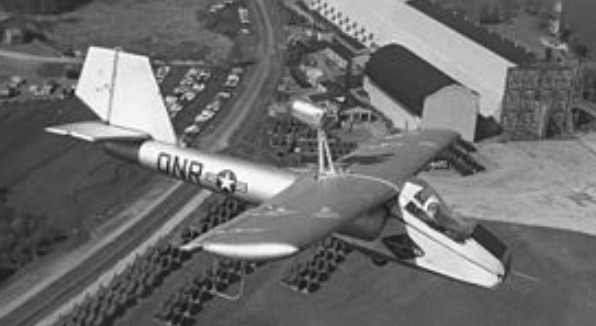
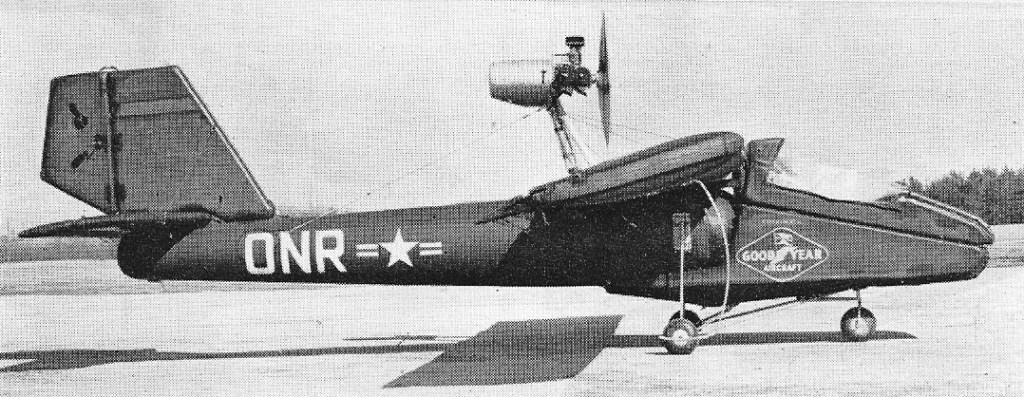
The original concept of an all-fabric inflatable aircraft was based on Taylor McDaniel inflatable rubber glider experiments in 1931. Designed and built in only 12 weeks, the Goodyear Inflatoplane was built in 1956, with the idea that it could be used by the military as a rescue plane to be dropped in a hardened container behind enemy lines. The 44 cubic ft (1.25 cubic meter) container could also be transported by truck, jeep trailer or aircraft.

The inflatable surface of this aircraft was actually a sandwich of two rubber-type materials connected by a mesh of nylon threads, forming an I-beam. When the nylon was exposed to air, it absorbed and repelled water as it stiffened, giving the aircraft its shape and rigidity. Structural integrity was retained in flight with forced air being continually circulated by the aircraft’s motor and guy wires.

There were at least two versions: The GA-468 was a single-seater. It took about five minutes to inflate to about 25 psi (170 kPa); at full size, it was 19 ft 7 in (5.97 m) long, with a 22 ft (6.7 m) wingspan. A pilot would then hand-start the two-stroke cycle, 40 horsepower (30 kW) Nelson engine, and takeoff with a maximum load of 240 pounds (110 kg). On 20 US gallons (76 L) of fuel, the aircraft could fly 390 miles (630 km), with an endurance of 6.5 hours. Maximum speed was 72 miles per hour (116 km/h), with a cruise speed of 60 mph. Later, a 42 horsepower (31 kW) engine was used in the aircraft.

Takeoff from turf was in 250 feet with 575 feet needed to clear a 50 foot obstacle. It landed in 350 feet. Rate of climb was 550 feet per minute. Its service ceiling was estimated at 10,000 ft.

The GA-466 was the two-seater version, 2 in (51 mm) shorter, but with a 6 ft (1.8 m) longer wingspan than the GA-468. A more powerful 60 horsepower (45 kW) McCulloch 4318 engine could power the 740 pounds (340 kg) of plane and passenger to 70 miles per hour (110 km/h), although the range of the plane was limited to 275 miles (443 km).

The test program at Goodyear’s facilities near Wingfoot Lake, Akron, Ohio showed that the inflation could be accomplished with as little as 8 psi (544 mbar), less than a car tire. The flight test program had a fatal crash when Army aviator Lt. “Pug” Wallace was killed. The aircraft was in a descending turn when one of the control cables under the wing came off the pulley and was wedged in the pulley bracket, locking the stick. The turn tightened until one of the wings folded up over the prop and was chopped up. With the wings flapping because of loss of air, one of the aluminum wing tip skids hit the pilot alongside the head, as was clear from marks on his helmet. Wallace was pitched out over the nose of the aircraft and fell into the shallow lake. His chute never opened. He may have been knocked unconscious and rendered unable to open it.

Only 12 Goodyear Inflatoplanes were built, but development continued until the project was cancelled in 1973. The US Army was not ready for blow up aircraft, however, and civilian certification standards prevented Goodyear from offering their Inflatobird to the public.

Mk.II with enclosed cockpit and smaller undercarriage

Goodyear donated two Inflatoplanes for museum display at the end of the project, one to the Franklin Institute in Philadelphia and one to the Smithsonian Institution in Washington, D.C.

Variants:

GA-33 Inflatoplane
The initial single-seat version, with open cockpit, based on the Taylor McDaniel inflatable rubber glider experiments from the early 1930’s. One built.

GA-447 Inflatoplane
An enclosed cockpit and new wing, used for undercarriage experiments (tricycle, uniwheel, and hydroskid). One built.

GA-466 Inflatoplane
Company designation for the AO-2 Inflatoplane

GA-468 Inflatoplane
Company designation for the AO-2 Inflatoplane

XAO-2-GI Inflatoplane
Military designation for the GA-466. One built.

XAO-3-GI Inflatoplane
Military designation for the GA-468. Five built.

General characteristics
Engine: 1 × McCulloch 4318 air-cooled, 60 hp (45 kW)
Length: 19 ft 2 in (m)
Wingspan: 28 ft (8.53 m)
Height: 4 ft (1.22 m)
Loaded weight: 740 lb (336 kg)
Maximum speed: 70 mph (113 km/h)
Range: 275 mi (440 km)
Service ceiling: 6,500 ft (1,981 m)
Rate of climb: 500 ft/min (152 m/min)
Crew: 1
Capacity: 1 passenger

Goodyear GZ-20

GZ-20A

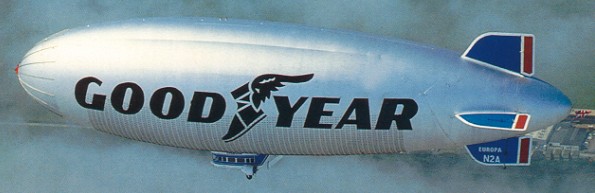
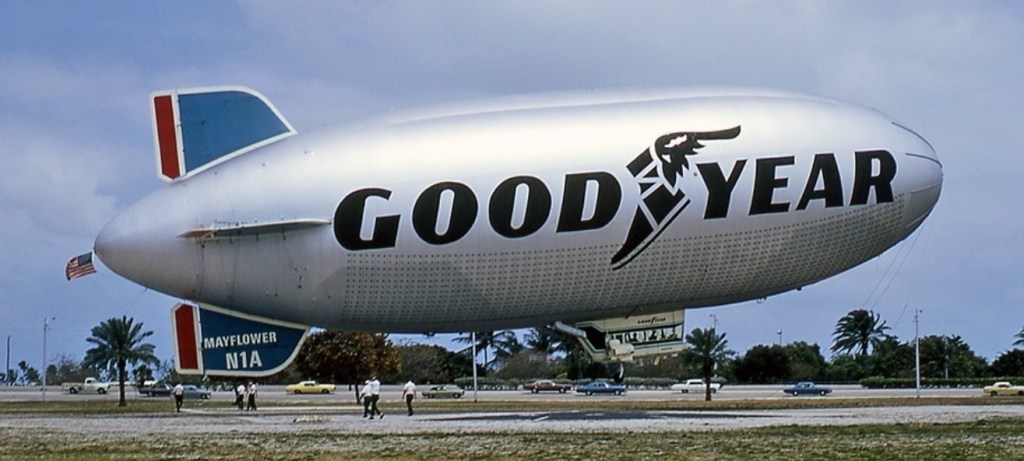
The GZ-20 class was introduced in 1969, with America (N10A) and Columbia (N3A) being the first two. The Europa (N2A) followed in 1972 and was based in Italy, the first Goodyear blimp operated outside of the United States. These blimps are slightly longer than the GZ-19. Beginning in 2014, Goodyear began retiring the GZ-20 and replacing them with the Zeppelin NT. On February 23, 2014, Spirit of Goodyear was retired in Pompano Beach after the 2014 Daytona 500. On August 10, 2015, the California-based GZ-20, the Spirit of America, was decommissioned. The Spirit of Innovation, took over California operations in September 2015 until its retirement in March 2017 as the last remaining GZ-20. In fall of 2017, Wingfoot Two will be relocated to California.

The interest shown by the general public in the Goodyear airships led in 1968 to a major expansion pro¬gramme involving the construction of a new “Mayflower” (GZ 19A) for Miami, a new “Columbia” (GZ 20) for Los Angeles, and a third ship “America” (GZ 20) for a new base near Houston, Texas. The GZ 20 type has an envelope of 202,700 cu.ft. and is powered by two 210 h.p. Continental engines. These ships became operational during 1969 and were joined in 1972 by “Europa” (GZ 20A), a brand new ship based at Rome as part of a new European venture. A completely new ship built at Akron (car) and Litchfield Park, Arizona (Envelope). Assembled and first flown at Cardington, Beds, 10 71 to 3 72.

The GZ 20 commercial airship America first flew in 1969, and was previously Ranger II and L 8. The second “Ranger” was a replacement for the first. Completed after outbreak of war and delivered direct to U.S.N. as L 8 at Moffett Field, 26 2 42. The car returned to Goodyear in 1946 and was stored. Rebuilt as GZ 20 type for AMERICA, 1968 69.

Goodyear operated four helium non-rigid airships, made of neoprene-coated dacron, for publicity and rides.
The Los Angeles based airship Columbia, owned and operated by the Goodyear Tire and Rubber Company, was scheduled to be retired in late July 1975. During six years of operation the Columbia has flown more than 10,200 hours, covering more than 306,000 miles at an average speed of 30 miles per hour.

The blimp will be replaced by another airship bearing the same name, and of the same dimensions: 192 feet long, 59 feet high, and 50 feet wide. The new Columbia will be the 301st airship constructed by Goodyear since 1917, and will join three other Goodyear blimps based in Miami, Houston, and Rome in 1975.

Gallery

GZ 20 AMERICA
Ex RANGER II and Navy L 8.
Registration: N10A.
First Flight: 25 4 69.

GZ 20 COLUMBIA (III)
Ex ENTERPRISE II and Navy L 16.
Registration: N3A.
First Flight: 18 8 69.

GZ 20A EUROPA
Registration: N2A.
First Flight: 8 3 72.
Engines: 2 x Continental IO 360 D, 210 hp.
Length: 192ft 6in.
Maximum Diameter: 46ft.
Volume: 202,700 cu ft.
Max speed: 50 mph.
Cruising speed: 35 40 mph.
Max ROC: 2,400ft/min.
Endurance: 10 hours (with normal tanks), 23 hours (with auxiliary tanks).
Fuel: 138 Imp Gal (normal tanks), 158 Imp Gal (auxiliary tanks).
Max Gross Wt: 12,840 lb.
Empty Wt: 9,375 lb.
Useful load: 3,475 lb.

Goodyear GZ-19

Introduced in 1963 and discontinued in 1978 after the Mayflower (N38A) was destroyed by a tornado, the GZ-19 design for this class resembles the U.S. Navy’s L class blimp.

The interest shown by the general public in the Goodyear airships led in 1968 to a major expansion pro-gramme involving the construction of a new “Mayflower” (GZ 19A) for Miami, a new “Columbia” (GZ 20) for Los Angeles, and a third ship “America” (GZ 20) for a new base near Houston, Texas.

Flying the Goodyear Columbia

Four American completed training for blimps when Columbia was christened in August 1963. Ray Belotti, Oxnad, Calif.; D.E.Swanson, Orange County, Fla; M.R.Johnson, St.Petersburg, Fla, and L.M.Cermak, Akron, Oh, completed 150 hrs of flight instruction including 20 hrs instrument.

The GZ 20 type has an envelope of 202,700 cu.ft. and is powered by two 210 h.p. Continental engines.

These ships became operational during 1969 and were joined in 1972 by “Europa” (GZ 20A), a brand new ship based at Rome as part of a new European venture.

The Goodyear post-war fleet was;
RANGER (III) Registration: N1A. First Flight: 28 5 46.
Ex U.S.N. L 18. To Goodyear 1946. Retired, 30 5 49. Flew again, 24 5 51. Wrecked, Fort Lauderdale, Fla., 26 1 58. Car stored. Rebuilt as GZ 19A type MAYFLOWER IV, 1968.
VOLUNTEER (II) Registration: N2A. First Flight: 26-9 46.
Ex U.S.N. L 17. To Goodyear 1946. Retired, 30 10 49. Car rebuilt as GZ 19A type for COLUMBIA II 1963.
ENTERPRISE (II) Registration: N3A. First Flight: 9 10 46.
Ex U.S.N. L 16. To Goodyear 1946. Retired, 10 12 59. Car rebuilt as GZ 20 type for COLUMBIA III 1969.
MAYFLOWER (II) Registration: N4A. First Flight: 12 5 47.
Ex U.S.N. L 14. To Goodyear 1946. Retired, 24 11 49. Car rebuilt as GZ 19 type for MAYFLOWER III 1958 59.
PURITAN (II) Registration: N10A. First Flight: 27-3 47.
Ex .U.S.N. K 28. To Goodyear 1946. Retired 7 4 48. Reg. transferred to AMERICA 1969.
MAYFLOWER (III) Registration: N4A. First Flight: 25 2 59
Car rebuilt as GZ 19A, 1963. Retired from fleet service, 9 68. Used for R & D work and experimental military duties, 10 68 to 10 69. First airship to fly powered by stern mounted propeller system. Retired, 24 10 69.
COLUMBIA (II) Registration: N2A
First Flight: 23 7 63
GZ 19A type. Retired, 10 69. Ex VOLUNTEER 11 and Navy L 17.

GZ 19A
Capacity: 147,000 cu.ft.
Engines: 2 x 175 h.p. Continental.

GZ 19A MAYFLOWER (IV)
Ex RANGER III and Navy L 18. Registration: N1A. First Flight: 4 9 68.

Goodyear ZPN / ZPG / ZP2N / ‘N’ Class

ZPG-3W

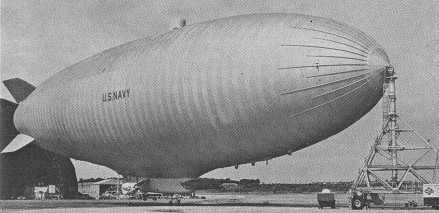
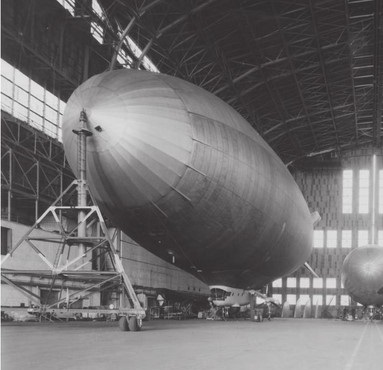
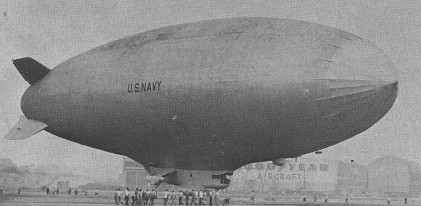
With the end of WW II, the U.S. Navy’s airship service was reduced in size, but new types were developed by Goodyear and brought into service with the Navy. First of these was the N Class of 875,000 cu.ft. flown in prototype form on June 18, 1951. Preliminary ground and flight tests for the prototype were disappointing, mandating further evaluation to explore improvements. The Board of Inspection and Survey trials for N-1 persisted into 1953.

N-1 at Lakehurst, 18 Nov 1952

Under the post war naval airship designation system NA became ZPN 1, and with a further change in 1954 became ZPG 1. This greatly improved, long range patrol ship was 334ft long and powered by, two 800 h.p. Wright Cyclone 7 engines mounted inside the car. A crew of 14 was carried in the double decked car which gave much improved messing and sleeping arrangements compared with those of the wartime ships. One of the most notable external features of the design was the angled position of the tail surfaces, so arranged to, help keep the overall height of the ship (96ft) within the limits of existing sheds. Only one example of this type was built, (GZ 9) but it served as the basis of the later ZPG 2 and ZPG 3 ships.
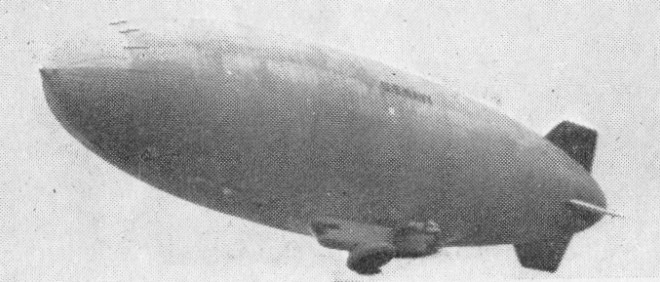
After extensive evaluation trials with the prototype ZPN 1, an improved and slightly larger version, the ZP2N4, was completed and flown on March 20, 1953. This type was put into production in two forms known as the ZPG 2 patrol version and the ZPG 2W Airborne Early Warning version. The ZPG 2 of 975,000 cu.ft. was powered by two 800 h.p. Wright Cyclone 7 engines driving Curtiss Electric three blade, variable pitch, reversible propellers on out riggers projecting from each side of the car.
The control car accommodated the fourteen crew on two decks, with all operational stations on the lower deck and crew’s quarters on the upper deck. All control surfaces were operated by a single control column, duplicated for the pilot and co pilot; a major departure from the previous normal airship practice of separated elevator and rudder control wheels. The ship was also equipped with an autopilot which was of immense value in reducing crew fatigue on patrols lasting two or more days.
Twelve were 12 built 1953-1955 and were in service to 1961.
The ZPG-2W version was essentially the same except that it carried large quantities of sensitive, long range, radar equipment for aircraft detection, and a large radome on top of the envelope. This could be reached from the control car by way of a 75ft vertical tunnel inside the envelope. The, ZPG 2s made many long flights, setting up World endurance records in May, 1954, of 200.4 hours continuous flight, and in March, 1957, of 264.2 hours (11 days), both flights without refuelling. The second flight took the airship from its base at Weymouth, Mass., to Key West, Florida, by way of Portugal and North Africa, 8,216 miles in all.
Five were built 1957 1958 and were in service to 1961.
As a further development of the ZPG type, the ZPG-3W appeared in July, 1958. The largest non rigid airship ever built, it was 404ft long with an envelope capacity of 112 million cubic feet. Power was provided by two specially developed Wright Cyclone 9 engines of 1,525 h.p., driving 18ft diameter propellers. Twenty four crew were carried in a car 83ft long, with extensive crew quarters on the upper deck. The envelope itself served as a radome for a 40ft internally mounted radar antenna which rotated within the helium gas. Four were built 1958 1960.
Total post war naval airship production accounted for 55 of the 200 new airships built by Goodyear between December 1939, and July 1963. The last for the U.S. Navy was a ZPG3W delivered on April 4, 1960. At that time the Navy still had 27 airships in commission. However, changes in naval policy and the need for budget savings in the light of the costly new Polaris submarine programme, forced a re think of naval air requirements. On June 26, 1961, the Navy announced that the airship service was to be closed down, a decision which took effect during the following year.
Thirteen naval airships were deflated and placed in long-¬term storage in case of future need, while two ZPG 2s were retained for experimental work with the Airship Test and Development Department at Lakehurst. In addition, one ZS2GA was made available to Mississippi State University for a programme of boundary layer control research on airship envelopes. When these ships, too, were deflated at the end of 1962, forty five years of U.S. Naval airship operations came to an end.
The last Goodyear airship for the American Navy was the ZPG 3W of 1958, the largest non rigid ever built. A 40ft radar antenna rotated inside the envelope. These served until the closure of the airship service in 1962.

Goodyear ZPN

ZPG 1 (GZ 9)
Volume: 875,000 cu ft.
Length: 324ft.
Max Dia: 74ft.
Engines: 2 x 800 h.p. Wright R 1300 3A Cyclone 7.

ZPG 2 (GZ 11)
Volume: 975,000 cu ft.
Length: 343ft.
Max Dia: 76ft.
Engines: 2 x 800 h.p. Wright R 1300 3A Cyclone 7.

ZPG 2W (GZ 14)
Volume: 975,000 cu ft.
Length: 343ft.
Max Dia: 76ft.
Engines: 2 x 800 h.p. Wright R 1300 3A Cyclone 7.

Type GZ 17 (Navy ZPG 3W) 1958
Engines: 2 x 1,525 h.p. Wright R 1820 88 Cyclone 9.
Length: 403ft 6in.
Maximum Diameter: 85ft.
Volume: 1,465,000 cu ft (before stretch).
Maximum Speed: 90 m.p.h.
Cruising Speed: 50 60 m.p.h.
Maximum rate of climb: 2,400ft/min.
Range: in excess of 5,000 miles.
Endurance: 80 hours plus.
Fuel: 4,375 gallons.
Maximum Gross Weight: 93,496 lb.
Empty Weight: 71,130 lb.
Useful Load: 22,366 lb (including dynamic lift).

ZPG 3W (GZ 17)
Volume: 1,490,000 cu ft.
Length: 404ft.
Max Dia: 85ft.
Engines: 2 x l,525 h.p. Wright R 1820 88 Cyclone 9.

ZPN-1
Volume: 875,000 cu. ft.
Length: 324.4 ft.
Engines: two 800 h.p. Wright R1300
Top speed: 85 m.p.h.

ZPG-2
Volume: 975,000 cu. ft