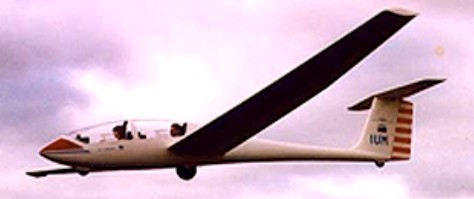
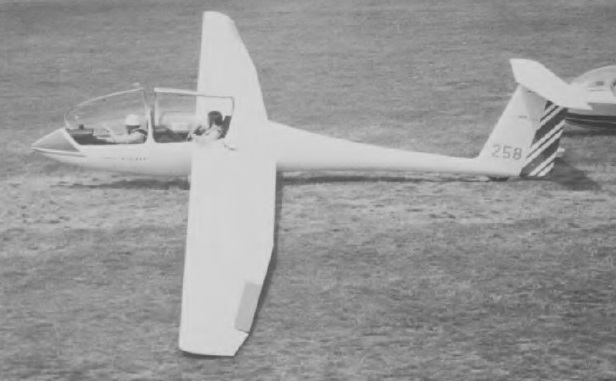
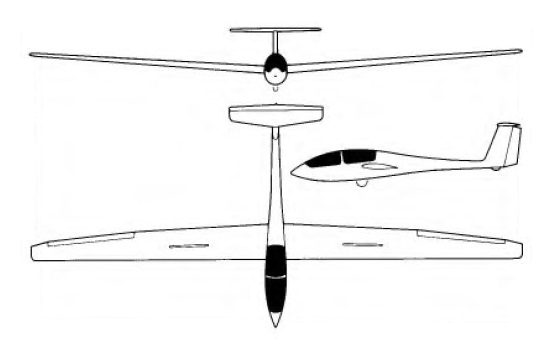
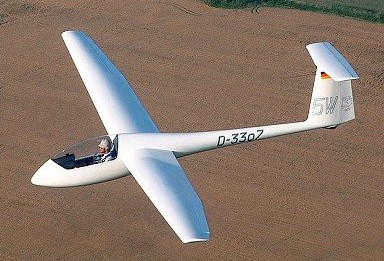
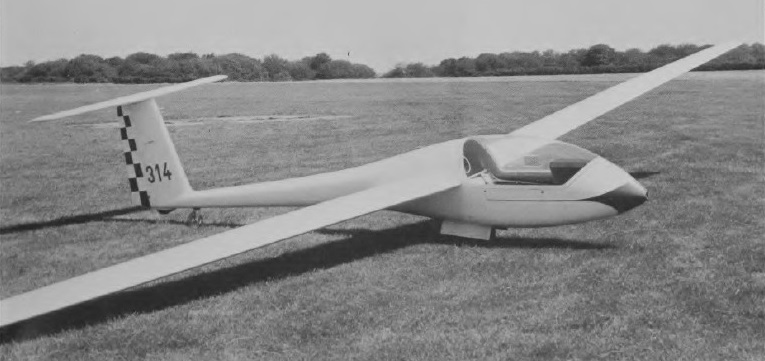
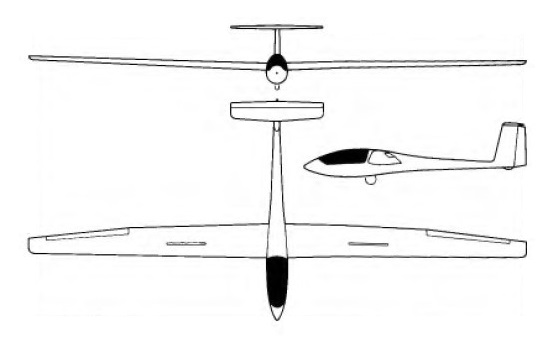
The Twin Astir was a two-seat 1970s development of the Standard Class Astir CS, differing from it principally in having a fuselage lengthened by 9.75 in to accommodate the second seat, and also reduced in depth by 1.5 in; wing span has been increased to 17.5m (57 ft 5 in) and the wings are now swept forward 3° 18′. The gear retracts by folding up to the left and lying horizontally under the rear seat. The 3.3 degree forward wing sweep was replaced by a straight wing with leading edges at right angles to the fuselage centerline early in the production run. Dual controls are provided under the two individual canopies, and the Twin Astir is offered to customers both with and without the basic instruments in the front cockpit and with or without water ballast, of which up to 198 lb can be carried.
The Twin Astir has the same mid wing position and T-tail as its single-seat counterpart, and is of the same glassfibre construction. In contrast to later G 103 models, the Twin Astir has the main wheel ahead of the center of gravity, and does not have a nose wheel. It was offered with a tailskid or an optional tail wheel. The G 103T Twin Astir had a fixed main wheel.
Design of the Twin Astir began in September 1974 and construction of the prototype was commenced in March 1976; this made its first flight on 31 December 1976. By the end of 1978 over 225 Twin Astirs had been delivered; production has now ended. The type is also known as the Twin Astir Trainer when used for this task.
Twin Astir G 103
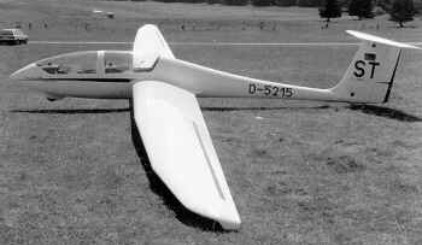
Formerly the G118, the Twin II is a new tandem two-seater for training and club use to succeed the Twin Astir, from which it differs in having a narrower and more streamlined fuselage, improved cockpit layout and larger canopies, lower-set wings, a fixed monowheel plus a small wheel (likewise semirecessed) under the forward cockpit and a tailwheel, downturned wing tips and reduced empty weight. The same type of elasticated flaps as featured on the Speed Astir are fitted, and the T-tail is similar to the Twin Astir’s. Unlike the latter, no water ballast is carried. The Twin II first flew late in 1979.
The G-103 A Twin II was the successor of the Twin Astir with a nose wheel and a fixed six-inch main gear fitted behind the center of gravity in a fairing. The main wheel is equipped with a hydraulic brake. Modified ailerons produce a substantially improved roll response. Approach control is by top surface Schemmpp-Hith type airbrakes.
The Twin II won the world Out & Return record for two-seat sailplanes (1000.88 km/ 621.92 miles) flown by Tom Knauff of the U.S. The Twin II Acro is similar to the earlier model, but with strengthened mainspar caps and steel control pushrods which permit greater aerobatic performance. The Royal Air Force acquired 100 Acros (known as the Viking T. MK.1) for its air cadet training program. The G 103 has a FAA approved modification kit for all-hand control for handicapped operation. Air Transport Certified.
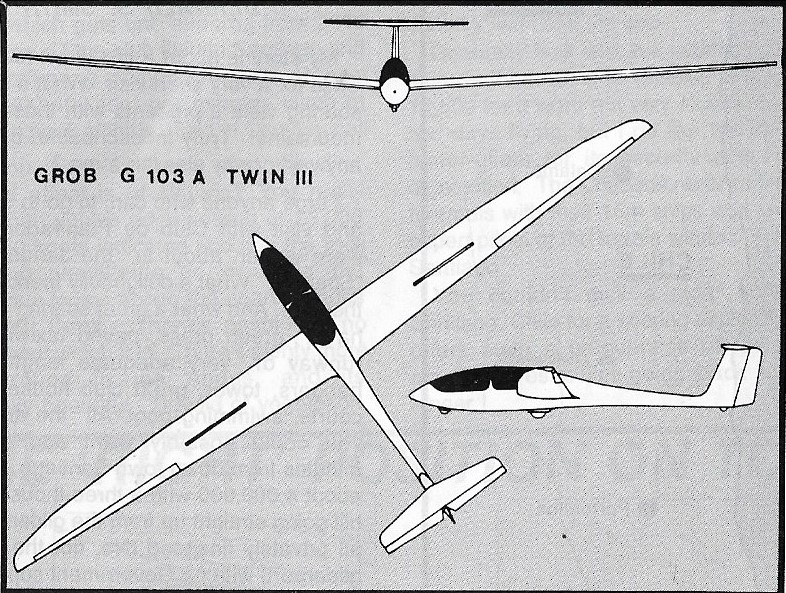
G 103 C Twin III
The G 103 C Twin III is a development of the Twin II with a new Discus plan wing of slightly increased span and modified airfoil section. The cockpit has detailed improvements including better ventilation, relocated airbrake levers to give better purchase, and canopies restrained by gas-filled struts. The unpowered sailplane is cleared for aerobatics similar to the Twin II Acro. The self-launching version (Twin III SL), which is non-aerobatic, has an electrically actuated mast-mounted retracting engine and steerable nose wheel. Fuel is stored in a main tank in the fuselage close to the engine, and in an auxiliary tank in the left wing root from which fuel is moved by a transfer pump. The variable pitch propeller has climb and cruise setting.
Twin Astir G 103 Wing span: 17.5 m / 57 ft 3 in Wing area: 17.89 sq.m / 192.6 sq.ft Length: 8.1 m / 26 ft 8.75 in Height: 1.6 m / 5 ft 3 in Empty Weight: 390 kg / 859 lb Payload: 286 kg / 631 lb Gross Weight: 676 kg / 1490 lb Wing Load: 37.79 kg/sq.m / 7.73 lb/sq.ft Water Ballast: 90 kg / 198 lb Aspect ratio: 17.1 Airfoil: Eppler E 603 Max speed: 155 mph / 135 kt / 250 km/h (smooth air) Max aero-tow speed: 105 mph Stalling speed: 40 kt / 74 km/h MinSink: 0.68 m/s / 2.23 fps / 1.32 kt at 56 mph / 40 kt / 75 km/h L/DMax: 38 at 109 kph / 59 kt / 68 mph Seats: 2
Grob G-103 Twin II Span: 57 ft 5 in Length; 26 ft 10 in Height: 8 ft 1 in Wing area: 191.6 sqft Aspect ratio: 17.2 Empty weight: 794 lb Max take-off weight: 1,278 lb Max speed: 155 mph (smooth air) Max aero-tow speed: 105 mph Min sinking speed: 2.1 0 ft/sec at 50 mph Best glide ratio: 37:1 at 65 mph
Twin II and Twin II Acro G 103A Wing span: 17.5m / 57.4ft Wing area: 17.8sq.m / 191.6sq.ft Empty Weight: 368kg / 811lb Payload: 212kg / 468lb Gross Weight: 580kg / 1279lb Wing Load: 32.58kg/sq.m / 6.67lb/sq.ft Water Ballast: 0 L/DMax: 35 105 kph /56 kt / 65 mph MinSink: 0.75 m/s / 2.45 fps / 1.45 kt Aspect ratio: 17.2 Airfoil: Eppler E 603 Seats: 2 No. Built: 549
Twin III Acro and III SL G 103 C Wing span: 18m / 59ft Wing area: 17.5sq.m / 188.4sq.ft Empty Weight: 390kg / 860lb Payload: 210kg / 463lb Gross Weight: 600kg / 1323lb Wing Load: 34.29kg/sq.m / 7.03lb/sq.ft Water Ballast: 0 Aspect ratio: 18.5 Airfoil: Eppler E583 L/DMax: 36 107 kph / 58 kt / 67 mph MinSink: 0.70 m/s / 2.3 fps / 1.36 kt Engine: SL model only Seats: 2 No. Built: 167
The G-102 Astir is a single seat glassfibre Standard Class sailplane, designed by Burkhart Grob. It was the first Grob-designed sailplane.
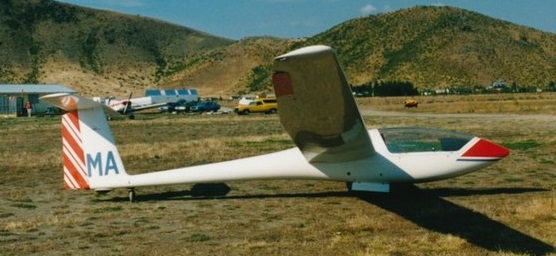
Construction of the prototype Astir CS began in March 1974. It features composite (fiberglass/resin) construction, a large wing area, a T-tail and water ballast. A Standard Class Sailplane, the large wing area gives good low speed handling characteristics. The main gear retracts. It first flew on 19 December 1974 and it went into production in July 1975 and soon proved to be popular, a total of 534 being delivered.
The cantilever mid wings have glassfibre roving main spars and a glassfibre/epoxy resin sandwich skin except for the ailerons, which are of glassfibre sandwich. There are Schempp-Hirth aluminium air brakes in the wing upper surfaces, but no flaps, and up to 220lb of water ballast can be carried in tanks in the wings, being jettisoned via a dump valve in the fuselage. Rigging is carried out without any separate removable parts as the wings and the tailplane are attached by a system of ‘snaplock’ connectors. The glassfibre semi-monocoque fuselage has a towing/launching hook, and the large one-piece cockpit canopy opens sideways to starboard. Construction of the T-tail unit is the same as that of the wings.
This was followed by the Club II with similar fixed gear. A slightly improved version, the CS-77, was introduced in 1977. The CS-77 has a different rudder profile fuselage similar to that of the Speed Astir. The Astir CS 77 made its first flight on 26 March 1977; nearly 400 of the CS 77 and Club Astir had been built by the end of 1978.
The Club Astir II and the Standard Astir II featured the new fuselage of the Speed Astir II. with a one piece canopy, as well as the elasticated flaps of the Speed version and a new wing tip profile.
The Astir CS 77 has a retractable monowheel with an internally-expanding drum brake located ahead of the center of gravity, which folds up behind closed doors, and there is also a rubber-sprung tail wheel. The Astir CSM was a powered version under development in mid-1976 with a 25hp Fichtel & Sachs Wankel KM24 rotating piston engine on a retractable pylon aft of the pilot, driving a two-blade Hoffman tractor propeller. A 6.6 gal fuel tank is fitted.
G-102 Astir
The Astir CS Jeans was of similar configuration to the CS 77, but with fixed wheel, and a tailskid.
The Standard III followed in the early 1980’s reverting to the higher profile fuselage and with reduced empty weight and increased payload. The Club III has a fixed main gear ahead of the center of gravity, and a tailwheel. The Club IIIB has a cockpit almost identical to the front seat of the two-place G 103 Twin II with a fixed main gear aft of the center of gravity and a nosewheel. Air Transport Certified (except Club II which is EXP). One, flown by R.R. Harris of the U.S., won the world absolute altitude record at 14.938 m/ 49.009 ft in 1986.
Production variants were the Club Astir III, IIIB and Standard Astir III, which have a roomier cockpit and reduced empty weight.
Grob G-102 Astir CS77 ZK-GMA
Grob 102 Wingspan: 15.00 m (49 ft 3 in) Wing area: 12.4 sq.m (133 sq.ft) Water ballast: 50 kg (110 lb) Aspect ratio: 18.2 Empty weight: 255 kg (561 lb) Gross weight: 450 kg (990 lb) Maximum glide ratio: 38 Glide Ratio: 36 at 50 kt (92 km/h) / 5.9 nm (10.97 km) per 1000 ft Sink rate: 141 ft/min (0.71 m/s) at 50 kt Glide Ratio: 34 at 41 kt (76 km/h) / 5.6 nm (10.36 km) per 1000 ft Sink rate: 122 ft/min (0.62 m/s) at 41 kt At 90 knots (166 km/h) Glide Ratio: 23 at 90 kt (166 km/h) / 3.8 nm (7.01 km) per 1000 ft Sink rate: 393 ft/min (2.00 m/s) at 90 kt Stall: (without airbrakes) 32 knots (60 km/h) Stall: (with airbrakes) 35 knots (65 km/h) Never Exceed: 135 knots (250 km/h) In Rough Air: 135 knots (250 km/h) Manoeuvering: 92 knots (170 km/h) On Aerotow: 92 knots (170 km/h) On Winch: 64 knots (120 km/h) Airbrakes: 135 knots (250 km/h) Gear Down: 135 knots (250 km/h) Minimum Payload: 70 kg Maximum Payload: 110 kg Crew: One pilot
Grob G-102 Astir CS77 Span: 49 ft 2.5 in / 15.0 m Length: 21 ft 11.25 in / 6.69 m Height: 4 ft 7 in / 1.4 m Wing area: 133.5 sq.ft / 12.4 sq.m Aspect ratio: 18.2 Wing section: Eppler E603 Empty weight: 595 lb / 270 kg Max weight: 992 lb / 450 kg Water ballast: (220 lb / 100 kg Max wing loading: 7.43 lb/sq ft /36.3 kg/sq.m Max speed: 155 mph / 135 kt / 250 km/h Stalling speed: 32.5 kt / 60 km/h Max aero-tow speed: 105 mph Max rough air speed: 135 kt / 250 km/h Min sinking speed: 0.6 m/sec / 1.97 ft/sec at 47 mph / 40.5 kt / 75 km/h Best glide ratio: 38:1 at 65 mph / 56.5 kt / 105 km/h
1926: Company foundation in Munich Aviation work began in 1971 and has since built many thousands of motorgliders, lightplanes and other aircraft. 1974: Foundation of aircraft plant in Mattsies Burkhart Grob Flugzeugbau GmbH built the Schempp-Hirth Standard Cirrus under licence during 1972-75. Recent aircraft include the G 103 Twin III and G 109 series of gliders/motorgliders, piston-engined G 115 two-seat lightplane (some versions suited to training and aerobatics; first flown November 1985), GF 200 pusher piston-engined and pressurised 4/5-seat lightplane (first flown November 1991, turboprop-powered G-520 Egrett and Strato 1 high-altitude and long-duration research platforms capable of carrying different electronic payloads in 12 separate compartments (first flown June 1987 in G-500 Egrett form), and the most recent G-850 Strato 2C high-altitude and long-duration atmospheric/ stratospheric/ climatic research aircraft with a unique compound propulsion system using two turbocharged piston engines and two gas generators (first flown March 1995).
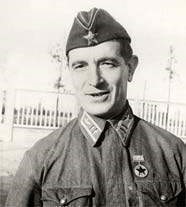
Vladislav Konstantinovich Gribovski (Russian: Владислав Константинович Грибовский) was born on September 7, 1899 in Saint Petersburg. Soon his parents died and Gribovski was forced to enter an orphanage in Gatchina where he would receive high school education. In 1909 during an excursion he visited the local airfield and according to his own statement, from that moment he fell in love with aviation. From an early age he began to read all the materials he found on aviation, made a series of model airplanes and helped the mechanics at the airfield. In 1919 he would leave the orphanage, joining the Red Army. He tried to enter the aviation school, but did not succeed, being assigned to the artillery courses in Petrograd. As part of a group of cadets from the school he would participate in combat against Yudenish, being wounded. In the fall of 1920 he was promoted to commander in the Second Moscow Artillery Brigade.
In 1921, he was finally able to enter the Yegorevsk Aviation Theoretical School. He would continue his pilot studies at the Kacha (Sevastopol) and Moscow (VAShL) flight schools in 1923. In 1924 he passed the Higher School of Aerial Shooting and Bombing in Serpukhov. In this way, in just three years, he passed the entire program of preparation courses and became a fighter pilot. Upon graduation in 1924 Gribovski would be assigned to serve in the 3rd Fighter Squadron based in Kiev.
VK Gribovski began flying gliders practically from the moment he joined the unit in Kiev.
In 1924 in Kiev he designed his first glider, the G-1. This aircraft was included in the list of competitors of the III National Sailing Competitions in Koktebel. After some short test flights, the 22 of September of 1925 the G-1 was hit by a gust of wind that destroyed land.
In 1924 he participated in the II National Sailing Competitions in Koktebel and was one of the first pilots who managed to keep his glider in horizontal flight for some time. In these tests, the category of pilot-planerista was established, which was reached after achieving 5 flights with a total duration of 60 seconds of which, at least one, had to exceed 30 seconds. The title of “paritiel” pilot or thermal exploiter was received by those who managed to keep their glider in flight without losing altitude for 3 minutes.
In the II National Competitions of 1924 Artseúlov, Gribovski, Zernov, Kalan, Kravtsov, Rudzig, Seregeyev, Tarasov and Yakovchuk received the title of pilots “paritiel”.
VK Gribovski.
Gribovski became an instructor at the Serpukhov Flight School in 1927. In the workshops of this institution he would build his second glider, which was launched as G-2 in 1927. The G-2 would fly with great success in the IV, V and VI National Sailing Competitions, becoming one of the main Soviet training gliders in those early years.
In parallel with the G-2, Gribovski designed in 1926 a 4-seater transport glider that received the designation G-3 and was not approved. The G-4 was a never-completed project for a low-power Bristol Cherub-powered light aircraft, designed in conjunction with AB Yumashiev. Its construction also began in 1926 in the workshops of the Serpukhov Flight School. Following the transfer of the flight school to Orenburg, Gribovski would successfully build and fly the G-5 light aircraft.
The G-6 (1928) and G-7 (1929) gliders were also built in Orenburg. The G-7 was one of the best gliders among the participants in the VI National Sailing Competitions. In this glider, the renowned pilot VA Stepanchonok set the Soviet record for flight duration by staying in the air for more than 10 hours.
At the beginning of 1930 Gribovski was appointed head of the OSOVIAJIM Flight School in Moscow. Based on his initiative, the famous Túshino aerodrome was built and the OSOVIAJIM Central Aeroclub was created on the basis of the school. Towing tests of Gribovski’s G-2bis glider were carried out in the autumn of 1931 in Túshino and from their results the G-9 towed glider was built, which was manufactured in series and became one of the main training gliders. of the USSR in the pre-war period.
In 1931, in the workshops of the OSOVIA Flight School, Jim Gribovski would build the excellent G-8 light single-seater training aircraft. This small plane with a takeoff weight of only 483 kg and a 60 hp engine reached a speed of 150 km / h and a flight height of 3000 meters. In the autumn of 1932 the G-8 was used by the pilot D. Koshits to carry out a flight that covered a dozen cities in the USSR, covering a total of 4,500 km.
In 1932 Gribovski began working at the Bureau of Construction of Moscow (MKB) of OSOVIAJIM and a year later would steer. The MKB was financed from donation funds and was located in an apartment in the basements of building No19 on Sadovo-Spaskaya Street in Moscow. In addition to the MKB, the founders of the GIRD – creators of the first Soviet rockets – were also located in this basement. Currently at the entrance is a memorial plaque.
Under Gribovski’s direction, the G-512 and G-16 hydro-gliders were built. In the latter, for the first time in the USSR, a takeoff was made from the water in a glider, towed by a Shavrov Sh-2. Another interesting example was the G-14 towed glider, used for different tow tests. The G-14TsL-2A tanker glider was built on the basis of this model in the “Aviajim” factory for the first time in the world, conceived for long-distance flights from the refueling of the tow plane from the glider itself.
Also noteworthy are the G-15 light tourist aircraft and the G-22 and G-23 single – seaters. In the G-22 the pilot Ye. Miednikov set a world speed record in its category in July 1938 by reaching 165 km / h and pilot I. Grodzyanski in the G-23 set a height record of 7266 meters.
Among light Gribovski models include the G-20 in 1935. With a 100 hp M-11 engine this light aircraft reached 210 km / h and a ceiling of 4000 meters. In 1937, after the installation of a more powerful 150 hp engine, the pilots of the aero club began to perform high school acrobatics on this airplane.
In 1938 on the basis of the MKB OSOVIAJIM and the glider factory, the Experimental Department (Opitni Otdiel – OO) was created under the leadership of Gribovski. Its latest models for OSOVIAJIM were built in this department: the G-26 fast plane and the G-27 twin – engine trainer . This latest model was designed as a crew trainer for the newly introduced Túpolev SB and Ilyushin DB-3 bombers. Although the G-27 in weight did not exceed the Polikarpov U-2, it introduced a two-seater cabin for the pilots and a glass nose for the navigator. This aircraft presented excellent performance but was too demanding in piloting, so it was not considered suitable for teaching. The builders proposed to improve it, but this was never realized. At the beginning of 1939 the glider factory was closed.
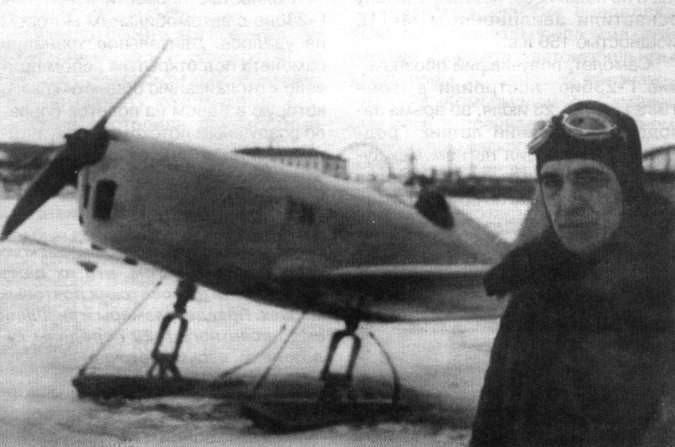
VK Gribovski with the G-26 light aircraft during testing.
The Glider Factory of the OSOVIAJIM, in which the Gribovski models were built, was closed in March 1939 and its facilities transferred to Professor Lievkov, who would build air-cushioned aircraft there. The experimental department was dissolved and Gribovski went into the reserve of the Aviation Directorate of the Union of Defense and Aviation Assistance Societies-Chemical Construction of the USSR (OSOVIAJIM). Through his own efforts, Gribovski managed to be transferred to the system of the Commissariat of the Aeronautical Industry (NKAP). Initially, in December 1939, a new Construction Bureau was created as a subsidiary of Factory No.301. This new organization was based on a garage under construction belonging to the “Mosvoyentorg” located in the Pavshino village, belonging to the Moscow suburbs.In March 1940 Gribovski was appointed to command the newly created OKB-28 and by May 22 of next year the Gr-28 “Krechet” (TI-28) training fighter had been created under his leadership. The cockpit of this trainer had been configured to allow training in day and night flight. The TI-28 featured a synchronized ShKAS machine gun, a photo-machine gun and a collimator for aiming. Under the wings it could carry training bombs of up to 40 kg. The beginning of the war prevented its production.
With the start of the war the OKB was tasked with building an 11-seater landing glider. To carry out this task, Gribovski asked only 2 months. AS Yakovlev thought the answer was not serious and asked the builder to put this in writing. Work on the new glider, known as Gr-29 (serially as G-11), began on July 7 and its maiden flight was made on September 2. After a week of test flights, its series production was decided. This model was produced until June 1942.
When the production of the G-11 ceased in 1942, the OKB-28 collective was integrated into the technical staff of Factory No. 471, re-destined to produce the Yakovlev Yak-6. Gribovski was placed at the disposal of the Commissariat for the Aviation Industry.
For the invaluable contribution of his planners in the tasks of support to the guerrilla groups of Belarus, Vladislav Cheranovski was one of the few Soviet servicemen in the rear to be awarded the 2nd rank “Guerrilla of the Patriotic War” medal.
In 1943, production of the G-11 was re – established in Ryazan, where Gribovski was appointed chief builder and factory manager. The production of this model was maintained until 1948 in different versions.
In these years Gribovski would work on the development of an improved version of the G-11 glider, which, called G-31, was not approved because priority was given to the Moscaliov SAM-28 (which would not be produced either).
In 1946 he would work on the 3 and 6 ton transport glider projects that would not be built either. A year later Gribovski would be tasked with designing a two-seater training glider with spacious cabins located in tandem. Two specimens were produced that began to fly in the spring of 1948. The dissolution of Gribovski’s KB prevented further work.
In 1948 Gribovski would present a new design for a primary training two-seater aircraft with tandem seats and a 90 hp M-10 engine, conceived to participate in the light aircraft competition promoted by DOSAV. This would be his last “official” job. In 1948 his KB had been disintegrated as part of the process of reorganization and contraction of the aeronautical industry.
After the liquidation of the Construction Bureau (KB) in 1948, Gribovski received proposals to go on to work in the Scientific-Technical Committee of the VVS, to dedicate himself to the development of aeronautical technology. Declining this proposal, he requested his retirement from the ranks of the Red Army, passing to the reserve with the military rank of colonel.
In later years he would participate in various sports glider projection competitions and would work on sports boat design, photography and painting.
Vladislav Konstantinovich Gribovski designed 20 gliders and 14 airplanes between 1925 and 1948, not counting the unrealized or finished projects. Virtually all of his designs were successful and some of his gliders were mass-built. Their small collective included specialists including VV Abramov and BK Landyshev.
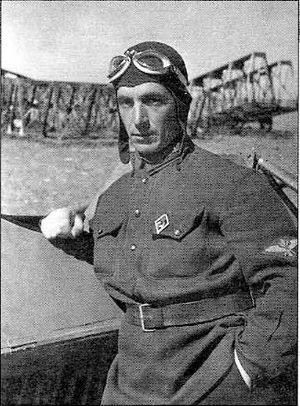
It should be noted that despite his activity as an aeronautical constructor, Vladislav Gribovski flew actively. He was generally the first to test his designs in flight. He personally participated in various aviation competitions, public demonstrations and propaganda flights.
Most of his designs, built basically in wood, were characterized by their simplicity. For this same reason, their models did not stand out for their performance, but in all cases they were characterized by their robustness and ease of maintenance.
Gribovski was a great defender of the airplane accessible to anyone and fought for the development of sports and tourist aviation.
The pilot and aeronautical constructor Vladislav Gribovski passed away in 1977.
Designed by John W. Grega, as a modernized version of the 1920’s Pietenpol Aircamper two-seat parasol-wing monoplane, first flown 1963 and available in plans form (plus some components) as the GN-1 Aircamper.
Engine: Continental C-65, 65 hp. HP range: 65-90. Speed max: 115 mph. Cruise: 87 mph. Range: 400 sm. Stall: 25 mph. ROC: 500 fpm. Take-off dist: 300 ft. Landing dist: 300 ft. Service ceiling: 12,000 ft. Fuel cap: 12 USG. Weight empty: 650 lbs. Gross: 1100 lbs. Height: 6.8 ft. Length: 18.1 ft. Wing span: 29 ft. Wing area: 145 sq.ft. Seats: 2. Landing gear: tail wheel.
Developed a modernized version of the 1920’s Pietenpol Aircamper two-seat parasol-wing monoplane, first flown 1963 and available in plans form (plus some components) as the GN-1 Aircamper. 1995: 355 Grand Blvd., Bedford, OH 44146, USA.
Established in 1929 at Cleveland, Ohio. Built aircraft for U.S. Army and Navy, plus a series of single and two-seat biplanes, beginning with the 2T-1A single-seater and including also the TG-1 Torpedo bomber. Company reappeared in mid-1960s to build scaled-down kit version of Great Lakes Sport Trainer known as Baby Great Lakes.
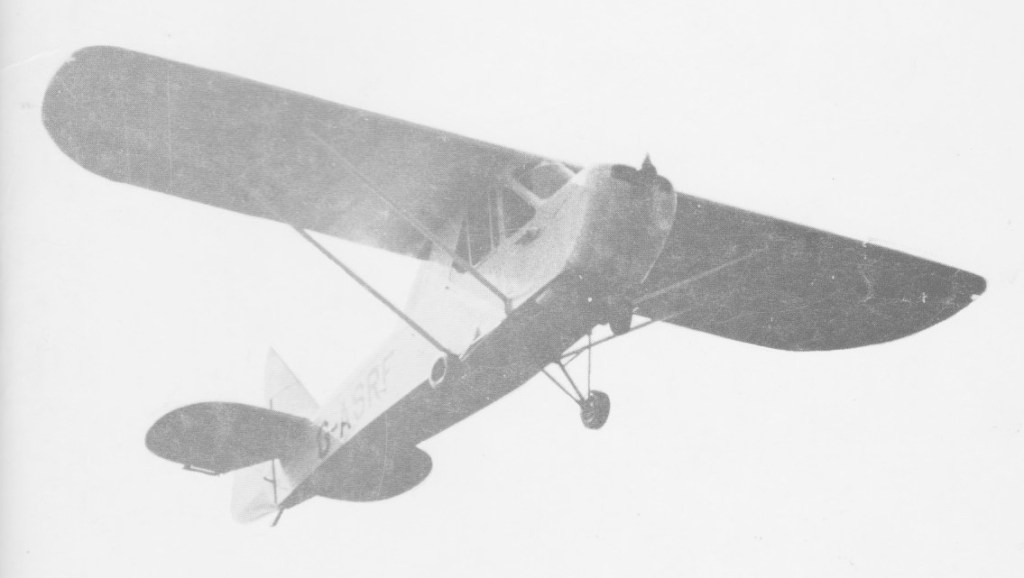
Built by G.W.Gowland in the mid-1960s, the Gowland Jenny Wren G-ASRF c/n GWG.2, PFA.1300, was basically a Luton Minor with an enclosed cockpit with pilot and a child’s seat in tandem, tricycle undercarriage, and a Lycoming O-145-A2 engine.
It was built by the designer at Brookmans Park with final assembly taking place at Panshanger in 1966. It used the wings of Luton Minor G-ACEP (PFA.538b).
The first flight took place on 13 October 1966.
Withdrawn from use prior to 1971, it was thought to be stored at Gowlands home. Only one conversion was made.
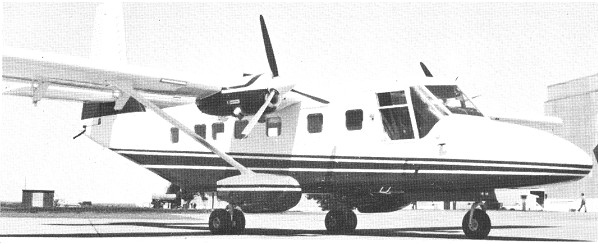
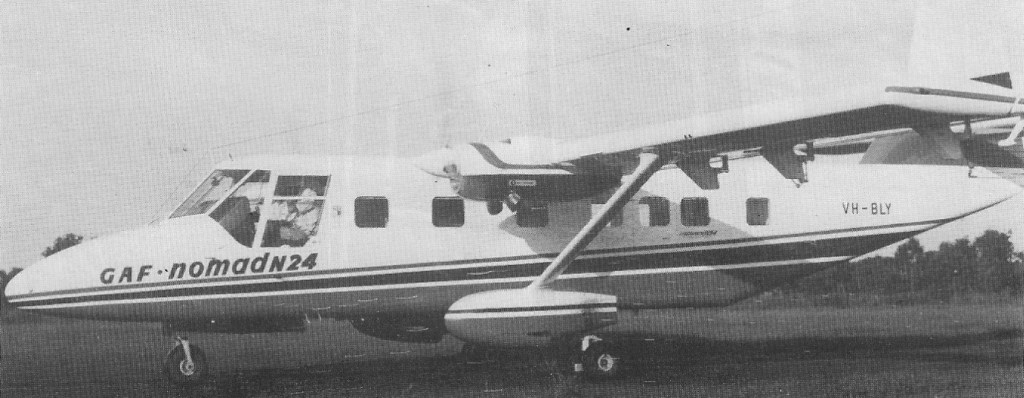
Originally designed in the 1960s as a STOL utility aircraft for both civil and military use. The first prototype flew in 1971. One hundred and seventy were sold by GAF / ASTA. Certification in accordance with the Australian Department of Transport air regulation 27 approves the use of N24A as an 18-place airliner in regular public transport as well as in normal operation. N24A is an improved version of the previous ‘stretched’ Nomad N24. It has increased passenger and load carrying capacity with an all-up-weight of 9400 pounds from the original 8500 pounds.
Production ceased in 1984 after safety concerns following a number of accidents and the loss of 54 lives. Boeing obtained the type certificate via its 1999 acquisition of Rockwell, which had previously acquired ASTA. Gippsland Aeronautics purchased the GAF N24 Nomad type certificate from Boeing Australia and planned to restart production.
N-24 Engine: 2 x Allison 250-B17B, 400 hp. Seats: 18. Wing loading: 27 lb/sq.ft. Pwr loading: 10.5 lb/hp. Gross wt: 8750 lb. Empty wt: 4844 lb. Equipped useful load: 3811 lb. Payload max fuel: 1451 lb. Range max fuel/75%: 964nm/5.7hr. Range max fuel /55%: 1071nm/7.7hr. Ceiling: 22,500 ft. Max cruise: 167 kt. Max range cruise: 140 kt. Vmc: 62 kt. Stall: 52-70 kt. 1.3 Vso: 68 kt. ROC: 1430 fpm. SE ROC: 280 fpm @ 87 kt. SE ceiling: 9000 ft. Min field length: 1100 ft. Fuel cap: 1770/2360 lb.
N24A Engines: 2 x Allison 250-B17C, 400 shp. Props: Hartzell 3-blade, 90-in. Seats: 17. Length: 47 ft. Height: 18.2 ft. Wingspan: 54.2 ft. Wing area: 320 sq.ft. Wing aspect ratio: 9.1. Maximum ramp weight: 9450 lbs. Maximum takeoff weight: 9400 lbs. Standard empty weight: 5480 lbs. Maximum useful load: 3970 lbs. Maximum landing weight: 9200 lbs. Wing loading: 20.9 lbs/sq.ft. Power loading: 12.2 lbs/hp. Maximum usable fuel: 1770 lbs. Best rate of climb: 1313 fpm. Service ceiling: 23,300 ft. Maximum single-engine rate of climb: 240 fpm @ 96 kts. Single-engine climb gradient: 113 ft/nm. Single-engine ceiling: 11,390 ft. Maximum speed: 173 kts. Normal cruise @ 8,000 ft: 169 kts. Fuel flow @ normal cruise: 335 pph. Endurance at normal cruise: 5.3 hrs: Stalling speed clean: 72 kts. Stalling speed gear/flaps down: 57 kts. Turbulent-air penetration speed: 134 kts. Takeoff distance (50ft) 1,710 ft Landing distance (50 ft) 1,380 ft
 All Aero