Haufe Hawk

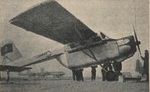
Designed and built by Walter Haufe, of Neenah, Wisconsin, this single-seater high wing motor glider is powered by a 40hp Nelson H-59 four-cylinder horizontally-opposed engine mounted in the nose. The engine, when stopped for soaring flight, swings back through 80° inside its cowling so that the two-blade fixed-pitch propeller, also designed and built by Mr Haufe, is stopped in the vertical position and lies flat along the top of the cowling to minimise drag. The cooling air intakes for the cylinders are open when the engine is running but are closed when the engine is stopped. The cantilever wooden wing is of semi-elliptical planform with upturned tips, the fuselage is a fabric covered steel tube structure and the tail unit is wooden with fabric covering. Landing gear consists of a fixed monowheel and a tailskid, plus an unusual skid with small balancer wheel just behind the engine cowling to prevent the prop from touching the ground. The pilot sits under a removable cockpit canopy set into the wing leading edge. The Hawk prototype, N1051Z, made its first flight in 1962.

Span: 40 ft 6 in
Length: 22 ft 6 in
Empty weight: 462 lb
Max speed: 40 mph
Min sinking speed: 3.0 ft/sec
Rate of climb: 500 ft/min
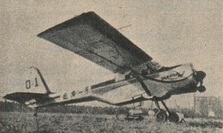
Hatfield Man-Powered Aircraft Club MPA / Puffin

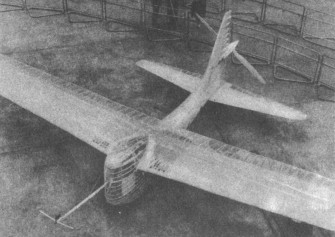
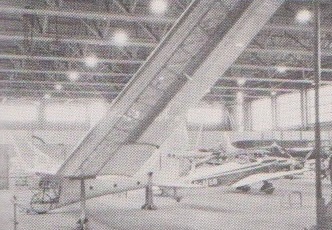
Built specially to compete for the Kremer prize of £5,000 for man-powered flight. A single seat, fixed wing monoplane with the propellor driven by pedalling. Employees of the de Havilland Aircraft Company’s Puffin flew in November 1961 from Hatfield aerodrome. Puffin was with transparent Melinex covering and extreme dihedral on its 25.6 m (84 ft) wings. Its pilot, Jim Phillips, by the end of the year had flown the craft up to 686 m (750 ft) and made turns through 8o degrees. On 4 May 1962 Hatfield Man Powered Aircraft Club chairman John Wimpenny flew the Puffin 908 m (993 yards). He was awarded a £50 prize for his record 805 m (880 yard) flight.

Construction was metal tube with balsa for the non-load carrying areas with Mellinex covering. A single main wheel undercarriage with a jockey wheel at the tail were fitted.

It crashed after ninety flights at Hatfield in April 1964 and was rebuilt as the Puffin II.

The Puffin II was an entirely new design wing of greater span and having a different Airfoil section. It flew for about another ninety flights at Hatfield until it collided with some ground equipment there in 1969 and was wrecked.

Liverpool University MPAG bought the remains and they were used in their ‘Liverpuffin’.

Puffin I
Wingspan: 84.00 ft
Wing area: 380 sq.ft
Aspect ratio: 21:1
Empty weight: 140 lb

Puffin II
Wingspan: 93.00 ft
Wing area: 390 sq.ft
Aspect ratio: 22:1
Empty weight: 140 lb

Harker Hawk

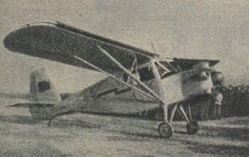
The Harker Hawk PFA 003-10004 is a single-engined aircraft registered G-BDNE. An original design by Don Hawker, the Harker Hawk was started in 1973. A two seat low wing monoplane with slightly swept-back wings, it had a tail wheel undercarriage. Powered by a Continental A65, construction of PFA.03010004 was underway during 1974.

Harbin Songhuajiang-1

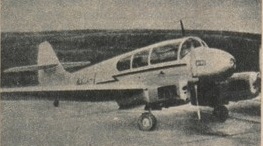
The Harbin Songhuajiang-1 (松花江一号) was a Chinese unlicensed copy of the Aero Ae 45S produced in 1959.

Built at the Weijian State-owned Machinery Factory, Harbin, it first flew on 29 September 1959.

Engines: 2 x Walter Minor 4-III, 104 hp
Propeller: two-blade
Wingspan: 40ft 4,25in
Length: 28ft 1,8in
Maximum Take-off Weight: 3527 lb
Crew: 1 + 5
Maximum Speed: 170.3 mph
Range: 500.2 mi

Harbin SH-5/PS-5

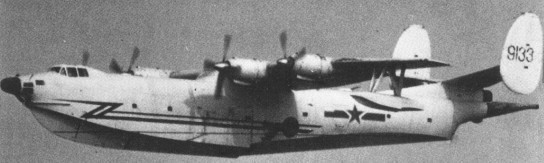
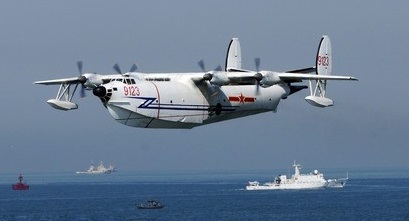
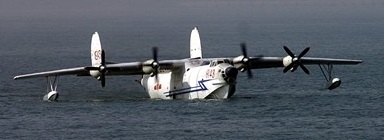
The SH-5 is an indigenous seaplane designed to replace the domestically produced Beriev Be-6s then in PLANAF service. Design work began in 1970, with the new aircraft aimed at performing maritime patrol and search and rescue duties. An entirely new in design, static testing didn’t begin until 1974. The Harbin Shuishang Hongzhaji 5 / PS-5 first flew April 1976, with series production commencing 1984 and 8-9 built to 1987 at Harbin.

The four-turboprop amphibian PS-5 appears to have the wing and powerplant of the Y-8 (An-12) transport and the tailplane and twin fins of the Beriev Be-6, combined with a new fuselage.

Powered by four 3,150 hp WJ¬-5A-1 (AI-24A) turboprops, PS-5S has 22,045-lb (10-tonne) max payload, includ¬ing four torpedoes or AShMs on underwing racks, or up to 13,227 lb (six tonnes) of depth bombs.

The SH-5 saw active use, and several of the aircraft were upgraded with EW systems. One example was converted for use as an aerial firefighter. In 2009, production of a new variant was announced with deliveries planned for 2014.

Harbin Aircraft Manufacturing Corp

Created in 1952 from the Mansyu Hikoki Seizo Kabushiki Kaisha of Manchuria. Began the H-6 bomber program in 1957, initially assembling two Tu-16s from Soviet supplied components, the first flying in September 1959, but in 1961 this program was transferred to Xi’an. Manufactured the H-5 jet bomber from 1966 to the 1980s, based on the Soviet llyushin II-28. Developed and still produces the Y-11 (first flown about 1975) and Y-12 (first flown June 1984) general-purpose transports and Z-9 Haitun twin-turboshaft helicopter as license-produced Eurocopter Dauphin 2. Was pursuing development of a new helicopter in 1999, and is a partner in the Colibri EC 120 B helicopter program . Also produced two prototype (one static) and five production SH-5 anti-submarine amphibians (one civil, tested as a firebomber).

In 1998, the core company of Harbin Aircraft Industry Group (HAIG) was under under AVIC II and occupied a 514 ha (1.270 acre) site, including 350,000 sq.m of workshop space. The workforce in 1998 numbered approximately 18,000.

Harbin partnered with Eurocopter and Singapore Technologies Aerospace in the Eurocopter EC 120 Colibri programme, for which it builds the cabin.