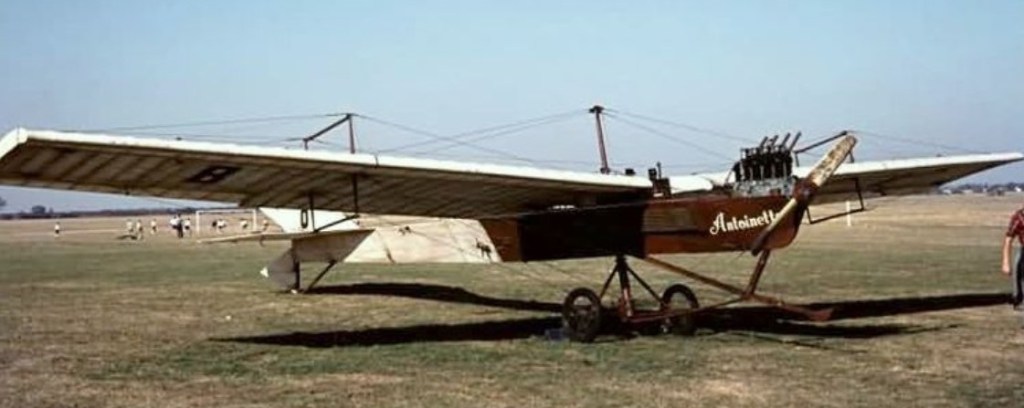
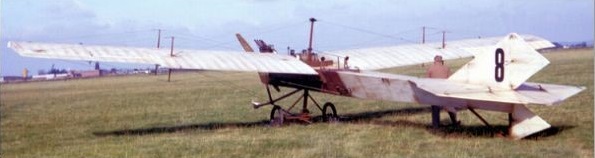
In 1964 Hants & Sussex Aviation was contracted to build three Levavasseur Antoinette IV monoplane replicas of 1910 vintage for the film ‘Those Magnificent Men in Their Flying Machines’. The Antoinette IV movie model closely replicated the slim, graceful monoplane that was very nearly the first aircraft to fly the English Channel, in the hands of Hubert Latham, and won several prizes in early competitions. When the Hants and Sussex Aviation Company from Portsmouth Aerodrome undertook its construction, the company followed the original structural specifications carefully, although an out-of-period de Havilland Gypsy I engine was used.
They were built in wood but the Antoinette’s wing structure proved, however, to be dangerously flexible, and lateral control was very poor, even after the wing bracing was reinforced with extra wires, and the original wing-warping was replaced with “modern” ailerons (hinged on the rear spar rather than from the trailing edge, as in the “real” Antoinette). The final configuration was still considered marginal in terms of stability and lateral control.
Both of the flying examples (one was static only) are thought to still exist. The first machine was noted in a hanger at Fairoaks in 1972 and the second machine was undergoing a rebuild in Geneva, Switzerland.
Hants and Sussex Aviation Ltd was an aircraft manufacturer based at Portsmouth Airport, Hampshire, England. It is still in business in the aircraft components industry.
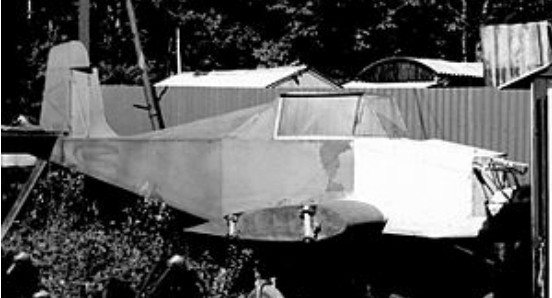
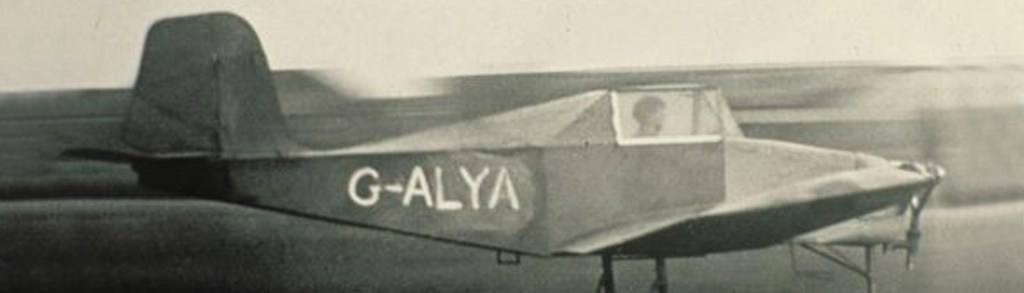
In 1953, HSA designed its first aircraft. This was the H&S Herald. The Herald was a single-seat ultra-light aircraft with a fixed tricycle undercarriage and powered by a 40 h.p. Aeronca-JAP J-99 piston engine. Aircraft Registration: G-ALYA Construction Number: HA/AC/001
The Herald made flight tests at Portsmouth Airport in 1953, but these revealed that it had a poor performance and the aircraft was grounded and dismantled in 1955.
Powerplant: 1 × Aeronca-JAP J-99, 40 hp (30 kW) Wingspan: 29 ft 0 in (8.84 m) Length: 21 ft 6 in (6.55 m) Empty weight: 580 lb (263 kg) Gross weight: 900 lb (408 kg) Maximum speed: 92 mph (148 km/h, 80 kn) Cruise speed: 82 mph (132 km/h, 71 kn) Crew: 1
Hants and Sussex Aviation (HSA) was formed in 1946 at Portsmouth Airport, Portsmouth, Hampshire, England, by the Hawes family (A.H.Hawes, W.E.Hawes, A.E.Hawes & F.G.Lewis) and initially worked on component manufacture and repair for military aircraft.
The first Hants and Sussex office was located above the archway of what was then the Bailey family business of builders and estate agents in Bognor Regis. The company’s first workshop was in Fratton, Portsmouth and comprised of an estimated 1,500 square feet. They relocated to the edge of what was then Portsmouth Municipal Airport in 1947 and have been here ever since.
In 1953, HSA designed its first aircraft. This was the H&S Herald. The Herald was a single-seat ultra-light aircraft with a fixed tricycle undercarriage and powered by a 40 h.p. Aeronca-JAP J-99 piston engine. The Herald made flight tests at Portsmouth Airport in 1953, but these revealed that it had a poor performance and the aircraft was grounded and dismantled in 1955.
HSA were contracted in 1965 to build one of the pre-World One flying replica aircraft for the film Those Magnificent Men in their Flying Machines. HSAs aircraft was the Antoinette IV which they powered by a de Havilland Gypsy I engine.
HSA then concentrated on work on the overhaul, modification and repair of aircraft engines and components. In late 1976 the firm advertised its work on the overhaul and repair of Continental piston engines for aircraft. By September 1986 HSA were overhauling and modifying Rolls-Royce Dart and Pratt and Whitney PT-6 turboprop engines. HSA still carry on trading within the aviation support industry in 2008.
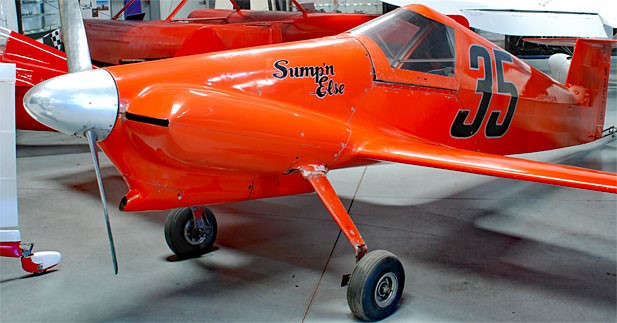
William Hanson’s WH-1 Formula 1 racer N35TS, Race 35, began life with the name of “Thunderchicken.” The fuselage is of welded tubular steel construction, with the cockpit and engine areas covered with sheet aluminum, and the area aft of the cockpit covered with fabric. The tail surfaces were constructed similarly to the aft fuselage. The wings were made of wood spars and ribs with plywood covering.
The aircraft, wearing the name “Thunderchicken,” qualified at the Cleveland Air Races in 1972, flown by Ken Haas. However, due to failure of the windshield, the aircraft failed to place. The same year, Tom Cooney flew finished in fifth place in the Formula 1 Silver Race at Reno, with a speed of 202.74 mph.
The WH-1 was renamed “Sump’n Else,” retaining race number 35, and repainted for the 1974 Reno Air Races, but did not qualify. In 1975, Thomas Summers flew “Sump’n Else” to a third-place finish in the Silver Race at Reno with a speed of 204.69 mph.
Engine: Continental 0-200 Span: 18 ft. 8 in Length: 18 ft. 3 in Height: 6 ft. 2 in Maximum Speed: 225 mph Crew: 1
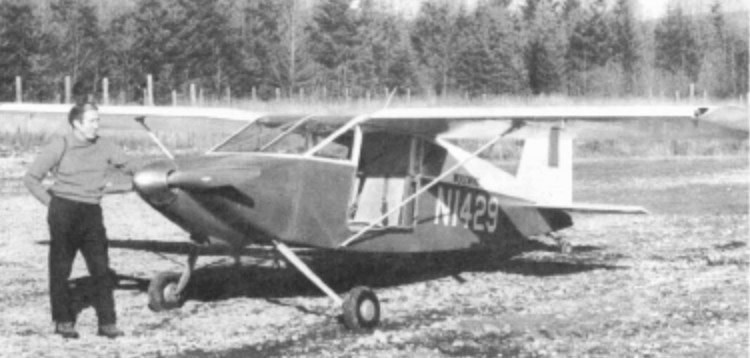
The Hanson Woodwind is an all-wooden homebuilt aircraft with a fiberglass wing designed by Carl Hansen.
The Woodwind is a two seat side-by-side configuration, strut-braced, high-wing aircraft with conventional landing gear and Plexiglas doors. Some construction elements were adapted from the all-wood Bowers Fly Baby. The Woodwind was a homebuilt copy of the Wittman Tailwind using all-wood construction, rather than welded steel tube and aircraft fabric covering for the fuselage. The Wittman design uses plywood covering for its wings, while the Woodwind uses fiberglass. The fuselage sides and tail surfaces are built flat on a table at the same time and covered with aircraft grade plywood. The wings are covered in fiberglass with stainless steel torque tubes for aileron control. The fuel tanks and cowling are also made from fiberglass. The prototype used a moose-hide interior.
The prototype first flew on 20 June 1969. The aircraft was written off in an non-fatal accident on 5 June 1976 after hitting a large rock.
Engine: 1 × Lycoming O-235-C, 100 hp (75 kW) Propeller: 2-bladed variable-pitch Sensenich “Skyblade” Capacity: 2 Empty weight: 851 lb (386 kg) Gross weight: 1,425 lb (646 kg) Fuel capacity: 32 U.S. gallons (120 L; 27 imp gal) Maximum speed: 126 kt / 233 km/h (145 mph) Cruise speed: 122 kt / 225 km/h (140 mph) Stall speed: 52 kt / 97 km/h (60 mph)
USA After acquiring in 1948 the manufacturing and marketing rights to the prewar Rose Parakeet single-seat sports biplane from Rose Aeroplane & Motor Company, Hannaford Aircraft Co offered production versions of the airplane with 40- 85hp engines.
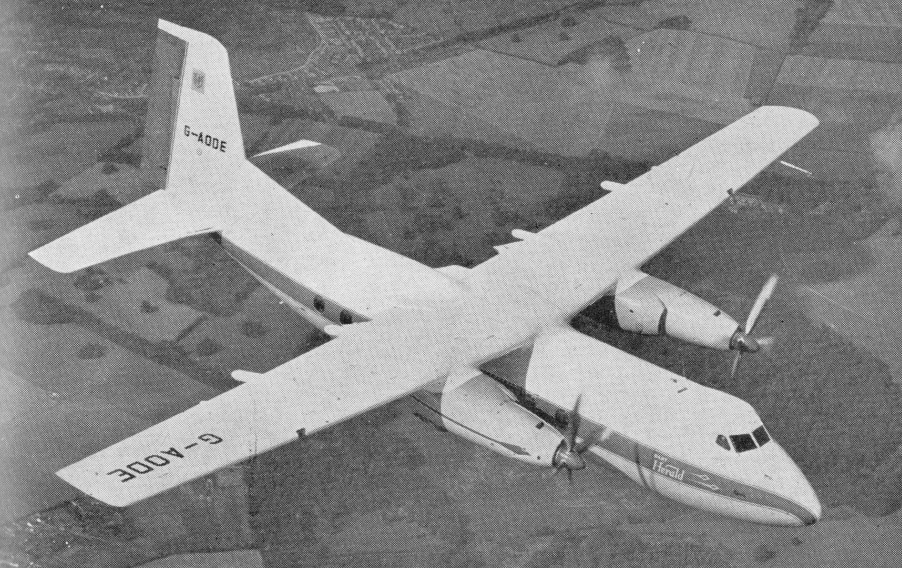
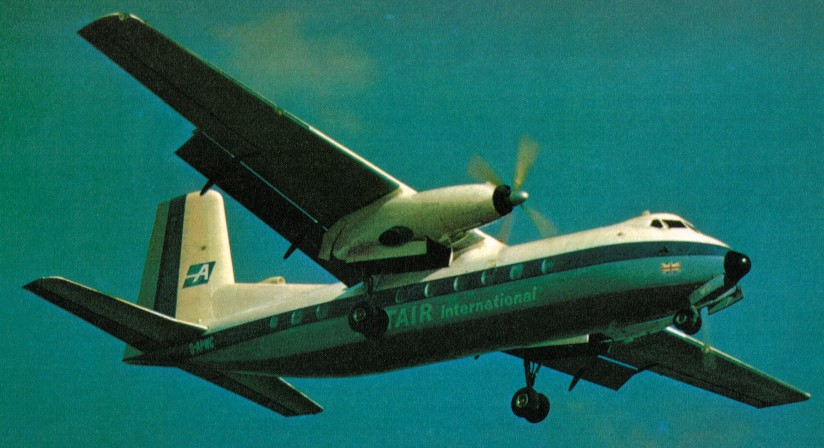
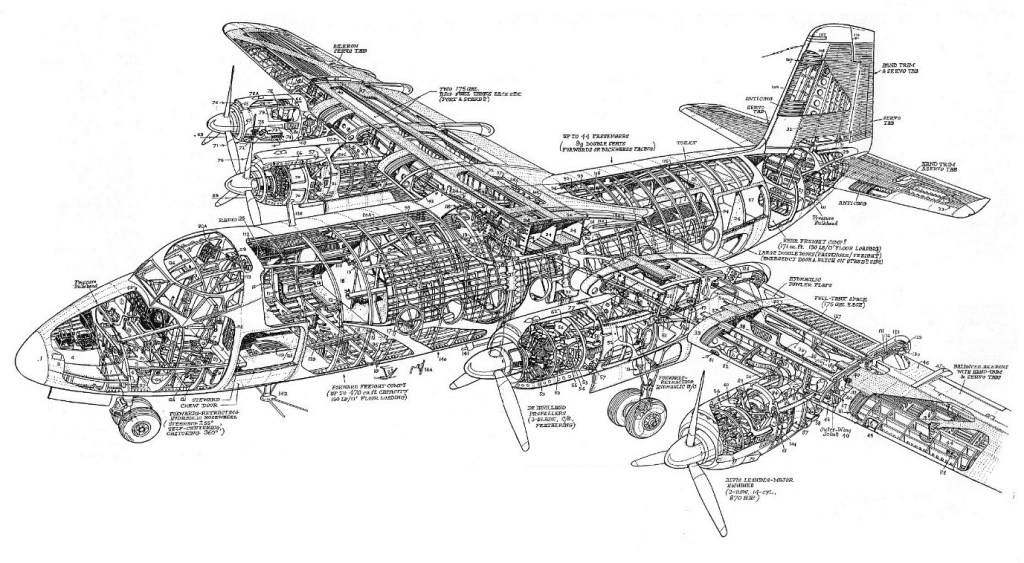
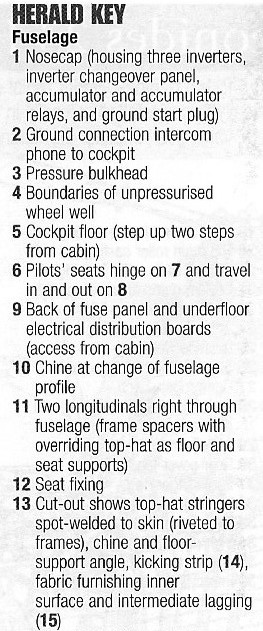
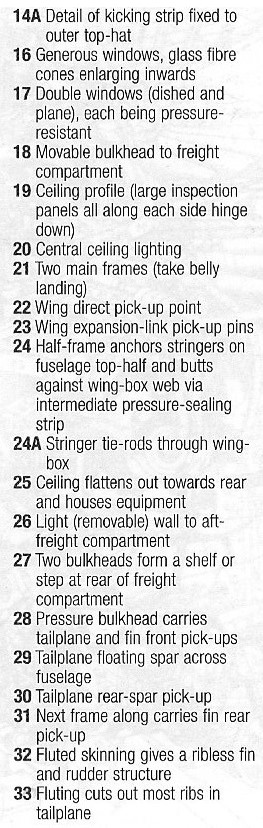
A medium sized transport designed to take the place of the DC 3, the Handley Page HPR 3 Herald design shows an essentially straight forward approach ¬with four piston engines, a high wing layout and a fuselage designed to carry 44 passengers, freight, or mixed loads. It is to be pressurized to a relatively low differential, and will carry a full payload of 10,705 lb. for a no reserve range of 350 st. miles, or 4,650 lb. for a full tank range of 2,050 miles.
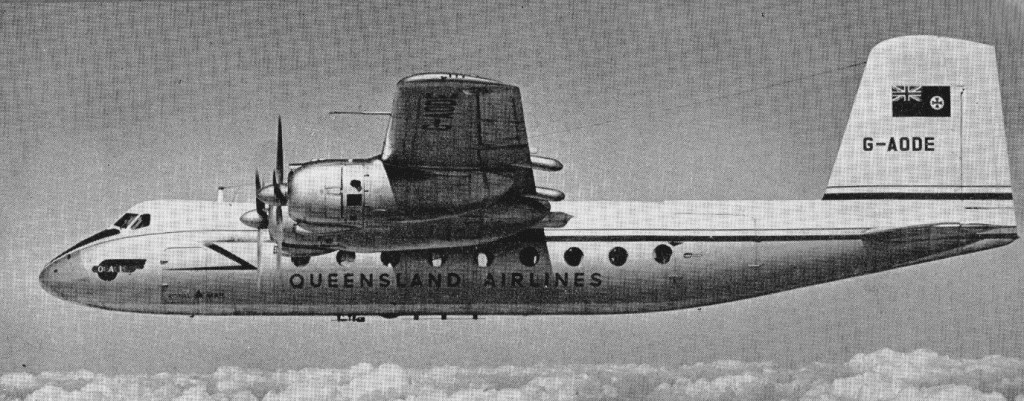
The first Herald, G-AODE, flew on 25 August 1955 from Radlett, powered by four Alvis Leonides piston engines. Airborne for 30 minutes, the pilot was H.G.Hazelden. It appeared at that years SBAC Display.
Handley Page HPR.3 Herald
The first Handley Page Herald completed 125 hours flying in a year and received a Special Category of C of A in 1956.
By 1956 the Herald had been ordered by Queensland Airlines, Australian National Airways, Lloyd Aereo Colombiano and Air Kruise.
The prototype Dart-engined Herald made its first flight on 11 March 1958 and the first production Herald Series 100 flew on 30 October 1959. The Series 100 accommodated between 38 and 47 passengers. The Series 200 was the main production version with a forward fuselage 1.07m longer than that of the Series 100. Accommodation was provided for 50-56 passengers. Powered by two Rolls-Royce Dart 527 turboprops of 2,150 shaft hp, its maximum cruise speed is 274 mph.
In 1960 Handley Page were offering both the Leonides Major and Dart powered versions.
The Series 300 (a modified Series 200 developed to meet US airworthiness requirements) was followed by the Series 400 military transport with a side loading door and accommodation for 50 troops, paratroops, 24 stretchers or freight, eight of which went to the Royal Malaysian Air Force. The projected Series 500 was followed by the Dart 532/9 turboprop-engined Series 600.
The final two versions were the Series 700 long-range version of the Series 600, accommodating up to 60 passengers or 52 passengers and baggage over 1,980km stages, and the Series 800 military version of the 700. By 1958, when they offered an alternative version powered by Rolls-Royce Dart turboprops, the Fokker F 27 had cornered the market. Only 48 aircraft were produced.
HP(R) HP.3 Herald Engines: 4 x Alvis Leonides Major, 850 bhp Wingspan: 95 ft Length: 70 ft 3 in Mauw: 34,000 lb Max speed: 263 mph
HP Herald Srs 200 Powerplant: two Rolls-Royce Dart RDa.7 M1k. 527 turboprops, 1570kW / 2105 ehp Propellers: Rotol four-blade, fully feathering 12 ft 6 in diameter Wingspan, 94 ft 9 in / 28.88 m Length, 75 ft 6 in / 23.01 m Height, 24 ft 1 in / 7.34 m Gross wing area, 82.31 sq.m / 886 sq.ft Max. usable floor area, 283 sq.ft Max. usable volume, 1802 cu.ft Max. cabin length, 54 ft 0 in Max. width, 8 ft 8.25 in Max. height, 6 ft 3.75 in Accommodation: 50 passengers at 30.5 in pitch; 56 at 30 in pitch. Basic operational 25,758 lb Total fuel, 8640 1b Max. take-off with 5 deg flap, 41000 lb Max. landing, 39,500 lb Max. payload, 11,242 lb Max. zero fuel, 37,500 lb Power loading (max. take-off weight), 10.2 lb/ehp Wing loading (max. take-off weight), 48.5 lb/sq.ft Wing loading (max. landing weight), 44.5 lb/sq.ft Max level speed: 275 mph / 443 kph High-speed cruise, 237 kt. at 15,000 ft Long-range cruise, 230 kt. at 23,000 ft Approach speed, 89 kt Ceiling: 8500 m / 27900 ft Take-off field length, ISA at sea level, 5000 ft Landing field length, ISA at sea level, 3575 ft Range, no reserves, ISA with max fuel, 8602 lb payload, 1 500 nm Range w/max.payload: 1786 km / 1110 miles Crew: 2 Passengers: 50-56
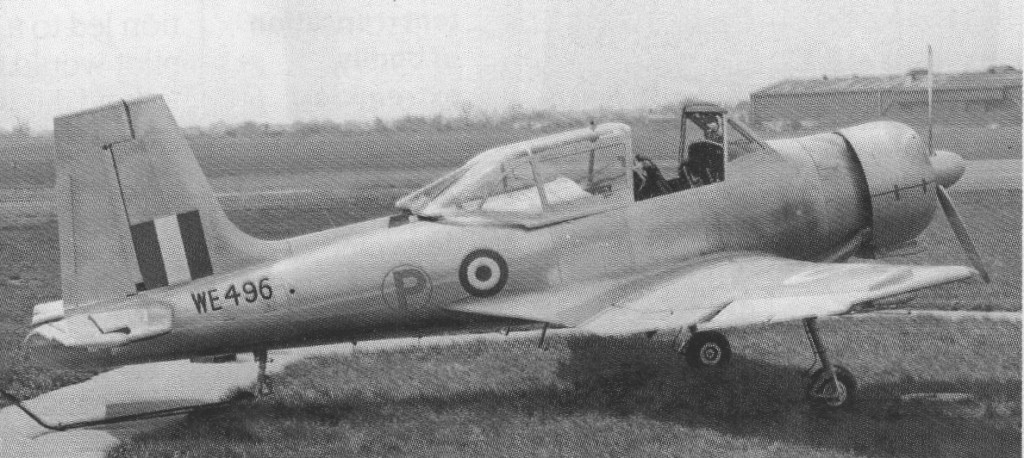
Competing with the Percival Provost for an RAF order circa 1950, two HPR-2 basic trainers were built. Seating two side by sice and powered by an Armstrong Siddeley Cheetah 17 radial, the original canopy generated too much turbulence and had to be replaced.
In 1966 feasibility and market studies revealed a definite market for a medium-sized turboprop mini-airliner for commuter and executive use. The H.P.137 Jetstrearn was launched, attracting nearly 200 orders and options in the first year. It even won the United States Air Force contest for the C- 10A transport. But it was a difficult aircraft for a firm used to large and expensive military designs, and development was prolonged. Its airworthiness category imposed a nominal limit in all-up weight which severely affected range/load performance. This was improved with the advent of higher-power engines and a change in category, which allowed take-off weight to rise to the level for which the Jetstream was designed.
The Jetstream had accommodations for a crew of two plus flight attendant and 4-18 passengers. With a diameter of 6 feet, a length of 24 feet, and 613 cu. ft. of usable cabin space, the Jetstream has the largest interior in its class. There is stand-up headroom, ample walkaround space, and 14 windows.
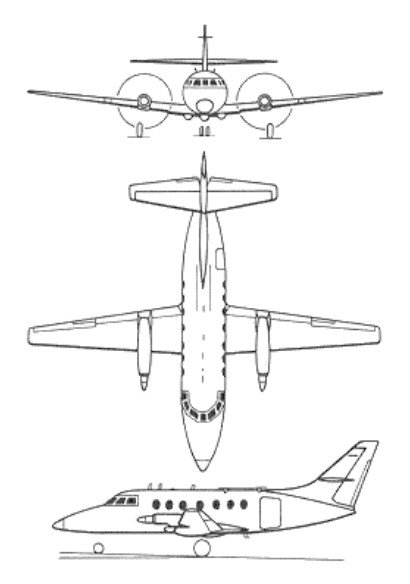
The HP.137 Jetstream was a pressurized 12/18 seat low-wing monoplane with a retractable undercarriage, powered by a pair of 840 hp Turbomeca Astazou XIV turboprops. Before the drawings were complete, Riley placed an order for 20 for the United States feeder liner market.
The prototype H.P.137 (G-ATXH c/n 198) flew first on 18 August 1967 powered by the Astazou XII. The first four aircraft were powered by the French Astazou, the fifth aircraft was fitted with the US-built Garrett AiResearch TPE-331 instead to improve sales prospects in the US. This re-engining lead to an order by the US Air Force for 11 Jetstream 3M or C-10A as a mission support transport aircraft. Early 1969 however this order was cancelled on the grounds of late delivery.
The Jetstream 1 had entered production by this time; with the first production model Jetstream 1 flying on 6 December 1968. Over the next year 36 would be delivered. The Astazou XIV engines however proved to be generally underpowered for the design. Due to these engine problems the Jetstream 1 was re-designed as the Jetstream 2 with more powerful 1073 hp Astazou XIVCs, starting deliveries in late 1969. By this point the late delivery and engine problems had driven costs to £13 million and Handley Page ran into serious financial difficulties. Only three Jetstream 2’s would be completed before Handley Page went bankrupt, and the production line eventually shut down in 1970. Only 39 aircraft had been completed by the time of Handley Page’s collapse in 1970. Although Handley Page was wound up as a company, the Jetstream lived on. Ten further aircraft were completed, five by Jetstream Aircraft and five by Scottish Aviation. In 1971 Scottish Jetstream Ltd was the name of a new company formed by Scottish Aviation and Jetstream Aircraft for the manufacture of the Jetstream twin turboprop transport. Scottish Aviation continued production of the Jetstream 2 although they referred to it as the Jetstream 200.
The Royal Air Force ordered twenty-six Jetstream 200’s as navigation and multi-engine trainers known as the Jetstream T.1. The Royal Navy later subsequently took over some of these as T.2’s. In 1977, Scottish Aviation was nationalized along with the British Aircraft Corp. and Hawker Siddeley Aviation to form British Aerospace.
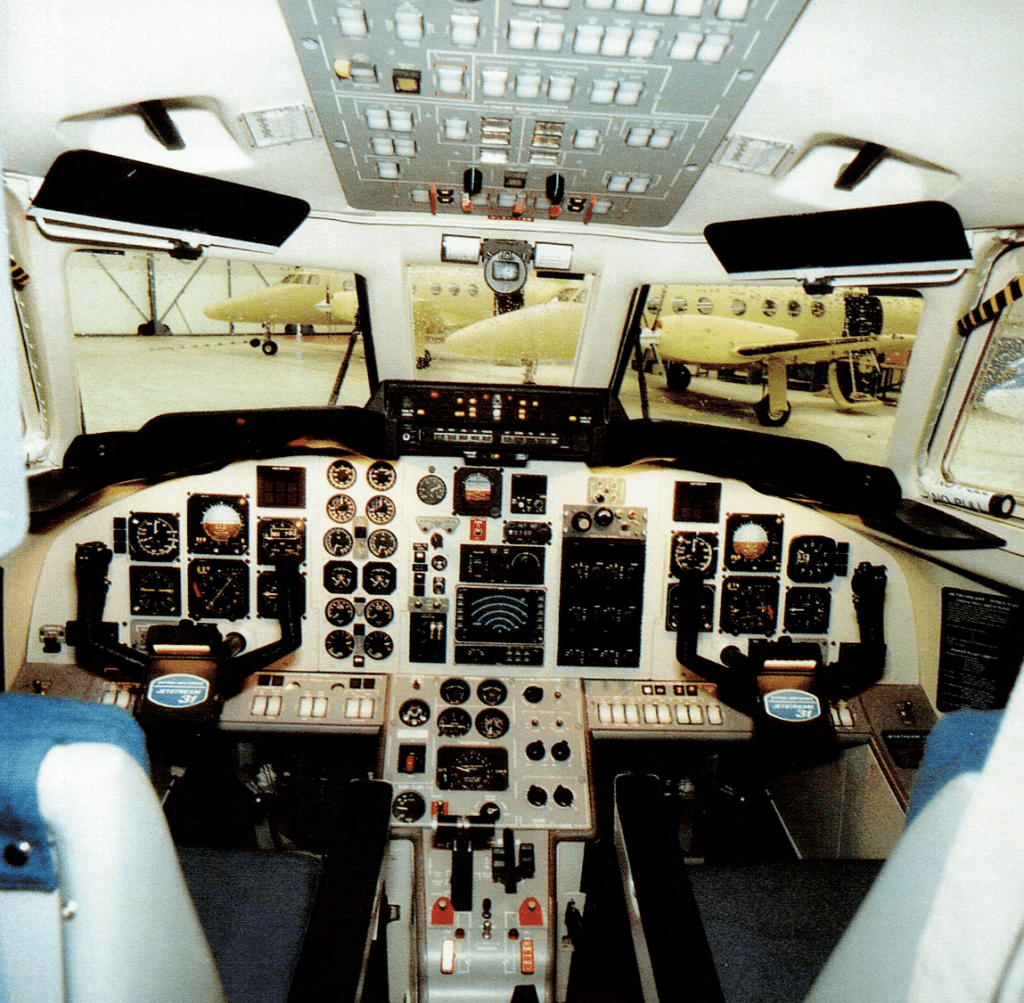
Jetstream 31
BAe decided the design was worth further development, and started work on a “Mark 3” Jetstream. The new version was re-engined with two 1020 hp Garrett TPE331-12UAR turboprops that offered significant advantages over the Turbomeca units. This allowed the aircraft the ability to operate at maximum load from a much greater range of airfields. The prototype of the BAe Jetstream 31, converted from an original HP137 airframe to suit revised FAR requirements for 19-seat commuter aircraft, made its maiden flight on 28 March 1980 (G JSSD) from Prestwick Airport, Scotland and was airborne for 1hr 22min. Aboard on the flight were BAe test pilots Angus McVittie and J. L. S. ‘Len’ Houston, J. R. ‘Bob’ Baker from Garrett-AiResearch and BAe flight test engineer Andrew Eldred.
The new British Aerospace Jetstream 31 entered production 28 March 1980 and is powered by two Garrett AiResearch TPE331 IOU engines and also features advanced technology propellers and new electrical, air conditioning and cockpit systems. By 1994 some 380 had been delivered, 320 of those to the USA. The Royal Navy received four Jetstream 31 twin turboprops, designated T.3, which are used for observer training. These aircraft join 16 Astazou-powered T.2s which are used in similar roles. The T.3s differ not only in having Garrett TPE331 engines, but also in having an underfuselage Racal ASR360 search radar in place of the nose-mounted MEL E90 unit of the T.2. The RAF also used 11 Astazou powered Jetstream T.ls for multi-engine pilot training. Saudi Arabia has bought two Jetstream 31s for tornado crew training.
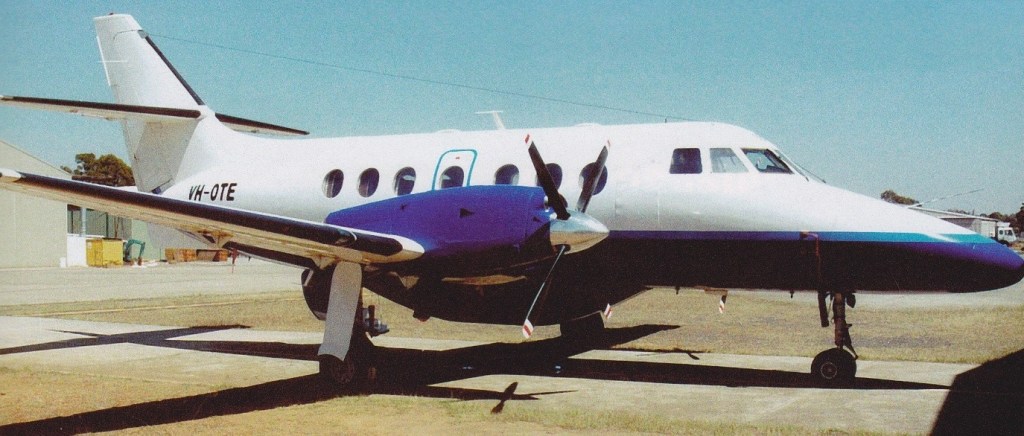
In 1985, development of a further upgrade started resulting in the Jetstream Super 31, also known as the Jetstream 32, with more powerful engines that flew in 1988. The Jetstream 32EP (also known as Jetstream Super 31) was designed to increase the payload and range of the Jetstream 32 in extreme climatic conditions. It provides significant improvements in performance, derived from the use of two upgraded Garrett TPE331-12 turboprop engines flat-rated at 1,020 shp (760 k)XD and driving four-bladed advanced technology propellers.
Jetstream 32EP VH-OTE December 2007, Bankstown, Australia
More than 310 Jetstream 31s and Super 31s had been ordered by 1987. In 1991, the 29-seat Jetstream 41 was introduced. Production of the Jetstream 31/32 ended in 1993, while the production of the Jetstream 41 ended in 1997.
The Handley Page Jetstream came back for another round, as the newly certi¬ficated Century Jetstream III, with 904 shp Garrett AiResearch TPE 331 turboprops in place of the French Astazous. Century Aircraft Corp. of Amarillo, Texas, Jetstream III is air-conditioned and pressurized at 6.5 psi. The conversion to Garrett engines allows a range of 1,920 miles out of a 426-gallon fuel capacity. The engine conversions were performed by Volpar, Inc. in Van Nuys, California.
Jetstreams built since the early start in 1965 until the production ended in 1997 are: 38 H.P.137 Jetstream by Handley Page Ltd; 5 H.P.137 Jetstream by Jetstream Aircraft Ltd; 5 H.P.137 Jetstream by Scottish Aviation Ltd; 26 Jetstream T.1 by Scottish Aviation; 220 Jetstream 31 by British Aerospace; 161 Jetstream Super 31 by British Aerospace; 100 Jetstream 41 by British Aerospace.
HP 137 Jetstream Powerplant: two Turbomeca Astazou XIV, 850 shp / 625kW Propellers: Hamilton Standard three-bladed 8 ft 3 in diameter Wingspan: 15.9 m / 52 ft 2 in Length: 14.7 m / 48 ft 3 in Height: 5.1 m / 16 ft 9 in Wing area: 25.1 sq.m / 270.17 sq ft Max. usable floor area, 85.5 sq.ft Max. usable cabin volume, 564 cu.ft Max. cabin length, 24 ft 3 in Max. width, 6 ft 1 in Max. height, 5 ft 11 in Accommodation: max. high density 18 passengers at 30 in pitch. Basic operational (gross less usable fuel and payload), 8200 lb or 8530 lb / 3869 kg Total fuel, 3120 lb / 456 USG Max take-off weight: 5657 kg / 12472 lb Max. landing, 12,250 lb Max. payload (volume limited), 4000 lb Power loading, 7.76 lb/shp Wing loading (max. take-off weight), 45.4 lb/sq.ft Wing loading (max. landing weight), 45.4 lb/sq.ft Top speed 345 mph. High-speed cruise, 265 kt at 15,000 ft Long-range cruise, 217 kt. at 30,000 ft Stall 84 mph. Take-off field length to 50 ft, ISA at sea level, 2550 ft Landing field length, ISA at sea level, 2130 ft Range with allowances, max. fuel, 1000 lb payload at 217 kt. at 30,000 ft, 1910 nm Range with allowances, max. payload 18 passengers, at 265 kt. at 15,000 ft, 220 nm Initial climb rate 2,100 fpm. Ceiling 30,000 ft.
Jetstream III Engines two 902 shp Garrett AiResearch turboprops Gross wt. 12,500 lb Empty wt. 8,200 lb Fuel capacity 426 USG Cruise mph 300+ Range 1,920 miles Takeoff distance (50′) 2,500 ft Landing distance (50′) 1,000 ft Seats 4-18.
British Aerospace Jetstream 31 Engine : 2 x Garrett TPE 331-10UG, 691 shp Length : 47.146 ft / 14.37 m Height: 17.388 ft / 5.3 m Wingspan : 52.001 ft / 15.85 m Wing area : 271.253 sq.ft / 25.2 sq.m Max take off weight : 15324.8 lb / 6950.0 kg Weight empty : 9613.8 lb / 4360.0 kg Max. weight carried : 5711.0 lb / 2590.0 kg Max. speed : 264 kts / 488 km/h Landing speed : 86 kts / 159 km/h Cruising speed : 230 kts / 426 km/h Initial climb rate : 2066.93 ft/min / 10.50 m/s Service ceiling : 25000 ft / 7620 m Wing load : 56.58 lb/sq.ft / 276.0 kg/sq.m Range : 675 nm / 1250 km Crew : 2 Payload : 19PAX / 1805kg
BAe Jetstream 3100 First built: 1982. Engines: 2 x Garrett TPE 331-10V-501H, 940 shp. Props: Dowty-Rotol 4-blade, 106-in. Seats: 9/18. Length: 47.1 ft. Height: 17.5 ft. Wingspan: 52 ft. Wing area: 271.3 sq.ft. Wing aspect ratio: 10. Maximum ramp weight: 14,660 lbs. Maximum takeoff weight: 14,550 lbs. Standard empty weight: 9046 lbs. Maximum useful load: 5614 lbs. Maximum landing weight: 14,550 lbs. Wing loading: 53.6 lbs/sq.ft. Power loading: 8.1 lbs/hp. Maximum usable fuel: 3079 lbs. Best rate of climb: 2200 fpm. Service ceiling: 25,000 ft. Max pressurisation differential: 5.5 psi. 8000 ft cabin alt @: 25,000 ft. Maximum single-engine rate of climb: 520 fpm @ 109 kts. Single-engine climb gradient: 286 ft/nm. Single-engine ceiling: 15300 ft. Maximum speed: 267 kts. Normal cruise @ 25,000ft: 230 kts. Fuel flow @ normal cruise: 460 pph. Endurance at normal cruise: 6.1 hrs: Stalling speed clean: 98 kts. Stalling speed gear/flaps down: 86 kts. Turbulent-air penetration speed: 180 kts.
HP Jetstream Mk.1 / Century Jetstream III Engines: 2 x Garrett TPE 331-3U-303, 904 hp. Seats: 10/20. Wing loading: 47 lb/sq.ft. Pwr loading: 6.9 lb/shp. Max TO wt: 12,500 lb. Empty wt: 8,600 lb. Equipped useful load: 3600 lb. Payload max fuel: 528 lb. Max cruise: 489 kt. ROC: 2000 fpm. Min field length: 2310 ft. Cabin press: 6.5 psi. Fuel cap: 3072 lb.








 All Aero