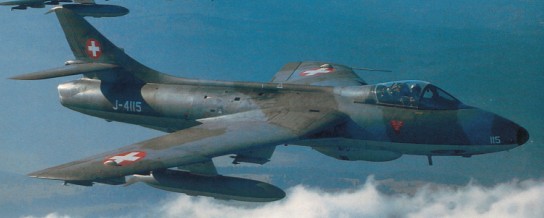
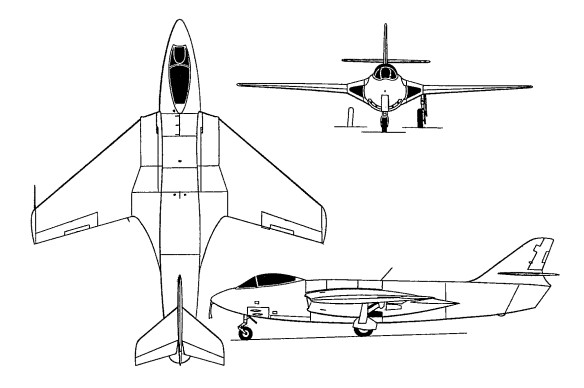
Hawkers worked on a number of designs for jet fighters after the war and the Hunter would follow on from the Sea Hawk via another design, the P.1052. Basically a swept-wing Sea Hawk, the P.1052 looked promising enough to be considered as a Meteor replacement but other designs looked to be even better. One such was one born from Air Ministry specification F.3/48, the Hawker P.1067. Designed by Sir Sydney Camm, designer of the Hurricane and Sea Hawk, the P.1067 was his attempt to meet the earlier F.43/46 specification, which was then discarded and replaced with F.3/48, which was written to match the P.1067. To be armed with four 30mm cannon and powered by the then-new axial flow turbojet, three prototypes were to be built, two using the Rolls Royce AJ.65 (Avon) and one using the Metrovick F.9 (later known as the Armstrong-Siddeley Sapphire), in case the AJ.65 development ran into problems. The cannon were to be in a single unit complete with ammo, enabling quick re-arming by simply winching the pack down and replacing it with another.
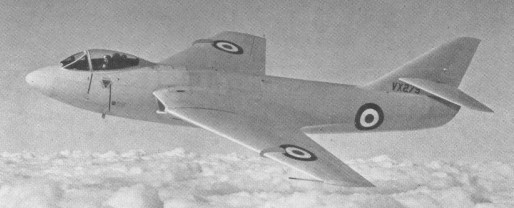
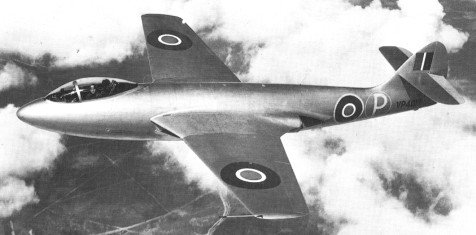
Detailed design began in late 1948 but it was not until early 1950 that Hawkers were ready to proceed with constructing a prototype. Receiving an order for 400, split equally between Sapphire and Avon powered aircraft, construction of the prototype began and by early 1951 the aircraft was ready for ground tests. Neville Duke, Hawker’s chief test pilot, began taxiing trials at Boscombe Down and the first flight of the P.1067, serialled WB188, was on the 20th of July, 1951. After a number of flights out of Boscombe, the prototype returned to Hawker’s home airfield at Dunsfold where development flying began in earnest. September saw the aircraft’s appearance at the 1951 Farnborough SBAC show, and in April 1952 Duke took the aircraft through the much publicised ‘sound barrier’ for the first time.
With two more prototypes joining WB188, the project became a ‘super priority’ one with production accordingly accelerated.
The British Government, said Mr. Jefferson, general manager of Hawker Aircraft (Blackpool), Ltd., ordered the Hunter for the R.A.F. “off the board.” The “instruction to proceed” was placed in October 1950 and the contract followed six months later. The first production aeroplane flew in May 1953. Thus, from the date that Hawker Aircraft first knew they were going to receive an order to the time when the first production Hunter was flying, only two years and seven months elapsed.
The Hunter was a new aircraft and the company had to start from zero and build up a completely new production set-up. A serious aspect was the finding of firms to make large jigs and tools in the numbers required. The Hunter required some 3,250 tool designs, and about 40,000 jigs, tools and fixtures had to be provided for. To break the bottleneck the British Government introduced the “super-priority” scheme. This only partially produced the required results, since priority had to be allocated to so many items that suppliers and sub-contractors were often unable to give any measure of preference. In addition, every effort was being made to maintain exports.
Eventually, tool-making difficulties were overcome by a combination of two methods. The first took care of initial detail and sub-assembly work and involved a compromise – the development and use of “rough tools,” prepared not by the virtually unobtainable toolmakers but by skilled fitters. Although capable of manufacturing several hundred parts these tools were intended as a temporary measure. For major assembly jigs, eventually a large number of jigs were obtained from such Italian firms as Macchi, Breda and Fiat.
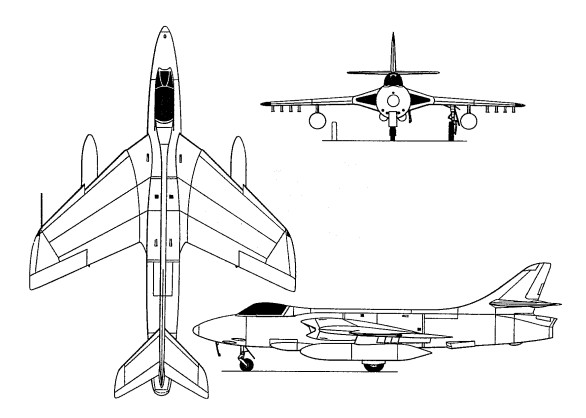
To facilitate manufacture, the Hunter was broken down into main assembly units, e.g. front fuselage, centre fuselage, rear fuselage, wings. This was common practice, but with the Hunter it was carried a stage farther. Each major component was not only built as a separate structural unit but was complete in itself, containing all ancillary equipment, services, pipes and runs, as in the finished aircraft. Thus for final assembly it was necessary only to connect the structural members and plug the pipes and leads together.
During the early days the resources of the entire Hawker Siddeley Group were pooled for difficult items. Hawker Aircraft itself was far from being housed all under one roof. Production plans, therefore, called for the detail parts and main assemblies to be made in several places, with Kingston-upon-Thames as headquarters. There were two other factories in the South of England and assemblies were fed to the final-assembly plant and airfield about 50 miles from Kingston. Certain specialized components were sent 250 miles from Hawker Aircraft (Blackpool), Ltd.
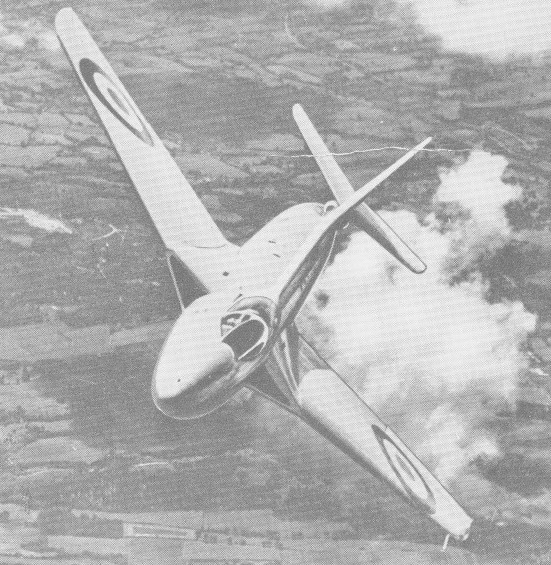
The first production F.Mk.1 powered by the 3425-kg (7,550-lb) thrust Avon 113 flew on the 16th of May, 1953, but this and a further 22 early production aircraft were used for development purposes. Like Supermarine’s troublesome Swift, problems began to arise. The use of the flaps as airbrakes turned out to cause a severe nose-down pitching at high speeds, and after much work a simple hinged brake was fitted to the fuselage underside. However even this was troublesome and had to be disabled when the landing gear was down. Cannon firing was restricted to low altitudes because exhaust gas from them could cause the engine to flame out. The Sapphire engined variant, the F.2, did not suffer from this.
Another cannon problem was that of spent links being ejected and tumbling along the lower fuselage causing much damage. Bulbous link collectors were fitted from the F.4 onwards, being added to earlier marks too. These were known as Sabrinas after a well-endowed pin-up girl of the time.
The Hunter F.1 entered RAF service with 43 Squadron in July 1954, replacing their Meteor F.8s. The Armstrong¬ Whitworth built Hunter F.Mk 2, with the 3629-kg (8,000-lb) thrust Sapphire 101 engine, followed in November, equipping 257 Squadron. The F.2 arrived at Dunsfold during the middle of November 1952, bearing the RAF roundels, not painted pale green like the F.1 but finished in its aluminium service colour. On November 29th everything was set to take it up for the first time; directors arrived at Dunsfold and a number of people. But the weather clamped down and snow fell. Everybody had to go away disappointed. The Sapphire-engined F.2 order was cut back, despite it not having the flame-out problem. Both variants were also short on fuel, something Hawkers were looking at with some concern.
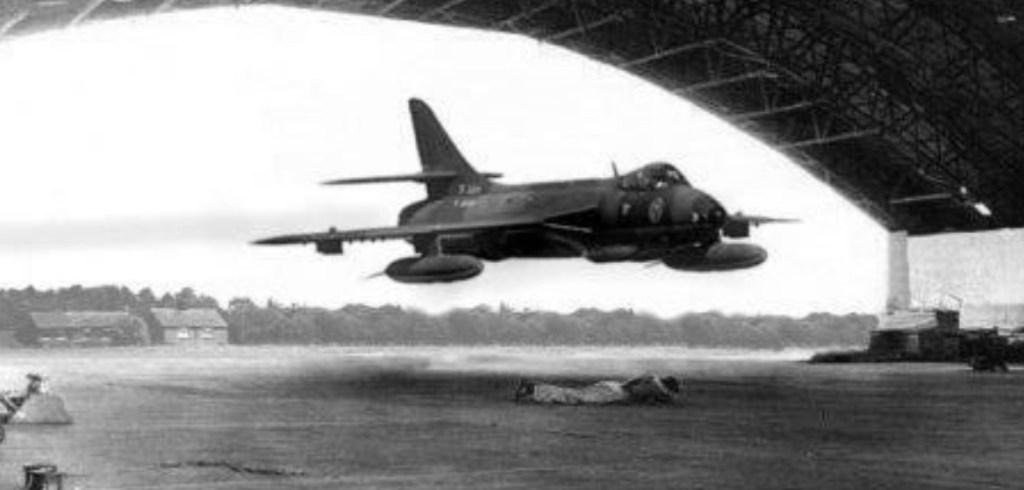
The early Hunters were basically employed as short-range day interceptors, radius of action limitations being overcome to some degree by the Hunter F.Mk 4 and Hunter F.Mk 5 variants which benefited from in¬creased internal fuel capacity and the ability to carry two 455-litre (100-Imp gal) external drop tanks. These two models both flew for the first time during October 1952 and were quickly introduced to service, the Hunter F. Mk 4 also becoming the first sub-type to secure export orders when the air arms of Belgium and the Netherlands acquired substantial numbers (most of them built under licences) whilst Sweden, Denmark and Peru also received some as the Hunter F.Mk 50, Hunter F.Mk 51 and Hunter F.Mk 52 respectively.
Work on the Hunter for the R.A.F. was proceeding at a satisfactory rate when the U.S.A. off-shore procurement order was placed with the British Government early last summer. So far as Hawker Siddeley were concerned, the new contract called for some 450 Hunters to be delivered by June 1956.
The order was being met from the existing organization by continuing production at the peak rate which had been planned to meet as quickly as possible R.A.F. requirements. Thus the offshore order assured a longer run of peak production and promised a level of capacity not otherwise possible. As the aircraft were completed, the M.o.S. and NATO representatives would decide between themselves which would go to the RA.F. and which to other NATO countries.
Off-shore orders were also placed with Holland and Belgium; thus eventually Hunters would also be built by three companies in Holland-Fokker (who are to undertake the majority of manufacture in that country), Aviolanda and de Schelde-and by two in Belgium-S.A.B.C.A. and Avions Fairey. There were the normal array of sub-contractors to each one company. The Netherlands and Belgium would between them manufacture some 100 off-shore Hunters by the summer of 1956, and thereafter would produce further Hunters for their Governments.
Since the war Holland had made Meteors from raw materials; in Belgium, however, the manufacturing side barely existed, except for Avions Fairey. But the country had an industrial tradition and her machine-tool industry was capable of undertaking any work entrusted to it. A large number of jigs and tools had been ordered through Hawker Aircraft in the United Kingdom for both countries, but Belgium had ordered these items in her own territory as well; S.A.B.C.A. had erected a new factory and were in process of receiving special plant from the U.S.A.
Broadly speaking, each of the companies engaged had certain responsibilities, each making various detail parts and subassemblies. Some factories would then incorporate these into main assemblies and finally the main units would be brought together-by S.A.B.C.A. in Belgium and by Fokker in Holland. In Belgium, Avions Fairey would make only detail parts and subassemblies and would be provided with some finished parts, and with main assemblies, by Hawker Aircraft-and, later, by Holland. Thus the pattern previously worked out of necessity in Great Britain would virtually be reproduced on the Continent. And such was the degree of standardization that components made anywhere in the three countries would be interchangeable.
Hawker teams were constantly going to both countries to advise and assist, and technicians and operatives were continually coming to England to be trained.
Much information and material had been supplied, including complete sets of master aircraft drawings and schedules, pre-production manufacturing information, jig and tool drawings, details of manufacturing processes, and master part schedules.
Hawker Aircraft were sending teams to Holland to install the major jigs. To get work started they were supplying 50 initial sets of raw materials and complete sets of master templates, tooling aids and interchangeability media. Holland and Belgium were being provided with sample components-including two complete aircraft, one for each country, and a whole set of specimen detail parts so that engineers would see the standards which they would be required to work. Sets of all pipe runs were being sent, as the forms of such parts were difficult to visualize accurately from drawings. The complete aircraft would help both countries to get accustomed to all that was involved in the construction of a complicated fighter, and to develop the flying, servicing and ground-handling techniques it would necessitate.
In addition, Hawker Aircraft were providing components, skeleton components and sub-assemblies.
Many special machine tools for the Hunter, both on the Continent and in Britain, had been obtained from the U.S.A. Certain machined components for the wing and fuselage attachments were made from forgings of high-tensile steel. In their manufacture a large amount of profile and contour milling was involved and for this work American duplex milling machines and Hydro-Tels had been found invaluable. The company also used Hufford and Sheridan stretch-forming machines, Onsrud spar-millers, Farnham rolls, Verson brake-presses and, for pipe manipulation, Pines benders. The great deal of formed sheet metal work called for at Hawker Aircraft was done on Cecostamps, employing light-alloy dies, which could be altered easily and economically in the event of modifications.
In an emergency, the long lines of production jigs in the Hawker factories could quickly be dispersed to safe areas. All main jigs were erected on rafts made of a structure of rising steel joists, welded together and provided with jacking points for levelling up. This was useful even in peace, for the jigs could be moved to any part of the country where labour was available. The method would also prove invaluable in setting up production on the Continent.
The F.4 entered service with 54 Squadron in March 1955, replacing their F.1s. The F.4 had more fuel and strengthened wings, enabling carriage of various air to ground stores including bombs and rockets. With the increased fuel load, the pilots of 54 Squadron began competing with each other to see how long a Hunter could stay airborne, and the record got to 1 hour and 25 minutes before the CO stopped the competition – that particular pilot having landed with dry fuel tanks. The previous year a pilot had been killed after running out of fuel in an F.1. Despite the poor fuel load of the Hunter, no inflight refuelling capability was ever added.
The F.5 also entered service, a month earlier than the F.4, with 263 Squadron. The F.5 was similar to the F.4 but Sapphire-powered and was the first variant to see active service, being deployed against ground targets in Egypt during the Suez campaign. None were lost on missions but two were destroyed on the ground at Cyprus by EOKA terrorists.
The first Swedish Hunter F.4 was flown from Dunsfold to Stockholm with a refuelling stop at Jever, Germany, on 26 August 1955. The Hunters were designatred J 34 in Swedish Service.
Hunter deployment accelerated, with the aircraft replacing the Sabres, Vampires and Venoms of Fighter Command and RAF Germany. No less than 19 squadrons operated the Hunter in 1957, by which time the F.6 was beginning to replace the F.4s and F.5s.
The last single-seat version to attain quantity production was the Hunter F.Mk 6, first flown in prototype form on 22 January 1954 and incorporating the more powerful Avon 203 turbojet engine, rated at 4559-kg (10,050-lb) thrust. The Hunter was stressed to +7 & -3.75g. One of the problems was a pitch-up at high speeds, not unlike the Swift. This was cured by extending the leading edges of the outer portion of the wing, giving the dog-toothed look of later variants. F.6s could also scramble more quickly as they used an AVPIN starter system, enabling quicker engine spool-up than the cartridge-started early variants.
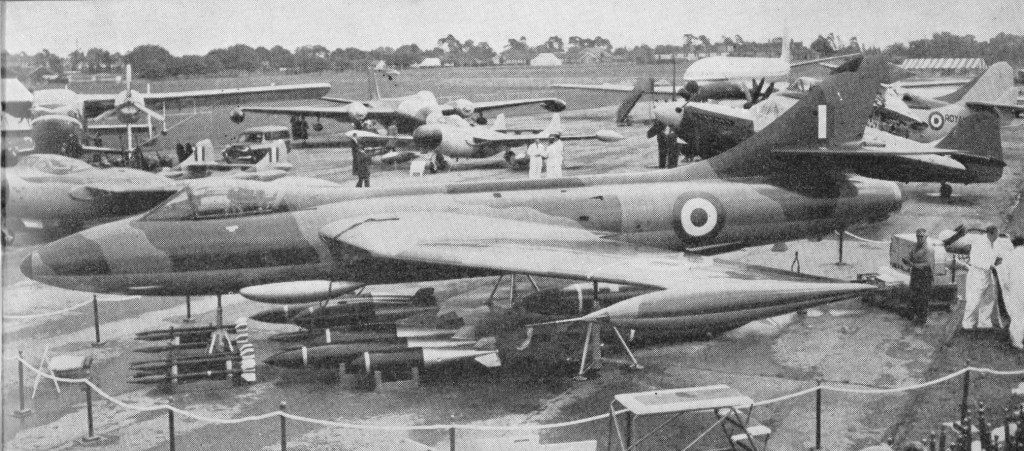
Manufacture of this variant was undertaken in the UK, Belgium and the Netherlands, and it eventually became the most widely used Hunter of all, providing the basis for aircraft exported to India Hunter F.Mk 56, Switzerland Hunter F.Mk 58 and Iraq Hunter F.Mk 59 amongst many others.
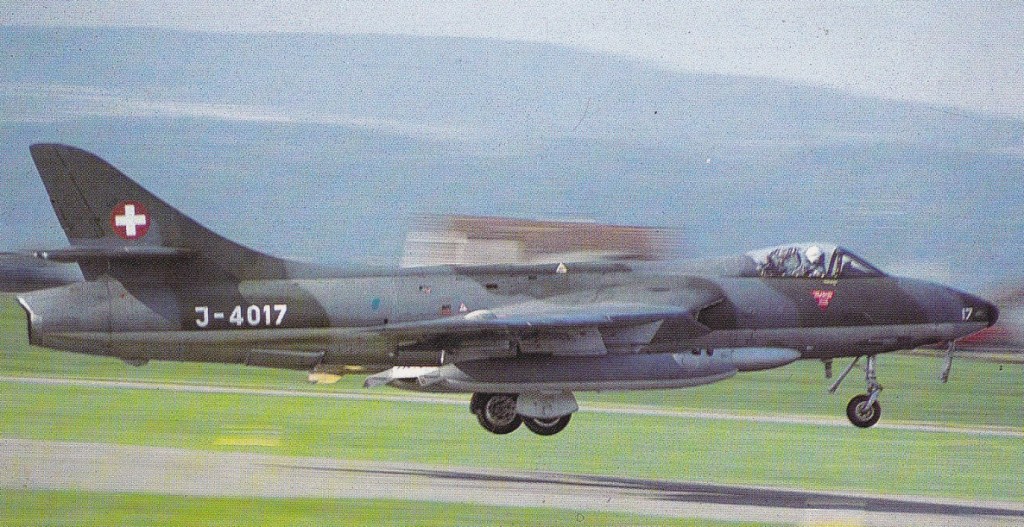
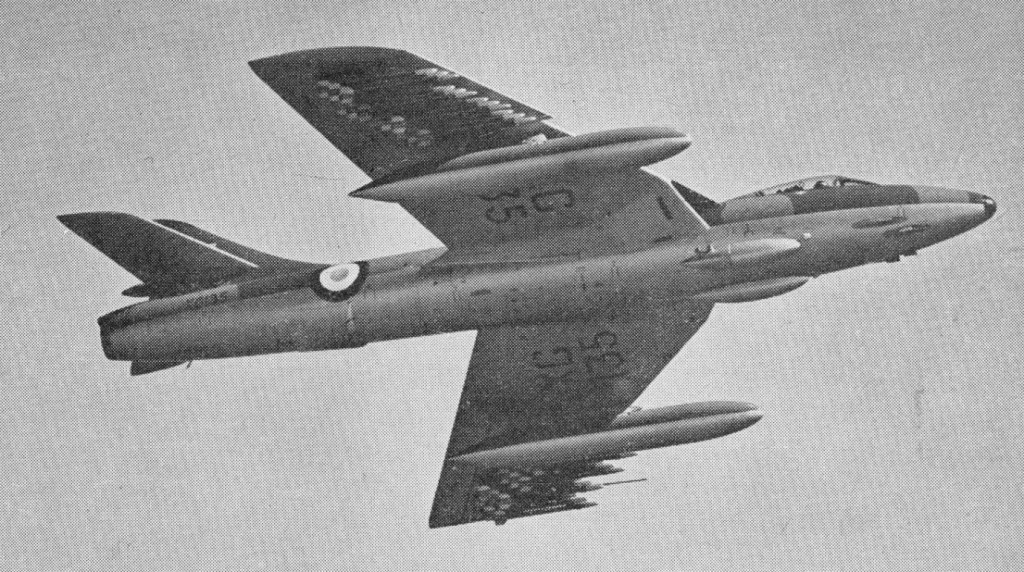
In addition, a substantial number of RAF aircraft were later updated to Hunter FGA.Mk 9 and Hunter FR.Mk 10 configuration for ground-attack and reconnaissance tasks respectively. The specially developed ground attack FGA.Mk 9 was fitted with one 10,000 lb thrust Rolls Royce Avon Mk 207 turbojet engine. Supplied to the air forces of Abu Dhabi, Chile, India, Iraq, Kenya, Oman, Qatar, Rhodesia, Singapore, and the United Kingdom, this ground-attack version carries fuel drop tanks, was provided with a tail parachute to simplify operation into small airfields, and with special underwing attachments for bombs and rockets: they also retain the standard armament of four 30 mm cannon in the nose.
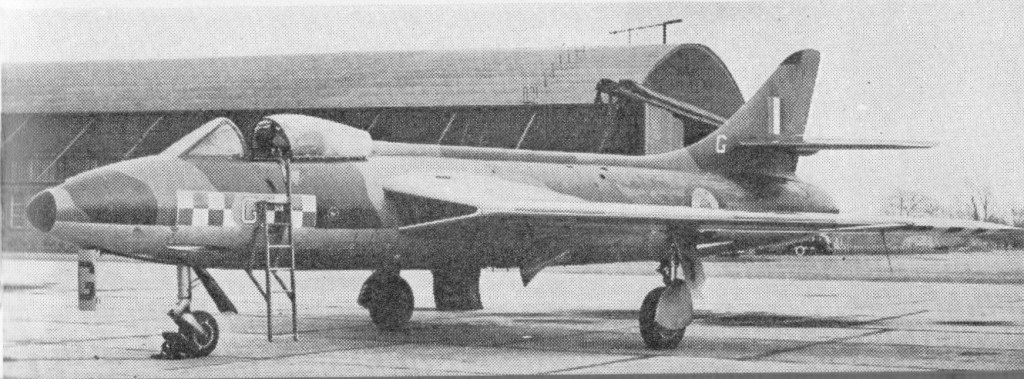
A two-seat trainer variant, designed as a private venture, was based on the F.4 despite the F.6 with its more powerful engine being available. The first T.7 protoype flew on 8 July 1955 and appeared at the 1955 Farnborough show two months later. While generally similar to the single seaters, these aircraft differed from the fighter by having a lengthened nose and ‘side by side’ seating, and the cannon pack was deleted and replaced with a single 30mm cannon fitted to the starboard side. The T.7 had a troubled gestation, with speed being limited to mach 0.88 until the canopy fairing was redesigned. A brake parachute was first fitted to the T.7, in an extended fairing over the top of the jetpipe. From 1957, a total of 45 Hunter T.7s were built at Kingston for the Royal Air Force. In addition, 6 Hunter F.4 airframes were converted to T.7 specification in 1958 and 1959.
The first T.7s entered service with 229 OCU in July 1958. Some twin-seat Hunters entered service with the Fleet Air Arm, being fitted with arrestor hooks (for airfield use only) and designated as T.8s. The T.8B and T.8C followed, with improved navigational equipment, guns deleted and Harley lights added in the nosecone.
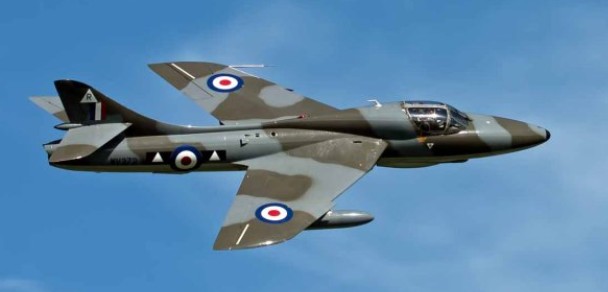
Another variant known as the Hunter GA.Mk 11 was delivered to the Fleet Air Arm for training purposes.
A new version of the Hawker Hunter, the T.Mk.8C (XL604), flew for the first time on Septem¬ber 2, 1963, this differing from previous T.Mk.8s in equipment installed. Two ex Belgian Hun¬ter F.Mk.6s were converted as a private venture by Hawker Siddeley to two seat configuration against possible future orders.
By 1970 the FGA.9 and FR.10 were leaving service, being replaced by a mixture of Buccaneers, Phantoms and Harriers. In 1979, the T.8M variant arrived. This was a T.8 given a Sea Harrier’s nose and was used to train pilots for the then-new Sea Harrier FRS.1, particularly the use of the Blue Fox radar. A small number of T.8Cs had transferred to RAF service with the loss of the RN’s carrier-borne Buccaneers in 1978, and these continued in use with RAF Buccaneer squadrons until that aircraft’s retirement in 1994. A T.12 variant had been on the cards, to train TSR.2 crews, but with that aircraft’s cancellation the T.12 was dropped, the single example produced being used for a variety of purposes by the RAE, including fly-by-wire developments and aerial surveys.
A number of aerobatic teams operated the Hunter, most famously 111 Squadron’s ‘Black Arrows’ and 92 Squadron’s ‘Blue Diamonds’. In 1958 by The Black Arrows looped 22 Hunters in formation at Farnborough.
In July 1959, several T.7s were entered in the Daily Mail London-Paris race, one of them achieving the fastest time. All Buccaneer pilots were trained in the Hunter T.7 or T.8, one set of pilot’s instruments being removed and replaced with Buccaneer instruments.
The Hunter settled in for the next five years as the RAF’s foremost air defence and ground attack aircraft, and Hawker completed their F.3 variant. This was actually the original prototype with a new sharp nose, canopy, Avon RA.7R with reheat and airbrakes either side of the rear fuselage. Painted in a brilliant red colour scheme, Neville Duke then used the aircraft to set a number of records, including the World Absolute Speed Record on 7th September 1953 – achieving a speed of 727.6 mph off the Sussex coast. No further work was carried out on producing a production version of the F.3.
However, by 1963, the fully supersonic missile-armed Lightning was entering service and the Hunter’s RAF day fighter role was at an end. The Blue Diamonds briefly teamed up with the Lightnings of 74 Squadron to put on a performance at the 1961 Farnborough show. From now on the Hunter’s job would primarily be that of ground attack, and the next variant was the FGA.9.
In 1958 the Royal Air Force held a competition to find a suitable type to replace its Middle East-based Venom ground attack fighters. Hawkers won with a proposal for a modified Hunter F6 and an order was placed for the conversion of a number of airframes. The new version was designated FGA9 to show its new role and the first flew in July 1959.
With further strengthened wings, provision for greater external fuel carriage (first tested by Hawkers back on the F.4 but only now accepted by the Air Staff) and increased oxygen supply, the variant also included the T.7’s brake parachute. The FGA.9 entered service with 8 Squadron in January 1960 and soon equipped a number of squadrons. Further action for the Hunter came in attacks against dissident tribes and rebels in Aden, and attacks against Indonesian terrorists in Borneo.
In 1968 it was the RAF’s 50th birthday, yet the top brass did not se fit to mark this with any flypast, choosing instead for mere parades on the ground. Many RAF personnel were less than impressed and one Flt Lt Alan Pollock of 1(F) Squadron decided to mark the occasion in style – first with toilet-roll bombing missions against rival squadrons, and then on April 5th, while suffering from the beginnings of pneumonia, he flew his Hunter over London and at the last second decided to fly under the top span of Tower Bridge. Knowing of the consequences of his unauthorised trip, he proceeded to beat up several airfields and landed to meet his fate. It would be the end of his RAF career (he went on to run a successful exporting company), with political influences making sure he was thrown out of the RAF with no right to appeal, no court martial at which he could present his case, medical evidence ignored, unable to meet with his superiors, etc. It took until 1982 for his case to be fully heard, and only then was he exonerated. Coincidentally, that same year the Hunter he had flown (XF442, which had been sold to the Chilean Air Force) was written off in an accident.
The last operational Hunter FGA9s were flown by No.8 Squadron which disbanded in December 1971 although the type continued to be used in training units for a little longer.
Some F.6 models were also upgraded by Hawker Siddeley to FR.74As, then FR.74Bs models. The last converted aircraft (for Kuwait) was delivered in 1975.

The FR.10, a reconnaissance version used largely in RAF Germany, replacing the Swift FR.5s. The FR.10 had also been used in the Far East, using cannon only in many attacks. The Fleet Air Arm extended their use of the Hunter to acquiring a number of single seaters, these being the GA.11 (with Harley light in the nose) and PR.11A (with cameras in the nose), though these were mostly operated by the civilian Fleet Requirements and Air Direction Unit (FRADU). The GA.11s were used for mock attacks against RN warships, the light in the nose being used to initially train gunners in how to track high speed aircraft.
The Dutch operated F.4s, F.6s and T.7s, beginning in 1956 and retiring them in 1968. Belgium also operated F.4s and F.6s from 1956 onward, but had no trainers – instead they used Dutch ones in a cooperative effort. Belgium retired the Hunter in 1963, though many were retired in 1957. Replaced by the F-104 in Dutch and Belgian service, as many of the Belgian examples had retired very early, they were in excellent condition and Hawker bought many back to sell once more. Sweden operated the Sidewinder-equipped F.50 (designated the J-34) from 1955 to 1966, replacing it with the SAAB Draken. Denmark operated the F.51 and a small number of T.53s (similar to the T.7 but with F.4-style wings rather than the F.6 ones) from 1955 to 1974. Switzerland operated their F.58s and T.68s from 1958 until 1995. The F.58 was essentially an FGA.9, but with Sidewinders and enlarged Sabrinas holding chaff and flare dispensers. Most famous of the Swiss Hunters were those of the national aerobatic team, the Patrouille de Suisse.
India made extensive use of the Hunter F.56(A) and T.66(D/E) from 1957 to the early 1980s, being the first export customer of the type, and continued to operate a small number for target towing duty until 2000. Participating in the 1965 and 1971 conflicts with Pakistan, the Hunter took a toll of Pakistani armour. However in combat with Pakistani Sabres, 8 were lost in the 1965 war compared to 6 Sabres being shot down by Hunters.
In the 1971 war six Hunters were lost, eight (possibly nine) Sabres were claimed by Indian Hunters (Pakistani sources accepting fewer losses but not by any great margin). A further three Hunters were lost to MiG-19s and four to Mirages.
Singapore employed the Hunter from 1970 – FGA.74s, FR.74A/Bs and T.75(A)s, forming the newly independent island’s Air Defence Command.
In the Middle East, Hunters were operated by a number of air forces. Abu Dhabi had the FGA.76, FR.76A and T.77 from 1970, being replaced by Mirage 5s. Qatar had the FGA.79 and T.79 from 1969, being replaced by Alpha Jets in the mid 1980s. Saudi Arabia operated a small number of F.6s and T.7s from 1966 to the mid 1970s as conversion trainers for students transitioning from the Jet Provost to the Lightning. Kuwait had the FGA.57 and T.67 from 1965, initially being replaced by the Lightning but soon coming back into use when the Kuwaitis had problems with the Lightning. By 1977 the FGA.57s had been replaced by A-4KU Skyhawks, but the T.67s continued in service for a few years after that point. Lebanon operated the F.6, FGA.70(A) and T.66C for a short time, all ending up being destroyed, mostly by Israeli strikes. Jordan operated F.6s, FGA.9s, FR.73Bs and T.66Bs from 1958 until 1974, and their Hunters were the first Arab aircraft to attack Israeli territory in the Six Day War. They were outclassed by Israeli Mirages in the air and most were destroyed in airstrikes on their bases. The few survivors of Israeli attacks were finally replaced by F-5s. Oman ended up with around 30 Hunters, ex-RAF, ex-Kuwaiti and ex-Omani examples among those operated from 1975 to the mid 1980s, being replaced by Jaguars. Iraq also operated the Hunter, F.6s, FGA.59(A/B)s and T.69s were used from 1958 to the mid to late 1980s, being replaced by Su-7Bs and Su-20s.
Peru operated F.52 and T.62 Hunters from 1956 to 1980 (replaced by Su-22s) and Chile (FGA.71, FR.71A and T.72) from 1966 to 1996. In Africa the Hunter was operated by Kenya (FGA.9 and T.81) from 1974 to 1979 and Rhodesia/Zimbabwe (FGA.9 and T.80) from 1963, being replaced by F-5s in Kenya and partially replaced by Hawks in Zimbabwe. Zimbabwe’s Air Force’s remaining Hunters were grounded by lack of spares. The Hunter was operated by the UK’s Defence Research Agency and the Empire Test Pilots School until 1999 and India retired hers in 2000. In 2007, the Hunter came back into UK military use when a pair were returned to the military register for defence simulation and trials work.
A total of 1972 were built including 445 manufactured under licence in Belgium and the Netherlands, until production ceased in 1960.
Principle users;
Abu Dhabi
Chile
Denmark
Great Britain
India
Iraq
Jordan
Kenya
Kuwait
Lebanon
Oman
Peru
Qatar
Singapore
Sweden
Switzerland
Zimbabwe
F.1
Engine: 3425-kg (7,550-lb) thrust Avon 113
Length: 45 ft. 3 in.
Seats: 1
Load factor: +7 / -3.75G
F.2
Engine: 3629-kg (8,000-lb) thrust Sapphire 101
Span 33 ft 8 in
Length: 45 ft. 9 in.
Seats: 1
Load factor: +7 / -3.75G
F.3
F. 4
Engine: 1 x Rolls-Royce AJ65 Avon RA7 Mk.113 or 114 turbojet, later Avon 115.
Span: 33 ft 8 in
Length: 45 ft 3 in
MTOW: 17,100 lbs.
Max speed: 715 mph @ SL / M0.95 @ 36,000ft.
Service ceiling: 48,500 ft.
Time to 45,000 ft: 9.8 min.
External fuel: two 455-litre (100-Imp gal) drop tanks
Seats: 1
Load factor: +7 / -3.75G
Armament: 4 x 30 mm cannon & 2 x 1000 lb bomb.
F.Mk 5
Engine: 3629-kg (8,000-lb) thrust Sapphire 101
Span 33 ft 8 in
Length 45 ft 3 in
External fuel: two 455-litre (100-Imp gal) drop tanks
Seats: 1
Load factor: +7 / -3.75G
F.Mk 50 / J-34
Seats: 1
Load factor: +7 / -3.75G
Armament: Sidewinder AAM
F.Mk 51
Seats: 1
Load factor: +7 / -3.75G
F.Mk 52
Seats: 1
Load factor: +7 / -3.75G
T.53
F.Mk 56
Seats: 1
F.56A
FGA.57
F.Mk 58
Seats: 1
Armament: Sidewinder AAM
F.Mk 59
Seats: 1
FGA.59A
FGA.59B
F.Mk 6
Engine: Avon 203 turbojet, 4559-kg (10,050-lb) thrust
Seats: 1
Load factor: +7 / -3.
F.6
Engine: 1 x Rolls-Royce Avon 207, 10,145 lb.
Wing span: 33 ft 8 in (10.26 m).
Length: 45 ft 10.5 in (13.98 m).
Height: 13 ft 2 in (4.01 m).
Max TO wt: 24,000 lb (10,900 kg).
Max level speed: 715 mph.
Ceiling: 50,000 ft
Range: 1,900 miles (ferry)
Seats: 1
Armament: 4 x 30mm Aden cannon
F.6A
Engine: 1 x Rolls-Royce Avon 203, 10050 lb.
Height: 13 ft 4 in / 4.01 m
Length: 45 ft 10.5 in / 13.98 m
Wing span: 33 ft 8 in / 10.26 m
Wing area: 348.969 sq.ft / 32.42 sq.m
MTOW: 24,100 lb.
Weight empty: 13891.5 lb / 6300.0 kg
Max. weight carried: 9834.3 lb / 4460.0 kg
Wing loading: 68.06 lb/sq.ft / 332.0 kg/sq.m
Max Ldg wt: 17,000 lb.
Initial climb rate: 5905.51 ft/min / 30.0 m/s
Service ceiling : 51509 ft / 15700 m
Max level speed: 620 kt.
Range: 540 nm / 1000 km
Endurance: 1 h
Armament: 4 x 30 mm Aden cannon plus up to 2000 lb bomb.
Crew: 1
T.62
T.66B
T.66C
T.66D
T.66E
T.67
T.68
T.69
T.7
Engine: Rolls-Royce Avon 207 turbojet, 10,145 lbf (45.13 kN)
Wingspan: 33 ft 8 in (10.26m)
Length: 48 ft 10.5 in
Maximum speed: 1,900 mph (1150 kph)
Maximum range: 808 miles (3,060 km) with external tanks
Service Ceiling: 50,000 ft (15,240 m)
Seats: 2
Armament: one 30 mm cannon
T.7B
FGA.70A
FGA.71
FR.71A
FR.73B
T.72
FGA.74
FR.74
Engine: Rolls-Royce Avon 207 turbojet, 10,145 lbf (45.13 kN)
Wingspan: 33 ft 8 in (10.26m)
Length: 45 ft 11 in (14m)
Maximum speed: 1,900 mph (1150 kph)
Maximum range: 808 miles (3,060 km) with external tanks
Service Ceiling: 50,000 ft (15,240 m)
FR.74A
FR.74B
Engine: 1 x RR Avon 207, 10,150 lb thrust.
Best climb speed: 430 kts.
Seats: 1
T.75A
FGA.76
FR.76A
T.77
FGA.78
Engine: Rolls-Royce Avon 207 turbojet, 10,050 lb thrust.
Rate of climb: 17,200 fpm
Ceiling: 53,400 ft
Maximum speed: 710 mph at sea level.
Seats: 1
Armament: four 30mm cannon, plus bombs or rockets
FGA.79
T.79
T.8
Seats: 2
T.8B
Seats: 2
T.8C
Seats: 2
T.8M
Seats: 2
T.80
T.81
FGA.Mk 9
Engine: 10,000 lb / 4559-kg thrust Rolls Royce Avon Mk 207 turbojet
Wingspan 10.25 m (33 ft 8 in)
Length 13.98 m (45 ft 10½ in)
Height 4.02 m (13 ft 2 in)
Wing area 32.42 sq.m (349 sq ft).
Empty wt: 6532 kg (14,400 lb)
Maximum take-off 11159 kg (24,600 lb)
Maximum speed: 1144 km/h (710 mph) at sea level
Initial climb rate 5245 m (17,200 ft) per minute
Service ceiling 16275 m (53,400 ft)
Range, clean 787 km (489 miles)
Ferry range 2965 km (1,840 miles)
Armament: four 30-mm Aden cannon, plus four 227-kg (500-lb) or 454-kg (1,000-lb) bombs, or four 455-litre (100-Imp gal) napalm tanks, or 2476-mm (3-in) rockets, or four 51-mm (2-in) rocket pods.
FR.10
GA.11
Seats: 1
PR.11A
Seats: 1
T.12
Engine: 1 x Rolls-Royce “Avon” RA 28, 44.1kN
Max take-off weight: 10885 kg / 23997 lb
Empty weight: 6020 kg / 13272 lb
Wingspan: 10.2 m / 33 ft 6 in
Length: 14.9 m / 48 ft 11 in
Height: 4.3 m / 14 ft 1 in
Wing area: 32.4 sq.m / 348.75 sq ft
Max. speed: 1150 km/h / 715 mph
Ceiling: 16760 m / 55000 ft
Range w/max.fuel: 2900 km / 1802 miles
Range w/max.payload: 900 km / 559 miles
Armament: 4 x 30mm cannons, ext. stores
Crew: 1-2






 All Aero