USA
Formed 1955 to build the Stout Bushmaster 15-AT, a modern development of the Ford Tri-Motor transport. Initial pre-production series of three aircraft planned with financial support from Air-Craft & Hydro Forming Inc.
Post WW2
Hawkridge Venture
A two seat side-by-side sailplane of conventional wooden construction. Designed and built by Hawkridge Aircraft Ltd during 1946/7.
The undercarriage was a main skid, main wheel of fixed centre, plus a tail bumper. No flaps were fitted, but it was fitted with spoilers on the upper surfaces of the wings. It is believed to have flown first at Dunstable in 1947.
Wingspan: 16.76 m / 55 ft 0 in
Length: 7.42 m / 24 ft 4 in
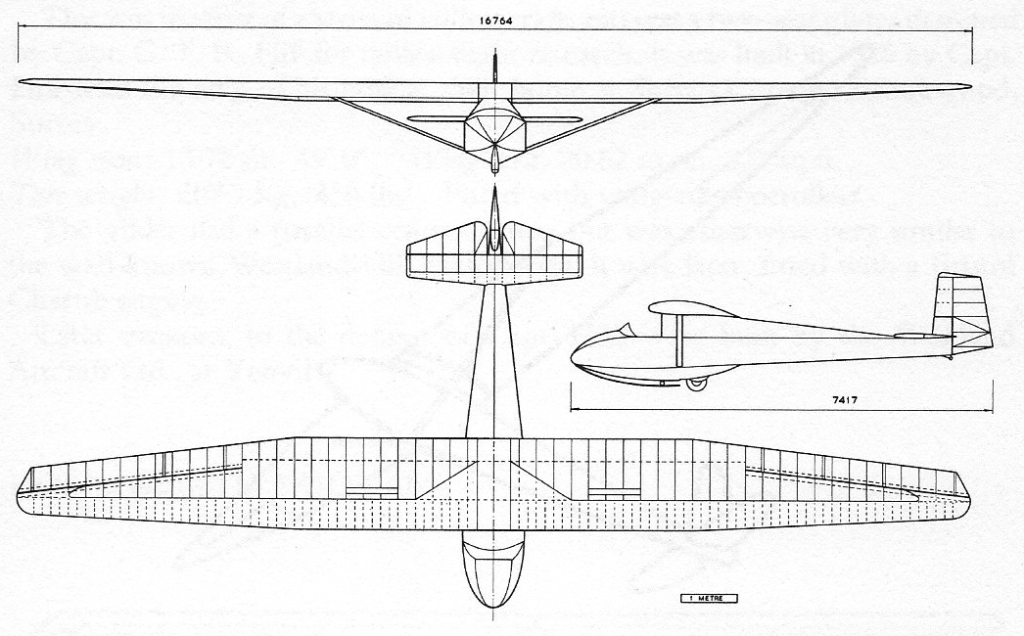
Hawkridge T.M.2
A single-seat sailplane designed to have a laminar-flow wing section. It was designed by Hawkridge Aircraft Ltd.
Although this glider was featured in Hawkridge advertisements in ‘Sailplane and Gliding’, if construction commenced it was not completed. BGA C of A No. 574 was allocated to a sailplane with the name of ‘T.M.2’ in 1948, but it is presumed this was a reservation only.
Hawkridge Kittiwake
The Slingsby T.15 Gull 3 was purchased by Hawkridge after the war as a wreck. The fuselage was in two pieces and both wings had had their spars broken. The Gull 3 was, at that time, finished in the standard pre-war finish of clear varnish but RAF roundals had been applied, and the name ‘Kittiwake’ had been stencilled on the fuselage underneath the cockpit. No RAF serial was allocated to the Gull, and the open cockpit was of the same shape as the Slingsby T.12 Gull 1.
Hawkridge repaired and rebuilt the Gull using the name Kittiwake, and incorporated many modifications including the fitting of a bubble-type canopy.
C of A No. BGA 643 was issued in November 1949, using the name Kittiwake, and it was owned by Prince Bira in the late forties/early fifties. It was later based at Weston-on-the-Green with members of the Oxford Gliding Club where it was generally referred to as the ‘Cantilever Gull’.
Hawkridge Dagling
A primary glider built by Hawkridge Aircraft Co. post-WW2. A version of the R.F.D. Dagling and the Slingsby T.3 Primary.
Hawkridge Aircraft Co
Formed by E.P. Zander and H.E. Bolton in 1945, the company initially took office space at 68 Victoia St, London. A small workshop was established at Bolton’s home in Denham, Buckinghamshire, and a factory was later acquired in High St, Dunstable, to build and service gliders.
A two-seat side by side training sailplane known as the venture was designed and built by the company, also, a small batch of primary gliders and two Grunau Baby gliders. Repair and service work was carried out on a wide variety of gliders, including the Slingsby Gull 3. This sailplane was extensively modified and repaired, and was, for sometime afterwards, referred to the Hawkridge Kittiwake in company advertisements. Only one example was produced, and another new type, known as T.M.2, apparently only reached the project stage.
Zander left the company in 1947 and emigrated to Canada, but the firm continued under Bolton. By early 1950 the Dunstable factory had been closed and all the work was carried out at Denham. The last company advertisement appeared in ‘Sailplane and Gliding’ in March 1952 after which the company dissolved. Bolton emigrated to America, and in the meantime Zander travelled to Argentine then retired near Christchurch on the South coast of England.
Hawk MiniHawk
The GAF-125 was developed by Hawk Industries Inc. from Yucca Valley, CA. This company specialised in equipment and tools for the off-shore oil industry, and was looking for a more efficient way to transport their products all over the country. Road transport was too slow most of the time, and loading their large and unusually-shaped products onto conventional aircraft often posed many expensive and time-consuming problems.
And so in July 1977, the president of the company, Ernest “Ernie” Hauk, together with designer Larry Stewart, initiated the development of a freighter aircraft that was to overcome these problems. The design was named the GAF-125 GAFHawk, with GAF meaning General Aviation Freighter. The name later changed to GAFHawk 125. The design would have to meet many demands: rear loading door for easy on/off loading, STOL capability for remote airstrips, square-section fuselage for maximum loading efficiency, single engine to lower maintenance time and cost, single-pilot operation etc.
The company obtained 1956-built Piper PA-22-150 Tri-Pacer N6911B (msn 22-4186), which was almost completely disassembled in the workshops of Hawk Industries’ Aircraft Division on Aviation Drive, at the small airport in Yucca Valley, California. The little aircraft was then rebuilt, but in an extensively modified form. It was made to look like a miniature version of the GAFHawk design, to serve as a small scale flying testbed for the GAFHawk’s development. The aircraft was appropriately named the MiniHawk, and first flew in 1978.
Looking like a miniature version of the actual GAFHawk, this little aircraft served as a flying testbed for the GAFHawk’s development. It is now preserved at Roy Williams Airport in Joshua Tree, CA. Photo taken by AirNikon in May 2004.
In 2006 the MiniHawk testbed N6911B was also still registered, with its status quoted as “In Question”, and no registered owner. It just says “Sold to Hawk International”, which was the new name for Hawk Industries’ aircraft division.
The MiniHawk eventually went to Roy Williams Airport in Joshua Tree, only 15 km (9.5 miles) from Hawk Industries’ workshops in Yucca Valley. The little aircraft is now preserved there, swiveling freely on a short pole and acting as a big windsock.
Hawker Siddeley
The 1957 Defence White Paper was also a preface to the first major “rationalisation ‘, overhaul of the British industry, which took place in 1960 and caused the disappearance of so many pioneering aviation names. From this process, achieved by a simple, Govern¬ment ruling that with one or two exceptions (such as the Westland Helicopter Company), official contracts would only be placed with rationalized companies, nearly all the historic organizations in British aviation were swal¬lowed by two large aerospace groups. The British Aircraft Corporation combined Bris¬tol, English Electric, Hunting and Vickers-Armstrong/Supermarine, while Hawker Siddeley absorbed com¬panies as Avro, Armstrong Whitworth, Black¬burn, de Havilland, Folland, Gloster and Hawker.
In mid-1963 the Hawker Siddeley Group incorporated the Hawker, de Havilland, Avro, Armstrong Whitworth, Folland and Blackburn companies into Hawker Siddeley Aviation, the aircraft products of each company becoming known as Hawker Siddeley aircraft.
In 1962, the Hawker Siddeley Group formally dissolved A.V. Roe Canada and transferred all A.V. Roe Canada assets to its newly-formed subsidiary Hawker Siddeley Canada. Avro Aircraft was closed.
Final products under its own name were the HS 125 corporate jet (first flown August 1962); HS 748 turboprop airliner (first flown June 1960), Trident short/medium-range airliner first flown January 1962), Harrier and Sea Harrier, Buccaneer, Nimrod maritime patrol jet (first flown May 1967), and Hawk jet trainer.
Merged into British Aerospace in April 1977.
Hawker HS.1127 Harrier

A pre-production derivative of the P.1127 was built as the Kestrel, and the full production type as the Harrier, with a turbofan of 21,500 pounds nominal thrust. Installed thrust is around 18,000 to 18,900 pounds, but if the Harrier’s weight is kept fractionally below that figure, it will be able to take off and land vertically and hover in between. In practice, however, vertical takeoff is seldom employed, since a forward roll of only a few hundred feet adds several thousand pounds to the permissible weight and payload by the addition of wing lift. Since the Harrier is designed to operate from any reasonably firm and smooth surface away from airfields, STO invariably presents no problems. Having used up most of its 5,000 pounds of internal fuel and dropped up to 7,000 pounds or more of external ordnance, the Harrier can then return for a standard vertical landing into a clearing or onto a pad only a few feet bigger than its 25 foot three inch span and 45 foot six inch fuselage.
The first of six development Harriers was flown on 31 August 1966 and the first production aircraft flew in December 1967. The type entered service with the Royal Air Force with 1 Squadron at Wittering in July 1969.
Hawker HS.1127 Harrier Article
The two seat Harrier is more than 10 feet longer, not only because of the extra cockpit section, which adds 47 inches to the forward fuselage, but also because of the 33 inch rearward extension of the vertical tail for aerodynamic balance. The remaining extra length results from the need to move the tail reaction control valve (RCV) farther aft to maintain its effectiveness without draining the Pegasus of excessive amounts of bleed air. Since the Harrier can go on flying at speeds down to zero, or even backward, its aerodynamic control surfaces have to be supplemented by reaction controls or jet thrusters. Linked to the stick and rudder pedals, these use bleed air from the Pegasus compressor to RCVs at each wingtip and in the nose and tail, producing the correct aircraft response in pitch, roll and yaw. They automatically come into operation when the engine nozzles are deflected downward through 20 degrees or more and are designed to maintain a progressive feel and response from wingborne to jetborne flight without too much of a power loss from the Pegasus.
All Harriers have a sideslip vane just in front of the cockpit that (in addition to providing a visual reminder of the aircraft’s attitude) is linked to the rudder pedals. When critical combinations of sideslip and airspeed (between 30 and 100 knots) are approached, the appropriate rudder pedal starts vibrating as a reminder that it might be a good idea to apply some boot to it if you want to remain right side up. The autostabilizer also helps in this respect.
For ground maneuvering, the nosewheel of the Harrier’s bicycle landing gear steers hydraulically via the rudder pedals from a flip of a trigger on the stick. With this system, and with the nozzles at 45 degrees to reduce its high idling thrust, the Harrier will turn almost in its own length, kept steady by its wingtip outrigger legs.
There seems to be no real reason why the Harrier should accidentally spin during combat, since it can go on flying with jet deflection below normal wingborne stalling speeds. It can instantly halve its turning radius by the use of vectoring in forward flight.
First flown on 28 December 1967, the GR.1 is the single-seat close-support and reconnaissance version for the RAF, which has also ordered the two-seat T.2 for operational training.
The Harrier GR Mk.1 was the first production model taken from the Kestrel and entered service with the RAF on April 1, 1969. Construction took place at factories in Kingston-upon-Thames in southwest London and at Dunsfold, Surrey. The latter adjoined an airfield used for flight testing; both factories have since closed.
The Harrier’s max low level speed is not greatly reduced by the carriage of external stores, since the main limitation on its speed is the drag from its huge intakes. These are required to enable the engine to obtain the necessary mass flow of air in the hover with no forward speed, or even flying backwards.
Normal attack speed is 450 kts or 480 kts depending on configuration. Weapons include 30mm cannon, 1000 lb free-fall or retard bombs, CBU (cluster bomb unit carrying 247 armour-piercing bomblets), SNEB (pod with 19 x 68mm rockets), and laser-guided bombs. The Sea Harrier can also carry anti-shipping missiles of the Harpoon/ Martel type. Sidewinder AAM (9L) may be carried for air combat.
The avionics carried includes INAS (Inertial Navigation Attack System), which provides weapon aiming information through the Head-up Display (HUD); navigation via computer and moving-map display; and instrument flying information via HUD. Other equipment includes Laser ranger and marked-target seeker, radar warning receiver, reconnaissance camera, voice recorder, IFF/SSR, Tacan, and, Martin Baker Mk 10 ejection seat. This rocket-assisted seat has a zero-zero capability.
The GR.Mk 1A was an upgraded version of the GR.Mk 1, the main difference being the uprated Pegasus Mk 102. 58 GR.Mk 1As entered RAF service, 17 GR.Mk 1As were produced and a further 41 GR.Mk 1s were upgraded.
The Harrier GR3 was a development of the Harrier GR1, being fitted with improved attack sensors, electronic countermeasures and a more powerful Pegasus Mk 103 engine over the GR1.
The Harrier GR3 was utilised by the Royal Air Force as a ground attack and reconnaissance aircraft in the Close Air Support role (CAS). RAF Harriers were deployed to the Royal Navy aircraft carrier HMS Hermes, as part of the Task Force sent to recapture the Falklands Islands. The Harrier GR3 performed attack sorties from the aircraft carrier, and later from basic landing strips on the islands, often in conditions that would have grounded conventional aircraft. Ten Harrier GR.3s from this 1 Squadron operated with Royal Navy Sea Harriers in the Falklands Conflict in 1982, flying 150 missions. Three of these aircraft were lost.
In addition to operations with RAF Germany, the Harrier GR3 has also seen service with the Royal Air Force in Norway and Belize.
The GR.5 features a new nose shape housing a Hughes angle rate bomb set greatly improving target acquisition and weapon aiming capabilities, a McDonnell-Douglas manufacture carbon fibre wing 20% larger than the GR.3, leading edge root extensions which provide a better turn rate, retractable refueling probes and a new wrap-around front windscreen panel.
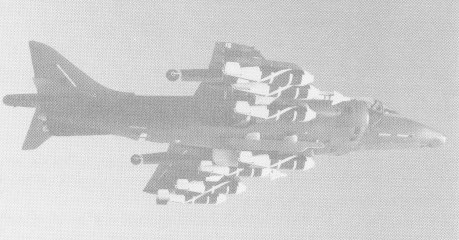
The first Harrier GR.7, a converted GR.5, first flew on 26 November 1989.
The Royal Navy version of the Harrier, the Sea Harrier, is basically the same airframe fitted with dif-ferent equipment. British Aerospace handed over XZ451, the Royal Navy’s first Sea Harrier, at BAe Dunsfold on 18 June, 1979. The cockpit has been raised to improve rearward visibility, and to accommodate the Blue Fox radar. The cockpit radar display is a TV-tube conveying flight information as well as air-air and air-surface radar. The navigation system is based on an attitude reference platform with a radar input. The Sea Harrier provides the RN with an air defence, recce and strike/attack capability. As an air defence fighter, it’s effectiveness is partly in its quick reaction time. There is no necessity to turn the carrier into wind as with conventional aircraft, and no need for time-consuming catapult launches. This, plus the Harrier’s built-in starting system, means a scramble take-off within 2 minutes of an alarm. Once airborne the high-altitude intercept radius is 400 nm, with 3 minutes full throttle combat, and vertical landing recovery on the ship. In the reconnaissance role, the Sea Harrier can carry out electronic and visual surveillance, covering approx 20,000 sq miles in one hour at low level.
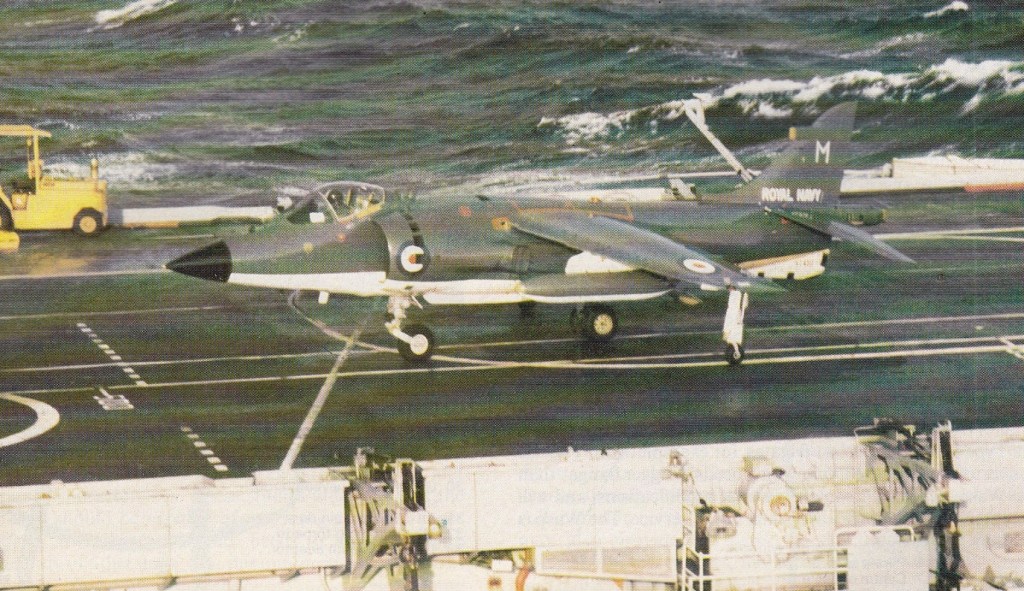
The ski-jump technique for STOL use by Harriers launched from Royal Navy aircraft carriers was tested at the Royal Navy’s airfield at Yeovilton, Somerset. Their flight decks were designed with an upward curve to the bow following the successful conclusion of those tests. The ski-jump on the carriers provides an improvement in take-off performance. Launched off the end of the ski-jump, with the nozzles deflected to approx 50 degrees at the moment of departure, the Harrier flies a partly ballistic trajectory for some seconds, during which time it is jet-borne while accelerating as the nozzles are gradually moved aft again. This reduces the take-off distance required. Additionally if the ship is pitching in bad weather, it ensures the aircraft never leaves the carrier pointing at the water. The ski-jump enables 1500 lb more load to be carried, or 200 feet less ground roll to be used, than flat-deck equivalents.
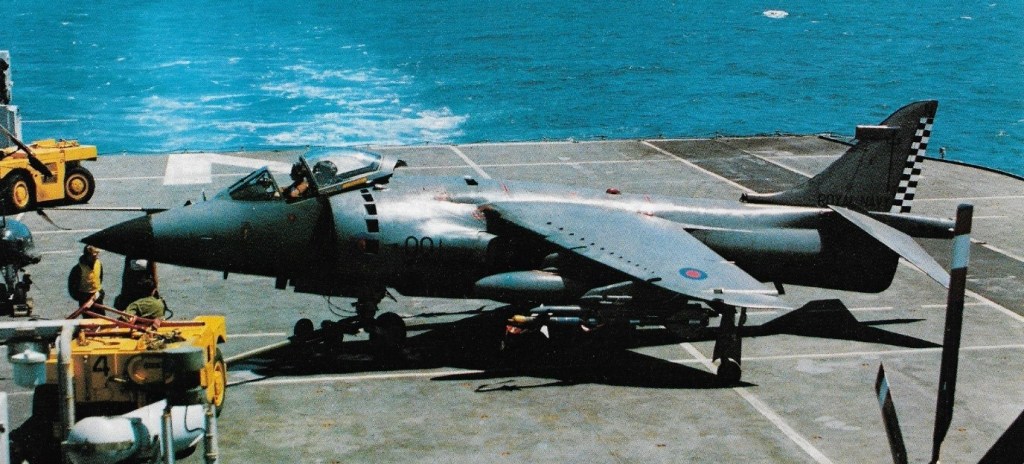
The Indian Sea Harrier FRS.51s (plus two T.60s) differ from standard RN Sea Harriers only in using gaseous rather than liquid oxygen, modified radar and avionics, and provision for Matra Magic AAMs rather than AIM-9 Sidewinders. The T Mk 60 two-seaters are more extensively modified, with Sea Harrier-type cockpits and most of the Ferranti NAVHARS nav-attack system.
Export versions, which have the more powerful Pegasus II engine, are desig¬nated Mk 50 (single seat) and Mk 51 (2 seat). US Marine Corps designation is AV 8A.
The first Hawker Siddeley AV 8A Harrier for the Spanish navy was flown at Dunsfold, Surrey, on 18 September 1975. Known as the Matador in Spanish service, these aircraft were shipped to the USA for pilot training before embarkation in the carrier Dedalo. All 11 (plus two two seat TAV 11As) had been handed over by November 1975.
McDonnell Douglas / BAe AV-8 Harrier II
The marine corps first Harriers were Hawker Siddeley-built AV-8As delivered between 1970 and 1976. The AV-8A and the RAF’s Harrier GR.I had much in common, including the RAF camouflage colors and pattern. The upper surfaces were a disruptive pattern of RAF Dark Green (641) and Dark Sea Grey (638) with undersurfaces in Light Aircraft Grey (627). For repainting, the Marines chose dark olive green FS 34064 and dark gray FS 36099 for the uppersurface camouflage, with Light Gull Gray FS 36440 underneath.
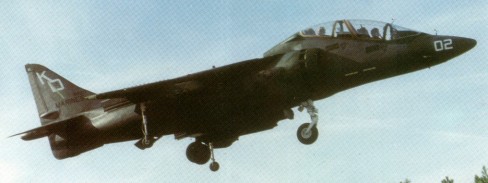
The prototype AV-8B, converted from an AV-8A, first flew on November 9, 1978, and the first of four full-scale development aircraft followed on November 5, 1981. Production deliveries to the USMC began in October 1983, and the first unit became operational in January 1985. USMC deliveries will continue into the 1990s, against a requirement for 300 AV-8Bs and 28 TAV-8Bs.
The No 2 VAV 8B, modified by McDonnell Douglas from a British built AV 8A Harrier, was fitted with leading edge root extensions (LERX) of the type already test¬ flown on a Harrier GR Mk 3 under MoD contract. The LERX serve to increase the turn rates of the AV 8B from a figure of about 14 deg/sec to at least 16 deg/sec.
The improved AV-8B Harrier II is a MeDonnell Douglas design, produced in the U.S. Two YAV-8Bs (modified from AV-8A airframes) were painted in red, white, black, and gold high-visibility schemes. The first of four Full-Scale Development airframes came in standard RAF camouflage; the second came in another, high-visibility scheme. The third FSD AV-8B was painted in the RAF pattern, but with Marine Field Green FS 34095 and Blue Gray FS 35237 uppersurface colors with FS 36440 undersides. This color change was evidently an attempt to economize by using standard Navy/ Marine colors.
The fourth development Harrier II received a counter-shaded hree-tone gray camouflage similar to the Navy’s other TPS schemes. Its colors were FS 36375 Light Ghost Gray on top, FS 36440 on the sides, and FS 36495 light gray on the bottom. The Marines applied the FS 34064/36099/36440 scheme to the first 25 production Harrier IIs. After reviewing the AV-8B’s tactics, the Corps adopted a wraparound scheme beginning with the 26th airframe, serial number 162081. The camouflage pattern was continued on the undersurfaces, and FS 36440 was eliminated.
Spain has ordered 12 EAV-8Bs to supplement its fleet of AV-8A Matadors from late 1987. British Aerospace manufactures some 40 per cent of the AV-8B airframe.
Two Harrier GR.5 development aircraft, the first of which flew on April 30, 1985, will be followed by 60 production aircraft. Deliveries to the RAF began in July 1987, and long-lead authorisation has already been approved for up to a further 27 aircraft. British Aerospace manufactures 50 per cent of each GR.5 airframe.
The cockpit of the AV-8B is similar to that of the Harrier GR.5, but has a second multi-function didplay instead of the moving map display.
The decision to put the much improved Harrier II into production was taken in August 1981; initial plans calling for 257 American and 60 British aircraft. Since then the requirements have increa¬sed to 328 and 96 aircraft respectively, the American total including 28 TAV-8B two-seat conversion and proficiency trainers. An initial 27 of these aircraft were ordered in 1984. The first of them flew in October 1986, and the type’s service debut came in March 1987.
A two-seat operational trainer version of the Harrier II, designated TAV-8B for the USMC, flew on October 21, 1986, and deliveries began on schedule in March 1987. The TAV-8B has a forward fuselage lengthened by 4 ft (1.22 m) by comparison with that of the AV-8B to allow the incorporation of a second seat in the standard vertically staggered arrangement. This increases structure weight by 1,325 lb (601 kg), but the TAV-8B still possesses full combat capability in the form of an underfuselage cannon and six underwing hardpoints for dispo¬sable ordnance. In 1990 the British decided to procure 10 similar two-seater conversion trainers with the designation Harrier T.Mk 10. The TAV-8B also has a taller fin than the single-seat AV-8B. The development of a night attack capability for USMC AV-8Bs continues, and a prototype flew in June 1987, with deliveries following in 1989. Night attack equipment includes a Flir system, night vision goggles for the pilot, and a modified headup display.
For the 1991 ‘First Flights’ television series, Neil Armstrong flew the Harrier.
GR.1
Engine: One 19,000 lb (8,618 kg) st Rolls Royce Bristol Pegasus Mk 101 vectored thrust turbofan
Wing span: 25 ft 3 in (7.70 m)
Length: 45 ft 8 in (13.92 m)
Height: 11.253 ft / 3.43 m
Gross weight: over 22,000 lb (9,979 kg)
Max. speed: over 720 mph (1,159 km/h)
Service ceiling: 49213 ft / 15000 m
Crew: 1
Armament: Two 30 mm Aden gun pods / max 2268kg
Max. endurance: over 7 hr with in flight refuelling.
GR-3
Engine: Bristol Siddeley Pegasus II Mk.103, 21,500 lb / 9752 kg thrust.
Wing span: 25 ft 3 in / 7.70 m ( 29 ft 8 in / 9.04 m w/ferry tips)
Length: 46 ft 10 in / 14.27 m
Height: 11 ft 4 in / 3.45 m
Wing area: 201.1 sq.ft / 18.68 sq.m (216.0 sq.ft / 20.075 sq.m w/ferry tips)
Empty wt: 13,535 lb / 6139 kg
MAUW: 25,200+ lb / 11,431+ kg
Max speed: M1.2; at low level approx 600 kts. / 737+ mph / 1186+ kph
Ceiling: 50,000+ ft / 15,240+ m
Time to climb brakes off to 40,000 ft: 2 min 20 sec.
Initial ROC: 30,000 fpm.
Range: 828 mi / 1316 km
External store load 8,000 lb / 3269 kg
Armament: 2 x 30mm Aden cannon pods.
GR-5
Armament: 2 x 30 mm cannon
Sea Harrier FRS.51
T.60
British Aerospace Sea Harrier FRS.1
Engine: Rolls-Royce Pegasus II Mk.104, 9752 kg / 21,500 lb
Wingspan: 7.7m / 25 ft 3 in
Length: 14.5 m / 47 ft 7 in
Height: 12 ft 2 in / 3.71 m
Wing area: 201.1 sq.ft / 18.68 sq.m
Empty weight: 13,100 lb / 5942 kg
MTOW: 26,190 lb / 11,880 kg
Max speed: 1191 kph / 740 mph
Range: 920 mi / 1480 km
Ceiling: 50,000+ ft / 15,240+ m
Armament: 2 x 30 mm Aden / 150 rds
Max external load: 8000 lb / 3630 kg
Seats: 1
AV-8A
McDonnell Douglas / Bae AV-8B Harrier II
Engine: Rolls-Royce F402-406 (Pegasus 11-21 / Pegasus 105) vectored turbofan, 22,000 lb / 95.8 kN
Wingspan: 30 ft 4 in / 9.25 m
Length: 46 ft 3 in / 14.12 m
Height: 11.483 ft / 3.5 m
Wing area: 230.35 sq.ft / 21.4 sq.m
MTOW: 29,750 lb / 13,495 kg
Weight empty: 13986.3 lb / 6343.0 kg
Max. payload weight: 17016.0 lb / 7717.0 kg
Wing loading: 134.69 lb/sq.ft / 657.0 kg/sq.m
Max speed: 673 mph / 1083 kph
Cruising speed: 470 kts / 870 kph
Initial climb rate: 14763.78 ft/min / 75.0 m/s
Service ceiling: 43307 ft / 13200 m
Fuel internal: 4260 lt
Range: 961 nm / 1780 km
Air refuel: Yes
Ferry range: 3310 sm / 5327 km
Armament: 1 x 25 mm cannon (300 rds)
Hard points: 7
External load: 17,000 lb / 7711 kg
Crew: 1
TAV-8B Harrier II
Engine: one 21,550-lb (9,775-kg) thrust Rolls-Royce F402-RR-406 (Pegasus 11- 21) vectored-thrust turbofan.
Maximum speed 647 mph (1,041 km/h) at sea level
Service ceiling 50,000+ ft (15,240+ m)
Radius 553 miles (890 km) with no loiter
Empty weight 14,075 lb (6,384 kg)
Maximum take-off weight about 29,750 lb (13,494 kg)
Wing span 30 ft 4 in (9.25 m)
Length 50 ft 5 in (15.37 m)
Height 13 ft 5 in (4.09 m)
Wing area 230.0 sq ft (21.37 sq.m).
Armament: one 25-mm multi-barrel cannon, and up to about 15,500 lb (7,031 kg) of disposable stores.
Seats: 2
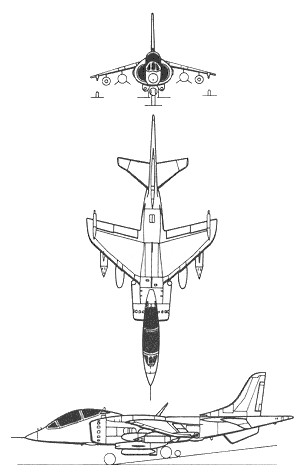
Hawker P.1127 / VZ-12 / XV-6 / Kestrel
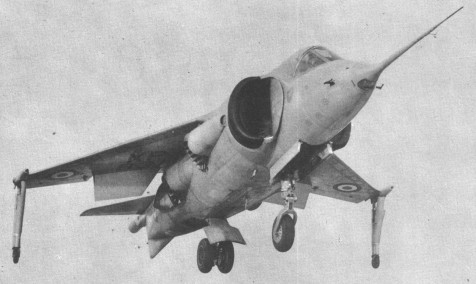
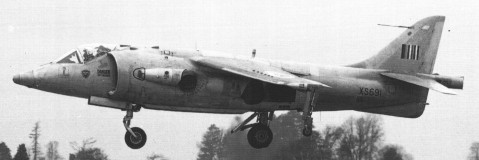
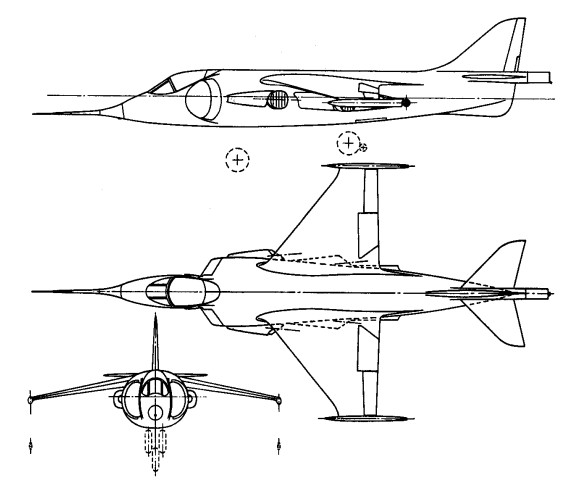
A design by Sir Sydney Camm starting in 1957, the P.1127 incorporated vectored thrust, which enabled one engine to lift and pro¬pel the aircraft by means of rotatable exhaust nozzles. The airframe of the P.1127 was designed round the unique character of its Bristol Pegasus engine, which had four nozz1es (the forward pair exhausting cold air from the engine’s fan stage and the aft pair exhausting hot gases from the engine’s turbine stage) arranged two on each side fore and aft of the centre of gravity.
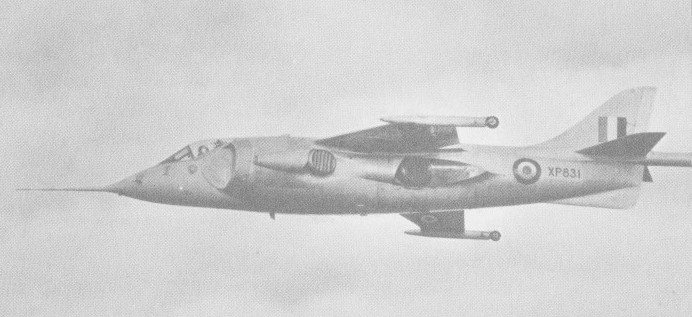
Hovering trials with the first P.1127 (XP831) began on October 21st, 1960, over a specially prepared hovering platform with the aircraft tethered. Free vertical hovers on the vectored thrust of an 5126kg Pegasus 2 engine were made in November and the first conventional take off was made on March 13th, 1961. For low speed con¬trol, the aircraft has jet reaction nozzles at each wing tip and at the nose and tail.
The second P.1127 (XP836) flew on July 7th, 1961, and continued conventional flight trials while the first reverted to hovering trials in September. This aircraft made the first complete transition from hovering to horizontal flight and back on September 12th, 1961. The third P.1127 (XP972) flew on April 5th, 1962.
Such was the promise of the type that a pre-production derivative was built as the Kestrel. The P.1127 was renamed Kestrel after Hawker Siddeley Aviation was created.
Three examples were ordered in 1962 by the U.S. Department of Defense, with the U.S. Army financing 50 per cent of the programme and the USAF and Navy sharing the remainder. Compared with these aircraft and three sub¬sequent prototypes, the three XV 6As have a 9 in longer fuselage, anhedral on the tailplane and more powerful versions of the Bristol Pegasus.
Of the six prototypes built in total, one of which was lost at an air display.
The Kestrel had fully swept wings and a larger tail than the P.1127, and the fuselage was modified to take the larger 15,000 lbf (85 kN) Pegasus 5 engine. The first of these flew on 7 March 1964.
Due to interest from the US and Germany the Tri-partite Evaluation Squadron was formed, staffed by military test pilots from Britain, the US and West Germany. A Tripartite Trials Squadron existed from 15 October 1964 until 30 November 1965, after which six of the Kestrels were transferred to the USA where they were designated XV-6As. After testing at RAF West Raynham, the eight surviving Kestrel FGA Mk 1s evaluation aircraft were transferred to the USA for evaluation by the Army, Air Force and Navy (including USMC). After Tri-Service evaluation they were passed to the USAF for further evaluation at Edwards AFB.
The Kestrel featured two wing hardpoints each capable of lifting gun pods or stores of up to 450kg.
The Kestrel FGA Mk 1 ground attack fighter was an operational evaluation derivative of the P.1127 V/STOL.
An order for 60 aircraft was received from the RAF in 1966, and the first pre-production Harriers were flying by mid-1967.
Engine: Bristol Siddeley Pegasus, 12,000 lb thrust.
Max take-off weight: 5625-7031 kg / 12401 – 15501 lb
Empty weight: 4445 kg / 9800 lb
Wingspan: 6.96 m / 22 ft 10 in
Length: 12.95 m / 42 ft 6 in
Height: 3.28 m / 10 ft 9 in
Wing area: 17.28 sq.m / 186.00 sq ft
Max. speed: 1067 km/h / 663 mph
 All Aero