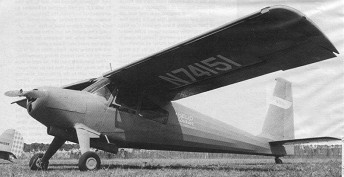
The Stallion is specifically designed for operation from unprepared fields and is equipped with a full complement of STOL devices. Design of the Stallion began in 1963, and the first models were produced in 1966. The Stallion is powered by a single 680-ehp turboprop engine driving a three blade reversible-pitch prop and fed by wing tanks with a capacity of 120 gallons. Its all-metal cantilevered wings are equipped with high lift slotted all-metal flaps, fabric-covered balanced ailerons, and full-span automatic leading-edge slats. The tail unit features a one-piece horizontal surface with combined trim and antibalance tab. The cabin is protected by a crash-resistant tubular frame. The Stallion’s accommodations provide for a pilot and copilot up front with either eight passengers on bench seats or six passengers seated individually. Access is made through a door on the port side near the pilot, an optional starboard door, and a double cargo door on the port side. The double door is in two sections—the forward half hinges and the rear half slides. The rear half can be opened during flight for cargo drops or parachutists.
THE Credible Chase programme, an off shoot of Pave Coin, in which a number of aircraft were evaluated by the USAAF at Eglin AFB in order to come up with a new light-strike attack aircraft for the South Vietnamese Air Force, resulted in a 15 each order for the Helio Stallion and Fairchild Peacemaker. These aircraft, carrying the designations AU 24 and AU 23 respectively, are militarised versions of their commercial counterparts, but have increased gross weights, underwing and fuselage hardpoints and Gatling guns firing from the cabin doors. In the case of the Helio AU 24 the prototype was modified and tested by Kaman Aerospace under contract from Helio, although Helio supplied the test pilot. Kaman has stressed the aircraft to a new gross weight of 6,300lb, 2,860kg as well as adding two hardpoints under each wing and one fuselage centreline point. The AU 24 can carry 300lb, 135kg on the outboard pylons and 600lb, 270kg inboard, plus 500lb, 225kg on the fuselage centreline. Ordnance can include single bombs, cluster bombs, FFAR launchers and machine gun pods. The AU 24 is powered by a UAC PT6A 27 of 680 shp, 508kW. The AU 24 has a speed range of from 42 mph, 68km/hr to over 200 mph, 320km/hr. The Stallion is basically the same aircraft as the Courier the wing planform is identical but span is increased from 39ft, 11.9m to 41ft, 12.5m.
H-550A Stallion Engine: P&WAC PT6A-27, 680 hp. Seats: 10. Wing loading: 21.1 lb/sq.ft. Pwr loading: 7.5 lb/hp. Gross wt: 5100 lb. Empty wt: 2860 lb. Equipped useful load: 2090 lb. Payload max fuel: 1280 lb. Range max fuel/cruise: 360 nm/1.9 hr. Range max fuel / range: 483 nm/ 3.5 hr. Service ceiling: 25,000 ft. Max cruise: 179 kt. Max range cruise: 140 kt. Stall: 36-41 kt. 1.3 Vso: 47 kt. ROC: 2200 fpm. Min field length: 750 ft. Takeoff distance (50′) 660 ft Landing distance (50′) 750 ft Fuel cap: 810 lb. Ceiling 25,000 ft
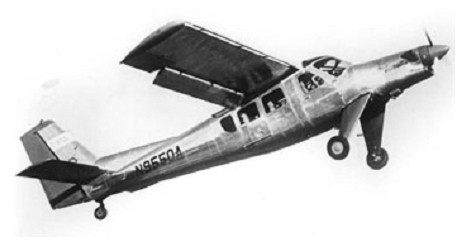
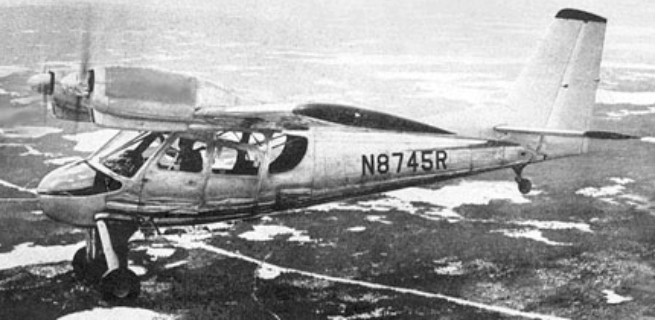
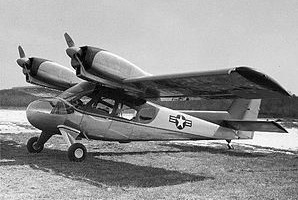
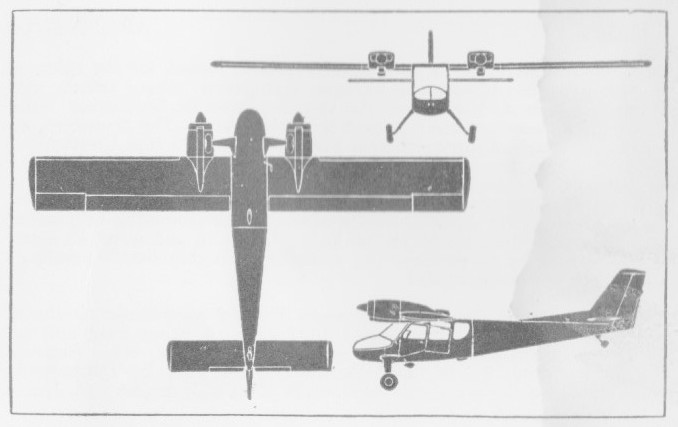
Known by Helio as the model H-500 this STOL aircraft mounted twin Lycoming engines on top of the high-set wing, close to the fuselage. With the engines mounted in this manner, lateral and over-the-nose visibility were much improved while the propellers were kept clear of cabin doors and away from possible debris damage during rough field operations. This was a tail-wheel design, so the vertical component of propeller thrust assisted STOL take-off performance from rough fields. Fully automatic full-span, leading-edge slats were fitted along with high-lift flaps.
Full span automatic leading slots are monocoque and hollow. Spoilers or “interceptor” blades protrude through upper surface of the wing, forward of main spar. They are interconnected with the ailerons and rise only when aileron is deflected more than 4 degrees. Magnesium is usd as a weight saver n the rudder and horizontal tail in the skins aft of the main spar on each surface. Horizontal tail is one piece all-flying type with anti-balance and trim tab. Vertical stabiliser is sweptback 25.5 degrees.
Flown for the first time in 1960, Faa certification was obtained late in 1963.
In 1964 the USAF Air Commandos were testing the Helio U-5A at Hurlburt AFB (Fla). The USAF ordered seven for tests.
In 1967 or 68, work was started on a redesign of the Twin Courier in a tricycle-gear configuration for the commercial market, since many firms which desired STOL capability had regulations which required multi-engine aircraft. The company ran out of money and the project was terminated.
The aircraft structure of the Helio Stallion, a single-engine turboprop version of the more successful Helio Courier, was based on the design of the Twin Courier.
The Twin Courier could seat six and first flew in April 1960, being awarded FAA certification on June 11, 1963. (The Twin Courier met FAA requirements marginally and was certificated to meet immediate needs for service in Vietnam, on the understanding that the design would not be marketed commercially. Thus, the redesign.) Only seven examples were built, these receiving the United States Armed Forces designation U-5A. One was reported to have been evaluated by US Army Special Forces.
U-5A Twin Courier
Official Air America records preserved at the Air America Archives do not mention such an aircraft, but there are three ways to explain why Twin Couriers were mentioned to have been in service with Air America: In the summer of 1965, Air America pilot William Andresevic, who had flown the regular Helio extensively in Laos, was ordered to fly a Helio Twin Courier to Bolivia for evaluation by the US Embassy. After some operational use in Bolivia, it was returned to an airstrip in Virginia. In 1962, the USAF evaluated 2 U-5A Twin Couriers, 59-5955 and 59-5956, at Hulburt for use by the air commandos. “90336” is possibly a fake serial for 59-5956.
Operators were Aviation Research Centre, India, Indian Intelligence Bureau, Air America, CIA and United States Air Force.
U-5A Twin Courier Powerplant: 2 × Lycoming O-540-A2B or -C2C air-cooled flat-six, 250 hp (190 kW) each Propellers: 2-bladed Hartzell, 7 ft 0 in (2.13 m) diameter Length: 32 ft 0 in (9.75 m) Wingspan: 41 ft 0 in (12.50 m) Height: 8 ft 10 in (2.69 m) Wing area: 242 sq ft (22.5 m2) Empty weight: 3,126 lb (1,418 kg) Max takeoff weight: 5,850 lb (2,654 kg) Maximum speed: 185 mph (298 km/h; 161 kn) at sea level Cruise speed: 166 mph (144 kn; 267 km/h) (econ cruise, 60% power) at 10,000 ft (3,050 m) Range: 1,500 mi (1,303 nmi; 2,414 km) (max fuel) Service ceiling: 19,500 ft (5,944 m) Rate of climb: 1,640 ft/min (8.3 m/s) Crew: 1 Capacity: 5 passengers
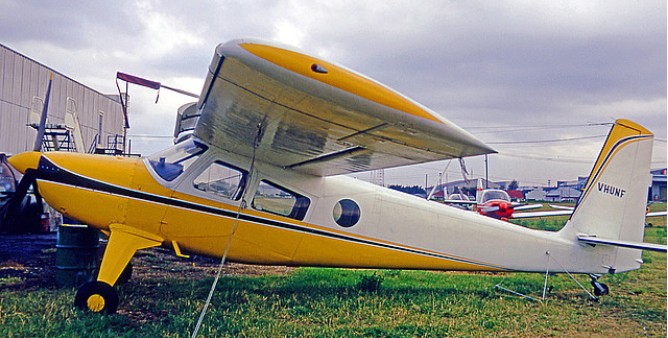
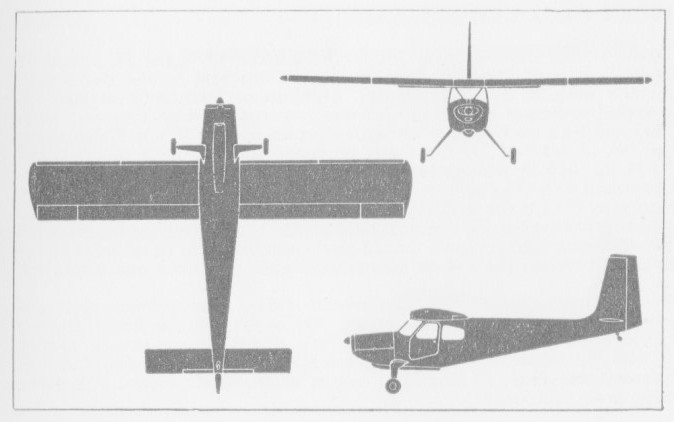
Using the knowledge gained from the Vaga¬bond experiment, Koppen went back to the drawing board and came up with the prototype Helio Courier with full span automatic leading edge slats, large flaps and drooped ailerons. Aileron-linked airflow interceptors provide excellent lateral control while large slotted flaps on the trailing edge, working in conjunction with the slats on the leading edge, double the lift of the wing. It had four seats, an 11 foot prop and a 145 hp Continental engine. With an all-moving stabilator for pitch control and a tall, swept fin, and rudder for its direction control, the two Courier models possess maximum stability during slow flight.
By the time the production model was certificated in 1954, it had five seats, a 260 hp Lycoming and a smaller prop.
The original Courier prototype was a converted Piper Vagabond. Superseded by the H-391B, H-395 and H-395A Super Couriers introduced from 1958. Helio H-250 and H-295 six-seat utility aircraft flew in 1964 and 1965 respectively, and were produced for both civil and military use; Super Couriers in USAF service designated U-10.
In April 1964 it was announced that a lower priced six-place STOL with higher payload and better economy than standard Helio Couriers that went into production during May. Called the Caballero, it was to sell for $33,400, Helio factory advertisement brochure showing N5444E with a H-395 style cowling (no landing lts). It was also labeled as a Mark II Caballero H-250A Model other pictures show that the first 5 H-250s had the same H-395 style cowling. It appears that the Caballero was dropped.
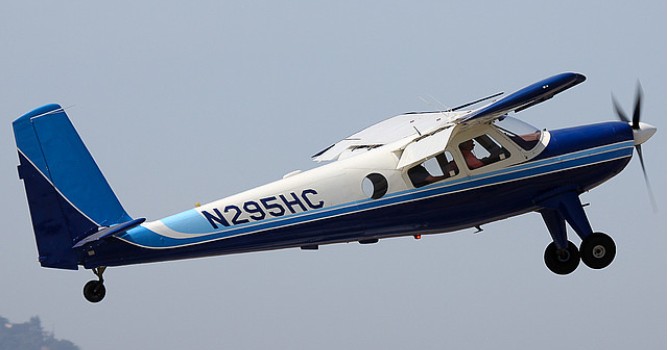
The H-391 was powered by a 260-hp Lycoming and offered seating for four to five. The H-395 followed in 1959 with its 295-hp engine and five seats. The H-295 first appeared in 1965 and featured increased seating and the same 295-hp engine. Its counterpart was the H-250 powered by the 250-hp Lycoming.
H-295
An early Helio Courier was evaluated by the Army in 1955 as a YL 24 but no order resulted. The YL-24 is a cantilever monoplane with full span automatic wing slats and drooping ailerons, which enable it to land in 50 yards and fly under perfect control at less than 30 mph. Powered by a 260 h.p. Lycoming engine, it is a four-seater.
Helio YL-24 Courier
Helio produced more than 450 piston engined Helio Couriers. Of these, 131 U 10s were delivered to the USAF under six separate fixed ¬price contracts between 1959 and 1968.
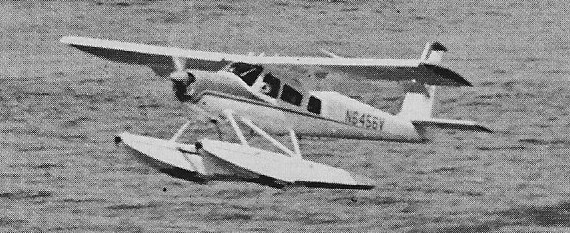
Two commercial versions of the Helio were the Super Courier H-295 with nonretractable conventional landing gear and the Tri-gear 54-Courier HT-295 with nonretractable tricycle gear. Three models are flown, by the U.S. Air Force: the U-10A with a fuel capacity of 60 gallons; the U-10B, a long-range version with tankage for 120 gallons; and the U-10D, an improved long-range version with a fuel capacity of 120 gallons and a gross weight boosted to 3,600 pounds.
Delivery of the initial four-set H-391 began in July 1954. Few were produced before the introduction of the H-391B, and a specialised high-altitude photographic version, the H-392 Strato-Cruiser, was powered by a 340 hp Lycoming GSO-480-A1A6.
The first model to be built in quantity was the H-395 Super Courier four/five seater first flown in 1958. After evaluation of three by the USAF, a number were ordered in 1962 for the USAF Tactical and Strategic Air Commands, and in 1963 twenty were ordered for the US Army and 24 for the Air National Guard, the military version designated U-10A.
The H-395A Courier is similar to the H-395 but has 260 hp GO-435-C2B2-6 engine, and 250 Couriers had been delivered by the end of 1963.
Approximately 450 Helio Couriers were built over 20 years.
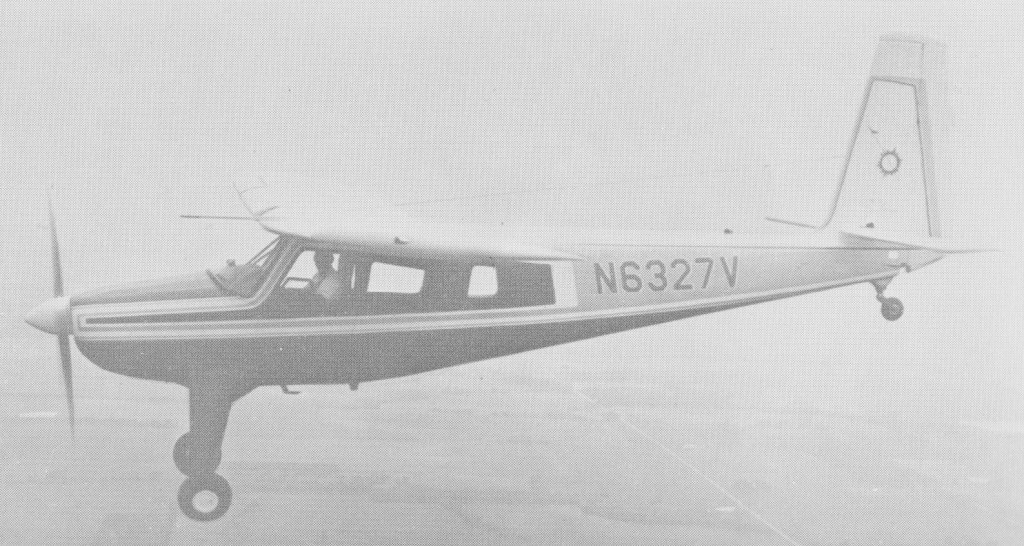
Super Courier H-295 Engine: 1 x Lycoming GO-480-G1A6, 295 hp. Prop: 3 blade, CS, 8 ft 0 in / 2.44 m Wingspan: 39 ft 0 in / 11.89 m Length: 31 ft 6 in / 9.61 m Height: 8 ft 10 in / 2.69 m Wheel track: 9 ft 0 in / 2.74 in Max TOW: 3000 lb / 1360 kg Empty weight: 2080 lb / 940 kg Equipped useful load: 1251 lb. Payload max fuel: 543 lb. Fuel cap – std: 50 Imp.Gal / 60 USG / 229 lt Fuel cap: 351/708 lb. Wing loading: 14.7 lb/sq.ft. Pwr loading: 11.5 lb/hp. Max range MTOW: 690 mi / 1120 mi / 600 nm Range max fuel/75% pwr: 1028nm/7.1hr. Range max fuel / 55% pwr: 1165 nm/ 9.3 hr. Service ceiling: 20,500 ft. 75% cruise: 144 kt. Max level speed: 170 mph / 274 kph / 147 kt at SL 55% cruise: 126 kt. Cruise 75% 8500 ft: 168 mph / 270 kph / 146 kt Stall flaps up: 50 mph / 80 kph / 43 kt Stall flaps down: 30 mph / 48 kph / 26 kt 1.3 Vso: 34 kt. Initial ROC: 1150 fpm / 350 m/min Best climb speed: 65 mph / 105 kph / 56 kt TO to 50 ft: 495 ft / 151 m Approach dist from 50 ft / 15 m: 253 ft / 78 m Ground roll: 240 ft / 74 m Min field length: 610 ft. Undercarriage: Fixed tail wheel. Seats: 6. Loading: +3.8g, non-aerobatic Base price 1970: £17,500 / $41,900
Courier H-250 Engine 250-hp Lycoming. Seats 6 Gross wt. 3,400 lb Empty wt. 1,890 lb Fuel capacity 120-270 USG Top speed 160 mph Cruise 152 mph Stall 31 mph Initial climb rate 830 fpm Ceiling 15,200 ft Range 644-1,288 miles Takeoff distance (50ft) 750 ft Landing distance (50ft) 520 ft
H-395 Super Courier / U-10A Engine: 295 hp Lycoming GO-480-G1D6 Wingspan: 39 ft Length: 30 ft 9 in Height: 8 ft 10 in Wing area: 231 sq.ft Empty weight: 2037 lb Max loaded weight: 3920 lb Max speed: 176 mph Cruise 75%: 170 mph at 8200 ft Econ cruise: 150 mph ROC: 1350 fpm
Helio was founded 1948 as Helio Aircraft Corporation to develop the two-seat Koppen-Bollinger lightplane. Otto Koppen may best be known as the creator of the Helio, the first modern short takeoff airplane. “We built the Helio before STOL was invented,” Koppen remembers. “I felt that an effective short field airplane shouldn’t have to fly at the obstacle, it should be able to fly around it.” Koppen wanted an airplane that could climb steeply and maneuver safely at low airspeeds and high angles of attack. The Helio development model, put together in 1944, was a Piper Vagabond with an 80 horsepower engine swinging a nine foot prop. Leading edge slots and full span flaps com¬pleted the rig. With the propeller turning at a maximum 960 rpm, the airplane took off in 125 feet. It climbed steeply with two people aboard, and it flew quite happily at 26 mph.
Founded 1948 as Helio Aircraft Corporation to develop the two-seat Koppen-Bollinger lightplane. Four-seat STOL derivative Helio Courier entered production 1954. Superseded by the H-391B, H-395 and H-395A Super Couriers introduced from 1958. Helio H-250 and H-295 six-seat utility aircraft flew in 1964 and 1965 respectively, and were produced for both civil and military use; Super Couriers in USAF service designated U-10. The H-550A Stallion with turboprop engine followed. Helio was acquired by General Aircraft Corporation in 1969 and renamed Helio Aircraft Company, but the assets later acquired by Helio Courier Ltd. (which produced H-295 Super and HT- 295 Trigear Couriers), Helio Precision Products and, in 1976, Helio Aircraft Ltd. In 1984 company bought by Aerospace Technology Industries and in 1989 by Aircraft Acquisition Corporation; the latter re-formed company as Helio Aircraft Corporation to produce Couriers and turboprop H- 550A Stallion, plus develop new piston-engined Courier 700 and turboprop-engined Super Courier, which did not take place.
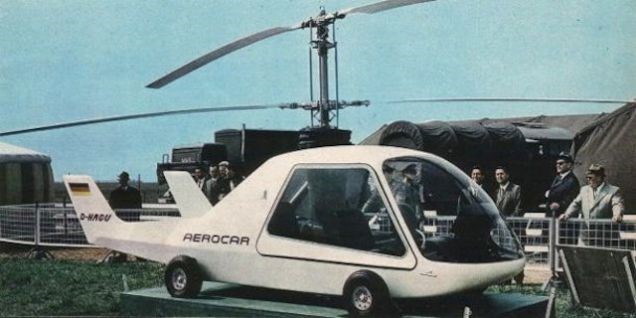
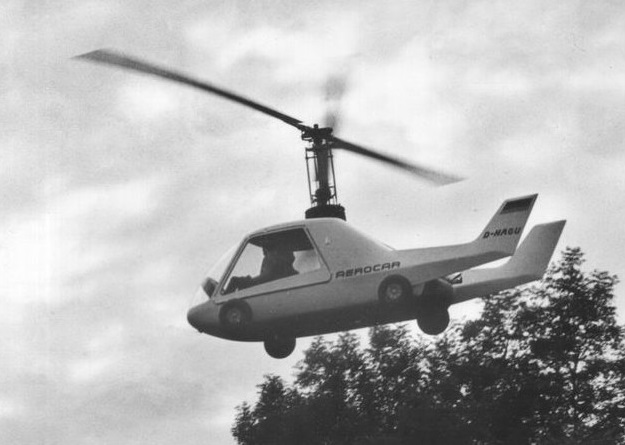
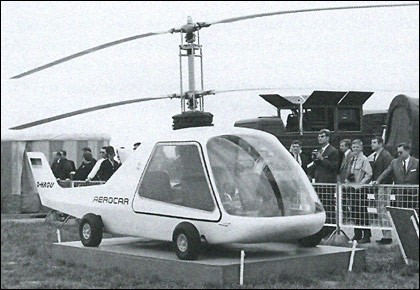
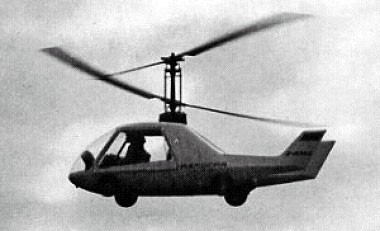
The Rotocar III has developed into the Aerocar. This has a 4-seat cabin, a twin tail assembly, and four road wheels hydraulically driven from the Oredon IV engine mounted behind the rotor pylon.
Wagner built a prototype (D-HAGU) Aerocar roadable helicopter, powered by a 260hp Franklin 6AS-335-B engine, which had a complete body shell. It was first flown in 1965. It was subsequently rebuilt with a Turbomeca Oredon turbine engine.
After extensive development work had been carried out, the Wagner designs were passed to a new company, Helikopter Technik Munchen (HTM) in 1971. HTM abandoned the Aerocar.
The first five designs evolved by Alfred Vogt of the Helicopter Technik Wagner since the company’s formation in 1960 included two experimental helicopters, each powered by a 95hp rotary engine. One was a simple 2-seater with a skid undercarriage and pod-shaped body. From this Wagner produced the Sky-Trac torque-less helicopter, which is basically a chassis frame carrying the engine and rotor system, to which a variety of cabins or equipment can be fitted to fulfil different roles.
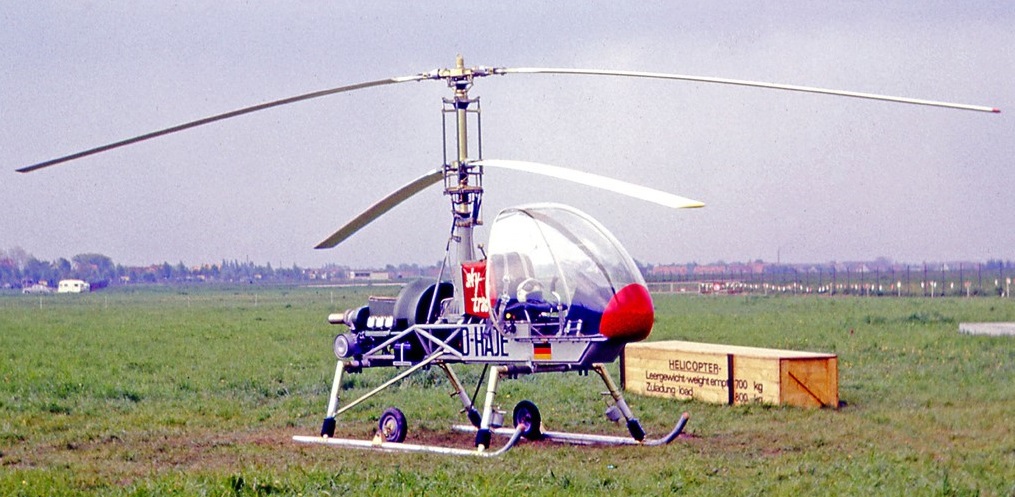
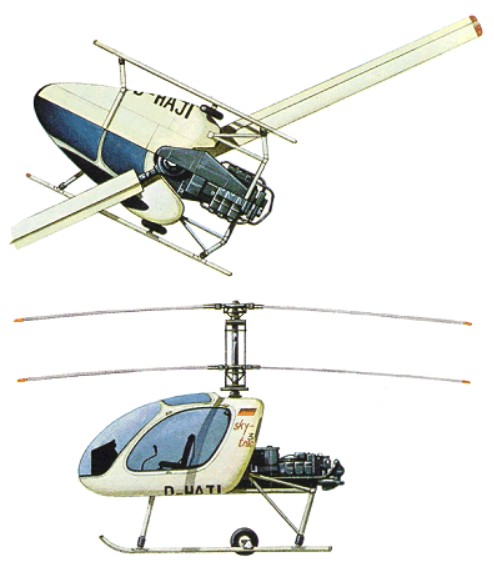
Development commenced in the mid-1960s as an offshoot of the Wagner firm’s attempts to develop a roadable helicopter, and utilised the same coaxial dynamic components that had been developed for that project. Each design utilized a contra-rotating rotor system in which the lower three-blade rotor was attached to the crankcase of a 95 hp three-cylinder rotary engine, rotating around the rotor pylon, with the upper two-blade rotor driven by the crankshaft. The Skytrac featured a narrow single-seat cabin at one end of a box-like “keel” structure, a horizontally mounted Franklin flat-6 engine at the other end, and the transmission and rotor mast between them. The pilot’s seat was enclosed by a sliding, bubble canopy. The prototype flew in this form in July 1965. The Wagner Sky-Trac 1 (D-HAJE), still had a frame structure but was fitted with a 260hp Franklin 6AS-335-B engine, and had a sliding canopy forming an enclosed cabin for the single pilot.
Prototypes of the Sky-Trac 1 (D-HAJE) and Sky-Trac 3 (D-HAJI) were exhibited publicly for the first time at the Hanover Air Show in May 1966.
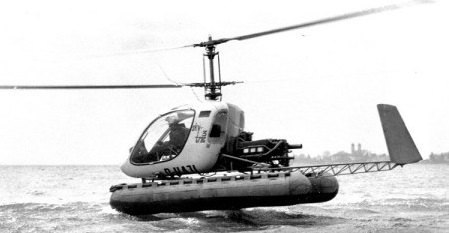
The second machine built (D-HARB) was fitted with a pontoon landing gear and a longer boom with a V-tail. Both are powered by similar 260hp Franklin 6AS-335-B piston-engines, the Sky-Trac 1 being a single-seater with a ‘goldfish bowl’ moulded canopy, open at the rear.
The three-seat Sky-Trac 3 (D-HAJI c/n 11), also flown in 1965, had a more complete cabin structure, faired-in at the back and underneath, and was fitted with spray bars and under-slung tanks for agricultural chemicals. The Sky-Trac 3 can lift loads at least equivalent to its own weight, an under-fuselage hook permitting slung loads of over 700kg to be transported. Alternatively, the heart-shaped cabin can accommodate a stretcher and medical attendant in addition to the pilot, or for agricultural use can be fitted with spray bars and an under-slung tank holding 650 litres of liquid chemicals.
The HTM FJ-Skytrac received both German and FAA certification in 1969.
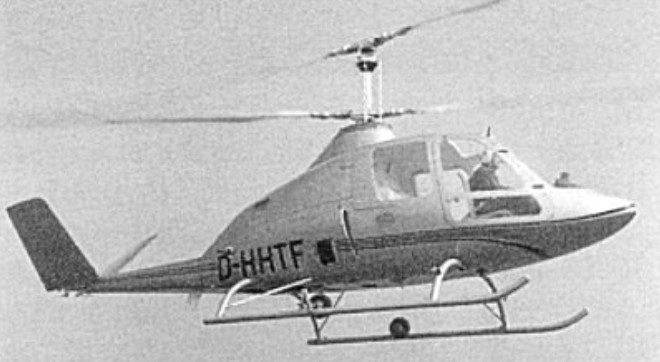
The company developed a kit to convert the Skytrac into a four-seat light helicopter known as the HTM Skyrider. On 21 February 1974 Helicopter Technik München flew the prototype (D-HHTF) of the HTM Skyrider four-seater powered by a 260-hp (194-kW) Avco Lycoming engine.
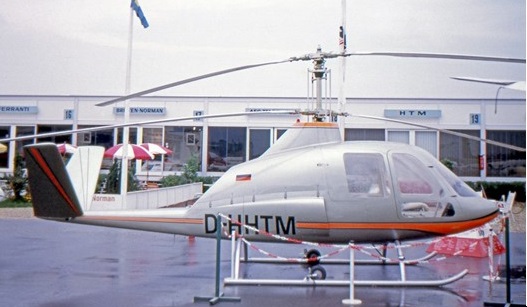
After extensive development work had been carried out, the Wagner designs were passed to a new company, Helikopter Technik Munchen (HTM) in 1971. HTM abandoned the Aerocar, but built a new prototype of the FJ-Sky-Trac (D-HHTM) in tandem two-seat configuration, as a utility helicopter with a 260hp Lycoming IO-540 engine. This still had the coaxial rotor system but was extensively redesigned to accommodate the new engine and cockpit layout.
In 1971, the newly formed Helikopter Technik München (HTM) took over the manufacture and marketing of the Skytrac, announcing in mid-1972 that a production line was being established at Jesenwang with the intention of producing 35 machines by the end of 1973, all of which had found buyers. After this initial batch, HTM planned to sell licences to produce the design in batches of 30 machines each. None of this was to come to pass, however, as HTM was unable to finance the production of the first batch of aircraft.
HTM then went on to build two examples of the HTM Skyrider (D-HTMS and D-HHTF) which reverted to the configuration of the Sky-Trac with a four-seat cabin and a fully enclosed streamlined structure. Mockups of this configuration were displayed at the Hanover and Cannes airshows in 1972 and a prototype was exhibited at the June 1973 Paris Air Show. The Skyrider had a skid undercarriage and V-tail, which commenced flight testing on 21 February 1974. It was possible to convert the basic Skytrac into a Skyrider in a matter of only a few hours’ work.
The Sky-Trac 1 and Sky-Trac 3 were used by HTM to demonstrate the concept, and a new prototype of the Sky-Trac (D-HHTM) was built in tandem two-seat configuration, as a utility helicopter with a 260 h.p. Lycoming 10-540 engine. This still had the coaxial rotor system but was extensively redesigned to accommodate the new engine and cockpit layout.
HTM Skyrider exhibited at the 1973 Paris Air Show
Since 1992 all the rights for production and design of the Skytrac and Skyrider helicopters are owned by Mr. P. Chrobak.
I worked in the Montege des Skytrack and Skyrider from 1972 to 1974 as a group leader and was one of the few co-riders who was allowed to get into a Skyrider. Unfortunately, the company HTM then went into insolvency and I still have a title from the insolvency administrator about 5000 DM that was never enforced. The helicopter was moved in Moosbach / Lohrbach airfield in the Odenwald. Franz Wenninger
Skytrac Engine: 1 × Franklin 6AS-335-B, 195 kW (260 hp) Length: 4.00 m (13 ft 2 in) Main rotor diameter: 10.40 m (34 ft 1 in) Height: 3.80 m (12 ft 6 in) Main rotor area: 84.9 m2 (914 ft2) Empty weight: 850 kg (1,870 lb) Gross weight: 1,500 kg (3,300 lb) Maximum speed: 160 km/h (100 mph) Range: 400 km (250 miles) Service ceiling: 3,500 m (11,000 ft) Rate of climb: 2.0 m/s (400 ft/min) Crew: One pilot Capacity: 2 passengers
Wagner Sky-Trac 3 Engine: 1 x Franklin 6AS-335-B, 195kW / 260 hp Rotor diameter: 10.0m Fuselage length: 4.0m Height: 3.80m Max take-off weight: 1500kg Max speed: 166km/h Service ceiling: 2200m Max range: 200km
The Helikopter Technik Wagner of Friedrichshafen, Germany, was formed by Josef Wagner with the objective to develop a torque-free basic vehicle which could be fitted with a variety of cabins and specialized equipment for different applications. Founded to produce the Skytrac two-seat lightweight multipurpose helicopter, designed originally by Wagner Helicopter Technik.
Development was started in 1960 and designed by Chief Engineer Alfred Vogt, the earliest simple two-seat pod-shaped test models with coaxial rotors and skid landing gear were fairly rudimentary machines built to test the concept, and one design was a roadable machine titled the Rotocar III.
The HTM FJ-Skytrac received both German and FAA certification, and the company developed a kit to convert the Skytrac into a four-seat light helicopter known as the HTM Skyrider. Production terminated owing to lack of capital.
Helicopteros Do Brasil sa was founded 1978, with partial Aerospatiale of France shareholding, to assemble Aerospatiale SA 315B Lama and AS 350B Ecureuil helicopters, known locally as HB 315B Gaviao and HB 350B Esquilo respectively. Programs encompassed assembly of Esquilo plus the military AS 550 Fennec version, and AS 365 Dauphin and military AS 565 Panther (all Eurocopter types).
Canada Based in Canada for project management, but with French connections in helicopter development; first flew in France in 1976 and 1984 two prototypes of a four-seat helicopter with rotor driven by cold-air tip jets. Program halted.



 All Aero