Heuberger-Rinker H-5 Stinger

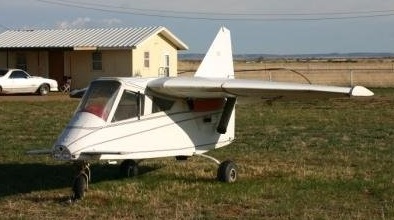
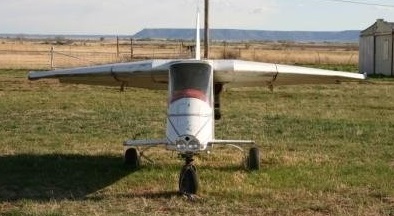
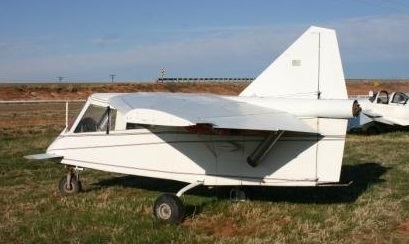
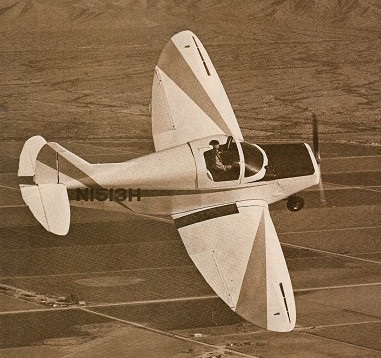
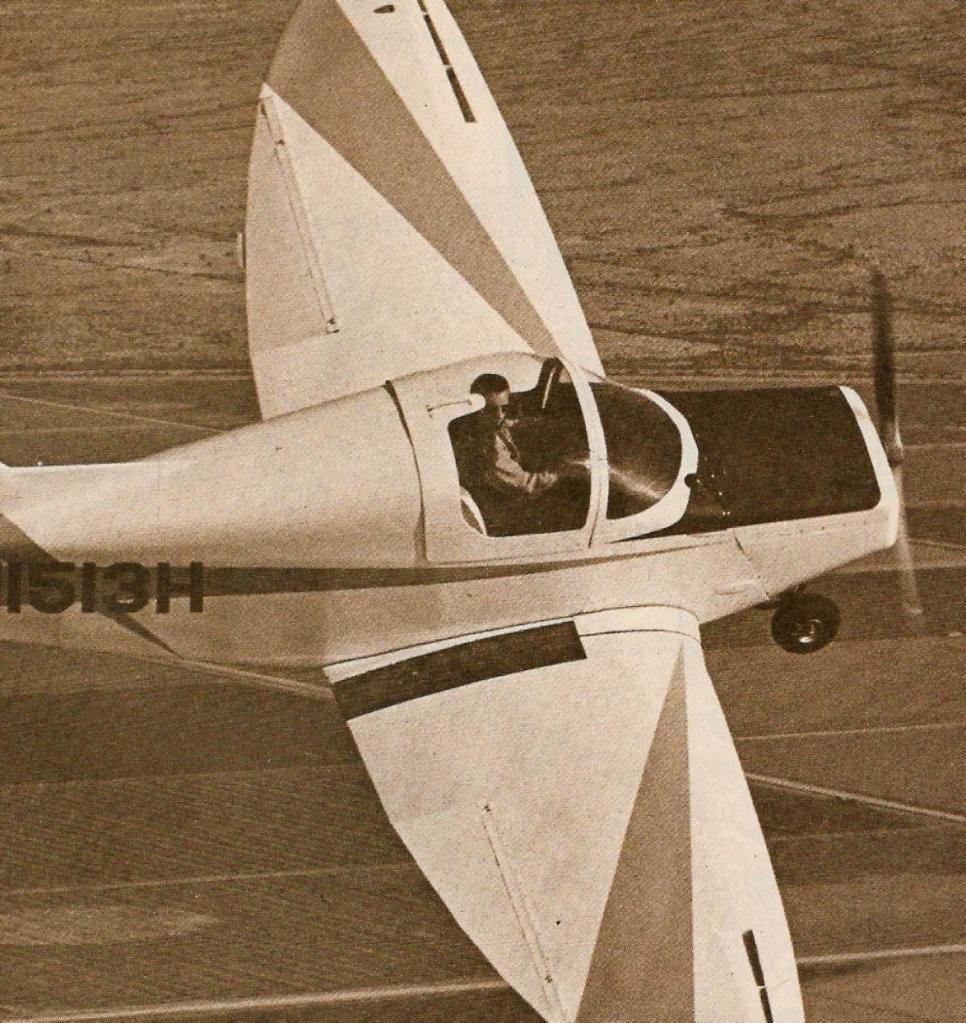
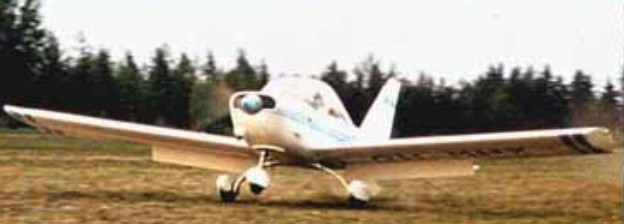
The Heuberger-Rinker H-5 Stinger N3638G was a designed by Lawrence K. “Larry” Heuberger, who started its construction at Tucumcari, New Mexico, around the early 1960s.

Prior to completion the project was acquired (around 1968) by Bud Rinker of Santa Barbara, Cal., who almost certainly did some limited testing in 1970.

Engine: 140hp Lycoming O-290-G
Wingspan: 16ft 6 in
Length: 14ft 8 in
Seats: 2
Est. performance
Max. speed: 180 mph
Cruise: 160 mph
Ceiling: 10,500ft
Climb rate: 1.200ft/minute.

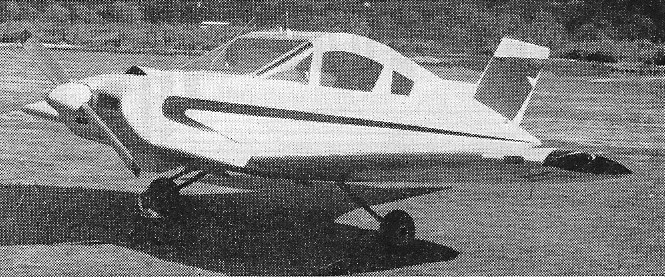
Heuberger Sizzler

Lawrence K. “Larry” designed and built the Sizzler in 1957. The two-place Sizzler features a T-tail arrangement and gets a fair amount of lift from its fuselage. The low-wing monoplane is built entirely of metal and flush-riveted throughout. Compound curves are no problem on the Sizzler, which uses flap panels. It stands on tricycle landing gear and carries a 125-hp Continental engine.

N75345

At least two were built (the prototype N75345 of Mr. Heuberger and C-GSIM of Mr. James Sim in Canada).

Engine: Lycoming O-290-D, 125 hp
Wingspan 18 ft 4 in
Length 20 ft 7 in
Wing area: 100 sq.ft
Gross Wt. 1350 lbs.
Empty Wt. 950 lb
Fuel capacity 33 USG
Payload: 510 lb
Top speed 175 mph
Cruise 160 mph
Stall 70 mph
Climb rate 900 fpm
Takeoff run 1200 ft
Landing roll 700 ft
Range 600 sm

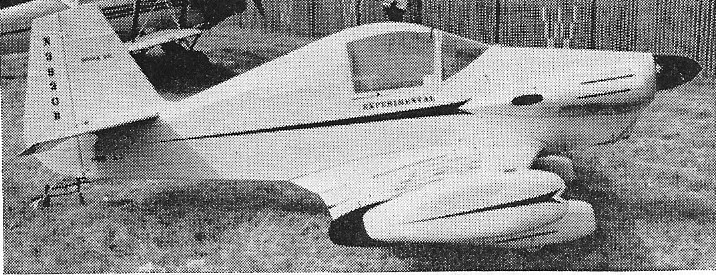
Heuberger Doodle Bug

This fast single-seater picked up three trophies when it flew to the 1955 EAA Fly-In at Oshkosh, Wisconsin. The Doodle Bug was registered N3930B cn.A.1. With its 12½-gallon main fuel tank and a pair of 6½-gallon fiberglass tip tanks, the Doodle Bug boasts an amazing 700-mile range. It is built from welded steel tube. The fuselage and tail group is fabric covered. The wings are all metal.

Engine: 90-hp Continental.
Gross Wt. 970 lb
Empty Wt. 616 lb
Fuel capacity 25 USG
Wingspan 18 ft
Length 16 ft 6 in
Top speed 196 mph
Cruise 170 mph
Stall 70 mph
Climb rate 2000 fpm
Takeoff run 1000 ft
Landing roll 800 ft
Range 700 sm

Helwan HA-300

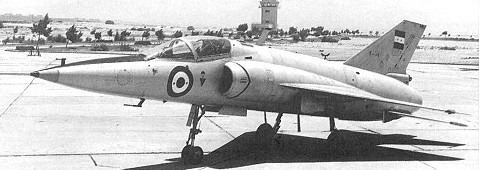
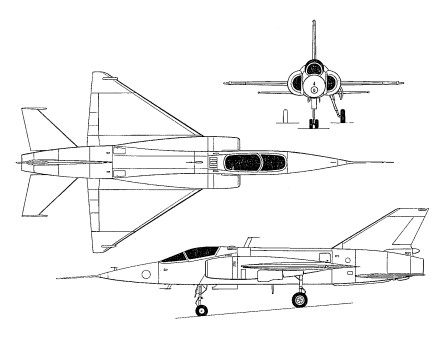
Originally conceived to meet a Spanish Ejercito del Aire requirement for a small M=1.5 interceptor and the design responsibility of a Germano-Spanish team supervised by Prof Willy Messerschmitt, the HA-300 programme was transferred to Egypt. Here development and construction was undertaken in Factory No 36 at Helwan, this being controlled by the Egyptian General Aero Organisation (EGAO). Originally designed for the proposed afterburning Orpheus BOr 12 turbojet, the HA-300 was modified for the Brandner-designed E-300 with a calculated afterburning rating of 4800kgp. The first V.1 prototype, powered by a 2200kgp Orpheus 703-S-10, was flown on 7 March 1964, a similarly-powered second V.2 prototype flying on 22 July 1965. The version flew supersonic.

The definitive third prototype with the E-300 engine commenced taxi trials in November 1969, but the HA-300 programme was then terminated without flight testing of this prototype being undertaken. It was anticipated that the E-300-powered HA-300 would be capable of attaining 12000m and M=2.0 within 2.5 min of take-off. The Orpheus-powered prototypes achieved approx M=1.13 during flight test.

Egypt’s HA-300 was test flown in the Spring of 1964 by an Indian pilot, showing no appreciable advantages over the MiG-21.

The HA-300 V.1 is displyed in the Deutsches Museum – Oberschleissheim and the Ha-300 V.2 and V.3 remained in Cairo.

Wingspan: 5.84 m / 19 ft 2 in
Length: 12.40 m / 40 ft 8 in
Height: 3.15 m / 10 ft 4 in
Wing area: 16.70 sq.m / 179.76 sq ft
Max. speed: 1490 km/h / 926 mph

Helwan Air Works

Egypt
Inaugurated by President Nasser in 1962, Helwan’s first project was license-manufacture of the Spanish Hispano HA-200 Saeta jet trainer, known in Egypt as Al Kahira. German designer Willy Messerschmitt led a Helwan team to develop the HA-300 supersonic fighter, first flown in prototype form in March 1964.

Helton Lark 95

When Culver went out of business in 1946 the rights were bought by Superior Aircraft Co and then sold to California Aero Co of Tracy. They revived the model in 1966 as the Helton Lark 95 with a 90hp Continental C 90 16. Dimensions were similar to the Cadet, though the overall height was 6ft 10in due to the tricycle gear.

There is some doubt as to how many Larks were built, but seventeen constructor’s numbers were allotted and not all may have been completed. The last to be built, c/n 9517, was N5017J.

Further developments on the drone theme followed the PQ 8 and the NR D was built as the PQ 14A and PQ 14B for USAAF use and as the TD2CA for the Navy (which used a few TDCs from PQ 8 contracts). About 2,570 were built for use by the two services. Basic power was the 150hp Franklin O 300 11.

Post war limited type certificate LTC 28 was granted in December 1947 and a few were registered, there being eleven listed in the 1959 statistical survey, and one, N4744N was still in existence fairly recently There was a strong similarity with the Cadet, but the fuselage was lengthened and a larger fin and rudder fitted to counter increased power, plus tricycle undercarriage.

Helsinki University of Technology PIK-19 Muhinu / PIK Pik-19

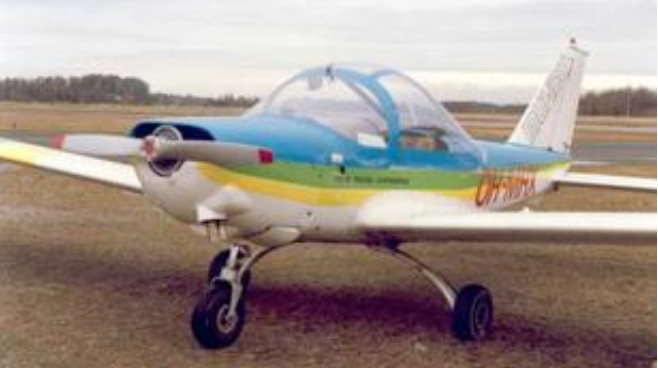
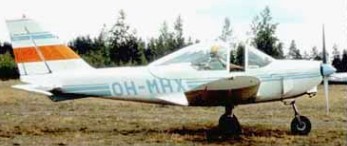
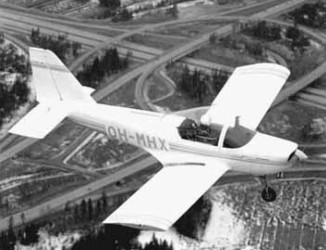
The PIK-19 Muhinu was a light aircraft developed in Finland in the early 1970s for use as a glider tug and flight trainer. It was a low-wing cantilever monoplane of conventional configuration, with an enclosed cockpit and fixed, tricycle undercarriage. Its construction was of composite materials throughout, a novel approach at the time. Some unique design details were used in the construction of the Muhinu -e.g., the wing was made of one-meter (3 ft) panels, thus avoiding big female molds for the wing. Both the fuselage and wing were made of glass-epoxy- honeycomb sandwich. The main landing gear was also made of fiberglass-epoxy by the filament winding process.

When the PIK-19 flew for the first time in 1972, it was only the fourth aircraft in the world made of these materials.

The project was undertaken as a joint venture by the Finnish government and the Helsinki University of Technology. Its “PIK” designation belongs to a sequence of designations applied to the aircraft designed and built by the university’s gliding club, Polyteknikkojen Ilmailukerho, although this was not a project by the club. Design work commenced in 1969 under the leadership of Jukka Tervamäki, Ilkka Rantasalo and Pekka Tammi and the prototype flew on 26 March 1972. This project involved many skilled young engineers and graduates from the University: Ilkka Rantasalo, Pekka Tammi, Hannu Korhonen, Markku Hiedanpää, Erkki Haapanen, Olof Lagerkrantz, etc.

In 1978 the Pik-19 was re-powered with a 180 hp Lycoming 0-360 engine.

Plans for production in series were never realised, and the single prototype (OH-MHX) was the only example ever built. Over the next 21 years, it accumulated 5217 hours of flying time and some 40,000 glider tows. It was destroyed in a crash in June 1994 when the engine failed at low altitude.

Gallery

Engine: 1 × Lycoming O-320-B2BC, 120 kW (160 hp)
Propellers: 2-bladed McCauley1A-175/GM-8241 for towing and 1C-172/MGM-7657 for other tasks, Both fixed pitch, metal blades.
Length: 6.90 m (22 ft 8 in)
Wingspan: 10.00 m (32 ft 10 in)
Height: 2.60 m (8 ft 6 in)
Wing area: 14.00 sq.m (150.7 sq ft)
Aspect ratio: 7.14
Airfoil: NACA 632415
Empty weight: 560 kg (1,235 lb) equipped
Max takeoff weight: 840 kg (1,852 lb)
Fuel capacity: 150 L (33 Imp gal; 40 US gal)
Maximum speed: 240 km/h (149 mph; 130 kn)
Cruising speed: 220 km/h (137 mph; 119 kn) maximum, 75% power
Stall speed: 83 km/h (52 mph; 45 kn) flaps down
Never exceed speed: 310 km/h (193 mph; 167 kn)
Range: 950 km (590 mi; 513 nmi) maximum fuel, no reserves, 65% power
Rate of climb: 7.00 m/s (1,378 ft/min)
Wing loading: 60.0 kg/sq.m (12.3 lb/sq ft)
Take-off to 15 m (50 ft): 240 m (787 ft)
Landing from 15 m (50 ft): 220 m (722 ft
Crew: Two