In 1968, Snecma took control over Hispano-Suiza, which included the mechanical engineering firm Bugatti, the landing gear manufacturer Messier, and the engine maker Berthiez. All of these were at the edge of ruin.
Post WW2
Hispano HA-300 / XC-6
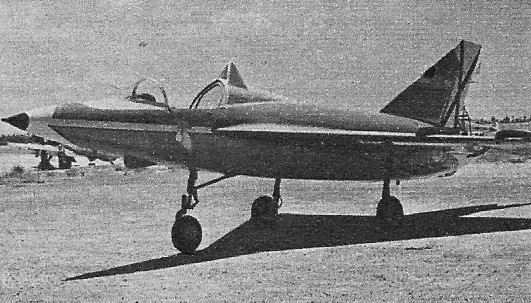
The HA-300P research glider was to provide advance information on the probable flight characteristics of the powered aircraft.
Rolled out of Military Factory No. 36 at Helouan for the first time in 1963, the Messerschmitt designed supersonic interceptor was expected to commence flight trials with an Indian test pilot. Development on the Hispano HA 300, or, XC 6, began in Spain and was subsequently shelved. The fighter is powered by two 4,850 lb.s.t. (2 200 kgp) Bristol Siddeley Orpheus 703 turbojets for initial flight trials, but the definitive version is expected to be powered by a pair of 7,000 lb.s.t. (3 175 kgp) turbojets of a type developed in Egypt by Ferdinand Brandner. Whereas the fighter is only likely to attain about Mach 1.2 with Orpheus engines, a maximum speed of the order of Mach 2.2 is anticipated with the Brandner designed engine which, if successful, may also power the Hindustan HF 24. Basically of clipped delta planform, and featuring a long, needle nose, the fighter has side by side mounted engines, a narrow track, fuselage housed undercarriage, and a Martin Baker zero altitude ejection seat.
HA-300P
Wingspan: 20 ft 2 in
Length: 33 ft 5.5 in
Wing area: 215.278 sq.ft
Hispano HA.220 Super Saeta
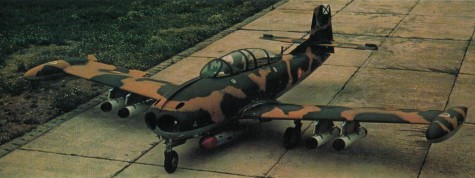
HA 200 Saeta development potential as a lightweight ground attack aircraft lead, via the two seat HA 200E Super Saeta with more powerful Marbore engines, to the purpose built, single seat HA 220 Super Saeta, with increased armour, self¬-sealing fuel tanks and an additional fuel tank in the rear cockpit, replacing the second seat. Powered by two 1,058 lb thrust Marbore VI engines, the rear cockpit is used to accommodate an additional fuel tank. Armament can comprise a variety of bombs, guns, and rockets on under-¬fuselage/wing stations.
Two Browning M 3 machine guns.
Prototype (XC.10C) flown for first time on April 25, 1970. EdeA designation C.10C, later A.10C.
Twenty five were built.
Military Users: Egypt, Spain.
HA 220 Super Saeta / C-10C
Wing span: 35 ft 10 in (10.93 m)
Maximum speed: 435 mph (700 km/h).
Hispano HA-200 Saeta / Helwan HA 200B AI Kahira

Hispano decided to build a basic jet trainer using two Marbore II engines, and designed the HA.200 Saeta (Arrow) Spain’s first jet aircraft which used many components from the HA.100 Trianaa, including the wings and rear fuselage.
Willy Messerschmitt supervised the design. The engines, mounted in the lower forward fuselage, were fed from an air intake in the nose, and exhausted from two nozzles below the trailing edge of the wing roots. The HA.200 stored its fuel in two wing and two fuselage tanks.
Two prototypes were built and first flew on 12 August 1955 with the Fernando Juan Valiente. 190 were built, both by Hispano and under a licence agreement in Egypt (as the Helwan HA 200B AI Kahira).
From the autumn of 1957 an experimental program was initiated by INTA. Ten pre-production aircraft were ordered by the Spanish Air Force, of which 5 will be transformed into HA-200 A (E14A Ejército del Aire in). The first aircraft was to fly on July 21, 1960, the rest be be delivered until 1962.
An additional series of 30 HA-200 A was built. The first of them flew October 11, 1962, the others being delivered between 1963 and 1965. In April 1965 flew the first HA-200 B (C10B in Ejército del Aire service) of which 55 were built and incorporated in the Ejército del Aire over 1965-1967.
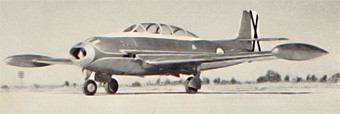
Hispano’s Saeta fulfilled jet training, ground attack training and, in the dedicated single seat HA.220 model, limited strike roles in Spainish service. The indigenous CASA 101 Aviojet provided the replacement, deliveries commencing in 1980.
The Egyptian aircraft were supplanted by the Aero L 29 Delfin.
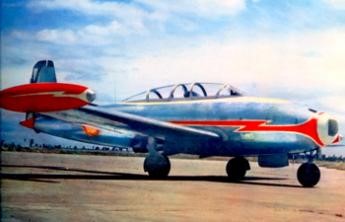
Variants:
HA 200R Saeta
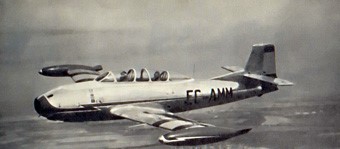
Prototype EC AMM first flew on August 12, 1955, followed by second prototype. Spanish Air Force (Ejercito del Aire EdeA) designation XE.14 for the prototypes and E.14 for 10 pre-production examples, five of which were brought up to HA 200A status.
HA 200A Saeta
First production batch (of 25), powered by Turbomeca Mabore lls, first example flown on October 11, 1962. Much refined over earlier HA.200s. EdeA designation E.14A. Attack version (two hard points) C.10A, later A.10A.
HA 200B AI Kahira
Version for Egyptian Air Force. 20mm Hispano cannon in the nose, replacing 7.7min Breda Safat machine guns of the HA.200A. First of five Spanish built examples flown on July 21, 1960. 63 HA¬200Bs built under licence in Egypt as the AI Kahira (Cairo) at Factory 36, Helwan, Cairo.
HA 200D Saeta
Further refined production batch, EdeA designation E.14B. 55 built.
HA 200E Saeta
Dedicated ground attack/counter insurgency aircraft, with four wing hardpoints and Mabore VIs. Conversions (about 40) undertaken from HA 200Ds, designated C.10Bs then A.10Bs.
Wing span: 36.17 ft (10.42 m)
Overall length: 29.29 ft (8.9 m)
Height: 9.33 ft (2.8 m)
Wing area: 187.2 sq.ft (17.4 sq.m).
Wing aspect ratio: 6.22.
Empty wt: 4233 lb (1921 kg).
Normal T/O wt: 5842 lb (2652 kg).
MTOW: 7617 lb (3458 kg).
Internal fuel cap: 164 Imp.Gal. (745 lt).
External fuel cap: 106 Imp.Gal. (481 lt).
Wing loading: 31.2 lb/sq.ft (152 kg/sq.m).
Max speed: 435 mph (699 kph)
Initial ROC: 2755 fpm (14 m/sec)
TO dist 50 ft: 1740 ft (530 m)
Range: 930 sm (1496 km).
Hispano Aviation HA 200 D Saeta
Engine: 2 x Turboméca Marboré II A, 3924 N
Length: 29.429 ft / 8.97 m
Height: 10.696 ft / 3.26 m
Wingspan: 35.860 ft / 10.930 m
Max take off weight: 8048.3 lb / 3650.0 kg
Max. speed: 352 kt / 652 km/h
Service ceiling: 39370 ft / 12000 m
Range: 810 nm / 1500 km
Crew: 2
HA 200 R1
Engines: 2 x 880 lbs.t. (400 kgp) Turborneca Mabore IIA turbojets
Max speed, 435 mph (700 kph) at 22,966ft (7 000 m)
Cruise, 298 mph (480 kph)
Initial climb, 3,345 fpm. (17 m/sec)
Service ceiling, 41,000 ft (12 500 m)
Range, 1,056 mls (1 700 km)
Empty weight, 3,697 lb. (1677 kg)
Loaded weight, 6,305 lb (2 860 kg)
Span, 34ft 2.25 in (10.42 m)
Length, 29ft 1.5 in (8.88 m)
Wing area, 187.2 sq.ft (17,4 sq.m)

Hispano HA-100 Triana
Hispano designed and built a 755hp piston engined advanced trainer, the HA.100 Triana. The HA-100 EI replaced the HA-43D-1 trainer. A tandem seater, tricycle landing gear, and with a gross weight of 6,460 lbs (2,932kg) was designed by Willy Messerschmitt.
It went into production for the Spanish Air Force in 1953.
Hispano HS-42 / HA-43
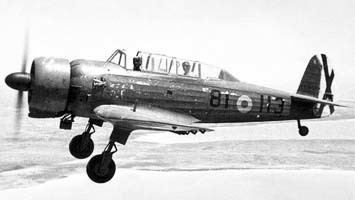
First flying in 1947, the Hispano HS-42 and its derivative, the HA-43, were advanced military trainer aircraft produced in Spain. The basic design was that of a conventional, low-wing, cantilever monoplane with seating for the pilot and instructor in tandem.
The HS-42 had fixed, tailwheel undercarriage with spatted mainwheels, while the HA-43 had retractable main units. Produced on the assembly line that had been used to build Fokker D.XXI fighters, the HS-42 shared some components with this aircraft.
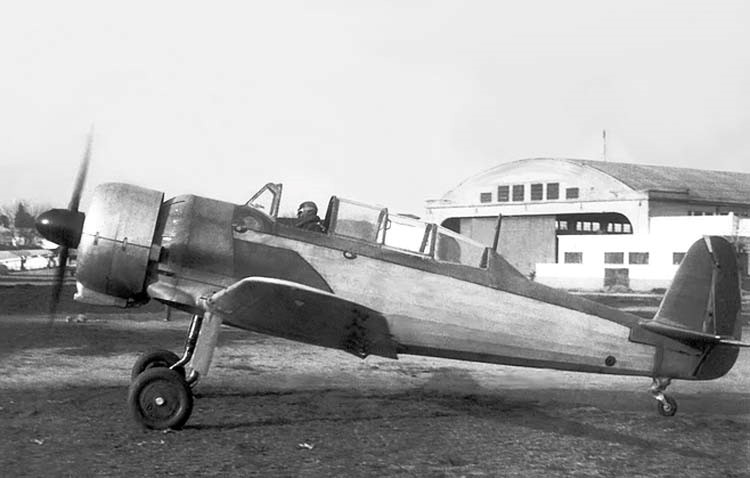
The HA-43D-1 advanced two-seat military trainer went into production for the Spanish Air Force in 1947.
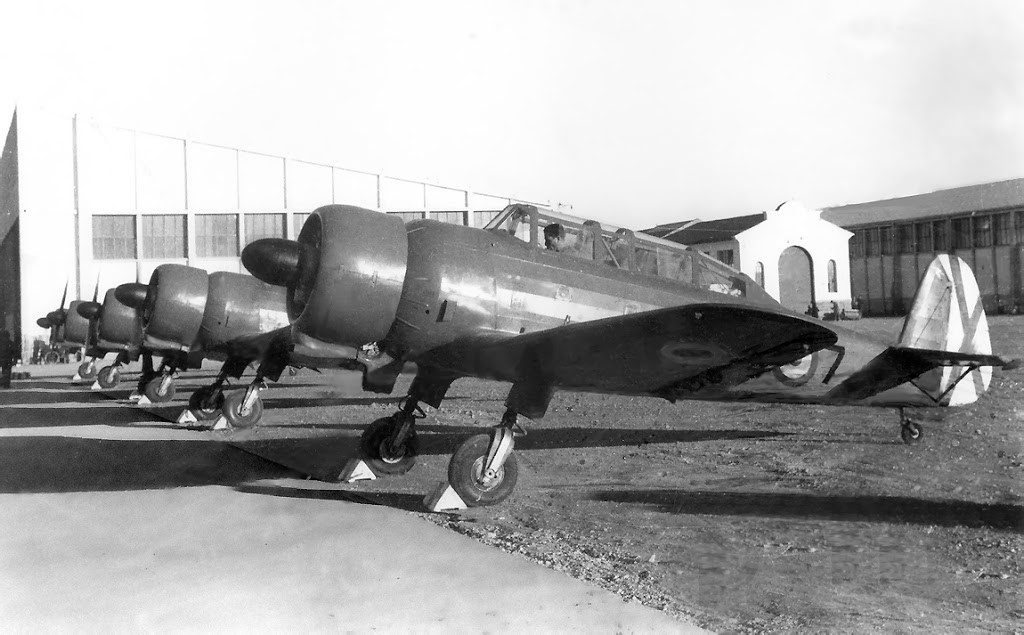
The HA-43D-1 was followed in 1953 by the HA-100 EI replacement
HS-42
Engine: Piaggio Stella P.VII C.16
Fixed undercarriage
HA-43
Engine: Armstrong Siddeley Cheetah 27, 290 kW (390 hp)
Propeller: 2-bladed Rotol wooden variable-pitch
Propeller diameter: 2.84 m (9 ft 4 in)
Wingspan: 10.00 m (32 ft 10 in)
Wing area: 16.3 sq.m (175 sq ft)
Aspect ratio: 6.13:1
Length: 7.95 m (26 ft 1 in)
Height: 2.60 m (8 ft 6 in)
Empty weight: 1,504 kg (3,316 lb)
Gross weight: 2,050 kg (4,519 lb)
Fuel capacity: 400 L (110 US gal; 88 imp gal)
Maximum speed: 335 km/h (208 mph; 181 kn)
Cruise speed: 295 km/h (183 mph; 159 kn)
Stall speed: 118 km/h (73 mph; 64 kn) (flaps down)
Range: 1,200 km (746 mi; 648 nmi)
Endurance: 4 hr 15 min
Service ceiling: 6,000 m (20,000 ft)
Rate of climb: 7.2 m/s (1,410 ft/min)
Crew: 2
Guns: 2 × fixed, forward-firing 7.7 mm Breda-SAFAT machine guns in wings
Retractable undercarriage
Hispano Aviacon
Spain
La Hispano Aviacion SA manufactured the Fiat CR.32 biplane fighter as the HA-132-1 Chirri between 1938- 1942. In 1943 the company received a contract to build the Messerschmitt Bf 109G under license for the Spanish Air Force. Designated Hispano HA-1109, it was powered initially by a Hispano-Suiza HS-12Z engine and later, in HA-1109/1110 Buchon variants, by the Rolls-Royce Merlin. An indigenous HA-43D-1 advanced two-seat military trainer went into production for the Spanish Air Force in 1947, followed in 1953 by the HA-1 OOEI replacement, with tricycle landing gear, designed by Willy Messerschmitt. Messerschmitt also supervised design of the HA-200 Saeta jet trainer, which first flew in 1955 and which was later developed as the HA-220 Super Saeta single-seat light ground-attack aircraft.
Hispano merged with Construcciones Aeronauticas SA in 1972.
HKS
HKS Co., Ltd. (株式会社エッチ・ケー・エス Kabushiki-gaisha Ecchi Kē Esu) was formed in 1973 by Hiroyuki Hasegawa, a former engineer for Yamaha Motor Company, and his partner Goichi Kitagawa, while the start up capital was supplied by Sigma Automotive (hence the name HKS). The company began operations by tuning gasoline-powered engines in a dairy-farming shed at the foot of Mount Fuji in Japan. Their goal was to design and build high performance engines and components that major OE (original equipment) manufacturers could not or would not produce. In July 1974, Hasegawa engineered and built the first commercialized turbocharger kit for passenger automobiles; since then developing turbocharger upgrades and bolt-on turbocharger kits that subsequently became the core business of HKS. Hasegawa also created the first commercially available electronic turbo timer and boost controller.
HKS is a publicly traded company with an international sales and distribution network spanning Asia, Europe, Australia and the Americas to support its customer base. The main manufacturing and R&D facility is at the foot of Mount Fuji. Subsidiary companies have been established in California (HKS USA), Cambridgeshire, England (HKS Europe), and Bangkok, Thailand (HKS Thailand). HKS USA, established in 1982, shut down operations in 2011 electing instead to use wholesale distributors to handle their supply chain in the USA. Motovicity Distribution was selected as the North American warehouse for HKS where a full inventory of products is maintained for HKS’ North American customers.
The company also produces the HKS 700E aircraft engine, under its subsidiary, HKS Aviation. And also produced a 600cc Speedway cycle engine.
1998:
226 Kamijde Fujinomiya-shi
418-0103 Shizuoka-ken
Japan
Highster
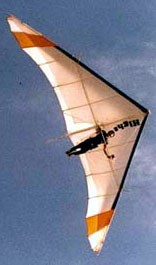
The Highster was built in Oakland Ca. by Mike Giles 1978. It was a 90% double surface glider with triple deflexers (wing truss wires). These wires where adjusted with out turnbuckles. They where adjusted by turning over the outer tangs which would tighten the winding of one cable and lossen the other. For increased strenth, the cross bar was inner sleeved with out pop rivets. Later versions had a floating cross bar. Highster used Manta hardware and was considered the flex wing side of Manta when Manta swithched over to making the Fledge. Highster was named after a fork lift because it was a “Heavy Lifter”.
The most common size was 190 square feet. During peak demand for the Highster, some where manufactured in Sacramento, Ca.
It was easy to set up, with all the Manta hardware, good static balance, but a bit stiff to fly. The floating cross bar helped the handling. Glide was poor for a 90% double surface glider due to the triple set of wires out in front of the leading edge. The glider could be easliy spun and this was an accepted thermalling practice when the pilot was tired.
Hirth Hi-27 Akrostar
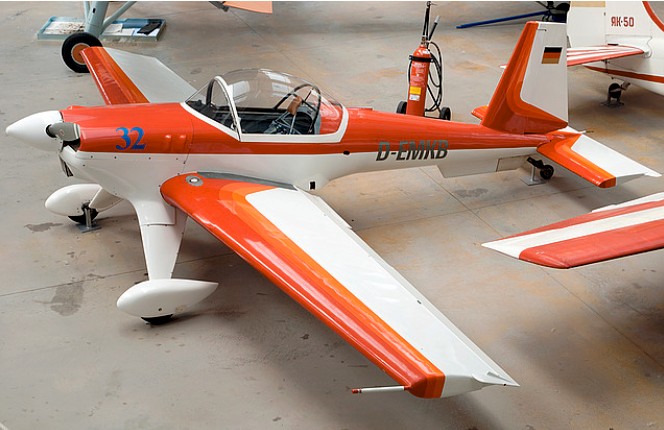
The prototype of the Akrostar aerobatic aircraft was first flown in 1970. It was later converted to a Mk.II.
 All Aero