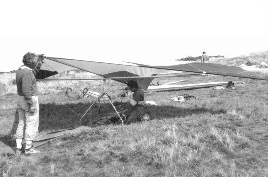
The new company of Hiway first produced a standard Rogallo, in 1973. The Hiway Standard has no kingpost.
The new company of Hiway first produced a standard Rogallo, in 1973. The Hiway Standard has no kingpost.
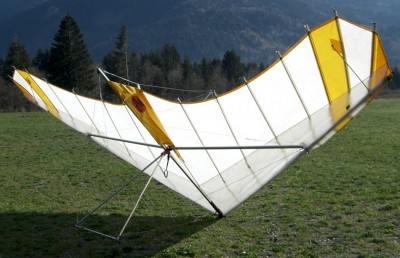
The 1979 Vulcan was designed to supercede the Super Scorpion. It is much like a Super Scorpion to look at but has a higher aspect ratio, much tighter sail and more double surface. Unlike other fourth generation machines, the Vulcan does not use preformed battens. Performance is not quite as good as the other machines of this generation, although min-sink is as good as its predecessor and the top speed much improved.
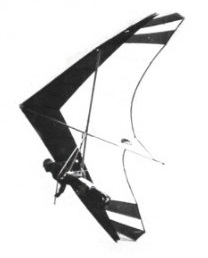
Handling is very pleasant although there is a delay between pulling the bar in and the glider speeding up, this is probably due to the huge control frame. The size of the control frame also makes ground handling tricky but with any wind the glider is easily launched with the harness straps tight.
The 1980 Vulcan has high performance and especially penetration. The 128° nose angle, a hyper-tensioned trailing edge, a 30% lower leading edge sleeve and a highly worked sail give it a very high speed range. Molded umbrella folding, an original system of transverse link – leading edge and intelligent hooking of the cables below the nose make it simple and very fast assembly.
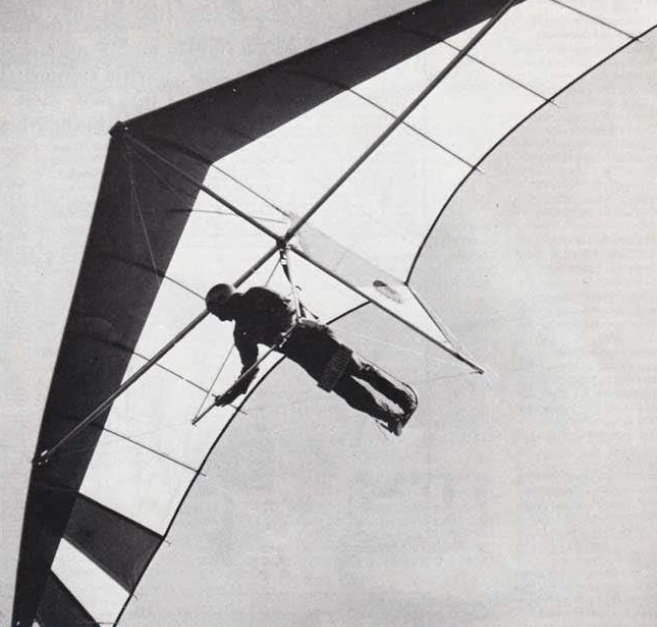
The Vulcan was the first hang glider that gained a C of A before release to the public. The high aspect rato and low twist wing gives good penetration for competition and coss-country. The cross boom is moved into the slower moving air closer to the sail reducing drag, as does the lack of deflexors. For de-rigging, a sliding centre box leaves the cross booms permanently attached to the leading edges. A removable king post prevent tangled wires.
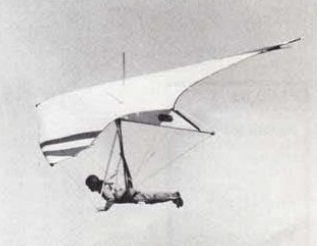
Very light on all axes, but what inertia! In fact this lightness was given artificially by trapezoidal uprights of 1,80m which facilitate efforts. Very good in thermal, but bad to shave the walls. The big model was so much surfaced that it supported the bi.
Unfortunately maneuverability has decreased considerably but the finishing is impeccable and the sail impeccable.
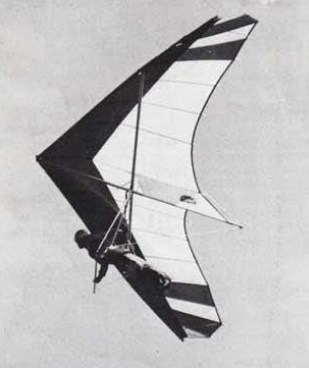
1979 Vulcan
Leading edge: 19 ft 8 in
Span: 34 ft 5 in
Nose angle: 180 deg
Aspect ratio: 8:1
Root chord: 9 ft 2 in
Sail area: 184 sq ft
Aspect ratio 6.45
Packed length: 20 ft
Knockdown length: 14 ft
Weight: 57 lb
Pilot weight range: 11.5-17 st
Strength rating: 1575 lb
Price: £640.00
1980 Vulcan
Wing area: 17.1 m²
Aspect ratio: 6.5
Hang glider weight: 26 kg
Minimum pilot weight: 70 kg
Maximum pilot weight: 100 kg
Packed length short: 3.9 m
Nose angle: 127°
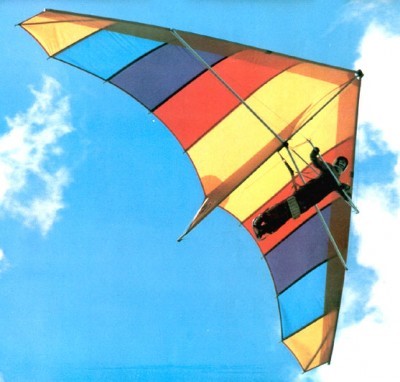
The 1978 Spectrum (released same day as Superscorpion) is a sporty machine, complying with FAI Class 1 Competition regulations. Although an intermediate with a conservative 105 deg nose angle, it generates a lot of lift. The Spectrum’s turning ability was second to none and 360’s were self balancing. Pitch is light and very high speeds are attainable. It also has a low stall speed facilitating top landings in light winds.
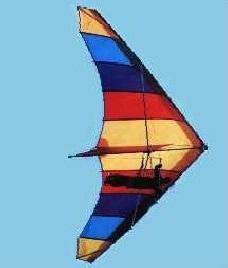
Hiway decided to return to simplicity for a new range of gliders, with no wing wires. Hiway designed the airframe to fly in a particular way under flight loads, and then sew the sail to fit the shape exactly. The first of the range were 1) Super Scorpion, a cross-country hang glider. 2) Spectrum, intermediate glider. 3) Gemini, purpose designed two-place glider. 4) Harrier, primary and training glider.
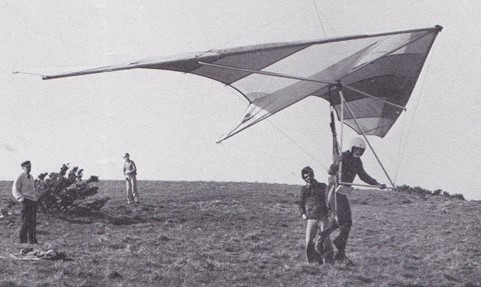
The Spectrum complies with FAI Competition regulations as an Intermediate glider. Turns are self balancing and very high speeds are attainable, and it has a low stall speed.
The Spectrum was available in two sizes and could be rigged for seated or prone. A “B” bar accessory converts from prone to seated.
The Hiway Spectrum was regarded as easy to handle although it had a reputation for tip-stalling.
The Gemini two place glider is an enlarged and strengthened version of the Spectrum.
Small
Wing span: 26 ft 10 in / 8.2 m
Wing area: 165 sq,ft / 15.3 sq.m
Aspect ratio: 4.45
Leading edge: 17 ft / 5.15 m
Keel length: 13 ft 3 in / 4 m
Nose angle: 105˚
Weight: 45 lb / 20 kg
Pilot weight: 50-76 kg
Packed length: 17 ft 3 in / 5.25 m
Knockdown length: 14 ft / 4.25 m
Large
Leading edge: 18 ft 6 in / 8.66 m
Keel length: 15 ft / 4.5 m
Wing span: 29 ft 5 in / 9 m
Wing area: 193 sq,ft / 17.9 sq.m
Aspect ratio: 4.45
Nose angle: 105˚
Weight: 51 lb / 23 kg
Pilot weight: 57-90 kg
Packed length: 18 ft 10 in / 5.75 m
Knockdown length: 14 ft 3 in / 4.35 m
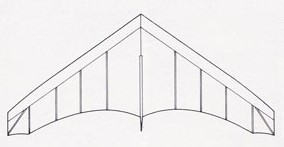
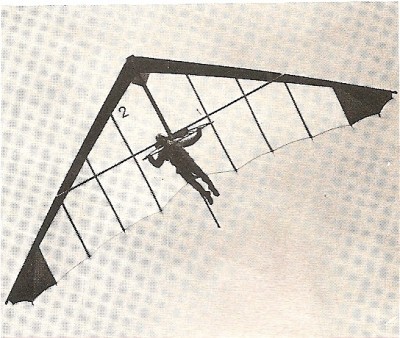
Hiway decided to return to simplicity for a new range of gliders, with no wing wires. Hiway designed the airframe to fles in a particular way under flight loads, and then sew the sail to fit the shape exactly. The first of the range were 1) Super Scorpion, a cross-country hang glider. 2) Spectrum, intermediate glider. 3) Gemini, purpose designed two-place glider. 4) Harrier, primary and training glider.
The 1979 Hiway Hang Gliders Harrier B was for novice pilots and Harrier C for intermediate pilots.
Harrier B
Wing area: 17.5 m²
Wing span: 9.04 m
Aspect ratio: 4.25
Hang glider weight: 18 kg
Minimum pilot weight: 50 kg
Maximum pilot weight: 70 kg
Packed length: 4 m
Number of battens: 12
Nose angle: 100°
Harrier C
Wing area: 20.4 m²
Wing span: 9.34 m
Aspect ratio: 4.25
Hang glider weight: 20 kg
Minimum pilot weight: 70 kg
Maximum pilot weight: 90 kg
Packed length: 4 m
Number of battens: 12
Nose angle: 100°
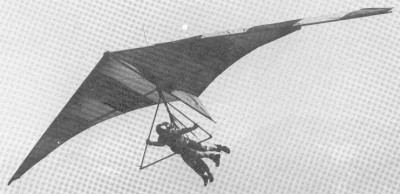
A 1978 hang glider from Hiway Hang Gliders.
Hiway decided to return to simplicity for a new range of gliders, with no wing wires. Hiway designed the airframe to fles in a particular way under flight loads, and then sew the sail to fit the shape exactly. The first of the range were 1) Super Scorpion, a cross-country hang glider. 2) Spectrum, intermediate glider. 3) Gemini, purpose designed two-place glider. 4) Harrier, primary and training glider.
The Gemini two place glider is an enlarged and strengthened version of the Spectrum.
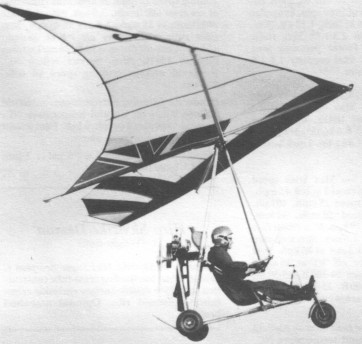
The Skytrike was the first British produced trike unit; allied to Hiway’s simple but effective Super Scorpion wing, (usually in the larger ‘C’ size). Designed by Frank Tarjanyi, the Skytrike/Super Scorpion C was introduced in 1979, the combination of a single surface wing and 10 hp did not exactly make for high performance and its pilot weight range was distinctly limited, but the basic formula was obviously right.
The power shortage was solved by the introduction of Robin engines, in which form the trike unit was dubbed Skytrike Mk II, with the Valmet engined version being known retrospectively as the Mk I. Two versions of the Mk II were offered, a single cylinder 250 cc version which usually retained the Super Scorpion wing, and a twin cylinder 330 cc version which typically is flown with the Hiway Demon wing.
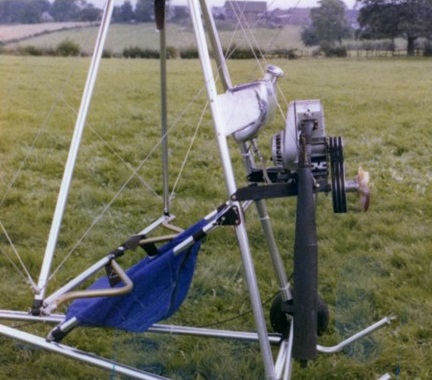
Hiway’s next move was an attempt to retain the performance of the 330 cc version but save some weight, by using the small but powerful liquid cooled Hiro Delta MkI engine to produce the Hiro Skytrike trike unit. The result was an aircraft with an impressive performance for its engine size, due partly to the elimination of drive belts in favour of integral reduction gearing. Moreover, the liquid cooling allowed the inclusion of an effective carburettor anti icing system. Other than the engine, the only significant change to the trike unit was the replacement of the front wire by a strut.
Despite these qualities, the Hiro Skytrike found few buyers in a market which was becoming enamoured with the smoothness and reliability of the 330 cc Robin. It was not helped by the Skytrike’s growing reputation for poor detail engineering. Having made the initial great leap to power, it seemed that the company’s heart had returned to soaring; the marketing and detail development of the Skytrike were neglected and the company’s resources concentrated instead on a radical new hang glider called the Explorer. When this was received less than rapturously by the hang gliding world, it spelt the end of the company. In 1983 Hiway Hang Gliders Ltd was in liquidation.
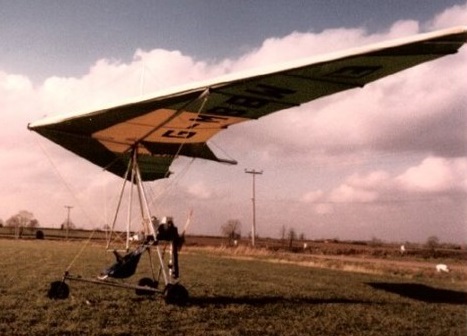
The Mk.II 330/Demon wing has floating cross tube construc¬tion with 75% double surface enclosing cross¬tube; pre formed ribs, and optional nosewheel brake.
Mk.I
Engine: Valmet, 10 hp at 5000 rpm.
Propeller diameter and pitch 54 x 30 ft, 1.37 x 0.76 m.
V belt re¬duction, ratio 2.8/1.
Max static thrust 75 lb, 34 kg.
Power per unit area 0.05 hp/sq.ft, 0.5 hp/sq.m.
Fuel capacity 2.1 US gal, 1.8 Imp gal, 7.9 litre.
Wing span 33.5 ft, 10.21 m.
Mean chord at 5.9 ft, 1.80 m.
Total wing area 198 sq.ft, 18.4 sq.m.
Wing aspect ratio 5.7/1.
Empty weight 1251b, 57kg.
Max take off weight 286 lb, 130kg.
Payload 161 lb, 73kg.
Max wing loading 1.44 lb/sq.ft, 7.1 kg/sq.m
Max power loading 28.6 lb/hp, 13.0 kg/hp.
Max level speed 26 mph, 42 kph.
Never exceed speed 40 mph, 64kph.
Max cruising speed 22mph, 35kph.
Economic cruising speed 22mph, 35kph.
Stalling speed 17 mph, 27 kph.
Max climb rate at sea level 100 ft/min, 0.5 m/s.
Min sink rate 190 ft/min at 21 mph, 1.0 m/s at 34 kph.
Best glide ratio with power off 8/1 at 22 mph, 35 kph.
Take off distance 150 ft, 45 m
Land¬ing distance 70 ft, 20 m
Range at average cruising speed 51 mile, 83 km.
Mk.II 250/Super Scorpion C
Engine: Robin EC25PS, 18 hp at 7000 rpm.
Propeller diameter and pitch 52 x 31 inch, 1.32 x 0.79 m.
V belt reduction, ratio 2.3/1. (Early aircraft used a 54×24 inch propeller with reduction ratio 2/1.)
Max static thrust 1301b, 59kg.
Power per unit area 0.09hp/sq.ft, 1.0hp/sq.m.
Fuel capacity 2.4 US gal, 2.0 Imp gal, 9.1 litre. (Early aircraft used a 1.6 US gal (1.3 Imp gal, 6.1 litre) fuel tank.)
Wing span 33.5 ft, 10.21 m.
Mean chord at 5.9 ft, 1.80 m.
Total wing area 198 sq.ft, 18.4 sq.m.
Wing aspect ratio 5.7/1.
Empty weight 1651b, 75kg.
Max take off weight 3491b, 158kg.
Payload 1841b, 83kg.
Max wing loading 1.76 lb/sq.ft, 8.6kg/sq.m.
Max pow¬er loading 19.41b/hp, 8.8kg/hp.
Max level speed 30 mph, 48 kph.
Never exceed speed 45 mph, 72kph.
Max cruising speed 25mph, 40kph.
Economic cruising speed 25 mph, 40 kph.
Stalling speed 18 mph, 29 kph.
Max climb rate at sea level 300 ft/min, 1.5 m/s.
Min sink rate 250 ft/min at 25 mph, 1.3 m/s at 40 kph.
Best glide ratio with power off 9/1 at 25 mph, 40kph.
Take off distance 90 100ft, 25 30 m.
Landing distance 90 100ft, 25 30m.
Range at average cruising speed 50 mile, 80 km.
Mk.II 330/Demon
Engine: Robin EC34PM, 32 hp at 6500 rpm.
Propeller diameter and pitch 52 x 30 inch, 1.32 x 0.76 m.
V belt reduction, ratio 2/1.
Max static thrust 180 lb, 82 kg.
Power per unit area 0.18 hp/sq.ft, 2.0 hp/sq.m.
Fuel capacity 2.4 US gal, 2.0 Imp gal, 9.1 litre. (Early aircraft used a 1.6 US gal (1.3 Imp gal, 6.1 litre) fuel tank.).
Length overall 11.0ft, 3.35m.
Wing span 32.0ft, 9.75m.
Chord at root 8.2ft, 2.50m.
Chord at tip 3.5 ft, 1.07 m.
Dihedral 0 degs
Nose angle 120 degs.
Total wing area 175 sq.ft, 16.3 sq.m.
Wing aspect ratio 5.9/1.
Empty weight 195 lb, 88kg.
Max take off weight 470 lb, 213 kg.
Payload 275 lb, 125 kg.
Max wing loading 2.69 lb/sq.ft, 13.1 kg/sq.m.
Max power loading 14.7 lb/hp, 6.7kg/hp.
Max level speed 40 mph, 64 kph.
Never exceed speed 45 mph, 72 kph.
Max cruising speed 35 mph, 56 kph.
Economic cruising speed 30mph, 48kph.
Stalling speed 22 mph, 35 kph.
Max climb rate at sea level 600 ft/min, 3.0 m/s.
Min sink rate 300 ft/min at 28 mph, 1.5 m/s at 45 kph.
Best glide ratio with power off 7/1 at 28 mph, 45 kph.
Take off distance 80 ft, 25 m.
Landing distance 100 ft, 30 m.
Range at average cruising speed 65 mile, 105 km.
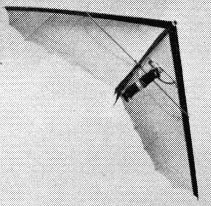
Hiway decided to return to simplicity for a new range of gliders, with no wing wires. Hiway designed the airframe to fles in a particular way under flight loads, and then sew the sail to fit the shape exactly. The first of the range were 1) Super Scorpion, a cross-country hang glider. 2) Spectrum, intermediate glider. 3) Gemini, purpose designed two-place glider. 4) Harrier, primary and training glider. The Scorpion was a 1977 hang glider from Hiway Hang Gliders.
The Scorpion is a high-aspect ratio Rogallo hybrid with tip extensions (also referred to as truncated tips), a deeply scalloped trailing edge, finite aft sail extension, and tapered leading-edge pockets. It is controlled solely by means of weight shifting.
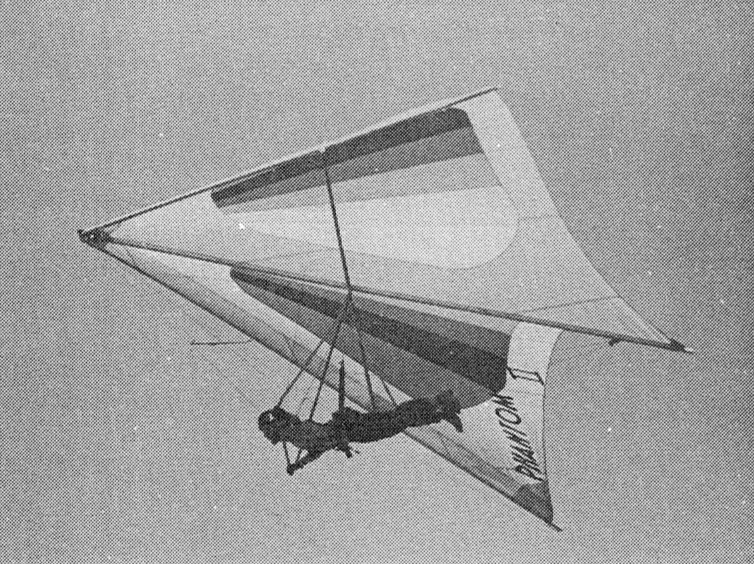
It is characterised by a unique aft sail extension which ought to mean improved longitudinal stability. It also has what the manufacturer calls a ‘keel sail equaliser’ that allows for the sail to adjust under the changing air pressure distribution in a turn. A typical trapeze bar / harness arrangement is used. Its wing loading is about the same as a standard Rogallo, thus, coupled with the greater efficiency of the high aspect ratio wing, it has a very low stall speed. This may limit its speed range. At the stall, one wing tip will tend to drop. Pitch and roll response are reported adequate just above stall.
Take down / set up times should be within 10 minutes, and the Scorpion may be folded and transported.
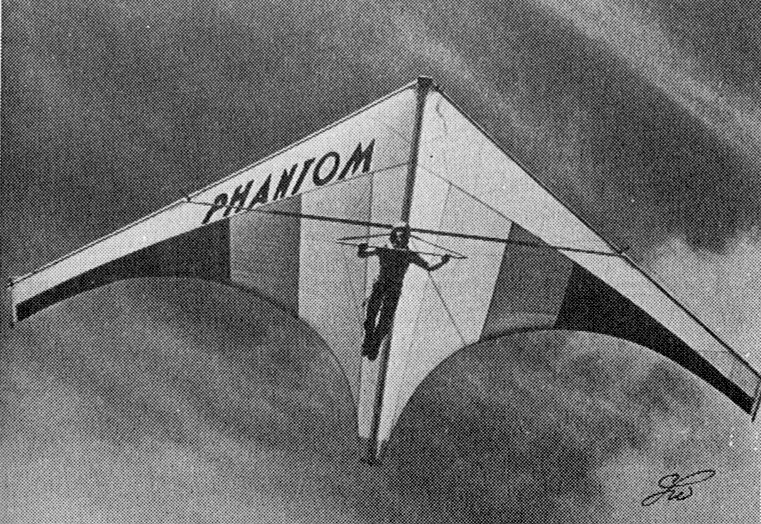
The 1977 Scorpion had a very low sink rate and could also be flown at very high angles of attack. This facilitates circling more easily in small thermals. Cross country thermaling flights on Scorpions were a common occurrence. The low stall speed made take-offs and landing a delight, and top landing could be made in lighter winds.
A and B Scorpions have 1 3/4 inch cross spars, C and D have 1 7/8 inch. The Scorpion has a totally folding A frame with a removeable bottom bar. The cross spar is split to facilitate storage and carriage. The usual Hiway quick release nose catch is retained and the wing posts simple push into bushed apertures in the leading edges. Knock down versions were available where the leading edges fold. Scorpions were available as either prone or seated and in four sizes, priced at £464.00 in 1977.
The Superscorpion (released the same day as the Spectrum), first appearing on the market in early 1978, is the first machine to have fully cambered sail and an absence of deflexers. The Mk 1 has a very simple airframe which is strong, reasonably light and easy to rig. The control frame uprights have a curve at the top and rigging is achieved by swinging out one upright which locates with a spring button. As the uprights are of 1 1/8 inch x 17 g they are quite easily damaged. The early Superscorpions are extremely easy to fly, being light in both pitch and roll, but with just the right amount of damping. One of the main virtues of the glider’s handling is the ease with which the glider will roll, even without any pitch co-ordination. This allows moderately flat turns and 360s to be achieved easily. It will fly very slowly indeed and still retain good roll control which makes it ideal for scratching on light wind days or in light thermal. The 1978 Super Scorpion glider had lightest handling ever made, but an abysmal sink rate at speed and tail heavy balance that can feel cumbersome at take off (but often useful for landing). In stronger winds however, anything over 25 mph, the machine becomes very frustrating to fly due to its lack of penetration.
The glider was supplied in sizes ‘B’ pilot weight up to 10 st and ‘C’ for heavier pilots.
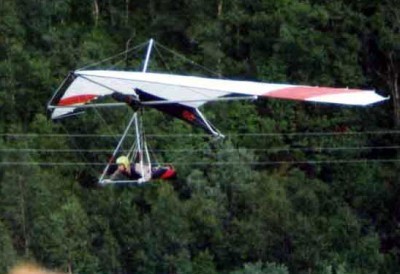
Paddy Monro was one of the many test pilots for Hiway and considered the Super Scorpion was an improvement on the Scorpion. The “C “was the best version. Best glider and best seller in its day.
The Super Scorpion C was top rated for manuverability and sink rate at its time. A very easy and safe wing, even withou lufflines. The downside was a lack of speed: over 40 km/h, it sank like a rock and a tendency to skid serious if turned with too little speed.
The Super Scorpion had a further 1980 development called the Super Scorpion II. The Mk II has a similar airframe set up to the Vulcan with a sliding centre-box system. And improved nose catch assembly makes for easier and more secure use. Visually the difference was the II had completely straight 13 g uprights. The earlier version I own has curves on each upright at the very top so that they end up parrallel to each other where connected. This glider is very sweet to fly having very pleasant handling qualities. The Mk.II is marginally faster than the Mk I, although the handling has suffered slightly due to the less flexible airframe, making roll just a little less responsive.Its only real drawback was a lack of penetration compared to some other gliders.
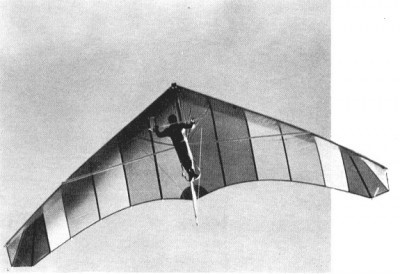
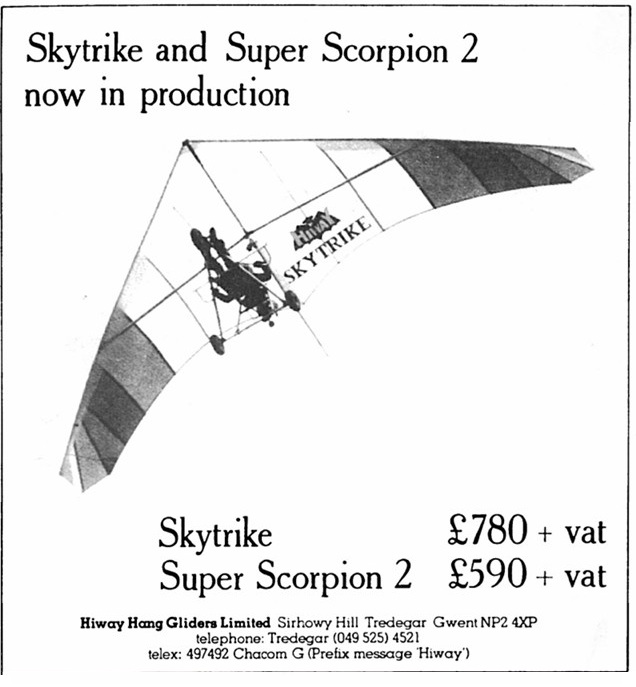
Phantom Scorpion
Wing span: 32 ft
Wing area: 200 sq.ft
Aspect ratio: 5
Keel length: 16 ft
Leading edge: 19 ft
Nose angle: 110 degrees
Billow: 2.75 degrees
Empty weight: 47 lb
Max flying weight: 242 lb
Useful load: 195 lb
Best L/D: 7-1
Min sink: 254 fpm
Stall: 14 mph
Cruise: 24 mph
Scorpion A
Wing area: 15 m²
Wing span: 9.6 m
Aspect ratio: 6
Hang glider weight: 20 kg
Minimum pilot weight: 40 kg
Maximum pilot weight: 55 kg
Packed length: 5.86 m
Packed length short: 3.3 m
Number of battens: 10
Nose angle: 112°
Scorpion B
Wing area: 17.5 m²
Wing span: 10.2 m
Aspect ratio: 5.6
Hang glider weight: 21 kg
Minimum pilot weight: 50 kg
Maximum pilot weight: 70 kg
Packed length: 6.16 m
Packed length short: 3.6 m
Number of battens: 10
Nose angle: 112°
Scorpion C
Wing area: 20.5 m²
Wing span: 10.6 m
Aspect ratio: 6.38
Hang glider weight: 25 kg
Minimum pilot weight: 70 kg
Maximum pilot weight: 90 kg
Packed length: 6.38 m
Packed length short: 3.77 m
Number of battens: 10
Nose angle: 112°
Scorpion C
Leading edge: 20 ft 11 in
Keel: 10 ft 9 in
Sail area: 220 sq ft
Aspect ratio: 5.3
Weight: 56 lb
Pilot weight range 11-14 st
Scorpion D
Wing area: 22.5 m²
Wing span: 10.8 m
Aspect ratio: 6.6
Hang glider weight: 27 kg
Minimum pilot weight: 90 kg
Maximum pilot weight: 110 kg
Packed length: 6.6 m
Packed length short: 3.95 m
Number of battens: 10
Nose angle: 112°
Super Scorpion A
Wing area: 13.6 m²
Wing span: 8.5 m
Aspect ratio: 5.5
Hang glider weight: 18 kg
Minimum pilot weight: 50 kg
Maximum pilot weight: 70 kg
Packed length: 5.1 m
Packed length short: 3.75 m
Nose angle: 120°
Super Scorpion B
Wing area: 16 m²
Wing span: 9.35 m
Aspect ratio: 5.6
Hang glider weight: 21 kg
Minimum pilot weight: 57 kg
Maximum pilot weight: 82 kg
Packed length: 5.6 m
Packed length short: 4.05 m
Nose angle: 120°
Super Scorpion B
Leading edge: 18 ft 0 in
Keel: 12 ft 1 in
Sail area: 173 sq ft
Nose angle: 120 deg
Aspect ratio: 5.6
Weight 46 lb
Span 30 ft 7 in
Pilot weight range: 9 to 13 st.
Super Scorpion C
Wing area: 18.4 m²
Wing span: 10.2 m
Aspect ratio: 5.7
Hang glider weight: 24 kg
Minimum pilot weight: 70 kg
Maximum pilot weight: 90 kg
Packed length: 6.1 m
Packed length short: 4.35 m
Number of battens: 7
Nose angle: 120°
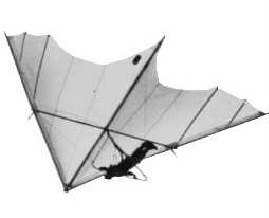
Made in 1975, the Hiway Cloudbase was a second generation glider which incorporated battens and deflexers. At this time battens became the norm. Early models had two radial battens whilst later ones, as pictured, have chordwise battens. The Cloudbase can be slowed down without the nose or wing dropping. On light marginal days this gives the pilot time to put the kite back on the top when the wind drops momentarily, instead of having to go down. On stronger days the higher aspect ratio ensures that the glider can use parts of the sky that other machines simply cannot reach. The Cloudbase was supplied in three sizes to cover pilot weights from 7 to 18 st.
Cloudbase model 20
medium 10-15 st
Leading edge 20 ft 2 in
Keel 18 ft 2 in
Sail area 220 sq ft
Aspect ratio 4
Weight 43 lbs
Price 1975 £378.00
Hiway, founded by John Ievers and Steve Hunt, first produced a standard Rogallo, in 1973.
Hiway Hang Gliders Ltd
Sirhowy Hill
Tredegar
Gwent NP2 4XP
UK
27/35 Bernard Rd
Brighton
UK
Hiway decided to return to simplicity for a new range of gliders, with no wing wires. Hiway designed the airframe to fles in a particular way under flight loads, and then sew the sail to fit the shape exactly.
The first of the range were 1) Super Scorpion, a cross-country hang glider. 2) Spectrum, intermediate glider. 3) Gemini, purpose designed two-place glider. 4) Harrier, primary and training glider.
Hiway hang gliders was re-floated as Hiway (83) Ltd. under the directorship of Jim Bowyer, Rod Macdonald and John Ievers (one of the original founders). Glider designs which have been carried over to the new company were as follows: Excalibur, a high performance CFX with flexible tips. Price £1141.95. Vision. double surface intermediate. £897.00. Explorer .Advanced rigid wing with aerodynamic controls. These were made to fulfill a German contract.Price £1581.25. Superscorpion 2. Post P1 .Price £747.50.(Manufactured 83 to 85).Stubby. Training glider.
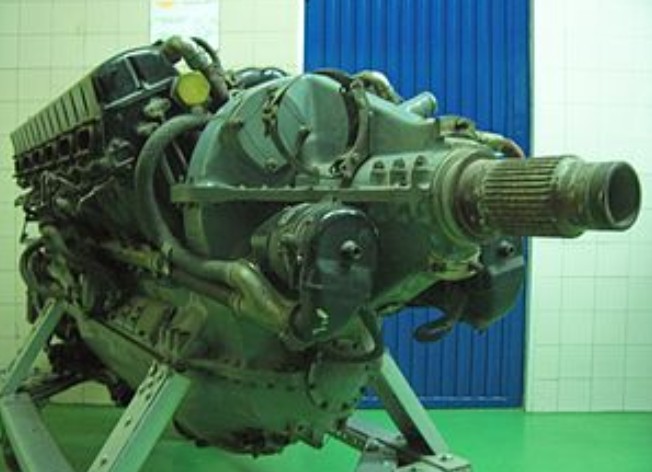
The 12Z was the final evolution of the series of Hispano-Suiza V-12 aircraft engines, which had just entered production when France fell to the Germans during World War II. A small number were produced during the war but the German occupation government would not allow full-scale production to start. After the war small numbers were built to equip new designs, but the rapid introduction of the jet engine ended further development.
The 12Z differed from the earlier 12Y primarily in the use of four valves per cylinder operated by dual overhead cams. This gave the cylinders considerably better volumetric efficiency and faster operation, raising the RPM from 2,400 to 2,700. The engine was also designed to run only on 100 octane fuel (instead of 87, which was common at that point) which allowed the compression ratio to rise from the 12Y’s 5.8:1 to the 12Z’s 6.75:1. These changes raised the power from 1,000 to 1,300 hp (750 to 970 kW) at sea level.
Unfortunately the engine continued to use a single-stage, single-speed supercharger and therefore lacked the all-altitude performance of German and British designs. But tuning the supercharger for a different critical altitude improved high-altitude performance considerably, delivering 1,500 hp (1,120 kW) at 21,000 ft (6,400 m) as opposed to 930 hp (690 kW) at 2,950 ft (900 m) for the 12Y.
Small prototype runs started in 1939, and were fitted to the French Armée de l’Air’s front-line fighter aircraft, the M.S.410 and D.520, creating the M.S.450 and D.524 respectively. Production of the main model, the 12Z-17, was just starting at the time of the armistice. Production was undertaken in Hispano-Suiza’s Spanish factories, but these engines had many problems and were never used in any numbers.
After the war a new version tuned to operate with 92 octane fuel, as opposed to the -17’s 100/130, was built in limited numbers as the 12Z-89. Compression ratio was raised slightly to 7:1, but with the lower grade fuel the power dropped slightly to 1,280 hp (950 kW) at 2,600 rpm (1,479 hp (1,100 kW) maximum take-off). These engines apparently had the same sorts of reliability issues as the earlier -17’s made in Spain, and the type never entered production.
Variants:
Hispano-Suiza 12Z-1
The initial version of the engine used for development
Hispano-Suiza 12Z-17
development peak at time of the Fall of France in May 1940
Hispano-Suiza 12Z-89
post-war development,not successful.
Applications:
Ikarus S-49C
Hispano Aviación HA-1112
Breguet 482
Specifications:
12Z-1
Type: V-12 60° liquid-cooled, geareed drive supercharged four stroke piston engine
Bore: 150mm (5.9in)
Stroke: 170mm (6.69in)
Displacement: 36.05 litres (2,199.9 cu.in)
Length: 2,384mm (93.8in)
Width: 744mm (29.3in)
Height: 1,074mm (42.3in)
Dry weight: 620kg (1,367lb)
Hollow propeller shaft to accommodate a cannon barrel
Valvetrain: Two intake and two sodium-cooled exhaust valves per cylinder actuated by dual overhead camshafts
Supercharger: Gear-driven single-stage two-speed centrifugal type supercharger with automatic boost control – ratios 6.36:1 and 9.38:1
Fuel system: Direct fuel injection @ 40kg/sq.cm (570psi) 2x Lavalette P511-AS2 6-plunger injection pumps with 1x Lavalette KFD injector per cylinder
Fuel type: 100/130-octane rating gasoline
Oil system: Dry sump, pressure feed @ 5kg/sq.cm (70psi), 20.5 centistokes (100S.U. secs) viscosity oil
Cooling system: Ethylene Glycol/water mix
Reduction gear: Spur reduction gear ratio 0.6:1
Air Equipment 1525 compressed gas starting system
Power output:
Take-off – 1,342kW (1,800hp) @ 1,150mm (45.3in)Hg boost @ 2,800rpm
Military, low – 1,193kW (1,600hp) @ 2,500m (8,200ft) @ 2,800rpm
Military, high – 984kW (1,320hp) @ 8,000m (26,200ft) @ 2,800rpm
Cruising, low – 1,193kW (900hp) @ 3,000m (9,800ft) @ 2,100rpm
Cruising, high – 1,193kW (900hp) @ 5,600m (18,400ft) @ 2,100rpm
Specific power: @ take-off power – 37.22kW/l (0.818hp/in³)
Compression ratio: 7.0:1
Specific fuel consumption: 0.29kg/kW/hr (0.48lb/hp/hr)
Oil consumption: 0.006 kg/kW/hr (0.018lb/hp/hr)
Power-to-weight ratio: @take-off power – 2.16kW/kg (1.32hp/lb)
B.M.E.P. (Brake mean effective pressure) 16.3 kg/sq.cm (232psi)
 All Aero