Horton Alita HX

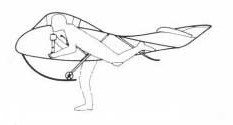
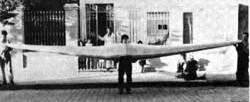
The first Alita designed by Reimar Horton was built by a group of enthusists in Argentina in 1953. It was destroyed in a storm.

The version B was then built, which never flew, and is in the aeronautical museum of moron Buenos Aires, Argentina.

HXa
Wing area: 11.2 m²
Wing span: 7.54 m
Hang glider weight: 39 kg
Minimum pilot weight: 75 kg
Maximum pilot weight: 75 kg
Maximum speed: 150 km/h
Max glide ratio: 30
Max glide ratio speed: 50 km/h
Maximum speed: 170 km/h
Max glide ratio: 18
Max glide ratio speed: 78 km/h
Landing speed: 42 km/h

HXb
Wing area: 17.5 m²
Wing span: 10 m
Hang glider weight: 39 kg
Minimum pilot weight: 75 kg
Maximum pilot weight: 75 kg
Maximum speed: 150 km/h
Max glide ratio: 20
Max glide ratio speed: 60 km/h
Landing speed: 36 km/h

HXc
Wing span: 15 m
Hang glider weight: 42 kg
Minimum pilot weight: 90 kg
Maximum pilot weight: 90 kg
Maximum speed: 150 km/h
Max glide ratio: 30
Max glide ratio speed: 50 km/h
Landing speed: 39 km/h

Horton Aircraft HW-X-26-52 Wingless

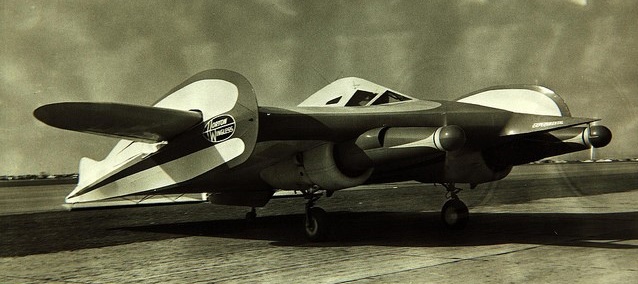
The Horton Wingless aircraft was invented by William Horton of Huntington Beach, California in 1952. He called the strange-looking plane “wingless” because he claimed the entire craft was a simple air foil with vertical fins and utilized all surfaces for lift. Unfortunately, Horton did not have the money to develop it, but was able to get into a partnership with billionaire Howard Hughes and Harlow Curtis.

The aircraft was a welded steel frame covered with a fabric skin and powered by two Pratt and Whitney R985 radial engines. Instead of a long high aspect ratio wing the fuselage was to create the lift and tip plates which he called ‘sealers’ were to tip losses that otherwise plague such airfoils. Essentially it was a highly-modified Cessna UC-78 with a more airfoil-shaped fuselage than wing.

Registered N39C, the aircraft logged around 160 hrs of flight time before Bill Horton had a falling out with Hughes. Horton was railroaded to prison.

Although this innovative prototype flew successfully, no backers were attracted. The venture failed not because the airplane didn’t fly, but because Hughes wanted to take full credit for the patents and production rights, which Horton refused to allow. Hughes sued Horton which effectively stopped any further development of the aircraft. Hughes managed to have the prototype and partially-constructed production version moved to the bone yard at the south end of the Orange Co airport and deliberately burned.

Horton Aircraft Corporation

Horton Aircraft was organized in 1952 for the purpose of engaging in the business of manufacturing and selling a so-called “Horton Wingless Airplane.” Its only asset was said to be a patent issued to William E. Horton, its president, with respect to the wingless plane and assigned by him to the company. Horton had agreed to assign the patent rights to the company for 500,000 shares of its stock, and to build and sell a model of the plane to the company for an additional 200,000 shares. The company’s entire personnel consisted of three directors, including Horton; and it had more than 800 stockholders. The first registration statement filed April 26, 1955, proposed the public offering of 400,000 shares by the company and 100,000 shares held by Horton, at $1 per share or the market price, whichever was higher. The second, filed October 18, 1956, proposed the public offering of 100,000 shares held by Horton at $25 per share.

The aircraft was designed and built by Bill Horton in a three way partnership with Howard Hughes and Harlow Curtice of General Motors. Horton had a falling out with Hughes.

The Securities and Exchange Commission announced the issuance of a “stop order” decision suspending the effectiveness of two registration statements filed by Horton Aircraft Corporation, of Las Vegas, Nevada, because of false and misleading representations contained in the registration statements, which proposed the public offering of 500,000 and 100,000 shares, respectively, of Horton Aircraft stock.

According to the Commission’s decision, Horton “had no patent rights or patent he could validly assign” to the company and it was at least doubtful whether he could legally sell a model of the wingless plane to the company because of a June, 1954 court decision upholding the validity of an earlier assignment to another company of Horton’s interest in his “invention” of the wingless plane. Furthermore, the Commission ruled that false and misleading statements were made in the registration statement with respect to the nature and performance of the wingless plane. The plane was represented as having no wings and it was stated that a model constructed by Horton in 1954 had been test-flown continuously and its performance had equalled Horton’s expectations.

The Commission found that the wingless plane in fact had wings which extended about 8 feet from the fuselage and had a depth of 5 to 6 feet, and that these wings, although retractable had never been retracted in flight. “The registration statements should have disclosed,” the Commission stated, “that the Horton plane, which was remodelled from a standard airplane, has in general performed in a manner inferior to that of a conventional plane Horton has used as a basis for comparison, that his plane admittedly was not built to fly any distance and the test flights were short, the longest flight being about 150 miles, that the maximum speed of the plane was about one-half that of another plane using the same motors, and that it had never been tested for range or load-carrying capacity. The second registration statement should have further disclosed that the prototype has not been test flown since it crashed in landing in June, 1955.

Moreover, the statement that the plane’s performance has equalled Horton’s expectations is misleading in view of statements made in brochures and form letters which Horton caused to be prepared and circulated by registrant in connection with previous sales of unregistered stock. Those statements, which were false and misleading, were to the effect that Horton’s development of the Horton Wingless Plane is comparable to the achievements of the Wright brothers, Leonardo da Vinci, Sikorsky, Billy Mitchell, and Charles Lindbergh; that his plane is one of the greatest aeronautical engineering achievements of all ages and the greatest advance in aviation since the advent of flying; that it can carry 100% greater payload over 100% greater range and is faster and easier to control than any other plane, and can carry twice the load at half the cost of any other plane; and that the Horton Wingless Jumbo Transport plane will carry 4,000 persons a distance of 25,000 miles non-stop) at 60,000 feet altitude, at speeds of over 400 miles per hour.”

The Commission also found false and misleading the disclosures in the registration statements with respect to past stock sales without prior registration, the selling costs of the proposed offerings, and the proposed use of the proceeds of the financing, as well as the implications that the $25 per share price of the second offering was based upon and related to some reasonable valuation of the stock.

Horton Aircraft and Horton were permanently enjoined by the United States District Court in Los Angeles in September, 1954 from making false and misleading statements in the sale of Horton Aircraft stock. Horton was convicted on March 8, 1957, of fraud in the sale of Horton Aircraft stock and sentenced to 3 years’ imprisonment followed by 5 years’ probation.

Honningstad Finnmark 5A

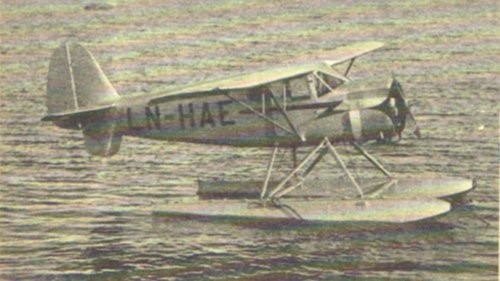
The Finnmark 5A amphibious flying boat, designed by Birger Honningstad and built by Norsk Flyindustri A.S., was produced specifically to suit the special climatic conditions prevailing in Norther and Artic regions, and the sole example of this type was flown on 17 September 1949.

The Finnmark carries two crew members and twelve passengers, and outrigger floats replaced the original hull sponsons which housed the retractable combined wheel and ski undercarriage.
Operated as a pure flying boat, the Finnmark was owned by A.S.Norronafly.

Engines: 2 x Pratt & Whitney R-1340 Wasp, 600 hp
Span: 62 ft 6 in
Length: 46 ft 4 in
Wing area: 522 sq.ft
Empty weight: 9966 lb
Loaded weight: 13,100 lb
Max speed: 195 mph
Cruise speed: 160 mph at 60% pwr
Max range: 840 miles

Holmes KH-1 / JSH Scorpion

J.S.H. Scorpion

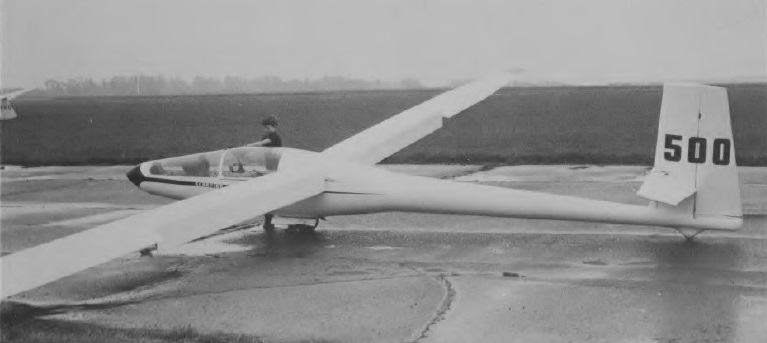
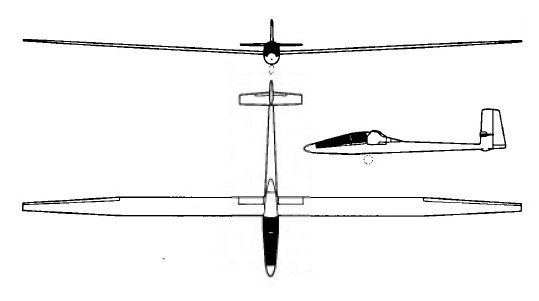
Designed and built entirely by Mr Kenneth Holmes, a meteorologist, this British high performance single seater is characterised by a very high aspect ratio (31.0) wing and a slim fuselage of minimum cross-sectional area; construction is largely of wood.

Design work on the KH-1 began in1968, construction commenced in the following year and the prototype flew for the first time on 24 November 1971. The cantilever shoulder wings are of largely wooden construction with single aluminium spars bonded by epoxy resin and also pop riveted to plywood webs. The spars and closely spaced ribs are covered by a pre-moulded plywood/balsa sandwich to the 50% chord line, by a 2mm thick plywood skin for a further 20% of the chord and with fabric for the remainder of the wing. Small-span trailing edge flaps also act as air brakes, but spoilers are not fitted. The fuselage is built of plywood frames and spruce longerons covered with a birch ply skin, and the landing gear consists of a retactable monowheel and a tail bumper. The tailplane is an all-moving surface with anti-balance tabs controlled by a spring trimmer in the cockpit, and the tall fin and rudder is unswept. A tail braking parachute is fitted for control during the approach and in short field landings.

A second example of the KH-1 named the JSH Scorpion was built by Mr John Halford and first flew in July 1977.

KH-1
Span: 60 ft 8.5 in / 18.5 m
Length: 23 ft 9 in / 7.24 m
Height: 5 ft 0 in / 1.52 m
Wing area: 120 sq.ft / 11.15 sq.m
Wing section: Wortmann FX-61 -184/60-126
Aspect ratio: 31.0
Empty weight: 490 lb / 222 kg
Max weight: 710 lb / 322 kg
Max wing loading: 28.9 kg/sq.m / 5.92 lb/sq ft
Water ballast: None
Max speed: 97 mph / 84.5 kt / 157 km/h
Max rough air speed: 75 kt / 139 km/h
Stalling speed: 36 kt / 67 km/h
Best glide ratio: 37:1 at 55.5 mph / 48 kt / 89 km/h