Lesher Teal

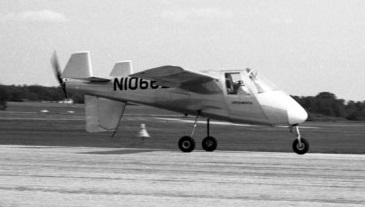
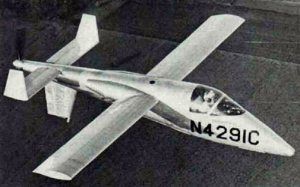
The Lesher Teal, registered N4291C, was explicitly designed to break records in the Fédération Aéronautique Internationale Class C1a, for propeller-driven aircraft of less than 500-kg (1102-lb.) gross weight.

The Teal retained the Nomad’s Continental O-200A power and all-aluminum pusher configuration, this time in a single-seat layout. Its wingspan is a diminutive 23 ft. 10 in. (by contrast, a Piper J3’s span is 35 ft. 3 in.).

At one point of the Teal’s design, Ed, who weighed well over 200 lb., considered using a jockey pilot. Instead, not wanting to miss the fun, he decided this was a good incentive to lose some weight.

The Teal first flew in April 1965.

In August 1965, Lesher piloted it to the EAA Fly-In in Rockford, Illinois, where he was honored for his achievements. Then he began attacking the FAI records.

In 1967, Lesher and his Teal set a Class C1a speed record for a 500-km closed course at 181.55 mph. Later that year, he flew the Teal at 169.20 mph for a new 1000-km closed-course record. Before the year ended, Lesher and the Teal averaged 141.84 mph for a new closed-course record of 2000 km.

In 1968, a loss of power brought the Teal to an emergency landing, and considerable damage, in a Michigan field. After a rebuild, Lesher and his Teal set another FAI record in 1970, this one for a closed-circuit distance of 1554.29 miles. In 1973, he and the Teal set a 3-km speed record of 173.101 mph as well as a 15-25-km record of 169.134 mph. Finally, the pair set an FAI C1a record for straight-line distance, officially 1835.459 miles, by traveling from Florida to Arizona.

For these record-breaking achievements, Lesher earned the FAI’s Louis Blériot Medal four times, in 1967, 1970, 1973 and 1975. He was inducted into the Michigan Aviation Hall of Fame in 1988.

The Lesher Teal has resided in the EAA Adventure Museum since 2002.
Lesher SN-1 Nomad

The 1946 Stinson 106 Skycoach, one of Stinson’s products during Lesher’s time with this Wayne, Michigan, company. The Skycoach’s pusher propulsion, though, intrigued Lesher and he incorporated this feature into his home-built aircraft.

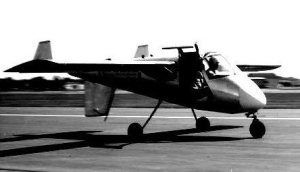
The Nomad was an all-aluminum side-by-side two-place pusher. Powered by a 100-hp Continental O-200A air-cooled flat-four placed immediately behind the cockpit, fed with air intakes at the wing roots, the Nomad made innovative use of a Dodge Flexidyne Coupling to dampen torsional vibration.

The wing was built as a single assembly with a very simple profile and no dihedral. The vee-tailed empennage and vertical fin in low position was meant to impair the Hartzell propeller’s efficiency as little as possible, while the vertical fin placed below helped to keep the propeller clear from the ground.

Construction began in 1959 and the Nomad, registered N1066Z, flew in October 1961 after 5000 hours of construction. Lesher and the plane took Grand Prize at the 1964 AC Spark Plug Rally.

The Nomad was followed by the better-known Lesher Teal, which also remained a prototype.

Lesher SN-1 Nomad N1066Z

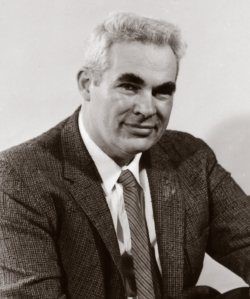
Lesher, Edgar J.

Edgar J. Lesher, 1914 – 1998, earned an undergraduate degree in mathematics during the Great Depression, then did graduate studies in this subject and physics. Prior to World War II, he taught ground school for the Civilian Pilot Training Program and earned his own pilot’s license.

In 1942 Ed joined the University of Michigan’s Department of Aeronautical Engineering, where he taught until retirement in 1985. Ed Lesher was a professor of aeronautical engineering, who used breaks in his academic career to perform design work at Douglas, Stinson and Convair Aircraft.

Attendance at a fledgling Experimental Aircraft Association Fly-In in 1958 inspired Lesher to design and fabricate two aircraft of his own. One of them, the Lesher Teal, set several international records for speed and distance.
Ed also found time to do set design and act at the Ann Arbor Civic Theater and to sing in the Ann Arbor Civic Chorus.

Ed and his wife Margaret had ten children, including four sets of twins. Lesher died in 1998.

Lemberger LD20b

The Karl Lemberger designed Lemberger LD20b cantilever biplane was one of this kind, designed with readily detachable wings and tailplane so that it could be towed by a car. Whilst towing, the wings were stowed alongside the fuselage. The tailskid was linked to the car via a luggage rack-like frame.

The upper and lower wings of the LD20b were very similar, with the same span, area and straight, near-constant chord, plan. The lower wings were attached to the lower fuselage longerons and the upper ones to cabane struts above the front of the cabin. They were arranged with considerable stagger. The wings were built around two closely spaced spars, with plywood skin from the rear spar forward forming a torsion box and fabric covering behind. Differential ailerons were mounted only on the lower wings.

The wooden, rectangular fuselage was plywood-covered to just behind the pilot’s seat and fabric-covered further aft apart from a curved plywood decking behind the cabin. The fin was integral with the fuselage and unusually shallow with the variable incidence tailplane mounted on top of it, a little above the fuselage and bearing damped elevators. The balanced rudder was much taller than the fin. The enclosed cabin seated two in tandem with the front seat under the upper wing and over the centre of gravity. Dual control was fitted. In front, a Walter Mikron inverted 4-cylinder engine drove a two-bladed propeller.

The LD20b was completed in 1971. Its first flights were made from EDSZ Rottweil-Zepfenhahn,(Germany), piloted by a Me 109 pilot. The next flight from Friedrichshafen, Germany, piloted by Arnold Wagner, an airline pilot, the Swiss aerobatic champion and designer of the Hirth Acrostar.

After its presentation at Friedrichshafen, Leonhard Kurt Kienlein took over ownership and the task of making the structural changes in order to make sure the plane did reach stable flight characteristics. He also maintained the aircraft. An enclosed, all-weather trailer was built to house the LD20. The last flight after a total of 368 hours was in 1998.

Engine: 1 × Walter Mikron 4-cylinder inverted air cooled, 46 kW (62 hp)
Propeller: 2-bladed
Length: 6.67 m (21 ft 11 in)
Wingspan: 7.28 m (23 ft 11 in)
Height: 2.20 m (7 ft 3 in)
Wing area: 14.00 m2 (150.7 sq ft) gross
Empty weight: 300 kg (661 lb)
Max takeoff weight: 538 kg (1,186 lb)
Maximum speed Est: 178 km/h (111 mph; 96 kn) at maximum take-off weight.
Cruising speed: 160 km/h (99 mph; 86 kn)
Time to altitude: 1,000 m (3275 ft) in 7 mins
Capacity: 2

Lefervre & Peauger Mobiplane

In the summer of 1977 in France, Camille Lefervre and Philippe Peauger powered a Rogallo flex wing hang glider and called it the Mobiplane. Without a trike unit, this single seat device needed foot launching and landing and had one Solo 130 cc 5.5 hp engine as a tractor at the front above the wing and a second similar engine used as a pusher below the wing, at the trailing edge. It was described in Pilote Prive in September 1977, but never went on sale.

Engines: 2 x Solo 130 cc, 5.5 hp.