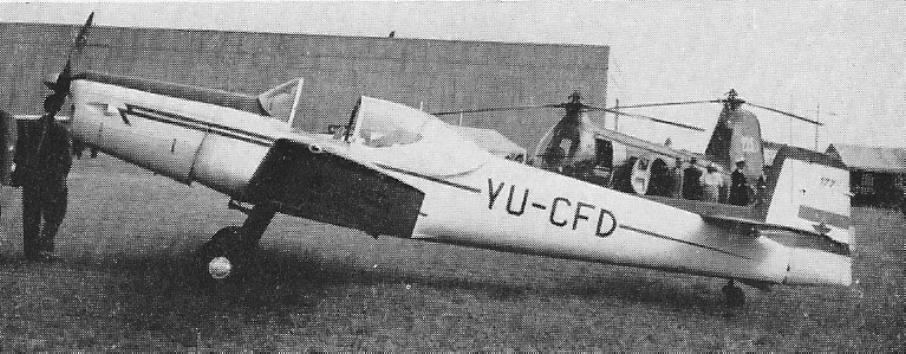
First flying in 1954 the Omnipol L-40 Meta-Sokol originated from Czechoslovakia. The initial version was a three-seater with either a 105 hp Walter Minor 4-III or 115/140 hp M 332 engine.
The four-seater is powered by a 110hp Let M-332 four-cylinder inline engine. Its retractable undercarriage is a reverse tricycle, though the technique is just the same as a normal taildragger.
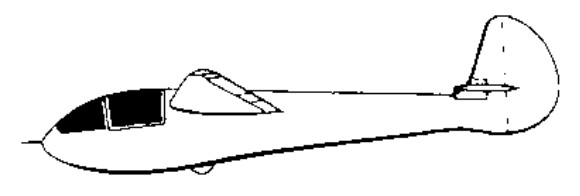
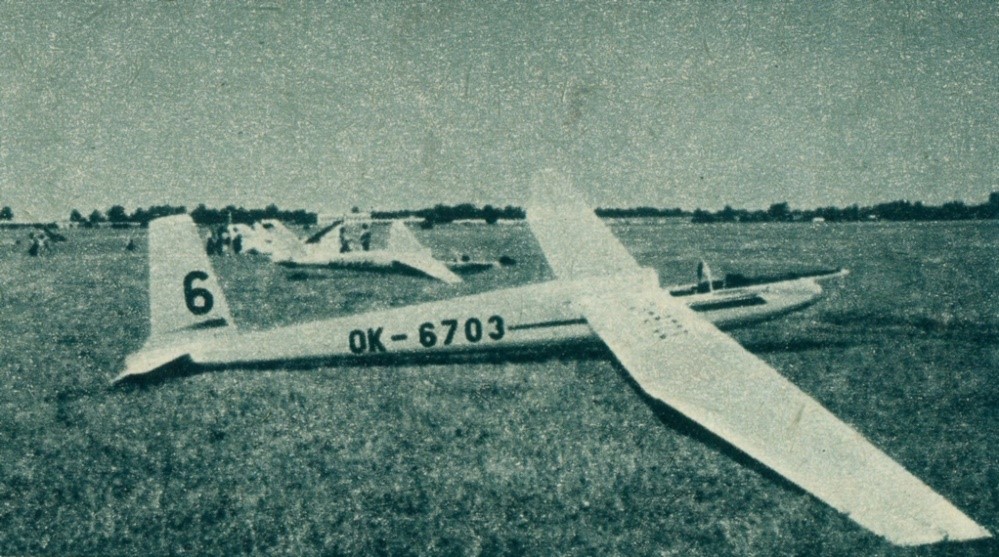
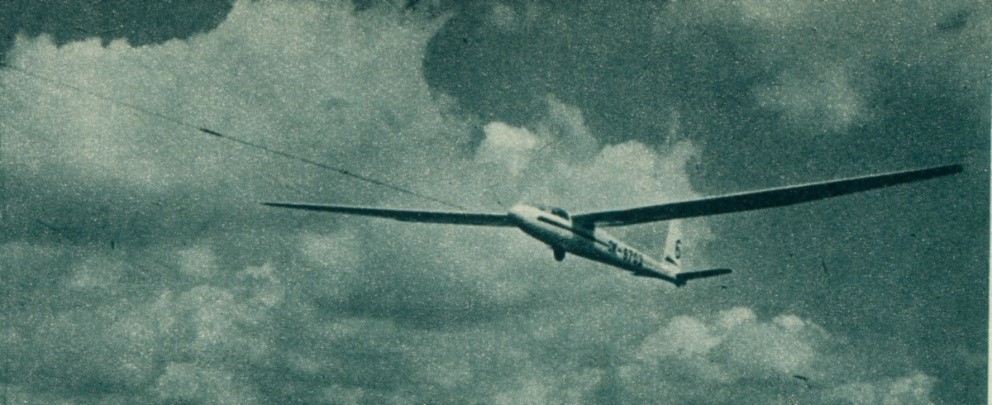
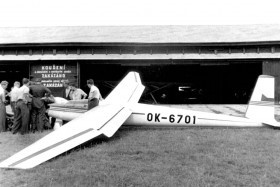
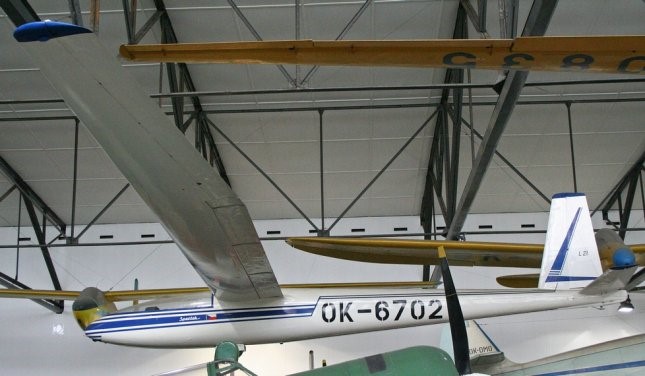
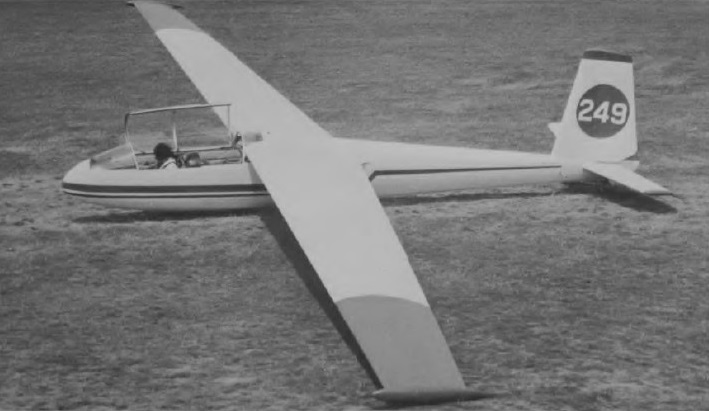
The Spartak free-class glider was designed in 1957 by Karel Dlouhý, the creator of “Blaník”. It was a more modern glider than its contemporary “Diamond”. The Spartak first flew in 1957.
Vladislav Zejda in 1961 achieved a national record in free flight at a distance of 644 km (From Žamberk to Brad in Romania). This performance was surpassed only in 2003 by Marek Pechance and Tomáš Suchánek with the Nimbus 4.
Most of the pilots at Spartak complained about the tight cabin and poor view through the wavy and distorting plexiglass of its cover.
The only surviving Spartacus can be seen in the aviation museum in Kbely.
Wingspan: 59.055 ft / 18.0 m Wing area: 172.224 sq.ft / 15.95 sq.m Aspect ratio: 20.3 Wing Profile: NACA 653-618 (root), 631-612 (end) Length: 26.575 ft / 8.1 m Weight empty: 295 kg Max take-off weight: 480 kg Wing load: 30,02 kg/sq.m Glide ratio: 38.0 at 81km / h Min sink: 0.59 m/s at 76 km / h Crew: 1
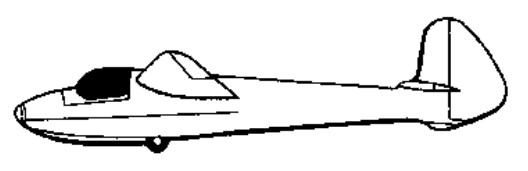
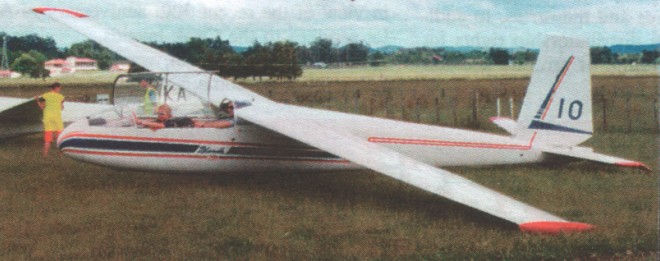
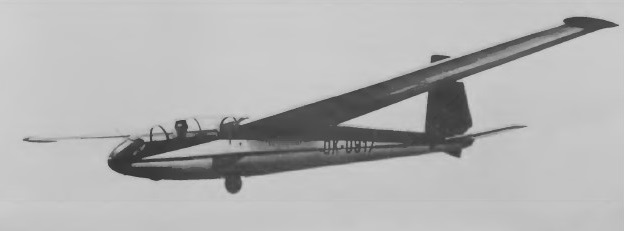
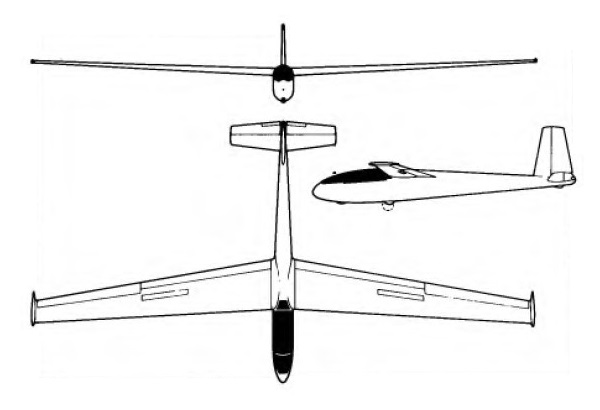
Designed by Karel Dlouhy as a two-place training and club aircraft. The cantilever shoulder wings are characterised by a moderate aspect ratio (13.7) and 5° forward sweep at the quarter-chord line; wing tip ‘salmon’ fairings are fitted. The wings are all-metal two-spar structures, the main spar forming a torsion box with the leading edge, and each wing is secured by three fuselage attachments. The metal ailerons and slotted area increasing flaps are fabric-covered, and there are light alloy DFS-type air brakes above and below the wings. The all-metal fuselage is a semi-monocoque of oval cross-section built in two halves riveted together in the vertical plane, with riveted skin, and the cantilever all-metal tail unit has fabric-covered elevators and rudder, with a controllable trim tab in each elevator. The horizontal tail surfaces fold upwards parallel to the rudder for transport. The landing gear consists of a partially retractable monowheel, with an oleo-pneumatic shock absorber and mechanical brake. The two pilots sit in tandem in a partlyupholstered cockpit with heat-insulated walls, under a sideways-opening canopy hinged to starboard which is jettisonable in flight. Optional ‘extras’ include, amongst other things, electric gyros, navigation lights, radio, a battery and rear compartment blinds for instrument flying instruction, while more unusual ‘extras’ are a water ballast system to increase the wing loading for solo flight and skis for operation on snow.
Design work on the Blanik started in January 1955 and construction of two prototypes began in August of that year; the first flight was made in March 1956 and 2,094 Blaniks had been built by the end of 1975.
The LET L-13 Blanik has been exported to more than 40 countries, more than 2,000 of about 2,500 sold by the summer of 1977 having been exported abroad, including more than 1,000 to the Soviet Union, about 200 to the USA, about 150 to the United Kingdom and more than 100 each to Australia and Canada. At least 2650 were produced by Let, and under licence (including by Aero circa 1956) in all metal, except fabric covered control surfaces.
Production continued at the LET Narodni Podnik (Let National Corporation) and is now getting close to the 3,000 mark; like all Czechoslovak aircraft, export sales of the L-13 Blanik are handled by the Omnipol Foreign Trade Corporation.
The Blanik has set up no fewer than 13 international records recognised by the FAI, as well as many other national gliding records, and in 1969 a particularly notable flight across the Andes in a Blanik by the Chilean pilot Alejo Williamson, taking 5hr 51 min, won him an FAI Gold Medal. The Blanik is intended for training in all categories from elementary to blind flying and is also suitable for high performance flight. It is fully aerobatic when flown solo, and can do basic aerobatic manoeuvres when carrying two pilots.
The L-13 (TJ) is an experimental motor glider fitted with a jet engine TJ100 with take-off thrust 1,0 kN from PBS (První brněnská strojírna Velká Bíteš). It was used as a single-seat motor glider.
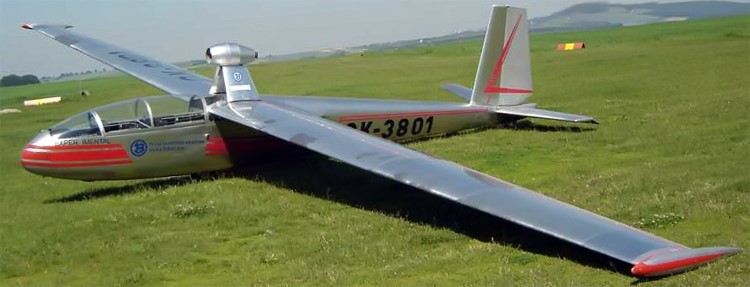
Let Blanik L-13 TJ
At least 2 L-13 has been converted to TJ version, the first one OK-1840 (cn 172016) fitted with a TJ100C and the second OK-3801 (cn 172602) with a TJ100A. Both were used by PBS for TJ100 experimetal tests.
The L-13J was a powered version of the L-13 Blanik tandem two-seater trainer, fitted with a newly-developed 42hp Avia Jawa (Motorlet) M-150 two-cycle three-cylinder inverted air-cooled engine, driving a V-210 two-bladed wooden tractor propeller. This auxiliary engine, which was housed in a non-retractable glassfibre cowling aft of the cockpit, could be stopped and restarted in flight to prolong periods of soaring flight. The L-13J prototype, OK-9821, first flew on 26 March 1968 but only a small number were built and this variant did not go into large-scale production.
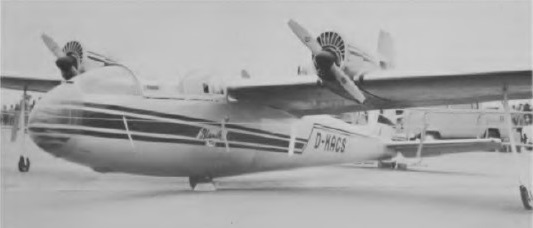
LET L-13-2M Blanik
The first powered version of the Blanik had been the XL-13M, a 1964 conversion with a 26hp Walter engine on a non-retractable mounting aft of the cockpit, and this was later followed by a number of other powered conversions of the Czech glider. The XL-13T was similar to the L-13J, with a 35hp Motorlet M-151 also on a non-retractable dorsal mounting; the prototype, registered OK-62, first flew in 1970. The following year a twin-engined conversion was produced by the German firm of Sigmund Flugtechnik. Designated L-13-2M, this version of the Blanik, registered D-KACS, was fitted with two 44hp Lloyd LS-400 two-cylinder two-stroke mounted in overwing nacelles in a conventional leading edge installation and driving two-blade fixed-pitch propellers; there is a small outrigger wheel under each wing to ensure ground clearance for the airscrews.
A second foreign conversion was produced in 1975 by the Russian LAK factory (Litovskaya Aviatsionnaya Konstruktsiya). LAK fitted a 68hp Limbach SL 1700E1 ‘flat four’ engine into the nose of a standard L-13 Blanik, the resulting aircraft being designated LAK-6 and serving as a flying test bed for a new motor glider of plastics construction, of which a prototype was being built in 1977. LAK became the sole repair and overhaul centre in the USSR for the Blanik, more than 300 of which had been overhauled by mid-1977.
Another version with the engine in the nose was the L-13SW with a 65hp Walter Mikron IIIA in-line powerplant; the prototype of this, registered OK-068, first flew on 10 May 1978.
L-13 SW Vivat
In 1976 a conversion of the L-13 with a 50hp Wankel twin lobe rotary engine appeared; this motor, built by RFB (Rheinflugzeugbau), was carried dorsally on a non-retractable mounting. In 2020 the last two were owned by Marc Scheffler. A similar mounting is being used by Mr Pentti Alanne of Finland in his conversion of an L-13 to have a Volkswagen engine; this was expected to make its first flight in 1981.
In Germany Blanik D-KOEB has been modified to flight test an RFB SG 85 fan pod engine, which is mounted dorsally and gives 209.5 lb st at full throttle at sea level. This powerplant, made by Rhein-Flugzeughau GmbH, is a fixed-geometry pod marketed as a complete unit for fitting to powered gliders or ultra light aircraft. It consists of dual rotating combustion Wankel-type engines mounted in tandem, and driving a three-blade fan in a circular fan duct.
L-13J – motor glider XL-13M – motor glider (Walter A) XL-13T – motor glider (Trabant engine)
LET Blanik L-13 Wing span: 16.2m / 53 ft 1.75 in. Wing area: 19.1 sq.m /206 sq.ft Length: 27 ft 6.5 in. Aspect ratio: 13.7 Max TO wt: 500kg / 1100 lb Empty wt: 292kg / 644 lb. Useful load: 208kg / 458 lb Water ballast: 170 lb Wing loading: 26.17kg/sq.m / 5.35 lb/sq.ft. Max speed: 136 kt Rough air speed: 76 kt. Stall: 34 kt. Lift to drag: 28 @ 90 kph / 49 kt / 56 mph. Min Sink: 0.76 m/s / 2.5 fps / 1.48 kt @ 44 kt. Seats: 2.
LET L-13 Blanik Span: 53 ft 2 in Wing area: 206.1 sqft Airfoil: NACA 63(2) A-615 root, -612, tip. Aspect ratio: 13.7 Length: 27 ft 6.5 in Height: 6 ft 10 in Empty weight: 677 lb Max weight: 1,102 lb Max speed: 157 mph (in smooth air) Max aero-tow speed: 87 mph IAS Min sinking speed: 2.79ft/sec at 47 mph IAS Best glide ratio: 28:1 at 55 mph IAS
Aero L 13 Blanik Length: 27.559 ft / 8.4 m Height: 6.89 ft / 2.1 m Wingspan : 53.15 ft / 16.2 m Aspect ratio: 13.7 Wing area: 206.131 sqft / 19.150 sq.m Max take off weight: 1102.5 lb / 500.0 kg Weight empty: 643.9 lb / 292.0 kg Max. weight carried: 458.6 lb / 208.0 kg Max. speed: 130 kts / 240 km/h Landing speed: 31 kts / 58 km/h Cruising speed: 49 kts / 90 km/h Wing load: 5.33 lbs/sq.ft / 26.0 kg/sq.m Glide ratio: 28.0 Crew: 2
L-13J Span: 53 ft 2 in Length: 27 ft 6.5 in Height: 6 ft 10 in Wing area: 206.1 sq ft Aspect ratio: 13.7 Empty weight: 794 lb Max weight: 1,228 lb (two pilots) Max speed: 92 mph Cruising speed: 80 mph Best glide ratio: 21:1 Normal range: 112 miles
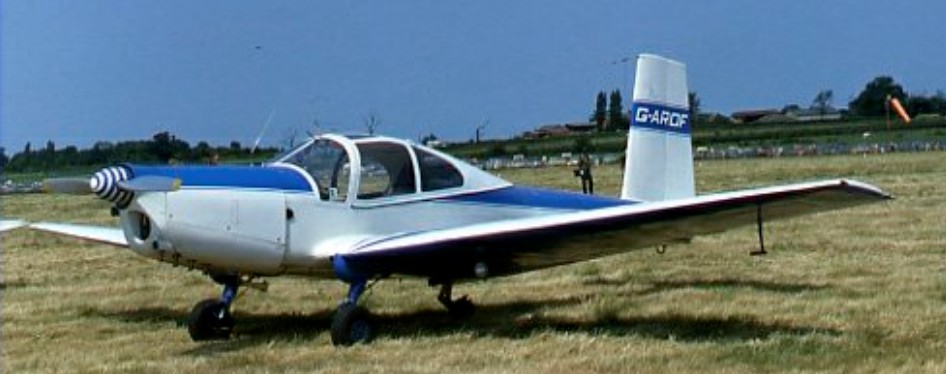
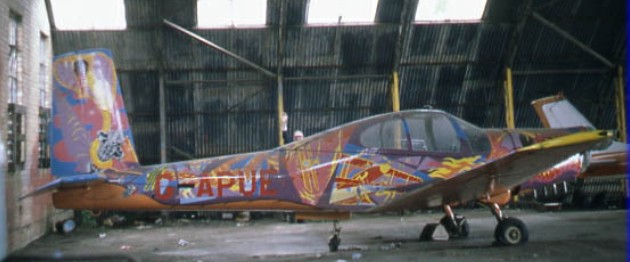
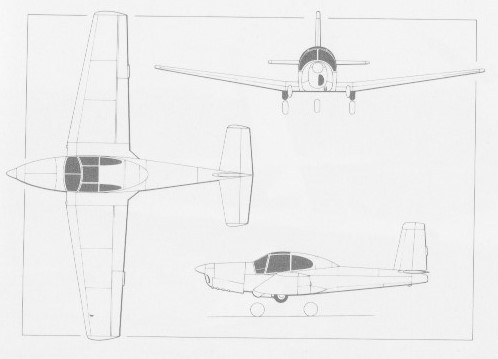
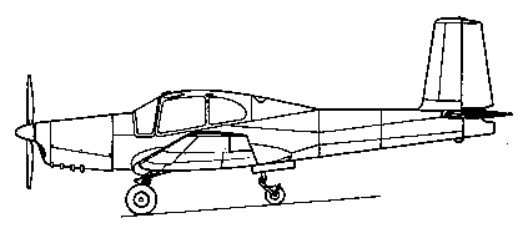
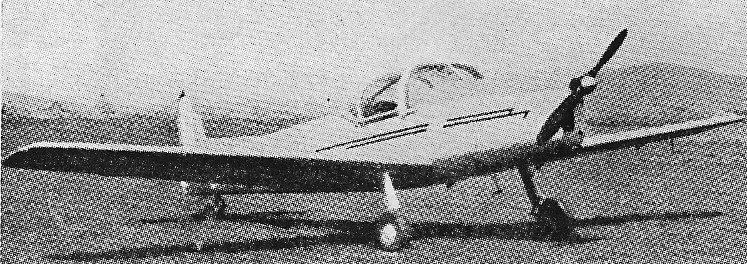
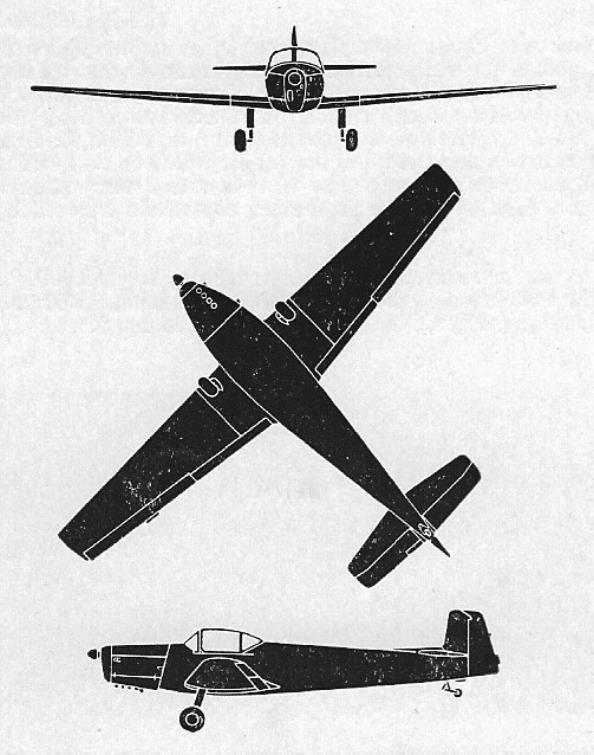
Designed by an amateur design group. The Konstrukeijski Letalskt Zveze Slovenije, comprising students of the Ljubljana Technical High School, the KB-6 Matajur flew for the first time on 4 June 1952.
The first prototype Matajur was powered by a 136 hp Regnier 4 L00 engine, but the second prototype and production aircraft have been powered by the 160 hp Walter Minor engine.
It was produced in quantity by the Letov factory at Ljubljana.
Engine: Regnier 4L00, 136 hp Wing span: 34 ft 9 in Length: 27 ft 5 in Height: 7 ft 1 in Empty weight: 1453 lb Loaded weight: 2159 lb Max speed: 138 mph at SL Cruise: 124 mph ROC: 689 fpm Service ceiling: 14,800 ft Seats: 2
Engine: 160 hp Walter Minor 6-III Wing span: 34 ft 9 in Wing area: 150.7 sq.ft Length: 27 ft 5 in Height: 7 ft 1 in Empty weight: 1453 lb Loaded weight: 2185 lb Max speed: 138 mph at SL Cruise: 114 mph ROC: 699 fpm Range: 441 mi Seats: 2
Yugoslavia Lubljana aircraft design office founded in 1947 on an amateur basis by students of the Higher Technical School. Designed KB-6 Matajur, two-seat trainer and tourer, in production in the 1950s. Letalski Konstrukcijski Biro and Institut LZS “Branko Ivanus”, which combined in about 1968 to form Letalski Institut ‘Branko Ivanus’ Slovenija / Libis.
Kurt Lessing migrated from Dresden to Australia after WWII. He was a very skilled machinist and proceeded to build this somewhat strange machine more or less in secret in his workshop at Woodend Vic.
In addition Kurt built a launch ramp 20 metres high with winches and an 800 metre catapult. He died before completion of the project.
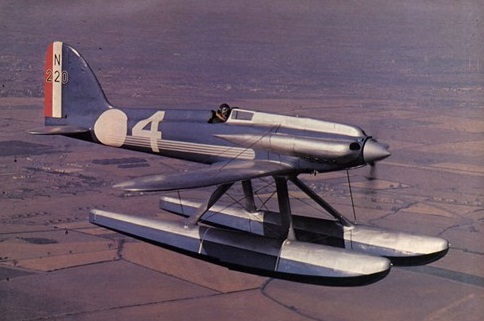
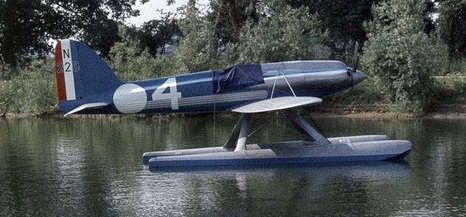
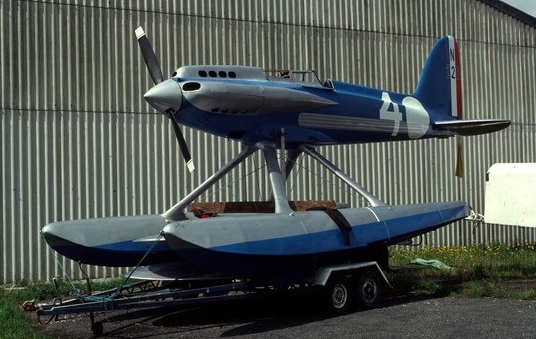
Ray Hilborne of Leisure Sports designed and built a full-scale S.5 replica, G-BDFF. Construction by Aviation Design Bureau under J.Hall took place at Thruxton Airport, Hampshire, over a 2.5 year period, and registered G-BDFF cn ADB-1 on June 13, 1975 the aircraft began preliminary water taxiing tests at Thorpe Water Park, Surrey, the same day.
The seaplane was not a true replica, although externally resembling the original S-5 it was basically an entirely different aircraft, while 50 % lighter than the original. The all-wood construction, loadings, systems and performance were different; other differences included a different wing section, smaller floats, water rudders, and a slightly wider cockpit and fuselage. Powerplant was a 210 hp Rolls-Royce Continental engine, driving a two-blade variable-pitch propeller. The replica had an overall weight reduction to an all-up weight of just 1,500 lb, less than 1/2 that of the original. The first flight was made on Southampton Water, near Calshot, Hampshire by Captain Keith Sissons on August 28, 1975 and lasted 14 minutes.
The aircraft was wrecked on September 23, 1982, when due to an engine failure on takeoff it crashed into Thorpe Water Park, the wings and float supporting structure were destroyed. The remains were acquired by hotelier William ‘Bill’ Hosie of Newquay, Cornwall, who rebuilt the aircraft at Bodmin using only the rear fuselage of the original, and on April 17, 1985 the aircraft was registered to the Hosie family. Bill Hosie was killed May 23, 1987 near Falmouth when the rudder separated shortly after takeoff, followed by the tail surfaces.
 All Aero