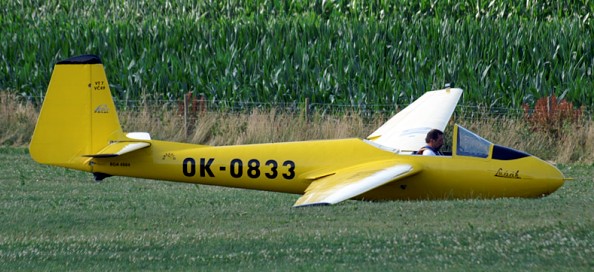
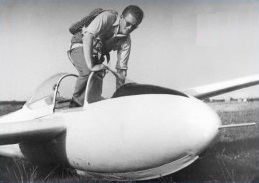
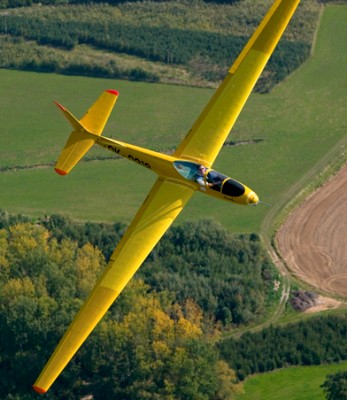
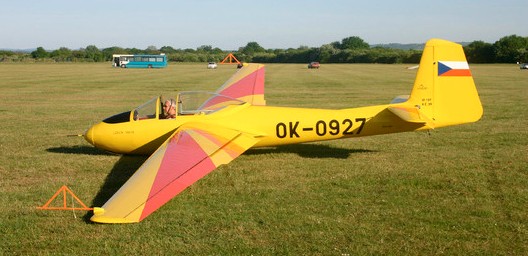
The Czech aerobatic glider LF-107 Lunak was designed by Rudy Letov and further developed by a group of sailplane pilots and aeronautical engineers. The first flight of the prototype took place on June 25, 1948 and a second prototype flew in July. The prototype participated later in the same year in an aerobatic competition in Grenchen, Switzerland, and in Ziar, Poland in 1949, where its good aerobatic and gliding characteristics drew considerable attention.
Designer Ing. K.Dlouhý & Letov LF-107 Luňák
Unfortunately the serial production was disrupted by geopolitical developments, as the factory was charged with production of MiG-15, MiG-19 and MiG-21F aircraft and the access to Western civil export markets was progressively hampered by the emergence of the Iron Curtain. Therefore, only 75 examples of the Luňák were produced in all. Production models were used in local clubs for sailing and aerobatics as well as for training jet pilots.
In 1950, a variant with simpler construction and a revised cockpit, among other changes, was developed. This LF-107 Luňák of wooden construction, designated Letov VT-7 under the military training system, was instrumental in the development of gliding and aerobatics in the Czech Republic. The LF-107 was also used for aerobatic training in the Soviet Union, Bulgaria, Romania and Poland.
The Letov XLF-207 Laminar, a derivative of the Luňák, holds the distinction of being the first glider in the world to have a laminar flow wing. Its maiden flight took place in Praha Letnany in August 1951. Research into laminar flow wings was carried out by the XLF-207 Laminar, a LF-107 fitted with laminar flow wings.
In 1990 there were only nine airworthy Luňák, of which two are in the United Kingdom. A Luňák is displayed in the American Museum of Flight.
LF-107 Luňák Length: 6.78 m Height: 1.47m / 5ft Wingspan: 14.27 m Wing area: 13.38 sq.m Aspect ratio: 15.22 Empty weight: 205 kg Gross weight: 310 kg Maximum speed: 300 km/h Maximum glide ratio: 24 @ 80km/hr (43kts) Rate of sink: @ 65km/hr 0.85 m/s (@ 35kts 167 ft/min) Crew: 1
A 1960 STOL light transport and trainer. Two projected M-603 turboprops (1200 to 1400 hp each) or two twinned M-601; 20 to 25 passengers (8 to 10 in VIP configuration). Takeoff run only 15 m.
A 1960 6-8 passengers business jet and trainer aircraft. Two rear-mounted M-701 turbojets (10,8 kN each). Cruise speed 870 km/h. Designed in two versions: low-wing (appears like typical bizjet) and more unconventional – high-wing.
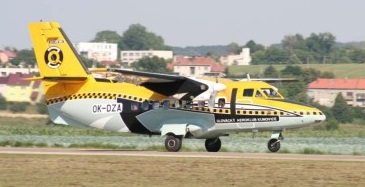
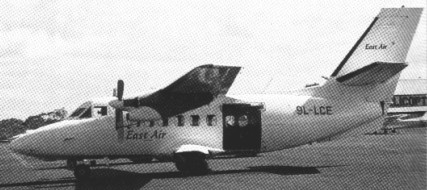
The PT-6A-powered prototype for the L.410 series first flew on April 16, 1969. Production versions include the L.410A, AF, M and UVP, which have Walter M601 turboprops.
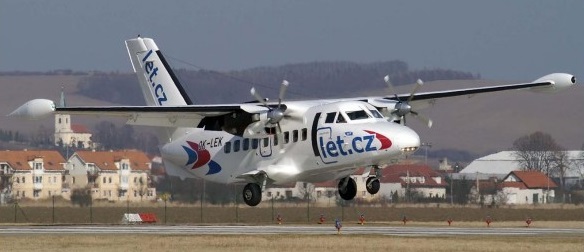
The L-410UVP-E production version succeeded earlier variants and entered service in 1986. Its main changes included a modified interior to take accommodation to 19 passengers, a reinforced wing for optional streamlined tip tanks (boosting range by 40 per cent) and modifications to the 750 shp (559 kW) Motorlet Walter M601 E turboprops with five-blade propellers.
L.410
The L.410UVP-E version features a strengthened wing, and seating for four more passengers, taking total accommodation to 19. Military utility versions exploiting the L.410’s rough-field capability are available for a range of duties, including transport, medevac, para-dropping, and training.
L-410 UVP-E20
More than 860 L-410s were in civil and military use by 1990. A higher-powered L 420 variant first flew November 1993.
1978 Let 410 Turbolet Engine : 2 x Walter M 601 A, 537 shp Length: 44.652 ft / 13.61 m Wingspan : 57.349 ft / 17.48 m Wing area : 353.059 sq.ft / 32.8 sq.m Max take off weight : 12568.5 lb / 5700.0 kg Weight empty : 8202.6 lb / 3720.0 kg Max. speed : 205 kt / 380 km/h Cruising speed : 194 kt / 360 km/h Initial climb rate : 1476.38 ft/min / 7.5 m/s Service ceiling : 19685 ft / 6000 m Wing load : 35.67 lb/sq.ft / 174.0 kg/sq.m Range : 626 nm / 1160 km Crew : 2 Payload : 17 Pax
L-410 UVP-E Turbolet Engine: 2 x Walter M601D. Installed pwr: 1120 kW. Span: 20 m. Length: 14.5 m. Wing area: 35.2 sq.m. Empty wt: 3970 kg. MTOW: 6400 kg. Payload: 1615 kg. Cruise speed: 375 kph. Initial ROC: 430 m / min. Ceiling: 4200 m. T/O run: 425 m. Ldg run: 320 m. Fuel internal: 1290 lt. Range/payload: 1380 km with 900 kg. Capacity: 19 pax.
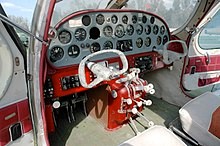
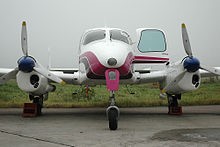
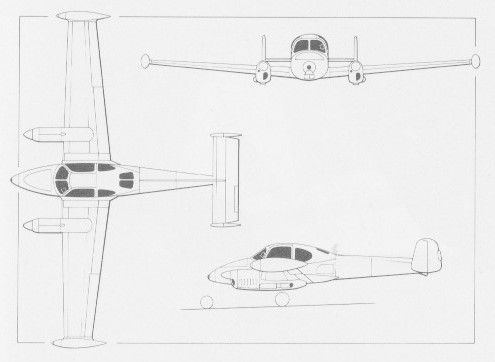
The Let L-200 Morava light twin-engine transport was preceded in production at the Let factory by the license-built Aero Ae 45. In 1955 the newly created design team led by Ladislav Smrcek of the Czechoslovak State Aircraft Factory decided to proceed with a proprietary design for a more modern twin with seating capacity of five and powered by a pair of then new 210 hp Avia M 337 engines, but as they were not yet available, the prototype made do with the less powerful Walter Minor 6-III engines of 160 hp each. While maintaining similar characteristics of western twin engine aircraft of the time, updated features of the Morava included twin tails, standard thermal wing de-icing equipment and inverted inline engines.
L-200D Morava
Three prototypes were built. The first, designated XL-200 (OK-LNA) made its maiden flight on 9 April 1957. It was followed in flight testing by the second prototype (OK-LNB) while the third was used for static testing. The aircraft sported clean, elegant lines. During the same year the factory built a run of 10 pre-production L-200s, one of these aircraft undergoing government flight testing in 1958. The program was successful, and the airplane was ordered into full-scale production. One L-200 was converted into a prototype of the M-337-powered production model L-200A. This aircraft incorporated minor changes, consisting mostly of new two-blade V-410 propellers, a cockpit lowered by 43mm, a modified tailfin design as well as longer engine nacelles. It was completed in 1959 and shown at the Paris Air Show in July of that year. The aircraft underwent government trials in the fall of 1959, having been fitted with M-337 engines. The trials once again proved successful and were completed the following July. The first production L-200A took to the skies in February 1960.
L-200B and C models were not produced. The second production variant was the L-200D, modified according to Soviet Aeroflot demands. It was fitted with new three-blade propellers V-506 of a smaller diameter and some minor improvements, such as dust filters. It also received more comprehensive navigation equipment. The prototype (OK-NIA) was converted from the L-200A prototype in 1960 and tested in 1961-1963.
In all, 367 L-200s were built by 1964, including 3 prototypes and 197 L-200D (eight L-200A and the L-200A prototype were converted to L-200D as well). 5 aircraft were manufactured from parts by Libis in Yugoslavia.
A further development was 6-place L-210 (also known as L-201; registration OK-PHB), converted from one L-200D in 1966, powered with 245 hp M-338 engines, but it was not ordered by the airlines and was not produced.
The pre-series aircraft L-200 were distributed for testing: 5 to the Czechoslovak airline Agrolet (OK-MEA – MEE), 2 to the Czechoslovak Air Force and 2 to Aeroflot in the USSR.
Aeroflot, who used them as air taxis, was the largest single user of Moravas – 68 L-200A and 113 L-200D, final deliveries taking place in 1966. In the 1970s however, the Soviet Union sold or withdrew its aircraft from use, in favour of indigenous designs.
Let L-200D Morava
About 100 Moravas were used for civilian purposes in Czechoslovakia by aeroclubs Svazarm (about 50), the airlines Agrolet (from 1969 Slov-Air) and Czechoslovak Airlines (45) and by businesses, such as Škoda. 20 were used by the Czechoslovak Air Force (16 of which L-200A), among others, for training. About 50 were sold to Poland, where they were used mostly as air ambulances and in aeroclubs. Some other countries had smaller fleets of Moravas.
During the Cold War Era, not many light aircraft were exported from behind the Iron Curtain. 144 L-200A were exported to 15 countries. They were used in Australia, Argentina, Cuba, Hungary, West Germany, Great Britain, Egypt, India, Italy, Poland, South Africa, USSR and Yugoslavia. L-200D were exported to Bulgaria, Cuba, Egypt, France, Hungary, GDR, Great Britain, India, Indonesia, Italy, Poland, Switzerland, Sweden, USSR and Yugoslavia.
Small number of Moravas are still used (as of 2008), mainly in Czech Republic, Slovakia Poland and Ukraine.
L 200D Engines: 2 × Walter M337, 160 kW (210 hp) each Propellers: 3-bladed Type V506 constant-speed, 1.75 m (5 ft 9 in) diameter Wingspan: 12.31 m (40 ft 5 in) Wing area: 17.28 m2 (186.0 sq ft) Length: 8.61 m (28 ft 3 in) Height: 2.25 m (7 ft 5 in) Empty weight: 1,330 kg (2,932 lb) Max takeoff weight: 1,950 kg (4,299 lb) Fuel capacity: 420 L (110 US gal; 92 imp gal) Maximum speed: 290 km/h (180 mph, 160 kn) at sea level Cruise speed: 256 km/h (159 mph, 138 kn) at 2,500 m (8,200 ft) (econ cruise) Range: 1,710 km (1,060 mi, 920 nmi) Service ceiling: 5,700 m (18,700 ft) Rate of climb: 6.4 m/s (1,260 ft/min) Takeoff distance to 15 m (50 ft): 390 m (1,280 ft) Landing distance from 15 m (50 ft): 480 m (1,570 ft) Baggage capacity: 297 lb / 135 kg Crew: 1 Capacity: 4 passengers

 All Aero