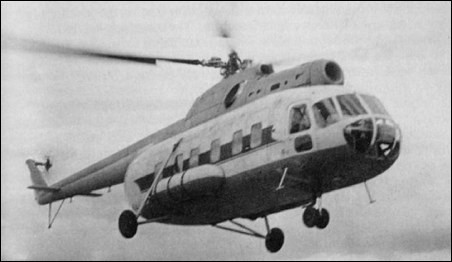
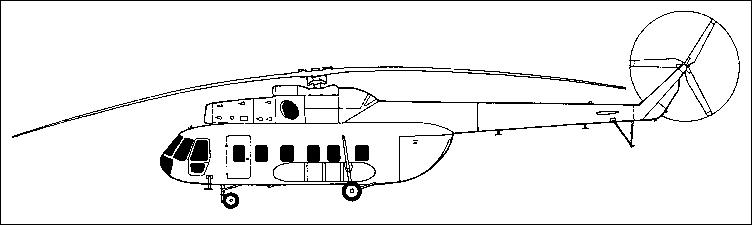
The Mi-8 prototype incorporating an Mi-4 main rotor and transmission and one 2700shp Soloviev AI-24V turbine mounted on top of fuselage. First flown on 24 June 1961 and subsequently fitted with 5-blade rotor and two 1400shp Isotov TV2-117 engines, being the standard for the Mi-8.
V-8 Crew: 3 Passengers: 18 Engine: 1 x AI-24V turboshaft, 1425kW Main rotor diameter: 21.0m Max take-off weight: 11200kg Empty weight: 5726kg Payload: 1500-2000kg
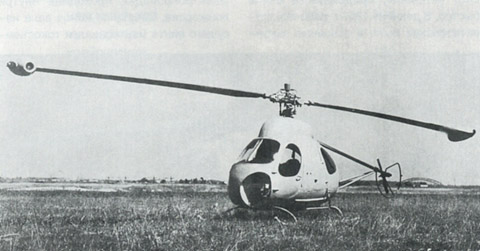
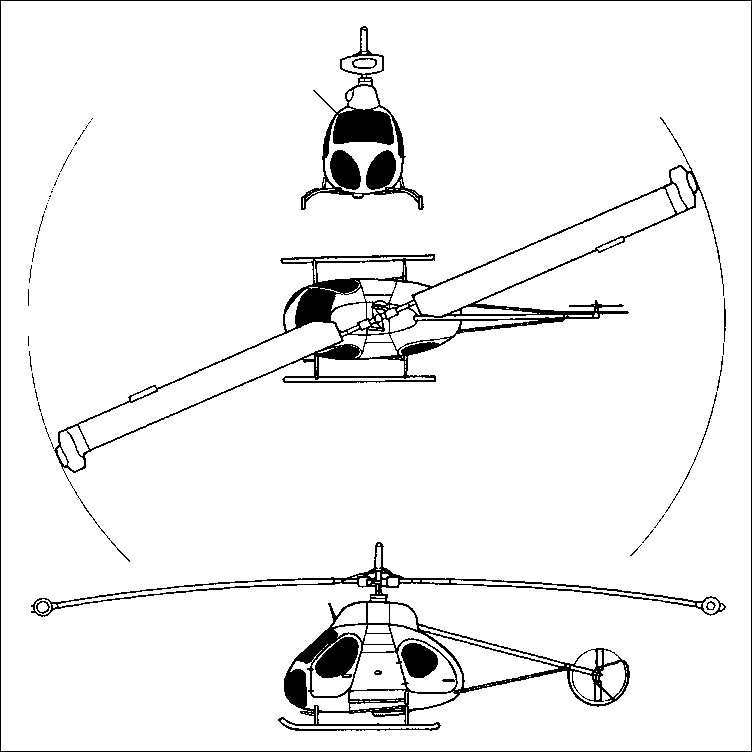
An experimental tip-drive helicopter completed in 1959. A 4-seat light helicopter with skid u/c, thin triangulated tail boom structure, powered was from two AI-7 tip-mounted ramjets. A pilot and three passengers were in a stressed-skin nacelle with three doors, tail on tubular boom, and kerosene tank in roof. The all-metal blades carrying subsonic tip ramjets. The hub was of design unlike other Mil helicopters. Inclined drive shaft to tail rotor.
One prototype was built and flown in 1959, but it is believed it never flew with more than the pilot on board.
Mil V-7 Engine: 2 x AI-7 Rotor diameter: 11.6m Loaded weight: 835kg Empty weight: 730kg
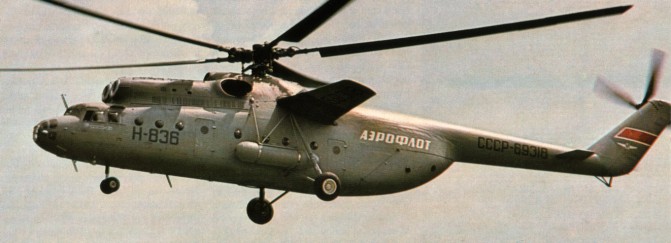
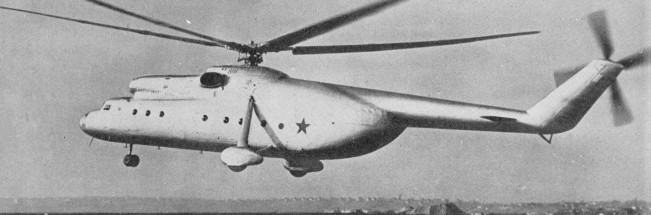
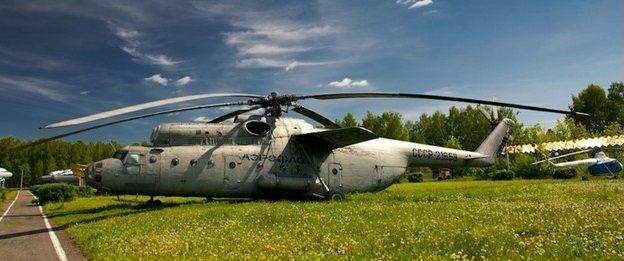
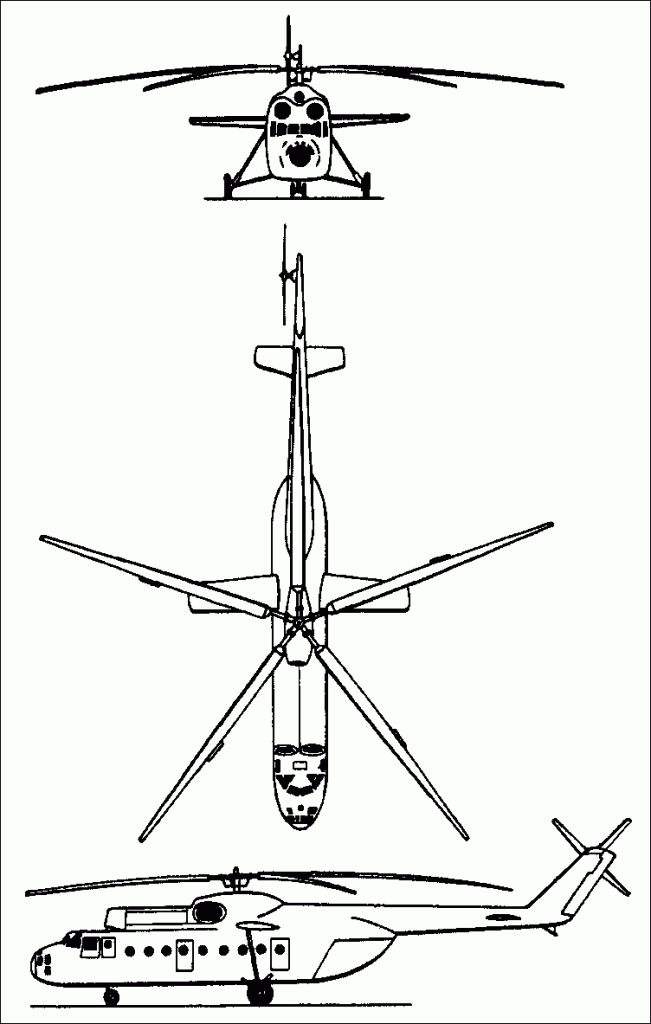
Developed to meet both VVS and Aeroflot requirements, the Mi-6 was also the first turbine-powered helicopter to enter production in the USSR. First flown in June 1957 by Rafail Kaprelian, five aircraft were involved in the development programme, which was completed very quickly for such a revolutionary aircraft, with production beginning in 1960. The first flown made its maiden flight originally without the shoulder-mounted stub wings which are sometimes fitted to production Mi-6’s. On October 30 1957 an Mi-6 lifted 12,000kg to 2432m.
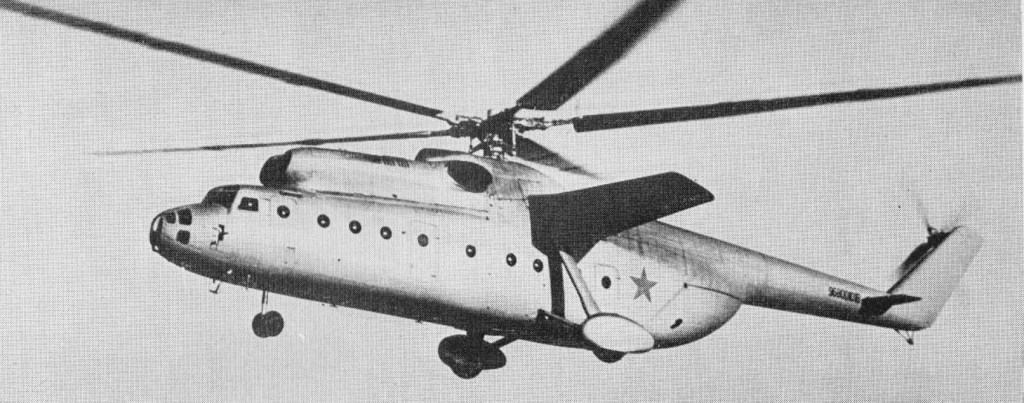
Of conventional helicopter configuration, the Mi-6 introduced two readily-detachable short-span shoulder wings which offload the rotor by some 20 per cent in cruising flight; for heavy-lift operations the stub wings are removed to give greater payload capability. For normal operations they can be fixed at either of two angles of incidence. Development by Mikhail L Mil’s design bureau at Zaporozhye of the dynamic system (rotors and shatting) of the Mi-6 was matched by Soloviev’s development of the R-7 gearbox, which weighs 7,054 lb (much more than the pair of engines).
When the Mi-6 first appeared, it was claimed to have a maximum passenger capacity of 120, with normal capacity for 70 to 80, each with 20kg of baggage. Such an airliner was built in 1967, but failed to proceed beyond the prototype stage. The standard capacity of 65 passengers in the convertible model is provided with tip-up seats along the cabin walls and with removable seats on the floor.
The prototypes were powered by two 4635shp Soloviev TV-25VM turboshafts, but production models have the 5500shp Soloviev D-25V developed models. Also fitted is a 100hp AI-8 auxiliary power unit for starting the engines in the absence of any external power source. The developed engines, which keep their rating at altitudes up to 3000m and so make possible operations in ‘hot and high’ conditions, also allowed some notable records, the most impressive being an altitude of 2840m with a 25,105kg payload on May 28, 1965.
In November 1959 an Mi-6 set a new 100km speed record at 167.206 mph.
The fuselage construction is a metal semi-monocoque pod-and-boom design, with large hydraulically operated clamshell doors at the rear of the pod. These doors, which can be removed to allow the carriage of outsize cargoes, cover an opening measuring 2.65m by 2.7m and leading into a hold with a volume of 62cu.m, measuring 12m by 2.65m by 2.5m. Freight is handled with the aid of an 800kg winch. As an alternative to internal freight, a load of 9000kg can be carried in a sling suspended from a cable on the aircraft’s centre of gravity, dropped through a hatch in the floor. The Mi-6 also has an electric winch for use when hovering which has a capacity of 500kg.
Five-blade main rotor and four-blade tail rotor. Main rotor blades each have tapered steel tube spar, to which are bonded built-up metal aerofoil sections. Conventional transmission. Main reduction gearbox drives tail rotor, fan AC generators and hydraulic pumps. Intermediate reduction gearbox fitted with special fan. Two small cantilever removable shoulder wings mounted above main landing gear struts, offload rotor by providing some 20% of total lift in cruising flight. The wings are removed in the fire-fighting variant, which can carry 12,000kg of water. Tail rotor support acts as vertical stabiliser.
The blades have coincident flapping and drag hinges and fixed tabs. Main rotor shaft inclined forward at 5 degrees to vertical. Control via large welded swashplate. Hydraulically actuated powered controls. Main rotor collective-pitch control interlocked with throttle controls. Variable incidence horizontal stabiliser near end of tailboom for trim purposes.
Power is from two 4,101kW Soloviev D-25V (TV-2BM) turboshafts, mounted side by side above cabin, forward of main rotor shaft. There are 11 internal fuel tanks, with total capacity of 6,315kg, and two external tanks, on each side of cabin, with total capacity of 3,490kg. Provision for two additional ferry tanks inside cabin, with total capacity of 3,490kg.
Crew of five, consisting of two pilots, navigator, flight engineer and radio operator. Four jettisonable doors and overhead hatch on flight deck. Electrothermal anti-icing system for glazing of flight deck and navigator’s compartment. Equipped normally for cargo operation, with easily removable tip-up seats along sidewalls. When these seats are supplemented by additional seats installed in centre of cabin, 65 to 90 passengers can be carried, with cargo or baggage in the aisles. Normal military seating is for 70 combat equipped troops. As an air ambulance, 41 stretcher cases and two medical attendants on tip-up seats can be carried. One of the attendant’s stations is provided with intercom to flight deck and provision is made for portable oxygen installations for the patients. Cabin floor is stressed for loadings of 2,000kg/sq.m, with provision for cargo tiedown rings. Rear clamshell doors and ramps are operated hydraulically. Standard equipment includes an electric winch of 800kg capacity and pulley block system. Central hatch in cabin floor for cargo sling system for bulky loads. Three jettisonable doors, fore and aft of main landing gear on port side and aft of landing gear on starboard side.
Some military Mi-6s have a 12.7 mm machine gun in the nose.
During flight trials in 1962 the Mi-6 (NATO code name Hook) established a number of impressive load-to-altitude and speed-with-payload records in 1959, most of which it bettered three years later when it set a total of eleven new FAI world records. In one of these, still unbeaten by early 1968, it lifted a payload of 20117kg. The normal load is limited to 26,450 lb (12,000 kg) internally, loaded via huge clamshell rear doors, or 19,840 lb (9000 kg) externally slung. It was also the world’s first twin-turboshaft helicopter, and the first to exceed 300km/h in level flight.
An initial batch of thirty production Mi-6’s was undertaken in 1958. Aeroftot was reported in 1963 to have introduced the big Mi‑6. It is being used at present to carry large and unwieldy loads such as pipes for natural gas and oil installations. Test pilot I.G. Drobishevsky has taken charge of Mi‑6 development for Aeroflot and is working on further applications such as the unloading of ships and the carriage of timber. The Mi-6’s in service with Aeroflot are employed mainly as freighters, in which role they have an internal capacity for 12000kg of payload. The standard passenger version seats 65 people normally, although up to 120 persons can be accommodated in a high density seating arrangement. If used as an ambulance, the Mi-6 can carry 41 stretchers and 2 medical attendants.
Major production version was the Mi-6A of which 864 were built at Rostov-on-Don (now Rostvertol) factory 1959-80, plus 50 at Moscow-Fili 1960-62.
The ‘Hook’ was exported to Algeria, Bulgaria, Egypt, Ethiopia, Indonesia, Iraq, Syria, Vietnam and Peru, where it was used by both the air force and army.
Flown by a crew of five, the Mi-6 has also seen extensive use with Aeroflot in civil engineering support work on projects such as bridge-laying, and as a versatile heavy transport in areas inaccessible to other vehicles. Most have the rotor unloaded in cruising flight (typically 150 mph) by a fixed wing of 50 ft 21 in span. These huge helicopters have played an active role in field exercises carrying troops (typically 68) and tactical missiles or vehicles. The under-fuselage hook can support an externally slung load of 9000kg.
Mi-6
Another version, developed into the Mil-10 ‘Harke’, is optimised as a flying crane, and the Mi-6 formed basis for Mi-22 airborne command post.
Mi-6 / Hook-A Basic transport with TV-2V. First 30 preproduction aircraft. Able to carry 70 combat-equipped troops or 65-90 civil passengers; also used in the air ambulance role, it can accommodate 41 stretcher cases and two medical attendants; can also be fitted for fire-fighting role with spraying or water bombing equipment; in the freight role the Mi-6 can carry an internal cargo payload of 12000 kg (26,455 lb)
Mi-6P (passazhirskyi) Airline-style seating for 80 passengers; rectangular windows.
Mi-6PS (poiskovo-spasetelnyi) Military SAR/medevac version, first noted in 1977.
Mi-6PZh and Mi-6PZh2 Firefighters with 21,000 litres capacity in single 12,000 litre metal tank and six 1,500 litre bag tanks suspended from the fuselage.
Mi-6S (sanitarnyi) Medevac version for 41 litters and two attendants.
Mi-6T Basic military transport with machine gun in nose glazing.
Mi-6TP (transportno-passazhirskyi) Convertible model with 65 folding seats.
Mi-6TZ (toplivo-zapravshchik) Tanker version for ground refuelling.
Mi-6VKP (vozduzhnyi komandnyi punkt) (‘Hook-B’) Command support version with dorsal ‘clothesline’ antenna; flat-bottom U-shape antenna under tailboom; large heat exchanger on starboard side of cabin; small cylindrical container aft of starboard rear cabin; small cylindrical container aft of starboard rear cabin door.
Mi-6VR (vodolei: Aquarius) Rotor systems testbed used in Mi-26 development; subsequently equipped as icing spray rig.
Mi-6AYaSh / Hook-D Airborne command post; flat-panel (reportedly SLAR), forward of external fuel tank as starboard side, many small antennas.
Mi-22 / Hook-C Developed command support version with single large dorsal blade antenna on forward part of tailboom; small antennae under fuselage; pole antenna on starboard main landing gear of some aircraft. Also known as Mi-6AYa or Mi-6VUS in service.
Specifications:
Mi-6 Engines: 2 x D-25A turboshaft, 4045kW Main rotor diameter: 35.0m Length with rotors turning: 41.74m Height: 9.16m Fuselage width: 3.2m Max take-off weight: 42500kg Empty weight: 27240kg Max speed: 300km/h Cruising speed: 250km/h Rate of climb: 6.5m/s Service ceiling: 4500m Hovering ceiling: 1000m Range with 8,000kg payload: 620km Range with max fuel: 1450km, payload: 12000kg Crew: 5 Passengers: 65
Mi 6 Engines: 2 x Solowjew D-25W, 5425 shp Length: 108.793 ft / 33.16 m Height: 32.349 ft / 9.86 m Wingspan: 114.829 ft / 35.0 m Max take off weight: 93712.5 lb / 42500.0 kg Weight empty: 60064.2 lb / 27240.0 kg Max. payload weight: 26460.0 lb / 12000.0 kg Max. speed: 162 kts / 300 km/h Cruising speed: 135 kts / 250 km/h Service ceiling: 14764 ft / 4500 m Cruising altitude: 3281 ft / 1000 m Maximum range: 783 nm / 1450 km Range: 783 nm / 1450 km Crew: 5 Payload: 65 Pax / 12000kg
Mi-6T Engines: 2 x Soloviev D-25V single-shaft free-turbine engines driving common R-7 gearbox, 5,500 shp (4045kW) each Main rotor diameter: 114 ft 10 in (35 m) Overall length (rotors turning): 136 ft 11½ in (41.74 m) Fuselage length: 108 ft 10½ in (33.18 m) Height: 32 ft 4 in (9.86 m) Empty weight (typical) 60,055 lb (27,240 kg) Max loaded weight 93,700 lb (42,500 kg) Max speed: 186 mph (300 km/h) (set 100 km circuit record at 211 36 mph, beyond flight manual limit) Cruise speed: 250km/h / 158 mph Service ceiling: 14,750 ft (4500 m) Range (with half payload) 404 miles (650 km) Range w/ aux. fuel: 1450km Armament: normally none, or 1 x 12.7 mm calibre Crew: Five – two pilots, flight engineer, navigator, and radio operator Payload: 70 troop or 17,640 lb (8000 kg)
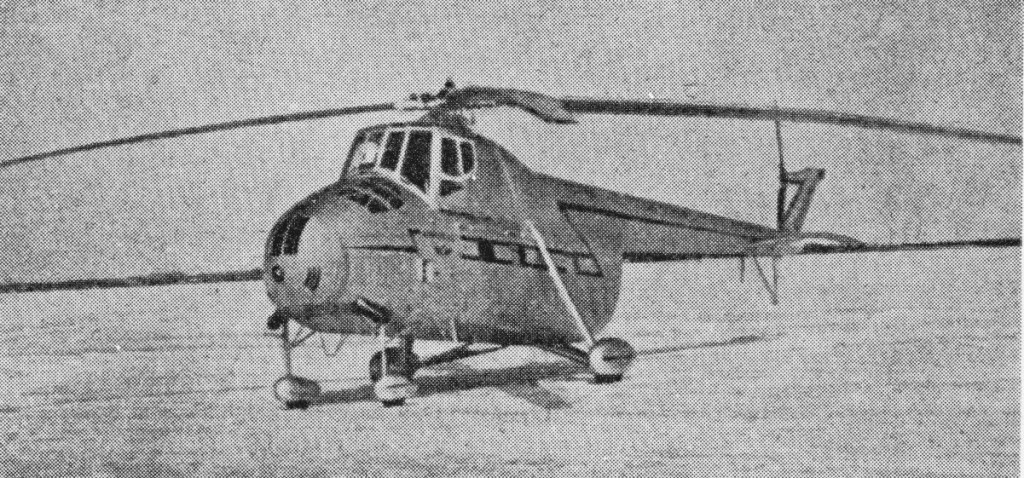
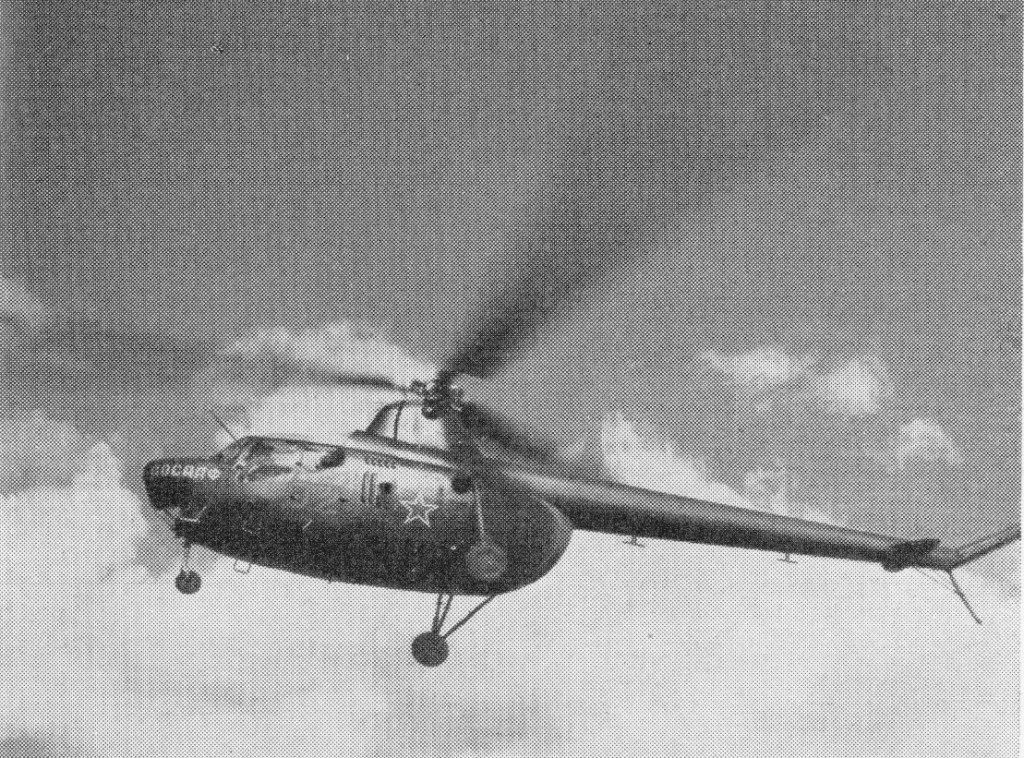
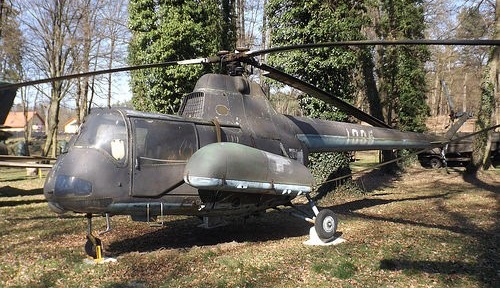
At a Kremlin meeting of constructors in September 1951 Stalin insisted on sudden great advance in Soviet helicopters. On following day Mil and Yakovlev were given one year to design, build and fly prototypes, Mil’s assignment being single-engined 12-passenger machine. Mil had prepared outline design beforehand which he produced at Kremlin; basically scaled-up rotors of Mi-1 with added fourth main rotor blade, rotor axis inclined forwards 5 degrees, and a fuselage of light-alloy semi-monocoque with extensive use of magnesium. The engine installed at 25 degrees in the nose, accessible through upper/lower hinged nose doors and left/right hinged side doors. Cooling fan and centrifugal clutch immediately to rear of engine, with inclined shaft between pilots to main gearbox. Separate cooling systems for oil radiator and hydraulics for flight control. Straight tail boom with adjustable stabilizers, deep skid/bumper and narrow fin carrying tail rotor on right, with three bakelite-ply blades. Main fuel tank welded aluminium, 960 lit, behind gearbox; optional aux tank 500 lit in hold or externally. Quad landing gear with pneumatic-braked mainwheels and castoring nosewheels, optional pontoons for water. Main hold 4.15m long, about 1.8m square section. Max internal load 1740kg including small vehicles loaded through left/right rear doors and clip-on ramps. Slung load to 1.3t. Alcohol de-icing of blades and windscreens as on Mi-1.
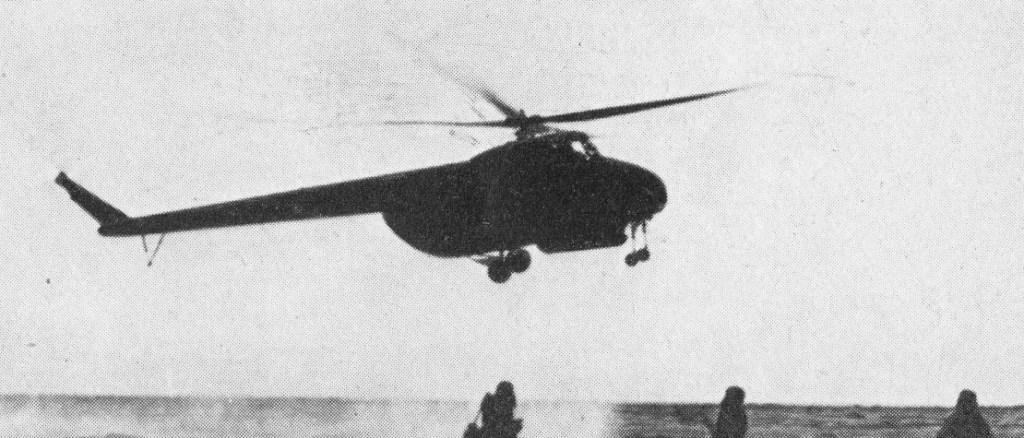
First flight delayed several weeks by blade flutter in ground-running from 14 April 1952. First flight May, Vinitsky assisted by Brovtsev. Remarkably few subsequent snags and NII testing completed before end of year. The Mi-4 was already in Soviet Air Force service by August 1953, when it was first seen publicly at the Tushino Aviation Day display. NATO code name ‘Hound’.
At the 1953 Soviet Aviation Day Display, 18 flew, 13 unloaded jeeps through rear clamshell doors under their tailbooms. The others each unloaded two motor-cycle and sidecar combinations.
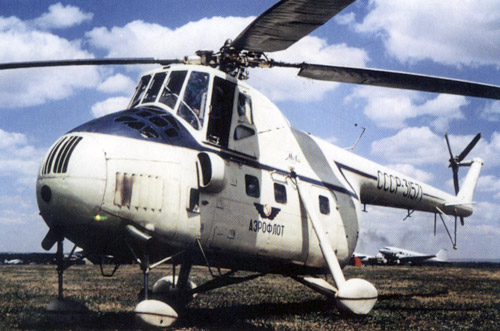
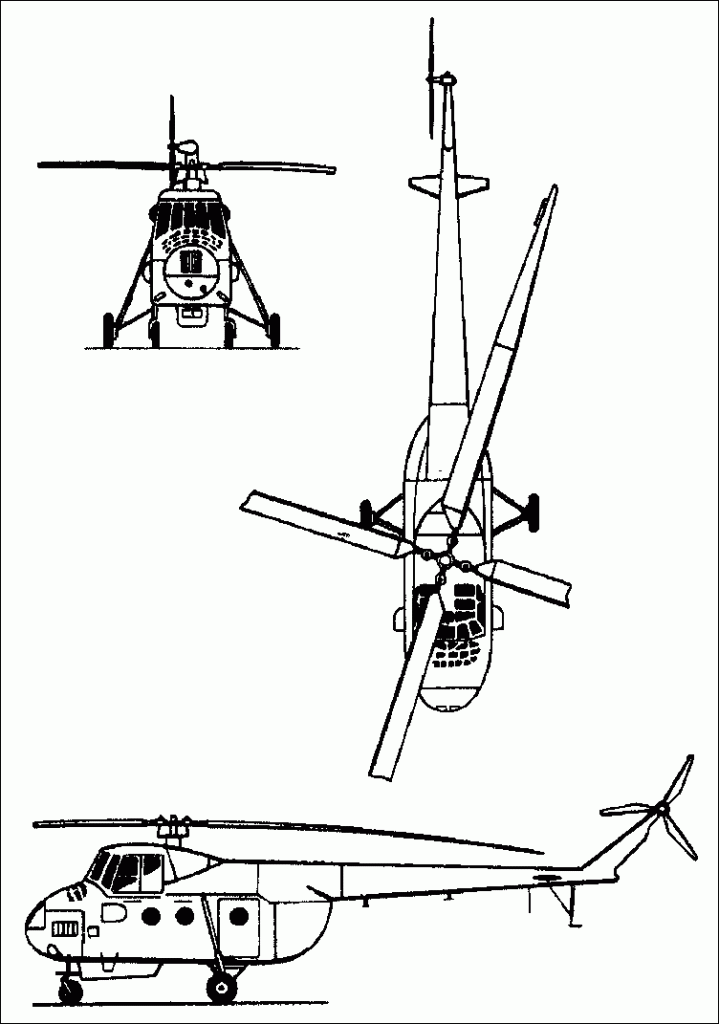
Featuring a four-blade main rotor with hydraulic servo-control and three-blade anti-torque rotor at starboard side of tailboom. The main rotor blades were originally tapered, with steel spars and plywood covering; since 1961 they have been of constant-chord all-metal construction.
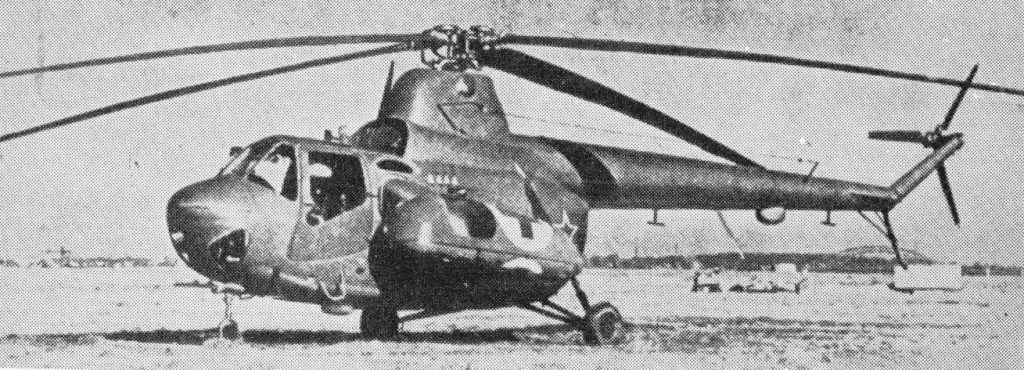
All-metal semi-monocoque structure of pod and boom type, with access to the main cabin via a normal side door, with provision for clamshell doors under the tailboom attachment point in freight-carrying version. The landing gear is a non-retractable four-wheel type. All units fitted with shock-absorbers. Nosewheels are fully castoring. Spats optional. Provision for fitting pontoons. Power is from one 1,700hp ASh-82 V 18-cylinder air-cooled radial engine mounted in fuselage nose.
Accomodation is for a crew of two on the flight deck, with underfuselage gondola for observer in military version. Commercial version carries 8 to 16 passengers in heated, ventilated and soundproofed cabin, with door at rear on port side. Aft of cabin are a toilet, wardrobe and compartment for 100kg of baggage. Ambulance version carries eight stretchers and attendant. Freight version has clamshell rear doors. Military version carries up to 14 troops, 1,600kg of freight or vehicles such as a GAZ-69 ‘Jeep’, 76mm anti-tank gun or two motorcycle/sidecar combinations.
Radio and instrumentation for night and bad weather flying are standard equipment. A liquid leading-edge de-icing system.
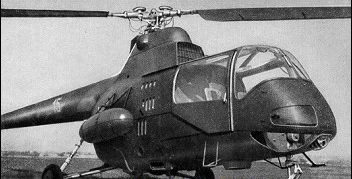
Produced initially since about 1953 for use by the Soviet armed forces in assault and troop transport roles, the Mi-4 ‘Hound-A’ has clamshell rear doors to simplify the loading of vehicles and freight; alternatively, the cabin can accommodate 3,520 lb (1,600 kg) of cargo, or up to 14 troops. Military Mi-4s are recognisable easily by having a ventral gondola which was intended originally for a navigator or observer, but can also house avionics equipment. Produced in large numbers for Soviet military use, the Mi-4 was also exported for service with more than 20 foreign air arms. Conversions have been reported in Soviet use for ASW (‘Hound-B’) armed close support and ECM (‘Hound-C’). From 1964 production of civil versions was initiated and combined civil/military production by Mil was estimated at 3,500 when production terminated in 1969. All versions can be equipped with inflatable pontoons which, mounted so that the landing wheels project below them, can be used for amphibious operations.
Urgent development of improved metal blades 1954-60 culminating in dural blade with extruded spar and honeycomb box trailing sections. Magnesium fuselage skins replaced by aluminium, and better flight control and avionics.
Main production model military Mi-4T, with increased diameter main rotor, aluminium cargo floor, bulged circular windows with gun ports, ventral gondola for nav/observer, and tactical avionics.
Military Mi-4’s have been exported to a number of air forces in the Soviet bloc, among the largest users being India, which had sixty, and Cuba, which had twenty-four.
A stripped-down Mi-4 established a number of speed-with-payload and payload-to-altitude records in April 1956, including 500km circuit at 187.254km/h, and later 1012kg lifted to 7575m.
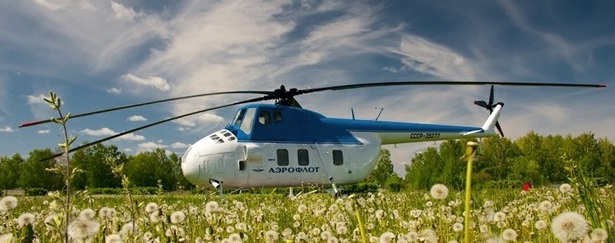
From 1964 civil versions of the Mi-4 were also built in considerable numbers. A basic Mi-4 for general use and freight transport followed by the Mi-4P (Passajirskii – passenger) and the Mi-4S (Selskokhoziaistvennii – rural economy). The Mi-4P is the standard version for Aeroflot, carrying 11 passengers normally or up to 16 in high density seating or, in the ambulance role, 8 stretchers and a medical attendant. The Mi-4P is distinguished by having square cabin windows, wheel spats and no ventral fairing; 100kg of baggage can be carried in addition to the normal passenger complement. The Mi-4P, which went into regular service with Aeroflot in November 1958, can carry up to 11 passengers or eight stretchers and a medical attendant for ambulance duties. The Mi-4S (SKh) is normally used for agricultural operations, when it can be fitted with a 1000kg dust hopper or a 1600-l tank holding pesticide or fire-fighting chemical.
First flown in 1962, the Mi-4PL ASW version for AV-MF carried four 250kg or six 100kg A/S bombs, chin radar (also fitted to various military variants), short but deeper gondola, and a towed MAD at rear and sonobuoys on external rack on right side. The Mi-4S Salon VIP version had a mtow of 7315kg. A small batch of Mi-4L (Lyuks, de luxe) six-seaters were built. Mi-4M tactical variant with gun turret and air/surface rockets 1968, and EW platform first seen 1977 with two pairs of lateral Yagi arrays and other aerials mainly for communications jamming.
In Spring 1965, details were given of a series of high-altitude tests made with an Mi-4 fitted with two-speed supercharger and all-metal main rotor. After engaging the second speed at 4,650m, the aircraft climbed to 8,000m. It was also operated at an airfield height of 5,000m.
Production ceased in 1964 after about 3,200 were built, of which about 700 were exported to 6 countries
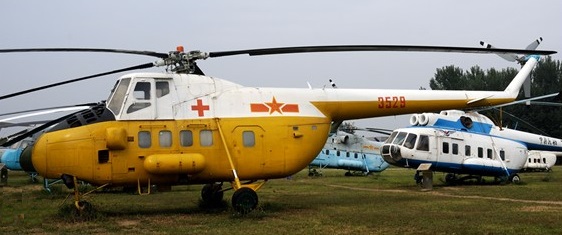
The Mi-4 was also manufactured under licence in China from 1959 as the Harbin Z-5 (Zhishengji 5) with many changes. A total of about 545 were built when production ended in 1979, and of which approximately two-thirds were for civil use.
Mi-4 Basic military version with underfuselage gondola for navigator. Production said to have started in 1952. Civil freight version is generally similar, with double clamshell rear-loading doors. Soviet films of military exercises, released in 1968, showed a close support version of the Mi-4, armed with a gun in the front of the underfuselage nacelle and air-to-surface rockets.
M-4A Soviet Army armed helicopter with two TRS-132 rocket pods fitted, or two TRS-132 rocket pods fitted, or six KARS-57 rocket pods fitted, 1960, or with eight UB-16-57 rocket pods with S-5K rockets, 1965
Mi-4A Agricultural version first flying prototype
Mi-4AV Fire-support helicopter, 1967
Mi-4A / Mi-4ADT Updated troop-carrier helicopter
Mi-4GF
Mi-4GR Helicopter with Grebeshok-3 wide-range reconnaissance station
Mi-4L Small batch of six-seat de luxe version; some equipped for medevac with eight stretchers and attendant.
Mi-4MK ECM helicopter with Mayak-3 countermeasures system
Mi-4MT Torpedo carrier helicopter
Mi-4M ASW helicopter with float-type gear during flight tests
Mi-4ME ASW helicopter
Mi-4P Civil transport version used extensively by Aeroflot and seating eight to 11 passengers in furnished cabin First flying prototype, 1955. Major use in ambulance configuration carrying up to eight stretchers and a medical attendant. Entered service on Aeroflot’s Simferopol’ to Yalta route in the Crimea in November 1958. This version has square windows instead of the circular windows of the military version and has no underfuselage gondola. The wheels are often fitted with spats.
Mi-4S Basically an agricultural version with a large chemical container in the main cabin, but used also for fire-fighting operations Spread through bifurcated ducts by hydraulically actuated fan in duct which replaces the military ventral gondola. Liquids are sprayed from bars mounted aft of mainwheels. Rate of spread is up to 18 litres or 20kg/s, with swath width of 40 to 80m, at forward speed of 60km/h.
Mi-4U Target acquisition helicopter with Uspekh system
Harbin Z-5 Chinese military version of the Mi-4, this being in service with both the army and navy
Harbin Xuanfeng Chinese name for civil version of the Mi-4, at least one of which is flying with the PT6T-6 twin turbine engine
Specifications:
Mi-4 Engine: Shvetsov ASh 82V eighteen cylinder radial, 1,700 hp Main rotor dia: 68 ft 11 in (21.00 m) Length: 55 ft 1 in (16.80m) Main rotor disc area: 3,724 sq ft (346.0 sq.m) Gross weight: 17,200 lb (7,800 kg) Max speed: 130 mph (210 km/h) at 4,920 ft (1,500 m) Typical range: 250 miles (400 km) Accommodation: Crew of 2 or 3 and up to 14 troops or 16 passengers
Mi-4 Crew: 2 Engine: 1 x ASh-82V piston engine, 1250kW Rotor diameter: 21.0m Length with rotors turning: 25.02m Height: 4.4m Fuselage width: 2.0m Max take-off weight: 7550kg Empty weight: 5100kg Max speed: 185km/h Rate of climb: 5.6m/s Service ceiling: 5500m Hovering ceiling: 2000m Range with max fuel: 500km Payload: 1600kg
Mil Mi 4 Engine: Shvetsov ASh 82 V, 1677 hp Length: 55.085 ft / 16.79 m Height: 16.995 ft / 5.18 m Rotor diameter: 68.898 ft / 21.0 m Max take off weight: 16647.8 lb / 7550.0 kg Weight empty: 10804.5 lb / 4900.0 kg Max. payload weight: 2646.0 lb / 1200.0 kg Max. speed: 100 kts / 185 km/h Landing speed: 86 kts / 160 km/h Service ceiling: 5577 ft / 1700 m Cruising altitude: 1640 ft / 500 m Maximum range: 221 nm / 410 km Range: 221 nm / 410 km Crew: 2-3 Payload: 8-14 Pax / 1200kg
Mi-4P Engine: Shvetsov Ash-82V, 1700 hp Rotor diameter: 68 ft 11 in / 21.00 m Fuselage length: 55 ft 1 in / 16.80 m Cabin volume: 565 cu.ft / 16.0 cu.m Max payload: 3835 lb / 1740 kg Normal TOW: 16535 lb / 7500 kg MTOW: 17,200 lb / 7800 kg Max level speed 4920ft / 1500m: 113 kt / 130 mph / 210 kph Econ cruise: 86 kt / 99 mph / 160 kph Service ceiling: 18,000 ft / 5500 m Range 11 pax, 220lb/100 kg baggage: 134 nm / 155 mi / 250 km Range 8 pax, 220lb/100 kg baggage: 217 nm / 250 mi / 400 km Crew: 2 Passengers: 8-11 Baggage: 220 lb / 100 kg
Mi-4S Agricultural version Hopper capacity: 2200 lb / 1000 kg / 352 Imp.Gal / 1600 lt
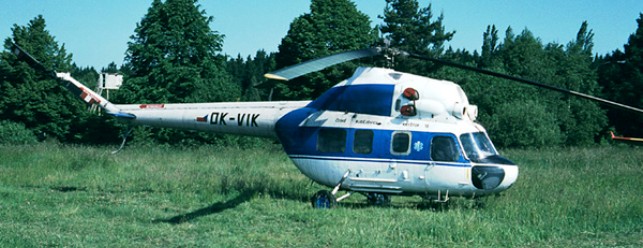
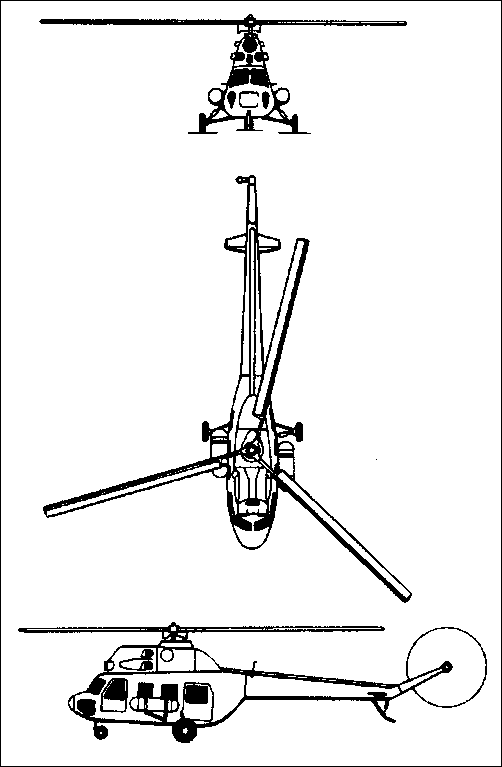
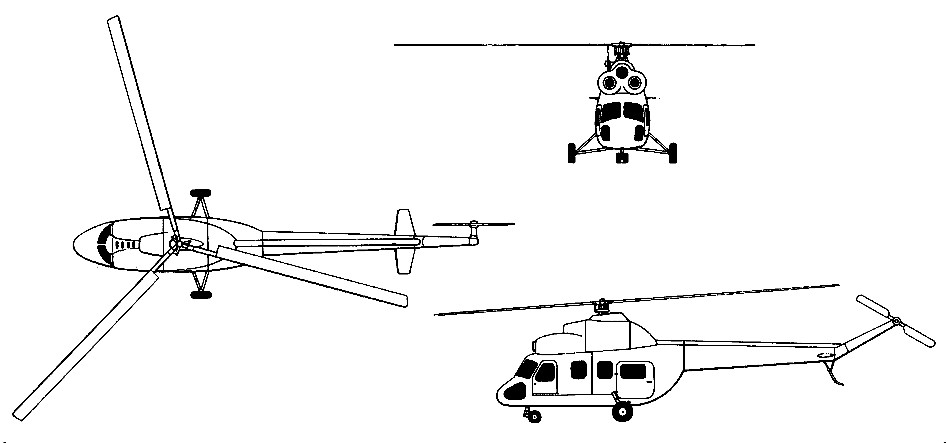
In the mid fifties, the Mil bureau decided to improve the performance of the Mi-1 by developing a turbine-powered version. The Mil Mi-2, which has the NATO reporting name Hoplite, was first announced in the autumn of 1961, and is essentially the Mi-1 updated in the light of operating experience with the Mi-6. The Mil Mi 2 is frequently referred to as V 2, the “V” indicating “Vertolet”, Russian for ‘rotary wing’.
Two of the new Isotov GTD-350 free-turbine engines were chosen. A free-turbine engine enables the r.p.m. of the rotor to be varied, whilst those of the engine are kept constant. For half the weight of the earlier piston engine, the two GTD-350 developed 40% more power. They were installed side-by-side above the fuselage, considerably increasing the available cabin space. Two 313kW Polish-built Isotov GTD-350 turboshafts, mounted side by side above cabin. Fuel in single rubber tank, capacity 600 litres, under cabin floor. Provision for carrying 238 litre external tank on each side of cabin. Refuelling point in starboard side of fuselage. Oil capacity 25 litres.
The first prototype, designated V-2 and then Mi-2, flew on 22 September 1961; it had the same rotor, transmission and tail unit as the Mi-1. After preliminary trials, a metal tail rotor was adopted (the Mi-1 had a wooden one) and later, from 1965, a new main rotor hub derived from that of the Mi-6.
A completely new fuselage, all light-alloy monocoque with steel forgings at concentrated loads, the structural basis was a deep floor box carrying wheel or ski landing gears and housing flexible fuel cell of 600 litres. Normal accommodation for one pilot on flight deck (port side). Seats for up to eight passengers in air conditioned cabin, comprising back to back bench seats for three persons each, with two optional extra starboard side seats at rear, one behind the other. All passenger seats removable for carrying up to 700kg of internal freight. Access to cabin via forward-hinged doors on each side at front of cabin and aft on port side. Pilot’s sliding window jettisonable in emergency. Ambulance version has accommodation for four stretchers and medical attendant, or two stretchers and two sitting casualties. Side by side seats and dual controls in pilot training version. Cabin heating, ventilation and air conditioning standard. Option of four stretchers and attendant, or slung load of 1.2t or two 600 lit ag containers. All versions plumbed for two 250-lit auxiliary tanks on sides.
The three-blade main rotor has hydraulic blade vibration dampers; flapping, drag and pitch hinges on each blade; anti-flutter weights on leading-edges, balancing plates on trailing-edges. Coil spring counterbalance in main and tail rotor systems; pitch change centrifugal loads on tail rotor carried by ribbon-type steel torsion elements. Blades do not fold; rotor brake fitted. Main rotor blade section NACA 230-12M. Main rotor shaft driven via gearbox on each engine; three-stage WR-2 main gearbox, intermediate gearbox and tail rotor gearbox; main rotor/engine rpm ratio 1:24.6, tail rotor/engine rpm ratio 1:4.16; main gearbox provides drive for auxiliary systems and take-off for rotor brake; freewheel units permit disengagement of failed engine and autorotation.
Each individual rotor blade used to be of typical Mil construction, with some 20 bonded sections attached to a light alloy spar, with a light aluminium honeycomb trailing edge, the whole being covered in light alloy sheet. WSK-PZL-Swidnik have since developed a more advanced rotor blade based on an extruded duralumin spar with plastic sections and covering. Subsequently developed as production Mi-2 with bonded/welded fuselage, hub with hydraulic instead of friction dampers, bleed-air anticed intakes, tail rotor with bonded-metal honeycomb blades and electro-thermal de-icing on all blades.
Flying controls have a hydraulic system for cyclic and collective pitch control boosters; variable incidence horizontal stabiliser, controlled by collective pitch lever.
The landing gear is non-retractable tricycle type, plus tailskid. Twin-wheel nose unit. Single wheel on each main unit. Oleo-pneumatic shock-absorbers in all units, including tailskid. Main shock-absorbers designed to cope with both normal operating loads and possible ground resonance. Mainwheel tyres size 600 x 180, pressure 4.41 bars. Nosewheel tyres size 400 x 125, pressure 3.45 bars. Pneumatic brakes on mainwheels. Metal ski landing gear optional.
Systems include cabin heating, by engine bleed air, and ventilation; heat exchangers warm atmospheric air for ventilation system during cold weather. Hydraulic system, pressure 65 bars, for cyclic and collective pitch control boosters. Hydraulic fluid flow rate 7.5 litres/min. Vented reservoir, with gravity feed. Pneumatic system, pressure 49 bars, for mainwheel brakes. AC electrical system, with two STG-3 3kW engine-driven starter/generators and 208V 16kVA three-phase alternator. 24V DC system, with two 28Ah lead-acid batteries. Main and tail rotor blades de-iced electrically; engine air intake de-icing by engine bleed air. Electric de-icing of windscreen.
The FAI has certified as a world record the speed of 157.7mph (253.818 km/h) established in May 1963 over a 62.1 mile (100 km) closed circuit course by a twin turbine Mil Mi 2 (Hoplite) helicopter. The Russians had claimed a speed of 164mph (264 km/h). The type established a class speed record of 269.38km/h on June 20, 1965, when piloted by Tatyana Russyan.
(32 yellow) Mil Mi-2 511019039 – marked 02 yellow
The first production aircraft had 400shp engines, but from 1974 these were uprated to 450shp. Another modification was the use of fiberglass materials for the main rotor, tail rotor and stabilizer, to simplify production and improve performance. As the Russian plants were fully occupied with production of the Mi-8 and other heavy helicopters in the Mil series, an agreement was reached with WSK-Swidnik to manufacture the Mi-2 in Poland, and they took over production and development rights in 1964. The first Polish Mi-2 had flown before this in November 1963, and once trials were completed, large-scale production began in 1965. The first Polish-built production example flew on 4 November 1965.
In the ambulance role it can accommodate 4 stretchers and a medical attendant; as a freighter, it can carry 700kg of cargo. For flying crane or rescue duties it can be fitted with an under-fuselage hook for a sling load of 800kg or a winch over the cabin door capable of lifting up to 150kg.
In the Mi-2’s agricultural role, it can carry a hopper on either side of the cabin containing 450kg of dry chemical or 500l of liquid (can be replaced by additional fuel tanks) and either a spraybar to rear of cabin on each side or distributor for dry chemicals under each hopper. Swath width covered by spraying version is 40 to 45m.
For search and rescue, electric hoist, capacity 120kg, is fitted. In freight role an underfuselage hook can be fitted for suspended loads of up to 800kg. Polish press has illustrated version equipped for laying smokescreens. Electrically operated wiper for pilot’s windscreen. Freon fire extinguishing system, for engine bays and main gearbox compartment, can be actuated automatically or manually.
All production and development subsequently at WSK, involving 12 series versions including SAR, photo, anti-armour and gunship. One in service with the Polish Air Force was equipped with rocket launchers and air-to-ground missiles, slung from rails at the sides of the fuselage.
The Mi-2B has upgraded electrical and navigation systems.
The Mi-2 has undergone continuous refinement and adaptation to special versions and more than 5,250 had been built when production was suspended in 1991 pending privatisation of the company planned for 1992.
Further development of the Mi-2 has been undertaken by WSK-PZL-Swidnik with a view to selling the type to western countries. The late-1970s result is the Kania or Kitty Hawk, and Taurus, powered by two Allison turboshafts. Developed with co-operation from Allison in the USA, the Kania, which first flew on June 3, 1979, is an Mi-2 airframe powered by two Allison 250-C20B turboshafts.
The engine selected for the Kania is the Allison 250 turboshaft. WSK-PZL Swidnik have worked closely with the Detroit Diesel Allison Division of the General Motors Corporation on the installation of the two 250-C20B turboshafts, to ensure optimum location at minimum weight. The two Allison 250-C20B turboshafts, mounted side by side above cabin; each rated at 420shp / 317kW for T-O, 30 minutes twin-engine emergency power and one engine out maximum continuous power, and 370shp / 276kW for normal cruise. Automatic and manual torque sharing control systems standard. Two separate fuel boost systems, each with fuel filter bypass switch, fuel pressure gauge and switch, connected by crossfeed. Fuel tankage remains unaltered, compared with that of the Mi-2, standard usable fuel capacity of 600 litres, with provision for additional 423 litres usable in optional auxiliary tanks. Fuel quantity gauge and fuel reserve warning. Two separate oil systems, each with oil cooling, temperature and pressure gauges, oil filter bypass pop-up and chip warning. Each engine equipped with starter/generator, engine fuel pump effective for cruise after both boost pumps out, N1 and N2 tacho-generators, TOT gauge and switch, start counter, and ‘engine out’ warning. Dual engine inlet anti-icing standard, each engine compartment equipped with fire detection system and with automatic and manual fire extinguishing systems.
The smaller size of the Allison 250-C20B, compared with the Isotov GTD-350P used on the Mi-2, has made possible a smaller engine installation, and the opportunity has also been taken to recontour the nose. Rotor diameter has been increased by 6cm compared with the 14.5m of the Mi-2. The overall effect has been a reduction in empty weight of 262kg, though maximum take-off weight falls by only 150kg.
The design features a three-blade fully articulated main rotor and two-blade seesaw tail rotor. Main gearbox equipped with freewheel units, oil cooling system, oil temperature and pressure gauges and switches, tacho-generator with low- and high-rpm warning, air compressor and a spare power pad of 19.1kW at 8,000 rpm. Steel engine driveshafts, each with two crowned tooth couplings. Tail rotor driveshaft of duralumin tube, with similar crowned tooth couplings and anti-friction bearings. Hoist and cargo sling attachment points standard. Transmission includes main rotor, intermediate and tail rotor gearboxes, each with individual lubrication system. Glass fibre/epoxy blades on both rotors. Conventional semi-monocoque fuselage and circular-section tailboom. Glass fibre/epoxy horizontal stabiliser at end of tailboom.
Two prototypes were produced by converting Mi-2 airframes. The first prototype (SP-PSA) was flown on 3 June 1979 and was intended, like the standard Mi-2, to fulfil a variety of roles. It could accommodate a pilot and a maximum of nine passengers or, alternatively, pilot and copilot plus eight passengers, and the cabin seats were removable to allow use in the agricultural or air ambulance roles. Reconfigured it could carry up to 800kg of cargo, some externally slung.
Polish certification of the Kania was carried out in two stages. The first took place in 1979-81 and resulted, on 1 October 1981, in a supplementary type certificate to that of the Mi-2.
A further refined version, the Kania Model 1, has a redesigned cockpit and improved control systems, and is offered in several military configurations.
Accommodation is provided at the front of the cabin for a pilot and co-pilot or passenger, on separate seats, with eight more passengers seated on two three-abreast benches and one double or two single seats at the rear of the cabin. The Kania is intended as a general-purpose helicopter, and so the seating is removable to allow the carriage of freight, agricultural equipment and litters. Access to the cabin is gained by a small door on each side of the forward fuselage, and a larger door on the left side of the passenger compartment’s rear. To suit the type to western markets, the Kania is provided with an array of western avionics. These include dual instrument lighting systems, pilot’s cabin extension light and an adjustable landing light. Standard instrumentation includes King KX-175BE com/nav, KR-85 digital Automatic Direction Finding equipment and KT-76 transponder. An optional feature is a 16k VA AC generator for de-icing the pilot’s windscreen and cabin heating and air conditioning.
Standard equipment includes dual anti-collision lights, navigation lights, portable fire extinguisher, tool kit and first aid kit. Fluorescent tube cabin lighting and/or individual lights optional. According to mission, the Kania can be equipped with an 800kg capacity stabilised cargo sling; 120kg capacity hoist (275kg); stretchers and casualty care equipment; or equipment for a variety of agricultural duties. Polish Border Guard aircraft have Spectrolab SX-5 searchlight and HLU-100 loudspeaker system.
Flying controls have three hydraulic boosters for longitudinal lateral and collective pitch control augmentation.
The landing gear is non-retractable tricycle type, plus tailskid. Twin-wheel castoring and self-centring nose unit; single wheel on each main unit. Stomil Poznan tyres, sizes 600 x 180 mm (main) and 300 x 125 mm (nose); tyre pressure 4.0 and 3.5 bars respectively. Pneumatic brakes on mainwheels. Metal skis and emergency flotation bags optional.
The second stage of Polish certification, concerning a considerably improved Kania Model 1 version, was carried out during 1982-86 under the leadership of Stanislaw I Markisz. Improvements included among others, redesigned cockpit and cabin layout, engine and flight controls as well as engine and transmission cowlings. On 21 February 1986 this version of the Kania was granted a separate type certificate as an FAR Pt 29 (Transport Cat. B) day and night SVFR multipurpose utility helicopter with Cat. A engine isolation.
PZL Swidnik Kania (Kitty Hawk)
The number ultimately converted (to the Kania Model 1) is believed to have totalled four prototypes plus half a dozen definitive aircraft by January 1999. Production may have been discontinued in 2000.
Despite the lower power of the American engines, the performance of the Kania is comparable with that of the Mi-2 except in range, where the Kania appears to be superior by a small margin.
Polish production at standstill early 1992, but reported continuing on limited basis. A total of 5,450 were built for civil and military operators by January 1999, a majority exported.
In 1988, the PZL W-3 Sokol replaced the Mi-2 in production. PZL’s W-3 Sokol (Falcon), which flew in 1979, was based on the Mi-2 but had new engines, rotors and a larger cabin.
Mi-2 Standard civil version available as convertible 6/8-passenger or cargo transport, crop sprayer (identified as the Bazant), pilot trainer, aerial photography, photogrammetry or as freight hauler with external sling and electric hoist
Mi-2 Engine: 2 x PZL Rzeszow GTD-350 Instant pwr: 294 kW Rotor dia: 14.56 m MTOW: 3550 kg Payload: 800 kg Useful load: 1140 kg Max speed: 113 kts Max cruise: 105 kts Max range (ferry): 580 km HIGE: 5167 ft HOGE: 2870 ft Service ceiling: 13,123 ft Crew: 1 Pax: 8
Mi-2 Engine: 2 x Isotov GTD-350 Installed pwr: 670 kW Rotor dia: 14.5 m Fuselage length: 11.9 m No. Blades: 3 Empty wt: 2370 kg MTOW: 3700 kg Payload: 800 kg Max speed: 210 kph ROC: 270 m/min Ceiling: 4000 m HIGE: 2000 m HOGE: 1000 m Fuel cap (+aux): 600 lt (480 lt) Range: 440 km Crew: 1 Pax: 8
Mi-2B Different electrical system and more modern navigational aids; manufactured in same versions (except agricultural) as basic Mi-2, and has same flight performance; empty equipped weights 2,300kg for passenger version, 2,293kg for cargo version; T-O weight unchanged; no rotor blade de-icing. Production total not large.
Mi-2Ch Chekla Radiation reconnaissance and smoke-laying conversion.
Mi-2D Przetacznik Airborne Command Post with radio communication, cipher and telephone equipment.
Mi-2FM Kajman Photogrammetry version. Only two built.
Mi-2M Engines: 2 x Izotov GTD-350P turboshaft, 331kW Main rotor diameter: 14.5m Length with rotors turning: 17.42m Height: 3.75m Max take-off weight: 3550kg Empty weight: 2402kg Max speed: 210km/h Cruising speed: 200km/h Service ceiling: 4000m Range with max payload: 170km Payload: 800kg Crew: 1-2 Passengers: 8
Mi-2P Standard eight-seat passenger, convertible all-cargo version with external sling and electric hoist.
Mi-2 Platan Minelaying conversion.
Mi-2R Agricultural version for conventional or Ultra Low Volume (ULV) dusting and spraying. Chemical hoppers mounted on each side of the fuselage; capacity 500 litres liquid or 375kg dry chemicals. Empty weight 2,372kg.
Mi-2RL SAR and air ambulance version for land use fitted with an electric hoist
Mi-2RM Anakonda SAR version for naval use with two-person electric winch over port side door and air-droppable dinghies. Nine built for Polish Naval Air Arm.
Mi-2Ro Military reconnaissance version.
Mi-2RS Padalec Special contamination reconnaissance version.
Mi-2S Medevac version equipped for four litters plus attendant or two litters and two sitting patients.
Mi-2Sz Dual-control training version.
Mi-2T Military transport version.
Mi-2URN 1973 Combat support/armed reconnaissance version; as Mi-2US but with two Mars 2 launchers (each 16 S-5 57mm unguided rockets) instead of pylon-mounted gun pods; PKV gunsight in cockpit for aiming all weapons; in service from 1973.
Mi-2URP Salamandra 1976 Anti-tank version; cabin side outriggers for four 9M14M Malyutka (AT-3 ‘Sagger’) wire-guided missiles; four additional missiles in cargo compartment; in service from 1976.
Mi-2URPG Gniewosz Similar to Mi-2URP but with four Gad (9M32 Strela 2/SA-7 ‘Grail’) anti-aircraft missiles.
Mi-2US Adder Gunship version; 23mm NS-23KM cannon on port side of fuselage, two 7.62mm gun pods on each side pylon, two other 7.62mm PK-type pintle-mounted machine guns in rear of cabin.
UMi-2Ro Reconnaissance training version.
PZL-Swidnik Kania / Kitty Hawk Engines: two Alli¬son 250-C20B turboshafts Instant pwr: 313 kW Rotor dia: 14.56 m MTOW: 3550 kg Payload: 1200 kg Useful load: 1590 kg Max speed: 113 kts Max cruise: 113 kts Max range: 886 km HIGE: 8202 ft HOGE: 4511 ft Service ceiling: 13,123 ft Crew: 1 Pax: 9
PZL-Swidnik Kania Model 1 Engines: two Allison 250-C20B turboshafts, 314kW at take-off Main rotor diameter: 14.56m Length with rotors turning: 17.41m Height: 3.75m Max take-off weight: 3550kg Empty weight: 2140kg Cruising speed: 210km/h Service ceiling: 4000m Range with max payload: 497km
PZL-Swidnik Taurus two Alli¬son 250-C20B turboshafts
Mikhail Mil was a contemporary of Nikolai Kamov at the TsAGI (Central Aero and Hydrodynamic Institute) during the 1930s, was given charge of his own design bureau in 1947 and became responsible for the first Soviet helicopter to go into quantity production. The GM-1 / Mi-1.
Designed to meet a requirement for a three seat communications machine which was issued in late 1947 and originally designated GM-1 (Gelikopter Mil, or Mil helicopter), the Mi-1 first of three prototypes was completed and flown in September 1948 piloted by M.K. Baikalov (ex-Bratukhin).
1105 PZL-Swidnik SM-1 Sz 01105
The Mi-1 was a compact machine with a fully-enclosed metal-skinned fuselage. Fuselage light alloy, except for welded steel tube basis of mid-section housing engine with crankshaft horizontal and cooling fan, driving through angle box to transmission with centrifugal clutch and rotor brake. Four-seat cabin with left/right hinged doors. Fuel in welded aluminium tank 240 lit behind engine and, from about 40th production, provision for external supplementary tank of 160 lit on left side. Monocoque tail boom and pylon for tail rotor with three wooden blades. A 2.5m shaft runs from the gearbox to the tail rotor. Fixed nosewheel-type landing gear with brakes, plus long rear skid to protect tail rotor. Three-blade main rotor, blades based on A-15 and related autogyros, mixed steel/ply/fabric NACA-230 profile, fully articulated hub with friction dampers, normal speed 232 rpm. The powerplant was an Ivcheriko AI 26V radial engine driving a three bladed rotor and producing 575 hp at takeoff. Like Soviet equipment during World War II, the Mi-1 is designed to operate at very low temperatures and has anti-freeze sprays for not only the rotors but also the windscreen.
Both the first two GM-1 were lost, the second killing Baikalov after a weld failure in the tail-rotor bearing. Project taken over by Mark Gallai and V.V.Vinitskii, followed in summer 1949 by NII testing by G.A.Tinyakov and S.G.Brovtsyev. The Mi-1 reached a height of 6800m and speed of 190.5km/h. Yak-100 delayed so production was authorized as Mi-1 and delivery of the production models began in 1951. The Mi-1 made its public debut when eight took part at the Tushino Air Display in 1951, by which time it was already in production and service with the Soviet armed forces. The four seat Mi 1 was ordered into production in September 1949. NATO code name ‘Hare’.
Subsequent production of the Mi-1, both in the Soviet Union and in Poland, has been extensive. Polish production began with the standard Mi-1 late in 1955, this being built at the WSK works at Swidnik under the designation SM-1 with a licence-built version of the AI-26V engine.
Once military requirements had been met by a production run of several hundred, the Mi-1 was also widely adopted for a great variety of civil tasks, such as air ambulance duties, fish-spotting or whaling, ice patrol in polar regions, highway patrol and for carrying mail.
Mi-1
From about the 40th, the Mi-1M was produced with a 0.32m adjustable stabilizer (tailplane).
From 1957 new blades with extruded steel-tube spar. By this time the basic model was the Mi-1T, which carries only 2 passengers plus radio and fluid de-icing, the 1950 Mi-1MU which is a dual-control trainer and the 1956 Mi-1NKh (Narodnoye Khozyaistvo), a utility model for such duties as freight and mail carriage, ambulance and agricultural operations. In an agricultural role it can be fitted with spraying bars and two 250-litre tanks, carrying 400kg at the sides of the fuselage.
In 1961, the Mi-1 Moskvich passenger version was developed for Aeroflot, with an all-metal rotor of almost untapered plan, hydraulic controls, better cabin soundproofing and night flying or all-weather instrumentation. The name was dropped and the improvements were mostly standardized.
Mil produced an ambulance version, the patients carried on stretchers in streamlined pods on either side of the fuselage. Pipes connected the pods to the fuselage to allow the temperature to be controlled.
The final production run was the Mi-1T, a three-seater with different operational equipment.
In 1956, a prototype (identified in the West as Mi-3) was also evaluated. This had a four-blade rotor, wider cabin, and various other external modifications, such as two lateral stretcher panniers, but it did not enter production.
Several of the Mi-1’s supplied to foreign air forces were Polish-built, and subsequent versions included the SM-1W (pilot and 3 passengers), SM-1WS (2-stretcher ambulance), SM-1WZ (agricultural) and SM-1WSZ (dual-control trainer). Production of the Mi-1/SM-1 is thought to have been phased out around 1963 in favour of the later turbine-powered developments.
1005 PZL-Swidnik SM-2 S2-01005
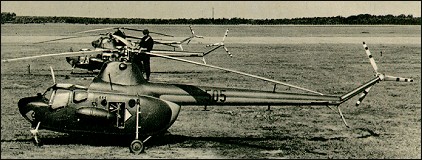
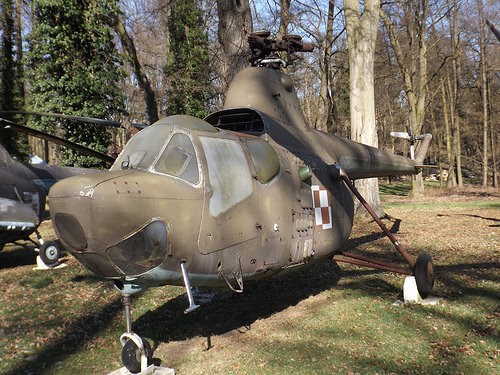
The PZL Swidnik SM-2, Polish development of the basic design was flown late in 1959. This has a longer nose, enlarging the cabin to accommodate 4 passengers in addition to the pilot. In the ambulance role, the SM-2 can take a third stretcher inside the cabin in addition to the two carried on external panniers. Production of the SM-2 was initiated in 1961 to fulfil both military and civil orders.
PZL Swidnik SM-2
Other variants include the Mi-1MRK reconnaissance and fire adjusting helicopter of 1960, Mi-1MG (Mi-1G) helicopter with float-type gear, SM-1/300 experimental helicopter with additional wing of 1971, and Mi-1M experimental helicopter with additional servo-tab of 1959.
The first armed Mi-1MU helicopter had TRS-132 rocket pods in 1958, and 4 Falanga anti-tank guided missiles in 1961. In addition to those built for the Soviet armed forces, military Mi-1’s have also been supplied to the DOSAAF and the air forces of Albania, Afghanistan, Cuba, Czechoslovakia, Finland, Iraq, Poland, Syria, the United Arab Republic and the Yemen. A wide range of duties has included those of observation, liaison, rescue, ambulance and training.
Production of the Mi-1 ended in 1961 in the Soviet Union and in 1965 in Poland.
Developed from the Mi-1, the Mi-3 has a four blade main rotor and other modifications.
Mi-1 Engine: 1 x Rybinsk AI-26V piston, 432kW Main rotor diameter: 14.35m Length without rotors: 12.05m Height: 3.28m Max take-off weight: 2550kg Empty weight: 1900kg Max speed: 190km/h Cruising speed: 140km/h Service ceiling: 4000m Hovering ceiling: 2000m Range: 360km Payload: 500kg Crew: 1 Passengers: 2
Mil Mi 1 Engine: Ivchenko AL-25 V, 424 hp Length: 39.698 ft / 12.1 m Height: 10.827 ft / 3.3 m Rotor diameter: 46.916 ft / 14.3 m Max take off weight: 5622.8 lb / 2550.0 kg Weight empty: 3880.8 lb / 1760.0 kg Max. speed: 111 kts / 205 km/h Cruising speed: 76 kts / 140 km/h Initial climb rate: 1377.95 ft/min / 7.00 m/s Service ceiling: 18045 ft / 5500 m Range: 319 nm / 590 km Crew: 1+2
Mi-1NKh Utility freight / ambulance / mail / agricultural version Engine: Ivchenko Al-26V, 575 hp Main rotor diameter: 46 ft 11 in / 14.30 m Length overall: 43 ft 6 in / 13.26 m Fuselage length: 39 ft 4.75 in / 12.01 m Empty weight: 3964 lb / 1798 kg MTOW: 4960 lb / 2250 kg Mas speed SL: 102 kt / 118 mph / 190 kph Econ cruise: 76 kt / 87 mph / 140 kph Service ceiling: 9850 ft / 3000 m Range max fuel: 205 nm / 236 mi / 380 km Range 330 lb / 150 kg payload: 188 nm / 217 mi / 350 km Crew: 1 Passengers: 5 External hopper capacity: 770 lb / 400 kg
Mi-1T Seats: 3
Mi-1U Dual control
Mi-1 Moskvich Aeroflot version Hydraulic controls
SM-1W Crew: 1 Passengers: 3
SM-1WS Ambulance version
SM-1WZ Agricultural version
SM-1WSZ Dual control trainer
PZL Swidnik SM-2 Engine: 1 x Lit-3, 425kW Main rotor diameter: 14.3m Length: 17.0m Height: 3.1m Max take-off weight: 2550kg Empty weight: 1934kg Max speed: 170km/h Cruising speed: 130km/h Ceiling: 3700m Range with max fuel: 550km
Mikhail Leontyevich Mil (died January 1970) began developing helicopters and autogyros in 1929. Mil was a contemporary of Nikolai Kamov at the TsAGI (Central Aero and Hydrodynamic Institute) during the 1930s, was given charge of his own design bureau in March 1947 and became responsible for the first Soviet helicopter to go into quantity production. The GM-1 / Mi-1.
Mi-1 first flown 1948, also manufactured by PZL-Swidnik in Poland 1956-1965. Mi-2 first flown in Soviet Union but production transferred to Poland. Enlarged Mi-4 introduced 1952, also built in China. Mi-6 with detachable wings to provide up to 20 percent of required lift in cruise flight first flown June 1957, then world’s largest helicopter, and 864 built at Rostov-on-Don (now Rostvertol) factory 1959-80, plus 50 at Moscow-Fili 1960-62. Mi-6 formed basis for Mi-22 airborne command post. Mi-8 first flown June 1961, becoming much produced medium civil and military helicopter (well over 7,000 built since 1965 and continuing), as turbine replacement for Mi-4; Mi-8 derivatives include Mi-9 tactical airborne command post (first flown 1977) and Mi-19 variant for use by commanders of tactical rocket units, Mi-17 (first flown August 1975) with change of engines and other modifications and Mi-171/Mi-172 export models, and lengthened Mi-173. Mi-10 flying crane development of Mi-6 first flown 1960, produced up to 1971. Two Mi-6 rotor/power packages used on giant Mi-12 with an overall rotors span of 67m, then the largest helicopter in world. Mi-14 became shorebased amphibious anti-submarine, SAR and mine-countermeasures helicopter (first flown August 1967). Mi-26 first flown December 1977 as very heavy lift helicopter with two powerful turboshaft engines and single eightblade main rotor, with Mi-27 as airborne-command-post derivative. Series of helicopter gunships began with Mi-24 (first flown September 1969) and joining Soviet armed forces from 1970s, with Mi-25 as export version of Mi-24D tandem-cockpit variant and Mi-35 as second and improved export variant based on upgraded versions of Mi-24; most of over 2,500 built between 1970 and 1989, though smallscale production up to 1996. The Mi-28 attack helicopter was first flown November 1982. Mi-34 first flown November 1986 as piston-engined lightweight sporting and training fourseat helicopter. Proposed new types include Mi-40 eighttroop armoured and armed assault helicopter, Mi-46 heavy transport helicopter, Mi-52 three-seat light piston helicopter, Mi-54 utility helicopter, Mi-58 medium civil helicopter, and Mi-60MAI two-seat light training helicopter. Approximately 25,000 Mil helicopters have been built. Became Mil Moscow Helicopter Plant. Has 25 percent shareholding in Euromil.
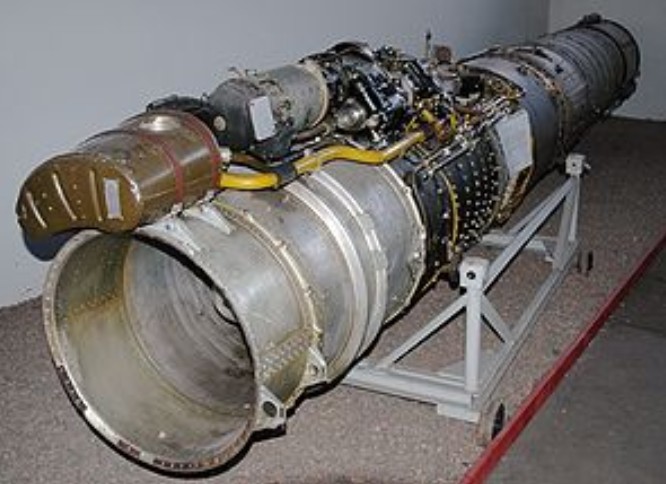
The Tumansky RD-9 (initially designated Mikulin AM-5) was an early Soviet turbojet engine, not based on pre-existing German or British designs. The AM-5 was available in 1952 and completed testing in 1953; it produced 5,732 lbf (25.50 kN) thrust without afterburner. AM-5 engine is notable for making possible the first Soviet supersonic interceptor MiG-19 and the first all-weather area interceptor Yak-25. When Sergei Tumansky replaced Alexander Mikulin as the OKB-24’s chief designer in 1956, the engine was renamed RD-9. The engine was later built under license in China as the WP-6.
Variants and applications: RD-9A
RD-9B Used in the East German civilian jetliner project Baade 152 in 1958 and 1959, replaced when Pirna 014 engines became available.
RD-9AK Non-afterburning versions for the Yak-25 and Yak-26.
RD-9AF-300 Afterburning version for the Yak-27 and Yak-28.
RD-9AF2-300 Afterburning version for the Yak-27 and Yak-28.
RD-9B Afterburning version for early MiG-19s.
RD-9BF-811 Afterburning version for later MiG-19s.
RD-9V Afterburning version used in the Ilyushin Il-40P.
WP-6 Chinese built version for the Shenyang J-6.
Specifications: RD-9BF-811 Type: Afterburning turbojet Length: 5,560 mm (219 in) Diameter: 670 mm (26 in) Dry weight: 725 kg (1,600 lb) Compressor: Axial compressor Maximum thrust: 3,000 kgf (6,600 lbf, 29 kN) military power, 3,750 kgf (8,300 lbf, 37 kN) with afterburner Specific fuel consumption: 104 kg/(h·kN) (1.02 lb/(h·lbf)) military power, 169 kg/(h·kN) (1.66 lb/(h·lbf)) with afterburner Thrust-to-weight ratio: 5.2:1
The Mikulin AM-3 (also called RD-3M) was a turbojet engine developed in the Soviet Union by Alexander Mikulin. The development of the high performance single-shaft engine began in 1948. The engine was used in different versions for the Tupolev Tu-16 and Tu-104, as well as the Myasishchev M-4. It had a single-stage blower and an eight-stage high pressure compressor, that were propelled by a two-stage high pressure turbine.
Variants: AM-3 first series version
AM-3A
AM-3D Version for M-4 with 85,6 kN thrust
AM-3M-200 AM-3M-500, AM-3M-500A: developed further versions with 93,1 kN
WP-8 Chinese copy of the AM-3 with 91,3 kN thrust for the Xian H-6 (reproduction of the Tu-16)
Specifications: Type: Turbojet engine Length: 5,380 mm Diameter: 1,400 mm Dry weight: 3,200 kg Compressor: Axial-flow Maximum thrust: 85,3 kN Specific fuel consumption: 0.932 kg (kN•h) Power-to-weight ratio:
The MiG-25 was designed to counter high-flying threats. The MiG-31 was the result of the demand to counter low-level threats, such as the B-1B and cruise missiles. Development began in 1967 and the S-155MP avionics complex was ordered for the Ye-155MP interceptor in 1968. The Ye-155MP ‘831’ was a converted Type 83 MiG-25MP, serving as the prototype of the design, and first flew on 16 September 1975. The second prototype (‘832’), with radar, first flew 22 April 1976.
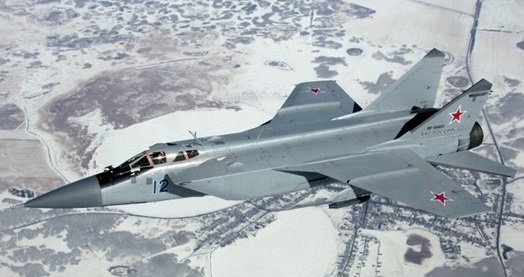
Designed as a long-range, extended-endurance PVO interceptor to replace the Tu-128 and MiG-25 based on the MiG-25 many changes were necessary to improve range and flight performance at low altitude. The fuselage was strengthened to make it suitable for supersonic flight at low level. The ‘Foxhound’ is powered by two D-30F6 turbofans which improved range drastically over the MiG-25 engines. The D-30F6 needed larger air intakes and larger exhaust nozzles. The key to success of the MiG-31 as an interceptor is the Zaslon SBI-16 phased array radar. This fire control radar is capable of tracking 10 targets at ranges up to 120 kilometers (75 miles) and engage four targets at once. Tracking and engagement is the task of the WSO which is seated behind the pilot. It is armed with four long-range R-33 (AA-9 Amos) air-to-air missiles carried under the fuselage. Two preproduction aircraft (011 and 012) built by Sokol and flown 13 July and 30 June 1977, followed by six development aircraft (201 to 203 and 301 to 303).
Full production (of about 450) started 1979 and in 1982 the NATO reporting name ‘Foxhound’ was made public. The first of 11 regiments were operational by 1983, replacing MiG-23 and Su-15 in the air defence role.
By 1987 over 150 MiG-31s were deployed across the Soviet Union, especially in the west and far east.
The MiG-31B incorporated an improved Zaslon-A fire control radar, superior long-range missiles (R-33S), additional missiles (the R-40TD medium-range missiles and R-60 short-range missiles), modernised navigation computer and new data exchange modes. The MiG-31B was also equipped with in-flight refuelling system, whereas the MiG-31BS designation was used for MiG-31B upgrades lacking this ability.
The MiG-31D was a specialised variant for the Russian equivalent of the ASAT program, carrying a single anti-satellite missile. It can be recognized by the big vertical fins at the wing tips.
In 1992 the MiG-31E (export) was first presented on the Berlin Air Show ILA. Only one aircraft was built. The MiG-31FE was a proposed multipurpose variant of the MiG-31 with improved weapons systems and avionics. It is able to operate the majority of the Russian air-to-surface missiles. Laser and TV equipment for missile guidance would have been accommodated in an external pod. Intended for export, it did not receive any orders.
The MiG-31M is a highly improved version of the original MiG-31. It has new IRST and phased-array radar to engage six targets at the same time. It is capable of carrying the R-37, which is an improved version of the R-33 AAM. And it is also capable of carrying the R-77 (AA-12 Adder), instead of the R-40TD, which was used on the MiG-31B. The cockpit was redesigned and features three colour multi function displays. Other changes include larger fuel capacity, no gun, uprated engines, aerodynamic improvements, larger brake chute housing, redesigned nosewheel. Six prototypes were built but none were ordered.
The MiG-31BM is an upgraded MiG-31B which adds an air-to-surface capability. New onboard computer systems and a new fire control radar capable of tracking up to 24 targets simultaneously.
In 2003 a MiG-31 claimed a 100 km closed circuit speed world record of 840 kts, a time to climb to 66,550 ft world record of 8 min 23 sec and an absolute altitude world record of 72,175 ft.
Kazakhstan inherited around 30 MiG-31 Foxhounds after the break up of the Soviet Union. Some of these aircraft remained in operational service.
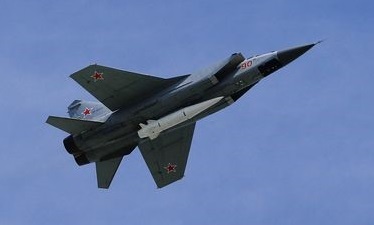
The Kinzhal hypersonic weapon, as carried by a MiG31K fighter.
Reportedly a contract with China was signed in 1992 for 24 MiG-31 interceptors. The plan included a newly set-up factory in Shenyang and were expected to enter service in 2000. At some point it was expected that at least 200 MiG-31s would be deployed by 2010. The contract was either cancelled or was never signed. Instead China opted for the Su-27/30 Flanker (J-11) as their long range interceptor.
MiG-31 Engines: 2 x D-30F6, 151.9kN Max take-off weight: 41000-46000 kg / 90390 – 101413 lb Empty weight: 29120 kg / 64199 lb Wingspan: 13.5 m / 44 ft 3 in Length: 22.7 m / 74 ft 6 in Height: 6.2 m / 20 ft 4 in Wing area: 61.6 sq.m / 663.06 sq ft Max. speed: 3000 km/h / 1864 mph Cruise speed: 2500 km/h / 1553 mph Ceiling: 20000 m / 65600 ft Range w/max.fuel: 3000 km / 1864 miles Range w/max.payload: 1200 km / 746 miles Armament: 1 x 23mm cannon, 8 missiles Crew: 2
Mikoyan Gurevich MiG 31 Fighter Interceptor and Reconnaissance, Russia, 1976 Engine : 2 Klimov R 31 F, 134691 N / 13730 kp Length : 68.898 ft / 21.0 m Height : 18.373 ft / 5.6 m Wingspan : 45.604 ft / 13.9 m Wing area : 602.784 sqft / 56.0 sq.m Max take off weight : 77175.0 lb / 35000.0 kg Weight empty : 46812.2 lb / 21230.0 kg Max. payload weight : 30362.9 lb / 13770.0 kg Max. speed : 1320 kts / 2445 km/h Service ceiling : 80052 ft / 24400 m Wing load : 128.13 lb/sq.ft / 625.0 kg/sq.m Range : 1026 nm / 1900 km Crew : 2 Hardpoints: 4 under fuselage, 4 under wing.
MiG-31B ‘Foxhound-A’ Powerplant: two 151.9 kN (34,170 lb st) Aviadvigatel D-30F6 afterburning turbofans Length 22.69m (74 ft 5¼ in) Height 6.15m (20 ft 2¼ in) Wing span 13.46m (44ft 2 in) Empty weight 21.825 kg (48,115 lb) Max Take-Off Weight 46.200 kg (101,850 lb) Max level speed at 17,500 m (57,400 ft) more than Mach 2.8 or 3.000 km/h (1,865 mph) Service ceiling 20,600m (67,600 ft) Armament: one 23mm GSh-6-23 six-barrel gun / 260 rounds; eight air-to-air missiles (4 R-33 and 4 R-60 AAMs, or 3 R-33 and 2 R-40TD AAMs)











 All Aero