Designed to provide Frontal Aviation with a tactical fighter offering secondary ground-attack capability, and capable of meeting contemporary Western fighters on more than equal terms, the MiG-23 was designed around the primary aim of an aircraft that could operate effectively without being tied to massive concrete runways. The Mikoyan bureau is known to have adopted two approaches to this requirement: first was the Ye-23 (or Ye-230) prototype of tailed-delta configuration and incorporated high-lift devices to give STOL capability, powered by a single turbofan engine supplemented by a battery of Kolesov lift-jets amidships for VTOL operations; the alternative prototype was the Ye-231, which deleted the lift-jets and replaced the delta wing by a variable-geometry wing.
The prototypes were evaluated during 1966-67, with a decision to develop the swing-wing Ye-231 finalised probably during 1968, resulting in the pre-production MiG-23S ‘Flogger-A’ which, powered by a Tumansky R-27 turbojet with an afterburning thrust of 10200kg, first entered service for operational evaluation in 1970-71.
At about this time it must have been decided to optmise the MiG-23 as an air-combat fighter, and to develop a dedicated ground-attack parallel version, which was allocated the designation MiG-27. In consequence, aerodynamic changes were made to the MiG-23, the fuselage structure being lightened and more advanced avionics being introduced by the time the initial MiG-23M version entered service in 1973. More or less simultaneously the dedicated attack variant was developed and, while having much in common with the MiG-23, this was sufficiently different to warrant the allocation of the separate designation MiG-27.
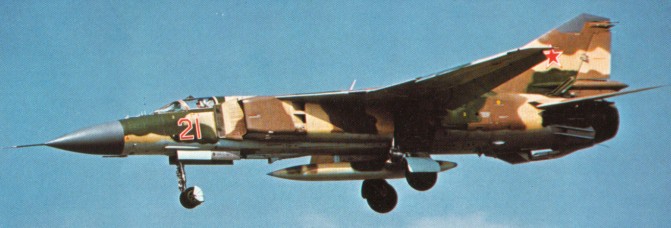
The most significant differences are the MiG-27s fixed-geometry air inlets and afterburner nozzles, which indicate a simplicity of design permitted by the mission requirement of only transonic speed, compared with Mach 2.35 attainable by the MiG-23. The aircraft is capable of carrying large variety of bombs, unguided rockets, and missiles. The twin-barreled GSh-23 cannon was replaced with Gatling-type 23-mm one.
The maiden flight was performed in August 1970. First of the MiG-27 variants, the MiG-27 ‘Flogger-D’ features a nose sharply tapered from the windscreen and containing a laser ranger and marked-target seeker, and a six-barrel 23-mrn gun is positioned beneath the belly. Pilot vision is improved for attack missions by a raised seat and canopy, and low-pressure tyres are compatible with rough-field operation. Issued in quantity to the Soviet tactical air force, Frontal Aviation, the ‘Flogger-D’ has an export counterpart in the MiG-23BN ‘Flogger F’.
About 1978, the first MiG-27s became operational with the Soviet Air Force. Flogger D is distinguished by its armoured forward fuselage, which is steeply sloped in the absence of a radar.
In 1981, the MiG-27 ‘Flogger-J’ was first noted, this differing from the ‘Flogger D’ in further nose revision, with a lip on the top and a blister fairing beneath, and leading edge extensions. Podded guns on two wing pylons have barrels which can be depressed for attacking ground targets without recourse to a steep dive.
India has acquired a production licence for the ‘Flogger-J’ and began manufacture in 1985. Hindustan Aeronautics rolled out its first locally assembled MiG-27M, known as the Bahadur, for the Indian Air Force in December 1984. The first Indian Flogger J squadrons were declared operational during 1986.
Other Flogger variants identified by Nato are the MiG-23 Flogger K interceptor with dog¬tooth notches in the wing gloves, and the MiG¬-27 Flogger J with revised under-nose sensors and leading-edge root extensions. Flogger F and Flogger H export models combine the Mig-27’s forward fuselage with the Mig-23’s airframe, intakes, and nozzle, while Flogger E has the M1G-21’s Jay Bird radar in place of the High Lark.
Both the MiG-23 and MiG-27 are in large-scale use with the former Soviet air force, an estimated 3,000 reported being operational. They served with the Warsaw Pact air forces, and were exported to t’he air arms of Algeria, Angola, Bulgaria, Cuba, Czechoslovakia, East Germany, Egypt, Ethiopia, Hungary, India, Iraq, Libya, North Korea, Poland, South Yemen, Syria and Vietnam.
MiG-27 Flogger-D Type: single-seat variable-geometry strike aircraft Engine: one 11500-kg (25,353-1b) (dry / reheat: 78 / 113 kN) thrust Tumansky R-29B-300 afterburning turbojet Wingspan, full extension (16′ sweep) 14.25 m (46 ft 9 in), fully swept (72′) 8.17 m (26 ft 9½ in) Length 16.00 m (52 ft 6 in) Height 4.35 m (14 ft 4 in) Wing area, spread 27.26 sq.m (293.4 sq ft) Maximum take-off weight: 18000-20670 kg (39,863-45570 lb) Empty wt: 10.760 kg / 28.778 lb Maximum speed Mach 1.5 at altitude / 1123 mph / 1807 kph Maximum speed Mach 1.1 at sea level Service ceiling 16000 m (52.495 ft) Range: 480 mi / 780 km Combat radius lo-lo-lo mission 390 km (242 miles) with four 500-kg (1,102-1b) bombs and two AA-2s T/O run: 900 m Ldg run: 900 m Warload: 4500 kg Fuel internal: 5750 lt Air refuel: No. Armament: one fixed six-barrel 23-mm gun Hardpoints: five weapon pylons and two rear-fuselage racks External max weight: 4000 kg (8,820 lb) Crew: 1
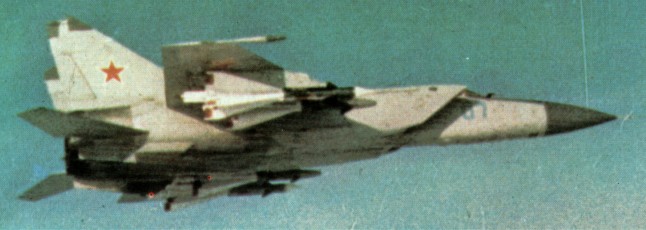
The MiG-25 was designed in 1962 to intercept high altitude, high speed aircraft such as the F-108 Rapier program, the Mach 3 capable XB-70 Valkyrie and more important the A-12 which resulted in the SR-71 spy plane. Some say the posed threat of the XB-70 was the main (and only) reason for the MiG-25 design, but MiG OKB revealed that the mean reason was to counter the A-12/YF-12 program. When the XB-70 Valkyrie development stopped in 1963, the development of the MiG-25 continued.
The bureau was instructed to ignore virtually every aspect of flight performance but outright speed, rate of climb and service ceiling in an airframe that was to be developed quickly by the use of existing technologies. This removed the possibility of delays and helped to ensure that the interceptor would be available at the time of the B-70s proposed service debut in 1964. The bureau chose a nickel-steel alloy as the primary airframe material, with titanium alloy leading edges.
The MiG-25 was later allocated the NATO reporting name ‘Foxbat’, but when news came that the North American B-70 programme had been cancelled, emphasis of MiG-25 development was shifted to high-speed reconnaissance rather than interception.
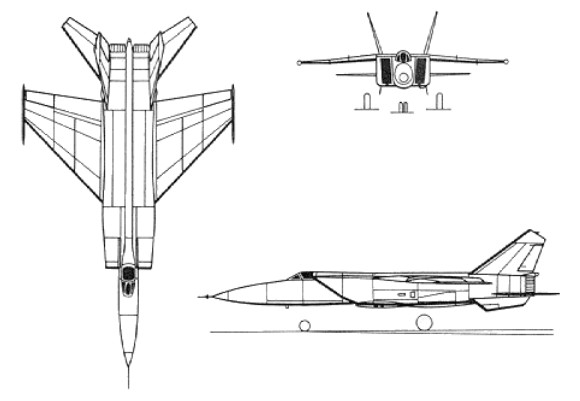
A cantilever high-wing monoplane with swept leading edges, a slender fuselage blended into the engine air inlets. With twin outward-canted vertical tail surfaces and all-moving horizontal tail surfaces, the MiG-25 is constructed primarily of steel, with titanium used for the leading edges of wing and tail unit to maintain structural integrity despite the high temperatures resulting from kinetic heating.
It has two afterburning turbo fans each capable of delivering 110 kN (24,700 lb) of thrust. It is equipped with a simple but very powerful radar for long range missile guidance. The MiG-25 relies on ground control radars for guidance to the target.
On 6 March 1964 the first MiG-25 prototype, designated Ye-155-R-1, made its maiden flight. Although this first prototype was a dedicated reconnaissance aircraft, it was soon followed up by an interceptor prototype. The Ye-155-P-1 made its first flight on 9 September 1964.
As the Ye-266. It featured a large fuselage (comprising mainly the powerplant arrangement of two Tumanskii R-31 afterburning turbojets plus their variable-geometry inlets and fully variable nozzles), high-set wings of broad chord and a modest sweep of 400 declining to 380 outboard of the outer pylon, slab tailplane halves and outward-canted vertical tail surfaces.
The first mention in the West that this aircraft, identified by the MiG design bureau as the Ye-266, had flown came in April 1965 with a Soviet claim that the aircraft had established a new speed record in a 1000km closed circuit. An E-266 achieved a speed of 1,441.5 mph (2,320 km/h) over a 1000 km closed circuit course with a 4,409 lb (2,000 kg) payload in April 1965. In October 1967 an E-266 raised this record, shortly after establish¬ing a 310 mile (500 km) closed circuit speed record (without payload) of 1852.61 mph (2981.5 kph). In the same month the E 266 also set a payload-¬to-height record by lifting a 2,000 kg load to an altitude of 98,349 ft (29,977 m). Since that time, further records have been set by the developed Ye-266M, holding the absolute world altitude record of 37650m.
On 17 May 1975 an E-266N established a climb record to 35,000m / 114,629ft of 251.3 seconds, piloted by A. Fedotov. The aircraft also re-took the time to 25,000m / 82,021ft at 154.2 seconds (piloted by A. Fedotov), to 30,000m / 98,425ft at 189.7 seconds (piloted by P. Ostapenko).
The MiG-25 was first displayed in 1967.
The Ye-155-R-1 led to the first production type of the recce MiG-25, designated MiG-25R. In 1970 these aircraft were redesignated MiG-25RB when a bombing capability was added.
In the mean time the Ye-155-P-1 led to the MiG-25P which was armed with up to four AAMs carried under the wings. The MiG-25P entered service in 1970 with the Soviet Air Forces. The MiG-25P (Foxbat-A) was the first interceptor model, improved Sapfir-25 radar, fire control and engines resulted in the MiG-25PD and PDS or Foxbat-E.
The first reconnaissance derivative to appear was the MiG-25R ‘Foxbat-B’, which features a total of five vertical/ oblique cameras in the nose section ahead of the cockpit. SLAR (SideLooking Airborne Radar) apparatus is also installed in the forward fuselage, whilst this model and the later ‘Foxbat D’ both employ a different wing of shorter span than that of the interceptor.
Apart from airbases in the Soviet military Baltic area like Bryusterport, Kaliningrad, Pllau, Palanga, Baltiysk and Riga, the Soviet Union also used support bases in Poland for reconnaissance operations over the Baltic. One of these is Kolobrzeg on the Polish coast, where the MiG-25R Foxbat-B was stationed. The Foxbat was regularly timed at speeds of almost 1,850 mph / M2.8 at altitudes of more than 70,000 ft. The MiG-25Rs of Kolobrzeg can look deep into NATO areas with long-range cameras, and to do this they fly via the GDR along the borders of the Federal Republic and Denmark. Because the Foxbat is so fast, at maximum speed it covers almost 30 miles per minute, the aircraft flying reissuance missions sometimes inadvertently flies over West European territory. So it happened that a Foxbat-B in 1983, due to starting its turn too late, flew some miles over Danish territory. The Soviet MiG-25R which, apart photographic missions, can also be used for radar reconnaissance (Foxbat-D), is part of the 24th Soviet Air Army stationed in Poland.
The variants for the recce role are the MiG-25RB/RBV/BBT and the later MiG-25RBK/RBS/RBSh and RBF models which had improved radar, sensors and cameras.
The Foxbat-B is also thought to have entered service in 1970, and it is known that four Soviet air force aircraft of this type were deployed to Egypt in the spring of 1971, making a number of forays from Cairo West to conduct reconnaissance sorties over the Israeli occupied Sinai peninsula and down Israel’s coast. Israeli attempts to intercept these with McDonnell Douglas F4E Phantoms met with no success, and the MiG-25Rs remained in Egypt until the autumn of 1975,
The ‘Foxbat-B’ was followed in due course by the Foxbat-D, generally similar in appearance although it lacks the camera installation and also incorporates a larger SLAR, located slightly farther aft and much closer to the cockpit. 1984 estimates indicate that a combined total of about 160 examples of the ‘Foxbat-B’ and ‘Foxbat-D’ models were present with Soviet tactical air forces, others having been supplied to Algeria, India, Libya and Syria since 1979. India was one of the biggest operator of MiG-25s among the export countries but was planning to have phased out the aircraft by 2005.
The conversion of more than 300 Foxbat A interceptors to MiG-25M Foxbat E standard, with more modern radar/missile combination and more powerful R- 31 F engines for better performance at lower altitude in the “look¬down/shoot- down” role. The aircraft are distinguished by a small infrared sensor under the nose. The Foxbat B also has 137.3kN uprated Tumansky R-31 turbojets.
The MiG-25BM was developed from the MiG-25RB recce-bomber. The -25BM or Foxbat-F is basically a MiG-25RB with ECM equipment instead of the recconnaissance equipment. It is developed for the suppression of enemy air defences, especially SAM radar sites and is armed with the Kh-58 stand-off anti-radiation missiles. The MiG-25 Foxbat-F is a conversion of older aircraft with AS-11 “Kilter” missiles for the anti-radar role.
The Foxbat A high-altitude interceptor was followed by a MiG-25U Foxbat C two-seat trainer. Two seat trainer variants are the MiG-25PU for the interceptor types, MiG-25RU for the recce types, and the basic MiG-25U variant. All designated as Foxbat-C by NATO.
Over 1200 have been built, of which about 75% were interceptors. Limited production of the MiG-25 series continued in 1987.
MiG-25s have been used extensively by the VVS, and versions have been exported also to Iraq. Production terminated in 1984 in favour of the MiG-31.
Operators: Russia Algeria Azerbaijan Belarus Bulgaria India Iraq Libya Syria Ukraine
Specifications:
E 266 Engines: 2 x 24250 lb (11,000 kg) st after burning turbojet engines Wing span: approx 40 ft 0 in (12.20 m) Length: approx 69 ft 0 in (21.00 m) Speed (1967 closed circuit record): 1,814,81 mph (2,920.67 km/h) over a 621 mile (1,000 km) course Crew: 1
MiG-25 Engines: 2 x Tumanski R-31, 123.0kN Max take-off weight: 35000 kg / 77162 lb Empty weight: 20000 kg / 44093 lb Wingspan: 15.0 m / 49 ft 3 in Length: 25.0 m / 82 ft 0 in Height: 6.0 m / 19 ft 8 in Wing area: 56.8 sq.m / 611.39 sq ft Max. speed: 3000 km/h / 1864 mph Ceiling: 37000 m / 121400 ft Range w/max.fuel: 2575 km / 1600 miles Range w/max.payload: 1260 km / 783 miles Crew: 1
MiG-25 Engines: 2 x Tumanski R-31 turbojet, 24,250 lb / 11,000 kg Wingspan: 45 ft 9 in / 13.95 m Length: 78 ft 1.75 in / 23.82 m MTOW: 79,800 lb / 36,200 kg Max speed: 2113 mph / 3400 kph Range: 1490 sm / 2400 km
Mig-25 Foxbat A Engine: 2 x Tumansky R-31. Installed thrust (dry / reheat): 182 / 240 kN (27,116 lb / 12,300 kg). Wingspan 45 ft 9 in (13.95 m) Length 78 ft 1.75 in (23.82 m) Height 20 ft 0.25 in (6.10 m) Wing area 611.7 sq ft (56.83 sq.m) Empty weight: 44,092 lb (20,000 kg) Maximum take-off 37,425 lb (17,011 kg) Warload: 2000 kg Max speed: 2,115 mph (3,404 km/h) or Mach 3.2 at 36,090 ft (11,000 m) Time to height: 2.5 min / 11,000 m Initial climb rate: 41,010 ft (12,500 m) per minute Service ceiling 80,050ft(24,400m) TO run: 1400 m Ldg run: 2200 m Fuel internal: 17,400 lt Air refuel: No Range:1400 mi / 2260 km Combat radius: 702miles (1,130 km) Armament: 4 x AA-6 Acrid air-to-air missile Seats: 1
MiG-25R Type: single-seat all-weather tactical/strategic reconnaissance aircraft Powerplant: two Tumansky R-31 turbojets, 11 000-kg (24,250-1b) afterburning thrust Maximum speed 3400 km/h (2,115 mph) or Mach 3.2 Service ceiling 27000 m (88,580 ft) Normal operational radius 1095 km (690 miles) Ferry range 2575 km (1,600 miles) Empty weight: 19595 kg (43,200 lb) Maximum take-off weight: 33400 kg (73,635 lb) Wingspan 13.40 m (44 ft 0 in) Length 23.82 m (78 ft 1 ¾ in) Height 6.10 m (20 ft 1/4 in) Wing area 56, 00 sq.m (603 sq ft).
MiG-25 RB Engine: 2 x Soyuz / Moscow R 15 BD 300 , 107753 N / 10984 kp Length: 70.702 ft / 21.55 m Height: 19.685 ft / 6.0 m Wingspan: 43.898 ft / 13.38 m Max take off weight: 90846.0 lb / 41200.0 kg Weight empty: 49215.6 lb / 22320.0 kg Max. speed: 1620 kts / 3000 km/h Cruising speed: 1350 kts / 2500 km/h Service ceiling: 75459 ft / 23000 m Range: 1150 nm / 2130 km Fuel capacity: 4028 gal / 15245 lt Crew: 1 Armament: 5000kg bomb
MiG-25 BM Engine: 2 x Soyuz / Moscow R 15 BD 300 , 107753 N / 10984 kp Length: 70.702 ft / 21.55 m Height: 19.685 ft / 6.0 m Wingspan: 43.898 ft / 13.38 m Max take off weight: 90846.0 lb / 41200.0 kg Weight empty: 49215.6 lb / 22320.0 kg Max. speed: 1620 kts / 3000 km/h Cruising speed: 1350 kts / 2500 km/h Service ceiling: 75459 ft / 23000 m Range: 1150 nm / 2130 km Fuel capacity: 4028 gal / 15245 lt Crew: 1 Armament: 4x Kh58 (AS-11 Kilter) 200km anti radar msl.
MiG-25PD Powerplant: two 110 kN (24,700 lb st) Soyuz/Tumansky R-15BD-300 afterburning turbofans Length 23.82m (78 ft 1¾ in) Height 6.10m (20 ft ¼ in) Wing span (over tip 14.02m (45ft 11¾ in) Weights clean 20.000 kg (44,100 lb) Max Take-Off Weight 36.720 kg (80,950 lb) Max level speed at 13.000m (42,650 ft) more than Mach 2.83 or 3.000 km/h (1,865 mph) Max level speed at sea level 1.200 km/h (745 mph) Service ceiling 20,700m (67,900 ft) Armament: up to four long range Air-to-Air Missiles such as the R-23 and R-40, and up to four short range IR guided AAMs like the R-60 and R-73A.
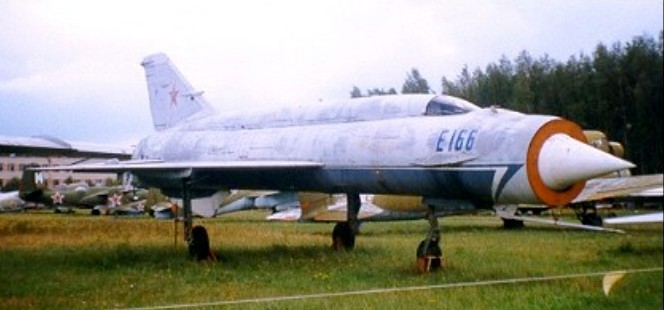
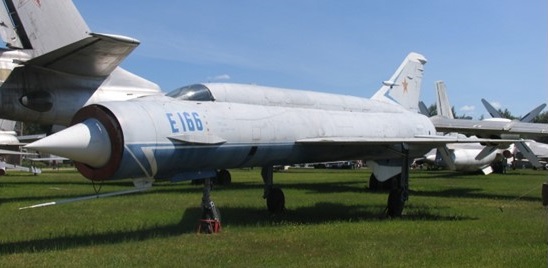
Development of the Ye-152 series of interceptors was stopped as a result of the OKB ‘s preoccupation with the Ye-155P (MiG-25P), but the remaining prototype was completed for high-speed research as the Ye-152M with an R-15B-300 engine providing an afterburning thrust of 10210kg. This aircraft established (as the Ye-166) an absolute speed record over a 100km closed-circuit of 2601km/h on 7 October 1961, and an absolute speed record of 2681km/h on 7 July 1962.
The Ye-166 was used for exploration into the structural and aerodynamic requirements of flight at speeds of more than 1864 mph (3000 km/h).
Engine: 1 x R-15B-300, afterburning thrust of 10210kg Max take-off weight: 3100 kg / 6834 lb Wingspan: 8.5 m / 27 ft 11 in Length: 18.5 m / 60 ft 8 in Max. speed: 2680 km/hr /1665 mph Crew: 1
For high speed development purposes and as a test bed for a 15-tonne engine that was being developed by the Tumansky bureau with a view to powering a proposed Mach=3.0 high-altitude interceptor (which was to materialise as the MiG-25), the MiG OKB developed what was ostensibly a pure research aircraft, the Ye-150. Powered by a Tumansky R-15-300 engine of 6840kg boosted to 10150kg with afterburning, the Ye-150 flew for the first time on 8 July 1960, and was subsequently to attain a speed of Mach=2.65 or 2816km/h and a ceiling of 22500m. Design of an all-weather high-altitude interceptor based on the research aircraft had paralleled work on the Ye-150. As the Ye-152A, this had been adapted to take two proven R-11F-300 engines owing to development problems with the large R-15 engine which were resulting in serious delays.
In consequence, the Ye-152A interceptor fighter was ready to fly before the Ye-150 research aircraft upon which it was based, this event taking place on 10 July 1959.
Powered by two R-11F-300 engines each rated at 3900kg and 5740kg with afterburning, the Ye-152A was intended to carry the Uragan 5B radar accommodated in a large, fixed intake centrebody and a pair of MiG-developed K-9 (K-155) long-range beam-riding missiles. While the intake centrebody of the Ye-152A was non-translatable, the extreme forward fuselage with intake orifice was hydraulically movable, thus achieving the same effect as a fully-variable shock cone. The Ye-152A was overtaken by the R-15-powered Ye-152, and its flight test programme was terminated after 55 flights of which only two were made carrying K-9 AAMs.
Ye-152P
Ye-152P
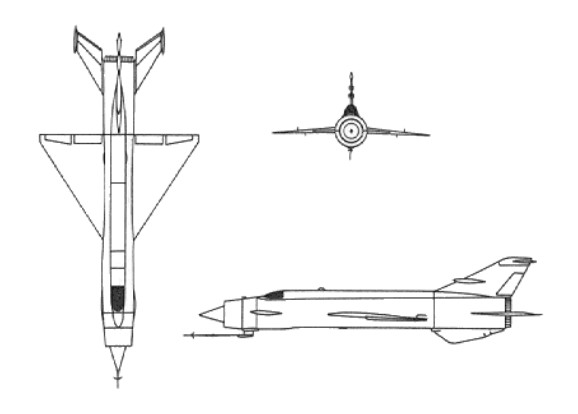
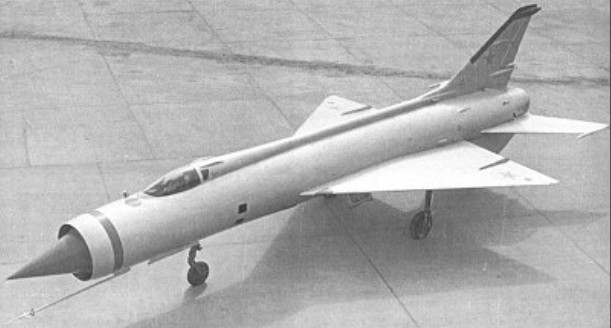
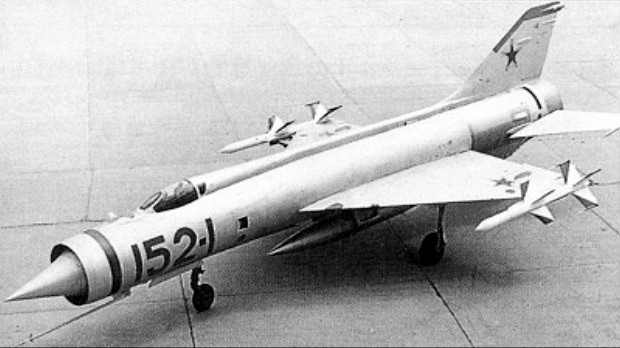
With the availability of the R-15-300 engine in acceptable form for fighter installation, the MiG OKB built two further prototypes of the Ye-152 with a single turbojet of this type supplanting the paired R-11F-300s of the Ye-152A. Retaining the systems of the Ye-152A, the Ye-152/1 and /2 were powered by the R-15-300 rated at 6890kg and boosted to 10210kg with afterburning. A larger delta wing swept back to 53° 47′ on the leading edge was fitted, and the tips terminated in launchers for two K-9 AAMs.
Equipped with Uragan 5B, the Ye-152/1 flew for the first time on 16 May 1961, and in the course of the following flight test programme, the Ye-152/2 attained 2740km/h and an altitude of 22500m, Mach=2.28 being recorded at 18000m with two K-9 missiles. Continuing development of the basic design resulted in the construction of two more prototypes, the first of these joining the test programme early in 1961 as the Ye-152P. Fitted with more sophisticated intercept and navigation equipment, the Ye-152P had a deeper and broader dorsal fairing substantially increasing internal fuel capacity and was intended to be fitted with an 3.50m canard surface which was to be free-floating at subsonic speeds and locked at supersonic speeds. In the event, this canard was not fitted.
Development of the Ye-152 series of interceptors was stopped as a result of the OKB ‘s preoccupation with the Ye-155P (MiG-25P), but the remaining prototype was completed for high-speed research as the Ye-152M with an R-15B-300 engine providing an afterburning thrust of 10210kg. This aircraft established (as the Ye-166) an absolute speed record over a 100km closed-circuit of 2601km/h on 7 October 1961, and an absolute speed record of 2681km/h on 7 July 1962.
Ye-152a Max take-off weight: 13960 kg / 3777 lb Wingspan: 8.49 m / 27 ft 10 in Length: 19.00 m / 62 ft 4 in Wing area: 34.02 sq.m / 366.19 sq ft Max. speed: 2500 km/h / 1553 mph Ceiling: 19800 m / 64950 ft
Ye-152/2 Max take-off weight: 14350 kg / 31637 lb Empty weight: 10900 kg / 24031 lb Wingspan: 8.79 m / 28 ft 10 in Length: 19.66 m / 64 ft 6 in Height: 42.02 m / 137 ft 10 in Max. speed: 2510 km/h / 1560 mph Ceiling: 22670 m / 74400 ft Range w/max.fuel: 1470 km / 913 miles
For high speed development purposes and as a test bed for a 15-tonne engine that was being developed by the Tumansky bureau with a view to powering a proposed Mach=3.0 high-altitude interceptor (which was to materialise as the MiG-25), the MiG OKB developed what was ostensibly a pure research aircraft, the Ye-150. Powered by a Tumansky R-15-300 engine of 6840kg boosted to 10150kg with afterburning, the Ye-150 flew for the first time on 8 July 1960, and was subsequently to attain a speed of Mach=2.65 or 2816 km/h and a ceiling of 22500m. Design of an all-weather high-altitude interceptor based on the research aircraft had paralleled work on the Ye-150, the Ye-152A.
The Ye-150 family of high-speed research aircraft introduced features such as stainless steel and titanium into the airframe to withstand the heat at speeds of more than 1491 mph (2400 km/h).
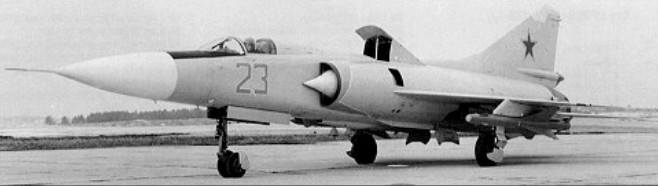
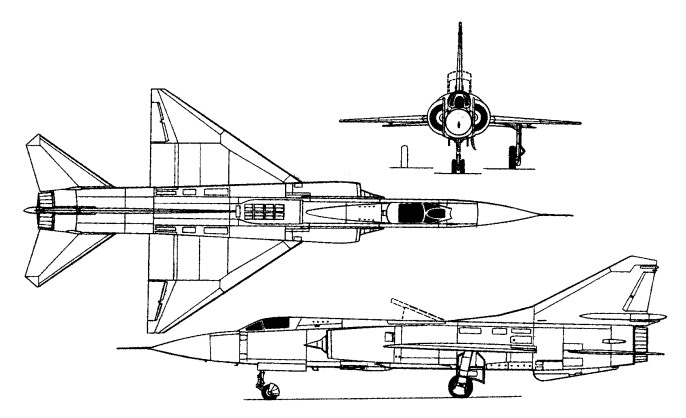
One of two parallel studies to meet a VVS requirement for a new frontal fighter capable of operating from small, austerely-equipped forward bases, the MiG-23PD – Pod’yomnye dvigateli, or, literally, “lifting engines” – or 23-01 was first flown on 3 April 1967. Featuring a 57° delta wing planform fundamentally similar to that of the MiG-21 but scaled up 73.6%, the MiG-23PD alias 23-01 featured auxiliary lift engines close to the CG. Two 2350kg Kolesov RD-36-35 engines were accommodated by a bay inserted in the centre fuselage and provided with a rear-hinged and louvred dorsal trap-type intake box and a ventral grid of transverse louvres deflecting the jet thrust during accelerating transition. A similar arrangement had been tested by the OKB in the previous year with the MiG-21PD test bed, which, with a 90cm fuselage lengthening aft of the cockpit and two RD-36-35 lift engines, had entered flight test on 16 June 1966. The primary power plant of the MiG-23PD was a Khachaturov R-27-300 of 5200kg and 7800kg with afterburning, and air was bled from the last compressor stage for flap blowing, the combination of lift engines and blown flaps reducing take-off distance to 180- 200m. Armament consisted of one 23mm GSh-23 cannon and two AAMs – one radar-guided K-23R and one IR-homing K-23T. Flight test continued until the autumn of 1967 when further development was discontinued in favour of the parallel MiG-23-11.
Engine: 1 x Khachaturov R-27-300, 5200kg – 7800kg with afterburning Max take-off weight: 18500 kg / 40786 lb Wingspan: 7.72 m / 25 ft 4 in Length: 16.80 m / 55 ft 1 in Height: 5.15 m / 16 ft 11 in Wing area: 40.00 sq.m / 430.56 sq ft
Trials in the direct-lift approach started with the MiG-21DPD to validate the basic concept, but were then taken a stage further with the Ye-230 prototype. This was built in parallel with the Ye-231 variable-geometry prototype to ensure maximum commonality for any production type resulting from the twin programmes. The Ye-230 was of tailed delta configuration, was powered by a Lyulka AL-1F-1 afterburning turbojet, and had the same type of lift engine arrangement as the MiG-21DPD, namely two turbojets (probably Koliesov units) located vertically on the centre of gravity with air drawn from above past a rear-hinged louvred dorsal door and exhausted downward through a grid of ventral transverse louvres which could be angled by the pilot to provide a forward thrust component during transition to forward flight.
The Ye-231 variable-geometry prototype was almost identical to the Ye-230 apart from its lack of lift jets and the use of variable-geometry swept wings similar to those of the General Dynamics F-111, the first operational variable-geometry warplane. Comparative trials revealed the superiority of the variable-geometry arrangement. and the Ye-231 thus became the precursor of the MiG-23 fighter, later adapted with a modified nose and simpler engine arrangements as the MiG-27 attack aeroplane.
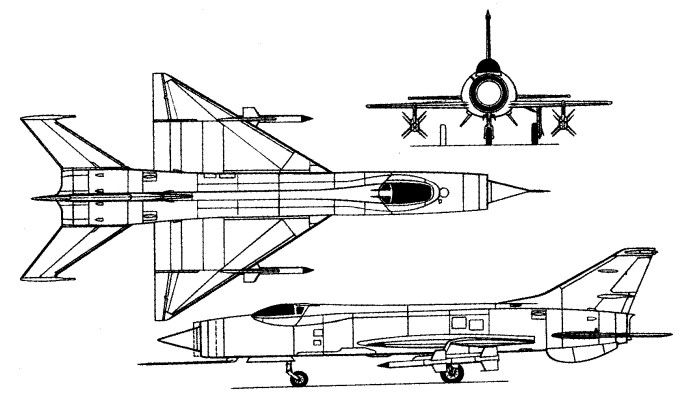
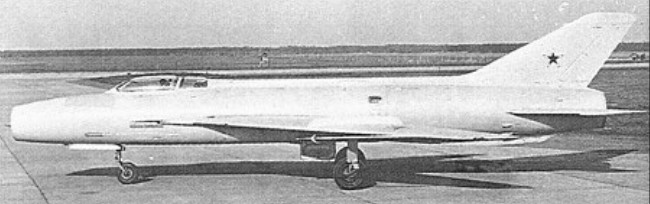
Retaining the wing of the I-7U and designed around the 30km acquisition-range Uragan 5 radar and a pair of heavy, long-range K-8 beam-riding AAMs, the I-75 was flown for the first time on 28 April 1958.
Powered by a Lyulka AL-7F-1 turbojet offering 6240kg and 9215kg with afterburning, the I-75 flew five times before being grounded on 15 May for installation of the Uragan 5B. Testing was resumed on 25 December 1958. Although the I-75 demonstrated exceptional performance, the prototype was flown only 18 times after the resumption of the test programme, which was terminated on 11 May 1959 with the decision to adopt the competitive Sukhoi T-431 for series production (as the Su-9).
Max take-off weight: 10950 kg / 24141 lb Empty weight: 8274 kg / 18241 lb Wingspan: 9.98 m / 32 ft 9 in Length: 18.27 m / 59 ft 11 in Wing area: 31.90 sq.m / 343.37 sq ft Max. speed: 2050 km/h / 1274 mph Range: 1470 km / 913 miles
Prior to abandonment of the I-3 (I-380) without flight test owing to the Klimov bureau’s inability to develop the intended VK-3 engine to an acceptable standard for installation, a further prototype had been completed as the I-3U (I-410). Similarly intended for the VK-3 engine, the I-3U (also known as the I-5) was intended to be part of the so-called Uragan (Hurricane) automated air interception system. When, in the summer of 1956, it became evident to the MiG OKB that the Klimov engine would not be forthcoming, work began on the redesign of the aircraft to take a Lyulka AL-7F turbojet of 6240kg and 9220kg with afterburning. In this form, the aircraft became the I-7U which flew for the first time on 22 April 1957. With quarter-chord sweepback reduced from the 57 deg of the I-3U to 55 deg, the I-7U carried a pair of 30mm NR-30 cannon in the wing roots and had four wing stores stations each capable of carrying a rocket pod containing 16 57mm ARS-57Ms. On 21 June 1957, the sole prototype I-7U suffered damage as a result of the starboard undercarriage leg failing when the aircraft landed following its 13th flight. After repair, the test programme was resumed but involved only six more flights, the last of these taking place on 24 January 1958. The I-7U was then re-engined with an AL-7F-1 to become the I-75.
Further development of the basic I-3 concept with the 20,500-lb (9300-kg) thrust Lyulka AL-7F, resulted in the I-7K that first flew in January 1959 and proved capable of flight at Mach 2.35. Evolution via I-7P, and I¬7P prototypes led to the I-7SF all-weather interceptor, but this too was not ordered into production.
Max take-off weight: 11540 kg / 25441 lb Empty weight: 7952 kg / 17531 lb Wingspan: 9.98 m / 32 ft 9 in Length: 16.92 m / 55 ft 6 in Wing area: 31.90 sq.m / 343.37 sq ft Max. speed: 2300 km/h / 1429 mph Range: 1505 km / 935 miles
The I-1 led to several further developments epitomized by the I-3U (1-380) fighter-bomber beaten by the Su-22, and the I-3P (with an unknown alternative designation in the I-¬380 series) radar-equipped interceptor beaten by the Su-9. The I-3 series of fighter-bomber prototypes were powered by the 18,518-lb (8400-kg) thrust Klimov VK-3 turbojet and had about double the empty weight of the initial MiG-21 variants.






 All Aero