Phillips & Powis Aircraft was formed in 1935 to take over the aircraft manufacturing business operated by Phillips & Powis Aircraft (Reading) Ltd., which had produced the initial Miles Hawk series of light aircraft.
The name changed in October 1943 to Miles Aircraft, as successor to Phillips & Powis Aircraft Ltd. at Woodley, Reading.
Developed M.33 Monitor target tug. Manufacture included M.38 Messengers, some at Newtownards, Northern Ireland, M.57 Aerovan light freighters, M.65 Gemini light twins. Also developed M.68 Boxcar, with detachable freight container; M.71 Merchantman, which was enlarged four-engined Aerovan, and M.60 Marathon feederliner, later produced by Handley Page.
Miles met financial demise and went into liquidation in November 1947, and was acquired by Handley Page (Reading) Ltd in 1947.
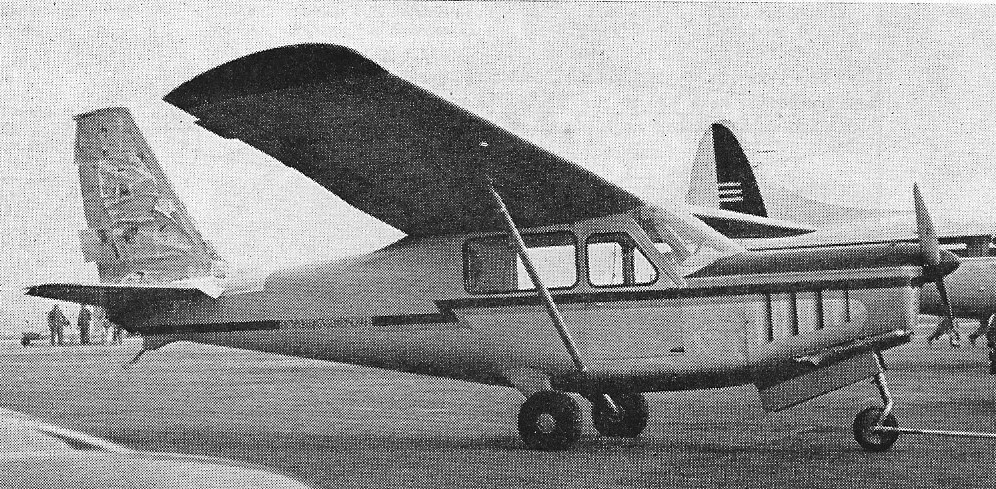
Under test during June 1959 at Stuttgart-Echterdingen, airfield in Germany, the Milan M.S,6 prototype was powered by a 105 hp Walter Minor 4-III engine.
The four-seat G.S.6 was designed by Graf v. Saurma-Jeltsch and Alfred Vogt.
During testing the prototype underwent modifications to the tail assembly.
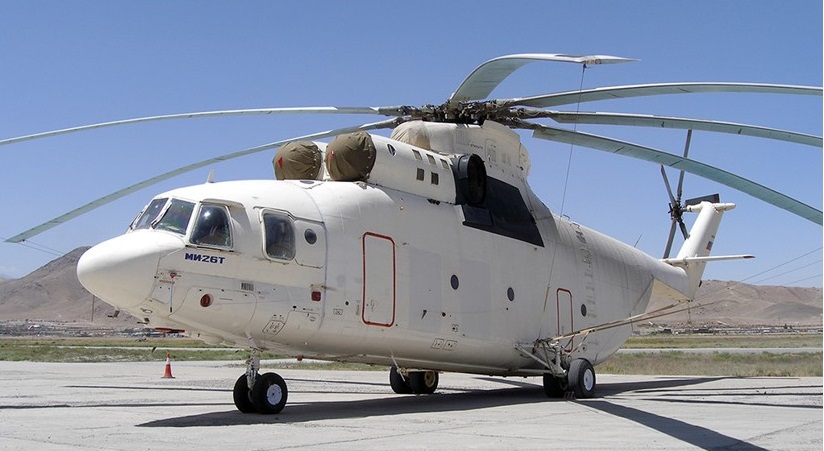
Designed to provide Aeroflot with a heavylift helicopter to assist in the exploitation of undeveloped regions, this aircraft began life in the early 1970s (initially as Mi-6M), as soon as it became clear that the V-12 was not going to fulfil this role. It required the design and development of a completely new rotor and transmission system, plus the need to meet an official requirement that the aircraft’s empty weight should be only half that of its maximum take-off weight, meant that it was not until 14 December 1977 that the V-26 prototype achieved its first hovering flight. NATO name Halo.
Weight has been saved by in-house design of the main gearbox providing multiple torque paths, GFRP tail rotor blades, titanium main and tail rotor heads, main rotor blades of mixed metal and GFRP, and use of alumimum-lithium alloys in airframe.
Equipped with a rear-loading ramp/doors, the main rotor rpm is 132, and the main rotor spindle is inclined forwards 4 degrees. Flying controls are hydraulically powered cyclic and collective pitch controls actuated by small parallel jacks, with redundant autopilot and stability augmentation system inputs. A fly-by-wire system flight was tested in 1994.
An eight-blade constant-chord main rotor has flapping and drag hinges, droop stops and hydraulic drag dampers. No elastomeric bearings or hinges, each blade has a one-piece tubular steel spar and 26 GFRP aerofoil shape full-chord pockets, honeycomb filled, with ribs and stiffeners and non-removable titanium leading-edge abrasion strip. Blades have moderate twist, taper in thickness toward tip, and are attached to small forged titanium head of unconventional design. Each has ground-adjustable trailing-edge tab. A five-blade constant-chord tail rotor on the starboard side, has GFRP blades and forged titanium head. A conventional transmission, with tail rotor shaft inside cabin roof, all-metal riveted semi-monocoque fuselage with clamshell rear doors, and flattened tail boom undersurface. The engine bay is of titanium for fire protection. All-metal tail surfaces and swept vertical stabiliser/tail rotor support are profiled to produce sideways lift. There is a ground-adjustable variable incidence horizontal stabiliser.
Landing gear is a non-retractable tricycle type with twin wheels on each unit. The steerable nosewheels have tyre size 900×300, and mainwheel tyres size 1,120×450. A retractable tailskid is at the end of the tailboom to permit unrestricted approach to the rear cargo doors. The length of the main legs is adjusted hydraulically to facilitate loading through rear doors and to permit loading on varying surfaces. A device on main gear indicates takeoff weight to flight engineer at lift-off, on panel on shelf to rear of his seat.
Power if from two 8,500kW ZMKB Progress (Soloviev) D-136 free-turbine turboshafts, side by side above cabin, forward of main rotor driveshaft. Air intakes fitted with particle separators to prevent foreign object ingestion, and have both electrical and bleed air anti-icing systems. Above and behind is central oil cooler intake. VR-26 fan-cooled main transmission, rated at 14,914kW, with air intake above rear of engine cowlings. System for synchronising output of engines and maintaining constant rotor rpm; if one engine fails, output of other is increased to maximum power automatically. Independent fuel system for each engine; fuel in eight underfloor rubber tanks, feeding into two header tanks above engines, which permit gravity feed for a period in emergencies; maximum standard internal fuel capacity 12,000 litres; provision for four auxiliary tanks. Mi-26TS normal capacity is 13,020 litres. Two large panels on each side of main rotor mast fairing, aft of engine exhaust outlet, hinge downward as work platforms.
Crew of five on flight deck: pilot (on port side) and co-pilot side by side, tip-up seat between pilots for flight technician, and seats for flight engineer (port) and navigator (starboard) to rear; upgrade proposal revealed in early 2001 involves installation of new avionics and will result in reduction of flight deck crew to three. Four-seat passenger compartment aft of flight deck. Loads in hold include two airborne infantry combat vehicles and a standard 20,000kg ISO container; about 20 tip-up seats along each sidewall of hold; maximum military seating for 90 combat-equipped troops; alternative provisions for 60 stretcher patients and four/five attendants. Heated windscreen, with wipers; four large blistered side windows on flight deck; forward pair swing open slightly outward and rearward. Downward-hinged doors, with integral airstairs, at front of hold on port side, and each side of hold aft of main landing gear units. Hold loaded via downward-hinged lower door, with integral folding ramp, and two clamshell upper doors forming rear wall of hold when closed; doors opened and closed hydraulically, with back-up hand pump for emergency use. Two LG-1500 electric hoists on overhead rails, each with capacity of 2,500kg, enable loads to be transported along cabin; winch for hauling loads, capacity 500kg; roller conveyor in floor and load lashing points throughout hold. Flight deck fully air conditioned.
It has a cargo hold 3.20m wide, 3.15m/ 10.25 ft high and 15m/49 ft deep. The maximum payload is 5000kg or 70-100 passengers. The helicopter has a crew of four, with room for an additional handler, and has a full range of navigational electronics and an automatic hover system.
Two main and one emergency hydraulic systems, operating pressure 157 and 206 bar. Electrical system three-phase 200/115V 400Hz; single-phase 115V 400Hz; three-phase, 36V 400Hz; single-phase 36V 400Hz; DC 27V. TA-8V 119kW. APU under flight deck, with intake louvres (forming fuselage skin when closed) and exhaust on starboard side, for engine starting and to supply hydraulic, electrical and air conditioning systems on ground. Electrically heated leading-edge of main and tail rotor blades for anti-icing. Only flight deck pressurised.
Systems include: Radar: Groza 7A813 weather radar in hinged (to starboard) nosecone. Flight: Integrated PKV-26-1 flight/nav system and automatic flight control system, Doppler, map display, HSI, and automatic hover system. Optional GPS. Self-defence: Military versions can have IR jammers and suppressors, IR decoy dispensers and colour-coded identification flare system.
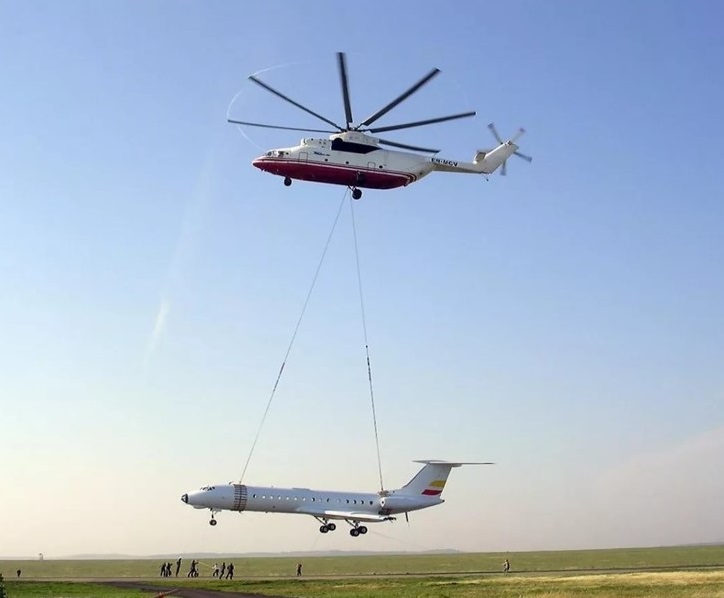
A hatch for a load sling is in the bottom of the fuselage, in line with the main rotor shaft, the sling cable attached to internal winching gear. Closed-circuit TV cameras observe slung payloads. Specialised versions can utilise firefighting equipment.
Mi-26T
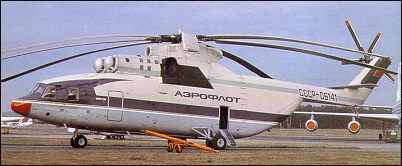
The first production aircraft rolled out in October 1980 and one of several prototype or preproduction Mi-26s (SSSR-06141) was displayed at the 1981 Paris Air Show. In-field evaluation began early 1982 and the type was fully operational in 1983. The production model carries a crew of five, and up to 85 combat-equipped troops, or two airborne infantry combat vehicles. More than 50 were in service in 1987.
On 3 February 1982, as just one of a string of new records established by the Mi-26, a “standard production” Mi 26 lifted a total mass (helicopter plus payload) of 56768.8kg to a height of 2000m. Also in February, 1982, set several load to height records, including lifting 25,000 kg (55,115 lbs) to 4,100 metres (13,451 ft).
In a series of flights with different crews the helicopter set various records; 25,000 kg / 55,115 lb to 4100m / 13,451 ft 20,000 kg / 44,092 lb to 4600m / 15,092 ft 15,000 kg / 33,069 lb to 5600m / 18,373 ft 10,000 kg / 22,046 lb to 6400m / 20,997 ft
The Mi-26 is reported to have entered service with Aeroflot in either 1982 or 1983.
India is the only export customer to 1987, with an order for ten. The first two were delivered in June 1986.
Production continued at low rate, with manufacture and marketing by Rostvertol.
Mi-26T
Nearly 300 were built by 2001. Reportedly sold to about 20 countries; operators include Belarus (15), Cambodia (two), Congo Democratic Republic (one), India (10), Kazakhstan, North Korea (two), South Korea (one), Mexico (two second-hand) in 2000, Peru (three), Russian Army (35), Russian Ministry of Emergencies, Mil-Avia and Ukraine (20). Russian Army deliveries included four in 1994.
COSTS: US$8 million to US$10 million (Mi-26T) (2000).
Mi-26A Modified military Mi-26, tested in 1985, with PNK-90 integrated flight/nav systems for automatic approach and descent to critical decision point, and other tasks. Not adopted.
Mi-26T Basic civil transport (Izdelie 209), generally as military Mi-26. Production begun in 1985. Variants include Geological Survey Mi-26 towing seismic gear, with tractive force of 10,000kg or more, at 180 to 200km/h at 55 to 100m for up to 3 hours. The mockup of an Mi-26 two-crew flight deck was shown al the 1997 Moscow Air Show and was again displayed at Farnborough 2002, when Rostvertol said decision to install new avionics on helicopter dependent upon outcome of discussions undertaken at Farnborough; if go-ahead is given, new designation Mi-26T2 will apply. New avionics suite will include PNK-26M flight-navigation system, incorporating five colour MFDs, two data input panels and a digital computer, plus GPS receiver and digital map and weather radar; increased automation will eliminate need for navigator/communications operator and flight engineer, although loadmaster will be retained. Military version will be adapted for night operations, using OVN-1 Skosok NVGs and GOES-321 gyrostabilised observation turret, containing a FLIR sensor and a laser range-finder. No designation has been announced for military versions.
Mi-26TS (sertifitsywvannyi: certified) Mi-26T (Izdelie 219), but prepared for certification and marketed (in West as Mi-26TC) from 1996. Preproduction version, with gondola (port, front), positioned a 16,000kg TV tower, 30m long, in Rostov-on-Don in 1996. One delivered to Samsung Aerospace Industries in South Korea on 13 Septernher 1997; supplied with Twin Bambi Bucket fire-suppressant system and fulfils dual transport/ firefighting roles. This version is subject of upgrade proposal involving installation of new avionics suite and other improvements that will reduce crew numbers from five to three and offer benefits in area of operational effectiveness; if implemented, is expected to result in improved helicopter becoming available in about 2006.
Mi-26MS Medical evacuation version of Mi-26T, typically with intensive care section for four casualties and two medics, surgical section for one casualty and three medics, pre-operating section for two casualties and two medics, ambulance section for five stretcher patients, three seated casualties and two attendants; laboratory; and amenities section with lavatory, washing facilities, food storage and recreation unit. Civil version in use by MChS Rossii (Ministry of Emergency Situations). Alternative medical versions available, with modular box-laboratories or fully equipped medical centres that can be inserted into the hold for anything from ambulance to field hospital use. As field ambulance can accommodate up to 60 stretcher patients; or seven patients in intensive care, 32 patients on stretchers and seven attendants; or 47 patients and eight attendants in other configurations, which can include 12 bunks in four tiers forward, or patent Rostvertol box laboratory behind the first row of bunks, with 16 bunks behind. The box includes an operating table, diagnostic equipment, anaesthetic and breathing equipment and other systems. Another configuration includes a larger theatre box by Heinkel Medizin Systeme and 12 stretchers behind, and the helicopter can be fitted with an X-ray laboratory or form the central element of a deployable air-portable field hospital.
Mi-26NEF-M ASW version with search radar in undernose faired radome, extra cabin heat exchangers and towed MAD housing mounted on ramp.
Mi-26P Transport for 63 passeugers, basically four abreast in airline-type seating, with centre aisle; lavatory, galley and cloakroom aft of flight deck.
Mi-26PK Flying crane (kran) derivative of Mi-26P with operator’s gondola on fuselage side, next to cabin door on port side. First produced in 1997.
Mi-26PP Reported ECM version. First noted 1986; current status unknown.
Mi-26S Hastily developed version for disaster relief tasks following explosion at Chernobyl nuclear facility; equipped with deactivating liquid tank and underbelly spraying apparatus.
Mi-26TM Flying crane, with gondola for pilot/sling supervisor under fuselage aft of nosewheels or under rear-loading ramp. First produced in 1992.
Mi-26TP Firefighting (pozharnyi) version that appeared in 1994, with internal tanks able to dispense up to 15,000 litres fire retardant from one or two vents, or 17,260 litres of water from an underslung VSU-15 bucket, or from two linked EP-8000 containers. Can fill tanks on the ground using pumps with 3,000 litres/min throughput. Prototype RA-06183 operated by Rostvertol. One delivered to Moscow Fire Brigade on 19 August 1999.
Mi-26TZ Tanker version that emerged in 1998, with 14,040 litres of T2, TS1 or R2 aviation fuel or DL, DZ or DA diesel oil fuel and 1,040 litres lubricants (in 52 jerry cans), dispensed through four 60m hoses for aircraft, or 10 20m hoses for ground vehicles. Conversion to/from Mi-26T takes 1 hour 25 minutes for each operation.
Mi-26M Upgrade under development; all-GFRP main rotor blades of new aerodynamic configuration, new ZMKB Progress D-127 turboshafts (each 10,700kW), and modified integrated flight/nav system with EFIS. Transmission rating unchanged, but full payload capability maintained under ‘hot and high’ conditions, OEI safety improved, hovering and service ceilings increased, and greater maximum payload (22,000 kg) for crane operations.
Mi-27 Two prototypes of a command support version of the Mi-26 are reported to have been built in 1988, with designation Mi-27. These feature new antennas along lower ‘corner’ of fuselage, blade and box-type and with long folded masts which are horizontal in flight, vertical when deployed on ground. Orders for production helicopters do not appear to have been placed.
Specifications:
Mi-26 Engines: 2 x ZMKB Progress D-136 Instant pwr: 14,710 kW Rotor dia: 32 m MTOW: 56,000 kg Payload: 20,000 kg Max speed: 159 kts Max range: 800 km HOGE: 5900 ft Service ceiling: 15,100 ft Crew: 5 Pax: 85
Mi-26 Halo A Engines: 2 x Lotarev D-136, 11,400 shp Installed pwr: 17,000 kW Rotor dia: 32 m Fuselage length: 33.7 m Height: 8.06m (26 ft 5.25 in) Wheelbase: 8.95m (29ft 4.5in) Tail rotor dia: 7.61m (24 ft 11.5in) No. Blades: 8 Empty wt: 28,200 kg MTOW: 56,000 kg Internal payload: 5000 kg External payload: 20,000 kg Max speed: 295 kph Cruise speed: 255 kph Ceiling: 4500 m HOGE: 1800 m Range: 800 km Crew: 5 Pax: 100
Mi-26T Engines: 2 x Progress D-126 turboshaft, 7355kW Main rotor diameter: 32.0m Length with rotors turning: 40.03m Width: 8.15m Max take-off weight: 56000kg Empty weight: 28200kg Fuel: 12000kg Max speed: 295km/h Cruising speed: 255km/h Service ceiling: 4600m Hovering ceiling, OGE: 1800m Range with 18000kg payload: 670km Payload: 20000kg Crew: 4 Passengers: 70
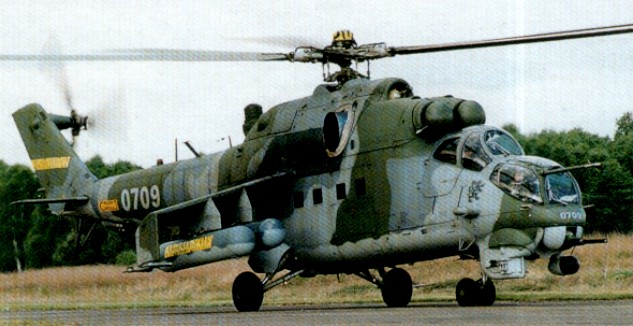
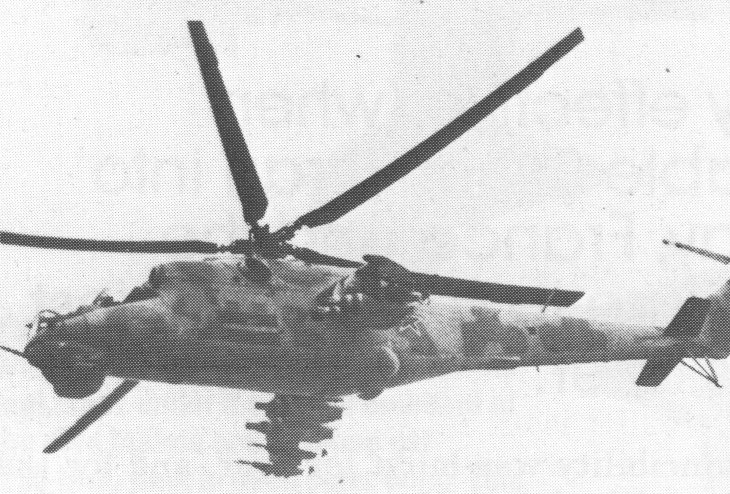
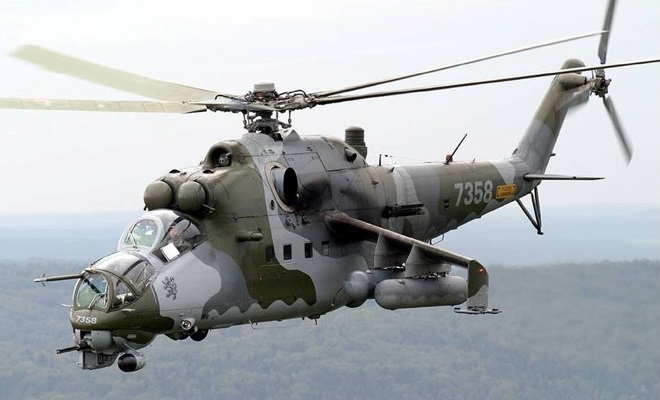
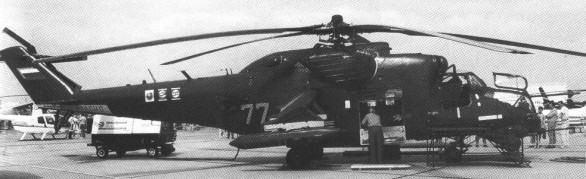
The development of the product design “240” (B-24) began immediately after the publication of the Decree of the Council of Ministers of the USSR and the Central Committee of the CPSU on May 6, 1968 at the Design Bureau of M. L. Mil, as first fire support helicopter in USSR, with accommodation for eight armed troops. Prototype machines (OP-1 and OP-2) were ready in a year. Significant part and assemblies were in common with the Mi-8 and Mi-14. Twelve prototypes were built with the first flown on 19 September 1969 (test pilot G.V. Alferov). The Mi-24 has the NATO reporting name ‘Hind’.
The prototype helicopter had a common front two-seat cockpit (the so-called “veranda”) with dual controls. Crew – pilot and operator. Later, a flight engineer was added to the crew. In the middle of the helicopter was a cargo compartment with a capacity of up to 8 personnel. On the right and left sides of the cargo compartment are double doors, with upper and lower wings. The opening windows were equipped with pivot mounts for firing during flight from personal weapons. Both cabs are sealed, supercharged by engines. Initially, the crew’s equipment included specialized flight helmets and body armor. Cabin reservation is represented by frontal bulletproof glass, armored crew seats, and local armored plates on the sides of the cabin and on the engine hoods.
Due to the unavailability of the Sturm weapons complex, it was decided on the first machines to equip the K4V complex of the Mi-4 helicopter – the Falanga-M missiles with a manual guidance system and the NUV-1 machine-gun mount with the A-12.7 machine gun, four beam holders under NUR or free-falling bombs.
Factory tests started on September 15, 1969 and almost immediately began the construction of an experimental series of ten helicopters. At the end of 1970, two machines were finished – to improve stability at speeds of more than 200 km / h, the helicopter was equipped with a wing with a negative V-12 degrees and an elongated cockpit. The first production helicopters Mi-24A (product “245”), designed in this form and equipped with the Falanga-M complex, entered the army for pilot operation.
First reported in the West in 1972, photographs became available in 1974 when two units of approximately squadron strength were based in East Germany. The Mi-24 uses the TV3 engines, transmission and rotor of the Mi-17 on a new fuselage, with stub wings carrying rockets and other offensive armament.
Two basic versions exist: the Hind A/B/C assault helicopter has a four-man crew under an extensive glasshouse canopy, while the anti-tank Hind D/E/F has a two-man crew under separate armoured glass canopies in a steel-plated forward fuselage. Both versions have stub wings to carry up to 1,500kg of stores, and eight combat equipped troops can be carried in the fuselage.
Mi-24A was produced by a factory in the city of Arsenyev. Almost 250 vehicles were built, which were put into service with the formed army aviation structures, in separate helicopter regiments of the combined arms armies and air assault brigades. On the basis of the Mi-24A, a trainer, the Mi-24U (ed. “244”) was created with full dual control.
Mi-24B (ed. ”241 ″) received a new USPU-24 machine gun mount with a YakB-12.7 machine gun (4500 h / min), the Falanga-P missile system. But the helicopter’s debugging was suspended and fundamental changes were made – the cockpit was converted into a tandem, the tail rotor and gearbox were mounted from the Mi-14 – the propeller became a pulling propeller, which sharply increased the efficiency of track control. The helicopter received the name “Mi-24V”, or product “242”. But due to the lack of knowledge of the Sturm complex, helicopters with a new cockpit had to be equipped with the Mi-24B type, and this “intermediate version” went into series under the designation Mi-24D (product “246”). Just in case, they decided not to use “G” … It took 8 years to finish the Mi-24V. In 1976, the helicopter was officially adopted and was produced in the mass series.
Thus, by 1973, the appearance of a helicopter had developed, which had become widely known throughout the world.
Mi-24 is made according to the classic single-rotor scheme with a five-blade three-joint bearing and three-blade tail rotors.
The undercarriage is three-leg, retractable, with a s steerable front wheel. In the bow of the fuselage there is a double crew cabin according to the tandem scheme: the operator-gunner is in a separate front cockpit, followed by a pilot, whose cockpit is raised by 0.3 m above the cockpit nose, the flight engineer can be located on the folding seat in the equipment compartment behind the cockpit. The crew is housed in pressurized cabins equipped with a heating and ventilation system. To prevent the entry of contaminated air and radioactive dust into them, a slight overpressure is maintained
Steel plates were used to armor the crew cabin, gearbox, engine oil tanks, gearbox and hydraulic tank. The pilot’s seat is armored, with a folding armored back and armored head, the nose is not armored, there is an armored partition between the cockpits, the windshields are armored, flat, equipped with wipers, the side convex glass is silicate, not armored.
The central section of the fuselage consists of a cargo compartment, which can accommodate up to eight paratroopers, and a rear cone-shaped part for equipment and niches for cleaning the main landing gear. The transmission and the duplicated control system are the same as on the Mi-8 helicopter.
The rotor shaft is tilted not only forward by 4.5 degrees, but also to the right by 2.5 degrees. This ensures stability during forward straight flight.
One of the main features of the helicopter is a wing with an area of 6.75 sq.m. with a negative transverse V – 12 degrees., Which provides from 22 to 28 percent of the lifting force, depending on speed and other factors.
Especially for the Mi-24 in the late 1970s, the GUV-1 helicopter gondolas (including the AGS-17 Flame automatic grenade launcher) and the GUV-8700 (one Yakb-12.7 four-barreled machine gun and two four-barrel GShG-7.62 machine guns) were created .The Mi-24 is also capable of carrying two cannon containers UPK-23-250 with a GSh-23L gun and an ammunition load of 250 shells.
At the end of the 1980s, some Mi-24Ps received 2 R-60 / R-60M air-to-air missiles to repel the attacks of enemy fighters and to combat enemy helicopters. APU with missiles mounted on internal holders. The Mi-24 is also capable of carrying two cannon containers UPK-23-250 with a GSh-23L gun and an ammunition load of 250 shells.
At the end of the 1980s, some Mi-24Ps received 2 R-60 / R-60M air-to-air missiles to repel the attacks of enemy fighters and to combat enemy helicopters. APU with missiles mounted on internal holders.
Identified by Nato is the anti-tank Hind E, armed with AT-6 Spiral missiles. A version of the Hind E without the 12.7mm Gatling-type gun in the nose, but with a twin-barrel cannon pod attached to the fuse-lage side, has been named Hind F by Nato. Hinds have also been reported carrying air-to¬-air missiles.
The Mi-24D has a gunship configuration, with stepped tandem seating for two crew and heavy weapon load on stub-wings, the fuselage is wide eniugh to carry eight troops. Dynamic components and power plant was originally as the Mi-8, but soon upgraded to Mi-17-type power plant and port-side tail rotor. Main rotor blade section NACA 230, thickness/chord ratio 11 to 12%; tail rotor blade section NACA 230M; stub-wing anhedral 12 degrees, incidence 19 degrees; wings contributing approximately 25% of lift in cruising flight; fin offset 3 degrees.
Five-blade constant-chord main rotor; forged and machined steel head, with conventional flapping, drag and pitch change articulation; each blade has aluminium alloy spar, skin and honeycomb core; spars nitrogen pressurised for crack detection; hydraulic lead/lag dampers; balance tab on each blade; aluminium alloy three-blade tail rotor; main rotor brake; all-metal semi-monocoque fuselage pod and boom; 5mm hardened steel integral side armour on front fuselage; all-metal shoulder wings with no movable surfaces; swept fin/tail rotor mounting; variable incidence horizontal stabiliser.
The landing gear is tricycle type; rearward-retracting steerable twin-wheel nose unit; single-wheel main units with oleo-pneumatic shock-absorbers and low-pressure tyres, size 720 x 320mm on mainwheels, 480 x 200mm on nosewheels. Main units retract rearward and inward into aft end of fuselage pod, turning through 90 degrees to stow almost vertically, discwise to longitudinal axis of fuselage, under prominent blister fairings. Tubular tripod skid assembly, with shock-strut, protects tail rotor in tail-down take-off or landing.
Power is from two Klimov TV3-117MT turboshafts, each with maximum rating of 1,434kW, side by side above cabin, with output shafts driving rearward to main rotor shaft through combining gearbox. There is 5mm hardened steel armour protection for engines. Main fuel tank in fuselage to rear of cabin, with bag tanks behind main gearbox. Internal fuel capacity 1,500kg; can be supplemented by 1,000kg auxiliary tank in cabin (Mi-24D); provision for carrying (instead of auxiliary tank) up to four external tanks, each 500 litres, on two inner pylons under each wing. Optional deflectors and separators for foreign objects and dust in air intakes; and infra-red suppression exhaust mixer boxes over exhaust ducts.
Pilot (at rear) and weapon operator on armoured seats in tandem cockpits under individual canopies; dual flying controls, with retractable pedals in front cockpit; if required, flight mechanic on jump-seat in cabin, with narrow passage between flight deck and cabin. Front canopy hinged to open sideways to starboard; footstep under starboard side of fuselage for access to pilot’s rearward-hinged door; rear seat raised to give pilot unobstructed forward view; anti-fragment shield between cockpits. Main cabin can accommodate eight persons on folding seats, or four stretchers; at front of cabin on each side is a door, divided horizontally into two sections, hinged to open upward and downward respectively, with integral step on lower portion. Optically flat bulletproof glass windscreen, with wiper, for each crew member.
Systems include cockpits and cabin heated and ventilated. Dual electrical system, with three generators, giving 36, 115 and 208V AC at 400Hz, and 27V DC. Retractable landing/taxying light under nose; navigation lights; anti-collision light above tailboom. Stability augmentation system. Electrothermal de-icing system for main and tail rotor blades. AI-9V APU mounted transversely inside fairing aft of rotor head. Blind-flying instrumentation, and ADF navigation system with DISS-1SD Doppler-fed mechanical map display. Air data sensor boom forward of top starboard corner of bulletproof windscreen at extreme nose.
Mission equipment includes undernose pods for electro-optics (starboard) and Raduga-F semi-automatic missile guidance (port). Many small antennae and blisters, including SRO-2 Khrom (NATO ‘Odd Rods’) IFF transponder.
Sirena-3M radar warning antennae on each side of front fuselage and on trailing-edge of tail rotor pylon. Infra-red jammer (L-166V-11E Jspanka microwave pulse lamp: ‘Hot Brick’) in ‘flower pot’ container above forward end of tailboom. ASO-2V flare dispensers under tailboom forward of tailskid assembly initially; later triple racks (total of 192 flares) on sides of centre-fuselage. Gun camera on port wingtip.
Armament is one remotely controlled YakB-12.7 four-barrel Gatling-type 12.7mm machine gun, with 1,470 rounds, in VSPU-24 undernose turret with field of fire 60 degrees to each side, 20 degrees up, 60 degrees down; gun slaved to KPS-53AV undernose sighting system with reflector sight in front cockpit; four 9M17P Skorpion (NATO AT-2 ‘Swatter’) anti-tank missiles on 2P32M twin rails under endplate pylons at wingtips; four underwing pylons for UB-32 rocket pods (each 32 S-5 type 57mm rockets), B-8V-20 pods each containing 20 80mm S-8 rockets, 130 mm S-13 and 250mm S-24 rockets, UPK-23-250 pods each containing a GSh-23L twin-barrel 23mm gun, GUV pods each containing either one four-barrel 12.7mm YakB-12.7 machine gun with 750 rounds and two four-barrel 7.62mm 9-A-622 machine guns with total 1,100 rounds or an AGS-17 Plamia 30mm grenade launcher, up to 1,500kg of conventional bombs, mine dispensers, night flares or other stores. R-60 (AA-8 ‘Aphid’), R-73 (AA-11 ‘Archer’) and Igla air-to-air missiles fitted experimentally. Helicopter can be landed to install reload weapons carried in cabin. PKV reflector gunsight for pilot. Provisions for firing AKMS guns from cabin windows.
Reconfiguration of the front fuselage changed the primary role to gunship. The new version was first observed in 1977. In the early Mi-24A the pilot sat behind the armament operator and had relatively poor forward vision but the later Mi-24D provided a raised rear seating position for the pilot and a bubble nose for the weapons position.
The Mi-24 was used operationally in Chad, Nicaragua, Ceylon, Angola, Afghanistan, Chechnya and Iran/Iraq war, when at least one Iranian F-4 Phantom II destroyed by AT-6 (NATO ‘Spiral’) anti-tank missile from Mi-24.
Low-rate production continued for export until 1994. Late models continued to be available from Rostvertol. By 1991 more than 2,300 had been built at Arsenyev and Rostov. An FAI record was set by the A-1O experimental variant of the ‘Hind’ on 2 September 1978 over a 15/25km course it achieved a speed of 368.4km/h.
The Mi-24 has been widely exported and a number are in service on most continents, with examples delivered to, or operating in, Afghanistan, Algeria, Angola, Bulgaria, Chad, Cuba, Czechoslovakia, Germany, Hungary, India, Iraq, Libya, Mozambique, Nicaragua, North Korea, Peru, Poland, Sri Lanka, Syria, Vietnam and Yemen.
Mi-35M
Some export variants of the Mi-24 are desig¬nated Mi-25 and Mi-35, indicating a different equipment standard. The Mi-35M having fixed undercarriage.
The Mil Experimental Design Bureau demonstrated a fundamentally modernized derivative, designated the Mi-24VM (Mi-35M), of the Mi-24 helicopter that has made a perfect showing under complicated combat conditions. The features of the modernization consist in modular updating of the Mi-24. Any module (unit) can be individually modernized in accordance with the customer’s request and financial potentialities.
The Mi-25 was an export version of Mi-24D tandem-cockpit variant and Mi-35 as second and improved export variant based on upgraded versions of Mi-24.
Installation of a new main rotor provided with blades made of glass fiber plastics, a hub furnished with elastolar bearings, and an X-shaped tail rotor developed for the Mi-28N helicopter, makes it possible to decrease the mass of the flying machine, increase its hovering ceiling and rate of climb, and improve its overall operating characteristics and invulnerability.
In modernizing the airframe, armament system and communications facilities, the Mil Design Bureau offers to install a shortened wing and nonretractable landing gear and retrofit the hydraulic system. The primary emphasis has been placed on an increase of weapon effectiveness. The Ataka air-to-ground guided missiles (ammunition establishment has been increased up to 16 missiles) have been introduced into the helicopter’s armament system. The missiles can also be used against air targets similar to the Igla-V guided missiles. The 12.7mm machine-gun mount has been replaced by a 23mm aircraft cannon. The most up-to-date BVK-24 computer and a laser range finder have been introduced into the heliborne equipment. A modernization program on this scale makes it possible to increase the accuracy against a single target 1.5 times, while increasing the kill zone 2 to 2.5 times when delivering cannon fire. The combat effectiveness of employing the guided missiles increases twofold on average.
The use of night-vision goggles with flight information displayed in the field of view, and equipping the helicopter with an optronic fire-control station comprising of thermal imaging and TV channels, control channel, and laser range finder, as well as display systems, enables the crew to detect and recognize targets at night and employ the heliborne weapons both by day and night.
Most of over 2,500 built between 1970 and 1989, though smallscale production up to 1996.
Mi-24 ‘Hind’ Early production version, reported in 1972 but not seen until 1973; introduced into Soviet service in 1973/74
Mi-24 ‘Hind-A’ Second production model, with tail rotor moved from the starboard to port side of the tailfin; used as armed assault helicopter, carrying eight troops and three crew members
Mi-24 ‘Hind-B’ Initial production model with tail rotor on starboard side, wings without anhedral, no wingtip stations and only four underwing hardpoints; test use only
Mi-24 ‘Hind-C’ Dedicated training helicopter similar to ‘Hind-A’, but without nose-gun installation and wingtip stations
Mi-24BMT Modified 1973 for minesweeping.
Mi-24D: (Type 24-6; ‘Hind-D’) Interim gunship version; design began 1971; entered production at Arsenyev and Rostov plants 1973; about 350 built 1973-77. Basically as late model ‘Hind-A’ with TV3-117 engines and port-side tail rotor, but entire front fuselage redesigned above floor forward of engine air intakes; heavily armoured separate cockpits for weapon operator and pilot in tandem; flight mechanic optional, in main cabin; transport capability retained; USUP-24 gun system, with rangefinding; undernose JakB-12.7 four-barrel 12.7mm machine gun in turret, slaved to adjacent KPS-53A electro-optical sighting pod, for air-to-air and air-to-surface use; Falanga P (Phalanx) anti-tank missile system; nosewheel leg extended to increase ground clearance of sensor pods; nosewheels semi-exposed when retracted.
Mi-24DU Dual-control training version has no gun turret.
Mi-24K (korrektirovchik: corrector) (‘Hind-G2’) As Mi-24R, but with large camera in cabin, f8/1,300mm lens on starboard side; six per helicopter regiment for reconnaissance and artillery fire correction; gun and B-8V-20 rocket pods retained. No target designator pod under nose; upward hingeing cover for IR sensor. About 150 built 1983-89.
Mi-24P (Type 24-3; ‘Hind-F’) Development started 1974; about 620 built 1981-90; first shown in service in 1982 photographs; P of designation refers to pushka = cannon; as Mi-24V, but nose gun turret replaced by GSh-30-2 twin-barrel 30mm gun (with 750 rounds) in semi-cylindrical pack on starboard side of nose; bottom of nose smoothly faired above and forward of sensors.
Mi-24PS Special version for Russian Ministry of Internal Affairs; prototype exhibited at Moscow Air Show ’95. Equipment includes undernose FLIR, searchlight on port side, loadspeaker pack on starboard side; hoist, climbdown ropes, stations for radio operator.
Mi-24R ‘Hind-G 1’ Fitted with wingtip ‘grapplers’ or ‘clutching hands’ apparently used in connection with NBC technology, the Mi-24R was first reported in 1986 after the Chernobyl disaster
Mi-24RKR (‘Hind-G1’) Identified at Chernobyl after April 1986 accident at nuclear power station; no undernose electro-optical or RF missile guidance pods; instead of wingtip weapon mounts, has ‘clutching hand’ mechanisms on lengthened pylons, to obtain six soil samples per sortie for NBC (nuclear/biological/chemical) warfare analysis; air samples sucked in via pipe on port side, aft of doors; datalink to pass findings to ground; lozenge-shaped housing with exhaust pipe of air filtering system under port side of cabin; bubble window on starboard side of main cabin; small rearward-firing marker flare pack on tailskid; crew of four wear NBC suits; six helicopters are deployed per regiment throughout RFAS ground forces. Designation (also appearing as Mi-24RCh) indicates Razvedchik: reconnaissance/chemical. About 150 built 1983-89.
Mi-24RR Derivative of Mi-24R for radiation reconnaissance.
Mi-24V (Types 20-1 and 24-2; ‘Hind-E’) As Mi-24D, but modified wingtip launchers and four underwing pylons; weapons include up to eight 9M114 (NATO AT-6 ‘Spiral’) radio-guided tube-launched anti-tank missiles in pairs in Shturm V (Attack) missile system; ASP-17V enlarged undernose automatic missile guidance pod on port side, with fixed searchlight to rear; R-60 (K-60; NATO AA-8 ‘Aphid’) air-to-air missiles optional on underwing pylons; pilot’s HUD replaces former reflector gunsight. Deliveries to former Soviet Air Force began 29 March 1976; about 1,000 built at Arsenyev and Rostov 1976-86.
Mi-24VM Proposed upgrade first shown in model form at Moscow Air Show ’95.
Mi-24VP Variant of Mi-24V with twin-barrel 23mm GSh-23 gun, with 450 rounds, in place of four-barrel 12.7mm gun in nose; photographed 1992; small production series built at Rostov.
Mi-24W ‘Hind-E’ Improved version of ‘Hind-D’ gunship first reported in early 1980s; equipped with 12 AT-6 ‘Spiral’ radio-guided ATMs mounted on stub wings together with AA-8 ‘Aphid’ air-to-air missiles for self-defence
Mi-24 Ecological Survey Version Modification by Polyot industrial research organisation, to assess oil pollution on water and seasonal changes of water level. First seen 1991 with large flat sensor ‘tongue’ projecting from nose in place of gun turret; large rectangular sensor pod on outer starboard underwing pylon; unidentified modification replaces rear cabin window on starboard side.
Mi-25 Export Mi-24D ‘Hind-D’, including those for Afghanistan, Cuba and India with inferior electronics.
Mi-35 Export Mi-24V ‘Hind-E’. Unarmed, dual-control trainer version also produced for India.
Mi-35M Upgraded Mi-24/35 designed to meet the latest air mobility requirements of the Russian Army.
Mi-35M1 Upgrade of production standard of Mi-24VP.
Mi-35P Export Mi-24P ‘Hind-F’.
ATE ‘Super Hind’ Upgrade configuration proposed by South Africa’s Advanced Technologies and Engineering. Derived from Denel/Kentron PZL W-3WB Huzar upgrade. Extended nose in front of cockpit with undernose Kentron IR/EO sight and 20mm chain gun, cheek fairing to port for ammunition feed, designator, improved displays, new night vision systems and provision for Denel/Kentron Ingwe or Mokopa ATMs. Prototype ZU-BOI rolled out at Grand Central Airport, Midrand, by 15 February 1999.
Tamam Mi-24 HMOSP Israeli upgrade configuration. US$20 million contract placed for upgrade of 25 (possibly Indian) Mi-24s based on existing Helicopter Multimission Optronic Stabilised Payload System, with TV, FLIR and automatic target tracker, integrated with helmet sight, digital moving map, integrated DASS and a new mission planning system. Cockpits can be reorganised to put pilot in front, weapon operator in rear.
Specifications:
Mi-24 Engine: 2 x Klimov TV3-117 Instant pwr: 1633 kW Main rotor diameter: 18.8m Height: 4.17m Empty weight: 7580kg Normal take-off weight: 10,500 kg MTOW: 11,500 kg Payload: 2400 kg Max external load: 2400 kg Internal fuel: 2100 kg Average fuel consumption: 780 l / h Max speed: 180 kts / 335km/h Max cruise: 100 kts Cruise speed: 217-270km/h HOGE: 4920 ft / 1500m Rate of climb: 12.5m/s Range: 1000km Service ceiling: 14,750 ft / 5000m Permissible roll angle: 50 degrees. Allowed pitch angle: 30 degrees. Crew: 2-3 Pax: 8
Hind-A Engines: 2 x 2200 hp / 1640 kW TV3-117 Gross weight: 22,000 lb / 9500 kg approx Max speed: 180 mph / 276 mph Armament: usually one 12.7 mm gun aimed from nose; two stub wings providing rails for four wire-guided anti-tank missiles and four other stores (bombs, missiles, rocket or gun pods). (Hind-B) two stub wings of different type with four weapon pylons.
Mi-24 Hind D Engine: 2 x Isotov TV3, 2,200-shp Installed pwr: 3280 kW Rotor dia: 17 m Fuselage length: 17.5 m Length rotors turning: 21.5 m Disc area: 226.98 sq.m Height: 6.5m No. Blades: 5 Empty wt: 8400 kg MTOW: 12,500 kg Payload: 1500 kg Max speed: 310 kph ROC: 750 m/min Service ceiling: 4500 m HOGE: 2200 m Range: 750 km Crew: 2 Pax: 8 Armament: one 12.7-mm (0.5-in) multi-barrel machine gun and up to 5,732 lb (2,600 kg) of disposable stores.
Mi-24P Primary Function: Armed assault/attack helicopter Engines: Two Klimov TV3-117 turboshafts, 1635 kW Main rotor: five blade Tail rotor: 3-blade Length: 57 ft 5 in (17.51 m) Rotor Diameter: 56 ft 9 in (17.30 m) Height: 13 ft 1 in (3.97 m) Empty: 18,078 lb (8200 kg) Maximum Takeoff: 26,455 lb (12,000 kg) Speed: 335 km/h Ceiling: 14,750 ft Range with aux. fuel: 1000 km Crew: Two Cabin: 8 troops or 14 stretchers
Mi-24VM Crew: 2-3 Rotor diameter: 17.20m Fuselage length with a gun: 18.57m Height: 4.39m Max take-off weight: 10800-11500kg Empty weight: 8090kg Max speed: 310km/h Cruising speed: 260km/h Service ceiling: 5700m Hovering ceiling: 3100m Range: 500km Fuel: 2050 lt Armament: 23mm cannon, 4 x “Ataka” anti-tank missiles, 2 x “Igla” anti-aircraft missiles, 40 x 80mm rockets
Mil Mi 24 W Engines: 2 x TW3-117WM, 2195 shp Length: 57.448 ft / 17.51 m Height: 17.946 ft / 5.47 m Rotor diameter: 56.759 ft / 17.3 m Max take off weight: 25357.5 lb / 11500.0 kg Max. speed: 181 kts / 335 km/h Service ceiling: 15092 ft / 4600 m Range: 607 nm / 1125 km Crew: 2 Armament: 1x MG 12,7mm JakB-12,7, 1200kg ext.
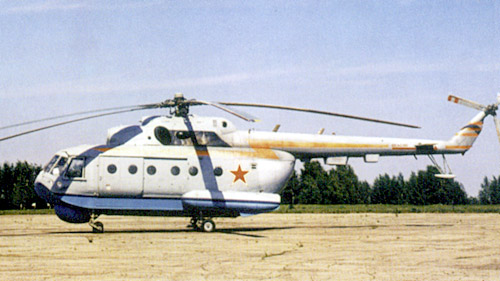
The Mi-14, allocated the NATO reporting name ‘Haze’, is an amphibious version of the Mi-8 intended to replace the Mi-4 in the ASW and mine counter-measure roles with the Soviet navy.
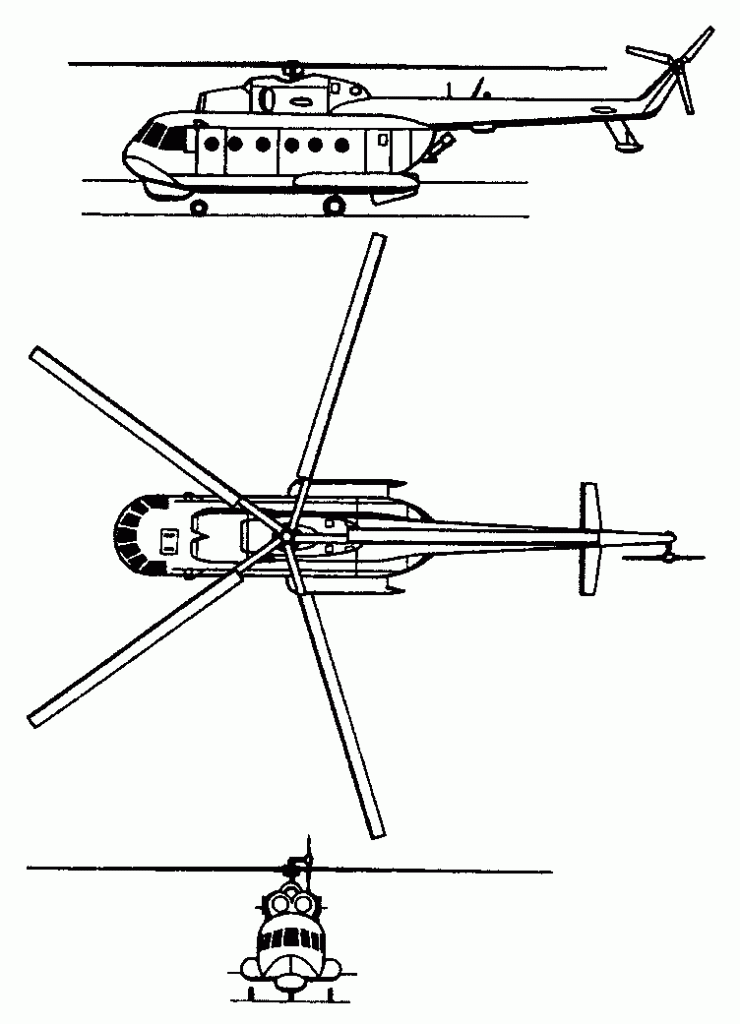
The prototype SSSR-11051, initially designated V-8G, then designated V-14, was first flown in September 1969 with a redesign watertight hull and sponsons containing fuel and a retractable undercarriage and with Mi-8 power plant. The sponson carry inflatable flotation bag each side at rear and small float the under tailboom. It has marine-type rudders on either side of the aft portion, into which the rear landing gear units retract. Two forward-retracting single-wheel nose units and two rearward-retracting twin-wheel main units. A fairing for the search radar is fitted under the nose, and a dipping sonar or magnetic anomaly detector beneath the root of the tail boom.
Production aircraft feature two 1,434kW Klimov TV3-117MT turboshafts, with a special anti-corrosion finish. Radar is the I-2M or I-2ME Initziativa undernose radar. Instrumentation includes RW3 radio altimeter, ARK-9 and ARK-U2 ADFs, DISS-15 Doppler, Chrom Nikiel IFF, AP34-B autopilot/autohover system and SAU-14 autocontrol system.
Using the twin powerplants and rotor system of the Mi-17, the ‘Haze’ went into service in 1977 and has become the basic shore-based helicopter with the Soviet navy for use in three distinct roles. Although amphibious, the Mi-14 is only intended for occasional operations from water. Initial deployment was with shore based antisubmarine units, although Haze was also expected to be oper¬ated from the Moskva Class helicopter car¬riers and the Kiev Class antisubmarine cruisers.
In the main cabin, which in transport versions can be equipped with 32 seats, a mission crew of three or four sit round a tactical display served by the radar, a towed MAD (magnetic anomaly detection) ‘bird’ and dipping sonar. Some ex¬amples have additional radio aerials and a few have a rescue hoist above the large sliding door on the left side. Fuel is housed in large tanks along the sides under the main floor, and poss-ibly also in the rear sponsons, leaving the central compartment free for use as a weapon bay, with belly doors.
Two versions have been identified: Haze A, the ASW variant with undernose search radar, towed MAD, and an internal weapons bay; and the Haze B mine countermeasures variant.
It was estimated in mid 1983 that there were 65 for the AV MF and 12 for Bulgaria. By 1991, about 230 had been delivered, with exports to Bulgaria, Cuba, East Germany, North Korea, Libya, Poland, Romania, Syria and Yugoslavia.
Mi-14BT (buksir-tralschik) (‘Haze-B’) Mine countermeasures version; fuselage strake, for hydraulic tubing, and air conditioning pod on starboard side of cabin; no MAD; container for searchlight, to observe MCM gear during deployment and retrieval, under tailboom forward of Doppler box.
Mi-14GP (gruzo-passazhirskyi) Conversion by Konvers Avia of military variants for civil use as cargo/passenger combi aircraft; 24 seats or 5,000kg payload. Two 1,434kW TV3-117M turboshafts.
Mi-14P (passazhirskyi) Conversion of military variants for civil use as passenger aircraft by Konvers Avia; 24 seats or 5,000kg payload. Two 1,434kW TV3-117M turboshafts.
Mi-14PL (protivo-lodoctinyi) (‘Haze-A’) Basic ASW version; four crew; large undernose radome; OKA-2 retractable sonar in starboard rear of planing bottom, forward of two probable sonobuoy or signal flare chutes; APM-60 towed Magnetic Anomaly Detection (MAD) bird stowed against rear of fuselage pod (moved to lower position on some aircraft); weapons include one AT-1 ASW or APR-2 torpedo, one 1kT ‘Skat’ nuclear depth bomb or eight PLAB-250, PLAB-50-64 or PLAB-MK depth charges or OMAB-25-120 or OMAB-MK in enclosed bay in bottom of hull; VAS-5M-3 liferaft (in all versions).
Mi-14PL ‘Strike’ Subvariant with provision for Kh-23 (AS-7 Kerry) air-to-surface missiles. Tested from 1983.
Mi-14PW Polish designation of Mi-14PL ‘Haze-A’
Mi-14PLM (protivo-lodochnyi mod) (‘Haze-A’) As Mi-14PL, but with updated equipment including rescue basket.
Mi-14PS (poiskovo-spasatelnyi) (‘Haze-C’) Search and rescue version, carrying 10 20-person liferafts; room for 10 survivors in cabin, including two on stretchers; provision for towing many more survivors in liferafts; fuselage strake and air conditioning pod as Mi-14BT; double-width sliding door at front of cabin on port side, with retractable rescue hoist able to lift up to three persons in basket; searchlight each side of nose and under tailboom; three crew.
Mi-14PX Single Polish Mi-14PL converted for SAR training. With all portable ASW equipment removed, extra liferafts and sponson-mounted searchlights.
Mi-14PZh Eliminator III Firefighting conversion.
Specifications:
Mi 14 ‘Haze’ Powerplant: two 2,200 shp (1641 kW) Isotov TV3 117A turboshafts Empty weight approx 800,0 kg (17,650 lb) Loaded weight approx 12000 kg (26,455 lb) Length overall about 25.30 m (83 ft 0 in) Height on ground 5. 65 m (18 ft 6½ in) Main rotor disc area 355.0 sq.m (3,828.0 sq ft).
Mi-14 Engine: 2 x Klimov TW3-117MT turboshaft Instant pwr: 1434 kW Rotor dia: 21.6 m Height: 6.93m Empty weight: 11750kg MTOW: 14,000 kg Fuselage length: 59 ft 8 in (18.2m) Max speed: 135 kts / 230km/h Cruising speed: 215km/h Service ceiling: 3500m Max range: 1135 km Service ceiling: 11,500 ft Crew: 4
Mil Mi 14 PL Engines: 2 x TW3-117M, 1923 shp Length: 60.302 ft / 18.38 m Height: 12.828 ft / 3.91 m Rotor diameter: 71.982 ft / 21.94 m Max take off weight: 30870.0 lb / 14000.0 kg Max. speed: 124 kts / 230 km/h Service ceiling: 13123 ft / 4000 m Range: 613 nm / 1135 km Crew: 4
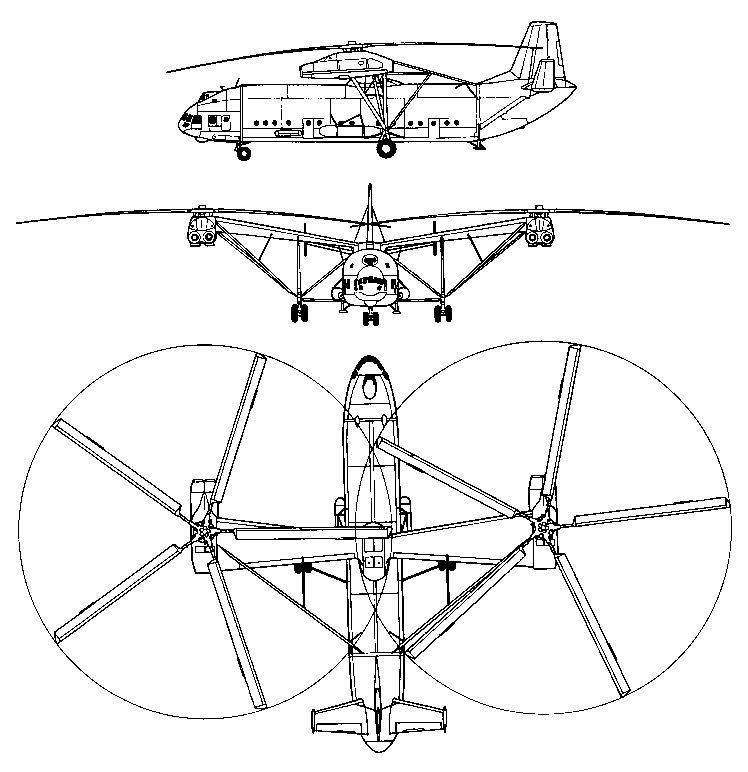
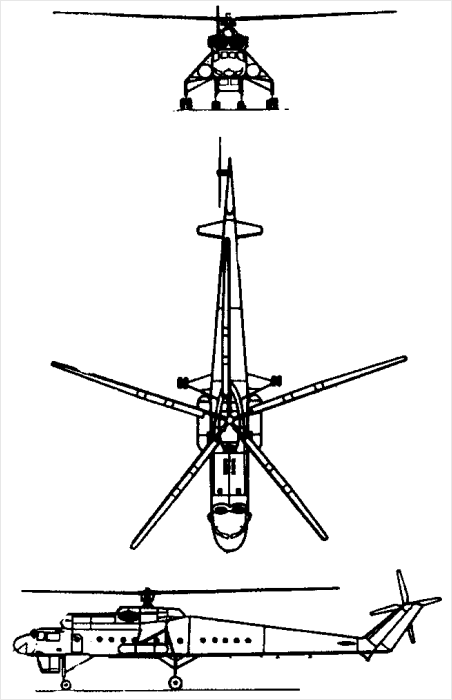
The origins of the V-12 / Mi-12 (NATO reporting name Homer) lie with a 1965 Soviet air force requirement for a heavy-lift helicopter able to carry major missile components. These would be brought into remote missile site areas by fixed-wing aircraft, notably the Antonov An-22, and then lifted from the airfield to the launch site by the new helicopter.
There also existed a civil requirement for such a machine, principally for use in developing Siberia which is resources-rich but communications-poor. The military specification, calling for a tandem-rotor configuration using dynamic system components from existing helicopters, and the V-12 has the same basic hold dimensions as the An-22: 4.4m by 4.4m, with length only 4.85m less than that of the An-22 at 28.15m.
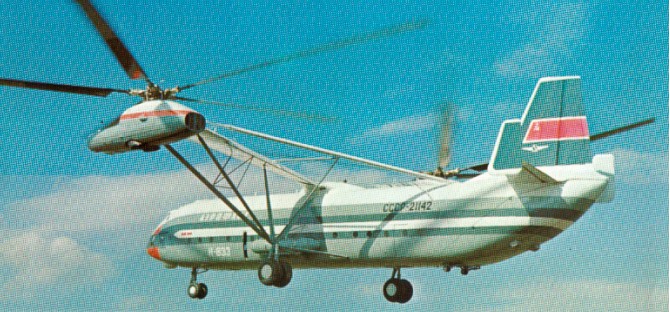
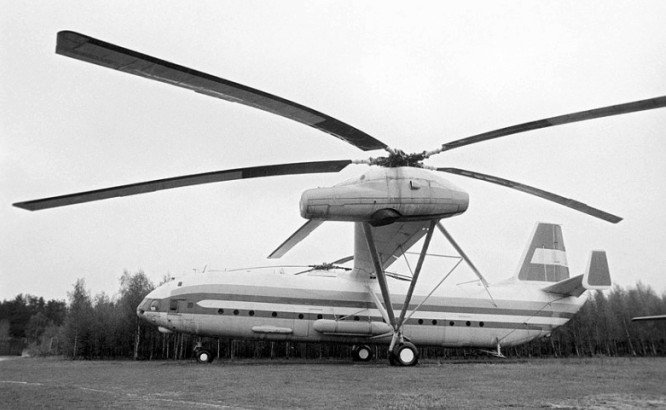
Although the requirement called for a tandem-rotor layout, Mil received early permission to concentrate instead on a twin side-by-side rotor configuration, which the design bureau claimed as having better reliability, fatigue life and stability. Thus the V-12, which first flew in the second half of 1968, appeared with a fuselage resembling that of a fixed-wing aircraft, from whose top spring two inversely tapered wings carrying the twin dynamic systems at their tips.
To avoid the task of developing new set of rotors, reduction gears and transmission, decision taken to double up Mi-6 dynamics and use two sets of Mi-6 engines, gearboxes and lifting rotors side-by-side, left rotor being mirror image, with small overlap.
The two engines are located side-by-side with twin intakes, and drive five-bladed metal rotors. The left rotor rotates anti-clockwise and the right unit clockwise; the two units are connected by transverse shafting to ensure synchronization and the continued rotation of both units in the event of engine failure at either wingtip. The lower part of each cowling can be dropped to form a working platform for mechanics.
The engines were 6500shp Soloviev D-25VF turbines giving the helicopter a maximum speed of 260km/h, with a 35400kg load and 500km range. The two 6500shp Soloviev D- 25VF turboshafts are uprated from the 5500shp of the Mi-6’s Soloviev D-25V by the addition of a zero stage to the compressor and by an increase of operating temperature. Rotor rpm reduced to 112; gearboxes linked by transverse shafting. Axes inclined forward 4deg 30min. Engine/rotor groups carried on wings of light-alloy stressed-skin construction with 8deg dihedral, sharp inverse taper and set at incidence 7deg root 14deg tip. Braced at root and tip to main landing gears with torque reacted by horizontal bracing to rear fuselage. Inner/outer trailing-edge flaps fixed in up position after flight trials. Fuel in outer wings and two external tanks; optional ferry tanks in cabin. Fixed twin-wheel landing gear with main tyres 1750 x 730mm, pneumatic brakes, and steerable nose tyres 1200 x 450mm. Large stressed-skin fuselage with crew door each side, three sliding side doors and full-section rear clamshell doors and ramp with left/right twin-wheel ventral bumpers. Aeroplane tail with fin, tabbed rudder, dihedralled tailplane with tabbed elevators, and endplate fins mounted vertically but toed inwards. Flight deck for pilot (left) with engineer behind and co-pilot (right) with elec-syst operator behind. Upper flight deck for nav with radio operator behind. Hydraulic flight control with emergency manual reversion. Autopilot with three-axis autostab; mapping radar under nose. AI-8 turbine APU for ground power and engine start. Main cabin 28.15m long, 4.4m square. Overhead gantry crane with four 1t hoists. Tip-up seats along sides (50 to 120).
Two V12 prototypes were built. Both prototypes had the same registration! This registration CCCP-21142 is in Cyrillic and means SSSR-75499. The first prototype was damaged in a heavy landing, but was repaired.
First hover 1967 terminated by impact with ground causing severe damage; cause coincidence of primary airframe aeroelastic freq with natural freq of control system, causing uncontrollable vertical oscillations.
The four Soloviev D-25 VF turboshaft engines had a combined output of 19388kW, enabling the V-12, first flown on 10 July 1968, to establish a series of records in February 1969. When submitted for ratification, was the first intimation received in the West of the existence of this giant helicopter. Later in the year, on 6 August 1969, the V-12 lifted a payload of 40204.5kg to a height of 2255m, establishing a record.
The first prototype was destroyed in a non-fatal landing accident during 1969, caused by engine failure.
The second prototype (21142, now at Monino), which was presented in the West at the 1971 Paris Air Show, and had set seven load-carrying records in 1969. On 22 February, a 31030kg load was lifted to 2951m and on August 6 1969, a load of 40,204.5kg was lifted to 2255m flown by Vasily Kolochenko. This was a new payload record for 2000m, and payload-to-height records for 35,000kg and 40,000kg.
No further development or production ensued.
The rebuilt first prototype Mil V-12 is located today next to the Mil Helicopter factory in Lyubertsi-Panki. The second prototype Mil V-12 CCCP-21142 is at the Central Museum of the Air Forces at Monino, located approximately 38 km from Moscow, Russia.
Mil V-12
Mil Mi-12 (V-12) Rotor dia: 114 ft 10 in (35 m) Overall rotors span: 67m Length: 121 ft 4.5 in (37 m) Height: 41 ft 0 in (12.5 m) Fuselage width: 4.4 m Engines: 4 x Soloviev D-25VF turboshaft, 6500 shp / 4780kW Empty weight: 60000kg Max TO wt: 231,500 lb (105,000 kg) Max level speed: 161 mph (260 kph). Cruising speed: 240km/h Service ceiling: 3500m Range: 800km Crew: 6-10
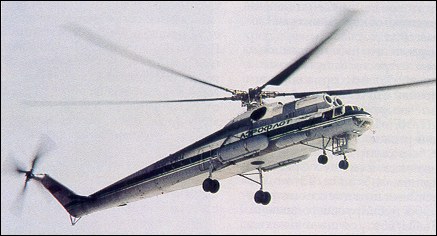
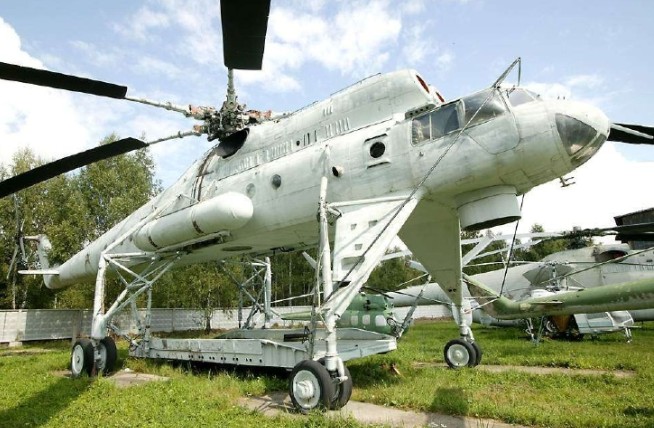
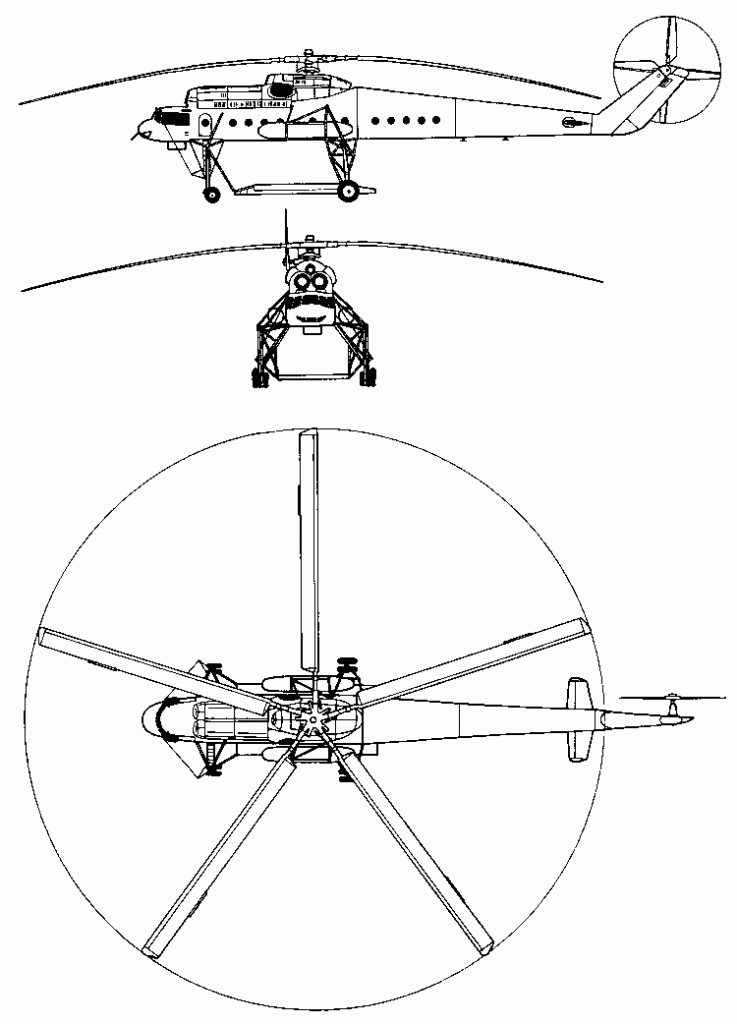
The V-10 prototype was a development of the Mi-6 heavylift helicopter, but optimised for the flying-crane role. Retaining basically the same rotor, transmission and powerplant, the V-10 had a slender fuselage and appears (falsely) to be much greater in length. The Mi-10 is 31.8cm shorter than the Mi-6. Wide-track stalky quadricycle landing gear is provided, so that the helicopter can taxi over a bulky load that is to be carried externally, and because it is intended to be used more extensively in the heavylift role than the Mi-6, it dispenses with the stub wings of this earlier helicopter. First flown during 1960, the V-10 entered production as the Mil Mi-10, then gaining the NATO reporting name ‘Harke’, and was first demonstrated publicly at Tushino in July 1961, Development aircraft had trapeze wires from above flight deck to front wheels for emergency crew escape in low hover. To counter side-thrust at tail and torque effects right legs 300mm shorter than left, crew cabin being canted to keep it laterally level on ground. The fuselage cabin is 14.04m long, 2.5m wide and 1.68m high for cargo and with 28 tip-up wall seats.
(Korotkonogii, short-legged) presaged by special Mi-10 flown 1965 with single centerline nose gear and single spatted main gears of min length and weight, used to lift 25,105kg to 2840m. This was restored to Mi-10R standard, but in 1966 OKB flew Mi-10K with four short landing gears reducing door sill height from almost 4 to 1.8m. New crew compartment with single pilot at original level and second in central all-glazed gondola facing aft with full controls for helicopter and load. Larger internal fuel cells, giving total with two external tanks of 9000 litres. Tail bumper and much narrower tail fin. Cleared for production October 1966, about 20 built. The Mi-10K differs from the Mi-10 by having an uprated 6500shp Soloviev D-25VF turboshafts in fully developed models. This allows a payload of 14,000kg in the slung mode, compared with the Mi-10’s 8000kg. The main cabin can be used for freight and/or passengers, the latter totalling 28 on tip-up seats.
First displayed publicly in Moscow on 26 March 1966, the USSR revealed for the first time the Mi-10K. At least one Mi-10K has been seen with a conventional tricycle undercarriage; this may have been the machine which in May 1965 established a new load-to-altitude record by lifting a weight of 25105kg to a height of 2840m.
Items which are interchangeable between the Mi-6 and Mi-10 include the power plant, transmission system and reduction gearboxes, swashplate assembly, main and tail rotors, control system and most items of equipment. The power of the Soloviev turboshaft engines remains constant up to 3,000m and to an ambient temperature of 40 deg C at sea level. The aircraft will maintain level flight on one engine. Full navigation equipment and an autopilot permit all-weather operation, by day and night.
The tall long-stroke quadricycle landing gear, with wheel track exceeding 6.0m and clearance under the fuselage of 3.75m with the aircraft fully loaded, enables the Mi-10 to taxi over a load it is to carry and to accommodate loads as bulky as a prefabricated building.
Use can be made of interchangeable wheeled cargo platforms which are held in place by hydraulic grips controllable from either the cockpit or a remote panel. Using these grips without a platform, cargoes up to 20m long, 10m wide and 3.1m high can be lifted and secured in 1.5 to 2 minutes. The cabin can accommodate additional freight or passengers.
The standard Mi-10 rotor system is the same as for the Mi-6, except that main rotor shaft is inclined forward at an angle of only 0 deg 45′. The landing gear is a non-retractable quadricycle type, with twin wheels on each unit. All units fitted with oleo-pneumatic shock-absorbers. Telescopic main legs. Main wheels size 1,230 x 260mm each with brake. Levered-suspension castoring nose units. Nosewheels size 950 x 250mm. All landing gear struts are faired. The port nose gear fairing incorporates steps to the crew door. Despite the height of the gear, the Mi-10 can make stable landing and take-off runs at speeds up to 100km/h.
Two 4,101kW Soloviev D-25V turboshaft engines, are mounted side by side above cabin, forward of main rotor drive-shaft. Single fuel tank in fuselage (731 litres) and two external tanks (3500 litres each) on sides of cabin 2400 litres (1920kg), with total capacity of 6,184kg. Provision for carrying two auxiliary tanks in cabin, to give total fuel capacity of 8,260kg. Provision for pressure-fuelling from ground whilst hovering. Engine cowling side panels (opened and closed hydraulically) can be used as maintenance platforms when open.
The maximum payload is 11000kg, but this can be increased to 14000kg by installing Soloviev D-25VF engines, each of which yield 6500shp.
Two pilots and flight engineer accommodated on flight deck, which has bulged side windows to provide an improved downward view. Flight deck is heated and ventilated and has provision for oxygen equipment. Crew door is immediately aft of flight deck on port side. Main cabin can be used for freight and/or passengers, 28 tip-up seats being installed along the side walls. Freight is loaded into this cabin through a door on the starboard side, aft of the rear landing gear struts, with the aid of a boom and 200kg capacity electric winch. In addition to the cargo platform described earlier, the Mi-10 has external sling gear as standard equipment. This can be used in conjunction with a winch controlled from a portable control panel inside the cabin. The winch can also be used to raise loads of up to 500kg while the aircraft is hovering on rescue and other duties, via a hatch in the cabin floor. AI-8 turbine APU permanently installed for electric/hydraulic power without main engines. Equipped with anticing as the Mi-6A.
Mi-10K
A closed-circuit TV system, with cameras scanning forward from under the rear fuselage and downward through the sling hatch, is used to observe the payload and main landing gear, touchdown being by this reference. The TV system replaces the retractable undernose ‘dustbin’ fitted originally.
Construction of both versions totalled 55 when production ended in 1971; manufacture was resumed briefly in 1977, but no new production figures have been quoted. Harke is operated by Aeroflot and by the Soviet forces in comparatively small numbers. The Mi 10K is not known to be in military service. All versions were grounded in August 1992.
Mi-10 Engine: 2 x D-25V turboshaft, rated at 4045kW Main rotor diameter: 35.0m Length without rotors: 32.86m Height: 7.8m Max take-off weight: 43450kg Empty weight: 24680kg Max speed: 235km/h Cruising speed: 220km/h Service ceiling: 3000m Range with 8,000kg payload: 420km Payload: 8000-12000kg
Mi-10 Engines: 2 x Soloviev D-25V single-shaft free-turbine engines driving common R-7 gearbox, 5,500 shp each. Main rotor diameter: 114 ft 10 in (35 m) Overall length (rotors turning): 137 ft 5½ in (41.89 m) Fuselage length: 107 ft 9¾ in (32.86 m) Height: 32 ft 2 in (9.8 m) Empty weight 60,185 lb (27.300 kg) Max loaded weight 96,340 lb (43.700 kg) Max speed: 124 mph (200 km/ h) Service ceiling: 9,842 ft (3000 m) Range: (with 12,000 kg platform load) 155 miles (250 km) Armament: normally none
Mi-10K Engine: 2 x Solovyov D-25V turboshaft, 4101kW Main rotor diameter: 114 ft 10 in (35 m) Overall length (rotors turning): 137 ft 5½ in (41.89 m) Fuselage length: 107 ft 9¾ in (32.86 m) Height: 25 ft 7 in (7.8 m) Empty weight 54,410 lb (24,680 kg) Max loaded weight 83,776 lb (38,000 kg) Service ceiling: 9,842 ft (3000 m) Armament: normally none. Range with typical payload: 250km Max payload: 11000kg
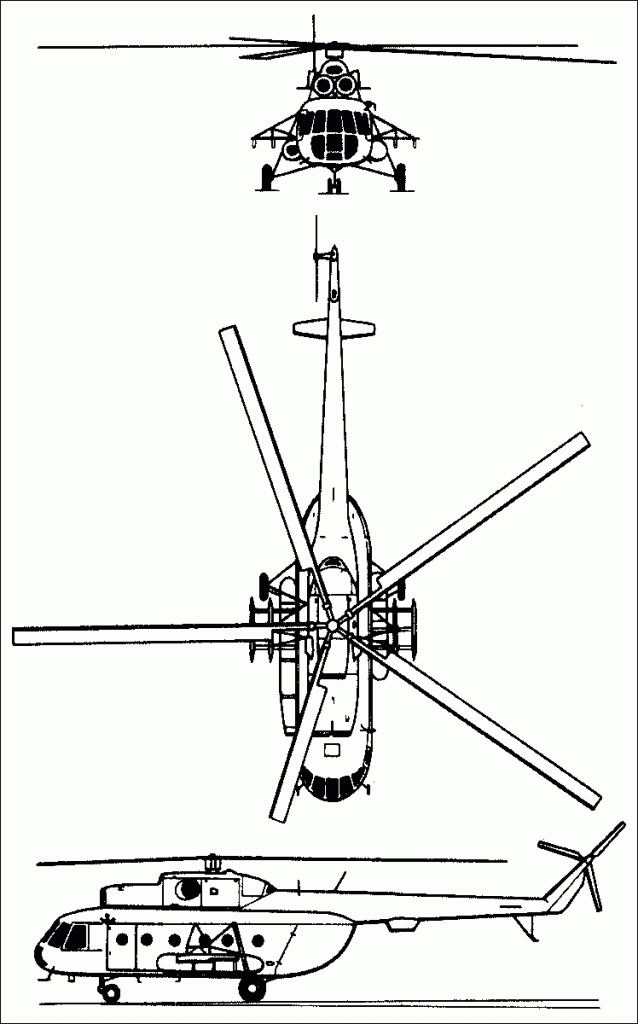
Designed originally in May 1960, the V-8 ‘Hip-A’ prototype helicopter was basically a turbine-powered version of the Mi-4, retaining initially its rotor, transmission and a number of other components. Intended powerplant was two Isotov turboshaft engines, but as these were not fully developed when the V-8 was nearing completion, it was powered instead by a single large 2700 shp Soloviev AI-24V turboshaft derated to the 2013kW limit of the transmission, for its first flight in 24 June 1960. However, the second machine (flown for the first time on 17 September 1962) introduced the Isotov TV2-117 engines, each then rated at 1119kW, and this became the standard installation on early production aircraft, designated Mil Mi-8 (NATO reporting name ‘Hip B’). The only other major change to be introduced since that time resulted from problems with the main rotor inherited from the Mi-4, replaced in 1964 by a five-bladed rotor of more advanced design in the ‘Hip-B’ prototype.
The fuselage is an all metal semi-monocoque in the pod and boom style. The rotor head has a conventional machined steel head spider with blades seated in oil-lubricated drag and flapping hinges. Collective pitch control is interlocked with the throttles and engine speeds and torques are automatically synchronized. The main rotor blades are all metal interchangeable blades of basic NACA 230 section, solidity 0.0777and employ automatic electkothermal de-icing and are fitted with an automatic gas pressure spar failure warning system. The main rotor shaft is inclined forward 4 degrees 30 minutes from the vertical. The blades are carried on a machined spider; pendulum vibration damper; and three-blade starboard tail rotor. The gear box is a VR-8 twin stage planetary reduction gearbox which drives the main rotor shaft and the intermediate and tail rotor gear boxes, the oil cooling fan, genera¬tors, and hydraulic pumps. The two 1500 shp Isotov turbo shafts with free turbines are automatic self governing of the main rotor speed, with a manual over-ride. Both engines drive the one main VR-8 two-stage planetary main reduction gearbox giving main rotor shaft/engine rpm ratio of 0.016:1and operate independently which permits flying the helicopter with one engine operative, when necessary. The transmission comprises gearbox, intermediate and tail rotor gearboxes, main rotor brake, and drives off main gearbox for tail rotor, fan, AC generator, hydraulic pumps and tachometer generators. The tail rotor pylon forms small vertical stabiliser and there is a horizontal stabiliser near the end of the tailboom; clamshell rear-loading freight doors.
Flying controls are mechanical with irreversible hydraulic boosters; main rotor collective pitch control linked to throttles.
The structure is all-metal; main rotor blades each have extruded light-alloy spar carrying root fitting, 21 honeycomb-filled trailing-edge pockets and blade tip; balance tab on each blade; each tail rotor blade made of spar and honeycomb-filled trailing-edge; semi-monocoque fuselage.
The undercarriage is a non-retractable tricycle type; steerable twin-wheel nose unit, locked in flight; single wheel on each main unit; oleo-pneumatic (gas) shock-absorbers. Mainwheel tyres 865 x 280mm; nosewheel tyres 595 x 185mm. Pneumatic brakes on mainwheels; pneumatic system can also recharge tyres in the field, using air stored in main landing gear struts. Optional mainwheel fairings.
Power is from two 1,250kW Klimov TV2-117A turboshafts (1,434 kW TV3-117MTs in Mi-8MT). Main rotor speed governed automatically, with manual override. Single flexible internal fuel tank, capacity 445 litres; two external tanks, each side of cabin, capacity 745 litres in port tank, 680 litres in starboard tank; total standard fuel capacity 1,870 litres. Provision for one or two ferry tanks in cabin, raising maximum total capacity to 3,700 litres. Fairing over starboard external tank houses optional cabin air conditioning equipment at front. Engine cowling side panels form maintenance platforms when open, with access via hatch on flight deck. Total oil capacity 60kg.
Two pilots side by side on flight deck, with provision for flight engineer’s station in between. Military versions can be fitted with external flight deck armour. Windscreen de-icing standard. Basic passenger version furnished with 24 to 26 four-abreast track-mounted tip-up seats at pitch of 72 to 75cm, with centre aisle 32cm wide; removable bar, wardrobe and baggage compartment. Seats and bulkheads of basic version quickly removable for cargo carrying. Mi-8T and standard military versions have cargo tiedown rings in floor, winch of 150kg capacity and pulley block system to facilitate loading of heavy freight, an external cargo sling system (capacity 3,000kg), and 24 tip-up seats along sidewalls of cabin. All versions can be converted for air ambulance duties, with accommodation for 12 stretchers and tip-up seat for medical attendant. Large windows on each side of flight deck slide rearward. Sliding, jettisonable main passenger door at front of cabin on port side; electrically operated rescue hoist (capacity 150kg) can be installed at this doorway. Rear of cabin made up of clamshell freight-loading doors, which are smaller on commercial versions, with downward-hinged passenger airstair door centrally at rear. Hook-on ramps used for vehicle loading.
The standard heating system can be replaced by full air conditioning system; heating of main cabin cut out when carrying refrigerated cargoes. Two independent hydraulic systems, each with own pump; operating pressure 44 to 64 bars. DC electrical supply from two 27V 18kW starter/generators and six 28Ah storage batteries; AC supply for automatically controlled electrothermal de-icing system and some radio equipment supplied by 208/115/36/7.5V 400Hz generator, with 36V three-phase standby system. Engine air intake de-icing standard. Provision for oxygen system for crew and, in ambulance version, for patients. Freon fire extinguishing system in power plant bays and service fuel tank compartments, actuated automatically or manually. Two portable fire extinguishers in cabin.
A four-axis autopilot to give yaw, roll and pitch stabilisation under any flight conditions, stabilisation of altitude in level flight or hover, and stabilisation of preset flying speed; Doppler radar box under tailboom.
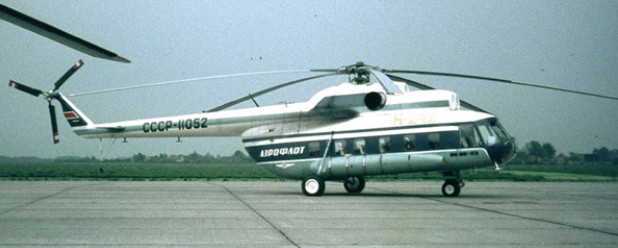
Intended primarily for Aeroflot, the Mi-8 carries a 2- or 3-man crew and has seating accommodation for up to 28 passengers in its standard airline form. Alternative internal arrangements include a de luxe saloon cabin for executive travel or a cargo layout for an internal payload of 4000kg. Emergency conversion of the cargo model to a passenger carrier can be carried out quickly by installing 24 tip-up seats along the cabin sides. Clamshell rear doors are provided for loading large items of cargo or, in the ambulance role, 12 stretchers which can be carried with an accompanying medical attendant. Large numbers of Mi-8s are used by Aeroflot in the transport role, being deployed also for ice reconnaissance, rescue operations and logistic support, but even greater numbers are operated by the Soviet Union’s Frontal and Naval Aviation and, in addition, these helicopters have been supplied to the armed forces of about 40 other nations.
The Mi-8 can also be used as a rescue machine with a winch on the cabin side capable of lifting a 250kg load, or with an under-fuselage hook for an external sling load of about 2500kg.
The Mil Mi-8V is a 28-seat multi-role transport helicopter powered by two Izotov turboshaft engines. The Mi-8 was exported to over 50 countries.
The Mil Mi-8MTV-1 is a 24-seat multi-role transport helicopter powered by two Klimov TV3-117VM turboshaft engines.
Powered by 1,900 shp Isotov TV3-117MT engines replacing the 1,700 shp TV2-117As, Hip serves Frontal Aviation in several forms, the principal of these being the basic assault transport Hip-C, which can carry 128 57-mm rockets in four packs on lateral outriggers; Hip-D which performs electronic duties, and Hip-E is the heavily armed attack variant, fitted with a flexibly-mounted 12,7-mm gun in the nose and can carry 192 57-mrn rockets in six packs plus four AT-2 Swatter anti-armour missiles. Hip F is the export version of the Hip E, with six AT-3 Sagger missiles, while Hip G is another communications relay model. Hip J and Hip K are electronic warfare derivatives, used principally to jam communications.
The primary task of Hip is to deposit assault troops, equipment and supplies immediately behind the enemy lines and evacuate casualties, and for this purpose it can carry up to 28 fully-equipped troops, 8,820 lb (4 000 kg) of freight or 12 casualty litters.
The Mi-8 Salon is an executive transport.
The Mi-8PPA is a special communications jammer variant.
In 1981, the Mi-8 was replaced in production by the re-engined Mi-17 that was flown first as Mi-8MT in 1980.
More than 10,000 Mi-8 and Mi-17 Hips have been built in several models, and production of both the Mi-8 and Mi-17 continued in 1987. Many hundreds being exported to more than 40 operators.
Mi-8s, Mi-17s and Mi-171s were marketed and delivered from Kazan (Mi-8, Mi-17, Mi-172) and Ulan-Ude (Mi-8T, Mi-171) plants for civil and military use, including 2,800 exported; many Mi-8s converted to Mi-17 standard.
Mi-8 derivatives include Mi-9 tactical airborne command post (first flown 1977) and Mi-19 variant for use by commanders of tactical rocket units, Mi-17 (first flown August 1975) with change of engines and other modifications and Mi-171/Mi-172 export models, and lengthened Mi-173. The Mi-8PPA is a special communications jammer variant. The Mil Mi-14 ‘Haze’ anti-submarine helicopter is derived from the Mi-8.
Long-range modification: AEFT (Auxilliary External Fuel Tanks) by Aeroton adds another 1,900 litres in two internal tanks, plus same quantity in four external tanks on the stores pylons of the Mi-8T and Mi-8AT. Operational range with all six tanks is 1,100km; ferry range 1,600km.
All helicopters of Mi-8/Mi-17 series in Russian military service are known as Mi-8s of various subtypes, regardless of engines fitted.
Mi-8APS Military VIP transport with enhanced communications fit and more luxurious interior; used as Russian Presidential aircraft.
Mi-8AT Civil transport version produced by Ulan-Ude; TV2-117AG turboshafts; optional 8A-813 weather radar, DISS-32-90 Doppler radar and A-723 long-range radio navigation.
Mi-8ATS Agricultural helicopter with spray hoppers on each side, and with ‘wing’-type spraybars.
Mi-8AV Dedicated minelayer, despatching mines down steep, ladder-like slide projecting from gap between lower corners of clamshell doors.
Mi-8BT Equipped for minesweeping, towing sled from winch in cabin. Clamshell doors removed for missions.
Mi-8K Reconnaissance and artillery fire correction version; large window for camera in rear clamshell doors.
Mi-8MT Flying crane version with operator’s glazed gondola in place of rear clamshell doors. SSSR-254444 may have been the prototype. Designation re-used for Mi-17.
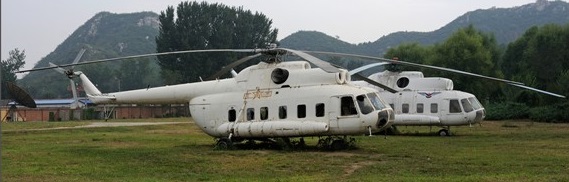
Mi-8P (‘Hip-C’) Civil passenger helicopter; standard seating for 28 to 32 persons in main cabin with large square windows.
Mi-8PD (punkt dowodzenia) Polish airborne command post version.
Mi-8PPA (‘Hip-K’) Active communications jammer; rectangular container and array of six cruciform dipole antennae each side of cabin; no Doppler box under tailboom; heat exchangers under front fuselage; some uprated to Mi-17 standard, with port-side tail rotor.
Mi-8PS (‘Hip-C’) Military VIP transport; basically as civil Mi-8 Salon.
Mi-8R Reconnaissance version.
Mi-8S (Salon) (‘Hip-C’) Original de luxe version of standard Mi-8; normally 11 passengers, on eight-place inward-facing couch on port side, two chairs and swivelling seat on starboard side, with table; square windows; air-to-ground radiotelephone and removable ventilation fans; compartment for attendant, with buffet and crew wardrobe forward of cabin; toilet (port) and passenger wardrobe (starboard) to each side of cabin rear entrance; alternative nine-passenger configuration; maximum T-O weight 10,400kg; range 380km with 30 minutes fuel reserve.
Mi-8SMV (‘Hip-J’) ECM version with R-949 jamming system; additional small boxes each side of fuselage, fore and aft of main landing gear legs. Also four containers with 32 droppable short-range jammers. Range 54 n miles (100 km; 62 miles).
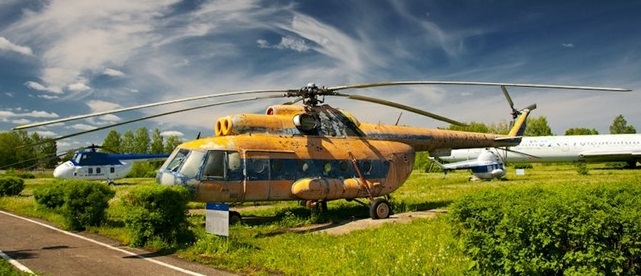
Mi-8T (‘Hip-C’) Civil utility transport version, with TV2-117A turboshafts and circular cabin windows, built by Ulan-Ude plant. Alternative payloads include internal or external freight; 24 passengers on removable folding seats; 26 passengers on conventional seats; 12 stretcher patients or executive layout similar to Mi-8S.
Mi-8T (‘Hip-C’) Also available as standard assault transport of Russian Federation and Associated States (RFAS) army support forces; carrying 24 fully armed troops. Able to dispense 200 anti-personnel or anti-tank mines in flight, by conveyor belt through rear doors.
Mi-8TB (‘Hip-E’) Development of ‘Hip-C’; KV-4 flexibly mounted 12.7 mm machine gun, with 700 rounds, in nose; triple stores rack each side, to carry total 192 S-5 rockets in six UV-32-57 packs, plus four 9M17P Scorpion (AT-2 ‘Swatter’) anti-tank missiles (semi-automatic command to line of sight) on rails above racks; about 250 in RFAS ground forces; some uprated to Mi-17 standard as Mi-8MTV, with port-side tail rotor.
Mi-8TBK (‘Hip-F’) Export ‘Hip-E’; missiles changed to six 9M14 Malyutka (NATO AT-3 ‘Saggers’; manual command to line of sight).
Mi-8TG Modified TV2-117TG engines permit operation on Liquefied Petroleum Gas (LPG) and Kerosene. LPG contained in large tanks, on each side of cabin, under low pressure. Engines switch to Kerosene for take-off and landing. Reduced harmful exhaust emissions in flight offer anti-pollution benefits. Modification to operate on LPG requires no special equipment and can be effected on in-service Mi-8s at normal maintenance centre. Weights unchanged. Large external tanks, each side of cabin, reduce payload by 100 to 150kg over comparable ranges, with little effect on performance. First flight on LPG made 1987.
Mi-8T(K) Dedicated photo-reconnaissance platform with AFA-42/100 or AFA-A87P starboard oblique camera in forward part of the cabin, possibly with some onboard processing capability. May be used as fire correction platform.
Mi-8TM Upgraded civil transport version of Mi-8T; weather radar and rotor head integrity system.
Mi-8TP Military executive version; upgraded communications include R-832 radio with two-blade antennae under front fuselage and tailboom and R-111 with rod antenna lowered under cabin.
Mi-8TS (tropichesky sukhoi: tropical) Export version for hot and dusty climates.
Mi-8TV (vooruzhonnyi: armed) (‘Hip-C’) As Mi-8T, but with added twin-rack each side, to carry total of 64 57 mm S-5 rockets in four UV-16-57 packs, or bombs, for army assault forces.
Mi-8TZ Adapted to deliver fuel to front-line areas.
Mi-8 VIP De luxe version by Kazan; three crew and seven to nine passengers; main rotor has vibration damper; hinged airstair door; interior divided into vestibule, passenger cabin crew department, cloakroom and toilet; optional water heater, TV and GPS. Maximum take-off weight 12,000kg.
Mi-8VZPU (vozduzhnyi zapasnoi punkt upravlenya: airborne reserve command post) (‘Hip-D’) As ‘Hip-C’ but rectangular-section canisters on outer stores racks; two large dorsal antennae above forward part of tailboom; no armament.
Mi8AMT, Mi-8MT and Mi-8MTV are versions of the Mi-17, with more powerful turboshafts and port-side tail rotor.
Mi-8M see Mil Mi-17
Mi-9 (‘Hip-G’) Airborne command post variant of Mi-8; ‘hockey stick’ antennae projecting from rear of cabin and from undersurface of tailboom, aft of Doppler radar box; rearward inclined short whip antenna above forward end of tailboom; strakes on fuselage undersurface. Crew of three to six.
Specifications:
Mil Mi 8 Engine: 2 x Isotov TW 2-117A, 1479 shp Length: 60.072 ft / 18.31 m Height: 12.828 ft / 3.91 m Rotor diameter: 69.849 ft / 21.29 m Max take off weight: 26460.0 lb / 12000.0 kg Max. speed: 135 kts / 250 km/h Service ceiling: 14764 ft / 4500 m Range: 532 nm / 985 km Crew: 3
Mi-8 Hip E Engine: 2 x Isotov TV2 Installed pwr: 2535 kW Rotor dia: 21.3 m Fuselage length: 18.2 m No. Blades: 5 Empty wt: 6625 kg MTOW: 12,000 kg Payload: 4000 kg Max speed: 260 kph Ceiling: 4500 m HIGE: 1900 m HOGE: 800 m Fuel cap (+aux): 1870 lt ( 1830 lt ) Range: 465 km Crew: 2 Pax: 32
Mi-8T Engines: 2 x Klimov (Isotov) TV2-117A turboshaft, 1250 kW (1677 shp) Max speed: 140 kts / 250km/h Max cruise speed: 120 kts / 225km/h Service ceiling: 14,765 ft / 4500m HIGE: 6235 ft Range (24 pax + res): 500 km Empty Wt: 14,990 lbs / 6625kg MTOW: 26,455 lbs / 12000kg Rotor dia: 69 ft 10 in / 21.29m Length overall: 82 ft 10 in Fuselage length: 59 ft 8 in / 18.17m Height: 18 ft 7 in / 4.38m Fuselage width: 2.5m Disc area: 3932 sq.ft Pax: 24 Payload: 4000kg





 All Aero