Neukom S-4A EIfe 15 / S-4A EIfe 17

Neukom S-4A EIfe

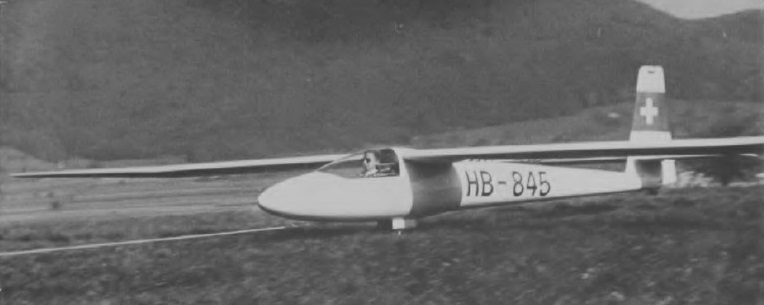
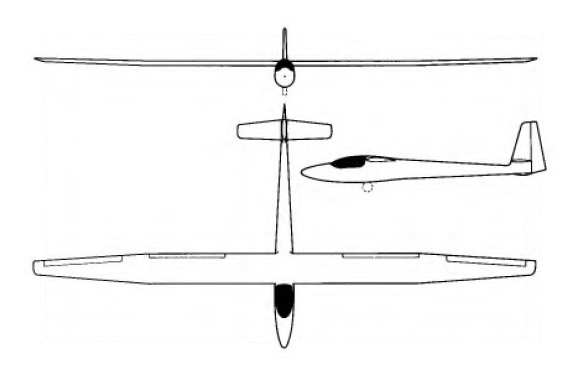
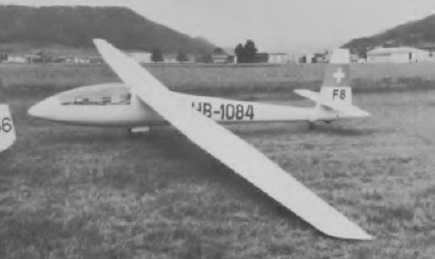
A developed version of the Standard EIfe S-3, the S-4A EIfe 15 differs from it principally in having a new two-piece wing of the same 15m span, strengthened and fitted with Schempp-Hirth air brakes; the single spar is of aluminium alloy and the wing skin of plywood/foam sandwich. A roomier forward fuselage of improved aerodynamic shape is featured, with the slight step forward of the canopy on the Standard EIfe S-3 completely eliminated. The fuselage and tail unit are of glassfibre and plywood/foam sandwich construction, and the landing gear consists of a retractable rubber-sprung monowheel with brake. The prototype EIfe 15 made its first flight in 1970 and 10 had been built by early 1973; production continues, although at a rather slow rate.

Both the EIfe 15 and EIfe 17 were available in kit form for amateur construction, the latter being a 17m span Open Class version of the S-4A EIfe 15, with the same fuselage but with a wider span two-piece wing, with provision for a tank in each leading edge to house a total of 132lb of water ballast. The EIfe 17 also has a braking parachute fitted, and a total of 10 of this version had been built by the spring of 1973, with production continuing at a relatively slow rate.

The EIfe M17 is a single-seat motor glider version of the Open Class EIfe 17 and first flew in prototype form in mid-March 1978. It is powered by a 45hp Parodi HP 45 four-cylinder four-stroke engine driving a Hoffmann two-bladed propeller; this is pylon-mounted aft of the cockpit and retracts into the fuselage when not in use. Electric starting is provided and the fuel tank capacity is 10 Imp gallons (45 litres). Apart from the engine and its related modifications the EIfe M 17 is the same as the unpowered EIfe 17.
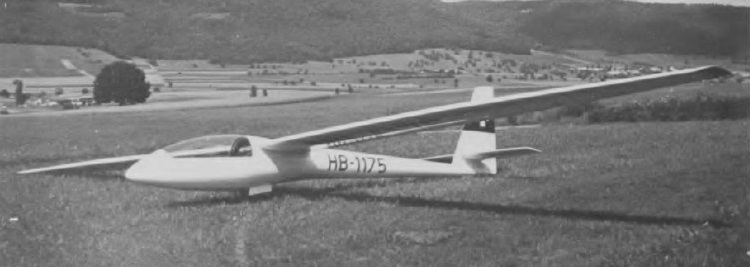
EIfe 17
Span: 55 ft 9.25 in / 17.0 m
Length: 23 ft 3.5 in / 7.1 m
Height: 4 ft 11 in / 1.50 m
Wing area: 142.1 sqft 13.2 sq.m
Wing section: Wortmann FX-61 -163/60-126
Aspect ratio: 21.8
Empty weight: 562 lb / 255 kg
Max weight: 837 lb / 380 kg
Water ballast: 60 kg / 132 lb
Max speed: 130 mph / 113 kt / 210 km/h
Max aero-tow speed: 87 mph
Max rough air speed: 113 kt / 210 km/h
Stalling speed: 35 kt / 65 km/h
Min sinking speed: 1.84 ft/sec / 0.56 m/sec at 46.5 mph / 40.5 kt / 75 km/h
Best glide ratio: 39:1 at 56 mph / 48.5 kt / 90 km/h
Neukom AN-20

AN-20B

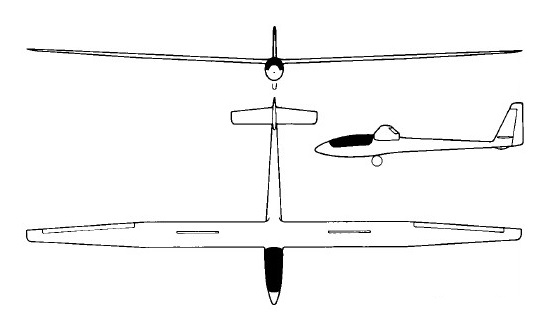
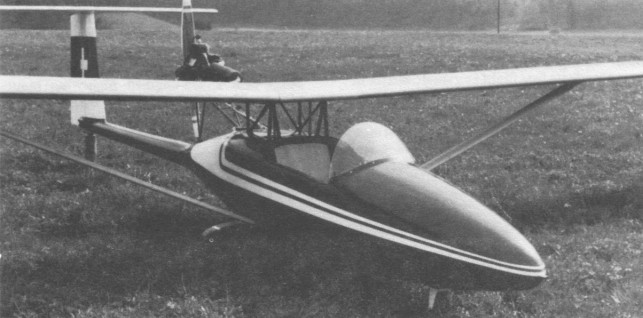
Single seat single engined high wing monoplane with conventional three axis control. Wing has unswept leading and trailing edges, and constant chord; T tail. Pitch control by elevator on tail; yaw control by fin mounted rudder; roll control by one third span ailerons; control inputs through stick for pitch/roll and pedals for yaw. Wing braced from below by struts; wing profile Wortmann FX 63 137; double surface. Undercarriage has three wheels in tricycle formation with tailskid; no suspension on nosewheel and glass fibre suspension on main wheels. Push right go right nosewheel steering connected to yaw control. Brakes on main wheels. Glass fibre fuselage, partially enclosed. Engine mounted at wing height driving pusher propeller. Wing and T tail have wood spars, ribs in styrofoam and covered with expoxied glass fibre.

His first microlight made its first flights in 1978, the prototype AN 20 using a T tail carried on a Kevlar spar of round section. Connected to the fuselage at the same height as the wing, the tubular fuselage carried basically a mono wheel undercarriage but with an additional nosewheel steerable from the rudder bar, the main wheel being positioned directly below the wing. Moreover, the vertical fin below the fuselage spar was provided with a tailwheel in line with the other two.

This machine was shown in various publications under the designation of AN 20M, which was a great surprise to Albert Neukorn, who tells us that he had never called this first model by any other name than AN 20, except that it eventually became AN 20A to distinguish it from the later AN 20B. The prototype was shown at the European homebuilders meeting at Brienne in July 1982.

The AN 20B is directly evolved from its predecessor whose rectangular plan form wing it has retained, supported by a profiled strut under each half wing. A significant change is the inclusion of air brakes, while the AN 20B is provided in addition with an elegant glass fibre fairing with windscreen encompassing all the forward section of the fuselage as far as the trailing edge of the wing, where it joins the spar carrying the tail. Another important difference from the AN-20A is that this spar is no longer level with the wing but mid mounted, a change which required a re design of the T tail. As a result, the fin and rudder no longer continue below the spar. The engine, previously fitted below the spar is now carried by a tubular structure above the rear spar, effectively level with the wing. Production models use the three cylinder Konig SC430 driving a three bladed pusher propeller. Finally, a last important modification, the AN 20B replaced the single main wheel undercarriage of the AN 20A with a tricycle undercarriage whose main wheels are fitted with drum brakes.

The AN 20B was still produced by Albert Newkom himself in 1983, either ready to fly ex works without engine or as a set of plans. An attempt to set up production facility in France with the AN 20B in 1981 has been abandoned.

Length overall 17.7 ft, 5.40 m
Height overall 3.9ft, 1.20m
Wing span 41.3ft, 12.60m
Constant chord 2.611, 0.80m
Dihedral 2 degrees
Sweepback 0 degrees
Tailplane span 8.0ft, 2.45m
Fin height 3.2ft, 0.95m
Total wing area 109sq.ft, 10.1sq.m
Total aileron area 8.5 sq.ft, 0.79 sq.m
Fin area 6.6 sq.ft, 0.61 sq.m
Tailplane area 8.4 sq.ft, 0.78 sq.m
Total elevator area 4.2 sq.ft, 0.39 sq.m
Wing aspect ratio 15.8/1
Wheel track 4.7ft, 1.43m
Nosewheel diameter overall 8 inch, 21 cm
Main wheels diameter overall 8.5 inch, 22cm
Engine: Konig SC430, 24 hp at 4200 rpm
Propeller diameter 42 inch, 1.06 m
Belt reduction, ratio 1.8/1
Max static thrust 121 lb, 55 kg
Power per unit area 0.22 hp/sq.ft, 2.4 hp/sq.m
Fuel capacity 5.3 US gal, 4.4 Imp gal, 20.0 litre
Empty weight 287 lb, 130 kg
Max take off weight 508 lb, 230 kg
Payload 221 lb, 100 kg
Max wing loading 4.68 lb/sq.ft, 22.8 kg/sq.m
Max power loading 21.2 lb/hp, 2.4kg/hp
Load factors; +5.3, 2.6 ultimate
Max level speed 93 mph, 150 kph
Never exceed speed 99 mph, 160 kph
Max cruising speed 68 mph, 110 kph
Economic cruising speed 59 mph, 95 kph
Stalling speed 31 mph, 50 kph
Max climb rate at sea level 500 ft/min, 2.5 m/s
Min sink rate 160 ft/min at 37 mph, 0.80 m/s at 60 kph
Best glide ratio with power off 18/1 at 37 mph, 60 kph
Take off distance 360 ft, 110 m
Land¬ing distance 330 ft, 100m
Service ceiling 11,500 ft, 3500 m
Range at average cruising speed 186 mile, 300km

Neukom Elfe M / Elfe S-1 / Elfe S-2 / Elfe S-3

The Elfe series started from a 9 m sailplane designed by W.Pfenninger before World War II. Just after World War 2 Albert Neukom of Switzerland began the creation of a line of sailplanes bearing the name EIfe; the first of these, the EIfe 1, had a wing span of only 9m (29 ft 6.25 in), later increased to 11m (36 ft 1 in).

A new design was introduced in 1947 to become the Elfe 2, probably the first sailplane with a laminar flow airfoil. The EIfe 2, with a span of 50ft 6.25in, had camber-changing flaps.

Subsequently the series was further developed by Albert Neukom with the Elfe M with laminar flow wings, Elfe MN and AN66 before the Standard Elfe S-1 appeared in 1964 with a V-tail. The prototype high performance single-seater Standard EIfe S-1 first flew on 1 May 1964. This was followed by the S-2 with conventional tail with the tailplane at the base of the fin.

The S-3, the production model of the S-2, first flew in May 1966 with a tailplane fixed part of the way up the fin. It has trailing edge airbrakes and a rubber- sprung retractable main wheel. The EIfe S-3 has a high cantilever wing built in three parts, and of plywood-balsa sandwich construction; it is fitted with trailing edge air brakes. The fuselage and tail unit are of glassfibre and plywood sandwich construction, while the landing gear consists of a retractable rubber-sprung monowheel with brake. The pilot sits upright under a removable transparent canopy.

Flown by the Swiss plot Markus Ritzi, a Standard EIfe took 2nd place in its class at the 1965 World Gliding Championships held at South Cerney, and at the 1968 World Championships at Leszno in Poland a Standard EIfe S-3 flown by Andrew Smith of the USA came 1st out of 57 entries, with other Elfes placed 4th and 6th.

A total of 18 Standard Elfes were flying by April 1970, the year in which the developed S-4A EIfe 15 first flew.

Standard EIfe S-3
Wing span: 15 m / 49 ft 2.5 in
Wing area: 11.9 sq.m / 128.1 sq.ft
Wing section: Wortmann FX Series
Length: 7.30 m / 23 ft 1.5 in
Height: 1.50m / 4 ft 11 in
Empty Weight: 208 kg / 459 lb
Payload: 112 kg / 246 lb
Gross Weight: 320 kg / 705 lb
Water ballast: None
Wing Load: 26.89 kg/sq.m / 6.79 lb/sq.ft
Aspect ratio: 19
L/D Max: 37.5 @ 95 kph / 51 kt / 59 mph
Min Sink: 0.64 m/s / 2.1 fps / 1.24 kt at 47 mph / 40 kt / 74 km/h
Max speed: 150 mph / 129.5 kt / 240 km/h (in smooth air)
Max rough air speed: 108 kt / 200 km/h
Stalling speed: 30 kt / 55 km/h
No. of Seats: 1
Structure: Balsa/ plywood sandwich wing; glass fibre/ plywood sandwich fuselage

Nesmith Cougar / Cougar Comet / Chigger / Landoll’s Skydoll

Cougar 1

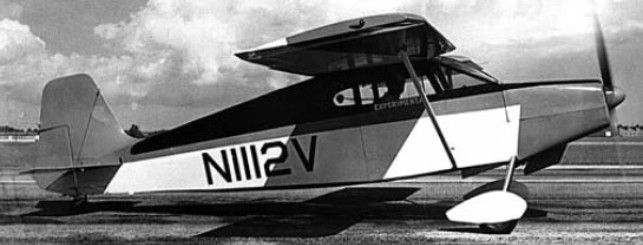
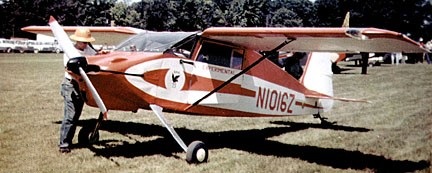
The design, by Robert Nesmith, is a conventional high-wing, strut-braced monoplane with fixed tailwheel undercarriage. The pilot and a single passenger were seated side-by-side with dual controls. The fuselage and empennage were of welded steel-tube construction, while the wings were of wood, and the whole aircraft was fabric-covered. Continental engines of C75, C85 and C90 can be used.

The first, N75282, first flew in March 1957.

With a redline speed of 195 mph, the Cougar maintains a brisk cruise of 120 to 165 mph, depending on choice of engine which can range form 65 hp to 125 hp. Landing approach is done at 80 mph and touchdown is around 70.

Cougar C-1 by Warren Croace

The original Cougar design was marketed by Nesmith himself. The design was modified by Leonard Eaves for an EAA design contest in 1963, principally for the purpose of including folding wings. When the modified Cougar won an Experimental Aircraft Association (EAA) design competition in 1963 that organization took over selling plans. Rights to the design were eventually purchased by Acro Sport.

The aircraft can be towed to and from the airport on its own landing gear.

The aircraft shape was influenced by the Beechcraft Staggerwing and Wittman Tailwind. The name came from the college of Nesmith’s daughter, the University of Houston, whose athletic mascot is a cougar.

Variants:

Nesmith Cougar
The original design for home building

Nesmith Cougar Comet
Cougar modified with a 125hp Lycoming O-290D.

Nesmith Chigger & Landoll’s Skydoll
One example was built with folding wings and Culver Cadet landing gear, called the “Chigger”. Another example built with folding wings with automatic control latching.

Variation:
Eaves Cougar 1

Engine: Lycoming O-235, 115-hp (86 kW)
Wingspan: 20 ft 6 in (6.25 m)
Wing area: 83 sq.ft (7.71 sq.m)
Aspect ratio: 5.06
Length: 18 ft 11 in (5.77 m)
Height: 5 ft 6 in (1.68 m)
Empty weight: 624 lb (283 kg)
Gross weight: 1,250 lb (567 kg)
Fuel capacity 25 USG
Maximum speed: 195 mph (314 km/h)
Cruise 166 mph
Stall 53 mph
Climb rate 1300 fpm
Service ceiling: 13,000 ft (3,950 m)
Takeoff run 450 ft
Landing roll 350 ft
Range: 750 miles (1,200 km)
Seats: 2

Engine: Continental C-85, 80 hp
Speed max: 195 mph
Cruise: 135 mph
Range: 600 sm
Stall: 53 mph
ROC: 1000 fpm
Take-off dist: 800 ft
Landing dist: 700 ft
Service ceiling: 16,000 ft
HP range: 65-125
Fuel cap: 25 USG
Weight empty: 624 lb
Gross: 1250 lb
Height: 5.5 ft.
Length: 18.9 ft
Wing span: 20.5 ft
Wing area: 82.5 sq.ft
Seats: 2
Landing gear: tail wheel