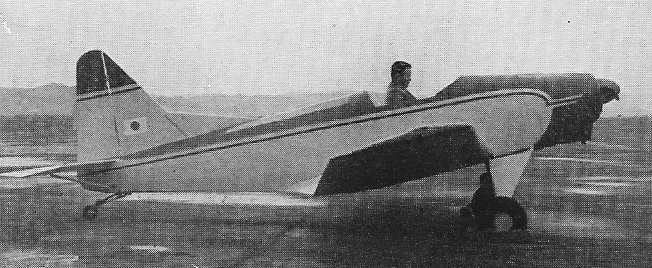
The students of Nihon University, under the leadership of Dr Hidemasa Kimura, have designed and built two light aircraft. The first was the Okamura N-52 low-wing monoplane, which flew on April 7, 1953.
Designed by Professor H. Kimura, the N-52 was powered by a 65 hp Continental C65. The N-52 is of mixed construction with fabric covering.
Engine: 65 hp Continental C65 Wingspan: 28 ft 2.5 in Wing area: 129 sq.ft Length: 19 ft 8 in Height: 8 ft 6 in Empty weight: 660 lb Loaded weight: 1100 lb Max speed: 108 mph at SL Cruise: 101 mph ROC: 550 fpm Range: 305 mi
Nihon University College of Science and Engineering Surugadai-Machi Chiyoda-ku Tokyo
The students of this university, under the leadership of Dr Hidemasa Kimura, have designed and built two light aircraft. The first was the Okamura N-52 low-wing monoplane, which flew on April 7, 1953. The second is a high-wing four-seat light-plane known as the N-58 Cygnet.
1962: No 32, 3-Chome, Choja-Machi, Naka-Ku, Yokohama
This company was engaged mainly on overhaul of US Navy aircraft and of the 60 Grumman Tracker anti-submarine aircraft of the JMSDF. It built the mock-up of the NAMC YS-11 and was responsible for the design and production of components for this transport. Under JASDF contract, Japan Aircraft Manufacturing Co carried out a lengthy high-lift research programme with a much-modified Saab-91B Safir. With the designation Z1G3, this aircraft has a 260 h.p. Continental IO-470-D engine, reduced span of 31ft 6in, blown flaps, large trailing-edge fillets, slotted tailplane and other changes to give it STOL performance.
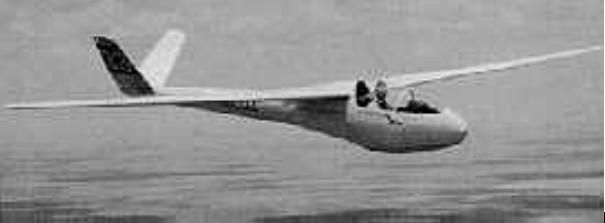
The prototype, designed and built over a period of six years by Convair engineer Leonard Niemi in his garage workshop and known as the Sisu 1, was a cantilever shoulder-wing type of all-metal construction with a laminar flow wing of NACA 65-series section to provide very low drag over a broad speed range, with forward sweep to delay tip stall. The ‘butterfly’-type V-tail has an included angle of 90°. The two-spar wing has an aluminium alloy skin and plate stringers, with glassfibre/foam stiffening in the leading edge and camber-changing flaps. To achieve the smoothness and accuracy necessary for laminar flow, wing contours were filled and sanded, and all control surface hinge lines and joints in the canopy and removable fairings were sealed.
The Sisu 1A was the production version, 10 of which were built by Arlington Aircraft at Arlington, Texas, and later at Greenville, South Carolina, between 1960 and 1965. This version had a lighter wing structure, and featured vented air brakes and large-span slotted flaps. Landing gear consists of a retractable monowheel and a miniature fixed tailwheel; the pilot sits under a flush-fitting two-piece canopy.
Sisu 1A
Flown for the first time on 20 December 1958, this American high performance single seater was noteworthy in being the first sailplane ever to exceed 1,000 km in a soaring flight when flown by Alvin H. Parker, it set up an international straight line distance record of 1,041.52km (647.17 miles) in a flight from Odessa, Texas,.
The Sisu 1 A set three world records for Alvin Parker out of Odessa, Texas: 784 km/ 487.24 miles on 27 August 1963, 1963; free distance 1,041.52 km. /647.17 miles to Kimball, Nebraska, on 31 July 1964; and goal, 930.6 km. / 578.27 miles, 1969. For the free distance flight Parker had an aero-tow to 2000 ft, soared to 14,300 ft and was airborne for more than 10.5 hours.
The Sisu 1A N1100Z, the second 1A to be built, that set the world distance record was donated to the Smithsonian Air & Space Museum and another was donated to the National Soaring Museum.
The type has won the US National Soaring Championships three times, in 1962,1965 and 1967, flown by different pilots (John Ryan, 1962; Dean Svec, 1965; and A.J. Smith 1967). A. J. Smith, winner of the 1967 US Championships, further lightened his ship, and flew his Sisu for a time with wing tip extensions to increase the span from the standard 50ft 0in.
Avions H. Nicoluer first flew in 1962 the HN.433 Menestrel single-seat monoplane, available for home construction from plans and some components; redesigned HN.434 also offered.
Avions H. Nicoluer First flew in 1962 the HN.433 Menestrel single-seat monoplane, available for home construction from plans and some components; redesigned HN.434 also offered. HN.500 Bengali first flew 1988 as side-by-side two-seat monoplane, and HN.700 Menestrel II two-seat version of Menestrel, both were available in plans form.
In 1978 Everett Neumann built a home-built single-place, open cockpit, low-wing monoplane folding wings. Registered N2287D c/n N782, power was a Continental O-200.
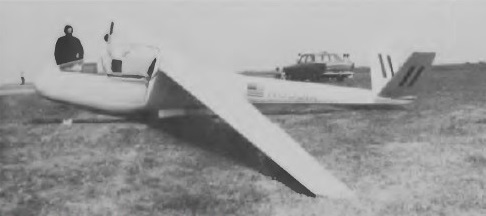
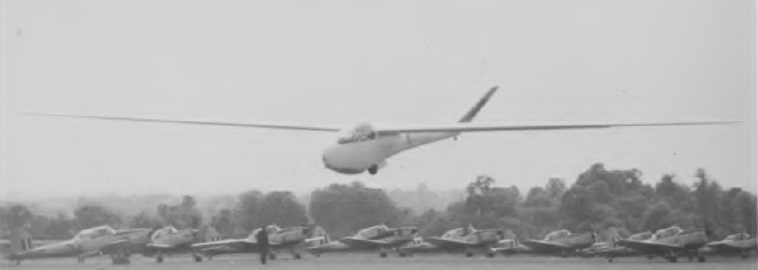
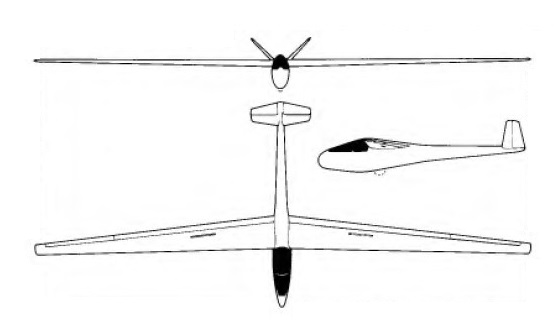
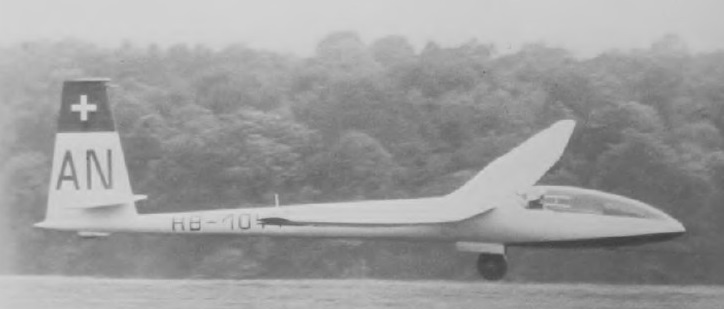
The Neukom AIM-66 high performance single-seater first flew in prototype form in 1966, and was followed by two others, designated AN-66-2, which featured a modified fuselage. These versions have cantilever shoulder-mounted wings of 18m (59ft 0.5in) span and of Eppler 441 aerofoil section, which are of sandwich construction with a metal spar and have plain flaps. The forward fuselage is a glassfibre sandwich structure, while the rear portion is a wooden plywood and balsa sandwich semimonocoque, and a ‘butterfly’-type V-tail is fitted. The landing gear is a rectractable monowheel and the pilot sits under a long flush-fitting transparent canopy.
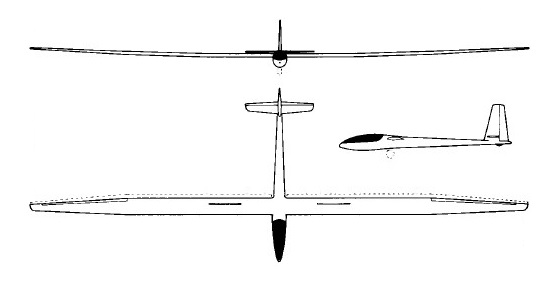
The AN-66C Super Elfe is a development of the AN-66-2 with the same fuselage but with an entirely new variable-geometry wing with a special aerofoil flap that can be extended to increase the wing area by about 20%; a conventional tail unit with a low-set tailplane, similar to that of the Standard Elfe S-3, replaces the AIM-66-2’s V-tail.
Flight tests of the prototype AN-66C began at Butzweilerhof in Germany on 11 September 1973. The new wing has a longer span of 23m (75 ft 5.5 in) and the aerofoil flaps are chain-operated by a crank in the cockpit and can either be fully extended or fully retracted, no intermediate position being possible; when fully extended or retracted the wing profile is changed so as to result in a continuous Eppler aerofoil section. A tank to contain 132 lb of water ballast is situated in the leading edge of each wing centre section, the latter being 21 ft 4 in in length and the two outer panels 27 ft 0.75 in each. The single-spar wings have riveted duralumin double-T spars, and plywood/balsa/plywood sandwich outer skins formed by vacuum pressing; Schempp-Hirth air brakes are fitted. Landing gear consists, as it did on the AN-66-2, of a retractable monowheel and tailskid. The wing area is increased from 172.2sq ft with the flaps in, to 206.7sq ft with flaps extended, when the aspect ratio is 27.6 compared to 33.1 with the flaps in.
The AN-66D prototype, produced in 1974, has a four-piece wing of 21m (68 ft 11 in) span.
AN-66C Super-EIfe Span: 75 ft 5.5 in / 23.0 m Length: 26 ft 6.25 in / 8.1 m Height: 6 ft 0.75 in / 1.85 m Wing area: 172.2 sq ft / 16.0 sq.m (flaps in) Wing section: Eppler 562/569 Aspect ratio: 33.1 (flaps in) Empty weight: 926 lb / 420 kg Max weight: 1,433 lb / 650 kg Water ballast: 60 kg / 132 lb Max wing loading: 33.1 kg/sq.m / 6.8 lb/sq ft Max speed: 168 mph / 146 kt / 270 km/h (in smooth air) Stalling speed: 32.5 kt / 60 km/h Min sinking speed: 1.64 ft/sec / 0.5 m/sec at 46.5 mph / 40.5 kt / 75 km/h (flaps out) Best glide ratio: 48:1 at 56 mph / 48.5 kt / 90 km/h (flaps in)

 All Aero