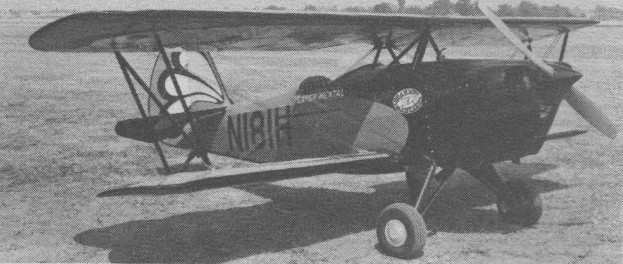
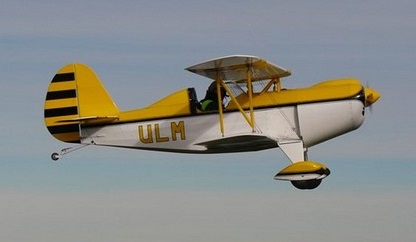
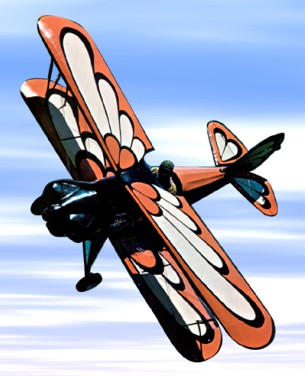
Harvey R. Swack had encountered a fellow named Barney Oldfield no relation to the auto racer who had designed a small, single seat sport biplane for homebuilders. Swack went into business with Oldfield, selling plans of the 2T 1 under the name “Baby Great Lakes” which he was entitled to do, as owner of the name, although the little homebuilt bore only a distant, imitative relationship to the original. When Champ¬lin bought Great Lakes Aircraft Company from Swack, Swack changed the name of the homebuilt design to “Barney Oldfield Special,” though it is still informally known as the “Baby Lakes.”
Dec 1973
Feb 1974
Barney Oldfield’s Baby Great Lakes flys much like its big brother, the Great Lakes Sport Trainer. The Baby “Lakes” was designed to get the same sort of flying ease and performance at lower cost. It uses a steel-tube fuselage, wood wings and fabric cover, and offers unusually lively aerobatic performance when powered by an 85-hp Continental engine. The Baby Lakes can also be fitted with 50- to 100-hp Continentals or the 108- and 125-hp Lycomings. (When fitted with the 108- and 125-hp engines, the airplane is called the Super Baby Lakes.) Its makers say it will out fly aircraft of twice the horsepower, and it is the least expensive, high-performance biplane available to the homebuilder.
Baby Lakes
The Baby Great Lakes (one place) and Buddy Great Lakes (two place) aircraft are well proven designs which are easy to construct and fly, provide classic good looks, and are aerobatic. Construction is of wood and steel tubing and plans are well presented for the first time builder. Aircraft Spruce & Specialty Company acquired all rights to these designs in May 1996 and offers packs, plans, raw materials kits, and pre-fabricated kits for these fine aircraft. The Baby Great Lakes Main Tank Standard holds 10 gallons. The Baby Great Lakes Tank Stretch is 3″ longer and holds 11 gallons.
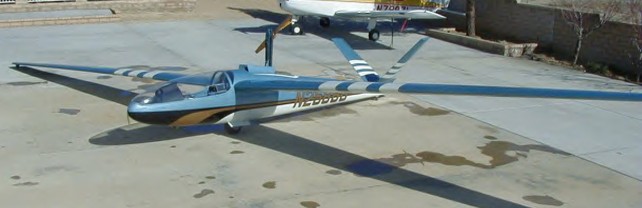
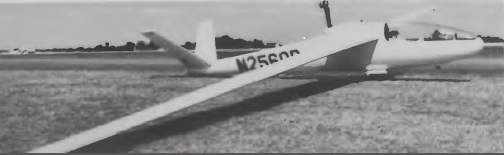
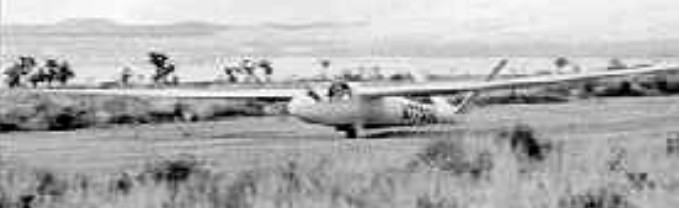
Designed and built by Mr Vernon W. Oldershaw of Bakersfield, California, in 15 months for a cost of $4,000, as a development of the O-2 but for Open Class competition, the O-3 featured a longer span of higher aspect ratio and a retractable gear.
The O-3 is of all-wood construction with cantilever shoulder wings and a V-tail; the wings have a spruce spar and plywood ribs and skins, with wooden ailerons and air brakes on the trailing edges. The ellipitcal-section fuselage is built up from plywood bulkheads, the front portion from the nose to the wing trailing edge having a glassfibre outer shell and the remainder being plywood-covered. The tail surfaces, which are slightly swept back, are of similar construction to the wings. There is a retractable rubber-sprung monowheel and a tailskid. The pilot sits under a one-piece flush-fitting cockpit canopy.
The original O-3 single-seat sailplane made its first flight in June 1967. One was flown in several Nationals and made a flight of 694 km./ 431 miles. Two O-3’s were built, and both were subsequently motorized. A two-cylinder, in-line, two-cycle Yamaha snowmobile engine was mounted inside the fuselage behind the wing spar driving a pylon-mounted wooden pusher propeller via belts.
Oldershaw began to develop a retractable powerplant installation which was added to a second O-3 completed in 1975, the engine being used primarily for take-off and climb to soaring height. It is a 31 hp Yamaha Snowmobile SW433 two-stroke ‘flat twin’ driving a two-blade fixed-pitch wooden pusher propeller, the pylon mounted propeller retracting forwards into the fuselage behind closed doors to lie over the engine, which is behind the cockpit. There is a single aluminium fuel tank in the fuselage of 2.5 US gallons capacity.
Span: 55 ft 0 in Height: 4 ft 8 in Wing area: 125.0 sqft Aspect ratio: 24.1 Empty weight: 780 lb Max weight: 1,000 lb Max speed: 125 mph (in smooth air, power off) Max cruising speed: 95 mph (power on) Min sinking speed: 2.30 ft/sec at 55 mph Best glide ratio: 37:1 at 68 mph Take-off run: 900 ft Range with max fuel: 50 miles
The all wood O-2 was designed by Vernon Oldershaw to be a competitive Standard Class aircraft with dive brakes, a V- tail and retractable gear, and first flew in 1961. It was flown in the 1962 and 1963 Nationals and made a number of flights of more than 200 miles, one of them 474.1 km./ 294.6 miles. One was built.
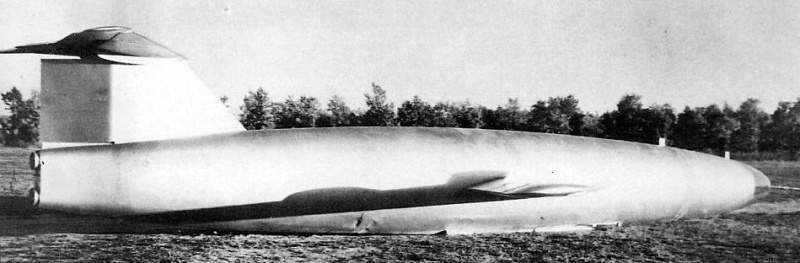
The “346-3” with the ski gear unfolded and the stabilization straps under the wings
In October 1946, a group of aeronautical specialists from Junkers and Siebel firms was transferred to the USSR and located on the territory of Factory No. 458.
The OKB-2 was created in order to design and study experimental aircraft with liquid reactive rockets (ZhRD).
The OKB-2’s first task was the study, construction and development of the tests of the aircraft “346” with a two-chamber liquid reactive engine.
The “346” was a development of the German DFS-346. A single copy of this model, almost in the final phase of construction, was destroyed by the fascists in 1945 so that it would not fall into the hands of the Soviets, but a large number of components and mechanisms were preserved that facilitated the construction work. The working group under the leadership of Hans Rössing, on September 29, 1946 completed the construction of a DFS-346 in the workshops of the Siebel aeronautical factory in Halle. After some tests on the ground the plane was shown and sent to the USSR. In a joint work of OKB-2 – TsAGI, a program was developed to use the Soviet development “346” as a flying test bed, with the aim of achieving speeds close to those of sound and studying the behavior of the aircraft in this environment, defining the loads and their distribution throughout the fuselage and the wings of the aircraft.
The “346” was designed as a monoplane with aerodynamically clean lines, with a mid-wing and a 45° sweep at the leading edge.
The main notable features of the “346” were: Removable hermetic cockpit conceived in such a way that it did not protrude in the line of the fuselage; Integral stabilizer with variation of the angle of incidence by + 2 °; Retractable ski undercarriage.
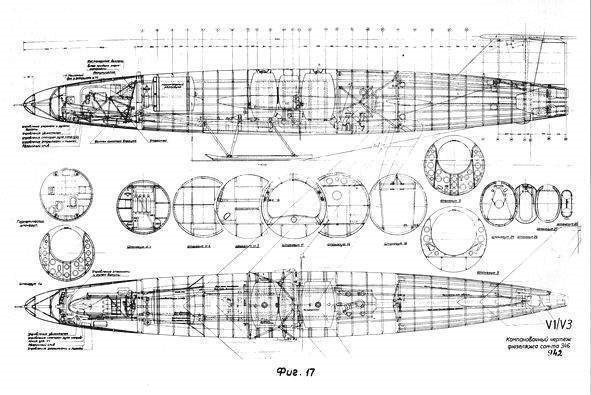
The entire aircraft was built in metal with a light sheet coating, except for the removable airtight cabin, which featured a wooden structure. The fuselage was made up of three sections. The front section, with a circular section, was obtained by rotating the NACA 00121-0.66-50 profile, with the entire glazed nose movable to allow access for the pilot. The central portion had a cylindrical shape that became a vertical oval towards the tail.
Detail of the opening of the nose to allow access to the pilot.
The wings had a NACA-012 profile of 12% thickness. The flaps and landing gear retraction were operated by a pneumatic system using gas balloons. The ailerons featured double section. At low speeds the inclination of both sections was the same, but at high speeds only the outer sections moved.
The tail was T-shaped with integral movable stabilizers with angles from -2º40 ‘to + 2º. The elevator had two sections, which, like the ailerons, were inclined at different angles depending on the flight regime.
The cockpit was attached to the fuselage by means of a hermetic gasket and featured a transparent plexiglass cover that moved to allow access for the pilot. This one was located lying down, with the look forward and in case of emergencies he could activate a system to detach the sealed cabin from the fuselage (with the help of explosive screws) and descend by parachute. This emergency system worked even in case the pilot had lost consciousness. Faced with certain uncontrolled reactions of the plane, a rescue system was activated that made the cabin detach from the rest of the aircraft and amortized its fall. For this purpose, the cabin featured a stabilization parachute fixed to its rear wall. Upon reaching 3,000 meters, the pilot was catapulted out of the cockpit by means of an automatic system that detached the cover. About 1,500 meters above the ground, the pilot’s parachute opened.
The decision to use a ski gear instead of a wheeled one was based on the fact that the “346” was designed to be launched from mother aircraft, so it did not need a landing gear to guarantee take-off. In all versions (except for the “346-P”) the undercarriage, once retracted, was covered by two panels to reduce aerodynamic resistance. A small steel skid was located under the tail. In the “346-3” version, curved metal skis were used under the wings to maintain the balance of the aircraft after landing.
In the ” 346” there were two Walter 509-109 reactive engines mounted on a common structure. This powerplant consisted of two superimposed chambers, one of which turned on whenever the engine was started. The other camera could be activated for short periods of time when maximum motive power was required. The cruise chamber developed 300 kg of thrust at sea level and the main chamber 1700 kg. The combined power at high altitude was approximately 2250 kg. Due to the high consumption this fuel guaranteed the work of the engine only for a few minutes. Just behind the cockpit was located the 1,100 kg tank with concentrated hydrogen peroxide (called T-Stoff in Germany) and in the central fuselage the methanol / hydrazine hydrate tanks (called C-Stoff) with capacity were interconnected for 552 liters of fuel. A system of pumps working with calcium permanganate injected the components into the combustion chambers.
In the USSR preparation of the flight of the “346” was carried out. Taking into account that the pilot had to steer the aircraft in a lying position, several experiments were carried out in the LII related to the particularities of this position. For this purpose, a DFS Kranich glider was specially prepared so that it could be piloted lying down. This glider was tested by a group of German and Soviet pilots, including Mark L. Galai, who described the position as “extremely uncomfortable.” Despite these assessments, it was impossible to change the cabin configuration, as it practically meant making it new and, on the other hand, it would significantly spoil the performance of the aircraft.
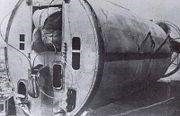
In the LII the detachment tests of the cabin and the catapult system were also carried out for emergency situations. For these tests, a “346” cockpit was prepared with a life-size mannequin. This cockpit was attached to the belly of a B-25J and tested successfully.
The emergency capsule tested from a B-25
The TsAGI played a major role during these preparations. Aerodynamic tests carried out in the T-101 tunnel of the TsAGI from March 1947, showed that at large angles of attack there was great turbulence at the wingtips. With the increase in speed, this turbulence spread through the wing, causing the loss of stability. It was concluded that this turbulence expanded because the wing had the same profile over its entire span. In order to combat this problem in the second example, four aerodynamic blades were added in the upper wing designed to break the flow along the entire length of the wingspan. This solution was later applied to virtually all Soviet swept wing aircraft developments of the 1950s – 1960s
Tests of the “346” in the T-101 tunnel of the TsAGI.
A model of the “346” was prepared and tested in the first high-speed wind tunnel in the USSR: the T-106 of the TsAGI. Testing at this facility demonstrated the loss of effectiveness of control surfaces as speed approached that of sound. This led to the decision not to exceed Mach 0.8 speed in manned flights.
Finally, after completing the aerodynamic tests, the example brought from Germany in 1946 was destined to carry out static resistance tests, until it was destroyed.
In the second half of 1948 the OKB-2 finished the construction of the glider version of the plane, designated “346-P”. Unlike the original model, this glider was built as a simplified version, lacking the sealed cabin, engine, and fuel tanks. Another detail was the removal of the panels from the undercarriage aerodynamic fairing. With the help of ballast, it was possible to modify the aircraft’s center of gravity in an operative way. The weight of the aircraft reached 1180-2180 kg.
The main objective of the “346-P” was to develop the launch system from the mother plane, the stability tests in flight and the control of the aircraft with different positions of the center of gravity. Another no less important objective was to test the piloting from the lying position and landing on the ski. The test pilot for the “346-P” was Wolfgang Ziese, formerly chief test pilot for the German firm Siebel Flugzeugwerke and with 20 years of experience flying different aircraft. As lead engineer for the tests, V. Ya. Malochayev was selected.
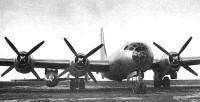
The first flight of the “346” in glider configuration was made on May 10, 1951. Between 1949 and 1949 the “346-P” made four flights using as mother ship one of the Boeing B-29 Superfortress (ex-USAAF 42 -6256) held in the USSR (and used as a material basis for studies to build the Soviet copy as Tupolev Tu-4). The “346” was fixed on a beam located under the right wing, between the two engines.
The B-29 mother plane prepares for flight.
The B-29 rose to the height set for the test, releasing the glider that began the descent towards the ground. Three of the flights went smoothly and in the fourth, Ziese, at the time of detachment, could not control the ailerons, so the plane turned over. With great work it was finally possible to stabilize the aircraft and land without further complications.
On 5 May 1949 the factory handed the “346-1” for testing. This model fully corresponded to the project except for the installation of a model instead of the reactive engine. The weight without fuel reached 3125 Kg.
The “346-1” under the wing of the B-29 mother plane.
Throughout the summer the preparatory work for the flight of the “346-1” was carried out at the Tiopli Stan airfield. The first flight of this model took place on September 30, 1949. The 3145 kg aircraft was lifted under the wing of the B-29 piloted by AA Efimov and NA Zamyatin to 9,700 meters. Following the detachment of the mother plane, Wolfgang Ziese began the descent. Upon reaching a height between 2,500 and 3,000 meters, it deployed the landing gear and began the approach. The calculation during the landing was not correct and the aircraft approached the runway with a high landing speed close to 310 km / h. The plane touched down and bounced to a height of 3-4 meters, covering a distance of close to 800 meters. During the second landing, the ski was picked up and the plane began to roll down the runway, moving on its belly. The pilot’s seatbelt system proved unsafe, so Ziese was thrown forward, his head hitting the cockpit deck structure and he lost consciousness. Luckily the traumas were not serious and after some time in the hospital Wolfgang Ziese was able to rejoin the tests.
The investigation commission, led by test pilot NS Rybko, concluded that the accident was caused by an error by the pilot, who, concentrating on controlling the aircraft, failed to fully deploy the landing gear. This flight showed that the behavior of the plane was still not very predictable, so it was decided to postpone the powered flight until the pilots had control of the flight, which required more test flights in a glider configuration.
The ” 346-2 ” or ” D ” was the ” 346-1 ” itself after repairs, but with the mock-up replaced by the actual powerplant. During Ziese’s time at the hospital the tests were continued by LII test pilot PI Kazmin. On its first flight, in October 1950, the ski could not be fixed after being extended, so it was also picked up when the airplane landed, but in this case the runway was covered with snow, so there was no considerable damage to the aircraft.
The “346-2” damaged after Kazmin’s landing on the belly in October 1950.
A short time later Kazmin made a second flight, this time towed by a Tupolev Tu-2, which released him at an altitude of 2000 meters. After being released, he made a free flight downhill, which also culminated in a bad landing due to the pilot landing before the start of the runway. Again, the plane had to be sent for repair.
Despite the landing accidents, it was concluded that the aircraft was controllable in flight and for this reason it was decided to move on to the main segment of the test program: flight with the reactive engine activated. For this purpose, a third example with an engine known as “346-3” was prepared.
The assembly of the “346-3″ culminated in May 1950. It differed from the “346-1” in the shape of the tail planes with greater sagging and thinner profile. As a result of these changes the calculated speed of the ” 346-3 ” grew to Mach 0.9.
Reactive engine tests on the ground before the first powered flight.
The reactive engine was tested on the ground on this model. The results obtained allow obtaining approval to carry out the powered flight tests. During the preparation for these flights, a high deterioration of the tanks, pipes and structure was observed, due to the action of the acid used as an oxidant. The OKB-2 carried out important works aimed at studying the causes of the corrosion of the ZhRD and the search for technological solutions.
For the tests of the “346-3” about 100 km southwest of Moscow, near the city Lujovits, the construction of a new factory airfield began. The preparation of this new aerodrome and the transfer of the necessary technology there took several months.
The tests of the “346” were carried out in extremely difficult conditions due to the fact that the new industrial aerodrome in Tretyakov (Lujovits) lacked the most basic services: there were no hangars or workshops, there was no electricity or water supply. The runway lacked surface and was extremely short (despite being somewhat longer than the one previously used).
At the beginning of 1951 and after returning from the hospital, Ziese began to conduct flight training in the glider “346-P” and on April 6 made a first flight in the “346-3” without starting the engine from the B-29.
The 346 during the approach to the runway.
On 15 August 1951 the first flight was performed with the engine running. Due to the limitations imposed by the TsAGI in relation to the maximum speed, only one of the combustion chambers was activated, so the maximum thrust reached only 1570 kg. The reactive engine was activated at the altitude of 7000 meters, one minute and 40 seconds after the detachment, and worked for 1 minute and a half, then the glide flight and landing was performed.
The flight was extremely difficult. When the engine started, there was marked lateral instability. Ziese was forced to keep a tight grip on the ailerons. The situation became more unbearable due to the poor performance of the cabin temperature regulation system, which caused it to rise above 40ºC.
After the flight, work was done on the cabin ventilation system. The second powered flight was carried out without major complications on September 2, 1951.
On 14 September 1951, the third planned flight ended in an accident. Ziese detached from the mother plane at an altitude of 9300 meters. After starting the engine, the plane continued its climb with increased speed. After two minutes of engine work, the speed exceeded 900 km / h, a moment later Ziese reported by radio that the plane lost control and began to fall. By order of the ground control, he was directed to leave the plane. The emergency system worked perfectly. The cockpit was detached from the rest of the aircraft at an altitude of 6500 meters and the stabilization parachute opened without problems. The automatic system allowed Ziese to evacuate upon reaching 3,000 m and landed, damaging one leg. The plane fell to the ground and caught fire near the Smolenskie Borki village.Shortly afterwards Ziese became seriously ill and died, being buried in Ivankovo village. Later his mother requested the transfer of his remains to Germany.
The “346” preparing for flight.
The specialists who participated in the investigation of the accident did not reach a single conclusion. One group of specialists concluded that the aircraft went into a spin due to human error by the pilot, while another group considered that Ziese reached the maximum allowable speed for the design, thus considerably increasing the pressure on the wing and tail, caused the loss of control of the aircraft.
Since the speed of 900 km / h had been reached, using less than half of the motive power, it could be assumed without margin of error that the speed of sound could be exceeded, but the structural and aerodynamic limitations did not allow these values to be achieved.
Despite the accident, it was considered that the investigative tasks posed to ” 346 ” were fulfilled. When reaching speeds close to Mach 0.9 it was shown: The working effectiveness of reactive engines both on the ground and in flight. The excellent response of the emergency system. The possibility of piloting the aircraft from the prone position, allowing it to better withstand large overloads on the pilot’s body, in relation to the normal position. The possibility of landing the plane at speeds of up to 330 km / h using a ski gear and on the runway of unprepared airfields. The excellent rate of climb with the use of the ZhRD at all flight heights.
In the course of the tests, the values of 12000 – 13000 meters were reached as a ceiling and a maximum speed of 950 km / h. The maximum flow velocity reached was 100 m / s. The dive speed during the accident was calculated to be higher than the speed of sound.
After the accident the testing program continued, but was soon closed. Despite the positive results and still having one (“346-1”) with flight capacity, it was decided not to continue the tests because it was considered that they would not yield any additional relevant results. All possible results (given the technological limitations of the TsAGI at the time) had been obtained.
The development of the “346” was the most expensive experimental program ever developed at Factory No.1. In the period from April 1946 to September 1951, 55 million rubles were spent on this project.
Various parts and components of the ” 346 ” were donated to the Moscow Aviation Institute. The OKB-2 in April 1951 was transferred to Factory No. 492 in Savielov. At the end of 1953 the OKB-2 was closed. All German specialists were repatriated to the GDR.
Versions
DFS-346 – First prototype built in the facilities of the Siebel firm in Halle by a group of specialists led by Hans Rössing and transferred to the USSR in 1946. It was used for a set of tests by the LII and the TsAGI and finally destroyed during the development of the static resistance tests.
346-P – Unpowered model built on the OKB-2 and used for motherboard launch and flight behavior tests. Externally it was identical to the DFS-346 except for the aerodynamic undercarriage fairing, removed in order to reduce weight. It lacked a pressurized cabin, fuel tanks, and powerplant.
346-1 (A) – Version with minor modifications to the rudder and tail design and a mock-up of the reactive engine. It was damaged on its first flight.
346-2 (D) – 346-1 after repair with reactive motor installed. It was never engine tested.
346-3 – The only specimen tested in flights with a reactive engine. It was destroyed during the third flight after exceeding 950 km / h.
In 1946, after the end of the war, by decision of the Soviet government, several groups of German aeronautical constructors began to work in the occupied German territory in the continuation of investigative and constructive works.
On 17 April 1946 the Council of Ministers of the USSR issued resolution No.874-366ss that, along with instruction No. 228ss of the minister of aviation industry MV Jrunishev of the, approving the development in the USSR of aeronautical projects with the use of the reactive technique and the German specialists.
These documents not only established the work prospects of the reactive technique, but also defined the equipment transfer processes, the relocation plan of the German specialists and their families in the USSR and the execution schedules of these processes.
In October 1946 a group of aeronautical specialists from Junkers in Dassau and Siebel in Gall was transferred to the USSR and located on the territory of Factory No. 458, located in the small village Ivankovo, Kimrski region in the Kalinin district (current city Dubná). Two OKBs were created in this factory with the aim of continuing the projection and testing tasks of work begun in Germany in the final years of the war, the development of new jet aircraft and the study of the possibilities of supersonic flight.
Among these special OKBs, OKB-2 was directed by Hans Rossing, and Alexander Yakovlevich Bereznyak as his replacement. This OKB was created in order to design and study experimental aircraft with liquid reactive rockets (ZhRD).
The OKB-2’s first task was the study, construction and development of the tests of the aircraft “346” with a two-chamber liquid reactive engine. The “346” was a development of the German DFS-346. A single copy of this model, almost in the final phase of construction, was destroyed in 1945 so that it would not fall into the hands of the Soviets, but a large number of components and mechanisms were preserved that facilitated the construction work.
The working group under the leadership of Hans Rossing, on September 29, 1946 completed the construction of a DFS-346 in the workshops of the Sieble firm’s aeronautical factory in Gall. After some tests on the ground the plane was shown and sent to the USSR. In a joint OKB-2 – TsAGI project, a program was developed to use the “346” as a flying test bed, with the aim of achieving speeds close to those of sound and studying the behavior of the aircraft in this environment, defining the loads, and its distribution throughout the fuselage and wings of the aircraft.
The “346” was successfully tested and despite the accident of the third prototype, the tests were deemed to have yielded the expected results. During the preparation for the flights with the reactive engine 109-510, a high deterioration of the tanks was observed due to the action of the acid used as oxidant. The OKB-2 carried out important works aimed at studying the causes of corrosion in ZhRD and the search for technological solutions to deal with it.
In 1949 OKB-2, on the basis of the “346”, developed the project for the supersonic interceptor fighter “486”, designed by the German aeronautical manufacturer Günter, who worked at Heinkel until the end of the war.
A model without an engine was built which, under the designation “466”, was tested in the wind tunnel of the TsAGI. In June 1951 the MAP closed the project.
In April 1951 the OKB-2 was transferred to the Factory No.492 in Savielov. At the end of 1953 the OKB-2 was closed. All the German specialists were repatriated to the GDR and the Soviet workers were distributed in other departments of the factory.
Japan The Okamura branch of Nihon aircraft works built the N52 two-seat lightplane in 1952, and collaborated with Tokyo University students in the design and construction of a two-seat sailplane.
The developed JOB 15 four-seater, which had metal/wood/glassfibre construction, entered production in 1961, powered by a Lycoming engine. It remained in service with Austrian and other European aero clubs, especially as a glider tug.