Oberlerchner MG-23

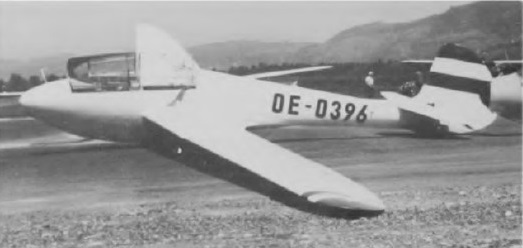
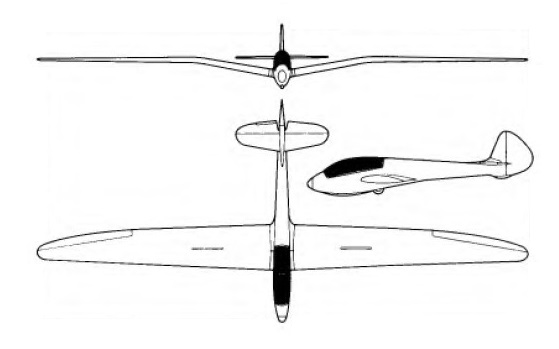
The Mg 23 high performance single-seater was the last of the Mg series designed by Erwin Musger. Of conventional wood and fabric construction, the Mg 23 has cantilever single-spar shoulder wings with no flaps and wooden fabric-covered inset-hinge ailerons. Wooden Schempp-Hirth air brakes are fitted, and there are layers of plywood stiffening forward of the spar which, combined with a close rib spacing, make easier the production of a smooth polished wing surface. The semi-monocoque plywood fuselage is of oval section and the wooden tail unit has fabric covered rudder and elevators, and a Flettner-type tab in the starboard elevator. The landing gear consists of a non-retractable monowheel behind the eg, with a brake but with no shock absorber, plus a nose skid partly shock-absorbed by rubber, and a bow-shaped tailskid. The pilot sits under a jettisonable Plexiglas canopy which slides forward to open; the seat back and rudder pedals are adjustable and the cockpit is ventilated.

The MG-23 first flew on 25 June 1955. That was the year in which Austria had signed its State Treaty with the Allied occupying powers, and Soviet and Western troops withdrew from the country. With normal peacetime conditions returning for the first time since 1938, Austrian gliding amongst other activities began a resurgence and the Mg 23, as the Mg 19 had done before it, won the Austrian State Championships and set a number of new national records; it also equipped the country’s national gliding team which began to re-establish Austria’s prewar position in competition flying.

The Mg 23 was followed by the production Mg 23SL, which flew for the first time on 1 April 1962, and had a number of refinements including a longer, flush fitting cockpit canopy, larger fin and rudder and a lowered monowheel. It is cleared for cloud flying and spinning, but is not acrobatic; it was awarded type approval by the US FAA, as well as by the Austrian authorities, and examples have been exported to the USA and Canada.

Approximately 90 were built when production ceased in 1967.
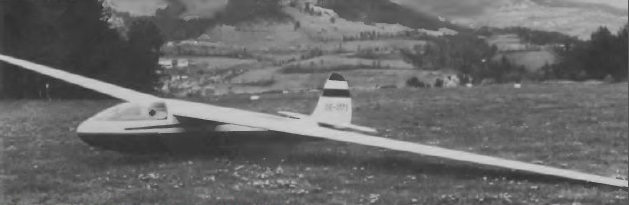
Mg 23 SL
Wing span: 16.4 m / 53 ft 9.5 in
Wing area: 14.21 sq.m / 153 sq.ft
Length: 7.11 m / 23 ft 4 in
Height: 4 ft 10.75 in
Empty Weight: 240 kg / 530 lb
Payload: 120 kg / 263 lb
Gross Weight: 360 kg / 793 lb
Water ballast: None
Max speed: 137 mph / 119 kt / 220 km/h (in smooth air)
Stalling speed: 32.5 kt / 60 km/h
Max aero-tow speed: 80 mph / 70 kt / 130 km/h
Wing Load: 25.33 kg/sq.m / 5.2 lb/sq.ft
L/DMax: 33 at 85 kph / 46 kt / 53 mph
MinSink: 0.64 m/s / 2.1 fps / 1.24 kt at 48.5 mph / 37 kt / 68 km/h
Aspect ratio: 18.54
Airfoil: NACA 63-315
Seats: 1

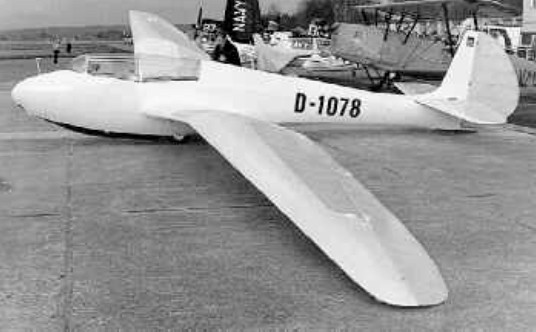
Oberlerchner Mg-19 Steinadler

Mg-19a Steinadler

The Mg 19, which made its first flight in November 1951, is a development of the prewar Mg 9, of conventional wood and fabric construction and distinguished by a laminar flow gull wing in the low/mid-set position, of Gottingen 549/676 section.

There are air brakes in the wing upper surfaces and the two pilots sit in tandem under a sideways hinging cockpit canopy.

The Mg 19 proved to be popular as a training sailplane and examples of the type competed in the 1954 and 1956 World Gliding Championships.

Oberlerchner Mg 19

Gallery

Mg-19a Steinadler
Wing span: 17.6 m / 57 ft 9 in
Wing area: 21.0 sq.m / 226.1 sqft
Wing section: Gottingen 549/676
Length: 8.04 m / 26 ft 4.5 in
Height: 1.65 m / 5 ft 6 in
Empty Weight: 303 kg / 657 lb
Gross Weight: 476 kg / 1,058 lb
Water ballast: None
Wing Load: 22.7 kg/sq.m / 4.69 lb/sq ft
Aspect ratio: 14.75
Max speed: 112 mph / 97 kt / 180 km/h
Max rough air speed: 70 kt / 130 km/h
Stalling speed: 27 kt / 50 km/h
L/DMax: 26 75 kph
Best glide ratio: 27.8:1 at 42 mph / 36 kt / 67 km/h
MinSink: 0.63 m/s / 2.1 ft/sec at 62 kph / 38.5 mph / 33.5 kt
No. of Seats: 2
No. Built: 1
Structure: wood

Oberlerchner, Joseph

Austria
The firm of Josef Oberlerchner Holzindustrie had become the foremost Austrian sailplane manufacturer, producing over 4,000 gliders and powered aircraft between 1941 and 1967, of which the Mg 19 tandem two-seater trainer and the Mg 23 high performance single-seater were the most important postwar types. Before the war Austria had produced some notable sailplanes, in particular the Mg series designed by Ing Erwin Musger which culminated in the Mg 19 and Mg 23.

A former manufacturer of sailplanes, Oberlerchner flew a prototype all-wood two-seat JOB 5 lightplane in 1958. The developed JOB 15 four-seater, which had metal/wood/glassfibre construction, entered production in 1961, powered by a Lycoming engine. It remained in service with Austrian and other European aero clubs, especially as a glider tug.

Oakland Airmotive

USA
California-based Oakland Airmotive specialized in civilian executive transport conversions of surplus U.S. Navy Lockheed PV-2 Harpoon patrol bombers. The resultant Oakland Centaurus seated 8/14 passengers and was offered as a highspeed corporate transport in the late 1950s and early 1960s. A twin-engined conversion of the Beechcraft Bonanza was also completed to order, and renamed Oakland Super V.

NZ Aerospace Industries

In the late 1950s several FU-24 operators; James Aviation, Thames Aerial Topdressing and Robertson’s Air Services, formed Air Parts (NZ) Ltd at Hamilton Airport to provide aftermarket sales and service to FU-24 operators. Also in the mid 1950s Aero Engine Services Ltd (AESL) was formed to provide Engine and component overhaul facilities in support of the FU-24 program.

These businesses continued on until the 1960s when things began to change for the both of them. In 1965 Air Parts (NZ) Ltd secured the manufacturing rights to the Fletcher FU-24 and began producing detail parts and FU-24 aircraft locally. In 1967 AESL secured the manufacturing rights to the Victa Airtourer and also began detail and aircraft production locally. Both companies then enjoyed some years of expansion and development.

AESL provided the catalyst for the next change. In the early 1970s it had developed the CT-4 Airtrainer out of the prototype Victa Aircruiser and successfully secured contracts to supply the Airtrainer to the RAAF and RTAF. As a result of this, there were moves to get the New Zealand Government involved and merge Air Parts (NZ) Ltd and AESL into a new strong entity.

New Zealand Aerospace Industries Ltd (NZASIL) was born in 1973 with a 50% Government shareholding, (25% Air New Zealand and 25% National Airways Corporation), with the other 50% shareholding remaining with the previous companies shareholders such as James Aviation.

NZASIL started off well and successfully marketed both lines of Aircraft all around the world. Peak production was reached in 1975 with the delivery of 36 CT-4 Airtrainers and 14 FU-24s a total of 50 aircraft for the year.

Things quietened down several years later when CT-4 production slowed and all that remained was short run FU-24 production.

Pacific Aerospace Corporation, (PAC) was established in July 1982, following the purchase of the assets of New Zealand Aerospace Industries. James Aviation took a 50% interest in Aero Engine Services Ltd in 1955. James Aviation also had a shareholding in Air Parts when it was formed in 1957 to market the FU-24.

Nyborg TGN.1

The Nyborg TGN.1 was a single seat experimental sailplane designed by T.G.Nyborg of Worcester, UK. Probably just one was built, but possibly as many as three.

Last flown in the late 1950s, it later went to the Midlands Aircraft Preservation Society and was stored at Solihull as BAPC.25.

Nurtanio NU-85 / NU-90 Belalang

NU-90 Belalang

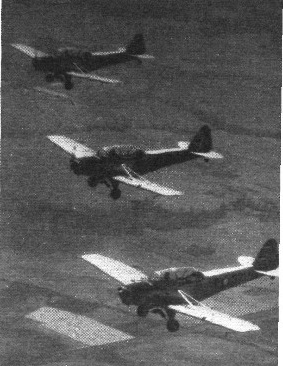
This aircraft is a low-wing conversion of the Piper Cub L-4J.
The prototype, designated NU-85, flew on April 17, 1958, and proved to be such an improvement over the original L-4J that the Indonesian Air Force was having all its L-4Js converted into Belalangs, with the production designation NU-90.
The programme was started in 1959 and the NU-90 became the standard primary trainer at the Air Force Flying School.

Engine: Continental C90-12F, 90 hp
Span: 31 ft l in
Length: 25 ft 3 in
Height: 6 ft 8 in
Wing area: 161.5 sq.ft
Gross weight: l,500 lb
Empty weight: l,038 lb
Max speed: 115 mph
Cruising speed: 90 mph
Max rate of climb at SL: 600 ft/min
Service ceilmg: 12,000 ft
TO run: 500 ft
Landing run: 400 ft
Range: 350 miles

Nurtanio NU-25 Kunang / NU-35 Kunang / Lipnur NU-25 Kunang / NU-35 Kunang

NU-25 Kunang

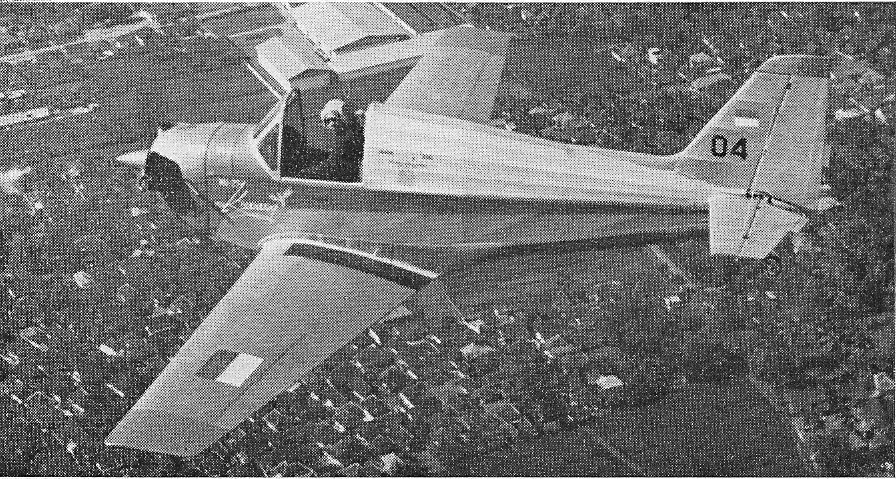
Development of the original NU-25 Kunang was started in 1957, to provide Indonesian flying clubs with an economical single-seat ultra-light trainer.
The original tapered wing, with fixed slots, was replaced by a constant-chord wing of 25 percent greater area during 1960. At the same time, the Volkswagen engine has been uprated from 25 to 35 h.p. and a cockpit canopy has been fitted. Now designated NU-35, the Kunang is of conventional wooden construction, with fabric covering.

NU-35 Kunang
Engine: Volkswagen, 35 hp
Span: 23 ft ll in
Height: 5 ft 11 in
Wing area: 102.6 sq.ft
Gross weight: 743 1b
Empty weight: 504 lb
Cruising speed: 80 mph
Max rate of climb at SL: 300 ft/min

Nurtanio Sikumbang

In 1953, the Indonesian Air Force began the development of a series of light combat and training aircraft at its research, development and production depot near Bandung.

The first was a single-seat light ground support aircraft named the Sikumbang, of which two prototypes were built.