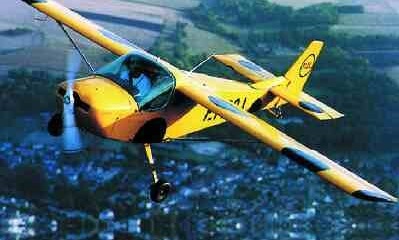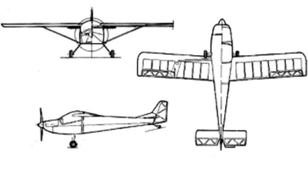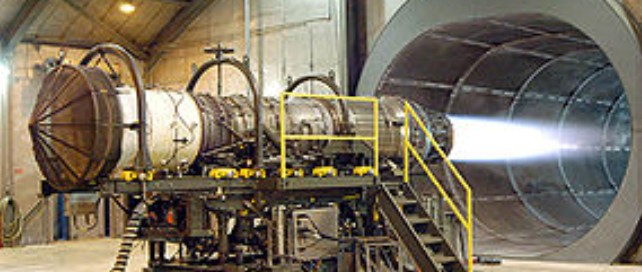
Pratt & Whitney F100 / JTF22 / F401

In 1967, the United States Navy and United States Air Force issued a joint engine Request for Proposals (RFP) for the F-14 Tomcat and F-15 Eagle fighters. The combined program was called Advanced Turbine Engine Gas Generator (ATEGG) with goals to improve thrust and reduce weight to achieve a thrust-to-weight ratio of 9. The program requested proposals and would award Pratt & Whitney a contract in 1970 to produce F100-PW-100 (USAF) and F401-PW-400 (USN) afterburning turbofan engines (company designation JTF22). The Navy would cut back and later cancel its order, choosing to continue to use the Pratt & Whitney TF30 engine from the F-111 in its F-14.

Pratt & Whitney F100 / JTF22 / F401 Article

F100-PW-229

Variants:
F100-PW-100
The F100-100 first flew in an F-15 Eagle in 1972 with a thrust of 106.4 kN (23,930 lbf). Due to the advanced nature of engine and aircraft, numerous problems were encountered in its early days of service including high wear, stalling and “hard” afterburner starts. These “hard” starts could be caused by failure of the afterburner to start or by extinguishing after start, in either case the large jets of jet fuel were lit by the engine exhaust resulting in high pressure waves causing the engine to stall. Early problems were solved.

F100-PW-200
The F-16 Fighting Falcon entered service with the F100-200, with only slight differences from the -100. Seeking a way to drive unit costs down, the USAF implemented the Alternative Fighter Engine (AFE) program in 1984, under which the engine contract would be awarded through competition. The F-16C/D Block 30/32s were the first to be built with the common engine bay, able to accept the existing engine or the General Electric F110.

F100-PW-220/220E
The F100-PW-220 incorporated the most advanced technology available, including the precision control and advanced maintenance features of digital electronic controls and the extended durability and reliability of metallurgical and heat-transfer advances. The F100-220 was introduced in 1986 and could be installed on either an F-15 or F-16. A non-afterburning variant, the F100-PW-220U powers the Northrop Grumman X-47B UCAV. The “E” abbreviation from 220E is for equivalent. The abbreviation is given to engines which have been upgraded from series 200 to 220, thus becoming equivalent to 220 specifications.

F100-PW-229
Using technology developed from the F119 and F135 engine programs for the F-22 Raptor and F-35 Lightning II, the production F100-PW-229 incorporates modern turbine materials, cooling management techniques, compressor aerodynamics, and electronic controls. The first -229 was flown in 1989 and has a thrust of 79 kN (17,800 lbf) (dry thrust) and 129.7 kN (29,160 lbf) with afterburner. It powers late model F-16s and the F-15E Strike Eagle.

Applications:
F100
McDonnell Douglas F-15 Eagle
McDonnell Douglas F-15E Strike Eagle
General Dynamics F-16 Fighting Falcon
Northrop Grumman X-47B

F401
Grumman F-14B Tomcat (planned; test aircraft only)
Rockwell XFV-12
Vought Model 1600 (proposed)

Specifications:
F100-PW-229
Type: Afterburning turbofan
Length: 4,900 millimetres (191 in)
Diameter: 880 millimetres (34.8 in) inlet, 1,180 millimetres (46.5 in) maximum external
Dry weight: 1,700 kilograms (3,740 lb)
Compressor: Dual Spool Axial compressor with 3 fan and 10 compressor stages
Bypass ratio: 0.36:1
Combustors: annular
Turbine: 2 low-pressure and 2 high-pressure stages
Maximum thrust: 79 kilonewtons (17,800 lbf) military thrust, 129.7 kilonewtons (29,160 lbf) with afterburner
Overall pressure ratio: 32:1
Turbine inlet temperature: 1,350 °C (2,460 °F)
Specific fuel consumption: Military thrust: 77.5 kg/(kN·h) (0.76 lb/(lbf·h)) Full afterburner: 197.8 kg/(kN·h) (1.94 lb/(lbf·h))
Thrust-to-weight ratio: 7.8:1
Pratt & Whitney JT3D / TF33

KC-135E with TF33 engines

Aware of the competition from the Rolls-Royce Conway turbofan, Pratt&Whitney decided to develop the JT3D turbofan from the JT3C turbojet for later deliveries of the Boeing 707 and the Douglas DC-8, then nearing entry into service. A 2-stage fan, based on work done on the J91 nuclear turbojet, replaced the first 3 stages of the 8-stage JT3C LP compressor. On the LP turbine, the second stage was enlarged and a third stage added. On the Boeing 707 the fan nacelle was relatively short, whereas the Douglas DC-8 installation had a full length fan cowl. First run in 1958 and flown in 1959 (under a B-45 Tornado test aircraft), Pratt & Whitney provided a kit whereby JT3C’s could be converted to the JT3D standard in an overhaul shop.

In 1959, important orders for the engine were the Boeing 707-120B and Boeing 720B when American Airlines ordered one 707 powered by JT3D turbofans and KLM ordered a JT3D powered Douglas DC-8. The earlier 707s had been powered by the turbojet JT3C and the improved efficiency of the turbofan soon attracted the airlines. A JT3D powered 707-123B and 720-023B (the suffix B was to indicate a turbofan powered aircraft) entered service with American Airlines on the same day, March 12, 1961.

The Boeing KC-135 Stratotankers were all originally powered by turbojet engines. With the demise of many airline 707s the United States Air Force took the opportunity to buy the surplus airframes and use the engines to re-engine the KC-135As used by the Air National Guard and reserve squadrons with the civilian JT3D (designated TF33-PW-102). Over 150 aircraft were modified and the former KC-135A were re-designated the KC-135E.

135 KC-135s use the JT3D while 354 were fitted with CFM International CFM56 engines which provide greater thrust and increased operational flexibility due to their lower noise footprint. The noise of the JT3D is one of the reasons NATO has debated re-engining their E-3 Sentry AWACS fleet, with the aircraft subject to restrictions that modern-engined aircraft are not. Operational flexibility would be further increased due to the ability of higher power engines to increase the ceiling of the aircraft, extending the horizon for radar surveillance; for instance, RAF, French and Saudi E-3s routinely fly higher than NATO/USAF counterparts.

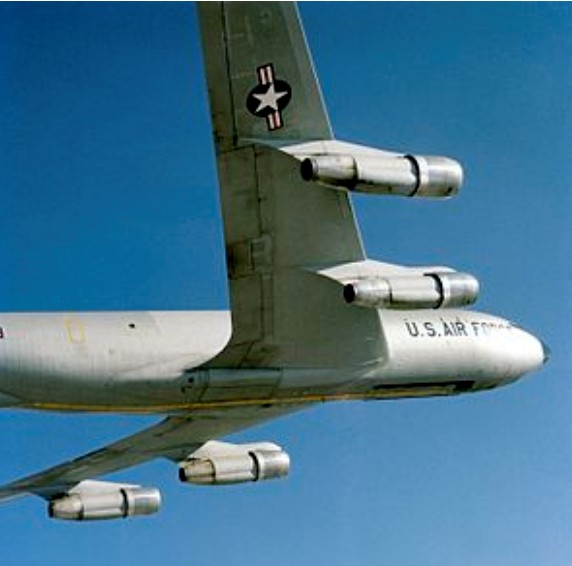
the Boeing B-52H Stratofortress is fitted with the JT3D (in TF33 form). The ‘H’ model of the B-52 was the only production variant of the bomber to be fitted with turbofan engines.

About 8,600 JT3Ds were produced between 1959 and 1985.

Variants:

JT3D-1
17,000 lbf (75.62 kN) thrust civil version, (Water injection optional)

JT3D-2
(TF33-P-3) 17,000 lbf (75.62 kN)

JT3D-3
18,000 lbf (80.07 kN), (Water injection optional)

JT3D-3A
(TF33-P-5) 18,000 lbf (80.07 kN)

JT3D-3B
18,000 lbf (80.07 kN) thrust civil version

JT3D-5A
(TF33-P-7) 18,000 lbf (80.07 kN), (Water injection optional)

JT3D-8A
(TF33-P-7) 18,000 lbf (80.07 kN), (Water injection optional)

JT3D-7
19,000 lbf (84.52 kN) thrust civil version

JT3D-15
22,500 lbf (100.08 kN) thrust civil version for the unbuilt 707-820

TF33-P-3
17,000 lbf (75.62 kN) thrust for the Boeing B-52H Stratofortress

TF33-P-5
18,000 lbf (80.07 kN) thrust for the Boeing KC-135 Stratotanker

TF33-P-7
21,000 lbf (93.41 kN) thrust for the Lockheed C-141 Starlifter

TF33-P-11
16,000 lbf (71.17 kN) thrust for the Martin B-57 Canberra

Aircraft applications:

Civilian (JT3D)
Boeing 707
Douglas DC-8
Shanghai Y-10

Military (TF33)
B-52 Stratofortress
Boeing C-18
C-135B Stratolifter
E-3 Sentry
E-8 Joint STARS
KC-135E Stratotanker (JT3Ds from surplus civil 707 airliners)
VC-137B/C Stratoliner
C-141 Starlifter
Martin RB-57F

Specifications:
JT3D-1
Type: Turbofan
Length: ~138in (3505mm) flange-to-flange
Diameter: ~51.57in (1310mm) fan tip
Dry weight: ~4360lb (1978Kg) bare engine
Compressor: Axial flow, 2-stage fan, 6-stage IP compressor and 7-stage HP compressor
Combustors: cannular, 8 flame tubes
Turbine: Axial flow,single stage HP turbine and 3-stage LP turbine
Maximum thrust: 17,000 lbf (75.6 KN)Take-off (flat-rated to ISA); partial thrust restoration with water injection
Overall pressure ratio: ~12.5:1; bypass ratio 1.42:1
Turbine inlet temperature: ~1150K @Take-off,SLS,ISA
Specific fuel consumption: ~0.78lb/hr/lbf (22.09g/s/KN) @ 4000lbf thrust M 0.82,35000ft,ISA
Thrust-to-weight ratio: 3.9 bare engine

TF33-PW-7
Type: Turbofan
Length: 6200 mm
Diameter: 1000 mm
Compressor: Axial flow, 7-stage LP
Maximum thrust: 21,000 lbf

Pratt & Whitney T73 / JFTD12 / FT12

T73/JFTD12

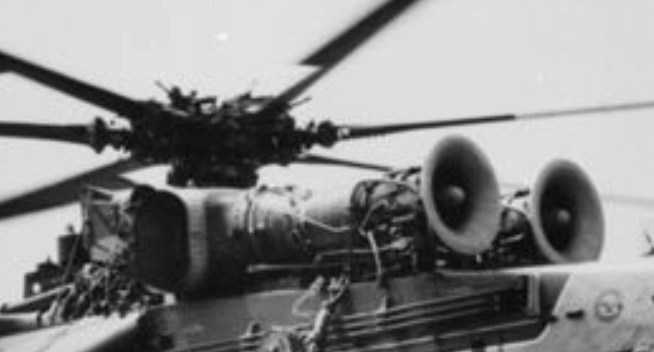
The Pratt & Whitney T73 (company designation JFTD12) is a turboshaft engine developed from the Pratt & Whitney JT12. Based on the JT12A, the T73 powered the CH-54 Tarhe/Sikorsky S-64 flying crane heavy-lift helicopter. Turboshaft versions for naval use are known as the FT12.
352 were built.

Applications:
Sikorsky CH-54 Tarhe (T73)
Sikorsky S-64 Skycrane (JTFD12)

Pratt & Whitney R-4360

R-4360-8

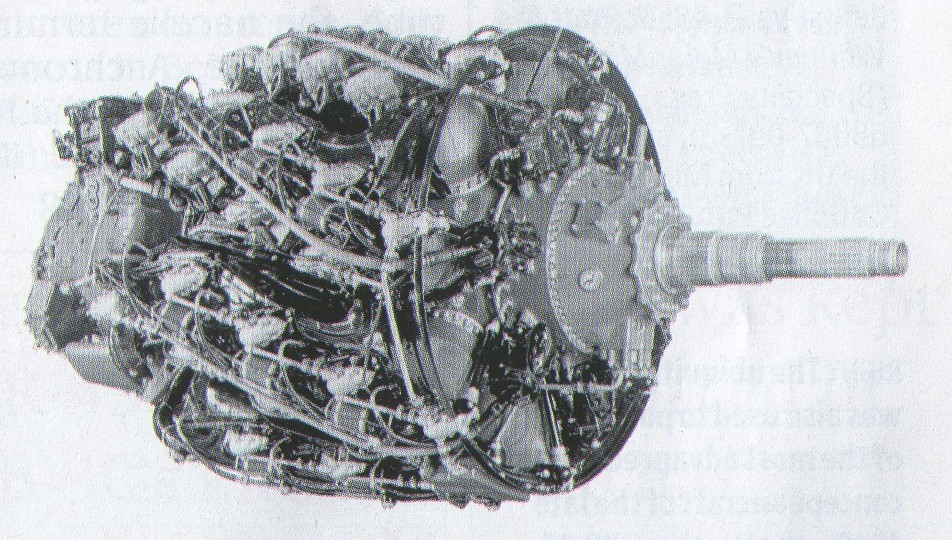
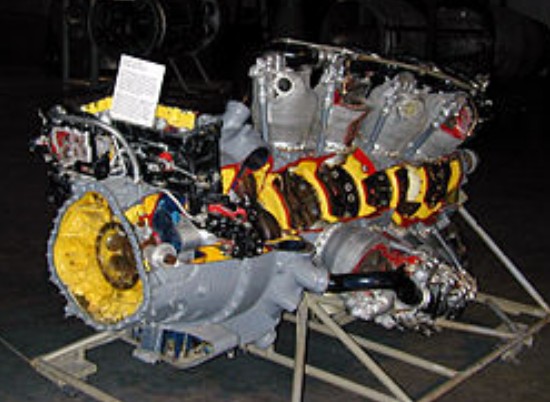
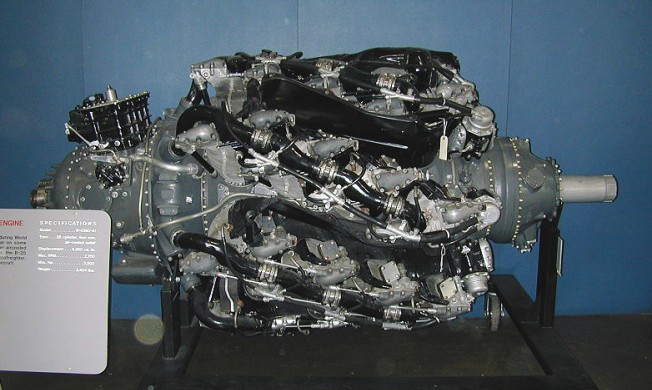
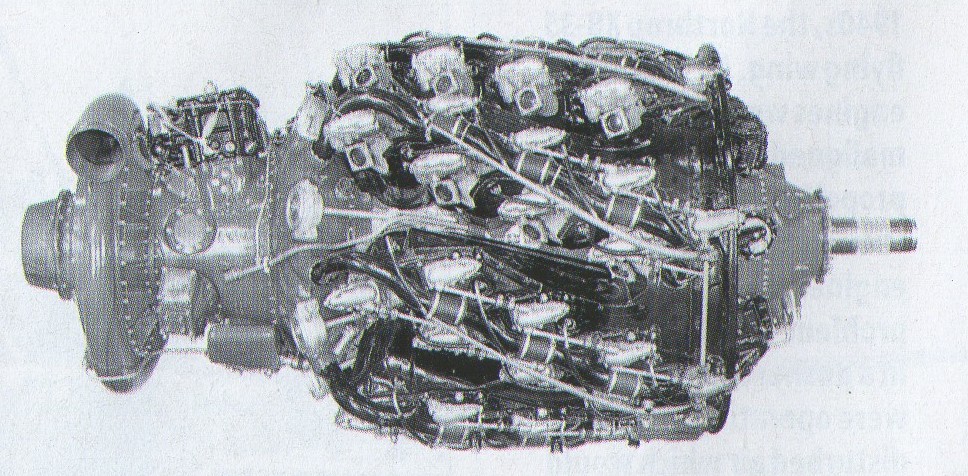
Starting in 1940, and production begining in 1945, just too late for the Second World War, the engineers at P&W were tasked with developing a 3,000 h.p.-plus engine. At the beginning of the R-4360’s development, state-of-the-art engines were struggling to achieve 2,000 h.p. P&W decided on air cooling and, after a number of variations and permutations of cylinder arrangement had been investigated, the final concept, which went into production, was four rows of seven cylinders, giving a total of 28.

Cooling high-performance air-cooled engines was always a challenge, for the R-4360. Each row of pistons was slightly offset from the previous, forming a semi-helical arrangement to facilitate efficient airflow cooling of the successive rows of cylinders, with the spiraled cylinder setup inspiring the engine’s “corncob” nickname. Seven plenums, one between each cylinder bank, created the necessary cooling air path. A complex tight baffling system ensured that cooling air was forced through the cylinders in a quasi-cross-flow pattern. To ensure an unobstructed path, intake manifolds were routed over the top of the cylinders, terminating in a downdraught flow into the hemispherical combustion chamber.

Pratt & Whitney R-4360 Wasp Major

A mechanical supercharger geared at 6.374:1 ratio to engine speed provided forced induction, while the propeller was geared at 0.375:1 so that the tips did not reach inefficient supersonic speeds. General Electric (GE) had designed most previous P&W superchargers, but this time P&W decided to do it in-house. According to former R-4360 engineers, P&W’s supercharger was more efficient than GE’s. Most superchargers were single-stage, with variable speed or single speed. Additionally, most R-4360 applications were augmented by GE turbosuperchargers with intercooling, A two-stage gear-driven supercharger was also developed.

Inevitable teething problems arose when the R-4360 entered service, such as frying the ignition system, intake manifold problems and, perhaps most seriously, poor oil scavenging owing to aeration of the oil. The disarmingly simple solution for the last of these problems was to incorporate perforated sheet-metal plates in the rear housing, which took out much of the entrapped air.

Although reliable in flight, the Wasp Major was maintenance-intensive. Improper starting technique could foul all 56 spark plugs, which would require hours to clean or replace. As with most piston aircraft engines of the era, the time between overhauls of the Wasp Major was about 600 hours when used in commercial service.

Engine displacement was 4,362.50 cu.in (71.5 lt), hence the model designation. Initial models developed 3,000 hp (2,240 kW), and later models 3,500 hp, but one model delivered 4,300 hp (3200 kW) using two large turbochargers in addition to the supercharger. Engines weighed 3,482 to 3,870 lb (1,579 to 1,755 kg), giving a power-to-weight ratio of 1.11 hp/lb (1.83 kW/kg), which was matched or exceeded by very few contemporary engines.

Designed for military use, the R-4360 also saw commercial use as the “Wasp Major”. The R-4360 was used for a number of applications, including commercial aviation, military aircraft and air racing. The R-4360-8 powered the Douglas XTB2D-1 Skypirate, the contra-rotating propeller shafts each drove a Hamilton Standard four-bladed propeller. The Skypirate was cancelled after one prototype.

Wasp Majors were produced between 1944 and 1955; 18,697 were built.

Pratt & Whitney R-4360 Wasp Major

A derivative engine, the Pratt & Whitney R-2180-E Twin Wasp E, was essentially the R-4360 “cut in half”. It had two rows of seven cylinders each, and was used on the postwar Saab 90 Scandia airliner.

R-4360-33

The R-4360-33 powered the Boeing XB-44, essentially a B-29 converted to carry R-4360s. Note auxiliary gear driven supercharger on the rear of the engine. Some R-4360s utilised both contra-props and two-stage supercharging.

Applications:
Aero Spacelines Mini Guppy
Aero Spacelines Pregnant Guppy
Boeing 377 Stratocruiser
Boeing B-50 Superfortress
Boeing C-97 Stratofreighter
Boeing KC-97 Stratotanker
Boeing XF8B
Boeing XB-44 Superfortress
Convair B-36
Convair XC-99
Curtiss XBTC
Douglas C-74 Globemaster
Douglas C-124 Globemaster II
Douglas TB2D Skypirate
Fairchild C-119 Flying Boxcar
Fairchild C-120 Packplane
Goodyear F2G Corsair
Hughes H-4 Hercules (“Spruce Goose”)
Hughes XF-11
Lockheed R6V Constitution
Martin AM Mauler
Martin JRM Mars
Martin P4M Mercator
Northrop B-35
Republic XP-72
Republic XF-12 Rainbow
SNCASE SE-2010 Armagnac
Vultee A-41

Variants:
R-4360-4 – 2,650 hp (1,976 kW)
R-4360-20 – 3,500 hp (2,610 kW)
R-4360-25 – 3,000 hp (2,237 kW)
R-4360-41 – 3,500 hp (2,610 kW)
R-4360-51 VDT – “Variable Discharge Turbine” 4,300 hp (3,210 kW). Intended for B-36C. Used on Boeing YB-50C Superfortress. Turbo-supercharger exhaust used to augment thrust.
R-4360-53 – 3,800 hp (2,834 kW)
R-4360-B3 – 3,500 hp (2,610 kW)
R-4360-B6 – 3,500 hp (2,610 kW)

Specifications:
R-4360-51VDT
Type: 28-cylinder supercharged air-cooled four-row radial engine
Bore: 5.75 inches (146 mm).
Stroke: 6.00 inches (152 mm).
Displacement: 4,362.5 cubic inches (71.489 lt).
Length: 96.5 inches (2,450 mm).
Diameter: 55 inches (1,400 mm).
Dry weight: 3,870 pounds (1,760 kg).
Valvetrain: Poppet, two valves per cylinder
Supercharger: Gear-driven single stage variable speed centrifugal type supercharger
Turbocharger: General Electric CHM-2
Fuel system: Bendix-Stromberg PR-100E2 pressure carburetor
Fuel type: 115/145 Aviation gasoline
Cooling system: Air-cooled
Power output: 4,300 hp (3.2 MW)
Specific power: 0.99 hp/cu.in (44.9 kW/lt)
Compression ratio: 6.7 : 1
Power-to-weight ratio: 1.11 hp/lb (1.83 kW/kg)

Pratt & Whitney

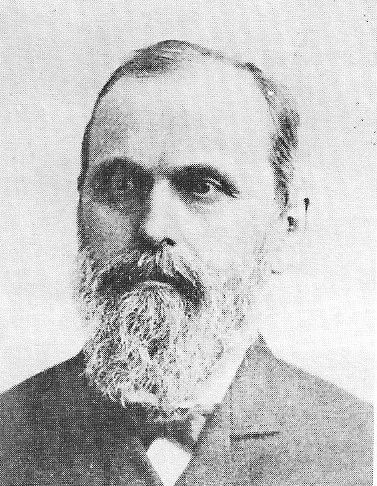
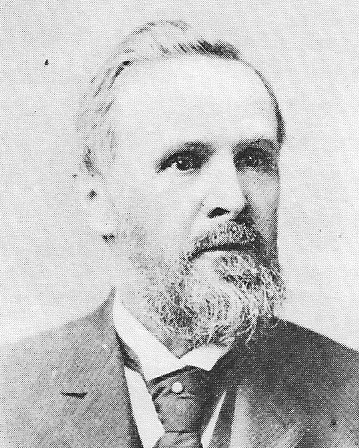
In 1925, Frederick Rentschler established the Pratt & Whitney Aircraft Company in Hartford, and Connecticut. Former president of the Wright Aeronautical Corporation of New Jersey, Rentschler was an astute businessman and visionary. Rentschler believed that the future of aviation lay in aircraft capable of carrying a large number of passengers’ great distances at ever-faster speeds. To do so required a more reliable, more powerful aircraft engine than was currently available, and this was where Rentschler focused his energies.

Pratt
Whitney

Within a year, Rentschler and his team had designed the air-cooled, radial Wasp engine, which together with its successor, the Hornet, provided increased power and reliability at a low relative weight. Both engines proved extremely successful. By 1929, Pratt & Whitney Aircraft had outgrown its Capitol Avenue plant in Hartford, and Rentschler moved the company to new headquarters on a 1,100-acre site in East Hartford, which included room for further expansion and an airfield to flight test his engines. Pratt & Whitney Aircraft was on its way to becoming one of the state’s largest employers.

Air power played a significant role in the Allied victory during World War II, and Pratt & Whitney Aircraft supplied much of that power. By the end of the war, Pratt & Whitney Aircraft had produced more than 350,000 engines for military use – more in number than any other American manufacturer and, in total horsepower, one half that of America’s combat air forces. In the meantime, Pratt & Whitney Aircraft became a division of the United Aircraft Corporation, which also manufactured the latest in aviation technology, the helicopter, invented by Igor Sikorsky in 1939.

During the post-war decades, Pratt & Whitney Aircraft continued to manufacture aircraft engines for commercial use and was also involved in the development of jet engines. During the 1950s, when government optimism in the peaceful uses of nuclear power was at its peak, Pratt & Whitney even investigated the possibility of using nuclear power in commercial aircraft at its Connecticut Aircraft Nuclear Engine Laboratory in Middletown.

Pratt-Read PR-G1 / LNE-1

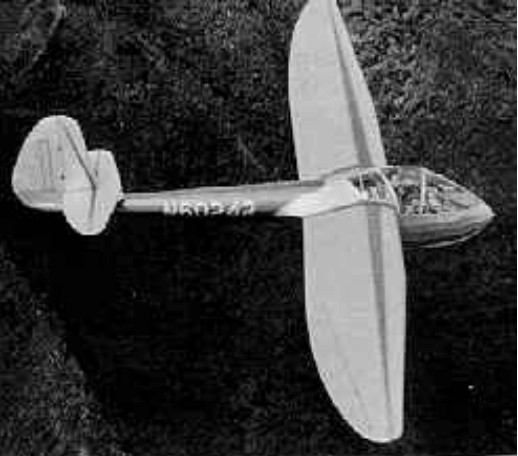
The Pratt-Read had two distinctions for a World War II training glider; the side-by-side seating and that it was the only training glider designed for the U.S. Navy. After release by the Navy, the LNE-1’s were acquired by the Army Air Corps which used some for a thunderstorm research project. Pratt-Read was a piano manufacturer and the G1 its only glider project. It has Schempp-Hirth type airbrakes. It won the multi-place world record for Absolute Altitude 13,489 m. / 44,255 ft. flown by Larry Edgar and H. Klieforth in 1952. One belongs to the National Soaring Museum.

Designed by M. Gluhareff, P. Leonard, J. Buxton, R. Stanley, H. Struck and R.W. Griswold, the PR-G1 has wood/ fabric wings and tail wood aft fuselage, steel-tube/ fabric forward fuselage.

This particualar airplane, N60242, crahsed about 1962 in Waimanalo, Oahu, from a low-altitude spin. Spin came from a low-altitude turn chasing a thermal in the landing approach! The pilot suffered back injuries but the ship was destroyed. Elevator and instrunments were recovered intact but everything is still in the gulch where it crashed. Pilot was a very light person and nose ballast may have been removed during a prior overhaul, as the aircraft was used to set a 71-hr aloft soaring record and all possible weight was removed to allow for supplies to be carried.
Ted Ralston

Wing span: 16.6m / 54.5 ft
Wing area: 21.37sq.m / 230sq.ft
Empty Weight: 349kg / 770 lb
Payload: 172kg / 380 lb
Gross Weight: 521kg / 1150 lb
Wing Load: 24.38kg/sq.m / 5lb/sq.ft
Aspect ratio: 12.9
Airfoil: GS-4, GSM, GS-1
L/DMax: 26 84 kph / 45 kt / 52 mph
MinSink: 0.91 m/s / 3.0 fps / 1.78 kt
Seats: 2
No. Built: 75

Praga D / DH

The Praga D was a four-cylinder, air-cooled, horizontally opposed aircraft engine first produced in Czechoslovakia in 1936 but which enjoyed its greatest success after World War II due to the explosion in popularity of sports flying. A version for helicopters was produced post WWII as the Praga DH.

Applications:
Mráz M-2 Skaut

Specifications:
Praga D
Type: four-cylinder, air-cooled, horizontally opposed
Bore: 95mm (3.7 in)
Stroke: 100mm (3.9 in)
Displacement: 2.83 lt (173 cu in)
Length: 893mm (35 in)
Width: 810mm (32 in)
Height: 546mm (21 in)
Dry weight: 67Kg (148 lb)
Fuel system: Zenith or Stromberg carburetor
Fuel type: 72 octane
Cooling system: air
Power output: 56 kW (75 hp) at 2,650 rpm
Compression ratio: 6.1:1
Fuel consumption: 235 g/HP hour
Specific fuel consumption: 220 g/HP hour
Oil consumption: 2 – 6 g/HP hour

Practavia Sprite

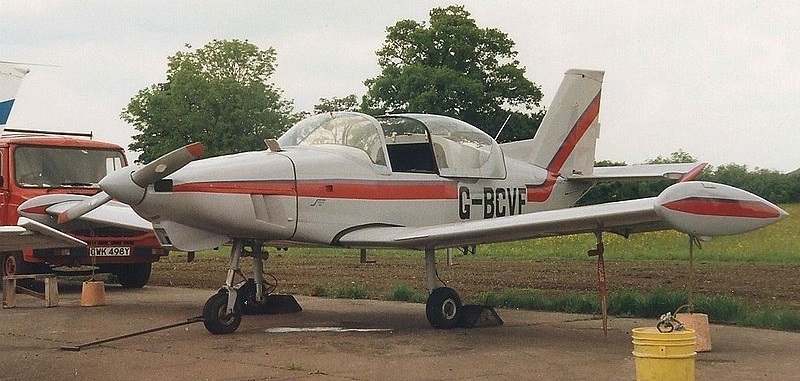
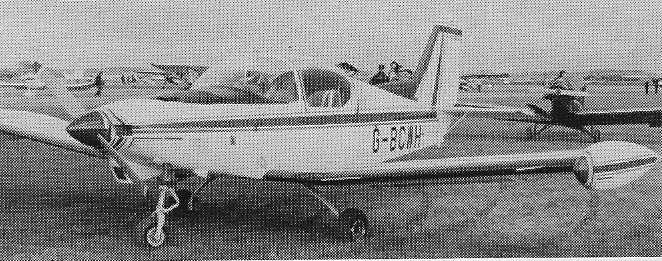
The prototype Sprite, named the Pilot Sprite, was designed by a team at Loughborough University as a British two-seat homebuilt training or touring monoplane for amateur construction. The design had been begun as a magazine-sponsored project by Peter Garrison, who worked for Pilot at the time; when the project did not move forward rapidly enough to suit him, he returned to the United States, where he modified his design into what would become his first Melmoth.

An all-metal side-by-side low-wing cantilever monoplanes with tricycle landing gear. The Sprite was powered by a Rolls-Royce Continental O-240-A piston engine.

It was the winning entry in a competition sponsored by Pilot magazine in 1968.

Plans for amateur building were marketed by Practavia Ltd as the Practavia Sprite.

First flying in 1971, eight are known to have been built.

Gallery

Engine: 1 × Rolls-Royce Continental O-240-A, 130 hp (97 kW)
Wingspan: 24 ft 0 in (7.32 m)
Length: 20 ft 0 in (6.09 m)
Height: 8 ft 3 in (2.51 m)
Empty weight: 850 lb (386 kg)
Gross weight: 1,400 lb (635 kg)
Cruise speed: 128 mph (205 km/h, 111 kn)
Crew: 1 (pilot)
Capacity: 1 (passenger)

Poullin JB-30

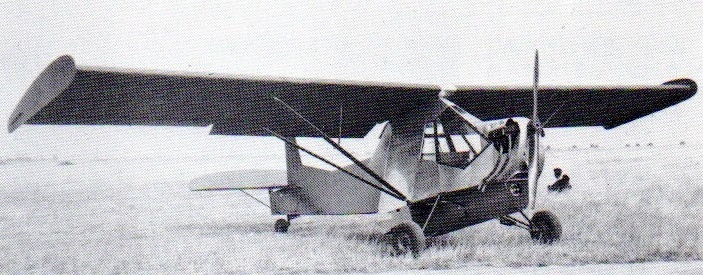
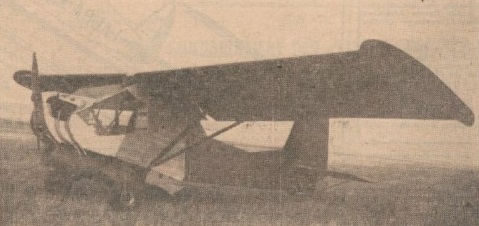
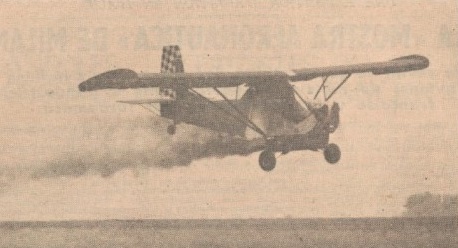
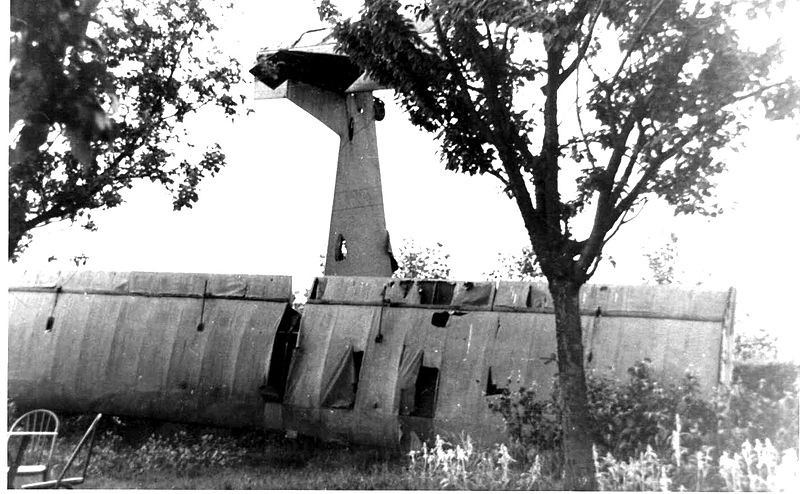
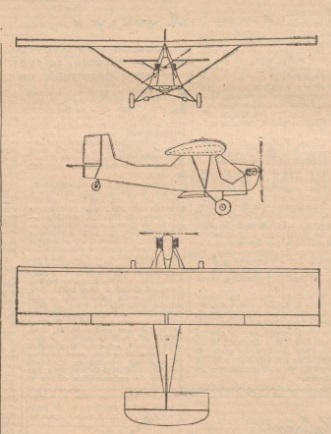
The Poullin JP.30 was a French single-seat agricultural aircraft designed and built by Jean Poullin. It was a single-seat high-wing monoplane with a fixed tailwheel undercarriage.

The powerplant was a Continental C-90 of 90 hp (67 kW).

One example (F-WGIR) was constructed and first flown on 15 August 1952.

After several years agricultural service, the aircraft, F-WGIR, was retired and used as an advertising feature for the former Bar de l’Escadrille at Guyancourt airfield to the west of Paris, where it was last noted in June 1963.

Engine: 1 × Continental C-90 , 67 kW (90 hp)
Wingspan: 10.00 m (32 ft 10 in)
Length: 6.06 m (19 ft 11 in)
Height: 2.1 m (6 ft 11 in)
Empty weight: 445 kg (981 lb)
Gross weight: 695 kg (1,532 lb)
Maximum speed: 140 km/h (87 mph, 76 kn)
Crew: 1

Pottier P.130 Coccinelle / Bleu Citron

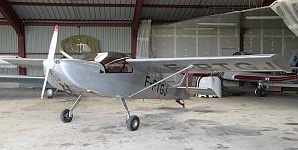
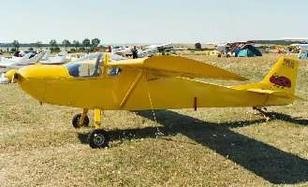
In 1966 Jean Pottier designed the P.30 Pétrel. It would have been a single engine, small, shoulder wing monoplane, but it was never built. Thirty years later Pottier produced a revised version seating two side-by-side and designated the P.130 Coccinelle. This venture was supported by the RSA’s Bleu Citron (English: Blue lemon) programme and the P.130 has sometimes been referred to as the Pottier Bleu Citron.

The Coccinelle is a simple wood framed, fabric covered monoplane, with shoulder mounted wings braced by a single strut each side from the lower fuselage longerons. The wings are essentially rectangular in plan, though with blunted forward tips, and have significant forward sweep. The balanced rudder is almost without a fin, though there is a shallow, triangular fillet in front of the rudder, which is large, straight edged and extends to the keel. The rectangular tailplane, mounted at the top of the fuselage, carries full span, rectangular plan elevators with a central cut-out to allow rudder movement.

The Coccinelle’s fuselage has a rectangular section throughout and its profile is straight edged except under the engine, where it curves upwards. The side-by-side seats are ahead of the wing leading edge and largely enclosed under a one piece, rear hinged, part bubble type canopy. Behind this are further transparencies which can vary from builder to builder but extend rearwards a little way into the wing. Most Coccinelles have a tail wheel undercarriage with front wheels on thin, steel cantilever legs, though a tricycle undercarriage is an option. Some builders have added spats.

The Coccinelle was intended for home building from his plans. These allow a choice between the P.130UL, meeting the ultralight certification requirements, or the normal P.130L. The 2014 French register shows that the latter is usually preferred. A variety of engines are suitable, including the Volkswagen air-cooled flat four with powers between 48–75 kW (65–100 hp) and the 60 kW (80 hp) JPX.

The prototype first flew in 1998 and by 2001 more than 60 were under construction in France. The European 2014 civil aircraft registers show 23 P.130s, 21 in France and 2 in Spain.

Gallery

Variants:

P.130L Coccinelle
meeting normal light aircraft certification requirements

P.130UL Coccinelle
meeting ultralight requirements

Specifications:

Engine: 1 × 1600 cc Volkswagen, 48 kW (65 hp)
Propeller: 2-blade
Wingspan: 5.28 m (17 ft 4 in)
Length: 6.9 m (22 ft 8 in)
Height: 1.98 m (6 ft 6 in)
Gross weight: 500 kg (1,102 lb)
Empty weight: 260 kg (573 lb)
Fuel capacity: 60 lt
Maximum speed: 195 km/h (121 mph; 105 kn)
Cruising speed: 181 km/h (112 mph; 98 kn)
Stall speed: 85 kph
Range: 480 km (298 mi; 259 nmi)
Rate of climb: 4 m/s (790 ft/min) initial
Seats: 2
Certification: CNRA