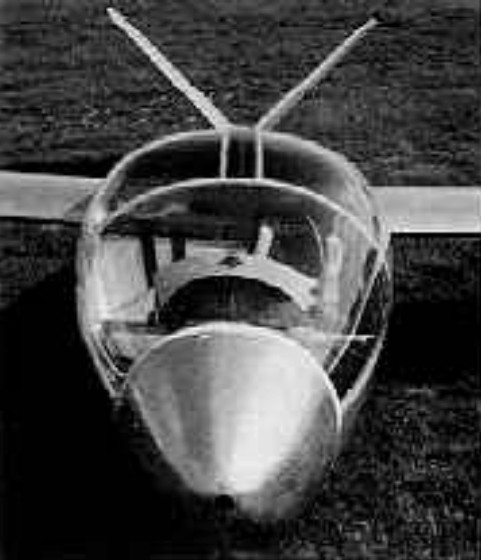
In 1966 Henry Preiss converted an all metal Schreder HP-14 into a 2-place ship with side-by-side seating (two sets of rudder pedals and a center control stick with a bar that swings from one side to the other) and a fixed landing wheel. The design used standard HP-14 wings with a 2-ft center section added in the fuselage.
The Pratt & Whitney Canada PT6T Twin-Pac is a turboshaft engine designed for helicopters. Manufactured by Pratt & Whitney Canada, its first application was in the Bell 212 and UH-1N Twin Huey helicopter family. The PT6T Twin-Pac consists of two PT6 power turbines driving a common output reduction gearbox, producing up to 2,000 hp at 6,000 rpm. The engine is designated T400 by the U.S. military.
The U.S. military came very close to not procuring the UH-1N Twin Huey because of the PT6T. The purchase of the aircraft for U.S. military use was opposed by the Chairman of the House Armed Services Committee at the time, Mendel Rivers. Rivers took this position because the PT6T was produced in Canada. The Canadian government had not supported U.S. involvement in Vietnam, and had opposed U.S. policies in southeast Asia, as well as accepting U.S. draft dodgers. Rivers was also concerned that procurement of the engines would result in a negative trade deficit situation with Canada. Congress only approved the purchase when it was assured that a U.S. source would be found for the PT6T engines. This source was Pratt & Whitney Engine Services in Bridgeport, West Virginia, which was established in 1971 to assemble and test new T400-WV-402 engines. As a result, the U.S. military ordered 294 Bell 212s under the designation UH-1N, with deliveries commencing in 1970.
Variants: PT6T-3 Basic production model
PT6T-3A Same as the PT6T-3 but with aluminum (instead of magnesium) gearbox casting, No longer used.
PT6T-3B Same as the PT6T-3, except for the single power section contingency ratings and has PT6T-6 compressor turbine components.
PT6T-3BE Same as the PT6T-3B with the removal of the torque sharing function in the torque control and is a PT6T-3BE gearbox fitted with two PT6T-3B power sections.
PT6T-3BF Similar to the PT6T-3B, except 30-minute one engine inoperative (OEI) rating is equivalent to the 2½ minute OEI rating.
PT6T-3BG Similar to the PT6T-3BE, except 30 minute OEI rating is equivalent to the 2½ minute OEI rating.
PT6T-3D Same as the PT6T-3B, except for improved hot section hardware to allow for increased ratings.
PT6T-3DE Same as the PT6T-3D, except the continuous OEI rating is replaced by a 30 minutes rating.
PT6T-3DF Same as the PT6T-3DE, except for improved hot section hardware to allow for increased ratings.
PT6T-6 Same as the PT6T-3, except for the 2½ min rating and higher ratings and improved engine parts.
PT6T-6B Same as the PT6T-6 with the removal of the torque sharing function in the torque control and is a PT6T-6B gearbox with two PT6T-6 power sections.
PT6T-9 Similar to the PT6T-3DF, except for an improved hot section and it is equipped with an engine electronic control system.
T400-C-400 Military PT6T-3
T400-CP-401 Military variant used on the VH-1N variant of the UH-1N.
T400-WV-402 Military PT6T-6, assembled by Pratt & Whitney Engine Services, Inc. in West Virginia
Applications: AH-1J and AH-1T SeaCobra Bell 212 Bell 309 Bell 412 CH-146 Griffon UH-1N Twin Huey Sikorsky S-58T Sikorsky S-69
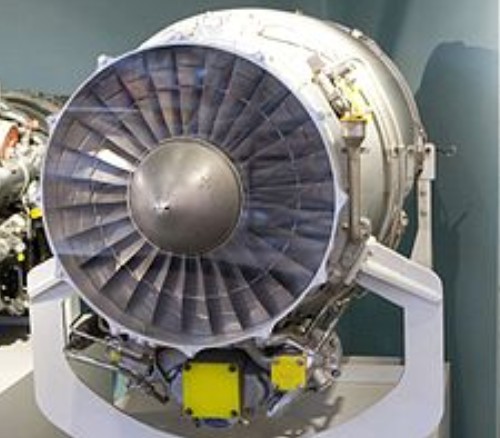
The Pratt & Whitney Canada JT15D is a small turbofan engine built by Pratt & Whitney Canada and first run in 1966. It was introduced in 1971 at 2,200 lbf (9,800 N) thrust, and has since undergone a series of upgrades to just over 3,000 lbf (13 kN) thrust in the latest versions. It is the primary powerplant for a wide variety of smaller jet aircraft, notably business jets. Over 6,000 JT15D’s have been delivered since the 1970s, with over 30 million hours of operation.
The JT15D is rare among modern turbofans in that it uses a centrifugal compressor as its main high-pressure system. This was a common feature of early jet engines, but was quickly replaced by axial compressors in most roles due to its large frontal size. In the turbofan role most of the jet thrust is generated by the cold air blown past the engine, and the internal “jet” portion is quite small. In this role the high single-stage compression of the centrifugal design has advantages, and the main reason most small turbofans don’t use them is that they are often developments of previous turbojet designs.
In the JT15D the fan blows about 70% of the air into the bypass duct, producing most of the overall thrust. On JT15D-4 models and above there is a small “booster” axial stage just behind the fan which is running at the same speed as the fan and directing the remaining 30% of the airflow into the engine core. This air is further compressed by the centrifugal stage, and burned in a reverse-flow annular combustor. The hot gases flow through a “high-pressure” turbine that drives the centrifugal stage, and then two more turbines driving the fan and booster.
The first model, the JT15D-1, was introduced to power the Cessna Citation I, then known as the Fanjet 500. Deliveries started in 1972, and eventually on 1,417 -1s were delivered. The JT15D-4 was introduced the next year, improving thrust to 2,500 lbf (11,000 N). The -4 was the primary engine for the Cessna Citation II, and went on to find use on the Mitsubishi Diamond 1A, Aerospatiale Corvette and SIAI Marchetti S.211. Eventually 2,195 engines of the -4 series were delivered.
The next major model was the JT15D-5, certified in 1983. The first versions delivered 2,900 lbf (13,000 N) and were used on the Beechjet 400A and Cessna T-47A. Several minor versions were introduced, the -5A for the Cessna Citation V, while the -5B powered the Beechcraft T-1A Jayhawk, the -5C the DASA Ranger 2000 and S-211A.
A more major upgrade was the JT15D-5D, which was certified in 1993. It increased thrust again, this time to 3,045 lbf (13,540 N). The -5D is used on the Cessna UC-35A and Cessna Citation Ultra. The D-5 of 2965 lb take-off rating was produced for the Diamond II/Beech 400A. The JT15D-5R is a later development, identical in all respects to the -5 except for changes to the fuel and oil systems associated with the elimination of the Fuel System Icing Inhibitor (FSII) additive.
Applications: Aérospatiale Corvette Alenia Aermacchi M-311 Beechcraft Beechjet 400 Cessna Citation I Cessna Citation II Cessna Citation V/Ultra Hawker 400 Mitsubishi MU-300 Diamond Raytheon T-1 Jayhawk Rockwell Ranger 2000 SIAI Marchetti S.211/Aermacchi S-211 Sport Jet II Boeing Bird of Prey
Specifications: JT15D-1 Takeoff thrust: 9,8 kN / 2200 lb Continuous thrust: 9,3 kN Length: 1506 mm Diameter: 691 mm Dry weight: 223,5 kg Bypass ratio: 3,3
JT15D-4 Takeoff thrust: 11,12 kN / 2500 lb Continuous thrust: 10,56 kN Length: 1600 mm Diameter: 686 mm Dry weight: 253 kg Bypass ratio: 2,6
JT15D-4C Takeoff thrust: 11,12 kN Continuous thrust: 10,56 kN Length: 1600 mm Diameter: 686 mm Dry weight: 261 kg Bypass ratio: 2,6
JT15D-5 Takeoff thrust: 12,92 kN Length: 1600 mm Dry weight: 287 kg Bypass ratio: 2
JT15D-5A Takeoff thrust: 12,92 kN Length: 1600 mm Dry weight: 287 kg Bypass ratio: 2
JT15D-5B Takeoff thrust: 12,92 kN Length: 1600 mm Dry weight: 292 kg Bypass ratio: 2
JT15D-5C Takeoff thrust: 14,21 kN Length: 1600 mm Dry weight: 302 kg Bypass ratio: 2
JT15D-5D Type: Turbofan Length: 60.5 in / 1531 mm Diameter: 27 inches Dry weight: 630 lb / 292,6 kg Compressor: Axial flow LP, centrifugal flow HP Fan Diameter: 520 mm Bypass ratio: 3,3 Maximum thrust: 3,050 pounds Takeoff thrust: 13,56 kN Specific fuel consumption: 0.562 at max, 0.552 at cruise (typ) Thrust-to-weight ratio: 4.58/1 (approximation)
JT15D-5F Takeoff thrust: 12,92 kN Length: 1600 mm Dry weight: 288 kg Bypass ratio: 2
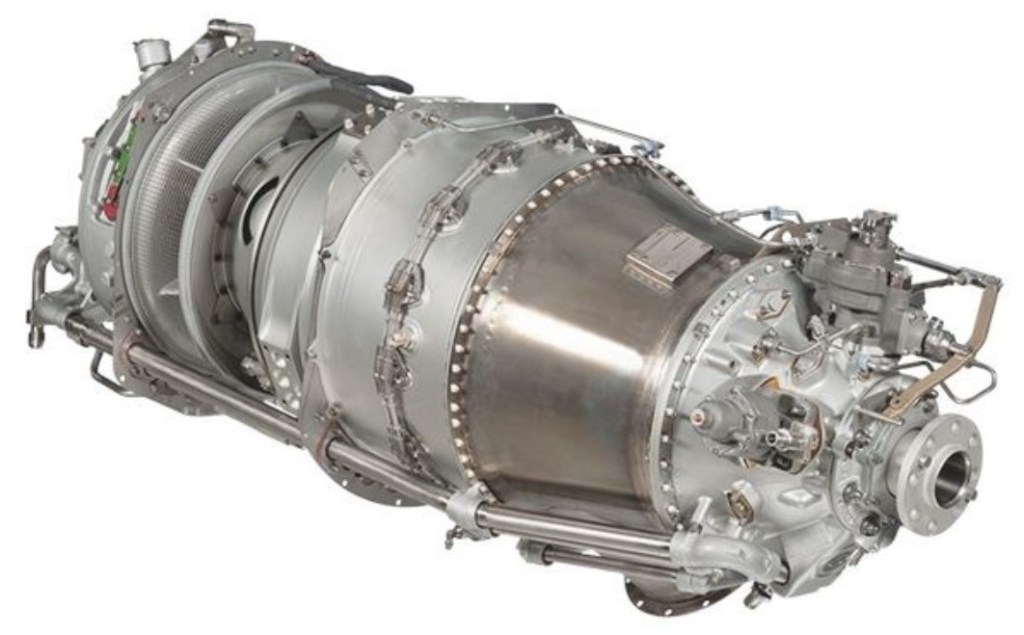
Development of the PT6 family started in the late 1950s, as a modern replacement for the Pratt & Whitney Wasp radial engines of that time. It first flew on 30 May 1961, mounted on a Beech 18 aircraft at de Havilland Canada’s Downsview, Ontario facility. Full-scale production started in 1963, entering service the next year.
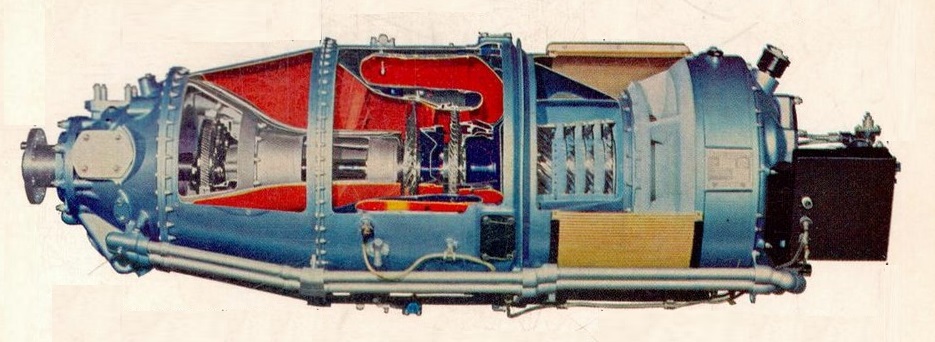
The engine consists of two sections that can be easily separated for maintenance. In the gas-generator section air enters through an inlet screen into the low-pressure axial compressor. This has three stages on small and medium versions of the engine and four stages on large versions. The air then flows into a single-stage centrifugal compressor, through the annular reverse-flow combustion chamber, and finally through a single-stage compressor turbine that powers the compressors at about 45,000 rpm. The hot gas from the gas generator section then flows into a separate power section of the engine, containing a single-stage power turbine driving the power take-off system at about 30,000 rpm. For turboprop use, this powers a two-stage planetary output reduction gearbox, which turns the propeller at a speed of 1,900 to 2,200 rpm. The exhaust gas then escapes through two side mounted ducts in the power turbine housing, and is directed away from the engine in order to provide up to 600 lbf (2,700 N) of jet thrust. The engine is arranged such that the power turbines are mounted inside the combustion chamber, reducing overall length.
In most aircraft installations the PT6 is mounted backwards in the nacelle, so that the intake side of the engine is facing the rear of the aircraft. This places the power section at the front of the nacelle, where it can drive the propeller directly without the need for a long shaft. Intake air is usually fed to the engine via an underside mounted duct, and the two exhaust outlets are directed rearward. This arrangement also aids maintenance by allowing the entire power section to be removed along with the propeller, exposing the gas-generator section.
In US military use, they are designated as T74 or T101.
The PT6A large added an additional power turbine stage and a deeper output reduction, producing almost twice the power output, between 1,090 and 1,920 shp (1,430 kW).
The PT6A-67A is equipped with an epicyclic speed reduction gear box to minimise the propeller noise by optimising the output speed. It also houses a single-stage centrifugal compressor, multistage axial, reverse flow combustor and a single-stage compressor turbine.
PT6A-20
The PT6B is a helicopter turboshaft model, featuring an offset reduction gearbox with a freewheeling clutch and power turbine governor, producing 1,000 hp (750 kW) at 4,500 rpm.
The PT6C is a helicopter model, with a single side-mounted exhaust, producing 2,000 hp (1,500 kW) at 30,000 rpm, which is stepped down in a user-supplied gearbox.
The PT6T Twin-Pac consists of two PT6 engines driving a common output reduction gearbox, producing almost 2,000 hp (1,500 kW) at 6,000 rpm. The ST6 is a version intended for stationary applications, originally developed for the UAC TurboTrain, and now widely used as auxiliary power units on large aircraft, as well as many other roles.
When de Havilland Canada asked for a much larger engine, roughly twice the power of the PT6 Large, Pratt & Whitney Canada responded with a new design initially known as the PT7. During development this was renamed to become the Pratt & Whitney Canada PW100.
By the 40th anniversary of its maiden flight in 2001, over 36,000 PT6As had been delivered, not including the other versions. The engine is used in over 100 different applications.
The PT6A Dash 66D engine in the 850 has four stages of axial compressors plus a final stage of centrifugal compression. The pressure is increased by each stage of the process. When the engine is operating at cruise power, only a small portion of the compressed air must be bled to maintain the 6.2 psi cabin pressure and keep the TBM 850 cabin pumped up. But, the rules require that the cabin pressure must be maintained when the engine power is low. In other words, you must be able to chop the power at the certified ceiling without the cabin altitude climbing. To meet that requirement, the TBM 700 tapped bleed air from a higher pressure section of the compressor than was needed for normal cruise and descent and that used more engine power. The new 850 has two engine-bleed taps to satisfy normal cruise power pressurization and the low power high-altitude condition.
Variants:
PT6A The PT6A family is a series of free turbine turboprop engine providing 500 to 1,940 shp (433 to 1,447 kW).
PT6A-15AG optimised for agricultural aircraft 715 eshp and 680 shp
PT6A-20 579 eshp and 550 shp
PT6A-21 580 eshp and 550 shp
PT6A-25 580 eshp and 550 shp (-25, -25A) 783 eshp and 750 shp (-25C)
PT6A-27 715 eshp and 680 shp
PT6A-28 715 eshp and 680 shp
PT6A-29 778 eshp and 750 shp
PT6A-34 783 eshp and 750 shp
PT6A-35 787 eshp and 750 shp
PT6A-36 783 eshp and 750 shp
PT6A-38 801 eshp and 750 shp
PT6A-40 749 eshp and 700 shp
PT6A-41 903 eshp and 850 shp
PT6A-42 903 eshp and 850 shp
PT6A-45 1070 eshp and 1020 shp
PT6A-50 1022 eshp and 973 shp
PT6A-52 898 eshp and 850 shp
PT6A-60 1113 eshp and 1050 shp (-60, -60A) 1081 ehsp and 1020 shp (-60AG)
PT6A-61 902 eshp and 850 shp
PT6A-62 1218 eshp and 950 shp
PT6A-64 747 eshp and 700 shp
PT6A-65 1249 eshp and 1173 shp (-65B, -65R) 1298 eshp and 1220 shp (-65AG, -65AR)
PT6A-66 905 eshp and 850 shp (-66, -66A, -66D) 1010 eshp and 950 shp (-66B)
PT6A-67 1272 eshp and 1200 shp (-67, -67A, -67B, -67P) 1285 eshp and 1214 shp (-67D) 1294 eshp and 1220 shp (-67AF, -67AG, -67R, -67T) 1796 eshp and 1700 shp (-67F)
PT6A-68 1324 eshp and 1250 shp
PT6A-110 502 eshp and 475 shp
PT6A-112 528 eshp and 500 shp
PT6A-114 632 eshp and 600 shp (-114) 725 eshp and 675 shp (-114A)
PT6A-116 736 eshp and 700 shp
PT6A-121 647 eshp and 615 shp
PT6A-135 787 eshp and 750 shp
T74 United States military designation for the PT6A-20/27, used in the Beechcraft U-21.
T101 United States military designation for the T101-CP-100 / PT6A-45R, used in the Shorts 330 and Shorts C-23 Sherpa.
PT6B-9 550 hp (410.1 kW) turbo-shaft engine for use in helicopters. A later mark of PT6B is rated at 981 hp (731.5 kW).
PT6C 1600 to 2300 horsepower (1190 to 1720 kW) engine for helicopters and tiltrotors.
PT6D-114A Based on the PT6A-114A. The main difference is the deletion of the second stage reduction gearing and output shaft, because the engine is intended for integration with a combining gearbox incorporating power turbine governors and a propeller output shaft.
PT6T Twin PT6 power units combining outputs through a gearbox for use in helicopters.
ST6 Variant originally developed as a powerplant for the UAC TurboTrain power cars, but later developed as a stationary power generator and auxiliary power unit.
ST6B 550 bhp (410 kW) version of the PT6 developed for use in the STP-Paxton Turbocar, raced in the 1967 Indianapolis 500.
STN 6/76 500 bhp (370 kW) version of the PT6 developed for use in the Lotus 56, raced in the 1968 Indianapolis 500 and later in Formula One races, in 1971.
Applications:
PT6A AASI Jetcruzer Aero Ae 270 Ibis Air Tractor AT-400 Air Tractor AT-501 Air Tractor AT-602 Air Tractor AT-802 Antilles Super Goose Antonov An-28 Ayres Turbo Thrush Basler BT-67 Beechcraft 1900 Beechcraft Model 99 Beechcraft C-12 Huron Beechcraft King Air Beechcraft Lightning Beechcraft Model 87 Beechcraft Model 99 Beechcraft RC-12 Guardrail Beechcraft RU-21C Ute Beechcraft Starship Beechcraft Super King Air Beechcraft T-6 Texan II Beechcraft T-34C Turbo-Mentor Beechcraft T-44 Pegasus Beriev Be-30K CASA C-212 series 300P Cessna 208 Caravan Cessna 425 Corsair/Conquest I Conair Turbo Firecat Conroy Tri-Turbo-Three de Havilland Canada DHC-2 Mk. III Turbo Beaver de Havilland Canada DHC-6 Twin Otter de Havilland Canada Dash 7 Dominion UV-23 Scout Dornier Do 128 Turbo Skyservant Dornier Seawings Seastar Epic LT Dynasty Embraer EMB 110 Bandeirante Embraer EMB 121 Xingu Embraer EMB 312 Tucano Embraer EMB 314 Super Tucano Frakes Mohawk 298 Frakes Turbocat Gulfstream American Hustler 400 Harbin Y-12 Helio AU-24 Stallion IAI Arava IAI Eitan JetPROP DLX Kestrel JP10 KAI KT-1 Let L-410 Turbolet Lancair Evolution NAL Saras NDN Fieldmaster FTS Turbo Firecracker PAC 750XL PAC Cresco Piaggio P.180 Avanti Pilatus PC-6/B Turbo-Porter Pilatus PC-7 Pilatus PC-9 Pilatus PC-12 Pilatus PC-21 Piper PA-31T Cheyenne Piper PA-42 Cheyenne III Piper PA-46-500TP Meridian Piper T1040 PZL-130T Turbo Orlik and PZL-130TC-II Orlik PZL M28 Skytruck Quest Kodiak Reims-Cessna F406 Caravan II Saunders ST-27/ST-28 Scaled Composites ATTT Shorts 330 Shorts 360 Short C-23 Sherpa Socata TBM Spectrum SA-550 Swearingen SA26-T Merlin IIA TAI Hürkuş US Aircraft A-67 Dragon
PT6A-6 Type: Turboprop Length: 62 in (1,575 mm) Diameter: 19 in (483 mm) Dry weight: 270 lb (122.47 kg) ComponentsCompressor: 3-stage axial + 1-stage centrifugal flow compressor Combustors: Annular reverse-flow with 14 Simplex burners Turbine: 1-stage gas generator power turbine + 1-stage free power turbine Fuel type: Aviation kerosene to MIL-F-5624E / JP-4 / JP-5 Oil system: Split system with gear type pressure and scavenge pumps, with pressure to gearbox boosted by a second pump. Maximum power output: 578 hp (431 kW) equivalent power at 2,200 output rpm for take-off Overall pressure ratio: 6.3:1 Specific fuel consumption: 0.67 lb/hp/hr (0.408 kg/kW/hr) Power-to-weight ratio: 2.14 hp/lb (3.52 kW/kg)
PT6A-11AG Diameter: 483 mm Length: 1.58 m Power: 550 kW (748 PS)
PT6A-50 Diameter: 483 mm Length: 1.73 m Dry weight: 193 kg Power: 705 kW (958 PS) Specific fuel consumption: 353 g/ekWh
PT6A-68C Diameter: 483 mm Length: 1.83 m Power: 1175 kW (1600 PS)
PT6B-36A Diameter: 825 mm Length: 1.5 m Dry weight: 169 kg Power: 732 kW (995 PS) Specific fuel consumption: 0.581 lbs/shph
PT6B-37A Diameter: 495 mm Length: 1.63 m Dry weight: 172 kg Power: 747 kW (1015 PS) Specific fuel consumption: 0.584 lbs/shph
PT6A-67A Length: 1.87m Diameter: 0.48m
PT6C-67B Diameter: 584 mm Length: 1.50 m Power: 895 kW (1217 PS)
PT6C-67C Diameter: 584 mm Length: 1.50 m Power: 1252 kW (1702 PS)
PT6C-67E Diameter: 584 mm Length: 1.50 m Dry weight: Power: 1324 kW (1800 PS) Specific fuel consumption:
PT6T-6B Diameter: 825 × 1105 mm Length: 1.67 m Dry weight: Power: 1469 kW (2000 PS) Specific fuel consumption: 0,602 lbs/shph
The Pratt & Whitney TF30 (company designation JTF10A) was a military low-bypass turbofan engine originally designed by Pratt & Whitney for the subsonic F6D Missileer missile carrier, but this project was cancelled. It was later adapted with an afterburner for supersonic designs, and in this form it was the world’s first production afterburning turbofan, going on to power the F-111 and the F-14A Tomcat, as well seeing use in early versions of the A-7 Corsair II without an afterburner. First flight of the TF30 was in 1964 and production continued until 1986.
In the 1958, the Douglas Aircraft Company proposed a short-range, four-engined jet airliner to fill the gap below its new DC-8 intercontinental; it was known internally as the Model 2067, and to be marketed as a four engine DC-9 which was later developed in a scaled down 2 engine DC-9 using the same engines due to emerging market demands. Pratt & Whitney (P&W) had offered its JT8A turbojet for the airliner, but Douglas preferred to go with a turbofan engine, which would have a greater fuel efficiency than a turbojet. P&W then proposed the JT10A, a half-scale version of its newly developed JT8D turbofan. Development of the new design began in April 1959, using the core of the JT8. Douglas shelved the model 2067 design in 1960, as the targeted US airlines preferred the newly offered Boeing 727.
In 1960, the United States Navy selected the JT10A, designated TF30-P-1, to power the proposed Douglas F6D Missileer, but the projected was canceled in April 1961. Meanwhile, the TF30 had been chosen by General Dynamics for its entrant in the TFX competition for the United States Air Force and USN, which was selected for production as the F-111. The version of the TF30 for the F-111 included an afterburner.
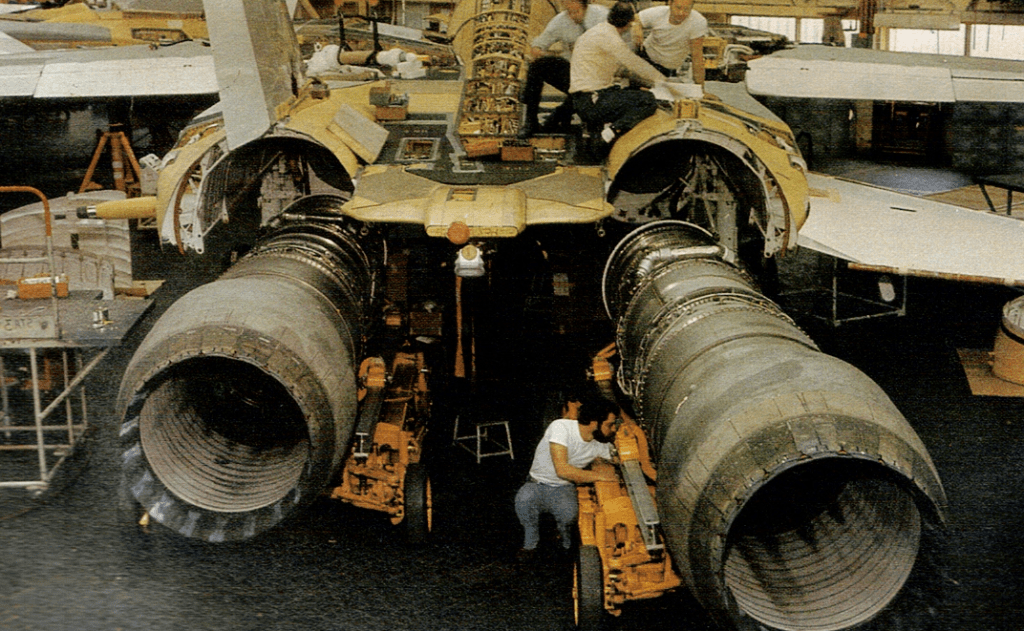
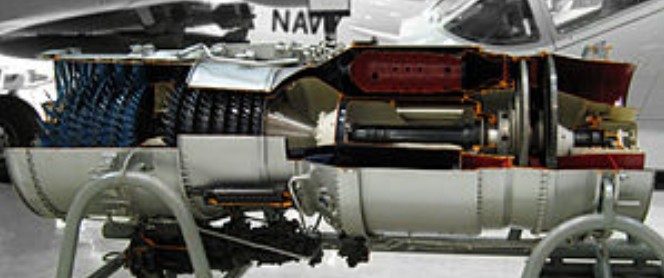
F-14 Pratt & Whitney TF30-P-412 turbofans
Operational history F-111 The F-111A/E used the TF30-P-103 (aka P-3) turbofan. The F-111 had problems with inlet compatibility, and many faulted the placement of the intakes behind the disturbed air of the wing. Newer F-111 variants incorporated improved intake designs and most variants featured more powerful versions of the TF30 engine. The F-111E used TF30-P-3 engines, the F-111D included TF30-P-9, and the F-111F had the TF30-P-100.
A-7 In 1964, the subsonic LTV A-7A Corsair II won the US Navy’s VAL competition for a light attack aircraft to replace the Douglas A-4 Skyhawk. The A-7A used a non-afterburning variant of the TF30, which would also power the improved A-7B and A-7C. In 1965, the USAF selected the A-7D as a replacement for its fast-jet F-100 and F-105 supersonic fighter-bombers. Though the USAF had wanted the TF30, Pratt & Whitney was unable to meet the production timetable because its facilities were already committed to producing other engines. Instead of producing the TF30 under license for P&W, the Allison Engine Company offered its own TF41 turbofan, a license-built version of the RB.168-25R Spey, to the AIr Force. The more powerful TF41 was selected by the USAF for the A-7D, and by the USN for its similar A-7E.
F-14 The Grumman F-14 Tomcat with the TF30 was underpowered, because it was the Navy’s intent to procure a jet fighter with a thrust-to-weight ratio (in clean configuration) of unity or better (the US Air Force had the same goals for the F-15 Eagle and F-16 Fighting Falcon). The F-14A’s thrust-to-weight ratio was similar to the F-4 Phantom II; however the new fuselage and wing design provided greater lift and a better climb profile than the F-4. The TF30 was found to be ill-adapted to the demands of air combat, and was prone to compressor stalls at high angle of attack if the throttles were moved aggressively. Because of the Tomcats’ widely spaced engine nacelles, compressor stalls at high AOA were especially dangerous because they tended to produce asymmetric thrust that could send the Tomcat into an upright or inverted spin, from which recovery was very difficult.
The F-14’s problems did not afflict TF30 engines in the F-111 to nearly the same extent, because that airplane was used as a strike aircraft. This type of mission is characterized by discrete phases so less abrupt changes in throttle, angle of attack and altitude are required. Though the F-14A entered service with the Navy powered by Pratt & Whitney TF30, by the end of the decade, following numerous problems with the original engine, the Department of Defense began procuring F110-GE-400 engines and installed them in the F-14A Plus (later redesignated to F-14B in 1991), which entered service with the fleet in 1988. These engines solved the reliability problems and provided nearly 30% more thrust, achieving a 1:1 dry thrust to weight ratio. The F-14D also used F110-GE-400 engines.
Variants: JTF10 – Company designation for the TF30 family of engines XTF30-P-1 YTF30-P-1 TF30-P-1 TF30-P-1A TF30-P-2 TF30-P-3 TF30-P-5 TF30-P-6 TF30-P-6A TF30-P-6C TF30-P-7 TF30-P-8 TF30-P-9 TF30-P-12 TF30-P-14 TF30-P-16 TF30-P-18 YTF30-P-100 TF30-P-100 TF30-P-408 JTF10A-7 – (TF30-P-2) JTF10A-10 SNECMA / Pratt & Whitney TF106 – A derivative of the TF30 to power the Dassault Mirage III-V VTOL fighter. SNECMA / Pratt & Whitney TF306 – A derivative of the TF30 to power the Dassault ‘Mirage’ IIIV 02 and tested in the Dassault Mirage F2.
Applications: Dassault Mirage F2 Dassault Mirage G2 General Dynamics F-111 General Dynamics F-111C General Dynamics/Grumman EF-111A Raven General Dynamics/Grumman F-111B General Dynamics F-111K Grumman F-14A Tomcat LTV A-7A/B/C Corsair II
Specifications: TF30-P-100 Type: Turbofan Length: 241.7 in. (6.139 m) Diameter: 48.9 in. (1.24 m) Dry weight: 3,985 lb. (1807 kg) Compressor: 2 spool axial: 3 fan and 6 low pressure stages, 7 high pressure stages Combustors: annular Turbine: 3 stage low pressure turbine, 1 stage high pressure turbine Maximum thrust: 14,560 lbf (64.766kN), 25,100 lbf (111.65kN) w/ afterburning Overall pressure ratio: 19.8 Bypass ratio: 0.878:1 Turbine inlet temperature: 2150F (1176C) Thrust-to-weight ratio: 6.0
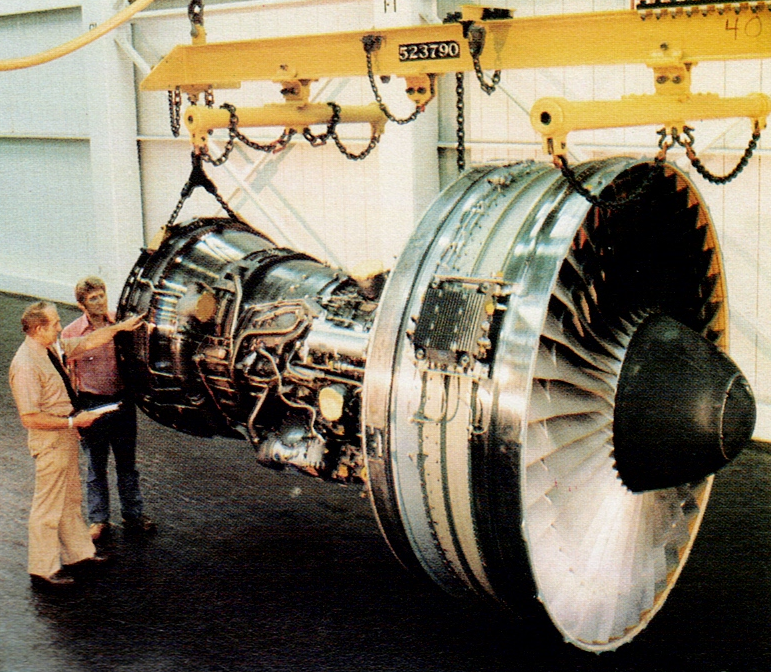
The JT9D was developed as part of the design phase of the C-5 Galaxy. A contract was awarded to Pratt & Whitney to study the type of large engine needed, but the production contract was eventually awarded to General Electric and their TF39 turbofan. First run in December 1966, the JT9D was chosen by Boeing to power the 747, with that aircraft’s first flight taking place on 9 February 1969. Flight testing of the engine had begun in June 1968, using a Boeing B-52E as a testbed.
The Pratt & Whitney JT9D engine was the first high bypass ratio jet engine to power a wide-body aircraft. Its initial application was the Boeing 747-100, the original “Jumbo Jet”. It was the company’s first high-bypass-ratio turbofan and also the first of today’s generation of large commercial turbofan engines to be produced.
The JT9D-3, which entered service in 1970, was constructed using titanium and nickel alloys. The engine featured a single stage fan, a three stage low pressure compressor and an eleven stage high pressure compressor coupled to a two stage high pressure turbine and four stage low pressure turbine. This version of the JT9D weighed 8,608 lb (3,905 kg) and produced 43,500 lbf (193,000 N) thrust. Production ceased in 1990.
JT9D-7R4
JT9D engines powering USAF E-4A airborne command posts are designated Pratt & Whitney F105. Pratt & Whitney’s designated successor to the JT9D family is the PW4000, which features fewer parts, greater reliability, and lower base selling price.
Applications: Airbus A300 Airbus A310 Boeing 747 Boeing 767 McDonnell Douglas DC-10
Specifications:
JT9D-3A Static Thrust: 45800 lbf Basic Engine Weight: 8608 lb Length: 128.2 in Fan Diameter: 92.3 in Used in: Boeing 747-100
JT9D-7 Static Thrust: 47900 lbf Basic Engine Weight: 8850 lb Length: 128.2 in Fan Diameter: 92.3 in Used in: Boeing 747
JT9D-20 Static Thrust: 49400 lbf Basic Engine Weight: 8450 lb Length: 128.2 in Fan Diameter: 92.3 in Used in: McDonnell Douglas DC-10, Boeing 747
JT9D-7Q/7Q3 Static Thrust: 53000 lbf Basic Engine Weight: 9295 lb Length: 132.1 in Fan Diameter: 93.6 in Used in: Boeing 747
JT9D-59A/70A Static Thrust: 53000 lbf Basic Engine Weight: 9155 lb Length: 132.2 in Fan Diameter: 93.6 in Used in: McDonnell Douglas DC-10/Boeing 747/Airbus A300
JT9D-7R4D/D1 Static Thrust: 48000 lbf Basic Engine Weight: 8905 lb Length: 132.7 in Fan Diameter: 93.4 in Used in: Boeing 767/Airbus A310
JT9D-7R4G2 Static Thrust: 54750 lbf Basic Engine Weight: 8935 lb Length: 132.7 in Fan Diameter: 93.4 in Used in: Boeing 747
JT9D-7R4H1 Static Thrust: 56000 lbf Basic Engine Weight: 8885 lb Length: 132.7 in Fan Diameter: 93.4 in Used in: Airbus A300
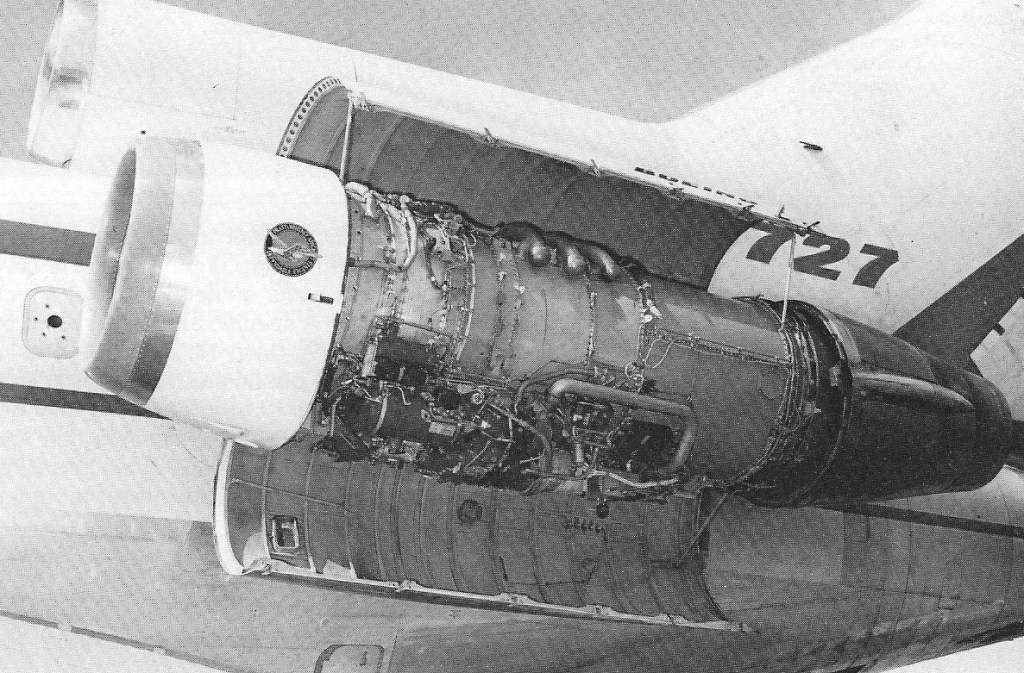
First run in 1960, the Pratt & Whitney JT8D is a low-bypass (0.96 to 1) turbofan engine, introduced by Pratt & Whitney in February 1963 with the inaugural flight of Boeing’s 727. It was a modification of the Pratt & Whitney J52 turbojet engine, which powered the US Navy A-6 Intruder attack aircraft. The Volvo RM8 is an afterburning version that was license-built in Sweden for the Saab 37 Viggen fighter. A “fixed” version for powerplant and ship propulsion is known as the FT12.
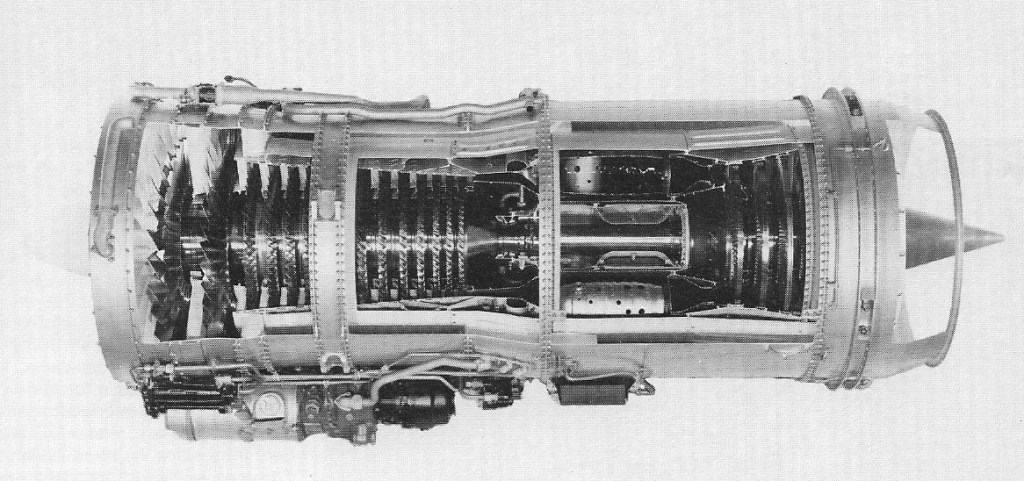
The JT8D is an axial-flow front turbofan engine incorporating dual-spool design. There are two coaxially-mounted independent rotating assemblies: one rotating assembly for the low pressure compressor (LPC) which consists of the first six stages (i.e. six pairs of rotating and stator blades, including the first two stages which are for the bypass turbofan), driven by the second (downstream) turbine (which consists of three stages); and a second rotating assembly for the high-pressure compressor (HPC) section, which has seven stages. The high-pressure compressor is driven by the first (upstream) turbine, which has a single stage.
The front-mounted bypass fan has two stages. The annular discharge duct for the bypass fan runs along the full length of the engine, so that both the fan air and exhaust gases can exit through the same nozzle. This arrangement allows some noise attenuation, in that the still-hot fast-moving turbine exhaust is shrouded in much-cooler and slower-moving air (from the bypass fan) before interacting with ambient air. Thus the JT8D noise levels were significantly reduced from previous non-turbofan engines, although the low bypass ratio meant that, compared to subsequently developed turbofans, high noise levels were still produced.
Eight models comprise the JT8D standard engine family, covering the thrust range from 12,250 to 17,400 pounds-force (62 to 77 kN) and power 727, 737-100/200, and DC-9 aircraft. More than 14,000 JT8D engines have been produced, totaling more than one-half billion hours of service with more than 350 operators making it the most popular of all low-bypass turbofan engines ever produced. Within the fan inlet case, there are anti-icing air bosses and probes to sense the inlet pressure and temperature. Similar units exist throughout the engine to check temperatures and pressures. At the 13th (i.e. the final) compressor stage, air is bled out and used for anti-icing. The amount is controlled by the Pressure Ratio Bleed Control sense signal (PRBC). The diffuser case at the aft end of the compressor houses the 13th stage. Its increasing cross-sectional area allows the compressed air to slow down before entering one of the engine’s nine burner cans. Again, there are two bosses to extract 13th stage air for anti-icing, de-icing of fuel, and airframe (cabin pressurization) use. Not all the compressed air enters the burner cans at the fuel-ignition point; some bypasses the can completely and cools the first turbine stage, and some is gradually introduced into the burner can’s perimeter in such a way that the burning fuel is held near the can’s centerline.
There are nine combustion chambers positioned in a can-annular arrangement. Each chamber has three air inlet hole sizes: the smallest is for cooling, the medium is for burning and the large for forming an air blanket.
In response to environmental concerns that began in the 1970s, the company began developing a new version of the engine, the JT8D-200 series. Designed to be quieter, cleaner, more efficient, yet more powerful than earlier models, the -200 Series power-plant was re-engineered with a significantly higher bypass ratio (1.74 to 1) covering the 18,500 to 21,700 pound-force (82 to 97 kN) thrust range and powering the McDonnell Douglas MD-80 series. This increase was achieved by increasing bypass fan diameter (from 39.9 to 49.2 inches) and reducing fan pressure ratio (from 2.21 to 1.92). Overall engine pressure ratio was also increased from 15.4 to 21.0. Since entering service in 1980, more than 2,900 of the -200 series engines have been produced.
The JT8D-217 and -219 engine(s) were tested in 2001 and were deemed suitable replacements for the old TF33 engines on military and commercial aircraft as part of the Super 27 re-engining program. The updated engines offer reduced (Stage-3) noise compliance standards without the need for hush kits, enhanced short field performance, steeper and faster climb rates with roughly a 10% reduction in fuel burn for extended range.
Pratt & Whitney, in a joint venture with Seven Q Seven (SQS) and Omega Air, has developed the JT8D-219 as a re-engine powerplant for Boeing 707-based aircraft. Northrop Grumman uses the -219 to re-engine the United States Air Force’s fleet of 19 Joint Surveillance Target Attack Radar System (E-8 Joint STARS) aircraft, which will allow the JSTARS more time on station due to the engine’s 17% greater fuel efficiency. NATO also plans to re-engine their fleet of E-3 Sentry AWACS aircraft. The -219 is publicized as being half the cost of the competing 707 re-engine powerplant, the CFM-56, for reasons of geometrical and balance similarity to the engine it is replacing and the associated relative up-front wing modification costs of the two choices.
Applications: Boeing 707RE Boeing 727 Boeing 737 Dassault Mercure McDonnell Douglas DC-9 McDonnell Douglas MD-80 series McDonnell Douglas YC-15 Northrop Grumman E-8C Joint STARS Sud Aviation Caravelle 10B, 10R, 11R, and 12 Kawasaki C-1( Japanese military transport) powered by the JT8D-M-9 manufactured by Mitsubishi
Accidents: 4 April 1977 Southern Airways Flight 242 – both engines on the DC-9 failed when the pilots flew into a severe thunderstorm after misreading their onboard radar. The flight encountered severe rain and hail. The NTSB concluded that the “loss of thrust was caused by the ingestion of massive amounts of water and hail which in combination with thrust lever movement induced severe stalling in and major damage to the engine compressors.” 63 people on-board and 9 on the ground died as a result of the accident.
22 August 1985 British Airtours Flight 28M – an engine failed during take-off from Manchester Airport, the fire spreading into the cabin, resulting in 55 fatalities aboard the Boeing 737-236 Advanced.
21 December 1991 Scandinavian Airlines Flight 751 – The engines on an MD-81 ingested wing ice during takeoff causing engine damage that led to a total loss of thrust on both engines. The aircraft crashed in a forest clearing with no fatalities.
6 July 1996 An engine explosion happened on an MD-88, Delta Air Lines Flight 1288, just prior to take-off at Pensacola, Florida, USA, with two fatalities.
5 September 2005 A Boeing 737-200 operated by Mandala Airlines crashed in Medan as Mandala Airlines Flight 091 with 96 passengers, five crew and 49 on the ground were killed. Sixteen passengers survived. The engine flamed out and lost power.
15 April 2008 A DC9-51 operated by Hewa Bora Airways crashed and burned at Goma following an engine fire, with 40 fatalities.
Specifications: JT8D-200 Type: Turbofan Length: 120.0″ / 3048mm – 154.1″ / 3914mm Diameter: 49.2″ / 1250mm Dry weight: From 3200lb / 1454.5kg (JT8D) to 4740lb / 2154.5kg (JT8D-219) Compressor: Axial flow, 2-stage fan, 6-stage LP, 7-stage HP Combustors: Nine can-annular combustion chambers Turbine: 3-stage (1 stage HP 2 stage LP) Maximum thrust: 21,700lbf / 96.5kN (JT8D-219) Overall pressure ratio: 16:1 Specific fuel consumption: 0.744 [kg/daN.h] Thrust-to-weight ratio: About 4.8
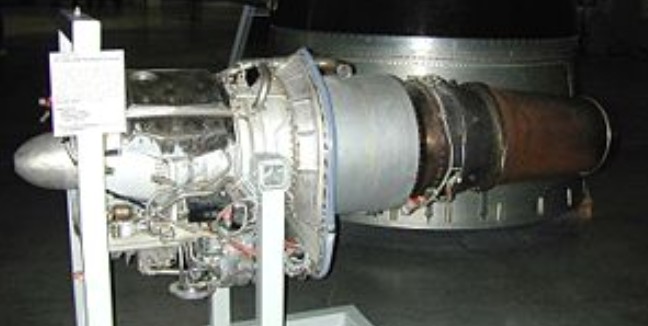
The Pratt & Whitney JT12, (US military designation J60) is a small turbojet engine. The J60 conception and project design began in July 1957 at United Aircraft of Canada (later Pratt & Whitney Canada) in Montreal. The project design details were transferred to the main P&W company in East Hartford and in May 1958, the first prototype, with military designation YJ60-P-1 commenced testing.
Flight tests were completed in early 1959; followed by the delivery of the new JT12A-5 engines in July 1959. These were for the two Canadair CL-41 prototype trainers with a rating of 12.9 kN (2,900 lb st).
The modified JT12A-3 turbojets with a basic rating of 14.69 kN (3,300 lb st) were tested in the two Lockheed XV-4A Hummingbird VTOL research aircraft. The next version, JT12A-21, had an afterburner which delivered a maximum thrust of 17.91 kN (4,025 lb st).
A total of 2621 were built.
The Pratt & Whitney T73 (Pratt & Whitney JFTD12) is a related turboshaft engine.
Variants: YJ60-P-1—prototype
J60-P-3
J60-P-4
J60-P-5
J60-P-6
T73 Military designation of the Pratt & Whitney JFTD12 free power turbine turboshaft version of the J60.
JT12A-3LH
JT12A-5 (J60-P-3/-5/-6) Take-off ratings from 2,900 lbf (12.9 kN) to 3,001 lbf (13.35 kN).
JT12A-6 Essentially similar to the –5
JT12A-7 (J60-P-4) up-rated to 3,300 lbf (15 kN)
JT12A-8
JT12A-21 An after-burning version developing 4,024 lbf (17.9 kN) thrust wet.
FT12 Turboshaft versions for marine use.
JFTD12 Comapny designation of the Pratt & Whitney T73 free power turbine turbo-shaft version of the J60.
Applications: Civilian (JT12) Lockheed JetStar North American Sabreliner
Military (J60) T-2B Buckeye T-39 Sabreliner Sikorsky XH-59/S-69 XV-4 Hummingbird
The Pratt & Whitney J52 (company designation JT8A) is an axial-flow turbojet engine originally designed for the United States Navy, in the 9,000 lbf-class as a scaled-down derivative of the J57/JT3A.
First run in 1955, it was initially intended to power the A4D-3 Skyhawk, an advanced avionics model that was canceled in 1957. After being canceled, the U.S. Air Force selected the J52 to power the AGM-28 Hound Dog cruise missile. The engine was designed with several unique features for this application, including a “conical centerbody mounted in the intake” and a “variable central plug … in the nozzle”.Then, in 1958, the US Navy selected the engine to power what became the A-6 Intruder.
The J52-P-6 model, designed for the YA2F-1 (YA-6A) Intruder, had a unique nozzle that could be angled downward at 23 degrees for STOL takeoffs; this was not used on production A-6s. The J52 was selected to power the A4D-5, another model of the A-4 Skyhawk, remaining in all subsequent new-built models.
The twin-spool J52 employs a split 12-stage axial compressor consisting of a five-stage low pressure unit and a seven-stage high pressure unit. Behind the compressor is a nine-unit can-annular combustion chamber and a two-stage split turbine.
A total of 4,567 were built.
The engine also provided the basis for the Pratt & Whitney JT8D, a civilian low-bypass turbofan engine.
JT8D
The P&W JT8D was first tested in 1961 resulting in nine basic models.
Variants: J52-P-3 Flown in: AGM-28 Hound Dog. This variant produced 7,500 lbf (33,000 N) of thrust. The design of the P-3 model included a variable inlet duct to improve engine efficiency at the various altitudes the cruise missile was designed to fly at.
J52-P-6 Flown in: A-6A. This variant produced 8,500 lbf (38,000 N) of thrust and included the 23-degree downward swiveling nozzle.
J52-P6A Flown in: A-4E, TA-4J, EA-6B (the first few). This variant produced 8,500 lbf (38,000 N) of thrust.
J52-P-8A/B Flown in: A-4F/G/H/K, TA-4E/F/G/H, A-6E, EA-6B. This variant produced 9,300 lbf (41,000 N) of thrust.
J52-P-408 Flown in: A-4M/N, TA-4KU, EA-6B. This variant included variable inlet guide vanes (VIGV) in the LPC, air-cooled turbine blades, and produced 11,200 lbf (50,000 N) of thrust.
J52-P-409 Also known as PW1212. 12,000 lbf (53 kN) thrust version of the J52-P-408 with an improved low pressure turbine (LPT) and faster acceleration. Designed for the EA-6B and was additionally marketed as an upgrade for the A-4. The J52-P-409 was also proposed as a cost-effective upgrade to the A-6E as an alternative to the A-6F Intruder II, but was not purchased. The P-409 engine was also proposed for use in the EA-6B ADVCAP, but that program was canceled after three prototypes were built and flown. The P-409 would have been available as a new engine or as an upgrade kit for P-408 engines, but was never ordered in significant quantities.
PW1216 An afterburning derivative of the J52-P409 engine proposed for the Grumman Sabre II concept (the project later evolved into the JF-17 Thunder). The afterburner, designed in China, would have increased thrust to 16,000 lbf (71 kN).
JT8A Company designation for initial versions of the J52
JT8B-1 (J52-P-6)
Applications: AGM-28 Hound Dog Dassault Super Mystere Douglas A-4 Skyhawk Grumman A-6 Intruder Lockheed Martin A-4AR Fightinghawk Northrop Grumman EA-6B Prowler
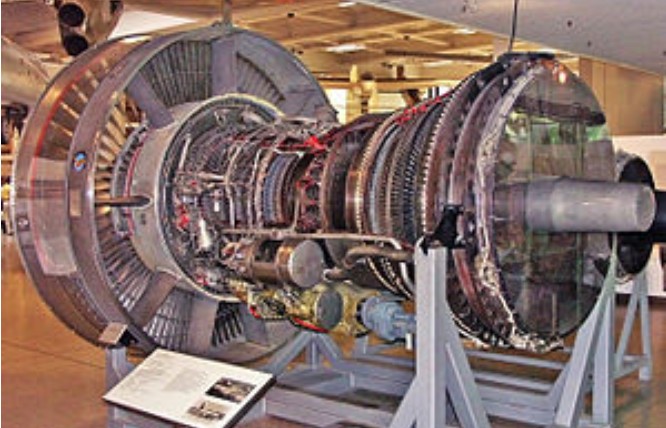
The J57 was a turbojet development of the XT45 (PT4) turboprop engine intended for the XB-52. As the B-52 power requirements grew, the design evolved into a turbojet, the JT3. The Collier Trophy for 1952 was awarded to Leonard S. Hobbs, Chief Engineer of United Aircraft Corporation, for “designing and producing the P&W J57 turbojet engine”.On May 25, 1953, a J57-powered YF-100A exceeded Mach 1 on its maiden flight. First run in 1952, the engine was produced from 1951 to 1965 with a total of 21,170 built. One XT57 was installed in the nose of a C-124 (BuNo 52-1069), and tested in 1956.
The Pratt & Whitney J57 (company designation: JT3C). The J57 was the first 10,000 lbf (45 kN) thrust class engine in the United States. The J57/JT3C was developed into the J75/JT4A turbojet, JT3D/TF33 turbofan and the PT5/T57 turboprop.
Variants: J57-P-1W 11,400 lbf (51 kN) s.t with water injection (B-52B)