Pritchard Rocket Air Ship

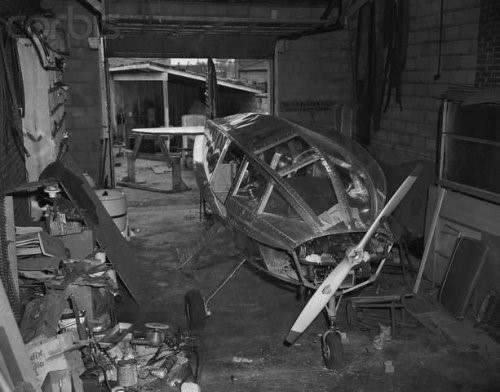
Charles Pritchard of Emporia, Virginia, was a railroader by profession, set out to build an all-aluminium wingless combined aircraft/car which had been ten years in the making.

The Rocket Air Ship plane has short baffles or fins in place of wings, a 90 hp engine, a conventional propeller and tail assembly and a tricycle landing gear. It was 21 feet long, 98 inches wide and weighed 800 lbs.

The body of the plane is made entirely of aluminium. Each side has baffles (or fins) of varying length. The fins “hold air in the proper channel over the hull of the ship to give the hull its lift”.

Ailerons for changing direction in flight are on the sides of the plane. Conventional equipment on the wingless craft includes a tricycle landing gear, metal propeller, 90 hp engine and flight instruments.

Built for less than $1500, Pritchard was helped in the construction by Billy Davis of Emporia.

“Charles Pritchard, designer builder and pilot, makes first test of his wingless Rocket Air Ship on mile lone runway at Emporia, Virginia, airport.
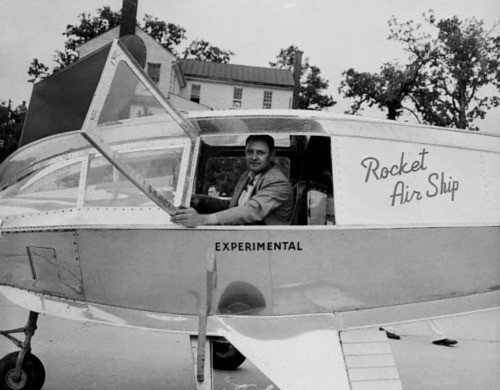
Plane has short baffles or fins in place of wings, 90 hp engine, conventional propeller and tail assembly, tricycle landing gear, is 21 feet long 98 inches wide weighs 800 lbs. Pritchard made eight runs along runway, but didn’t; get off the ground. Says he’ll make modifications and try again.” (circa 1955)
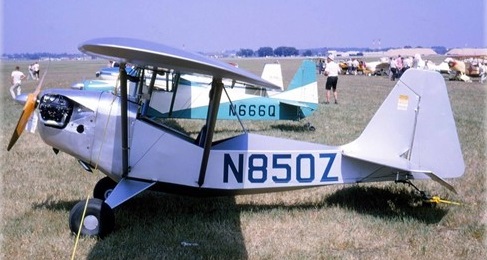
Price PL-2-DM

In 1962 Paul Price built the Price PL-2-DM, registered N850Z c/n 2,, which appears to be a much larger version of his Price Special. The PL-2-DM is also a single place, open cockpit high-wing monoplane.

PL-2-DM
Engine: 65hp Lycoming O-145 or Continental C-65
Wingspan: 24’0″
Length: 15’6″
Useful load: 225 lb
Max speed: 85 mph
Cruise: 60 mph
Stall: 40 mph
Range: 90 mi
Seats: 1

Preti PM-280 Tartuca

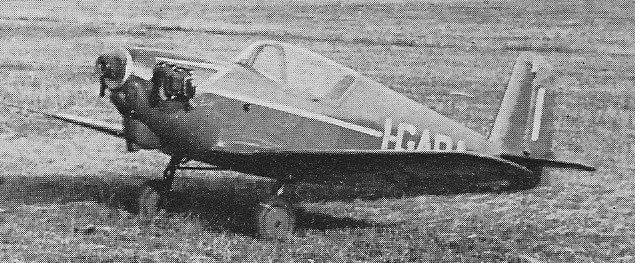
The PM-280 artuca (Tortoise) was produced in 1949 by the Instituto di Aeronautica of the Politecnico di Milano in Italy to the designs of Ermenegildo Preti.

A single-seat low-wing monoplane of all-wood construction, the Tartuca is fitted with flaps and a retractable undercarriage. Power is from a 60 hp C.N.A. D4 engine.

From the time that the design was started to the test flight was only ten weeks.

Engine: 60 hp C.N.A. D4
Wingspan: 16 ft 5 in
Wing area: 53.8 sq.ft
Length: 16 ft 6 in
Empty weight: 550 lb
Loaded weight: 770 lb
Max speed: 161 mph
Time to 3280 ft: 5 min 50 sec
Range: 342 mi
Ceiling: 10,827 ft

Preiss RHJ-9

A development of the Preiss RHJ-8 (itself a T-tailed, larger span, improved version of the RHJ- 7), the RHJ-9 is similar to its predecessors, but with a larger span wing. The wing has foam ribs bonded to the aluminum spar and skins with PVC ribs. It first flew in 1978.

Wing span: 18.29 m / 60 ft
Wing area: 14.38 sq.m / 154.8 sq.ft
Empty Weight: 304 kg / 668 lb
Payload: 196 kg / 432 lb
Gross Weight: 500 kg / 1100 lb
Wing Load: 34.77 kg/sq.m / 6.94 lb/sq.ft
L/DMax: 38
MinSink: 0.70 m/s / 2.3 fps / 1.36 kt
Aspect ratio: 26.6
Airfoil: Wortmann 63-3-318
Seats: 2