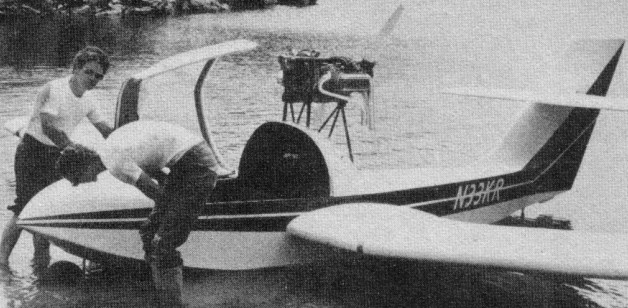
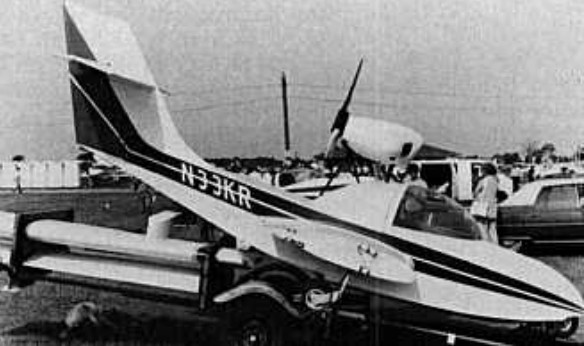
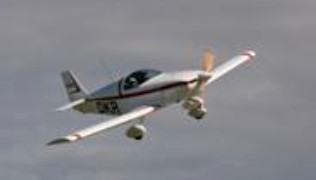
The KR-3 amphibian was originally designed and built by Ken Rand and Stu Robinson in 1976. The prototype was first tested in June 1977. Following Ken’s tragic death in a plane crash, the improved prototype was completed in February 1981, and was undergoing FAA certification as an Amateur-Built aircraft.
The KR-3’s wings are removable and the aircraft is trailerable. The new fuselage is 9” longer than the original, with the C of G moved forward 8” and the airfoil changed from GA(W)-1 to basically a Clark Y 4418 tapering to 4412. Following the trend-setting construction techniques of the KR-1 and KR-2, the KR-3 amphibian is quick and easy to build from wood, foam, Dynel and epoxy resin. The engine is a 2100cc Revmaster VW conversion with a three bladed Rand-Robinson propeller. The tricycle gear is hydraulically actuated. Retraction and extension are a matter of flipping a micro switch to the appropriate position and pumping a light handle located between pilot and passenger. Turbocharging permits the KR-3 to operate efficiently at altitudes up to 15,000 feet.
Engine: 2100cc Turbo Revmaster VW Span 25’ Length 17’9” Wing Area 83.17 sq.ft Seats 2 Gross Weight 1000 lb Empty Weight 630 lb Fuel 17 USgal Cruise 115 mph Ceiling 15,000’ Range three hours + 45 min res
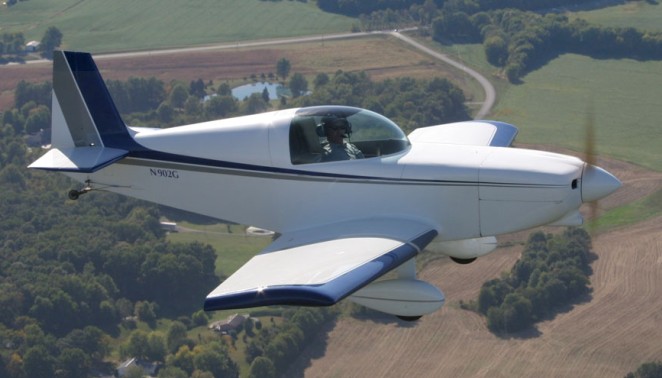
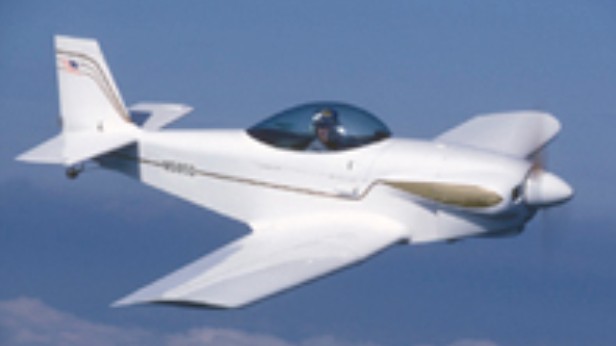
The KR-2 is a two-place version of the KR-1 and is generally similar in construction. The low wings are removable, the main gear is retractable and the tailwheel is steerable. With a stock 1600-cc engine, cruise speed is 140 mph. With a 2100-cc turbocharged VW conversion, cruise is 180 mph at 3200 rpm. To achieve simplicity of construction, the airplane is designed so that no machining or welding is required in building the airframe. The cost and construction time is minimized by using a combination of wood, polyurethane foam, fiberglass cloth and epoxy resin. The result is a structurally strong, clean, hard surface and an exceptionally fast airplane for the power used. All new premolded fiberglass parts have been developed to speed the building time for the KR-2. Luxury upholstery kits are also available and can be simply snapped into position.
First flown in July 1974.
Ken Rand, in 1974, commenced marketing plans and kits for the single seat KR-1 and two-place KR-2. Instant acceptance saw 9000 plans and kitsets sold within the first five years.
The KR-1 is the single seat low wing retractable monoplane which is typically powered by smaller VW engines, up to the VW 2100. The KR-1B motorglider is a standard KR-1 with modified outer wing sections. With this simple wing conversion, the original KR-1 becomes an excellent self-powered glider.
Ken Rand, in 1974, commenced marketing plans and kits for the single seat KR-1 and two-place KR-2. Utilising spruce, foam and Dynal cloth in construction, these designs could be built in as few as 800 hours sparetime work. The clean lines and smooth finishes attainable with this technique meant reduced drag, resulting in higher speeds on less power. Retractable gear adds to its performance. The prototype KR 1 (first flown in February 1972) reached 150 mph in level flight, powered by a 36 hp converted VW car engine. Instant acceptance saw 9000 plans and kitsets sold within the first five years.
Financed by the Royal Aeronautical Society was the Jupiter from Royal Air Force apprentices at Halton. In June 1972 the Jupiter flew 1071 m (1171 yards).
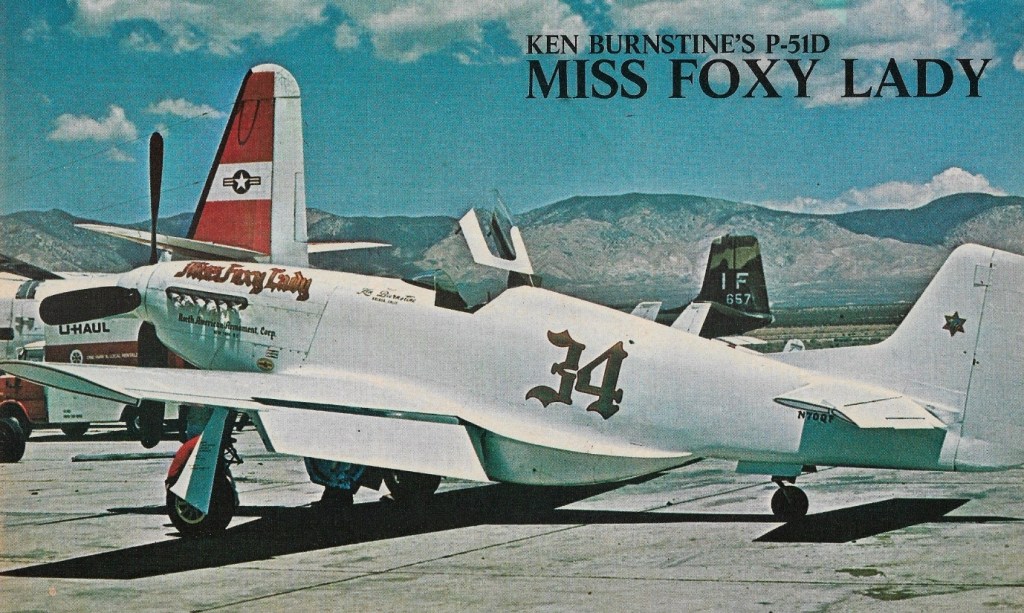
A P-51 Mustang-based racer, Surnthin’ Else belonged to World Airlines chief pilot John Crocker. Equipped with clipped wings and Hoerner wing tips, faired low-profile canopy and a Hovey machine products racing Merlin, this was one of the first Mustangs so modified. It was built up by Ken Burnstine, who was killed in another Mustang) and previously raced as Miss Foxy Lady.
Carrying the racing number six, Sumthin’ Else sports a colour scheme of white with a black spinner and nose that becomes a black fuselage stripe, and a black tail unit.
It took first place in the Unlimited Gold Championship race at Reno in 1979, with John Crocker at the controls, but has not been very competitive since.
Sumthin’Else Span: clipped from 11.89 m (37 ft 0.75 in) Length: 9.83 m (32 ft 3 in) Powerplant: 1 x Packard V-1650 Merlin, 2088 kW (2,800 hp) Max TO weight: about 3175 kg (7,000 lb) Max speed: about 460 mph at low altitude
The Raache LR-1 or Honroth Special of 1947 was a single-place cabin, low wing monoplane, NX/N5595N, powered by a Continental engine.
In its first Goodyear competition, when rounding the first pylon, this racer twisted its frame so badly it limped in and was immediately retired from flying.