USA Based at Chula Vista, California, was aircraft component subcontractor in Second World War. Built M.0.1 two-seat tail-first (canard) monoplane in 1946.
(Fred H) Rohr Aircraft Corp, Chula Vista CA. 1940
Fred H Rohr was the person who designed and built the fuel tanks for Lindbergh’s NYP Ryan. In 1945, ten conversins of Consolidated PB2Y-3 with turrets removed, side hatch added, for 44 passengers, for Naval Air Transport Service were completed as PB2Y-3R.
In 1974, Rohr Chairman Burt Raynes resolved to move Rohr into the light airplane market by summoning Walt Mooney as designer and project manager to come up with a quantum leap in light aircraft technology. Mooney selected the best people Rohr had, including key players Bill Chana, Bob Fronius, Mike Voydisch, and Don Westergren, and built three airframes; two flying prototypes and a static tester, plus 1/10- and 1/2-scale models for feasibility tests. By the time the project ended (for reasons having nothing to do with the merits of the airplane), one prototype had accumulated 23 hours in the air.
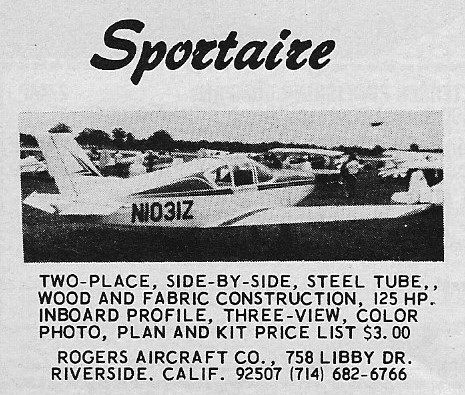
This two-place, low-wing monoplane stands on tricycle gear and is propelled by a Lycoming 125-hp engine. Building materials include tubular steel, wood and fabric.
Feb 74
Gross Wt. 1600 lb Empty Wt. 984 lb Fuel capacity 22 USG Wingspan 26’4” Length 20’6” Top speed 160 mph Cruise 150 mph Stall 55 mph Climb rate 1000 fpm Takeoff run 750 ft Landing roll 500 ft Range 400 sm
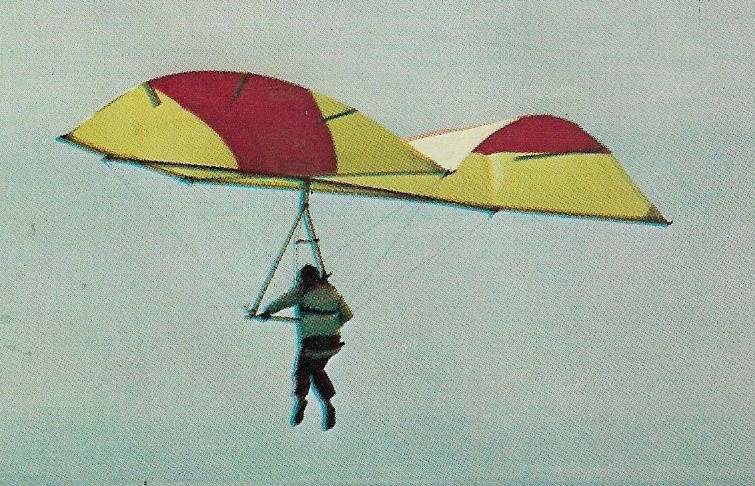
In 1948, Francis Rogallo, a NASA engineer, and his wife Gertrude Rogallo, invented a self-inflating flexible wing they called the Parawing, also known after them as the “Rogallo Wing” and flexible wing.
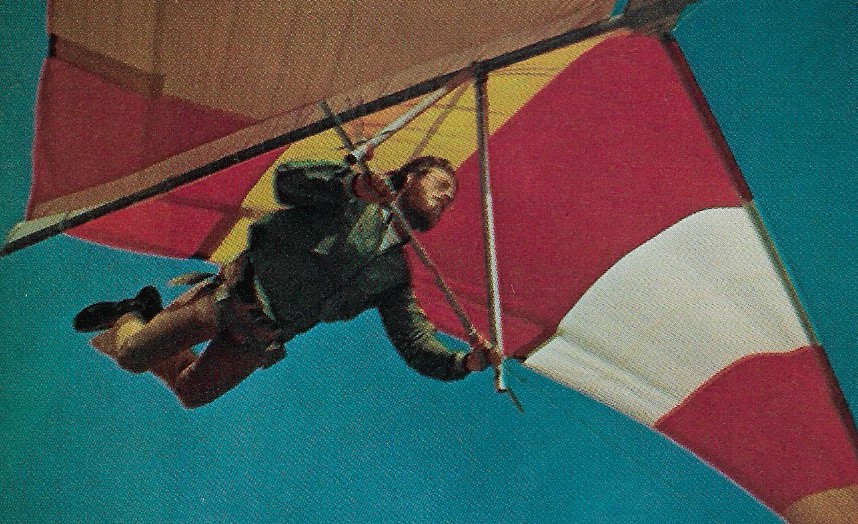
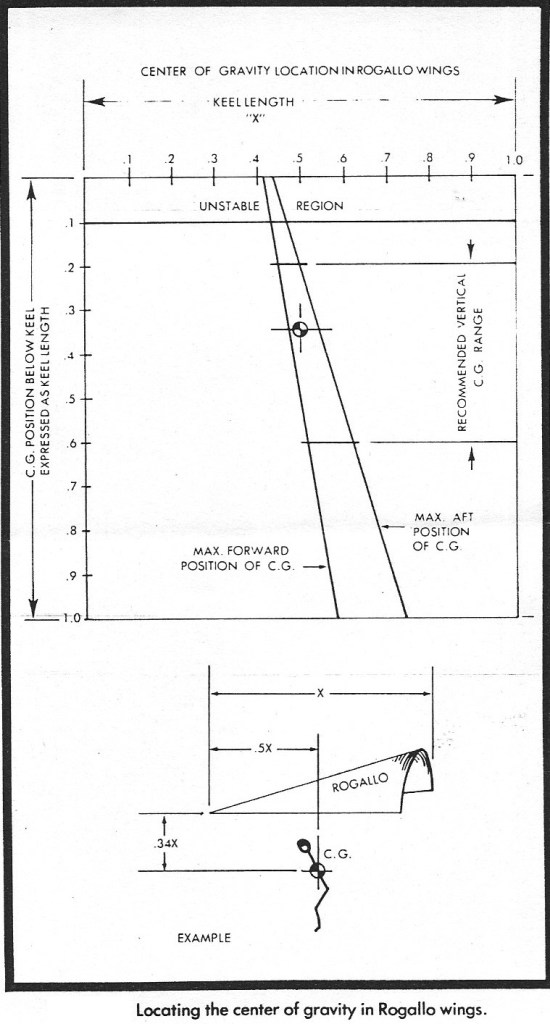
The term “Rogallo wing” is synonymous with one composed of two partial conic surfaces with both cones pointing forward. Slow Rogallo wings have wide, shallow cones. Fast subsonic and supersonic Rogallo wings have long, narrow cones. The Rogallo wing is a simple and inexpensive flying wing with remarkable properties. The wing itself is not a kite, nor can it be characterized as glider or powered aircraft, until the wing is tethered or arranged in a configuration that glides or is powered. In other words, how it is attached and manipulated determines what type of aircraft it becomes. The Rogallo wing is most often seen in toy kites, but has been used to construct spacecraft parachutes, sport parachutes, ultralight powered aircraft like the trike and hang gliders. Rogallo had more than one patent concerning his finding; the due-diligence expansion of his invention involved cylindrical formats, multiple lobes, various stiffenings, various nose angles, etc. The Charles Richards design and use of the Rogallo wing in the NASA Paresev project resulted in an assemblage that became the stark template for the standard Rogallo hang-glider wing that would blanket the world of the sport in the early 1970s.
Beyond that, the wing is designed to bend and flex in the wind, and so provides favorable dynamics analogous to a spring suspension. Flexibility allows the wing to be less susceptible to turbulence and provides a gentler flying experience than a similarly sized rigid-winged aircraft. The trailing edge of the wing – which is not stiffened – allows the wing to twist, and provides aerodynamic stability without the need for a tail (empennage).
In 1961–1962, aeronautical engineer Barry Palmer foot-launched several versions of a framed Rogallo wing hang glider to continue the recreational and sporting spirit of hang gliding. Another player in the continuing evolution of the Rogallo wing hang glider was James Hobson whose “Rogallo Hang Glider” was published in 1962 in the Experimental Aircraft Association’s magazine Sport Aviation, as well as shown on national USA television in the Lawrence Welk Show.
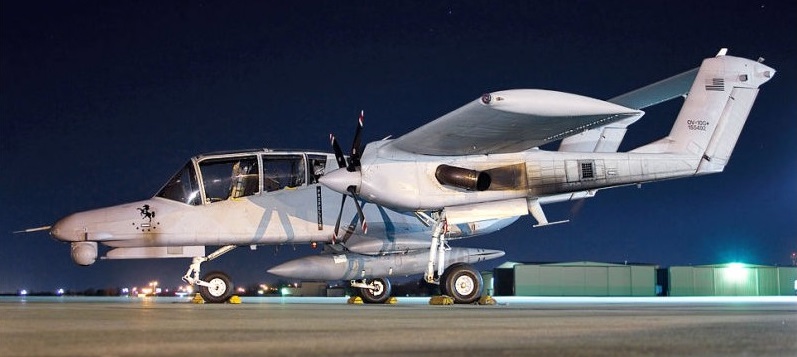
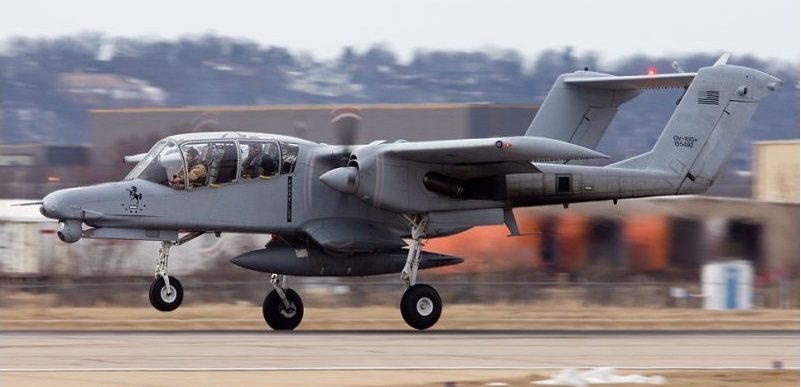
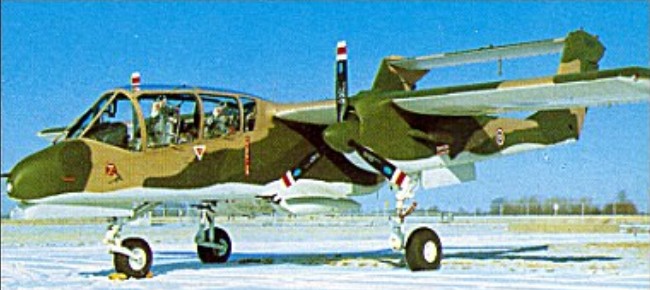
To meet a US Navy requirement for a light armed recon¬naissance aircraft, North American Rockwell produced their NA-300 design submission for the OV 10A Bronco. A contract for seven YOV-10A prototypes was placed in 1964, the first of them flying on 16 July 1965.
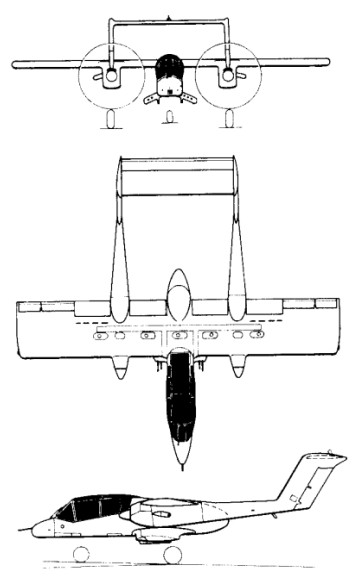
With a two-seat fuselage nacelle mounting a high-set monoplane wing, the aircraft had twin tailbooms extending aft from the nacelles of the two turboprop engines, each with a fin and rudder, and interconnected by a tailplane/elevator assembly. The main units of the tricycle landing gear retracted into the engine nacelles.
Six of the prototypes were powered by 447kW Garrett T76-G-6/8 engines, but had one Pratt & Whitney YT74-CP-8/10 turboprops for comparative evaluation.
The OV-10A Bronco production version had a 3.05m increase in wing span and more powerful T76-G-10/12 engines, the first flown on 6 August 1967, and 114 were built for the US Marine Corps.
These were followed by 157 similar OV-10As for the US Air Force, these entering operational service in Vietnam in 1968. Under the US ‘Pave Nail’ programme, 15 were provided with special equipment for the location and illumination of targets by night. Other versions have included six OV-10B aircraft supplied to Germany as target tugs, followed by 18 turbojet-boosted OV-10B(Z) aircraft for the same role. Versions similar to the OV-10A have been supplied to Indonesia (16), Thailand (40) and Venezuela (16), under the respective designations OV-10F, OV-10C and OV-10E, and six US OV-10As have been transferred to the Royal Moroccan air force.
Two OV-10As were modified under a US Navy contract of 1970 to YOV-10D NOGS (Night Observation/Gunship System) aircraft to provide the US Marines with advanced night operational capability. Since evaluation of these aircraft, 17 US Marine Corps OV-10As have been converted to OV-10D NOS (Night Observation Surveillance) configuration, now equipped with a FLIR (forward-looking infra-red) turret in the nose linked to an underfuselage 20mm cannon turret, and a laser target illuminator.
Production of the Bronco for the USMC, USAF, and four export customers was completed in 1980.
Able to carry a maximum weapon load of 3,600 lb (1,633 kg), the Bronco has proved valuable for Forward Air Control (FAC) operations in South East Asia.
Of the seven prototype North American Rockwell OV 10 Broncos built, No.3 on the line was heavily modified and was the only short-wing example of the aircraft ever built. YOV 10A 152881 (N718NA) has a wingspan of only 32ft (9.75m), whereas standard production aircraft had 40ft (12m) of wing. From 1966 to 1972 the aircraft was used as a demonstration airframe and was used to take Admirals, Generals and Congressmen for flights to extol the virtues of the twin engined observation and forward air controller design. The Bronco was also assigned to train new pilots on the gunnery ranges, using its machine guns and rockets. During the spring of 1972 it was assigned to NASA under the Department of the Army, for STOL flight testing. This was carried out at the Ames Flight Test Center in California, with the aircraft being allocated a civilian registration.
During its time at Ames, the Bronco was heavily modified, the aircraft’s Garrett T 76 turboprops were removed and replaced by Lycoming T 54s. Three blade 7ft (2.1m) Hamilton Standard propellers were replaced with 10ft (3m) four bladed Curtiss Electric composite propellers, and the engines were interconnected by a single solid shaft in the leading edge of the wing. With this system in operation, the aircraft flew at 47 knots and NASA was working toward getting the minimum speed down to 30 knots. The Bronco became unstable, and the programme was stopped. The aircraft was with NASA until it was sold to the Detroit Institute of Aeronautics in 1979.
OV-10A Engines: 2 x Garrett AiResearch T76-G-416/417, 715 shp Wing span: 40 ft 0 in (12.19 m) Wing area: 290.951 sqft / 27.03 sq.m Length: 41 ft 7 in (12.67 m) Height: 15 ft 2 in (4.62 m) Max TO wt: 14,446 lb (6563 kg) Weight empty: 6892.8 lb / 3126.0 kg Max level speed: 281 mph (452 kph) Cruising speed: 168 kts / 312 km/h Service ceiling : 27001 ft / 8230 m Maximum range: 1199 nm / 2220 km Range (max. weight): 410 nm / 760 km Crew: 2 Armament: 4x MG 7,62mm M60C/500rds., 1633kg ext. 5pts.
OV-10B Engines: 2 x Garrett T76-G-418
OV-10D Engines: 2 x Garrett T76-G-420/421 turbo-prop, 776kW / 1040 shp Max take-off weight: 6552 kg / 14445 lb Empty weight: 3127 kg / 6894 lb Wingspan: 12.19 m / 39 ft 12 in Length: 13.41 m / 43 ft 12 in Height: 4.62 m / 15 ft 2 in Wing area: 27.03 sq.m / 290.95 sq ft Ceiling: 9145 m / 30000 ft Range w/max.payload: 740 km / 460 miles Bombload: 2000kg Crew: 2
The Rockwell B-1 resulted from a November 1969 requirement for a medium-altitude with dash capability of Mach 2.2+ for the high-speed delivery of free-fall and stand-off nuclear weapons. Submissions were received from several companies, Rockwell’s design being selected in 1970 as the B-1A. The full-scale design and development programme for the initial production version was soon under way. The initial model was a complex and highly advanced variable-geometry type with General Electric F101 turbofans and fully variable inlets for maximum capability in all elements of the flight envelope.
The first of four prototypes (71-40158) of the Rockwell International B-1 four-turbofan strategic heavy bomber made its maiden flight on 23 December 1974; designed to meet USAF Strategic Air Command’s Advanced Manned Strategic Aircraft (AMSA) requirement, it incorporated variable geometry wings (maximum sweep of 67 degrees), accommodated a four-man crew and had an estimated maximum speed of Mach 2 at altitude.
In June 1977 President Carter decided to scrap the programme in favour of cruise missile development although flight trials with the B-1A aircraft were to be continued for research purposes, the flight testing continued through 1981 with the four prototypes.
Then with the inauguration of President Reagan matters began to look up again, the new administration deciding during October 1981 to procure 100 examples of a much revised B-1B version in the low-level penetration role for high-subsonic delivery of free-fall and stand-off weapons. The B-lB was.therefore a straightforward but nonetheless major adaptation of the B-1A optimized for the low-level transonic role with fixed inlets and revised nacelles (reducing maximum speed to Mach 1.25). But it did have a strengthened airframe and landing gear for operation at higher weights with nuclear and conventional weapons over very long ranges. Other changes were concerned with reduction of the type’s already low radar signature, S-shaped ducts with streamwise baffles being adopted to shield the face of the engine compressors and radar absorbent materials being installed in sensitive areas to reduce electromagnetic reflectivity. The second and fourth B-lAs were used from March 1983 to flight-test features of the B-1B, which first flew in September 1984 with the advanced offensive and defensive electronic systems.
In conjunction with the USAF, Edwards AFB, ASA Dryden Flight Research Center carried out two six-hour flights of the B-1, with the first taking place on 25 March 1981. B-1 number 3, part of the USAF/Rockwell joint test force Bomber Penetration Evaluation was utilised for the two flights. The two supersonic flights evaluated the Structural Mode Control System.
The first production B-1B flew on October 18, 1984, some five months ahead of schedule. Two B-1A development aircraft had previously been converted to B-1B standard, the first flying in B-1B form in March 1983. Production deliveries began in July 1985, to replace B-52Hs in the penetration role, and will continue until 1988.
The ninth B-1B was the first to be fitted with a moveable bulkhead in the forward weapons bay, enabling it to carry eight AGM-86 air-launched cruise missiles (ALCM), short-range attack missiles (Sram), and extra fuel tanks internally. Maximum ALCM loading is eight missiles internally and 14 externally on eight underfuselage hardpoints.
Initial Operational Capability was first achieved on 1 October 1986.
In January 1987 a B-1B successfully launched a short-range-attack missile for the first time, while in April an aircraft from the 96th Bomb Wing at Dyess AFB, Texas, completed a 2l hr 40min mission including five in-flight refuellings (to maintain a high aircraft weight), covering a distance of 15,145km (8,175 nm).
The final B-1B was delivered 2 May 1988.
In 1989, when Neil Armstrong became chairman of AIL Systems Inc., he was invited to fly the B-1 bomber. He later flew the B-1 again for the first flights television series.
The B-1B Lancer were modified and aircrews were trained for the use of conventional weapons, including stand-off and laser guided weapons, and did flew combat missions during Operation Desert Fox.
Also in 1999 the B-1s flew bombing missions using conventional weapons against Yugoslavia as part of Operation Allied Force.
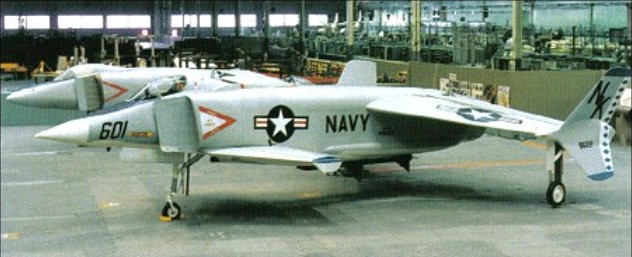
Rockwell became responsible in 1972 for development of the US Navy’s XFV-12A V/STOL Fighter/Attack Technology Prototype programme.
Basically a single-seat all-weather V/STOL fighter/ attack aircraft, the XFV-12A made use of an augmentor wing concept in which the efflux of its single Pratt & Whitney F401-PW-400 afterburning turbofan engine could be diverted to nozzles in the wings and foreplanes for V/STOL operations.
An ejector-flap system was incorporated in the design of each wing and foreplane, in which ambient air was mixed with turbine efflux in a ratio of 7:1 to provide the essential jet-lift for vertical operations and, when the flaps are raised or lowered progressively, for transition from vertical to horizontal flight and vice versa.
The main landing gear, canopy and other cockpit parts came from an A-4 Skyhawk. The main wing box and parts of the inlets were from an F-4 Phantom.
The XFV-12 did get off the ground – and was tested in a tethered mode, but the programme proved a disappointment and failed to provide an alternative to the Harrier.
Engine: 1 x 133.4kN Pratt & Whitney F401-PW-400 turbofan Max take-off weight: 11000 kg / 24251 lb Wingspan: 8.69 m / 29 ft 6 in Length: 13.35 m / 44 ft 10 in Height: 3.15 m / 10 ft 4 in
Rockwell-Standard Corp North American Rockwell Corp Rockwell International Corp
In 1919, Colonel W.R. Rockwell reorganised a bankrupt axle company in Oshkosh, Wisconsin. Following the Colonel’s development of the first double reduction axles for heavy-duty vehicles, Timken-Detroit Axle company acquired his axle company in 1928.
In 1953, Timken-Detroit merged with Standard Steel Spring Company to form Rockwell Spring and Axle Company. In 1958, the name of the company was changed to Rockwell-Standard Corporation. Rockwell-Standard embarked on a plan of diversification in the late 1950s and 60s and by 1967, it was a major independent producer of a wide-range of automotive components.
In 1965 Rockwell-Standard acquired Snow Aeronautical, continuing to produce agricultural aircraft at Olney as Snow Commanders (as division of Aero Commander), and acquired Intermountain Manufacturing Company (IMCO) 1966. Single-engined Model 112 delivered to customers from 1972. Low-wing twin-engined Rockwell Commander 700 produced jointly with Fuji in Japan. Thrush Commander was very notable specially-designed agricultural aircraft. The entire Thrush Commander range sold to Ayres Corp and then became known by the Ayres name. Shrike Commander 500S terminated 1980 but Commander Jetprops continued by Gulfstream American Corporation.
In 1967, Rockwell-Standard Corporation and North American Aviation merged to create the North American Rockwell Corporation.
Following company reorganization, the former Aero Commander division of Rockwell became part of NAR, and its Shrike, Commander 685 and Turbo Hawk Commander twin-engined business aircraft were marketed under the new company name, together with Quail, Sparrow, Snipe and Thrush Commander agricultural aircraft, and the Darter and Lark Commander single-engined lightplanes.
The Model 112 Commander lightplane and B-1 swing-wing supersonic bomber projects were started before the company name was changed to Rockwell International in 1973.
In 1973 North American Rockwell and Rockwell Manufacturing Company merged to become Rockwell International Corporation. Aircraft production after the 1967 merger included the Aero Commander line of single and twin-engine aircraft, the turboprop OV-10 Bronco armed reconnaissance aircraft, T-2 Buckeye jet trainer, B-1B Lancer supersonic swing-wing bomber, and the Sabreliner executive and light jet transport. Company’s aerospace and defence units purchased by the Boeing Company on December 6,1996, becoming Boeing North American. Similarly, Rockwell Australia became Boeing Australia Ltd.
In 1977 Rockwell International sold its agricultural airplane operation to the Ayres Corporation of Albany, Georgia. The new owners will continue to manufacture the Models 600 and 800 Thrush Commanders. Fred Ayres, who developed the Turbo Thrush PT6 retrofit, plans to begin producing that airplane at his new plant.
1984: Sabreliner Corporation, a new company formed to acquire the former Sabreliner Division of Rockwell International.