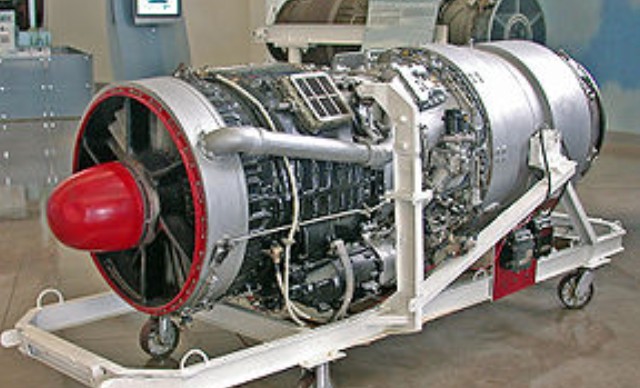
Rolls-Royce Avon / Svenska Flygmotor RM5 / RM6 / Westinghouse XJ54

The Avon design team was headed by Cyril Lovesey, who had previously been in charge of Merlin development. The engine was intended both as an experiment in axial-flow turbojet engines, as well as (if successful) a replacement for the 5,000 lbf (22 kN) Nene. Originally known as the AJ.65 for Axial Jet, 6,500 lbf which was originally designed by Alan Arnold Griffith, the engine developed as a single-spool design with an eight, later 10 stage compressor, mass flow rate of 150 lb/s (68 kg/s) and a pressure ratio of 7.45. Development started in 1945 and the first prototypes were built in 1947.

The main series of the Avon were the 1 and 100 Series and the 200 Series. The I and 100 series have a similar axial flow compressor, while the 200 Series has a axial flow compressor with additional stages. In the 1 and 100 Series the combustion assembly consists of eight flame tubes in individual casings, but the 200 Series has flame tubes contained in an Annular casing.

The first bench testing of the Avon took place early in 1947. The first production version was running during 1949. In 1951, the first engines of the 100 and 200 Series were bench tested.

The take-off thrust of the Avon I was 6,500 lbs. Development of material allowed increased operating temperatures and when the 100 Series was introduced the thrust was 7,500 lb.

Introduction was somewhat slowed by a number of minor problems. The first Avons to fly were two Avon RA.2s in the converted Lancastrian military serial VM732, which flew from Hucknall on August 15, 1948. The prototype RA.2 weighed 2,400 lb and gave 6,000 lb thrust, while the production RA.3 was 125 lb lighter.

Initially a private venture for the company, government backing was forthcoming around the time of the first prototypes.

The engine eventually entered production in 1950, the original RA.3/Mk.101 version providing 6,500 lbf (29 kN) thrust in the English Electric Canberra B.2. Similar versions were used in the Canberra B.6, Hawker Hunter and Supermarine Swift.

The 200 Series began with 9,500 lb thrust and was soon 11,250 lb.

Uprated versions soon followed, the RA.7/Mk.114 in 1952, producing 7,350 lbf (32,700 N) in the de Havilland Comet C.2, the RA.14/Mk.201 of 9,500 lbf (42 kN) in the Vickers Valiant and the RA.26 of 10,000 lbf (44 kN) used in the Comet C.3 and Hawker Hunter F.6.

The first of the series with all-weather protection, the RA.7 had a power/weight ratio even better than that of the original production engines, notwithstanding the fact that it had been restressed to accept the loads imposed at transonic speeds. The RA.7R (the suffix “R” denotes that reheat, or afterburning, is fitted) delivers 9,500 lb static thrust at sea level, and an offshoot of the same family is the civil 500 Series, the 503 being the engine of the Comet 2.
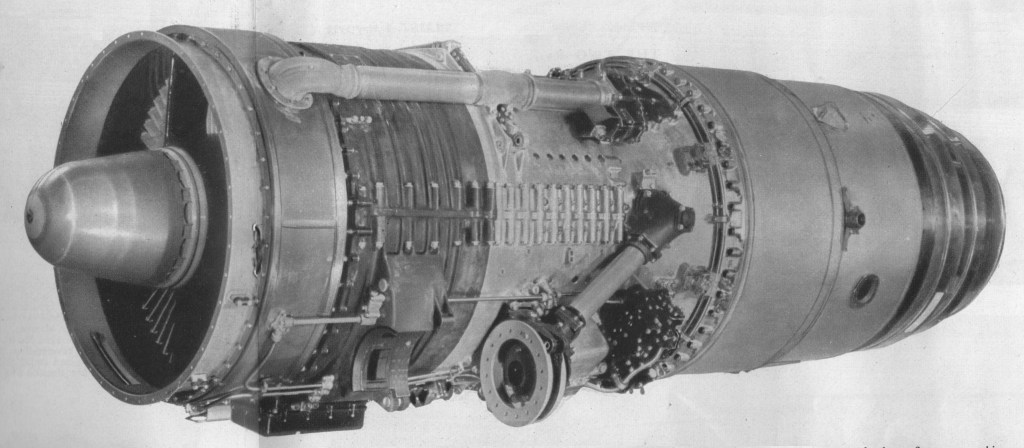
Avon RA.14

The Avon RA.14 first ran in 1952. It has a longer compressor than its forerunners, and it also has a true annular combustion chamber in order to accept the tremendous mass flow without increasing “hoop” diameter. The R.A.14 was intended for installation in the wing (it is known that it powers the Vickers-Armstrongs Valiant B.1), and every effort has been made to reduce depth to a minimum.

Originally the Avon was made as a military engine but, in February 1952, the first flight in a civil aircraft was made. A civil counterpart is the RA.16 of 9,000 lb thrust, which was originally intended to power the Comet 3, though that aircraft had later variant, giving 10,000 lb thrust.

An Avon-powered de Havilland Comet 4 flew the first scheduled transatlantic jet service in 1958.

The modifications and improvements introduced to the Avon 200 series were considerable, resulting in a completely different engine with very little in common with the early Marks. Despite this, the name Avon was retained. Differences included a completely new combustion section, a 15 stage compressor based on that of the Armstrong-Siddeley Sapphire, as well as other improvements.

The line eventually topped out with the 12,690 lbf (56,450 N) and 16,360 lbf (72,770 N) in afterburner RA.29 Mk.301/2 (RB.146) used in later versions of the English Electric Lightning. Other aircraft to use the Avon included the de Havilland Sea Vixen, Supermarine Scimitar and Fairey Delta.

Avon RA29

The Avon was also produced under license by Svenska Flygmotor as the RA.3/Mk.109 as the RM5, and an uprated RA.29 as the RM6 with 17,110 lbf (76,110 N). The RM5 powered the Saab Lansen, while the RM6 was the main powerplant of the SAAB Draken.

Production was also carried out in Belgium by Fabrique Nationale, including 300 Avon 113s, and a larger number of Avon 203s.

In the US, the Avon was used to power the vertical landing Ryan X-13 Vertijet aircraft (in RA.28-49 form).

In Australia, the Avon was used by Commonwealth Aircraft Corporation to power its heavily modified variant of the F-86 Sabre, known as the CA-27 Avon-Sabre.

The Avon continued in aero engine production, mostly for the use in the Sud Aviation Caravelle and English Electric (BAC) Lightning, until 1974, by which time over 11,000 had been built. The engine garnered an impressive safety record over that time. The Avon remained in operational service with the RAF, powering the English Electric Canberra PR.9, until 23 June 2006.

The Avon 200 is an industrial gas generator that is rated at 21-22,000shp. As of 2011, 1,200 Industrial Avons have been sold, and the type has established a 60,000,000 hour class record for its class.

Variants:
AJ65
The original designation, standing for Axial Jet 6,500lbs thrust

RA.1
Prototype engines for testing and development.

RA.2
Pre-production engines for testing. 6,000 lbf (26.69 kN)

RA.3
Civil designation for the first Avon production mark – 6,500 lbf (28.91 kN).

RA.7
Civil designation for the uprated version of the Avon. – 7,350 lbf (32.69 kN).

Mk.114
Military designation for the RA.7 Avon – 7,350 lbf (32.69 kN)

RA.14
Civil designation for the uprated version of the Avon with can-annular combustion chamber and Sapphire style compressor – 9,500 lbf (42.26 kN).

RA.21
8,050 lbf (35.81 kN) Production engine developed from the RA.7.

RA.24

RA.26
Further improvements to the Avon 200 series

RA.28
Second generation variant 10,000 lbf (44.48 kN)

RA.29
Civil designation for the Mk.300 series (used by the Sud Aviation Caravelle)

RA.29/1

RA.29/3

RA.29/6

Mk.100 series
Military designation for the RA.3 Avon – 6,500 lbf (28.91 kN).

Mk.200 series
Military designation for the uprated version of the Avon with can-annular combustion chamber and Sapphire style compressor – 9,500 lbf (42.26 kN).

Mk.300 series
Developed after-burning engines for the English Electric Lightning.
RB.146 Mk.301:The ultimate Military Avon for the English Electric Lightning – 12,690 lbf (56.45 kN) dry, 16,360 lbf (72.77 kN) wet.

RB.146 Mk.302:Essntially similar to the Mk.301

Avon 504
Civilian equivalent to military Mk.200 variants.

Avon 506
Civilian equivalent to military Mk.200 variants.

Avon 522
Civilian equivalent to military Mk.200 variants.

Avon 524
Civilian equivalent to military Mk.200 variants.

Avon 524B
Civilian equivalent to military Mk.200 variants.

Avon 525
Civilian equivalent to military Mk.200 variants.

Avon 525B
Civilian equivalent to military Mk.200 variants.

Avon 527
Civilian equivalent to military Mk.200 variants.

Avon 527B
Civilian equivalent to military Mk.200 variants.

Avon 531
Civilian equivalent to military Mk.200 variants.

Avon 531B
Civilian equivalent to military Mk.200 variants.

Avon 532R
Civilian equivalent to military Mk.200 variants.

Avon 532R-B
Civilian equivalent to military Mk.200 variants.

Avon 533R
Civilian equivalent to military Mk.200 variants.

Avon 533R-11A
Civilian equivalent to military Mk.200 variants.

Svenska Flygmotor RM5
Licence production of the RA.3/Mk.109 for the Saab 32 Lansen

Svenska Flygmotor RM6
Uprated RA.29/Mk.300 for the Saab Draken

Westinghouse XJ54
Version of Avon intended to be produced/sold by Westinghouse in the US

Applications:
Military aviation:
CAC Sabre
de Havilland Sea Vixen
English Electric Canberra
English Electric Lightning
Fairey Delta 2
Hawker Hunter
Ryan X-13 Vertijet
Saab 35 Draken
Saab Lansen
Supermarine Swift
Supermarine Scimitar
Vickers Valiant

Civil aviation:
de Havilland Comet
Sud Aviation Caravelle

Other uses:
The Avon is also currently marketed as a compact, high reliability, stationary power source. As the AVON 1533, it has a maximum continuous output of 21,480 shp (16.02 MW) at 7,900 rpm and a thermal efficiency of 30%. In 1982, an Avon engine on gas pumping duty in a Canadian installation ran for 53,000 hours before requiring a major overhaul. In 1994, another industrial Avon engine ran non-stop for 476 days (11,424 hours).

As a compact electrical generator, the type EAS1 Avon based generator can generate a continuous output of 14.9 MW.
On 4 October 1983, Richard Noble’s Thrust2 vehicle, powered by a single Rolls-Royce Avon 302 jet engine, set a new land-speed record of 1,019.46 km/h (633.46 mph) at the Black Rock Desert in Nevada.

Specifications:
Avon 301R
Type: Turbojet
Length: 126 in (3,200 mm)
Diameter: 35.7 in (907 mm)
Dry weight: 2,890 lb (1,310 kg)
Compressor: 15-stage axial flow
Combustors: Cannular, 150 lb/s (68 kg/s)
Turbine: Two-stage axial flow
Fuel type: Kerosene
Maximum thrust: 12,690 lbf (56.4 kN)dry/16,360 lbf (72.8 kN) with reheat
Overall pressure ratio: 7.45:1
Specific fuel consumption: 0.932 lb/(lbf·h) or 26.4 g/(kN·s) (dry) 1.853 lb/(lbf·h) or 52.5 g/(kN·s) (wet)
Thrust-to-weight ratio: 5.66:1 (56 N/kg)
Rolls-Royce

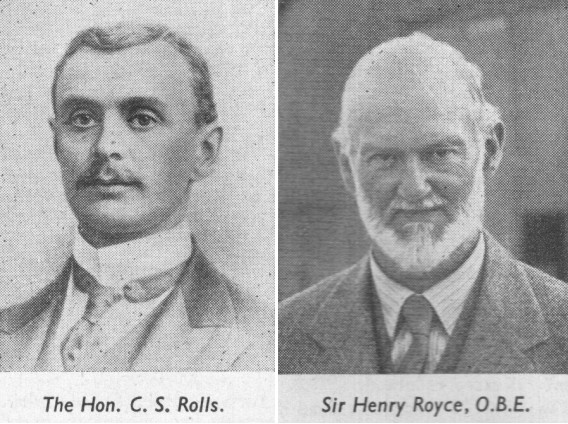
Rolls and Royce, met in Manchester in 1904. Rolls-the Hon. Charles Stewart Rolls-possessed wealth, an Eton-and-Cambridge education, a degree in mathematics and applied science, and a fine record as a motorist. He was a sportsman he had consistently displayed a daring at the wheel and a determined approach to the technical problems of motoring.

In the business of C. S. Rolls and Co., which he established with Claude Johnson in 1902. In 1903 he set a world speed record of 93 m.p.h.; but the car was a 70 h.p. Mors, and by the following year, when his books showed orders for a hundred Continental cars, he could still not find a British product which measured up to his standards.

At ten years of age Henry Royce started work as a telegraph boy, later attending a technical college, and serving a few years in the Great Northern locomotive shops at Peterborough. After a spell in an engineering works at Leeds, he set up a business in Manchester, making arc lamps and dynamos. The slump after the Boer War caused him to turn his ambition to cars. Disappointed with a foreign model which he acquired, he decided to put his own ideas into practice, and in 1903 he completed a two-cylinder car of 10 h.p., having handled much of the precision work himself.

One of his first three cars went to Henry Edmunds, who arranged the meeting in Manchester. The two men took to each other immediately, and having tried out Royce’s car, young Rolls undertook to sell its maker’s entire output. But he began to ply his partner with suggestions and demands.

The “two Rs” were first officially linked in business association at Christmas 1904, by a working agreement between the two firms; and thenceforth the Rolls-Royce car began.

By 1906 Royce’s production was large enough to allow Rolls to stop his sales of other makes of car, and Rolls-Royce, Ltd., was founded. Royce’s old partner, A. E. Claremont, became chairman; Rolls was technical managing director; and Royce was nominated chief engineer and works director.

Charles Stewart Rolls

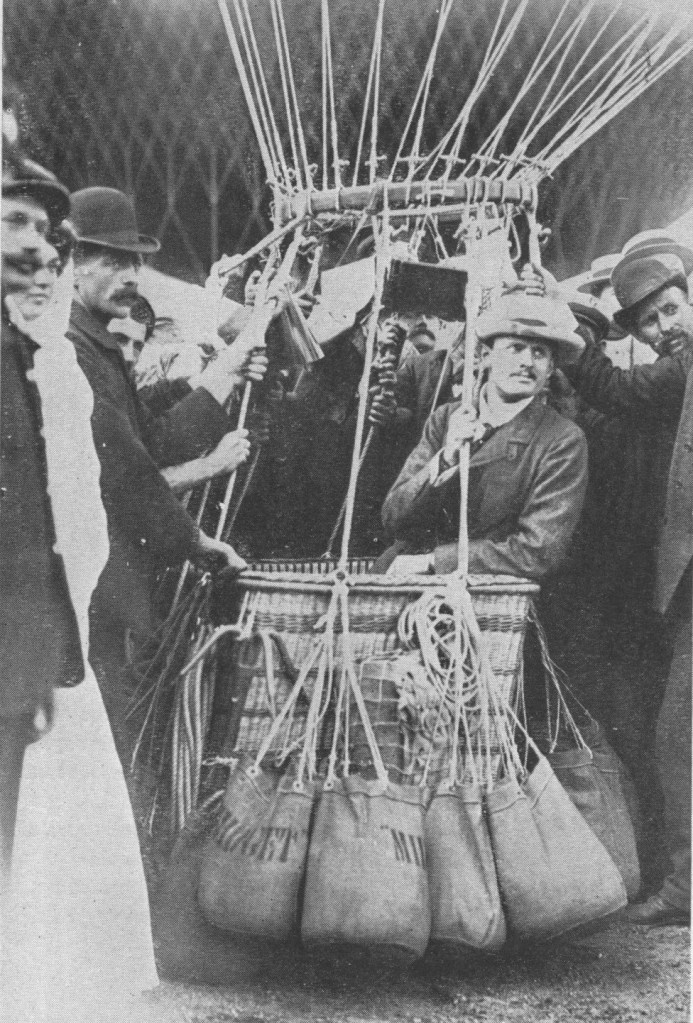
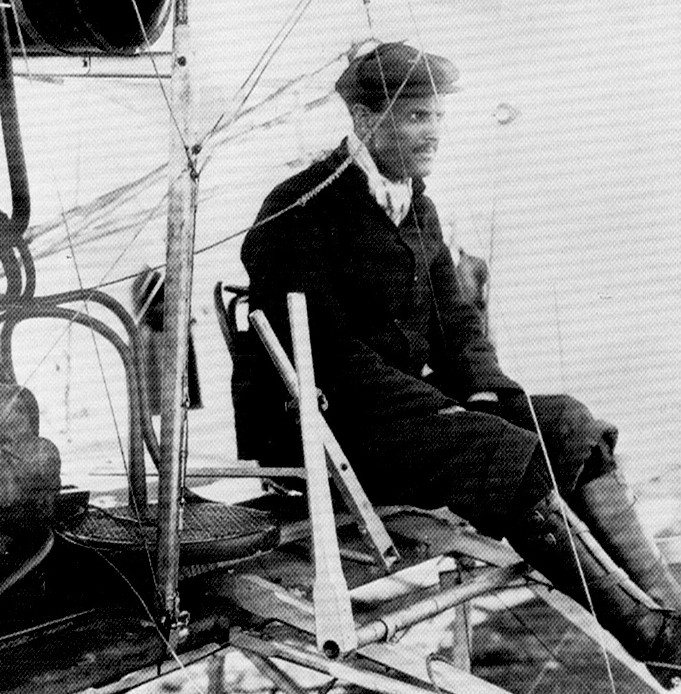
Rolls, who had become a member of the Aeronautical Society in 1901, was already a keen balloonist; then, having met the Wright brothers, he turned to heavier-than–aircraft. He was awarded his pilot’s certificate (No. 2) on March 8th, 1910-the very same day that Lord Brabazon received his No. 1. On the Wright biplane he made the first heavier-than-air crossing of the Channel by an Englishman, and the first double crossing by any aeroplane in history; but soon afterwards-on July 12th, 1910, he crashed to his death at the Bournemouth flying meeting, only 33 years of age. He was the first Englishman to die in an accident to a powered, heavier-than-air machine. His Wright Flyer broke up at 20 ft agl and he cracked his skull.

C.S. Rolls

In 1910 Royce became seriously ill and thereafter was absent for long periods from his new factory at Derby. He worked on in the south of France and on the south coast of England.

Following the British Schneider victory of 1929-made possible by the “R” engine-a baronetcy was conferred upon him, and he heard from his bed how an improved engine of this type sent a Supermarine S.6B to final victory in the Schneider Race of 1931. He died on April 22nd, 1933.

1914 Design of first Rolls-Royce aero engine-later named Eagle started. Company making engines of official pattern at Derby.

1915 Eagle on test six months after design initiated. Hawk
designed and developed. Falcon designed

1918 Condor on test at 525 h.p.

1919 Alcock and Brown, in a Vickers Vimy (two Rolls-Royce Eagle Vills), mode first direct crossing of North Atlantic; flying time, 16 hir 12 min. Ross Smith and Keith Smith, in an Eagle-Vimy, made first flight from England to Australia11,130 miles in 124 hr flying time.

1920 Van Ryneveld and Quintin Brand, also in an Eagle-Vimy, made first flight from England to South Africa-6,281 miles in 92 hr 58 min flying time.

Between 1915 and 1924 Rolls-Royce Aero-engine production was: Eagle, 4,674; Hawk, 200; Falcon, 2,185; Condor, 327.

1925 Design of Rolls-Royce “F” series of engines (later called
Kestrel) started.

1926 First “F” engine tested and delivered.

1927 The ” H ” engine-later the Buzzard-under development.

1929 Air Ministry decided in February to compete in Schneider Trophy Contest; Rolls-Royce asked to develop a racing engine. Within six months “R” engine was delivering 1,900 h.p. for a weight of 1,350 ]b. Installed in Supermarine S.6, which won Schneider Contest at 328.63 m.p.h.

1931 Rolls-Royce again asked to develop a Schneider Trophy engine to help secure a third victory, which would gain Trophy outright for Gt. Britain. Outcome was improved “R” engine of 2,360 h.p., weighing 1,630 lb. Schneider Trophy won outright. Later “R” engine gave 2,530 h.p. and enabled world speed record to be raised to 407.5 m.p.h.

By 1931, during the Great Depression, Bentley was having financial difficulties. When funds ran out in 1931, the receivers were negotiating with D.Napier & Sons Ltd for the sale of the remains of Bentley. However, Rolls-Royce put in a secret bid through a Liechtenstein company, and secured Bentley Motors for £125,256. For this, Rolls-Royce got the factory equipment, a number of incomplete car chassis, and the services of Walter Bentley for three years.

1932 Design of the P.V.12 engine (later called Merlin) started.
(P.V. denoted private venture.)

1934 Merlin completed its first 100 hr run at 790 h.p.

1936 Merlin completed Service Type Test at 975 h.p.

1938 Building of Crewe factory started.

1939 First Merlin built at Crewe. Design and development work
started on 37.V.12 engine, later named Griffon. Building of
Glasgow factory begun in August. 1

1940 First Merlin built at Glasgow. First test run of Griffon.

1942 Quantity production of Griffon started.

1943 First Rolls-Royce turbojet-the Welland-passed its 100 hr type test; thrust, 1,700 lb, weight, 850 lb. Design of Derwent 1 started.

1944 Deliveries of Welland begun, for installation in Gloster
Meteor. Design and development of Nene started.

1945 Meteor powered with Derwent Vs broke world air speed record at 606 m.p.h. In September a Meteor was flown with two Rolls-Royce Trent turboprops, being the first turboprop aircraft to fly. By this year power of Merlin had increased to over 2,000 h.p.

1946 World airspeed record again broken by a Derwent-Meteor;
speed 616 m.p.h.

1947 Pratt and Whitney signed licence agreement for manufacture of Rolls-Royce Nene and Toy. Nenes in production at Derby. Trans-Canada Airlines started operations with Merlin powered Canadair North Stars.

1948 First public appearance ofAvon turbojet at S.B.A.C. Display. Belgium signed licence agreement for manufacture of Derwents.

1949 Dart turboprop type-tested at 1,000 h.p. B.O.A.C. intro-
duced Merlin-powered Argonauts (similar to North Stars).

1950 Australia signed licence agreement to build Nene and Avon.
Hispano signed agreement to make Nene and Toy.

1951 English Electric Canberra, with two Rolls-Royce Avons, made first non-stop transatlantic crossing by a jet aircraft the first of numerous record flights by Avon-Canberras.

1952 Sweden signed licence agreement to build Avon.

1953 Avon-Canberra flew from London Airport to Darwin, Northern Australia, in 22 hr 21 sec. Avon-powered Hawker Hunter established world air speed record of 726.6 m.p.h.; Avon-powered Supermarine Swift later raised record to 735.7 m.p.h. Ministry of Supply opened new factory at East Kilbride, Lanarkshire, to augment production of Avons for the R.A.F. (in addition, Avons were being made by the Bristol Aeroplane Co., Ltd., D. Napier and Son, Ltd., and the Standard Motor Company.)

1954 By May 1954 British-built Rolls-Royce gas turbines had completed 23 million flying hours; Merlins had cornpleted over 5.1 million flying hours in commercial service. By the end of the year over 185,000 Rolls-Royce piston and gas-turbine engines will have been built.

LHTEC (Light Helicopter Turbine Engine Company) is a joint venture between Rolls-Royce and Honeywell founded in 1985. The company was originally a partnership between the Allison Engine Company and AlliedSignal Aerospace . In 1995 Rolls-Royce acquired Allison, and AlliedSignal merged with Honeywell in 1999, and adopted its name.

Rollason Beta

Rollason / Luton Beta B2

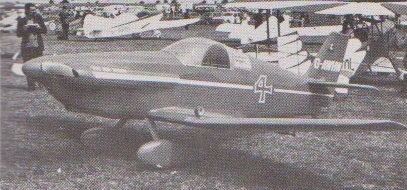
In 1964 Rollasons and the Tiger Club sponsored a competition for a midget racing aircraft which could be used for Formula One air racing. The winner was the Luton Group’s Beta, and after the prototype was attempted by that group, the design was taken over by Rollasons.

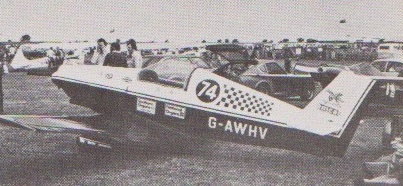
Beta B2A G-AWHV Continental C90

The Beta is a single seat sporting monoplane of all wood construction. The wing employs an NACA23012 aerofoil section and consists of a rectangular centre section and tapered outer panels. The wing is made up of a single main spar and auxiliary rear spar, wood ribs and plywood covering. The mass balanced wooden ailerons are fabric covered. Flaps are optional. The fuselage is a semi-monocoque structure consisting of elliptical wooden frames and plywood covered. The cantilever tail unit has a ply-covered fin and tail plane and fabric covered control surfaces. The fixed undercarriage has rubber in compression shock absorbers on early models, but spring steel legs on later models. Fuel capacity is 10.5 Imperial gallons. Four versions of the Beta are available, the basic difference being the engine fitted.

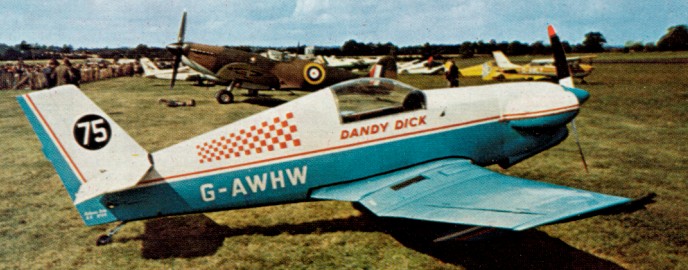
Beta B4 G-AWHW at Sywell 1975. Continental O-200-A

Beta B1
Engine: Continental A65, 65 hp
Wing span: 20.05 ft
Length: 16.08 ft

Beta B2
Engine: Continental C-90, 90 hp

Beta B2A
Engine: Continental C-90, 90 hp
Undercarriage: spring steel

Beta B3
Engine: Ardem 4C02 Mk.V, 55 hp

Beta B4
Engine: Rolls-Royce 0-200-A, 100 hp
Span: 20’ 5”
Length: l6’8”
Wing Area: 66 sq. ft
Empty Weight: 575 lb
Loaded Weight: 866 lb
Max. Speed: 200 mph
Cruise Speed: 166 mph
Stall Speed: 60 mph (less flaps)
Initial Climb: 1,800 fpm
Range: 300 miles

Rollason

Rollason Aircraft and Engines Ltd.
Initially an aircraft sales and service organization. Began aircraft construction in 1957 with Druine Turbulent single-seat light monoplane powered by a Rollason-converted Ardem motor car engine. Production was carried out at their works on the old Croydon Aerodrome with first flights generally taking place at Redhill.

In 1961 built two-seat Druine Condor with 75 hp Continental engine. Later versions used more powerful Continental engines. Rollason also rebuilt a number of Tiger Moths and other aircraft, and carried out seaplane conversions of the Tiger Moth and Turbulent.

In 1973 the company moved from Croydon to premises at Shoreham. Tiger Moth work was concentrated at Rochester, with Redhill providing back-up to both bases and the hub of the sales part of Rollasons.

Rolladen-Schneider LS 3

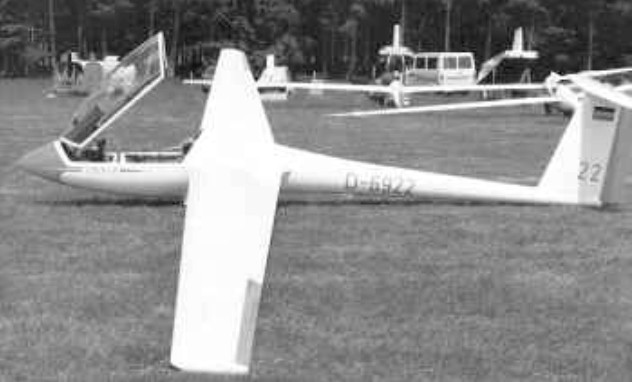
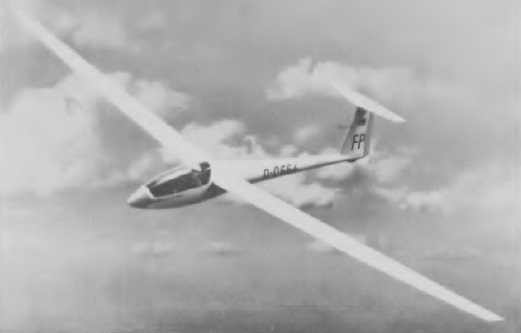
Developed by Wolf Lemke and Walter Schneider from the LS1-f via the LS2, which never went into production, the LS3’s design and construction began in 1975.

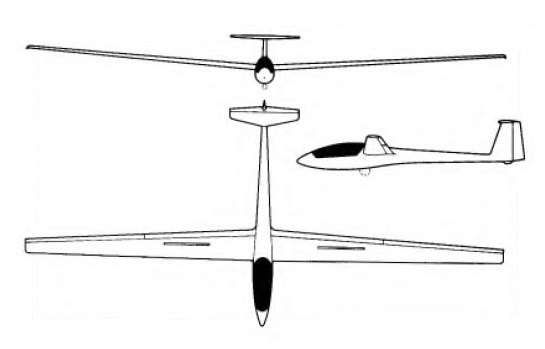
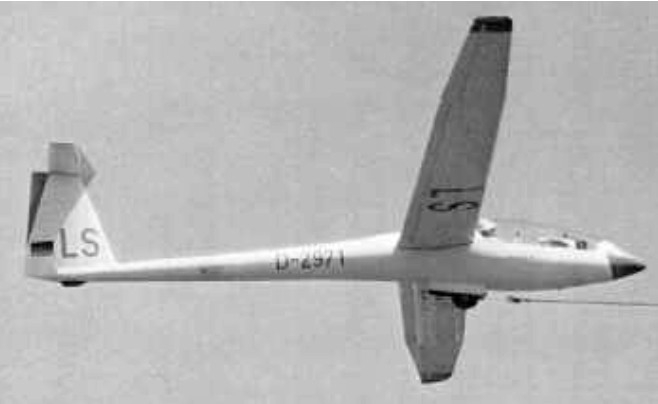
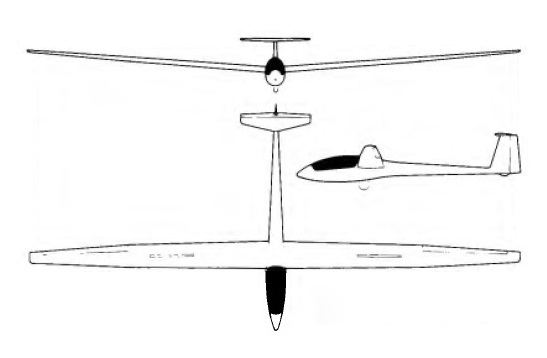
Like the LS1 -f, the LS3 is a cantilever mid-wing monoplane with a T-tail; the wings are of glassfibre/foam sandwich construction as are the one-piece ‘flaperons’, or combined ailerons and flaps, which form the entire trailing edge; from 1979 the ‘flaperons’ have been replaced by conventional flaps and ailerons. There are air brakes in the upper wing surfaces and there is provision for up to 309lb of water ballast. The semi-monocoque fuselage, very similar to the LS1-f’s, has a hinged one-piece flush-fitting canopy under which the pilot sits in a semi-reclining position. There is a retractable rubber-sprung monowheel with a drumbrake, and a tailskid. The fin and rudder, and the tailplane and elevators mounted on top of them, are all of glassfibre/foam construction. There is a mechanism to prevent the air brakes from opening at an incorrect flap setting, and the one-piece ‘flaperons’ enabled shorter, steeper landing approaches to be made than with conventional ailerons drooping in conjunction with the flaps. The flaperons are coupled with dive brakes to reduce approach and landing speeds. The prototype first flew on 4 February 1976 at Egels bach in Germany.

All LS-3 series use a fuselage similar to that developed for the Standard Class LS-1f, which features a front- hinged canopy and a fixed stabilizer on a T- tail.

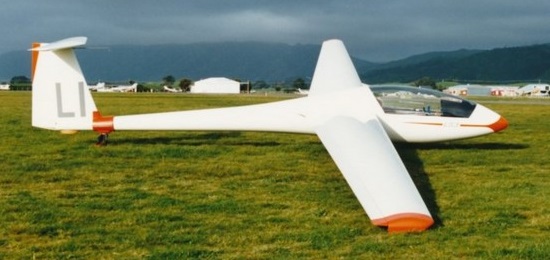
Rolladen-Schneider LS3 ZK-GLI

The LS3-a, which first flew in prototype form in the spring of 1978, differs from the LS3 chiefly in having horizontal and vertical tail surfaces of greater area and different aerofoil sections, and the empty weight reduced to 551 Ib; the maximum weight and performance remain the same. The LS-3a version has separate flaps and ailerons.

A 17m span version, designated LSS-a-17, was developed with detachable wing tips which can be removed to restore the span to 15m with no change in gross weight, the LS3 itself conforming to the Standard Class 15m span.

More than 200 LS3s had been ordered by mid-January 1978; by the beginning of 1980 a total of 358 of all versions had been built.

Span: 15m / 49 ft 2.5 in
Length: 22 ft 3.75 in
Height: 3 ft 11.25 in
Aspect ratio: 21.4
Airfoil: Wortmann mod
Wing area: 109.8 sqft
Empty Weight: 263kg / 580lb
Payload: 208kg / 458lb
Gross Weight: 471kg / 1038lb
Wing Load: 44.86 kg/sq.m / 9.17 lb/sq.ft
Water Ballast: 0
Max speed: 168 mph (in smooth air)
Max aero-tow speed: 118 mph
MinSink: 0.61 m/s / 1.97 fps / 1.18 kt at 43.5 mph
L/DMax: 40:1 at 68.5 mph
Seats: 1
Structure: fiberglass

LS3A
Wing span: 15.0 m / 49 ft 2 in
Length: 6.8 m / 22 ft 3 in
Height: 1.2m / 3ft 11.25 in
Wing area: 10.2 sq.m / 109.8 sq ft
Wing section: Wortmann
Aspect ratio: 22.0
Empty weight: 246 kg / 542 lb
Max weight: 470 kg / 1,036 lb
Water ballast: 120 kg / 265 lb
Max wing loading: 46.0 kg/sq,m / 8.19 lb/sq ft
Max speed: 135 kt / 250 km/h
Stalling speed: 35 kt / 65 km/h
Min sinking speed: 0.55 m/sec / 1.8 ft/sec at 38 kt / 70 km/h
Max rough air speed: 135 kt / 250 km/h
Best glide ratio: 40 at 59 kt / 110 km/h

Rolladen-Schneider LS 2

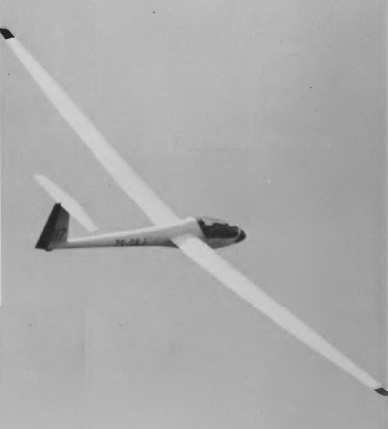
Designed by Wolf Lemke, the LS2 was developed from the LS1-f but never went into production even though in prototype form, flown by Helmut Reichmann, it won the Standard Class section of the 1974 World Championships in Australia. Further developed, the LS3’s design and construction began in 1975.

Span: 15 m
Area: 10.29 sq.m
Aspect ratio: 21.87
Airfoil: FX 67-K-170
Empty Weight: 240 kg
Gross Weight: 360 kg
Wing Loading: 34.99 kg/sq.m
Water Ballast: 0
MinSink: 0.65 m/s 80 kph
L/DMax: 40 100 kph
Seats: 1

Rolladen-Schneider LS 1 / Segelflugzeugbau Schneider OHG LS1

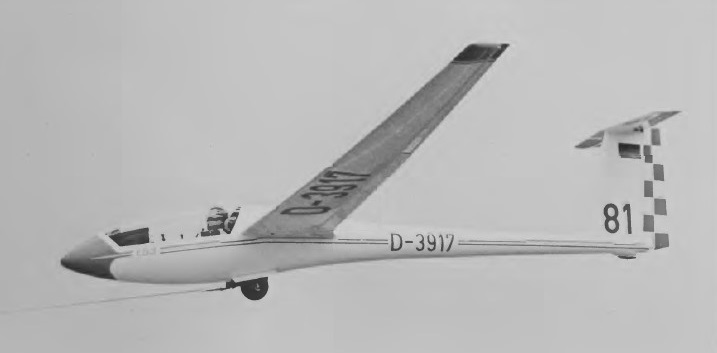
Walter Schneider and Wolf Lemke commenced glider production in 1968 with the LS1 in the standard class. The LS-1 Standard Class design resulted from the collaboration of Wolf Lemke and Walter Schneider after they had worked together on the Akaflieg Darmstadt D-36 project. The LS1 was produced by Walter Schneider, at first under the name Segelflugzeugbau Schneider OHG, but later as Rolladen-Schneider Flugzeugbau GmbH.

Two prototypes of the LS1 competed in the German National Championships of 1968, taking first and second places out of 44 competitors, and the prototypes were fitted with a novel form of air brake consisting of a portion of the trailing edge hinging upwards inboard of the ailerons, and hinged close to its midchord line so that the air brake’s leading edge moved down while its trailing edge moved upwards. These brakes were found to be effective only at certain speeds, however, and so production LSls featured conventional Schempp-Hirth air brakes.

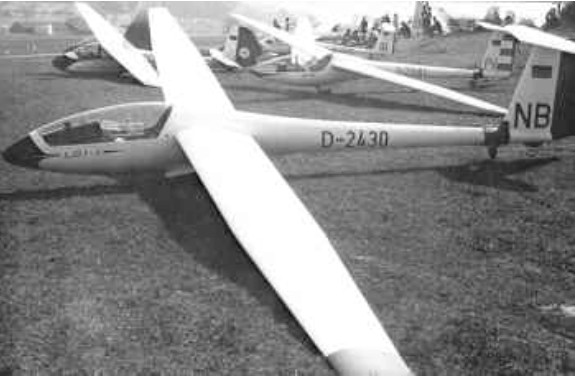
Characterised by a cantilever mid wing and a T-tail, the LS1 is of glassfibre and PVC foam construction, with the pilot seated in a semi-reclining position under a large one-piece flush-fitting canopy. The LS1-C featured an all-moving tailplane instead of the tailplane and elevators of earlier versions, and the LS1-d introduced provision for water ballast, over 200 of these two versions being built. The LS1-f has a redesigned rudder and reverts to a fixed tailplane and elevator; there is provision for up to 198 lb of water ballast and the monowheel is now retractable instead of fixed as on earlier versions, and has rubber shock absorbers. Some improvements have been made to the cockpit interior and the tow release mounted on the landing gear strut has been modified; this can also be fitted in the nose, as required.

The LS1-f first flew in 1972 and made its competition debut in that year’s World Championships at Vrsac, Yugoslavia; an LS1 flown by Helmut Reichmann of Germany had taken first place in the Standard Class at the 1970 World Championships at Marfa, Texas. The LS1 -f went on to take 8th, 10th and 14th places at the 1976 World Championships at Rayskala in Finland. By January 1977 a total of 240 LSI-fs had been built, and a club version of the LS1-f, designated LS1-C Club, was announced.

Span: 15 m / 49.2 ft
Area: 9.74 sq.m / 104.8 sq.ft
Aspect ratio: 23.1
Airfoil: Wortmann FX-66-S-196
Empty Weight: 230 kg / 507 lb
Payload: 160 kg / 353 lb
Gross Weight: 390 kg / 860 lb
Wing Load: 40.04 kg/sq.m / 8.19 lb/sq.ft
Water Ballast: 0
L/DMax: 38
MinSink: 0.64 m/s / 2.1 fps / 1.24 kt
Seats: 1

LS1-f
First flight: 1972
Span: 15.0 m / 49 ft 2.5 in
Length: 6.7 m / 21 ft 11.75 in
Height: 1.2m / 3 ft 11.5 in
Wing area: 9.75 sq.m / 105 sq ft
Wing section: Wortmann FX-66-S-196 mod
Aspect ratio: 23.0
Empty weight: 200 kg / 507 lb
Max weight: 390 kg / 860 lb
Water ballast: 90 kg / 198 lb
Max wing loading: 40 kg/sq,m / 8.2 lb/sq ft
Max speed: 155 mph (in smooth air)
Max rough air speed: 135 kt / 220 km/h
Stalling speed: 33.5 kt / 62 km/h
Min sinking speed: 0.65 m/sec / 2.1 ft/sec at 43.5 mph / 38 kt / 70 km/h
Best glide ratio: 38:1 at 56 mph / 48.5 kt / 90 km/h

Rolladen-Schneider

Walter Schneider and Wolf Lemke commenced glider production in 1968 with the LS1 in the standard class; with the LS3 in 1977 the entrance into the racing class followed.

In 1980 evolved in co-operation of Lemke and Hans Jörg Streifeneder in the LS4 as a successor of the LS1.

1984 the racing class glider LS6, which replaced the LS3, was introduced.

By adding winglets and removing flaps 10 Years later the LS8 developed and first places at the European Championships 1994 and the World Championships 1995 soon proved the successful concept of the LS8.

In 2003 Rolladen-Schneider Flugzeugbau GmbH was taken over by DG Flugzeugbau GmbH (formerly Glaser-Dirks). Rolladen-Schneider had gone into receivership, and DG Flugzeugbau did not take over the liabilities but only the rights to build the gliders and use the brand name.

Rohr 2-175

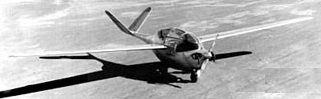
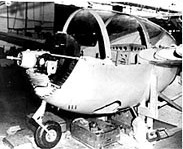
In 1974, Rohr Chairman Burt Raynes resolved to move Rohr into the light airplane market by summoning Walt Mooney as designer and project manager to come up with a quantum leap in light aircraft technology. Mooney selected the best people Rohr had, including key players Bill Chana, Bob Fronius, Mike Voydisch, and Don Westergren, and built three airframes; two flying prototypes and a static tester, plus 1/10- and 1/2-scale models for feasibility tests.

Fiberglass-reinforced plastic honeycomb construction. Sparless folding wings and vertical tail for storage in an average one-car garage. Goodrich Aerostructures Group was a contract manufacturer of engine cowlings and pylons.

A shortage of funds precluded further development. By the time the project ended (for reasons having nothing to do with the merits of the airplane), one prototype had accumulated 23 hours in the air.

Engine: 150hp Lycoming special high-rpm (4400rpm)
Prop: four-blade ducted-fan pusher prop plus a six-blade stator
Wingspan: 30’0″
Length: 28’0″
Gross weight: 1450 lb
Seats: 2