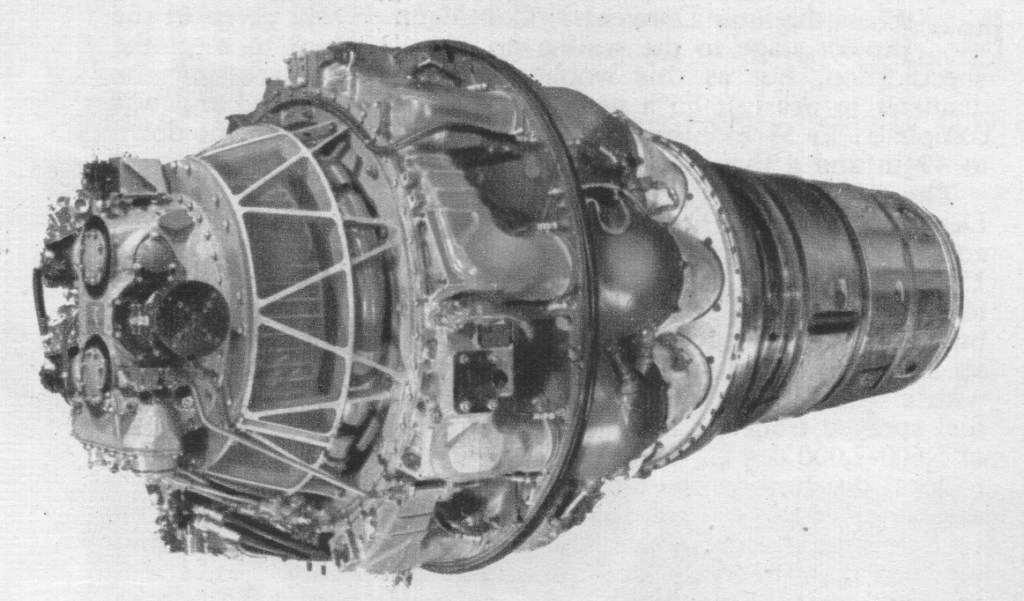
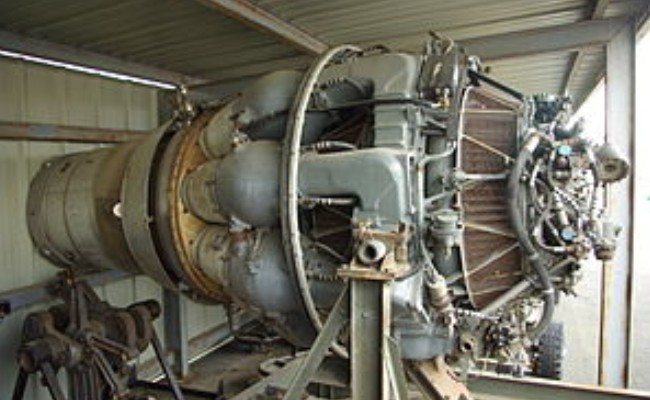
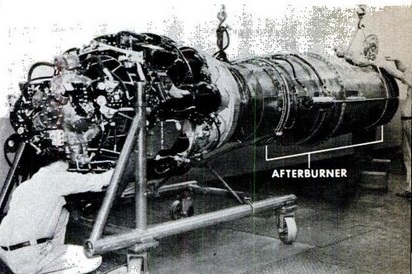
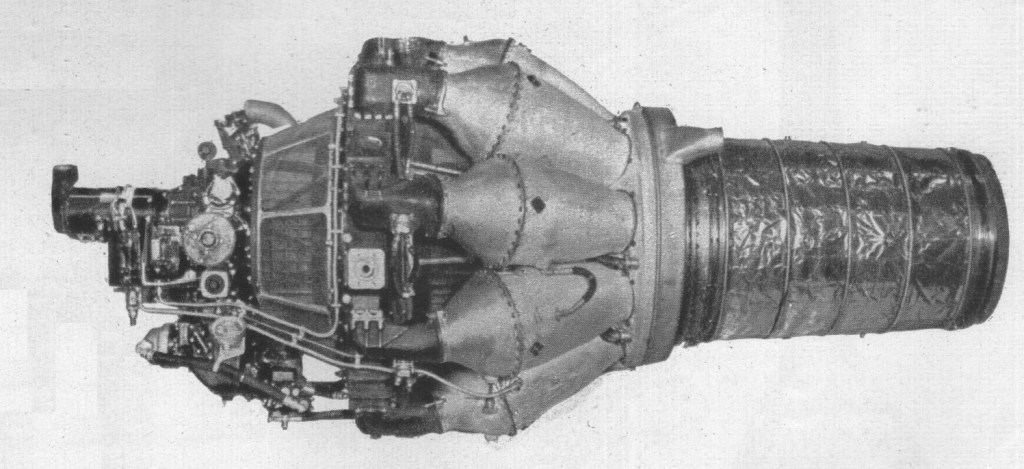
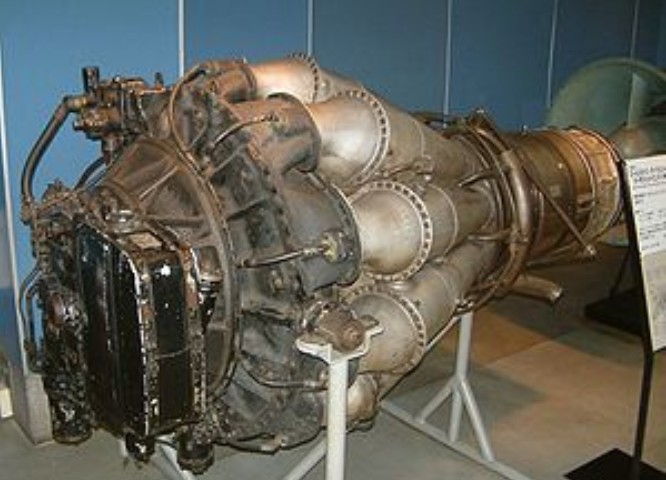
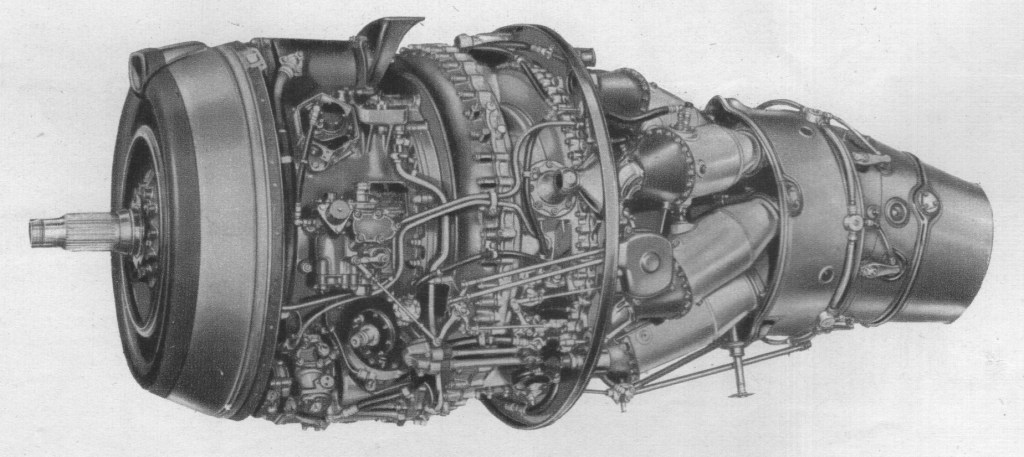
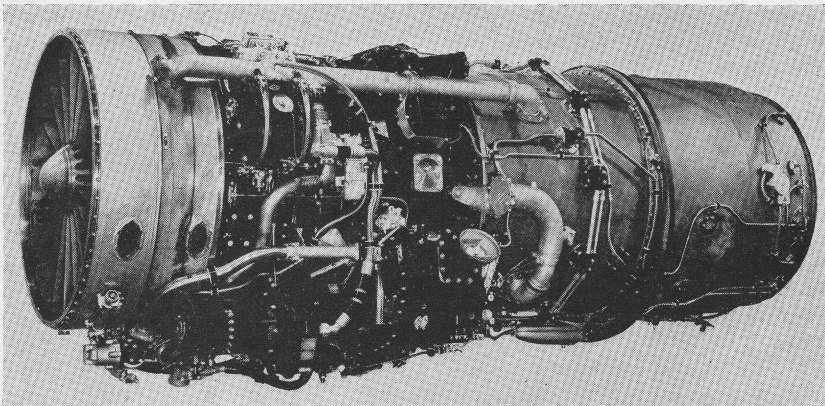
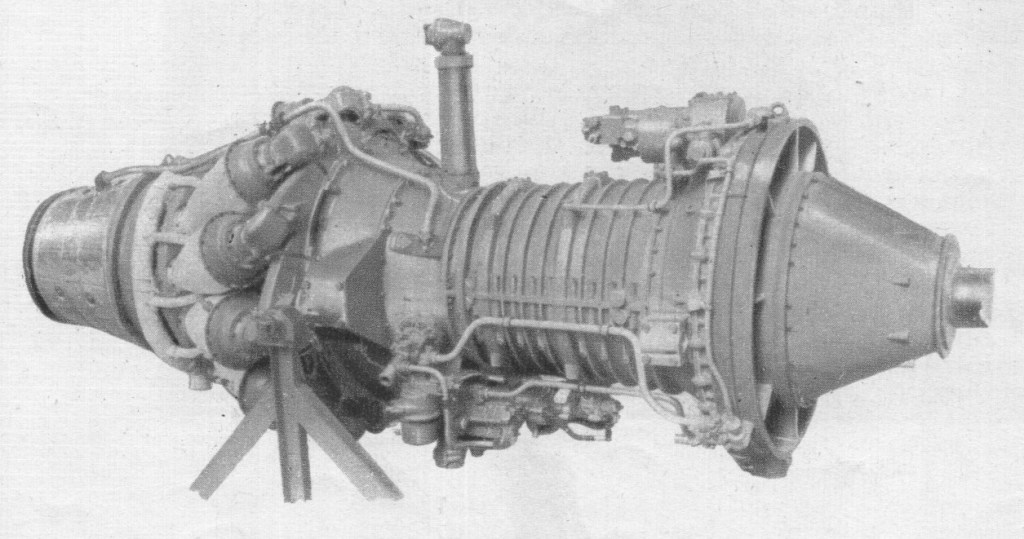
The Rolls-Royce/MAN Turbo RB.193 was a vectored thrust turbofan engine joint development project by Rolls-Royce/MAN Turbo originally designed to meet a requirement for the VFW VAK 191B project. Design work commenced after a contract from the Federal German Ministry of Defence was signed in December 1965. Bristol Siddeley (from 1966 part of Rolls-Royce) were sub-contracted to manufacture components for the engine.
The design was similar in concept and closely related to the earlier Bristol Siddeley Pegasus, employing the same layout of ‘hot’ and ‘cold’ pairs of rotating thrust nozzles, internal airflow was the same as the Spey. Tethered flight testing of the VFW VAK 191B commenced in 1966 with the first free hovering flight taking place at Bremen in October 1971. The aircraft later successfully transitioned from hovering to forward flight at Manching in October 1972. Production did not follow after cancellation of the associated aircraft project. By the end of the test programme in 1975 the RB.193 had accumulated 12 hours of flight time and 91 flights and cost £8,000,000 (1966).
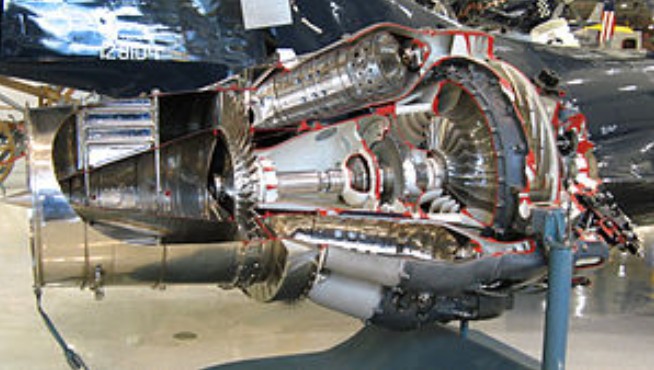
A VFW VAK 191B aircraft fitted with an RB.193-12 is on display at the Deutsches Museum Flugwerft Schleissheim, panels have been removed to allow viewing of the rotating nozzle and mechanisms.
Specifications:
RB.193-12 Type: High bypass twin-spool turbofan Diameter: 33 in Dry weight: 1,742 lb (790 kg) Compressor: Axial compressor, 3-stage fan, 2-stage LP, counter-rotating 6-stage HP Turbine: 3-stage LP, Single-stage air cooled HP Maximum thrust: 10,163 lb (4,610 kg)
The Rolls-Royce/MAN Turbo RB.153 was a high-performance 6,850 pounds-force (3,110 kgf) dry thrust turbofan engine developed jointly by Rolls-Royce Limited and MAN Turbo. Developed for the German EWR VJ 101D interceptor with a German-developed thrust-deflector system and first run in January 1963. The engine was also proposed for a number of other military VTOL projects including the Hawker P.1157. A commercial-version of the engine was also considered for the Messerschmitt Me P.160 airliner. The VJ101D project was cancelled and the engine never flew, being retained as a test bed.
The Tay was developed in the first instance by Rolls-Royce from the basic Nene design. Two units of the type were test-flown in a special Vickers Viscount. It has been further improved by the Pratt and Whitney and HispanoSuiza concerns, which, respectively, hold the American and French licences.
By 1948, Rolls-Royce had designed the Tay turbojet, also a centrifugal-flow design. However, as Rolls-Royce was then developing an improved design with an axial compressor, which would become the Avon, the development and production of the Tay turbojet was left to Pratt & Whitney. However, Rolls-Royce retained the rights to the Tay outside of the United States.
A total of 4,108 were built.
The Tay/J48 was a thirty percent enlargement of the preceding Nene/J42, and was produced both with and without afterburning.
Pratt & Whitney J48
Hispano-Suiza Tays have been installed in Dassault Mystere II, III and IV fighters, and the Tay 250 is for the Mystere IVA. A development of the Tay by the French company is called the Verdon (following the “River” nomenclature) and has a modified compressor with new guide-vanes, revised flame-tubes and combustion chambers, and new turbine-blades and disc. A special afterburner has been developed for this engine, which is to replace the Tay in the Mystere IVA.
Hispano-Suiza Verdon
The new J48 in 1950 powering the North American YF-93A developed 6250 lb thrust, with another 1750 lb with afterburner. It was also planned to power the Navy’s new F9F-5 Panther.
1950 J-48
Variants:
RB.44 Tay Rolls-Royce development engines only, no production.
Hispano-Suiza Verdon The Tay built and developed under licence in France.
Pratt & Whitney J48 The Tay built and developed under licience in the United States. J48-P-1: 6,000 lbf (26.7 kN), 8,000 lbf (35.6 kN) thrust with afterburning J48-P-2: 6,250 lbf (27.8 kN), 7,000 lbf (31.1 kN) thrust with water injection J48-P-3: 6,000 lbf (26.7 kN), 8,000 lbf (35.6 kN) thrust with afterburning J48-P-5: 6,350 lbf (28.2 kN), 8,750 lbf (38.9 kN) thrust with afterburning J48-P-6: 6,250 lbf (27.8 kN), 7,000 lbf (31.1 kN) thrust with water injection J48-P-7: 6,350 lbf (28.2 kN), 8,750 lbf (38.9 kN) thrust with afterburning J48-P-8: 7,250 lbf (32.2 kN) thrust J48-P-8A: 7,250 lbf (32.2 kN) thrust
Applications:
Tay Vickers 663 Tay Viscount
Verdon Dassault Mystère IV
J48 Grumman F9F-5 Panther Grumman F9F-6/F9F-8 Cougar Lockheed F-94C Starfire North American YF-93
Specifications:
Hispano-Suiza Verdon 350 Type: Turbojet Length: 103.2 in (2,621 mm) Diameter: 50 in (1,270 mm) Dry weight: 2,061 lb (935 kg) Compressor: Double sided centrifugal compressor Combustors: Nine tubular combustion chambers Turbine: Single-stage turbine Fuel type: AVTUR / JET-A1 / F-34 etc. Oil system: Pressure spray lubricated with scavenging Maximum thrust: 7,710 lbf (34 kN) at 11,000 rpm Overall pressure ratio: 4.9 Specific fuel consumption: 1.1 lb/lb/hr Thrust-to-weight ratio: 3.74
Pratt & Whitney J48-P-8A Type: Turbojet Length: 202 in (513 cm) Diameter: 50 in (127 cm) Dry weight: 2,101 lb (953 kg) Compressor: Centrifugal compressor Maximum thrust: 7,250 lbf (32.2 kN) thrust
Designed to a Ministry of Aircraft Production specification of 1944, calling for a turbojet having a maximum diameter of 55in, and minimum static thrust of 4,000 lb and a weight not exceeding 2,200 lb, the Nene is the “big brother” of the later Derwents. Consideration was given in the early project stage to the scaling-up of a Derwent to meet the specification, but as this would have entailed increasing the diameter to nearly 60in a new design was put in hand and was completed in 5.5 months. In this the diameter was kept down to 49.5in and a thrust of 5,000 lb was attained.
Although based on the “straight-through” version of the basic Whittle-style layout, the Nene used a double-sided centrifugal compressor for improved pressure ratio and thus higher thrust. It was during the design of the Nene that Rolls decided to give their engines numbers as well as names, with the Welland and Derwent keeping their original Rover models, B/23 and B/26. It was later decided that these model numbers looked too much like those for bombers, and “R” was added to the front, the “R” signifying “Rolls” and the original Rover “B” signifying Barnoldswick. The Nene first ran on 27 October 1944.
The design of the nine combustion chambers follows Derwent practice. Each consists of a cast expansion charnber attached to an outer air-casing containing a flame tube. About 15 per cent of the air entering each chamber is directed by perforated baffles and swirl-vanes in the flame tube into the combustion zone around the burner head. In this zone, where the air is turbulent and moving slowly, the primary air flow, together with a small reverse flow round the flame tube, mixes with the fuel sprayed from the burners and burns at a flame temperature of 1,600-2,000 deg C. To prevent distortion of the flame tube due to local overheating caused by flames impinging on the walls, a thin layer of air is admitted round the inside periphery of the tube through a circular “window piece.” The remaining air flows between the flame tube and air casing, and communicates with the combustion zone through rows of holes in the flame tube. This diluting air is consequently expanded and accelerated rearwards, but it also cools the products of combustion to the temperature required at the turbine inlet.
Early airborne tests of the Nene were undertaken in an Avro Lancastrian operated by Rolls-Royce from their Hucknall airfield. The two outboard Rolls-Royce Merlins were replaced by the jet engine. The Nene’s first flight however was in a modified Lockheed XP-80 Shooting Star.
The Nene doubled the thrust of the earlier generation engines, with early versions providing about 5,000 lbf (22.2 kN), but remained generally similar in most ways. This should have suggested that it would be widely used in various designs, but the Gloster Meteor proved so successful with its Derwents that the Air Ministry felt there was no pressing need to improve upon it. Instead a series of much more capable designs using the Rolls-Royce Avon were studied, and the Nene generally languished.
Marks of Nene include the 3, with electric starter motor and two torch-igniter units (this powers the Supermarine Attacker F.1); the Mk 10, which is similar to the Mk 102 later mentioned but has a larger wheelcase of accessories (this is the engine of the Canadair Silver Star); the Mk 101, specially adapted for the Sea Hawk and having a horizontal gear-box drive, Plessey turbo-starter and divided jet-pipe; and the 102, which is interchangeable with the III but has various design changes, including two high-energy igniters. This last powers the Supermarine Attacker F.B.2. Nenes have also been installed in the Gloster E.1/44, an experimental Lockheed Shooting Star and the Dassault Ouragan.
The Nene was used to power the first civil jet aircraft, a modified Vickers Viking, which flew first on 6 April 1948. The design saw relatively little use in British aircraft designs, being passed over in favour of the axial-flow Avon that followed it. Its only widespread use in Great Britain was in the Hawker Sea Hawk and the Supermarine Attacker.
In 1947, at the behest of the United States Navy, Pratt & Whitney entered into an agreement to produce the Rolls-Royce Nene centrifugal-flow turbojet engine under license as the J42 (company designation JT6), for use in the Grumman F9F Panther fighter aircraft. Concerned that the Nene would not have the potential to cope with future weight growth in improved versions of the Panther, Luke Hobbs, vice president of engineering for P&W’s parent company, the United Aircraft Corporation, requested that Rolls-Royce design a more powerful engine based on the Nene, which Pratt & Whitney would also produce. That engine was the Tay.
Twenty-five were given to the Soviet Union as a gesture of goodwill – with reservation to not use for military purposes – with the agreement of Stafford Cripps. The Soviets reneged on the deal, and reverse engineered the Nene to develop the Klimov RD-45, and a larger version, the Klimov VK-1, which soon appeared in various Soviet fighters including Mikoyan-Gurevich MiG-15.
It was briefly made under licence in Australia for use in the RAAF de Havilland Vampire fighters. It was also built by Orenda in Canada for use in 656 Canadair CT-133 Silver Star aircraft.
Applications: Nene Armstrong Whitworth AW.52 Avro Ashton Avro Lancastrian (test-bed) Avro Tudor VIII Boulton Paul P.111 Boulton Paul P.120 Canadair CT-133 Silver Star Dassault Ouragan de Havilland Vampire FMA IAe 33 Pulqui II Handley Page HP.88 Hawker P.1052 Hawker P.1081 Hawker Sea Hawk Nord 2200 Rolls-Royce Thrust Measuring Rig SNCASO SO.4000 SNCASO SO.6000 Triton Sud-Est Grognard Sud-Ouest Bretagne Sud-Ouest Triton Supermarine Attacker Vickers Type 618 Nene-Viking
Pratt & Whitney J42 Grumman F9F Panther
Specifications: Nene Type: Centrifugal compressor turbojet Length: 96.8 in (2,458.7 mm) Diameter: 49.5 in (1,257.3 mm) Dry weight: 1,600 lb (725.7 kg) Compressor: 1-stage double-sided centrifugal compressor Combustors: 9 x can combustion chambers Turbine: Single-stage axial Fuel type: Kerosene (R.D.E.F./F/KER) Oil system: pressure feed, dry sump with scavenge, cooling and filtration, oil grade 70 S.U. secs (13 cs) (D.T.D 44D) at 38 °C (100 °F) Maximum thrust: 5,000 lbf (22.24 kN) at 12,300 rpm at sea level for take=off Specific fuel consumption: 1.06 lb/lbf/hr (108.04 kg/kN/hr) Thrust-to-weight ratio: 3.226 lbf/lb (0.0315 kN/kg) Military, static: 5,000 lbf (22.24 kN) at 12,300 rpm at sea level Max. cruising, static: 4,360 lbf (19.39 kN) at 12,000 rpm at sea level Cruising, static: 3,620 lbf (16.10 kN) at 11,500 rpm at sea level Idling, static: 120 lbf (0.53 kN) at 2,500 rpm at sea level
According to Arthur Rubbra’s memoirs, a de-rated version of the “R” engine, known by the name Griffon at that time, was tested in 1933. This engine, R11, which was never flown, was used for “Moderately Supercharged Buzzard development” (which was not proceeded with until much later), and bore no direct relationship to the volume-produced Griffon of the 1940s.
The Griffon 37.V.12 was originally developed to meet Fleet Air Arm requirements specifically, to give high powers at low altitudes and thus to be suitable for installation in torpedo-bombers. The decision to go ahead with it was taken in December 1939, and it was recognized that the same basic engine should be suitable for installation in existing fighters, then powered with the Merlin.
On 8 November 1939 N E Rowe of the Air Ministry suggested fitting the Griffon in a Spitfire. Three weeks later permission was given to Supermarine to explore the possibilities of adapting the Griffon to the Spitfire; in response Supermarine issued ‘Specification 466’ on 4 December. This decision led to a change in the disposition of the engine accessories to reduce the frontal area of the engine as much as possible. As a result the frontal area of the bare Griffon engine was 7.9 square feet (0.73 m2) compared with 7.5 square feet (0.70 m2) of the Merlin. This redesigned engine first ran on 26 June 1940 and went into production as the Griffon II.
In early-1940, on the orders of Lord Beaverbrook, Minister of Aircraft Production, work on the new engine had been halted temporarily to concentrate on the smaller 27 L (1,650 cu in) Merlin and the 24 cylinder Vulture which had already surpassed the output achieved with the early Griffon.
Relative frontal areas were 7.5 sq ft and 7.9 sq ft. “It would seem well-nigh impossible,” Flight remarked, when describing the Griffon for the first time, “that with such similarity of overall dimensions in two engines of the same basic type the swept volume of one should be 35.9 per cent larger than that of the other. Piston area of the Griffon is 23 per cent greater than that of the Merlin, this having been achieved by increasing the cylinder bore to 6in.”
Though following Merlin lines, the Griffon differed very extensively in detail design. A prominent innovation was the taking of the camshaft and magneto drives from the front; this was decided upon in order to reduce torsional vibration in the camshaft drive. By interpolating a semi-floating coupling between the crankshaft and the driving wheel of the reduction gearing, and, in addition, by taking the cam drives from the airscrew-driving gear, angular variations in crankshaft speed were greatly reduced in their transmission to the camshafts.
A feature of the crank assembly is that the main bearings and big ends are all lubricated from the hollow interior of the shaft.
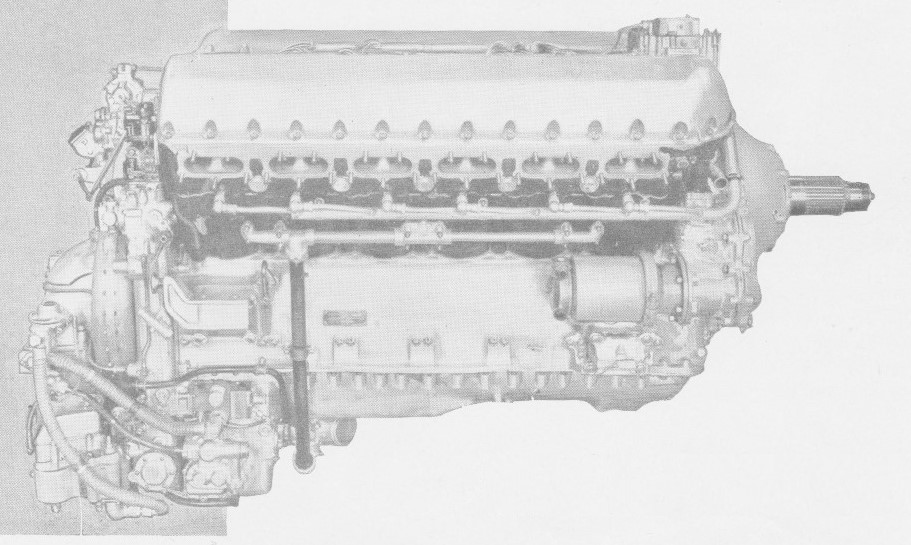
In 1938 the Fleet Air Arm approached Rolls-Royce and asked whether a larger version of the Merlin could be designed. The requirements were that the new engine have good power at low altitude and that it be reliable and easy to service. Work began on the design of the engine soon afterwards. The design process was relatively smooth compared with that of the Merlin, and the first of three prototype Griffon Is first ran in the Experimental Department on 30 November 1939.
Compared with earlier Rolls-Royce designs, the Griffon engine featured several improvements which meant it was physically only slightly larger than the Merlin, in spite of its 36% larger capacity of 37 litres (2,260 cu in). One significant difference was the incorporation of the camshaft and magneto drives into the propeller reduction gears at the front of the engine, rather than using a separate system of gears driven from the back end of the crankshaft; this allowed the overall length of the engine to be reduced as well as making the drive train more reliable and efficient. The Griffon was the first Rolls-Royce production aero engine to use a hollow crankshaft as the means of lubricating the main and big end bearings, providing a more even distribution of oil to each bearing. In another change from convention, one high efficiency B.T.H-manufactured dual magneto was mounted on top of the propeller reduction casing; earlier Rolls-Royce designs using twin magnetos mounted at the rear of the engine.
First run in November 1939, early Griffons-the II, III and IV-had two-speed, single stage blowers, and gave a maximum power of 1,735 h.p. at 16,000 ft and 1,495 h.p. at 14,500 ft. For take-off 1,720 h.p. was available. These engines differed in reduction gear ratio, the II and III being geared 0.451:1, and the 4, 0.510:1. Until superseded by the Griffon XII the series II engine was installed in the Firefly I and II; the Griffon III and IV were mounted in the clipped-wing Spitfire XII specially developed to tackle the Fw 190 at low and medium levels. By increasing boost pressure to 15 lb/sq in the take-off power of the Griffon VI was raised to 1,815 h.p., an increment of importance in that this engine powered the Seafire XV and XVII carrier-borne fighters. The Griffon XII resembled the VI except in supercharger and reduction gear ratios; it delivered 1,645 h.p. at 11,500 ft.
The system of designating the two-stage supercharged Merlins with series numbers beginning with 6 was also adopted for the Griffon range. For a weight increase of 290 lb, accounted for by the new blower system, the Griffon 61 delivered 2,035 h.p. at 7,000 ft and 1,820 h.p. at 21,000 ft; its most famous application was in the Spitfire 21. Identical in all but reduction gear, the Griffon 65 powered the Spitfire XIV, and the Griffon 66 was again similar but had a cabin supercharger for P.R. work in the Spitfire XIX. Griffons 64 and 67 were derived, respectively, from the 61 and 64, and gave no less than 2,375 h.p. at 1,250ft, and 2,145 h.p. at 15,500 ft; the 64 powered the Spitfire 21 and Seafire 46, and the 67 appeared in the Spitfire XIV.
The Griffon 61 series introduced a two stage supercharger and other design changes: the pressure oil pumps were now housed internally within the sump and an effort was made to remove as many external pipes as possible. In addition, the drive for the supercharger was taken from the crankshaft at the back of the engine, via a short torsion shaft, rather than from the front of the engine, using a long drive shaft as used by earlier Griffon variants.
Though early examples of the Vickers-Supermarine Spiteful had the Griffon 61, the production model had the Griffon 69, the maximum power of which exceeded that of the earlier two stage Griffons by some 300 h.p., with no increase in weight. Official maximum powers were 2,375 h.p. at 1,250ft in M.S. gear, and 2,130 h.p. at 15,500 ft in F.S. gear. Boost pressure was plus 25 lb/sq in, made possible by 150 grade fuel.
Griffons 72 and 74 were further developments of the 65 for the Fleet Air Arm; they delivered 2,245 h.p. at 9,250ft. The 74 was distinguished from the 72 in having a Rolls-Royce injection pump instead of the Rolls-Royce Bendix/Stromberg carburettor. These engines were, respectively, the power plants of the prototype Firefly IV and production Fireflies of the same mark.
Basic component overview – Griffon 65
Cylinders Twelve cylinders consisting of high-carbon steel, floating wet liners set in two, two-piece cylinder blocks of cast aluminium alloy having separate heads and skirts. Cylinder liners chromium plated in the bores for 2 1⁄2 inches from the head. Cylinder blocks mounted with an included 60-degree angle onto inclined upper faces of a two-piece crankcase. Cylinder heads fitted with cast-iron inlet valve guides, phosphor bronze exhaust valve guides, and renewable “Silchrome” steel-alloy valve seats. Two diametrically opposed spark plugs protrude into each combustion chamber. Pistons Machined from “R.R.59” alloy forgings. Fully floating gudgeon pins of hardened nickel-chrome steel. Two compression and one drilled oil-control ring above the gudgeon pin, and another drilled oil-control ring below. Connecting rods H-section machined nickel-steel forgings, each pair consisting of a plain and a forked rod. The forked rod carries a nickel-steel bearing block which accommodates steel-backed lead-bronze-alloy bearing shells. The “small-end” of each rod houses a floating phosphor bronze bush. Crankshaft One-piece, machined from a nitrogen-hardened nickel-chrome molybdenum steel forging. Statically and dynamically balanced. Seven main bearings and six throws. Internal oilway, with feed from both ends, used to distribute lubricants to main and big end bearings. “Floating” front end bearing consisting of an internally toothed annulus bolted to crankshaft, meshing with and incorporating a semi-floating ring, internally splined to a short coupling shaft. Coupling shaft splined at front end to driving wheel of propeller reduction gear. Clockwise rotation when viewed from rear. Crankcase Two aluminium-alloy castings joined together on the horizontal centreline. The upper portion bears the wheelcase, cylinder blocks and part of the housing for the airscrew reduction gear; and carries the crankshaft main bearings (split mild-steel shells lined with lead–bronze alloy). The lower half forms an oil sump and carries the main pressure oil pump, supercharger change-speed operating pump and two scavenge pumps. It also houses the main coolant pump which is driven through the same gear-train as the oil pumps. Wheelcase Aluminium-alloy casting fitted to rear of crankcase. Carries the supercharger; and houses drives to the supercharger, auxiliary gearbox coupling, engine speed indicator, airscrew constant-speed unit, intercooler pump and fuel pump, as well as the oil and coolant pumps in the lower half crankcase. Valve gear Two inlet and two exhaust poppet valves of “K.E.965” austenitic nickel-chrome steel per cylinder. Exhaust valves have sodium-cooled stems. “Brightray” (nickel-chromium) protective coating to the whole of the combustion face and seat of the exhaust valves, and to the seat only of the inlet valves. Each valve is held closed by a pair of concentric coil springs. A single, seven-bearing camshaft, located centrally on the top of each cylinder head operates 24 individual steel rockers; 12 pivoting from a rocker shaft on the inner, intake side of the block to actuate the exhaust valves, the others pivoting from a shaft on the exhaust side of the block to actuate the inlet valves.
An innovation of more than usual interest was the adoption, on the Griffon 85, of a drive for contra-rotating airscrews; this engine appeared in the Spitfire XIV, 21 and Seafire 45. The Griffon 87 was a further development, rated at 2,145 h.p. maximum at 15,500 ft, and the 88 differed only in having an injection pump. “Contraprop” Griffons, of the 85, 87 and 88 series, were mounted in the Spitfire XIV and 21, and Seafire 45 and 47.
For the Barracuda V Rolls-Royce developed the Griffon 37, with a modified two-speed, single-stage blower, maintaining 18 lb/sq in boost in either gear. Though the Barracuda was provided with 2,055 h.p. at 2,250 ft, only Merlin powered machines of this type went into squadron service.
The most impressive of all Griffon developments was the three-stage supercharger incorporated in the 101 series, together with Rolls-Royce fuel injection. The new blower made possible an output of over 2,000 h.p. up to 20,000 ft with no increase in dimensions. Weight rose by 40 lb.
Notable among post-war developments is the Griffon 67, for use in long-range Service aircraft and having provision for contra-rotating airscrews. On this engine water/methanol injection is automatically brought into play when the boost pressure for the standard fuel approaches maximum value. The controlling unit works in conjunction with the boost control and progressively increases the flow of water methanol with boost pressures from 18.5 to 25 lb/sq in. Contraprop Griffons power the Avro Shackleton maritime-reconnaissance aircraft. Other variants of the Griffon are serving in the numerous marks of Fairey Firefly.
Unlike the Merlin, the Griffon was designed from the outset to use a single-stage supercharger driven by a two-speed, hydraulically operated gearbox; the production versions, the Griffon II, III, IV, and VI series, were designed to give their maximum power at low altitudes and were mainly used by the Fleet Air Arm. The Griffon 60, 70, and 80 series featured two-stage supercharging and achieved their maximum power at low to medium altitudes. The Griffon 101, 121, and 130 series engines, collectively designated Griffon 3 SML, used a two-stage, three-speed supercharger, adding a set of “Low Supercharger (L.S)” gears to the already existing Medium and Full Supercharger (M.S and F.S) gears. Another modification was to increase the diameters of both impellers, thus increasing the rated altitudes at which maximum power could be generated in each gear.[18] While the 101 continued to drive a five-blade propeller, the 121 and 130 series were designed to drive contra-rotating propellers. In 1946 a Griffon 101 was fitted to the Supermarine Spiteful XVI, RB518 (a re-engined production Mk.XIV); this aircraft achieved a maximum speed of 494 mph (795 km/h) with full military equipment.
The Griffon was the last in the line of V-12 aero engines to be produced by Rolls-Royce with production of the aero version ceasing in December 1955 after 8,108 were built, the Griffon 130 being the last in the series. Griffon engines remained in Royal Air Force service with the Battle of Britain Memorial Flight and power the last remaining airworthy Avro Shackleton.
A marine version, the Sea Griffon, continued to be produced for the RAF’s High Speed Launches.
Several North American Mustangs raced in the Unlimited Class races at the Reno Air Races have been fitted with Griffons. These include the RB51 Red Baron (NL7715C), “Precious Metal” (N6WJ) and a Mustang/Learjet hybrid “Miss Ashley II” (N57LR).[33] In all cases, Griffons with contra-rotating propellers, taken from Avro Shackleton patrol bombers were used in these aircraft. The RB51 Red Baron is noteworthy for holding the FAI piston-engine 3-kilometer world speed record from 1979 to 1989.
In 1965, SFR Yugoslavia used Griffon engines as the main power unit for their first domestically produced self-propelled artillery system, the S65, but the system was withdrawn from service in the early 1980s, because of poor fuel economy.
The 1980 Miss Budweiser Unlimited Hydroplane dominated the race circuit with a Rolls-Royce Griffon engine. It was the last of the competitive piston-engined boats, before turboshaft powerplants took over.
In modern day tractor pulling, Griffon engines are also in use, a single or double, rated each at 3,500 hp (2,600 kW).
Type: 12-cylinder supercharged liquid-cooled 60° Vee aircraft piston engine Bore: 6 in (152.5 mm) Stroke: 6.6 in (167.6 mm) Displacement: 2,240 cu.in (36.7 L) Length: 81 in (2,057 mm) Width: 30.3 in (770 mm) Height: 46 in (1,168 mm) Dry weight: 1,980 lb (900 kg) Valvetrain: Two intake and two exhaust valves per cylinder with sodium-cooled exhaust valve stems, actuated via an overhead camshaft. Supercharger: Two-speed, two-stage centrifugal type supercharger, boost pressure automatically linked to the throttle, water-air intercooler installed between the second stage and the engine. Fuel system: Triple-choke Bendix-Stromberg updraught, pressure-injection carburettor with automatic mixture control Fuel type: 100 Octane (150 Octane January to May 1945) Oil system: Dry sump with one pressure pump and two scavenge pumps Cooling system: 70% water and 30% ethylene glycol coolant mixture, pressurised. Liquid-cooled Intercooler radiator with its own separate system, again using 70/30% water/glycol mix. Reduction gear: 0.51:1, left-hand tractor Power output: 2,035 hp (1,520 kW) at 7,000 ft (2,135 m MS gear), +18 psi boost pressure at 2,750 rpm 2,220 hp (1,655 kW) at 11,000 ft (2,135 m MS gear), +21 psi at 2,750 r.p.m using 150 Octane fuel 1,820 hp (1,360 kW) at 21,000 ft (6,400 m) at 2,750 rpm Specific power: 0.91 hp/cu.in (41.4 kW/L) Compression ratio: 6:1 Power-to-weight ratio: 1.03 hp/lb (1.69 kW/kg)
Variants:
Griffon IIB 1,730 hp (1,290 kW) at 750 ft (230 m) 1,490 hp (1,110 kW) at 14,000 ft (4,270 m) Single-stage two-speed supercharger Impeller diameter 10 in (25.4 cm) Gear ratios 7.85:1, 10.68:1. Used on Firefly Mk.I and Spitfire XII.
Griffon VI Increased maximum boost pressure 1,850 hp (1,380 kW) at 2,000 ft (610 m) Impeller diameter 9.75 in (24.7 cm) Used on Seafire Mk.XV and Mk. XVII, Spitfire XII.
Griffon 57 and 57A 1,960 hp (1,460 kW) 2,345 hp (1,749 kW) with water-methanol injection on take-off Used on Avro Shackleton.
Griffon 58
Griffon 61 Introduced a two-speed two-stage supercharger with aftercooler similar to that on Merlin 61 2,035 hp (1,520 kW) at 7,000 ft (2,100 m) 1,820 hp (1,360 kW) at 21,000 ft (6,400 m) Used on Spitfire F.Mk.XIV, Mk.21.
Griffon 65 Similar to Griffon 61 with different propeller reduction gear Impeller diameters 1st stage: 13.4 in (34 cm), 2nd stage: 11.3 in (29 cm) Used on Spitfire F.Mk.XIV.
Griffon 72 Increased maximum boost pressure to take advantage of 150-grade fuel 2,245 hp (1,675 kW) at 9,250 ft (2,820 m)
Griffon 74 Fuel-injected version of Griffon 72; used on Firefly Mk.IV
Griffon 83 Modified to drive contra-rotating propellers 2,340 hp (1,745 kW) at 750 ft (230 m) 2,100 hp (1,565 kW) at 12,250 ft (3,740 m)
Griffon 85 2,375 hp (1,770 kW) Used on Spiteful Mk.XIV
Griffon 89 2,350 hp (1,755 kW) Used on Spiteful Mk.XV
Griffon 101 2,420 hp (1,805 kW) Two-stage, three-speed supercharger using Low Supercharger (L.S), Moderate Supercharger (M.S), or Full Supercharger (F.S) Reduction gear ratio 4.45 Rolls-Royce fuel injection system Used on Spiteful Mk.XVI
Griffon 130 2,420 hp (1,805 kW) at 5,000 ft (1,524 m) in L.S gear 2,250 hp (1,678 kW) at 14,500 ft (4,419 m) M.S 2,050 hp (1,529 kW) at 21,000 ft (6,400 m) F.S Reduction gear ratio 4.44 Modified to drive contra-rotating propellers Rolls-Royce fuel injection system
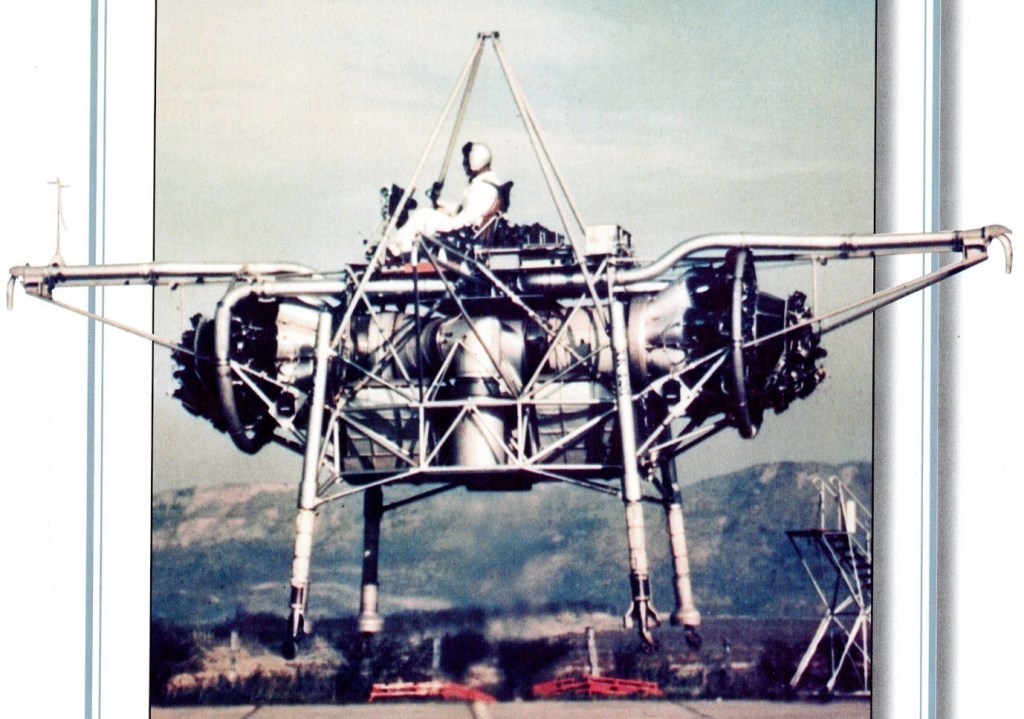
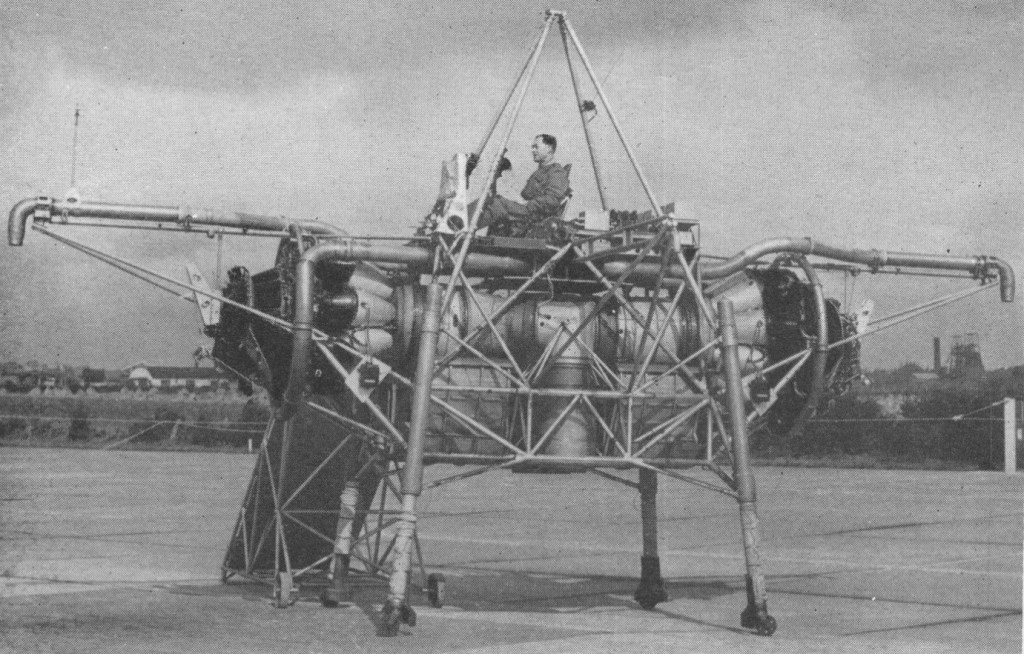
The Bedstead, officially called a Thrust Measuring Rig (TMR), was the brainchild of Doctor A.A.Griffith of Rolls Royce. It was a flat riser which hovered on the deflected exhaust gases of two Rolls Royce Nene jet engines. Compressed air nozzles provided directional control. The data gathered during the Bedsteads’ test programme in the mid 1950s led to the development of a special turbojet engine for jet lift, the RB108.
This was a radically new approach towards the development of vertical take off aircraft. Basically it consists of a tubular frame, said to measure about 20 ft. across, on which are mounted two Nene engines having a common, downward facing tail pipe. Space is also provided for fuel tankage and the pilot is seated in the normal attitude on the top.
The weight amounts to some 3.5 tons, and is a little less than the total maximum thrust from the 5,000 lb. thrust Nenes. The two engines are mounted horizontally, facing away from each other, the exhaust gases being turned through 90 degrees to enter a common downward directed tail pipe. The thrust so obtained provides for direct vertical jet lift of the rig.
Control in the pitch, roll and yaw planes is obtained by means of air jets bled from the Nene compressors. No aerodynamic control surfaces are used.
Capt. R.T. Shepherd, who was Rolls Royce’s chief test pilot until 1951, made the first fully free flight trials on August 3, 1954. During the previous 12 months or so, the ” jet lifter ” had undergone tethered flights, the amount of tethering being progressively relaxed as more experience was gained. The rig has since also been flown by Mr. H. Bailey, the company’s chief test pilot, and Sqn. Ldr. Harvey, of the R.A.E.
Flights have been made involving hovering and sideways and vertical movement. Landing is said to be very light and incurs no sudden drop. As with a helicopter, horizontal motion is produced by tilting the lift component, in this case from the propulsive jet, and a horizontal as well as a vertical thrust is obtained in this way.
Its pilot sat on a control station atop an entirely open-air framework of tubing, a calliope of ‘puff-pipes’ for attitude control arranged all around him. It was nicknamed the ‘Flying Bedstead’. NASA were interested in its reaction control system for their lunar lander simulator.
When Rover was selected for production of Whittle’s designs in 1941 they set up their main jet factory at Barnoldswick, staffed primarily by various Power Jets personnel. Rover felt their own engineers were better at everything, and also set up a parallel effort at Waterloo Mill, Clitheroe. Here Adrian Lombard developed the W.2 into a production quality design, angering Whittle who was left out of the team. Lombard went on to become the Chief Engineer of the Aero Engine Division of Rolls-Royce for years to come.
After a short period Lombard decided to dispense with Whittle’s “reverse flow” design, and instead lay out the engine in a “straight-through” flow with the hot gas exiting directly onto the turbine instead of being piped forward as in Whittle’s version. This layout made the engine somewhat longer and required a redesign of the nacelles on the Meteor, but also made the gas flow simpler and thereby improved reliability. While work at Barnoldswick continued on what was now known as the W.2B/23, Lombard’s new design became the W.2B/26 centrifugal compressor turbojet engine.
By 1941 it was obvious to all that the arrangement was not working; Whittle was constantly frustrated by what he was seeing as Rover’s inability to deliver production-quality parts for a test engine, and became increasingly vocal about his complaints. Likewise Rover was losing interest in the project after the delays and constant harassment from Power Jets in the critical testing process stage, where testing new designs and materials to breaking point is vital. Earlier, in 1940, Stanley Hooker of Rolls-Royce had met with Whittle, and later introduced him to Rolls’ CEO, Ernest Hives. Rolls had a fully developed supercharger division, directed by Hooker, which was naturally suited to jet engine work. Hives agreed to supply key parts to help the project along. Eventually Spencer Wilks of Rover met with Hives and Hooker, and decided to trade the jet factory at Barnoldswick for Rolls’ Meteor tank engine factory in Nottingham. A handshake sealed the deal, turning Rolls-Royce into the powerhouse it remains to this day. Subsequent Rolls-Royce jet engines would be designated in an “RB” series, standing for Rolls Barnoldswick, the /26 Derwent becoming the RB.26.
Problems were soon ironed out, and the original /23 design was ready for flight by late 1943. This gave the team some breathing room, so they redesigned the /26’s inlets for increased air flow, and thus thrust. Adding improved fuel and oil systems, the newly named Derwent Mk.I entered production, the second Rolls-Royce jet engine to enter production, with 2,000 lbf (8.9 kN) of thrust. Mk.II, III and IV’s followed, peaking at 2,400 lbf (10.7 kN) of thrust. The Derwent was the primary engine of all the early Meteors with the exception of the small number of Welland-equipped models which were quickly removed from service. The Mk.II was also modified with an extra turbine stage driving a gearbox and, eventually, a five-bladed propeller, forming the first production turboprop engine, the Rolls-Royce RB.50 Trent.
The project was to be of the same maximum diameter, in order that it might be installed in standard Meteor nacelles, but it was to develop 2,000 lb thrust. Drawings were started in April 1943 and by July the new unit was ready for test. In November of that year it passed its 100-hr type-test at the full 2,000 lb rating and in April the following year it went through its first flight tests in a Meteor, with a Service rating of 1,800 lb and a weight of 920 lb.
The Derwent II gave a thrust of 2,200 lb, and the III was a special unit to provide suction for boundary-layer removal; the Derwent IV was rated at 2,400 lb thrust. The Derwent 5 was an entirely new engine-still of 43in diameter, but developing twice the thrust of the original Derwent I. It was, in effect, a scaled-down version of the Nene, and its development was motivated by the promise shown by the Nene and the knowledge that the Meteor could utilize thrust greatly in excess of the original estimates.
The basic Derwent design was also used to produce a larger 5,000 lbf (22.2 kN) thrust engine known as the Rolls-Royce Nene. Development of the Nene continued in a scaled-down version specifically for use on the Meteor, and to avoid the stigma of the earlier design, this was named the Derwent Mk.V. Several Derwents and Nenes were sold to the Soviet Union by the then Labour government, causing a major political row, as it was the most powerful production-turbojet in the world at the time. The Soviets promptly reverse engineered the Derwent V and produced their own unlicensed version, the Klimov RD-500. The Nene was reverse-engineered to form the populsion unit for the famous MiG-15 jet fighter. The Derwent Mk.V was also used on the Canadian Avro Jetliner, but this was never put into production.
On 7 November 1945, a Meteor powered by the Derwent V set a world air speed record of 606 mph (975 km/h) TAS.
An unusual application of the Derwent V was to propel the former paddle steamer Lucy Ashton. The 1888 ship had her steam machinery removed and replaced by four Derwents in 1950–1951. The purpose of this was to conduct research on the friction and drag produced by a ship hull in real life conditions. Jets were preferable to marine propellers or paddles as these would have created a disturbance in the water, and the force exerted by them was harder to measure. The four engines could propel the Lucy Ashton at a speed in excess of 15 knots (28 km/h; 17 mph).
The Derwent 5 was superseded by the Derwent 8 and 9. The 8 incorporated two outlets to feed compressor-air through piping to heater muffs on the exhaust unit; tappings were taken from these muffs to heat the cabin and the guns and/or camera. The 9 used the same method of heating, but had in addition larger combustion chamber-inter-connectors and high-energy ignition to give more consistent relighting in flight as well as to increase the altitude at which relighting was possible.
Experimental Derwents included the RD.9, which had a 15 per cent increase in mass flow, and the RD.10-a scaled-up version utilizing the rotating parts of the Nene. The RD.11 was another scaled-up development.
The body of a typical Derwent is built up on the compressor rear casing which, though immensely strong, is very light and is considered by Rolls-Royce to be a fine example of their foundry technique. On the front face are the diffuser ring, the front casing and front air intake, and the wheelcase. To the rear the main structure comprises the rear air intake, the cooling-air casing and the centre and’rear bearing-housings, which successively lead to the nozzle-box assembly. This last takes the gas flow from the combustion chambers and distributes it to the annulus of stationary nozzle-guide vanes; it also carries the auxiliary coolingair ducts leading from the region of the turbine disc and rear bearing housing.
Centrally runs the main rotating assembly, and disposed round the engine, between the compressor casing outlet elbows and the nozzle-box, are the nine combustion chambers. So carefully balanced is the rotating assembly that as much as a minute and a half elapses before it comes to rest after the engine is shut down, At maximum static thrust the characteristic double-sided impeller deals with 62 lb of air per second, with an efficiency of 80 per cent and a compression ratio of 4 : 1. For this task it needs about 8,000 h.p., which is transmitted from the turbine through the coupling. The impeller is 24in in diameter and has 29 vanes on each side. Guide vanes convert axial to radial flow.
Variants: Derwent I – first production version. Straight-thru development of the trombone style W.2 configuration, with compressor and turbine upflowed by 25% to give 2000lbf (8.9 kN) static thrust Derwent II – thrust increased to 2,200 lbf (9.8 kN) Derwent III – experimental variant providing vacuum for wing boundary layer control Derwent IV – thrust increased to 2,400 lbf (10.7 kN) Derwent 5 – scaled-down version of the Rolls-Royce Nene developing 3,500 lbf (15.6 kN) of thrust Derwent 8 – developed version giving 3,600 lbf (16.0 kN) of thrust
This turboprop achieved renown as the power unit of the Vickers Viscount, it has also been flown on a limited scale in the Avro Athena and Boulton Paul Balliol advanced trainers.
The Dart is characterized by a two-stage centrifugal compressor, handling about 20 lb of air per second, and a two-stage turbine. Steel guide vanes direct the air between the 19 rotor blades, from which it is impelled at high speed. After passing through a diffuser the flow is directed through curved passages, formed by the compressor casings and inter-stage guide vanes, into the second rotor.
The two stages of the turbine are locked together on a common shaft and the blades of the high and low pressure, stages have “fir tree” roots. Both discs are cooled on their front and rear faces, and a steel-strip seal prevents gas leakage between the stages. There are seven combustion chambers.
Dart final checks at Derby
Under tropical conditions lost take-off power is restored by water/methanol injection.
The Dart RDa.6 was in production for Viscounts, and has a new reduction gear and other refinements, making possible a maximum rating of 1,500 h.p. The RDa.5 was completely new, and designed for even greater powers. It is scheduled to power the Viscount 800 Series.
Dart 505 Diameter, 37.9in Length, 95.1in Dry weight, 1,030 lb Max. power, 1,400 s.h.p. plus 365 lb thrust Equivalent shaft horsepower, 1,515 at 14,500 r.p.m Specific fuel consumption, 0.83 lb/hr/e.s.h.p.
In early jet engines the exhaust was much faster and hotter than it had to be (contrary to the ideal Froude efficiency) for efficient thrust; capturing some of that energy would improve the fuel economy of the engine. The turboprop is an obvious example, which uses a series of additional turbine stages to capture this energy to power a propeller. However there is a tradeoff in propeller efficiency compared to forward speed, so while the turboprops are efficient engines, they are only efficient at speeds of up to 500 mph (800 km/h; 430 kn). This meant there was a sweet spot between the high efficiencies of the turboprop at low speeds and the jet at high speeds that was not being directly addressed. This spot, between about 450 mph (720 km/h; 390 kn) and 700 mph (1,100 km/h; 610 kn), was precisely where the vast majority of commercial jet aircraft spent most of their time.
The basic concept of bypass had been studied from the earliest days of jet engine design. Alan Arnold Griffith had proposed a number of different bypass engine designs as early as the 1930s while he and Hayne Constant were trying to get their axial-flow jet engines working at the Royal Aircraft Establishment. Frank Whittle’s Power Jets also studied a number of bypass configurations. However, the need to get jet engines into service during the war meant this work had to be put aside in favour of simpler designs with shorter introduction times. The ending of the war changed priorities dramatically, and by 1946 Rolls-Royce agreed that existing engines like the Rolls-Royce Avon were advanced enough that it was time to start work on new concepts like bypass.
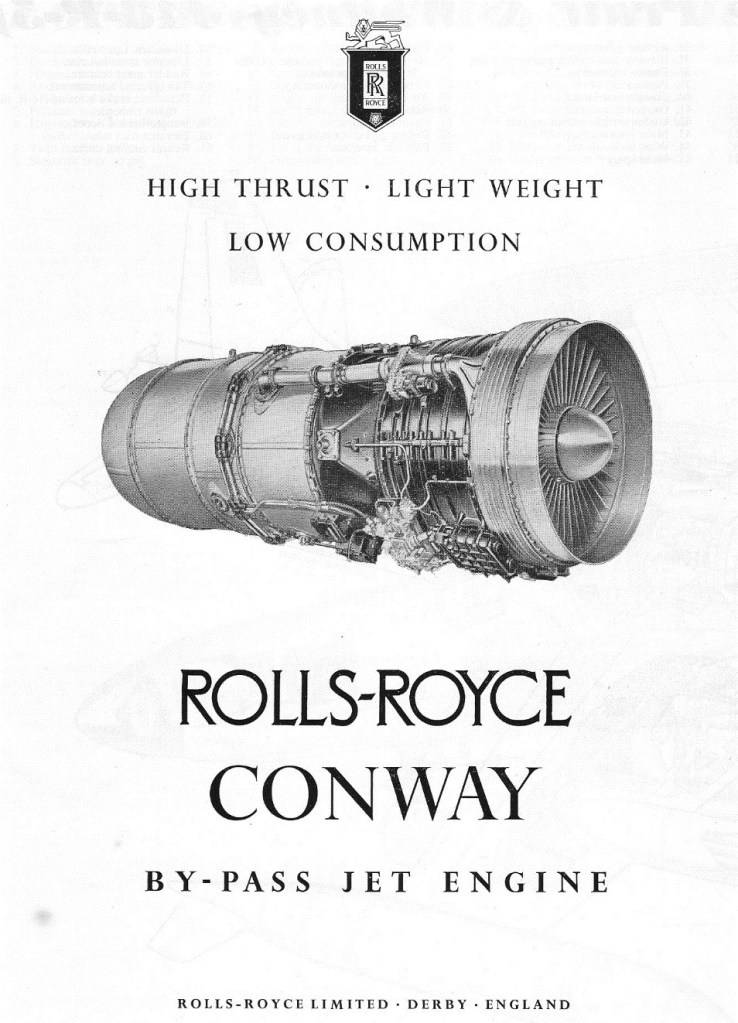
Griffith suggested building a purely experimental design using parts of the Avon and another experimental jet engine, the AJ.25 Tweed. In April 1947 a 5,000-pound-force (22,000 N) design was proposed, but over the next few months it was modified to evolve into a larger 9,250-pound-force (41,100 N) design in response to a need for a new engine to power the Mk.2 low-level version of the Vickers Valiant bomber. A go-ahead to start construction of this larger design was given in October, under the RB.80 name. The Rolls-Royce RB.80 Conway was the first by-pass engine (or turbofan) in the world to enter service. The name “Conway” is an Anglo-Saxon permutation of River Conwy, in Wales, in keeping with Rolls’ use of river names for jet engines.
During development it was decided to further improve the basic design by adding another feature then becoming common, a “two spool” compressor arrangement. Earlier engines generally consisted of a series of compressor stages connected via a shaft to one or more turbine stages, with the burners between them arranged around the shaft. Although this arrangement is mechanically simple, it has the disadvantage of lowering the efficiency of the compressor. Compressor stages run at their maximum efficiency when spinning at a specific speed for any given input air pressure – in a perfect compressor each stage would run at a separate speed. The multi-spool design, first used on the Bristol Olympus turbojet, is a compromise, the compressor is separated into “spools” designed to operate closer to most efficient speed, driven by separate turbines via concentric shafts. Two and three-spool designs are common, beyond that the mechanical complexity is too great.
The new version had a four stage low-pressure compressor driven by a two-stage turbine, and an eight stage high-pressure compressor driven by another two-stage turbine. Now known by the Ministry of Supply designation as the RCo.2, design work was completed in January 1950 and the first example ran for the first time in July 1952 at 10,000 pounds-force (44,000 N) thrust. By this time the low-level Valiant Pathfinder had been abandoned, and so the first example was also destined to be the last. Nevertheless it proved the basic concept sound, and “ran perfectly for the whole of its 133 hours life.”
Conway RC012
The work on the RCo.2 was soon put to good use. In October 1952 the Royal Air Force awarded a contract for the Vickers V-1000, a large jet-powered strategic transport that was intended to allow the V bomber force to be supported in the field through air supply only. Vickers also planned on developing a passenger version of the same basic design as the VC-7. The V-1000 design looked like an enlarged de Havilland Comet, but from the Valiant it took the wing layout and added a compound sweep (a passing vogue in UK design). It also featured the Comet’s wing-embedded engines, demanding an engine with a small cross-section, which limited the amount of bypass the engine could use. It nevertheless required higher power to support a 230,000 pounds (100,000 kg) gross weight, so Rolls responded with the larger RCo.5.
The new engine was similar to the RCo.2 in most ways, differing in details. The low-pressure compressor now had six stages, and the high-pressure nine, driven by two and one stage turbines respectively. The first RCo.5 ran in July 1953, and passed an official type rating in August 1955 at 13,000 pounds-force (58,000 N). Construction of the prototype V-1000 was well underway at Vickers Armstrongs’ Wisley works in the summer of 1955 when the entire project was cancelled. Having second thoughts about the concept of basing the V-bombers away from the UK, the need for the V-1000 became questionable and it became an easy decision to drop the project.
The Conway was saved once again when it was selected to power the Handley Page Victor B.2 variant, replacing the Armstrong Siddeley Sapphire of earlier models. For this role Rolls designed an even larger model, the RCo.8 of 14,500 pounds-force (64,000 N), which ran for the first time in January 1956. However the RCo.8 was skipped over after receiving a request from Trans-Canada Airlines (TCA) to explore a Conway powered Boeing 707 or Douglas DC-8, having interested both companies in the idea. Rolls responded by designing an even larger model of the Conway, the 16,500 pounds-force (73,000 N) RCo.10, and offering the similar military-rated RCo.11 for the Victor. The new engine differed from the RCo.8 in having a new “zeroth stage” at the front of the low-pressure compressor, further increasing cold airflow around the engine. The RCo.10 first flew in an Avro Vulcan on 9 August 1957, followed by the RCo.11 in the Victor on 20 February 1959.
1956
Boeing had calculated that the Conway, even though it had limited bypass in keeping with its original in-wing mounting, would increase the range of the 707-420 by 8% compared to the otherwise identical 707-320 powered by the non-bypass Pratt & Whitney JT4A (J75). In May 1956 TCA ordered Conway-powered DC-8s, followed by additional orders from Alitalia and Canadian Pacific Air Lines, while the Conway powered 707 was ordered by BOAC, Lufthansa, Varig and Air India. RCo.10’s development was so smooth that after delivering a small number for testing, further deliveries switched to the 17,150-pound-force (76,300 N) RCo.12, which was designed, built and tested before the airframes had finished their testing. These models also featured a distinctive scalloped silencer, and a thrust reverser that could provide up to 50% reverse thrust.
The RCo.12 Conway was an axial-flow turbofan with a low bypass ratio of about 25%. It had a seven-stage low-pressure compressor, the first six stages made of aluminium and the last of titanium. Behind this was the nine-stage high-pressure compressor, the first seven stages of titanium and the last two of steel. The bypass housing duct was also made of titanium. The combustion area consisted of ten cannular flame cans. The high-pressure compressor was driven by a single-stage turbine using hollow air-cooled blades, which was followed by the two-stage turbine powering the low-pressure compressor. Accessories were arranged around the front of the engine, leading to a minimum of increased diameter. The engine produced 17,150 pounds-force (76,300 N) for takeoff, weighed 4,500 pounds (2,000 kg) and had a specific fuel consumption of 0.712 at take-off thrust and 0.87 for cruise.
Although successful in this role, only sixty-nine 707’s and DC-8s were built with the Conway, due largely to the delivery of the first US-built bypass engines, particularly the Pratt & Whitney JT3D. Nevertheless the Conway was successful on these designs, and was the first commercial aero engine to be awarded clearance to operate for periods up to 10,000 hours between major overhaul.
Rolls continued working on the Conway, delivering the RCo.15. This was similar to the earlier RCo.12, but had a larger zeroth-stage along with a larger engine housing to fit it. This improved cruise fuel consumption by 3% while at the same time increasing take-off thrust to 18,500 pounds-force (82,000 N). The designs were otherwise similar, and RCo.12’s could be re-built into RCo.15’s during overhauls.
The final development of the Conway series was the RCo.42, designed specifically for the Vickers VC10. As the need for wing-embedded engines was long abandoned by this point, Rolls dramatically increased the zeroth-stage diameter to increase the bypass from about 25% to 60%, and further increasing thrust to 20,250 pounds-force (90,100 N). First run in March 1961, it would be the most successful of all the Conways, powering all of the VC10 fleet, later models with the RCo.43.
By 1968 a Hyfil carbon-fibre fan assembly was in service on Conways of the VC10s operated by BOAC.
The RB.39 Clyde was Rolls-Royce’s first purpose-designed turboprop engine, first run on 5 August 1945.
The Clyde used a two-spool design, with an axial compressor for the low-pressure section, and a single-sided centrifugal compressor as the high-pressure stage, running on concentric shafts. It had a nine-stage axial compressor and a single-stage centrifugal compressor, in addition to two turbines. The forward (high-pressure) turbine drove the centrifugal blower, and the rear (low-pressure) turbine the axial compressor and contra-rotating airscrews.
The Clyde was the first turboprop to pass its full civil and military type-tests. Its first tests were run at 2,500 s.h.p. and this was later increased to 3,020 s.h.p. Subsequent ratings were 3,500 e.h.p., 4,200 s.h.p. and 4,500 e.h.p.; these last proved that the reduction gear was capable of standing greatly increased overloads.
The Clyde was a long engine with the axial LP compressor in front of what was, in effect, a scaled down Derwent engine. Accessories were grouped around the axial compressor which conveniently narrowed towards the rear. Cooling for turbines and turbine bearings came from a small diffuser on the main shaft as well as tappings from the axial and centrifugal compressors. Testing of the development engines exceeded expectations with the engine soon being rated at 4,030 eshp. One problem un-earthed during testing was that damaging resonances emanated from the straight-cut spur gears in the reduction gearbox.
The 4,030 eshp versions were selected as the main engine of the Westland Wyvern TF Mk.2 strike aircraft.
Despite the promising performance of the test engines Ernest Hives felt that pure-jets were the future and the Clyde programme was terminated with only 9 built, forcing Westlands to use the less than satisfactory Armstrong Siddeley Python on the production Wyverns.
Clyde Type: Twin-spool turboprop Length: 10.1 ft (3.08 m) Diameter: 3.9 ft (1.19 m) Dry weight: 2,800 lb (1,300 kg) Compressor: LP – 9 stage axial, HP – Single centrifugal stage Combustors: Eleven can-type combustion chambers Turbine: HP – single stage axial, LP – single stage axial Fuel type: Kerosene (jet fuel grade) Oil system: Pressure spray scavenge system Maximum thrust: 1,225 lbf (5.45 kN) Overall pressure ratio: 6:1 Specific fuel consumption: 0.71 lb/hp/hr (0.24 kg/kW/hr) Power-to-weight ratio: 1.43 hp/lb (2.08 kW/kg)