Rotorcraft Ltd

Formed jointly by Mitchell Engineering Group and Servotec Ltd to develop the Grasshopper twin-engined light helicopter designed by Jacob Shapiro. Powered by two Walter Minor engines, this was first flown in 1962. A second example was built, but the type did not enter production.

James Weir became aware of the CR Twin development and in 1965 decided to give this development financial support. This combination of interests was cemented in a take over of Rotorcraft Ltd by the Cierva Autogiro Co, which was thereupon renamed the Cierva Rotorcraft Co.

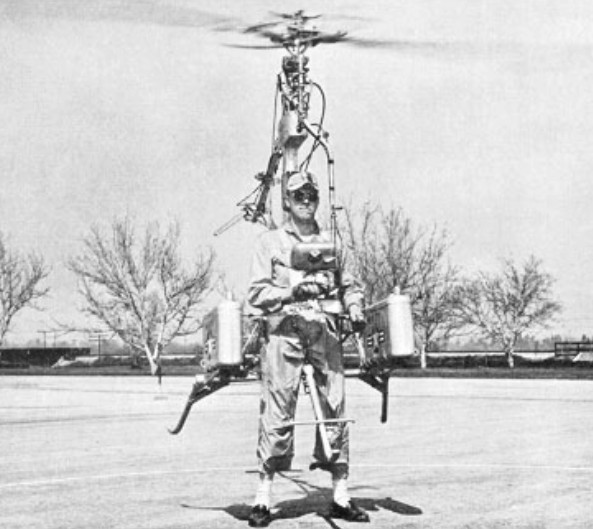
Rotor-craft RH-1 Pinwheel

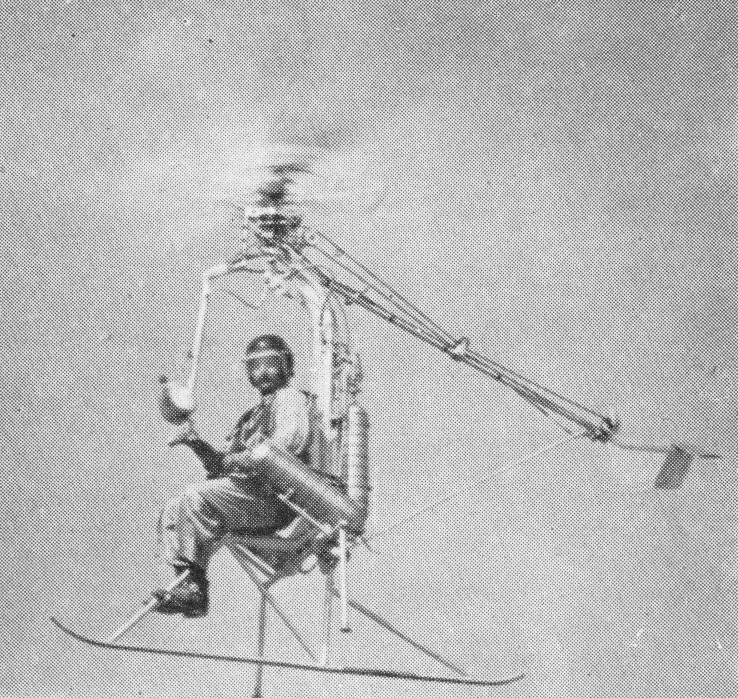
Little more heard of Gilbert Magill until the mid-1950s, when the RH-1 Pinwheel ‘strap-on’ personal helicopter appeared in 1954. The Rotorcraft RF-1 Pinwheel one-man helicopter was designed in 1954 to provide military personnel with a simple go-anywhere vehicle. Basically a strap-on device, it relied upon liquid propellants to power a tipjet at the end of each rotor blade, there thus being no rotor torque effect. The Pinwheel had a ‘quadripod’ frame layout, with the pilot sitting in the centre of the structure with a pair of liquid nitrogen tanks positioned behind him to feed Reaction Motors XLR-32RM rocket motors mounted at the rotor tips. A belt-driven rail rotor was incorporated in the simple and limited structure to provide steering capability.

Designed and built under US Navy contract, the RH-1 was extensively tested and made public demonstrations in 1955, leading to development of a similar Sky Hook military version. The capability of the Pinwheel can be measured by a maximum speed of 161km/h and ceiling of 4570m.

RH-1 Pinwheell
Engines: 2 x Reaction Motors XLR-32RM rocket
Rotors: 2-blade tip-powered main; 1-blade tail.
Empty weight: 100 lb
Cruising speed: 96km/h
Endurance: 9 min
Seats: 1

Rotor-craft X-2 Dragonfly / XR-11 / XH-11

In 1945 the Rotor-Craft Corporation began developmental work on a helicopter with tandem rotor configuration, designed by its President, Gilbert W. Magill, and embodying various novel features, especially the use of a rigid rotor system. The only designer in the United States to have preceded Magill in this line was Landgraf, who employed side-by-side rotor blades fixed rigidly to the hubs.

In 1953 Rotor-Craft acquired the patents of the Landgraf Helicopter Company, including those related to ‘rigid rotors’. At the time Magill stated: ‘Rigid rotor helicopters will be less costly to produce, and the safety of rigid blades that cannot droop and endanger passengers or others approaching the machine is expected to be attractive to both armed services and commercial helicopter operators.’

The absence of reliable technical data about its own particular version of the rigid rotor concept decided Rotor-Craft to design a test stand which would enable a quarter-scale rotor assembly to be thoroughly tested during the developmental stage.

This helicopter had two three-bladed rotors set in tandem and overlapping though separated by a distance of 3.76m; the level of the rear rotor was above that of the forward rotor.

The Rotor-Craft XR-11, designed by Mr. Gilbert Magill, is so far the only tandem rotor helicopter to have flown with rigid blades, and it is claimed that inherent stability has been built into the design without resorting to the use of auxiliary aerofoils or gyroscopic weights. Soon the designation of the helicopter was changed to XH-11. It was under development for the U.S.A.F. for three years, then tested at the Cal-Aero Technical Institute at Glendale, California.

A feature of the XR-11 is the rigid mounting of the rotor blades, without hinges or flapping joints, the rotor discs constantly remaining perpendicular to the shafts and following broadly the principle of the controllable-pitch airscrew. The blades were connected in such a way that their span axis was at the rear of the driving shaft. Pitch control rods are enclosed in hollow drive shafts, resulting in a very clean assembly. The blade roots embody levers, which enter the hollow drive shafts via slots, connecting with their respective pitch control rods; the two three-bladed oppositely rotating rotors are mounted in tandem and overlap, the forward rotar turning anti-clockwise and the aft rotor turning clockwise. It is of interest to note that the c of g location is some 40% to the rear of the forward rotor shaft, which is therefore carrying some 50% greater disc loading than the rear shaft.

Swashplates for cyclic and collective pitch changes are positioned at the bases of the rotor drive shafts, eliminating a number of components normally used for transferring control movements. For forward or backward flight the swash-plate was tilted fore and aft by a push-pull rod, while collective pitch change was obtained by raising or lowering another push-pull rod. Mr. Magill claims that the control system is extremely sensitive and the lag in control response is almost imperceptible. A number of standard automotive parts are incorporated in the structure, reducing initial costs and maintenance time. The clutch and gears in the rotor assembly are reworked Ford units, a Studebaker free-wheeling unit is employed and all the universal joints are standard car accessories.

Welded steel-tube construction is used for the fuselage and the rotor blades are of laminated birch construction.

The project was ultimately cancelled.

Randall Franklin, 13.01.2007
In 1948 I was 18 going to college and as a hobby designing a helicopter. By chance I met Gilbert Magill, and he was kind enough to advise me on my plans. He gave me a job at Rotot Craft working in the shop while developing the Dragon Fly. I did minor jobs of fileing tubing for welds etc. I witnessed it’s disastrous test flight. It got on the ground cushion and fell about 3 feet. The tube framing was hinged and an adjustable link was above the pilot head. That adjustment sheared and the fuselage collapsed in half. The rotors seperated in all directions and one missed my head by a foot or two. The pilot was uninjured but looked stunned. This happened at the Grand Central Air Terminal in Glendale Ca. The swash plates were at the bottom of the masts. Very much like the Enstrom Helicopter of today. Magill was a true genious, and years ahead of his time. One of the big investors in this helicopter was Lucille Ball. This early helicopter experience qualified me to be in the US Army’s first helicopter class at Ft. Sill OK. I flew in the Korean War, and later many years with World Wide Helicopters all over the world. I owe many thanks to Gilbert Magill, for a long and exciting career in helicopters. I regret that I have lost contact with him.

X-2 Dragonfly
Engine: Continental A 100, 110hp
Rotor diameter: 5.49m
Overall length: 4.57m
Height: 2.29m
Weight empty: 408kg
Weight fully loaded: 612kg

Engine: 110hp Continental C-100
Gross weight: 615kg
Rotec Engineering

Having been an aero¬nautical engineer at Bell and after working also for the helicopter division of the French Aerospatiale company, William Adaska de¬signed the first Rally series microlight in 1977, using a McCulloch engine and hybrid con¬trols. It was followed in 1979 by the Rally 2.

The Rally 2B was followed in 1981 by the Rally 3, the first FAA kit certified 2-place “ultralight style” airplane. The annual pro¬duction rate in 1982 was 3000.

In January 1983, Rotec introduced the aerobatic Rally Sport. The Rotec Rally Sport which they claimed was the first production aerobatic ultralight on the market.

1983-4: Rotec Engineering Inc, PO Box 220, Duncan¬ville, Texas 75116, USA.

Rotec was a leading producer of ultralight aircraft with the introduction of the ultralight Rally 2B.

Adaska, ex-Bell and ex-Aerospatiale employee who had specialised until then in helicopters, went on to sell over 2000 Rallys.

Bill Adaska owner of Rotec used the sales pitch that if an individual bought 5 aircraft, selling 4 to friends they would get their aircraft for nothing.

I had the opportunity to train on the Rally 3 Big Lifter, and the Rally 2 B. Before I could fly them I had to do modifications to the aircraft to make it safe to fly. The clutch had a tendency to fail, leaving you without power to the prop. The motorcycle style throttle was located on the stick, with the ignition switch right above it, and when wearing gloves and turning the throttle you would inadvertently turn the switch off.

The manufacturer also purchased large quantities of no longer in production snowmobile engines and installed them on his craft. While this kept the cost down, parts for these engines were almost impossible to find.

The Rotec was really just a cheap copy of the Quicksilver MX. For example the rudder, elevator, and spoileron cables were just rope. To attach these to the control systems Adaska used plastic hooks, and you literally tied a knot in the rope to attach the hook! Plastic fittings were used on the elevator, rudder, and spoilerons. These would crack and break when exposed to UV and cold.

With all this said the craft did fly, was quite forgiving, and easy to repair, and with some changes is a safe, fun, affordable flying machine.

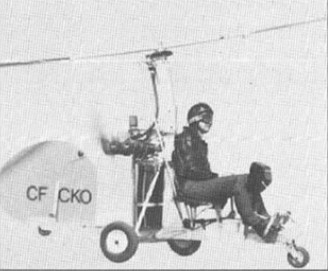
Haseloh Gyroplane

Late 1950s

Mr. Haseloh has logged more than 2000 hours of flying time on his experimental “HASELOH” designed machines and has spent over 10,000 hours in the development of prototype gyroplanes of “ THE TYPE “ manufactured and sold by Rotary Air Force South Africa.

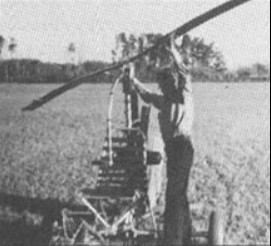
First Haseloh built gyroplane, 1954
Two place development, late 1970s.

1970 protptype with two part mast, and CW mounted shock mounted cheek plates.

Rotary Air Force / Haseloh

The origins of Rotary Air Force South Africa date back to 1943 when Bernard J. Haseloh hovered his first experimental helicopter at his shop in Ponoka, Alberta, Canada.

Mr. Haseloh was discouraged from building and testing amateur/experimental built helicopters, by the Government who felt that the technology for the power driven rotor system was too complex for the private individual.

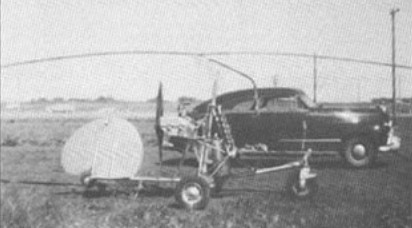
To further complicate matters, at that time the Government had no regulations in place for amateur/experimental built helicopters. Therefore, his keen interest in Rotary Winged Aircraft turned toward the development of gyroplanes, the first of which was successfully completed in 1954

Over 30 years, Bernard Haseloh has developed and implemented numerous design and structural innovations for gyroplanes.

Mr. Haseloh has logged more than 2000 hours of flying time on his experimental “HASELOH” designed machines and has spent over 10,000 hours in the development of prototype gyroplanes of “ THE TYPE “ manufactured and sold by Rotary Air Force South Africa.

Bernard Haseloh holds the first Gyro Pilot’s License issued in Canada and is widely recognized as a pioneer in the gyroplane industry. Mr. Haseloh is highly regarded by Federal Aviation Regulators having for many years served as the designated gyroplane instructor for Alberta, Canada.
Bernard Haseloh served as a key technical advisor to the development, testing & design of the
RAF 2000

1987 the Group forms Rotary Air Force Marketing Inc, First aircraft to go into production is the RAF 1000,
recognizing the need for proper flight instruction and to meet the demand for a two place gyroplane the
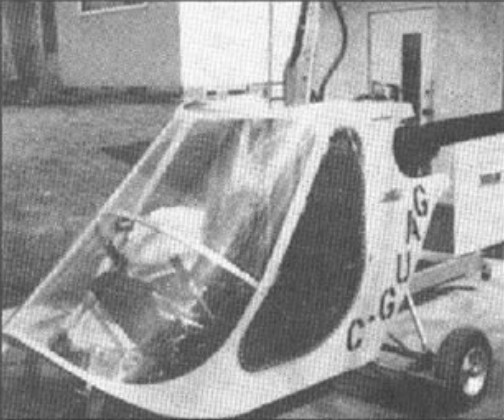
Rotary Air Force team introduces the Two place Gyroplane in 1989.

Incorporated in 1987, Rotary Air Force employed 16 people in 2001.

1995-7: Box 1236, Kindersley, Saskatchewan S0L 1S0 Canada.

In May 2001, RAF announced that it would be expanding its activities into commercial applications, including agricultural spraying and paramilitary functions.

As of April 2, 2007, Rotary Air Force Marketing Inc. closes doors.

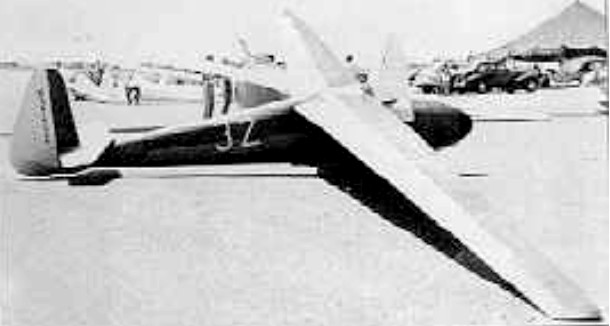
Ross RJ-5 / RHJ-5

The original design was almost entirely that of Harland Ross, whom Dick Johnson commissioned to build it in 1948. Johnson took delivery of the semi-complete ship in 1950 and finished it at Mississippi State University, incorporated some changes of his own.

The RJ-5 became one of the world’s most famous sailplane when Dick Johnson flew it 861 km/ 535 miles in 1951 for a world sitance record that stood for 13 years. It was one of the first sailplanes to utilize a laminar airfoil and to archieve a glide ratio of 40 to 1. With it Dick Johnson won the 1950, 1951, 1952 and 1954 Nationals and set a 510/ 317 miles National goal record, a 584 km/ 363 miles National distance record, a 85.0 kph/ 45.9 kt/ 52.8 mph 100 km. Triangular speed course record as well as the world distance record.

The wood fuselage and tail were badly damaged later in an accident so the then owner had an-all metal fuselage and tail built, designed by Adnan Kisovec (thus the K in the later designation). The ship originally used a takeoff dolly, but the fuselage was later modified to incorporate a Schweizer 1-34 retractable landing gear and airbrakes.

It now belongs to the National Soaring Museum, which has a project under way to build a replacemant original fuselage and tail.

RHJ-5
Wing span: 16.76 m / 55 ft
Wing area: 11.61 sq.m / 125 sq.ft
Aspect ratio: 24.2
Airfoil: NACA 63 (2)-615
Empty Weight: 295 kg / 650 lb
Payload: 91 kg / 200 lb
Gross Weight: 386 kg / 850 lb
Wing Loading: 33.25 kg/sq.m / 6.8 lb/sq.ft
Water Ballast: 0
L/DMax: 37 85 kph / 37 kt / 53 mph
MinSink: 0.61 m/s / 2.0 fps / 1.18 kt
Seats: 1
No. Built: 1

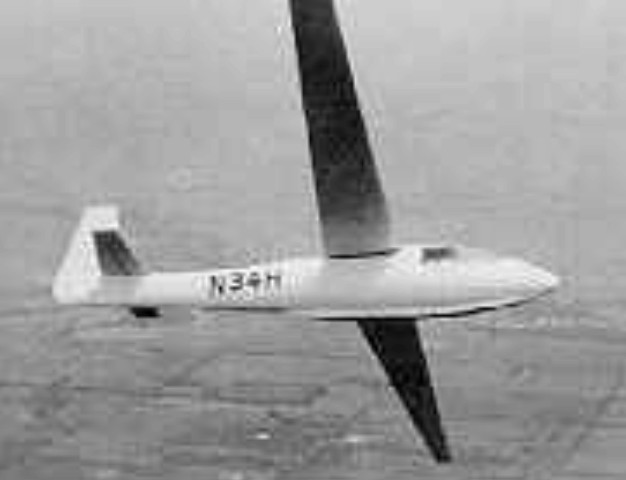
Ross R-6

Harland Ross completed the all metal, two-place R-6 in 1956 with the same wing designed for the RJ-5, giving it one of the heaviest wing loading in the world at that time. The span was subsequently increased by five feet (to 18.29 m/ 60 ft).

The R-6 has a metal fuselage and is equipped with dive brakes. The original skid and takeoff dolly was subsequently replaced with a retractable gear. The passenger sits aft of the spar under a removable bubble. Only one was built.

In 1958 Ross used it to set world multi-place records in the 100 km, 300 km and 500 km triangle speed categories and a national out-and-return record of 377.6 km./ 234.66 miles, all set in a four-day period.

Wing span: 18.29 m / 60 ft
Wing area: 11.91 sq.m / 128.2 sq.ft
Aspect ratio: 28
Airfoil: NACA 63(2)-615
Empty Weight: 300 kg / 662 lb
Payload: 256 kg / 564 lb
Gross Weight: 556 kg / 1226 lb
Wing Loading: 46.43 kg/sq.m /9.6 lb/sq.ft
Water Ballast: 0
L/DMax: 40 106 kph / 57 kt / 66 mph
MinSink: 0.72 m/s / 2.35 fps / 1.39 kt
Seats: 2