Lycoming T55 / LTC-4 / Honeywell T55

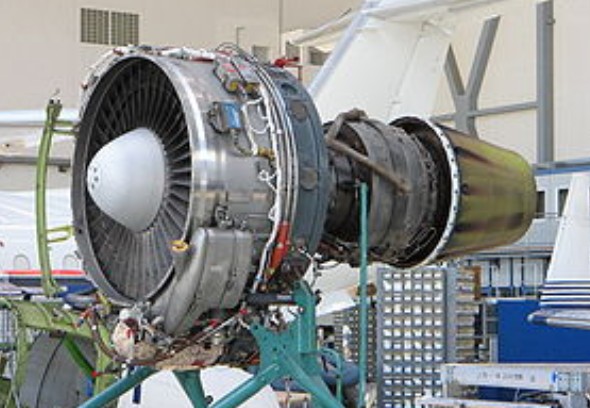
T55-GA-714A turboshaft

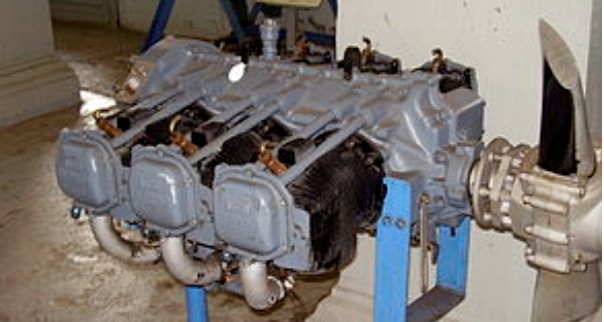
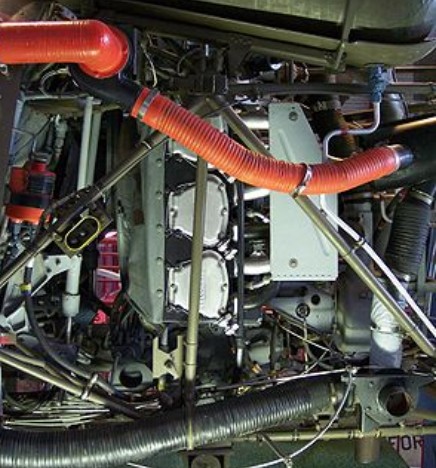
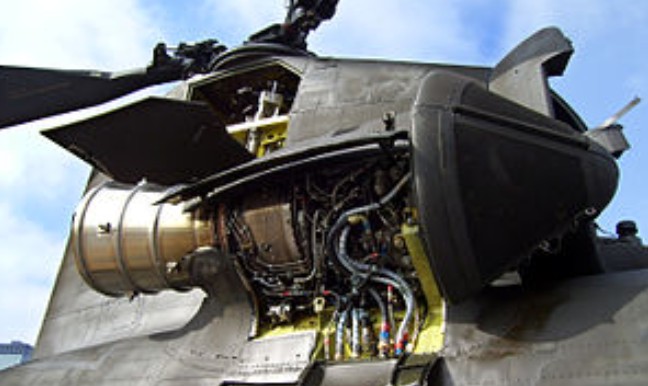
The Lycoming T55, (Company designation Lycoming LTC-4), is a turboshaft engine used on American helicopters and fixed-wing aircraft (in turboprop form), since the 1950s. It was designed at the Lycoming Turbine Engine Division in Stratford, Connecticut as a scaled-up version of the smaller Lycoming T53. Both engines are now produced by Honeywell Aerospace. The T55 also serves as the core of the Lycoming ALF 502 turbofan.

Applications:
Bell 309
Boeing CH-47 Chinook
Boeing Chinook (UK variants)
Boeing Model 360
Curtiss-Wright X-19
North American YAT-28E Trojan
Piper PA-48 Enforcer
H1 Unlimited hydroplane

Specifications:
T55-L-714A
Type: Turboshaft
Length: 1,196.3 mm (47.1 inches)
Diameter: 615.9 mm (24.3 inches)
Dry weight: 377kg (831 lbs)
Compressor: 7-stage axial compressor and 1-stage centrifugal compressor
Turbine: 2-stage gas producer and 2-stage free power
Maximum power output: 4,867 shp (3,631 kW)
Overall pressure ratio: 9.32
Turbine inlet temperature: 815C (power turbine inlet temperature)
Power-to-weight ratio: (4,867 shp / 831 lbs) ~ 5.8568:1 shp/lb

Lycoming T53 / LTC-1 / Honeywell T53

The Lycoming T53, (company designation LTC-1) is a turboshaft engine used on helicopters and fixed-wing aircraft (in turboprop form) since the 1950s. It was designed at the Lycoming Turbine Engine Division in Stratford, Connecticut by a team headed by Anselm Franz, who was the chief designer of the Junkers Jumo 004 during World War II. A much larger engine, similar in overall design, became the Lycoming T55. Both engines are produced by Honeywell Aerospace.

Variants:
Military designations:

T53-L-1B
860 hp (645 kW)

T53-L-11
825 hp (615 kW)

T53-L-13B
1400 shp (1044kW) improved L-11

T53-L-701
1,400 hp (1044 kW) Turboprop variant used on Mohawk and AIDC T-CH-1

T53-L-703
1,800 hp (1343 kW) improved durability variant of the L-13B

Civil designations

T5311A
1100 shp (820kW)

T5313A
1400 shp (1044kW) commercial variant of the L-13

T5313B
1400 shp (1044kW) commercial variant of the L-13

T5317A
1500 shp (1119kW) improved variant of the L-13

LTC1K-4K
1550 shp (1156kW) direct drive variant of the L-13B

Applications:
AIDC T-CH-1 (T53-L-701)
AIDC XC-2
Bell 204B (T5311A)
Bell 205A (T5313B)
Bell 205A-1 (T5313B and T5317A)
Bell AH-1 Cobra (T53-L-703)
Bell UH-1H Iroquois (T53-L-703)
Bell XV-15 (LTC1K-4K)
Boeing Vertol VZ-2 (YT53)
Canadair CL-84
Doak VZ-4
F+W C-3605
Grumman OV-1D Mohawk (T53-L-701)
Kaman HH-43 Huskie
Kaman K-1200 (T5317A)
Kaman K-MAX
Ryan VZ-3 Vertiplane
DB Class 210, diesel railway locomotive

Specifications:

T53-L-701
Type: Turboshaft
Length: 58.4in 1483mm
Diameter: 23in 584mm
Dry weight: 688 lb (312kg)
Compressor: 5-stage axial compressor and 1-stage centrifugal compressor
Maximum power output: 1,400 shp (1,044 kW)
Overall pressure ratio: (7.2 T53-L-32B)

Lycoming YF-102 / ALF 502 / AlliedSignal ALF502 / Honeywell ALF502/LF507

Lycoming ALF 502

The original YF102 was developed at the Lycoming Turbine Engine Division in Stratford, Connecticut by adding a fan to the Lycoming T55 engine, which was used as the gas generator. The YF102-LD-100 was tested on an AJ Savage in the early 1970s. Six engines were built for the Northrop YA-9 prototype ground-attack aircraft. These engines were later reused in the C-8A Quiet Short-Haul Research Aircraft (QSRA).

The ALF 502 geared turbofan was certified in 1980, and used on the British Aerospace 146 and Bombardier Challenger 600

The improved, higher-thrust LF 507 was used on the Avro RJ update of the BAe 146.

Applications:

YF102
Northrop YA-9
C-8A Quiet Short-Haul Research Aircraft (QSRA)

ALF 502
Bombardier Challenger 600
British Aerospace 146

LF 507
Avro RJ

Specifications:

ALF502-R5
Type: High bypass geared turbofan
Length: 63.6 in (162 cm)
Diameter: Fan: 40.25 in (102 cm)
Dry weight: 1336 lb (606 kg)
Compressor: Single stage fan, single stage axial low pressure compressor, 7 stage axial and single stage centrifugal high pressure compressor
Combustors: Annular
Turbine: Two stage high pressure turbine, two stage low pressure turbine
Maximum thrust: 6,970 lbf (31 kN)
Bypass ratio: 5.7:1
Specific fuel consumption: 0.406 lb/lbf-h (41.4 kg/kN-hr)
Thrust-to-weight ratio: 5.1:1

Lycoming O-145

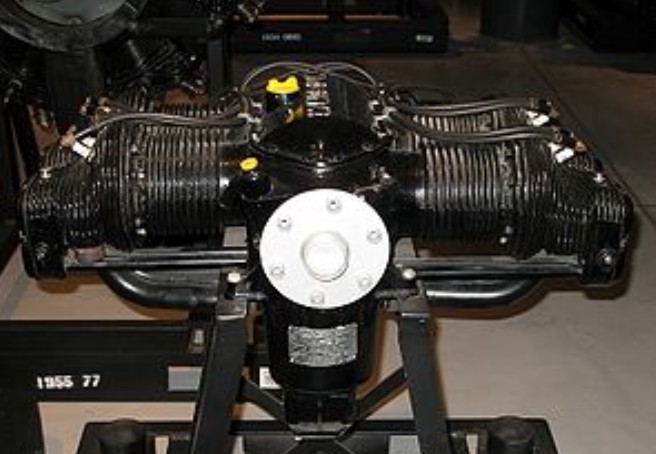
The Lycoming O-145 is a family of small, low-horsepower, four-cylinder, air-cooled horizontally opposed aircraft engine produced from 1938 until the late 1940s by Lycoming Engines. The family includes the reduction-geared GO-145.

The O-145 was produced in three major versions, the O-145-A rated at 55 hp (41 kW), the -B rated at 65 hp (48 kW), and -C rated at 75 hp (56 kW). The “B” model was the major production model, with the “A” and “C” produced in much smaller quantities.

All models of the series had the same bore, stroke and displacement, additional horsepower being generated by increasing compression ratio and maximum rpm. All use a Stromberg NA-S2 or NA-S2A or Marvel MA-2 or MA-2-A carburetor. The dual ignition versions use two Scintilla SF-4L, SN4LN-20 or -21, Superior SMA-4 or Edison-Splitdorf RMA-4 magnetos.

The original O-145-A produced 55 hp (41 kW) at 2300 rpm, weighed 165.5 lb (75 kg) and featured single ignition. In an attempt to compete with the Continental A-65 Lycoming boosted the rpm and power output to 65 hp (48 kW) at 2550 rpm and finally 75 hp (56 kW) at 3100 rpm. The O-145 had a hard time competing with the same horsepower Continentals due to its smaller displacement, which resulted in a steeper torque curve.

The GO-145 is a geared model, introduced in 1938, that uses a 27:17 reduction ratio (1.59:1) gearbox to produce 75 hp (56 kW) at 3200 crankshaft rpm, giving 2013 propeller rpm. The engine employs a gearbox bolted to the front of the engine and the resulting engine weighs 193 lb (88 kg) without starter or generator. The GO-145 suffered from a poor reputation for reliability, because pilots mis-handled the engine, running it at too low a cruising rpm and causing gearbox wear as a result.

The series’ type certificate expired on 2 November 1950 and no O-145-B1 or -C1 or GO-145-C1s engines produced after 1 August 1941 and O-145-B2, -B3 or -C2 or GO-145-C2 or -C3s produced after 24 August 1949 are eligible for certification. The single ignition O-145-A series, O-145-B1 and -C1 are not covered by the original type certificate.

Lycoming ended production of the O-145 and replaced it with the O-235 series.

Variants:
O-145-A
Four-cylinder, direct drive, 55 hp (41 kW), single ignition

0-145-A3
Four-cylinder, direct drive, 55 hp (41 kW), single ignition, with starter and generator installed

O-145-B1
Four-cylinder, direct drive, 65 hp (48 kW), single ignition

O-145-B2
Four-cylinder, direct drive, 65 hp (48 kW), dual ignition

O-145-B3
Four-cylinder, direct drive, 65 hp (48 kW), dual ignition

O-145-C1
Four-cylinder, direct drive, 75 hp (56 kW), single ignition

O-145-C2
Four-cylinder, direct drive, 75 hp (56 kW), dual ignition

GO-145-C1
Four-cylinder, reduction gearbox, 75 hp (56 kW), single ignition

GO-145-C2
Four-cylinder, reduction gearbox, 75 hp (56 kW), dual ignition

GO-145-C3
Four-cylinder, reduction gearbox, 75 hp (56 kW), dual ignition

Applications:
O-145
Airdrome Fokker D-VIII
Piper J-3L Cub, most often the 65 hp version
Carlson Skycycle
Piper PA-8 Skycycle

GO-145
Piper J-5 Cruiser
Funk B75L
General Skyfarer
Rich Twin 1-X-2
Shirlen Big Cootie

Specifications:
GO-145-C2
Type: Four-cylinder, reduction-geared engine
Bore: 3.625 in (92 mm)
Stroke: 3.500 in (89 mm)
Displacement: 144.5 cu.in (2.4 L)
Dry weight: 193 lb (87.5 kg)
Fuel system: Stromberg NA-S2 or NA-S2A or Marvel MA-2 or MA-2-A carburetor
Fuel type: minimum 73 octane
Cooling system: air-cooled
Power output: 75 hp at 3200 rpm (56 kW)
Specific power: 0.52 hp/cu.in (23.3 kW/L)
Compression ratio: 6.5:1
Power-to-weight ratio: 0.39 hp/lb (0.64 kW/kg)

Lycoming IO-580

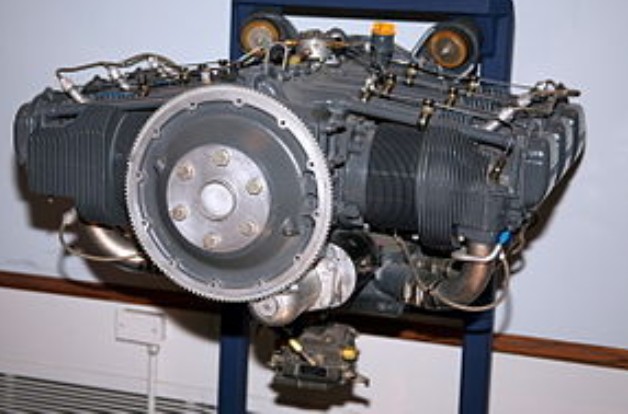
The Lycoming IO-580 engine is a horizontally opposed, six-cylinder aircraft engine featuring three cylinders per side, manufactured by Lycoming Engines.

There is no carburetted version of the engine, which would have been designated O-580 and therefore the base model is the IO-580.

This engine family competes with the Continental IO-550 series which are also six-cylinder engines with similar power output and weight.

First run in 1996, the IO-580 family of engines covers a range from 300 to 315 hp (224 to 235 kW). The engine has a fuel injection system which meters fuel in proportion to the induction airflow through air-bled nozzles at the individual cylinder intake ports. The engine has a displacement of 583 cubic inches (9.56 litres) and produces a maximum of 315 hp (235 kW) in its B1A version. The cylinders have air-cooled heads cast from aluminum-alloy with a fully machined combustion chamber.

The first IO-580 was type certified on 12 August 1997 on the regulatory basis of FAR 33 effective February 1, 1965 as amended to 33-1 through 33-18. The engine is certified for use in either tractor or pusher configuration installations.

Variants:
IO-580-A1A
Six-cylinder, horizontally opposed, air-cooled direct drive, 583 cubic inches (9.56 litres), 300 hp (224 kW) at 2500 rpm, dry weight 444 lb (201 kg), PAC-RSA-10ED1 fuel-injection system, certified 12 August 1997

IO-580-B1A
Six-cylinder, horizontally opposed, air-cooled direct drive, 583 cubic inches (9.56 litres), 315 hp (235 kW) at 2700 rpm, dry weight 434 lb (197 kg), PAC-RSA-10ED1 fuel-injection system, certified 23 March 2001

AEIO-580-B1A
Six-cylinder, horizontally opposed, air-cooled direct drive, 583 cubic inches (9.56 litres), 315 hp (235 kW) at 2500 rpm, dry weight 446 lb (202 kg), certified 13 August 2007. This model has an aerobatic fuel and oil system. It may be equipped with either the PAC-RSA-10ED1 fuel-injection system or a Lycoming FM-250 system.

Applications:
Cessna NGP
MSW Votec 252T

IO-580-B1A
Expedition E350 – factory installation

AEIO-580-B1A
Evektor VUT100-131i SuperCobra
Extra 330
XtremeAir Sbach 342 (XA 42)
XtremeAir XA41

Specifications
IO-580-A1A
Type: 6-cylinder fuel-injected horizontally opposed aircraft engine
Bore: 5.319 in (135 mm)
Stroke: 4.375 (111 mm)
Displacement: 583 c.in (9.56 litres)
Length: 39.34 in (999 mm)
Width: 34.25 in (870 mm)
Height: 21.04 in (534 mm)
Dry weight: 444 lb (201 kg) dry
Fuel system: PAC-RSA-10ED1 fuel-injection
Fuel type: 100LL avgas
Cooling system: air-cooled
Power output: 300 hp (223 kW) at 2500 rpm
Specific power: 0.51 hp/cu.in (24.7 kW/L)
Compression ratio: 8.90:1
Power-to-weight ratio: 0.68 hp/lb (1.11 kW/kg)

Lycoming H-2470

In 1932, the engineers at Lycoming Engines became aware that the United States Army Air Corps (USAAC) wanted a high performance engine that could produce at least one horsepower per cubic inch (46 kW/L) of engine displacement. Determined to become known as a high performance engine manufacturer, Lycoming began an experimental, high-performance engine of its own. After spending US $500,000, and after many attempts to develop a successful engine, it finally came close to the USAAC specifications with the O-1230 engine, which was a 12-cylinder liquid-cooled horizontally-opposed low-profile piston engine. In 1936, the single-cylinder development tests exceeded expectations, passing its 50 hour test requirement. The full-size engine was ready for testing in 1937, and was rated at 1,000 hp. Continued development of the O-1230 reached its peak when the engine was rated at over 1,200 hp (895 kW). The O-1230 was not well received by aircraft manufacturers, because it was not very reliable at that power setting.

It was apparent that the O-1230 engine was uncompetitive with the high performance air-cooled engines that were then becoming available. The US Navy began funding the development of the Lycoming engine. The funding enabled Lycoming’s engineers to attempt rescuing the design by proposing a 24-cylinder H-configuration engine made by stacking two of the O-1230 engines, gearing them together to one common output shaft. The new engine was the H-2470. It weighed in at 2,430 pounds and produced 2,300 hp (1,700 kW) at 3,300 rpm.

The Navy specified the H-2470 for the Curtiss XF14C-1 experimental fighter. After some rigorous testing the engine’s poor performance led to the substitution, before the aircraft flew, of a Wright R-3350 radial engine, which was also having technical problems but was considered to be more reliable than the H-2470. The testing program was eventually terminated due to the poor performance of the aircraft.

The USAAC was also interested in the H-2470, and installed and flew it in the Vultee XP-54 prototype fighter. The XP-54 was the only aircraft to actually use it for flight, but like the Navy’s XF-14C, the XP-54 never went into production.

Applications:
Curtiss XF14C
Vultee XP-54

Specifications:
Type: 24 cylinder, ‘H’ piston engine
Bore: 5.25 in. (133.35mm)
Stroke: 4.75 in. (120.65mm)
Displacement: 2467.8 cuin (40.44 Li)
Dry weight: 2,430 lb
Cooling system: Liquid-cooled
Power output: 2,300 hp at 3,300 rpm

Lycoming GSO-580

The Lycoming GSO-580 is a family of eight-cylinder horizontally opposed, supercharged, carburetor-equipped aircraft engines for both airplanes and helicopters, manufactured by Lycoming Engines in the late 1950s and early 1960s.

The family includes the original GSO-580 fixed-wing aircraft engine series, as well as the later SO-580 and VSO-580 helicopter engines. There is no non-supercharged, non-geared version of the engine, which would have been designated O-580 and therefore the base model is the GSO-580.

The GSO-580 family of engines covers a range from 375 hp (280 kW) to 400 hp (298 kW). All have a displacement of 578 cubic inches (9.47 liters) and the cylinders have air-cooled heads. Compared to other horizontally opposed engines of similar displacement this family of engines produces high output power by supercharging and high maximum rpm, at the cost of higher weight.

The GSO-580 series was certified under Type Certificate 256, while the SO-580 and VSO-580 series were certified under type certificate 285. Both were manufactured under Production Certificate No. 3.

Variants:
GSO-580
Eight-cylinder, horizontally opposed, geared-drive, supercharged, 578 cubic inches (9.47 litres), 375 hp (280 kW) at 3300 rpm for take-off, 320 hp (239 kW) at 3000 rpm continuous, dry weight 619 lb (281 kg), Bendix PSH-9BDE carburetor. Minimum fuel grade 91/98 avgas. Designation indicates Geared, Supercharged, Opposed.

GSO-580-B
Eight-cylinder, horizontally opposed, geared-drive, supercharged, 578 cubic inches (9.47 litres), 400 hp (298 kW) at 3300 rpm for take-off, 350 hp (261 kW) at 3000 rpm continuous, dry weight 624 lb (283 kg), Bendix PSH-9BDE carburetor. Minimum fuel grade 100/130 avgas. Designation indicates Geared, Supercharged, Opposed.

GSO-580-C
Eight-cylinder, horizontally opposed, geared-drive, supercharged, 578 cubic inches (9.47 litres), 375 hp (280 kW) at 3300 rpm for take-off, 320 hp (239 kW) at 3000 rpm continuous, dry weight 604 lb (274 kg), Bendix PS-9BDE carburetor. Minimum fuel grade 91/98 avgas. Designation indicates Geared, Supercharged, Opposed.

GSO-580-D
Eight-cylinder, horizontally opposed, geared-drive, supercharged, 578 cubic inches (9.47 litres), 400 hp (298 kW) at 3300 rpm for take-off, 350 hp (261 kW) at 3000 rpm continuous, dry weight 608 lb (276 kg), Bendix PS-9BDE carburetor. Minimum fuel grade 100/130 avgas. Designation indicates Geared, Supercharged, Opposed.

SO-580-A1A
Eight-cylinder, horizontally opposed, geared-drive, supercharged, 578 cubic inches (9.47 litres), 400 hp (298 kW) at 3300 rpm for take-off, 350 hp (261 kW) at 3000 rpm continuous, dry weight 596 lb (270 kg), Bendix PS-9BDE carburetor. Minimum fuel grade 100/130 avgas. Designation indicates Supercharged, Opposed. Designed for horizontal or up to 35 degrees nose-up helicopter installation.

SO-580-A1B
Eight-cylinder, horizontally opposed, geared-drive, supercharged, 578 cubic inches (9.47 litres), 400 hp (298 kW) at 3300 rpm for take-off, 350 hp (261 kW) at 3000 rpm continuous, dry weight 578 lb (262 kg), Bendix PS-9BDE carburetor. Minimum fuel grade 100/130 avgas. Designation indicates Supercharged, Opposed. Designed for horizontal or up to 35 degrees nose-up helicopter installation.

VSO-580-A1A
Eight-cylinder, horizontally opposed, geared-drive, supercharged, 578 cubic inches (9.47 litres), 400 hp (298 kW) at 3300 rpm for take-off, 350 hp (261 kW) at 3000 rpm continuous, dry weight 592 lb (269 kg), Bendix PS-9BDE carburetor. Minimum fuel grade 100/130 avgas. Designation indicates Vertical-mounted, Supercharged, Opposed. Designed for vertical helicopter installation.

Applications:
GSO-580
Beechcraft Model 34
Cessna 308
Fairchild XNQ

SO-580
Doman LZ-5

Specifications:
VSO-580-A1A
Type: 8-cylinder fuel-injected horizontally opposed, vertically mounted, helicopter engine
Bore: 4.875 in (124 mm)
Stroke: 3.875 (98 mm)
Displacement: 578 cu.in (9.47 litres)
Dry weight: 592 lb (268 kg) dry
Supercharger: 7.91:1 drive ratio
Fuel system: Bendix PS9BDE carburetor
Fuel type: 100/130 avgas minimum
Cooling system: air-cooled
Power output: 400 hp (298 kW) at 3300 rpm
Specific power: 0.51 hp/cu.in (33.3 kW/L)
Compression ratio: 7.30:1
Power-to-weight ratio: 0.68 hp/lb (1.11 kW/kg)
Lycoming O-540

AEIO-540

First run in 1957, the Lycoming O-540 is a family of six-cylinder, horizontally opposed fixed-wing aircraft and helicopter engines of 541.5 cubic inch (8,874 cc) displacement, made by Lycoming Engines. The engine is a six-cylinder version of the four-cylinder Lycoming O-360.

Generally these engines produce 230 to 350 horsepower. They are installed on a large number of different aircraft types. Their main competitive engine is the Continental IO-520 and IO-550 series.
The AEIO version was developed for high-performance competition aerobatics aircraft. Starting at 260 hp (190 kW), the power was then improved to 300 hp (220 kW). The AEIO-540 family has achieved results in competition aircraft such as the Extra 300, CAP 232, and Zivko Edge 540.

Lycoming IO 540

Gallery

Variants:

O-540
Standard, direct-drive, normally aspirated Opposed engine, equipped with a carburetor.

IO-540
Normally aspirated engine with fuel Injection.

AEIO-540
Normally aspirated engine with fuel injection and inverted lubrication for Aerobatic use.

TIO-540
Turbocharged and fuel-injected.

TEO-540
Turbocharged with independent Electronic sensors and fuel injection controls for each cylinder which manage detonation and exhaust gas temperature making the engine compatible with a range of fuel compositions producing up to 350 horsepower.

LTIO-540
Left-hand (opposite-direction) rotation, turbocharged, fuel-injected; used as the right-hand engine on Piper PA-31-325 Navajo C/Rs and Piper PA-31-350 Chieftains to prevent critical engine control issues. Also used for the left hand side of the Aerostar 700P.

IGO-540
Gearbox at the front end of the crankshaft to drive the propeller fewer revolutions per minute than the engine, normally aspirated with fuel injection. Dry sump engine built specifically for the Aero Commander 560F.

IGSO-540
Supercharger driven by the engine, gearbox to drive propeller, and fuel injection (up to 380hp).

VO-540
Vertically mounted engine for use in a helicopter, normally aspirated and equipped with a carburetor.

IVO-540
Normally aspirated engine with fuel injection, mounted vertically for use in a helicopter.

TVO-540
Turbocharged engine equipped with a carburetor, mounted vertically for use in a helicopter.

TIVO-540
Turbocharged engine with fuel injection, mounted vertically for use in a helicopter.

HIO-540
Helicopter engine mounted horizontally as in fixed-wing aircraft, normally aspirated with fuel injection; not used in any fixed-wing aircraft.

Applications:
AAC Angel
Aero Commander 500 series
AeroVolga LA-8L
Akaflieg München Mü30 Schlacro
Barrows Bearhawk
Bellanca Viking 300 (17-31 and 17-31TC)
Bellanca 17-31ATC Turbo Viking
Britten-Norman Islander
Britten-Norman Trislander
Brantly 305
CallAir A-9
Cessna 182
Dornier Do 28
Dream Tundra
Embraer EMB 202 Ipanema
Enaer T-35 Pillan
Evangel 4500
Gippsland GA8
Gippsland GA200
Lancair ES
Lasta 95
Helio/Maule M5-235
Mooney M20
Moynet 360-6 Jupiter
MSW Votec 252T
Murphy Moose
Neiva Universal
PAC CT-4E/F
PAC Super Mushshak
Piaggio P.166
Piper Aerostar
Piper Aztec
Piper Saratoga
Piper PA-24 Comanche
Piper PA-25 Pawnee
Piper PA-31 Navajo
Piper PA-46 Mirage
Pitts Special variants
PZL-104MA Wilga 2000
Raven 2XS
Ravin 500
Robinson R44
Rockwell Commander 114
Sharp Nemesis NXT
Socata TB-20
Socata TB-30 Epsilon
Team Tango Foxtrot
Utva 65
Van’s Aircraft RV-10
Zlin Z-143
Zlín Z 50

Specifications:

IO-540-AE1A5
Fuel Injected – 205 HP

IO-540-K1A5
Type: Six-cylinder air-cooled horizontally opposed engine
Bore: 5.125 in (130.2 mm)
Stroke: 4.375 in (111.1 mm)
Displacement: 541.5 cu.in (8.9 L)
Dry weight: 438 lb (199 kg)
Valvetrain: Two overhead valves per cylinder
Fuel system: Fuel injection
Fuel type: 100 octane rating gasoline
Cooling system: Air-cooled
Power output: 300 hp (223 kW) at 2,700 rpm at sea level
Specific power: 0.55 hp/cu.in (25.14 kW/L)
Compression ratio: 8.7:1
Power-to-weight ratio: 0.68 hp/lb (1.12 kW/kg)

Lycoming O-480 / BMW GO-480-B1A6

The Lycoming O-480 is a family of six-cylinder, horizontally opposed fixed-wing aircraft engines of 479.6 cubic inch (7.86 l) displacement, made by Lycoming Engines. The engine is a six-cylinder version of the four-cylinder Lycoming O-320.

O-480 series engines are installed on a number of different aircraft types. Their main competitive engines are the Continental IO-520 and IO-550 series.

Variants:
All engines have an additional prefix preceding the 480 to indicate the specific configuration of the engine. Although the series is known as the “O-480”, there are only geared engines in the series. There are also numerous engine suffixes, denoting different accessories such as different manufacturers’ carburetors, or different magnetos.

GO-480
Normally aspirated Opposed engine, equipped with a carburetor and Gearbox at the front end of the crankshaft to drive the propeller fewer revolutions per minute than the engine.

GSO-480
Supercharger driven by the engine, gearbox to drive propeller, and equipped with a carburetor. Designated the O-480-1 by the US military.

IGSO-480
Supercharger driven by the engine, gearbox to drive propeller, with fuel Injection. Designated the O-480-3 by the US military.

IGO-480
Gearbox to drive propeller, normally aspirated with fuel injection.

Applications:
Aero Commander 560, 560A, 560E and 680, 680E and the pressurized 720 Alti-Cruiser.
Aermacchi AM3CM (Bosbok)
Beechcraft Twin Bonanza
Beechcraft Queen Air
Dornier Do 27
Helio Courier
Soko J-20 Kraguj
Temco 58
Utva 66

Specifications:

GSO-480-A1A6
Type: Six-cylinder air-cooled geared supercharged horizontally opposed engine
Bore: 5.125 in (130 mm)
Stroke: 3.875 in (98 mm)
Displacement: 479.6 in³ (7.86 l)
Dry weight: 498 lb dry
Valvetrain: Two overhead valves per cylinder
Supercharger: 11.27:1 ratio, providing 48″ Hg (1.6 atm / 8.8 psi) manifold pressure at sea level at maximum power
Fuel type: 100 octane rating gasoline
Cooling system: Air-cooled
Reduction gear: 77:120 (.642:1)
Power output: 340 hp at 3,400 rpm at sea level
Compression ratio: 7.3:1

Lycoming O-435

Lycoming TVO-435

The Lycoming O-435 is a six-cylinder, horizontally opposed fixed-wing aircraft and helicopter engine made by Lycoming Engines, first run in the early 1940s. The engine is a six-cylinder version of the four-cylinder Lycoming O-290.

The powerplant is a horizontally opposed Lycoming six-cylinder design. It is a direct-drive or geared, air-cooled, and normally aspirated engine. The cylinders have steel barrels with aluminum heads, and the valves are operated by hydraulic lifters. The crankshaft is supported in an aluminum-alloy split case by four main bearings and one ball-thrust bearing, and lubricating oil is supplied from a 12 quart wet sump. The camshaft rides in journals that do not employ bearing inserts. The accessory housing supports two magnetos, a starter, a generator, and a dual tach drive. A spare mounting pad is included for a vacuum pump.

Variants:
O-435-A
O-435-C
O-435-D
GO-435
GO-435-B

Applications:

Aircraft
Aero Commander 500
AISA I-115
Beechcraft Bonanza
Bellanca Cruisemaster
Boisavia Mercurey
D’Apuzzo Senior Aero Sport
de Havilland Canada Super Chipmunk
Fleetwings BQ-2
Fokker F.25
Fokker S-11
Helio Courier
H-13 Sioux
Interstate TDR
Jeffair Barracuda
Karhumäki Karhu
Kawasaki KH-4
L-5 Sentinel
LIBIS KB-11
Miles Aerovan
OH-23 Raven
Piaggio P.148
Piaggio P.149
Pilatus P-4
Ra-Son Warrior
Saab 91 Safir
UTVA Aero 3
UTVA 56
Vertical Hummingbird

Other
M22 Locust – tank

Specifications:
O-435-D
Type: Six-cylinder horizontally-opposed gasoline piston engine
Bore: 4.875 in (123.7 mm)
Stroke: 3.875 in (98.4 mm)
Displacement: 434 cu in (7.1 L)
Width: 33.5 in (824 cm)
Height: 43.5 in (1,105 cm)
Dry weight: 433 lb (196.6 kg)
Valvetrain: Overhead valve, one inlet and one exhaust valve per cylinder
Fuel system: Marvel-Schebler carburetor
Fuel type: 100 octane gasoline
Oil system: Pressure pump type
Cooling system: Air-cooled by fan
Reduction gear: Direct-drive
Power output: 212 hp (158 Kw)at 3,000 rpm at sea level
Compression ratio: 7.5:1