1945
Axial flow compressor turbojet
1250 kg thrust
Gu-VRD project
Era
Lyulka RTD-1 / VDR-2
1938
Two stage centrifugal compressor turbojet
500 kg est thrust
Testbed only
Lyulka S-18 / TR-1
In May 1944 Arkhip Lyulka was ordered to begin development of a turbojet with a thrust of 12.3 kN (2,800 lbf). He demonstrated an eight-stage axial-flow engine in March 1945 called the S-18. In early 1946 the Council of Ministers ordered that the S-18 be developed into an operational engine with a thrust of 15.5 kN (3,500 lbf). The TR-1 was developed in early 1946 and had its first static run on 9 August. It was the first indigenous Soviet jet engine. It was tested in the air on a pylon fitted to a Lend-Lease B-25 Mitchell piston-engined bomber.
The TR-1 was not a success, proving to have less thrust and a higher specific fuel consumption than designed. Its failure led directly to the cancellation of the first Soviet jet bomber, the Ilyushin Il-22.
Lyulka further developed the engine into the TR-1A of 20.5 kN of thrust, but its specific fuel consumption was very high and it too was cancelled.
Applications:
Alekseyev I-21
Ilyushin Il-22
Sukhoi Su-10
Sukhoi Su-11
Specifications:
Type: Turbojet
Dry weight: 885 kg (1,951 lb)
Compressor: eight-stage axial-flow
Turbine: single stage
Maximum thrust: 12.8 kN (2,900 lbf)
Specific fuel consumption: 129 – 137 kg/kN·h (1.27-1.35 lb/lbf·h)
Thrust-to-weight ratio: 14.5 N/kg (1.47 lbf/lb)
Lyulka AL-31 / Saturn AL-31 / UMPO 117
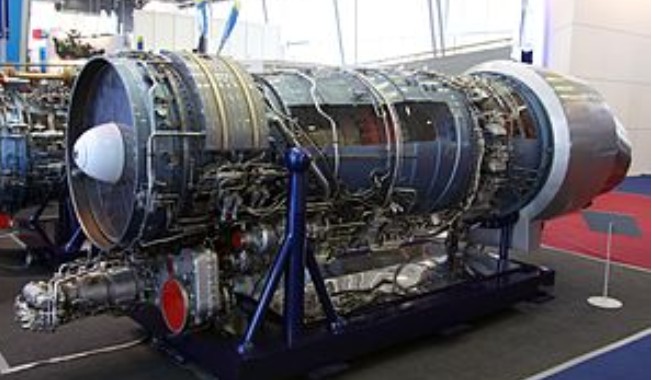
The Saturn AL-31 is a family of military twin spool turbofan turbofan engines. It was developed by Lyulka, later NPO Saturn, of the Soviet Union, originally for the Sukhoi Su-27 air superiority fighter. It produces a total thrust of 123 kN (27,600 lb) with afterburning in the AL-31F, 137 kN (30,800 lb) in the AL-31FM (AL-35F) and 142 kN (32,000 lb) in the AL-37FU variants. It powered all Su-27 derivatives and the Chengdu J-10 multirole jet fighter which was developed in China.
The AL-31FP and AL-37FU variants have thrust vectoring. The former is used in the Su-30MKI export version of the Su-30 for India & Sukhoi Su-30MKM for Malaysia . The AL-37FU can deflect its nozzle to a maximum of ±15° at a rate of 30°/sec. The vectoring nozzle is utilized primarily in the pitch plane. The Al-31FP is built in India by HAL at the Koraput facility under a deep technology transfer agreement.
It has a reputation for having a tremendous tolerance to severely disturbed air flow. In the twin-engined Su-27, the engines are interchangeable between left and right. The Mean Time Between Overhaul (MTBO) for the AL-31F is given at 1000 hours with a full-life span of 3000 hours. Some reports suggested that Russia was offering AL-31F to Iran to re-engine its F-14 Tomcat air fleet in the late 1990s.
According to Saturns Victor Mihailovic Chepkin, chief designer of the 117 and 117S engines, the Chinese WS-10 was developed with the aid of the AL-31s maintenance technical documentation. China can domestically produce most AL-31 parts for its own jet engine programs, but must import turbine blades from Russia.
The 117S (AL-41F1A) is an upgrade of the AL-31F based on the AL-41F intended to power the Su-35BM, producing 142 kN (32,000 lb) of thrust in afterburner and 86.3 kN (19,400 lb) dry. It features a fan 3% larger in diameter (932 millimetres (36.7 in) versus 905 millimetres (35.6 in)), advanced high- and low-pressure turbines, an all-new digital control system, and provisions for thrust-vectoring nozzles similar to the AL-31FP. This engine will have an assigned life of 4,000 hours and an MTBO of 1,000 hours. The first flight of this engine was completed in an Su-35BM on 20 February 2008. On 9 August 2010, Ufa-based company UMPO started supplying 117S engines (AL-41F1S) intended for Su-35S fighters.
The 117 (AL-41F1) is a 5th generation engine custom built for Russia’s fifth-generation stealth fighter jet PAK-FA according to Sukhoi General Director Mikhail Pogosyan. Mikhail Pogosyan has clarified that claims that fifth-generation fighter allegedly has an old engine are wrong. Though most parameters of the new 5th Gen Engine are classified General Director Mikhail Pogosyan provided some information on the new engine, The engine thrust was enlarged by 2.5 tonnes when compared with the AL-31 engine, while the engine weight was cut by 150 kilograms. That allowed the new jet to supercruise i.e. move at a supersonic cruise speed without the use of after burner.
The Saturn Research and Production center made digitally controlled system (FADEC) of Project 117 Engine.The new engine produces 33,000 lbs (147 kN) of thrust in afterburner has a Dry weight of 1420 kilogram and T:W ratio of 10.5:1.
Mikhail Pogosyan further mentioned that this engine (117) meets the client’s (Russian AirForce) requirements. This is not an intermediate product made particularly for test flights. The engine was to be installed in production PAK-FA fighter which will be supplied to the Russian Air Force and prospective foreign clients.
Bench testing of a radically new engine (the second stage) for the Russian fifth generation fighter aircraft PAK FA will start in 2014, said the general designer-director of the Scientific and Technical Center “Saturn”, Eugeny Marchuk “The engine will be ready in two years, and will begin bench testing then”, said Marchuk at the 11th International Conference” Aviation and Space – 2012 “, which opened at the Moscow Aviation Institute. According to him, the new “engine 117” will belong to the “5 +” generation and its characteristics will be superior to the existing foreign counterparts engine for fifth generation aircraft. “This is – a fundamentally new engine, The motor unit weight is 30% less (than the 117C – approx.), Life-cycle costs will by 30% less, and it should be cheaper, “- said Marchuk.
Variants:
Al-31F
The basic engine developed to power the Su-27 fighter
Builder: Salyut, UMPO
Year: 1981
Thrust: 123 kN (27,700 lbf)
Thrust vectoring: No
Aircraft: Su-27, Shenyang J-11, Sukhoi Su-30MKK, Sukhoi Su-30(Salyut)
Al-31FP
Improved variant for the Indian Su-30MKI with thrust vectoring
Builder: Salyut, HAL
Year: 2000
Thrust: 123 kN (27,700 lbf)
Thrust vectoring: Yes
Aircraft: Su-30 MKI, Sukhoi Su-30MKM
Al-31FN
Improved variant for the Chengdu J-10
Builder: Salyut
Year: 2002
Thrust: 125 kN (28,100 lbf)
Thrust vectoring: No
Aircraft: Chengdu J-10
Al-31FM1
Improved version for the Russian Air Force
Builder: Salyut
Year: 2007
Thrust: 132 kN (29,700 lbf)
Thrust vectoring: Yes
Aircraft: Su-27SM, Su-30, Su-34
Al-31FM2
Improved version for the Russian Air Force
Builder: Salyut
Year: 2012
Thrust: 145 kN (32,600 lbf)
Thrust vectoring: Yes
Aircraft: Su-27SM, Su-30, Su-34
Al-41F-1S (117S)
Advanced derivative for the Su-35
Builder: UMPO
Year: 2010
Thrust: 142 kN (31,900 lbf)
Thrust vectoring: Yes
Aircraft: Su-35
Al-37FU
Advanced derivative for the Su-37
Builder: UMPO
Thrust: 145 kN (32,600 lbf)
Thrust vectoring: Yes
Aircraft: Su-37
Al-41F-1 (117)
Advanced derivative for the Sukhoi PAK FA
Builder: UMPO
Year: 2010
Thrust: 147 kN (33,000 lbf)
Thrust vectoring: Yes
Aircraft: PAK FA prototype
Applications:
Sukhoi Su-27
Sukhoi Su-30
Sukhoi Su-34
Sukhoi Su-36
Sukhoi S-37 Berkut
Specifications:
AL-31F
Type: Two-shaft afterburning turbofan
Length: 4,990 millimetres (196 in)
Diameter: 905 millimetres (35.6 in) inlet; 1,280 millimetres (50 in) maximum external
Dry weight: 1,570 kilograms (3,460 lb)
Compressor: 4 fan and 9 compressor stages
Combustors: annular
Turbine: 2 single-staged turbines
Maximum thrust:
74.5 kilonewtons (16,700 lbf) military thrust
122.58 kilonewtons (27,560 lbf) with afterburner
Overall pressure ratio: 23
Bypass ratio: 0.59:1
Turbine inlet temperature: 1685 K (1,412 °C (2,574 °F))
Fuel consumption: 2.0 Kg/daN·h
Specific fuel consumption:
Military thrust: 0.67 lb/(lbf·h)
Full afterburner: 1.92 lb/(lbf·h)
Thrust-to-weight ratio: 4.77:1 (dry), 7.87:1 (afterburning)
Lyulka TR-7 / AL-7
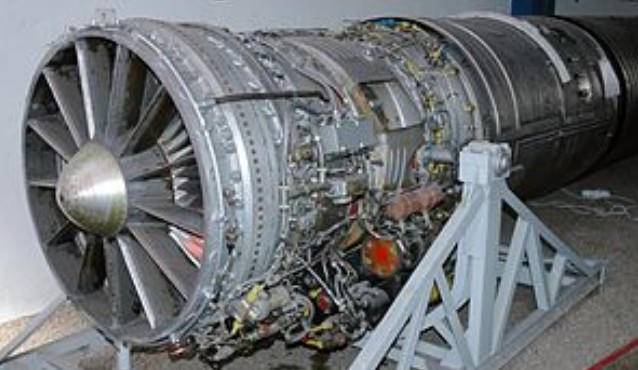
The Lyulka AL-7 was a 9 stage supersonic compressor turbojet designed by Arkhip Mikhailovich Lyulka and produced by his Lyulka design bureau. Produced between 1954 and 1970, the AL-7 had supersonic airflow through the first stage of the compressor. The TR-7 prototype developing 6,500 kgf (14,330 lbf, 63.7 kN) of thrust was tested in 1952, and the engine was initially intended for Ilyushin’s Il-54 bomber.
The afterburning version AL-7F was created in 1953. In April 1956, the Sukhoi S-1 prototype equipped with AL-7F exceeded Mach 2 at 18,000 m (70,900 ft), which lead to production of Su-7 ‘Fitter’ and Su-9 ‘Fishpot’ equipped with this engine. Later, the engine was adopted for Tu-128 ‘Fiddler’ in 1960, and for the AS-3 ‘Kangaroo’ cruise missile. The Beriev Be-10 jet flying boat used a non-afterburning AL-7PB with stainless steel compressor blades.
Applications:
Ilyushin Il-54
Sukhoi Su-7B
Tupolov Tu-98
Specifications:
AL-7F
Type: Afterburning turbojet
Dry weight: 2,010 kg (4,430 lb)
Compressor: 9-stage axial compressor
Maximum thrust:
67.1 kN (15,075 lbf) military power
98.1 kN (22,050 lbf) with afterburner
Overall pressure ratio: 9.5:1
Turbine inlet temperature: 860 deg C (1,580 deg F)
Specific fuel consumption:
95.0 kg/(h·kN) (0.94 lb/(h·lbf)) at idle
98.9 kg/(h·kN) (0.97 lb/(h·lbf)) military power
229.0 kg/(h·kN) with afterburner
Power-to-weight ratio: 3.4
Lyulka
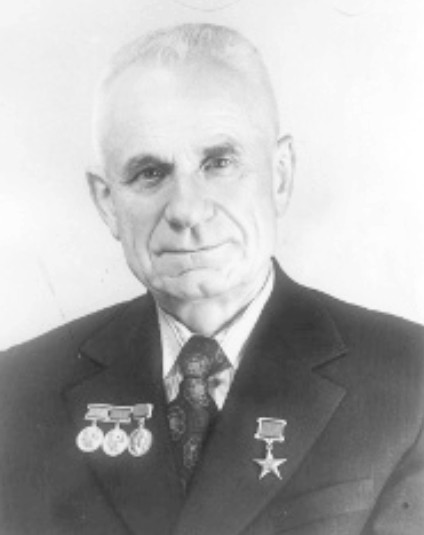
Born March 23, 1908, Kiev Oblast, Ukraine, Arkhip Mikhailovich Lyul’ka, was a Soviet scientist and designer of jet engines of Ukrainian origin, head of the OKB Lyulka, member of the USSR Academy of Sciences.
The Lyul’ka design bureau had its roots in the Kharkov Aviation Institute where Arkhip Mikhailovich Lyulka was working with a team designing the ATsN (Agregat Tsentralnovo Nadduva – Centralised supercharger) installation on the Petlyakov Pe-8 bomber. Lyul’ka was responsible for designing the first Soviet gas turbine engines. Preferring to steer away from copying captured German equipment, it succeeded in producing home grown engines.
Lyul’ka was a USSR aero-engine design bureau and manufacturer(OKB-165 started in 1946) from 1938 to the 1990s, when manufacturing and design elements were integrated as NPO Saturn based at Rybinsk.
Arkhip Lyulka died June 1, 1984, Moscow, Russia
Lycoming XR-7755
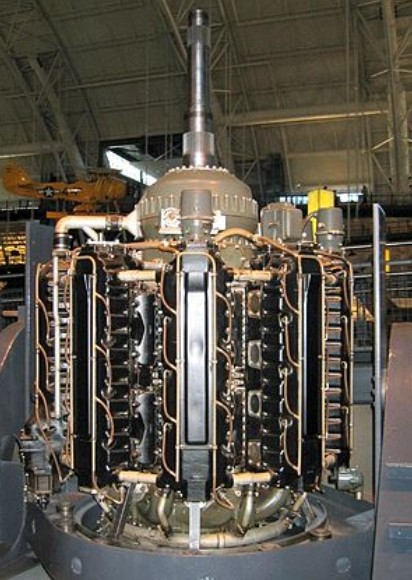
Lycoming had not been successful in designing a high-power engine. They had started with an attempt to make a hyper engine that led to the 1,200 hp (890 kW) O-1230; by the time the engine was ready, however, new aircraft designs were all calling for more power. They tried again by “twinning” the engine to produce the H block H-2470, which saw some interest in the Vultee XP-54 “Swoose Goose” project. Work on the H-2470 ended when the XP-54 was cancelled.
In one final attempt, Lycoming decided to go all out and build the largest engine in the world. They put together a team under the direction of VP of Engineering Clarence Wiegman at their main Williamsport factory in the summer of 1943 and started work.
The resulting design used 9 banks of 4 cylinders arranged around a central crankshaft with each cylinder bank at a 40 degrees angle to each adjacent bank, to form a four-row radial engine. Unlike most multi-row radials, which “spiral” the cylinders to allow cooling air to reach them, the R-7755 was water-cooled, and so each of the cylinder heads in a cylinder bank were in-line within a cooling jacket. Contrast this with the 24-cylinder Junkers Jumo 222, which looked similar from the outside, as both engines used banks of four cylinders each, but ran on a V-style cycle instead of a radial and only used six banks of cylinders. The XR-7755 was 10 ft (3 m) long, 5 ft (1.5 m) in diameter, and weighed 6,050 lb (2,740 kg). At full power it was to produce 5,000 hp (3,700 kW) at 2,600 rpm, maintaining that with a turbocharger to a critical altitude that was apparently never published.
Each cylinder bank had a single overhead cam powering the poppet valves. The camshaft included two sets of cams, one for full takeoff power, and another for economical cruise. The pilot could select between the two settings, which would shift the camshaft along its axis to bring the other set of cams over the valve stems. Interestingly, the design mounted some of the accessories on the “front side” of the camshafts, namely two magnetos and four distributors. The seventh camshaft was not used in this fashion, its location on the front of the engine was used to feed oil to the propeller reduction gearing.
The original XR-7755-1 design drove a single propeller, but even on the largest aircraft the propeller needed to absorb the power would have been ridiculously large. This led to a minor redesign that produced the XR-7755-3, using a new propeller gearing system driving a set of coaxial shafts to power a set of contra-rotating propellers. The propeller reduction gearing also had two speed settings to allow for a greater range of operating power than adjustable props alone could deliver. Another minor modification resulted in the XR-7755-5, the only change being the replacement of carburetors with a new fuel injection system.
The engine first started testing at 5,000 hp (3,700 kW) in 1944 with the XR-7755-3, but demonstrated terrible reliability problems. A second example was provided, as planned, to the United States Army Air Forces at Wright Field in 1946. However, by this time the Air Force had lost interest in new piston designs due to the introduction of jet engines, and the Lycoming delivery team was instructed to simply “dump it on the ground”. This engine has since disappeared. The original test engine was later delivered to the Smithsonian Institution, where it was restored.
Specifications:
Type: 36-cylinder turbosupercharged liquid-cooled “star” (9 banks at 40 deg angles, 4 cylinders in each bank) aircraft piston engine
Bore: 6 3⁄8 in (161.9 mm)
Stroke: 6 3⁄4 in (171.4 mm)
Displacement: 7,756.3 cu.in (127.1 L)
Length: 120 in (3,050 mm)
Diameter: 60 in (1,525 mm)
Dry weight: 6,050 lb (2,745 kg)
Valvetrain: Single overhead camshaft with separate cams for takeoff and economical cruise (Variable valve timing)
Cooling system: Liquid-cooled
Power output:
5,000 hp (3,730 kW) at 2,600 rpm takeoff
4,000 hp (2,985 kW) at 2,300 rpm cruise
Specific power: 0.64 hp/cu.in (29.3 kW/L)
Specific fuel consumption:
0.70 lb/(hp·h) (0.43 kg/(kW·h)) at takeoff power
0.485 lb/(hp·h) (0.29 kg/(kW·h)) at 70% power
0.37 lb/(hp·h) (0.22 kg/(kW·h)) at minimum cruise power
Power-to-weight ratio: 0.82 hp/lb (1.36 kW/kg)
Lycoming R-680
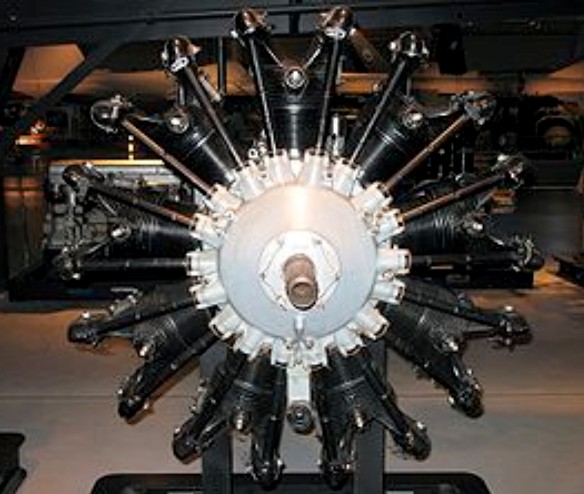
The Lycoming R-680 is a nine-cylinder air-cooled radial engine, the first aero engine produced by Lycoming.
Pressure lubrication is to the crankshaft, master rod, link pins, cam drive gears, and main accessories drive shaft and gears.
First run in 1929, the engine was produced in two types the E and B series both are essentially the same, the B4E was available in a trainer version with a front exhaust collector for use without cylinder air baffles.
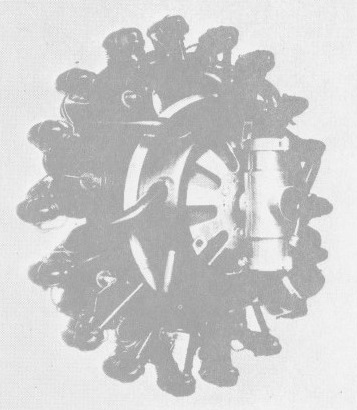
Equipment was a tachometer drive at ½ canshaft speed, exhaust ring, cowling and air cleaner.
Accessories available were a generator and starter,
Variants:
R-680-B4E
Rated at 225 hp at 2100 rpm.
R-680-E3A
Rated at 285 hp at 2200 rpm.
R-680-13
Rated at 300 hp at 2200 rpm.
Applications:
Beech AT-10 Wichita
Boeing-Stearman PT-13
Cessna AT-8/AT-17
Curtiss-Wright AT-9
Fleetwings BQ-2
Spartan NP-1
Stinson Airliner
Stinson Reliant
Stinson Vigilant
Waco S Series (very rare facory authorization)
Specifications:
Type: 9 cylinder air cooled radial
Rating: 210 hp at 2000 rpm
Displacement: 680 cu.in
Compression ratio: 5.2-1
Bore: 4 5/8 in
Stroke: 4 1/2 in
Length: 43 1/8 in
Diameter: 43 1/4 in
Weight: 465 lb dry
Fuel consumption: not more than .55 lb/hp/hr
Oil consumption: not more than .035 lb/hp/hr
Lubrication: 1 pressure pump, 2 scavenger pumps (in one unit)
Ignition: Scintilla dual magneto type SC-A
Carburation: 1 Stromberg NA-R7
Spark plugs: 2 per cylinder
R-680-E3A
Type: Nine cylinder air-cooled radial
Bore: 4 5⁄8 in (117 mm)
Stroke: 4 1⁄2 in (114 mm)
Displacement: 680 cu.in (11.15 litres)
Length: 37.5 in (953.1 mm)
Diameter: 43.5 in (1104 mm)
Dry weight: 515.46 lb (233.9 kg)
Valvetrain: One inlet and one exhaust valve per cylinder at 30 degrees.
Fuel system: single-barrel carburetor
Fuel type: 87 octane rating gasoline
Oil system: Full pressure type
Cooling system: Air-cooled
Power output: 330 hp (246 kW) at 2,300 rpm at sea level
Compression ratio: 7:1
Power-to-weight ratio: 0.64 hp/lb (1.05 kW/kg)
Lycoming O-1230
In 1932, the engineers at Lycoming Engines became aware that the United States Army Air Corps (USAAC) wanted a high performance engine that could produce at least one horsepower per cubic inch (46 kW/L) of engine displacement and that a contract had been made with Continental Motors, Inc., Lycoming’s main rival in the general aviation engine market. Lycoming’s management wanted to be considered for development of the next generation engine, but no USAAC development contract was signed. Still determined to become known as a high performance engine manufacturer, Lycoming began an experimental, high-performance engine of its own. After spending US $500,000, and after many attempts to develop a successful engine, it finally came close to the USAAC specifications with the 1,200 hp (895 kW) O-1230 engine.
Lycoming’s O-1230 engine design was a 12-cylinder liquid-cooled horizontally-opposed low-profile piston engine that could be mounted either horizontally, buried in the wing of a multi-engine aircraft; or vertically, in the fuselage of a single engine fighter. From 1935 the engine design proceeded at a faster pace after a number of former Continental engineers, who had become unhappy with the working conditions there, joined Lycoming.
The same year the USAAC became interested in the O-1230, and began supporting the engine development program. In 1936, the single-cylinder development tests exceeded expectations, passing its 50 hour test requirement. The full-size engine was ready for testing in 1937, and was rated at 1,000 hp.
The last Vultee A-19 that had been ordered by the USAAC was delivered as the XA-19A, fitted with an O-1230-1 offering 1200 hp. It first flew on May 22, 1940. This aircraft was subsequently re-engined with a Pratt & Whitney R-1830-51 and redesignated.
Continued development of the O-1230 reached its peak when the engine was rated at over 1200 hp. It was as powerful as the Allison V-1710, but with a narrower cowling than the Allison V12 engine. The O-1230 was not well received by aircraft manufacturers, because it was not very reliable at that power setting.
Specifications:
O-1230-1
Type: 12-cylinder, Geared, liquid-cooled, horizontally-opposed piston engine
Bore: 5.25 in (133.4 mm)
Stroke: 4.75 in (120.7 mm)
Displacement: 1233.9 cu.in (20.219 L)
Dry weight: 1342 lb
Valvetrain: Overhead camshaft
Cooling system: Liquid
Reduction gear: 0.40
separate cylinders
hemispheric cylinder head design
one-piece cylinder head for each bank
Power output: 1000 hp@3100 rpm, 1200 hp@3400 rpm, 1,275 hp (951 kW)
Specific power: 1.03 hp/cu.in
Power-to-weight ratio: .95 hp/lb
Lycoming IO-720
The Lycoming IO-720 engine is a large displacement, horizontally opposed, eight-cylinder aircraft engine featuring four cylinders per side, first run in 1961, manufactured by Lycoming Engines.
There is no carburetted version of the engine, which would have been designated O-720 and therefore the base model is the IO-720. The IO-720 and the Jabiru 5100 were the only flat-eight configuration aircraft engines in production in 2012.
The engine has a fuel injection system which schedules fuel flow proportionally to the airflow, with fuel vaporization occurring at the intake ports. The engine has a displacement of 722 cubic inches (11.8 litres) and produces 400 hp (298 kW). The cylinders have air-cooled heads cast from aluminum alloy with a fully machined combustion chamber.
The first IO-720 was type certified on 25 October 1961 to the CAR 13 standard as amended to 15 June 1956 including 13-1, 13-2, 13-3, 13-4.
In 2009 a new IO-720-A1B cost US$113,621, with a rebuilt engine retailing for US$75,435 and a factory overhaul priced at US$66,289.
Variants:
IO-720-A1A
Eight-cylinder, horizontally opposed, air-cooled direct drive, fuel injection, internal oil jet piston cooling, 722 cubic inches (11.8 litres), 400 hp (298 kW), certified 25 October 1961
IO-720-A1B
fuel-injected, 722 cubic inches (11.8 litres), 400 hp (298 kW), same as -A1A except equipped with Bendix S8LN-1208 and S8LN-1209 magnetos, certified 22 February 1971
IO-720-A1BD
fuel-injected, 722 cubic inches (11.8 litres), 400 hp (298 kW), same as -A1B except has a dual magneto, certified 30 December 1976
IO-720-B1A
fuel-injected, 722 cubic inches (11.8 litres), 400 hp (298 kW), same as -A1A except for top exhaust cylinders and offset exhaust valve shroud tubes, certified 4 November 1965
IO-720-B1B
fuel-injected, 722 cubic inches (11.8 litres), 400 hp (298 kW), same as -B1A except equipped with Bendix S8LN-1208 and S8LN-1209 magnetos and Bendix RSA-10ED1 fuel injection, certified 22 February 1971
IO-720-B1BD
fuel-injected, 722 cubic inches (11.8 litres), 400 hp (298 kW), same as -B1B except has a dual magneto, certified 30 December 1976
IO-720-C1B
fuel-injected, 722 cubic inches (11.8 litres), 400 hp (298 kW), same as -A1B except that it has up-exhaust cylinder heads, certified 22 December 1971
IO-720-C1BD
fuel-injected, 722 cubic inches (11.8 litres), 400 hp (298 kW), same as -C1B except has a dual magneto, certified 28 January 1977
IO-720-D1B
fuel-injected, 722 cubic inches (11.8 litres), 400 hp (298 kW), same as -A1B except has a rear type air inlet housing instead of a front inlet, certified 29 October 1973
IO-720-D1BD
fuel-injected, 722 cubic inches (11.8 litres), 400 hp (298 kW), same as -D1B except has a dual magneto, certified 28 January 1977
IO-720-D1C
fuel-injected, 722 cubic inches (11.8 litres), 400 hp (298 kW), same as -D1B except equipped with an angled fuel injector adapter, certified 15 April 1982
IO-720-D1CD
fuel-injected, 722 cubic inches (11.8 litres), 400 hp (298 kW), same as -D1C except has a dual magneto, certified 10 June 1977
Applications:
IO-720-A1A
Northwest Ranger – factory installation
Piper Comanche 400 – factory installation
IO-720-A1B
Beechcraft 80 – Excalibur and Queen Air conversions
Pacific Aerospace FU-24-954
Piper PA-36 Pawnee Brave – Johnson Aircraft conversion
IO-720-A1BD
Barr 6
IO-720-B1A
Northwest Ranger C-6 – factory installation
IO-720-B1B
Aero Commander – MR. R.P.M. conversion
IO-720-B1BD
Aero Commander – MR. R.P.M. conversion
IO-720-D1B
Embraer EMB 202 Ipanema – factory installation
IO-720-D1C
Piper PA-36 Pawnee Brave – Johnson Aircraft conversion
IO-720-D1CD
Piper PA-36 Pawnee Brave – Johnson Aircraft conversion
Specifications:
IO-720A
Type: 8-cylinder fuel-injected horizontally opposed aircraft engine
Bore: 5.125 in (130 mm)
Stroke: 4.375 (111 mm)
Displacement: 722 cu.in (11.8 litres)
Length: 46.41 In (117.88 cm)
Width: 34.25 in (87.00 cm)
Height: 22.53 in (57.23 cm)
Dry weight: 597 lb (271 kg) dry
Fuel system: Bendix RSA-10AD1 fuel-injection
Fuel type: 100LL avgas
Cooling system: air-cooled
Power output: 400 hp (297 kW) at 2650 rpm
Specific power: 0.55 hp/cu.in (25.2 kW/L)
Compression ratio: 8.70:1
Power-to-weight ratio: 0.67 hp/lb (1.10 kW/kg)

