1998:
Via Per Finale 38
I-41031 Camposanto (MO)
Italy
Trike builder
1998:
Via Per Finale 38
I-41031 Camposanto (MO)
Italy
Trike builder
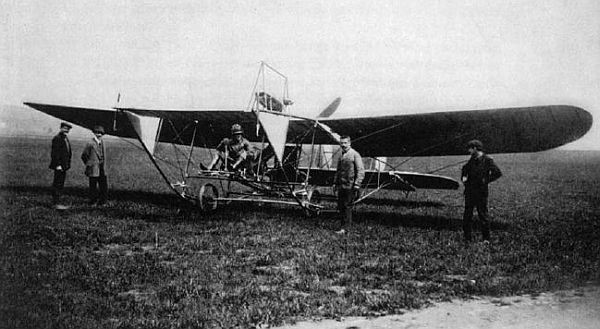
High-wing pusher monoplane powered by an opposed 4-cylinder Oerlikon engine rated to 45 hp. Henri Kunkler, born in St.Gallen 1886, was one of the young aviators in Switzerland. He flew since 1911 (Blériot) and in 1912 he completed his own monoplane that he built with his mechanic Rossier. Rossier obviously played an important role in the design but was neither financier, owner or pilot. The first noteworthy adventure with that machine was the cross-coutry flight from St-Gallen to Dübendorf on 4. September 1912 (ca. 60km in 12:30h with two emergency landings). Kunkler flew this craft until he gave the controls to Ernst Rech in May 1913, who would take part at the Meeting in Olten. He decided to move the plane by a cross-country flight but lost control in strong winds and crashed to his death.
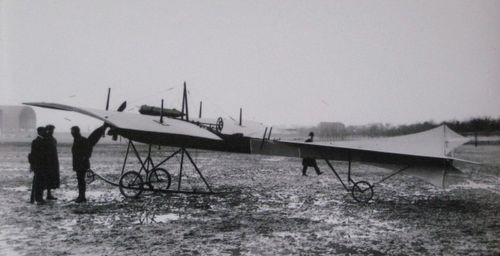
Frédéric Rossel, while already working for Peugeot a few years, and with car sales figures depressed at this time, turned his interests to aviation and convinced the Peugeot Brothers to form the “Société Anonyme des constructions aériennes Rossel-Peugeot”. Built by the Reggy frères, who also furnished the propeller, the monoplane was powered by a 50 hp Gnôme rotary engine. The first flight was piloted by Jules Goux – in 1913 the first Frenchman to win the Indianapolis 500 motorcar race – but just 5 minutes into the air the machine lay wrecked on the ground, with Goux unhurt.
Frédéric Rossel, while already working for Peugeot a few years, and with car sales figures depressed at this time, turned his interests to aviation and convinced the Peugeot Brothers to form the “Société Anonyme des constructions aériennes Rossel-Peugeot” in 1910.
The RS-2L two-seater, powered by a Lycoming engine, was built in 1942.
A light monoplane in 1940; war stopped production plans.
USA
Ross Aircraft Corporation was established in New York and built RS-1 light monoplane in 1940; war stopped production plans. A new model, the RS-2L two-seater, powered by a Lycoming engine, was built in 1942.
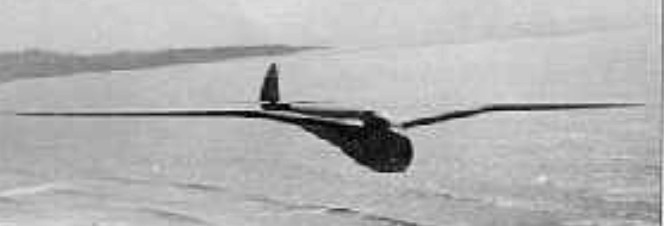
Harland Ross built the all wood RS-1 in 1937 for Harvey Stephens, hence the designation. It was one of the first small-span high-performance sailplanes. The lines of the ship were inspired by the Lippisch Fafnir II and the name comes from an Australian seed with good gliding characteristics.
Ross flew the RS-1 in the 1937 U.S. Nationals and placed 3rd behind Peter Riedel and Richard du Pont. The ship placed 2nd in the Easton design competition.
Later, owned and piloted by John Robinson, it made American Soaring history by winning the 1940, 1941 and 1946 Nationals, placing third in 1947 and second in 1948, and setting National distance record of 466 km. /290 miles in 1940 and 523 km. /325 miles in 1947 and the world altitude record of 10,211 m. / 33,500 ft. in 1949. Robinson also completed the Worlds’s first Diamond badge using the RS-1
Wing span: 14.02 m / 46 ft
Wing area: 11.61 sq.m / 125 sq.ft
Empty Weight: 150 kg / 330 lb
Aspect ratio: 17
Airfoil: NACA 2418,2412
Payload: 122 kg / 270 lb
Gross Weight: 272 kg / 600 lb
Wing Loading: 23.43 kg/sq.m / 4.8 lb/sq.ft
Water Ballast: 0
L/DMax: 30 77 kph / 42 kt / 48 mph
MinSink: 0.70 m/s / 2.3 fps / 1.36 kt
Seats: 1
No. Built: 1
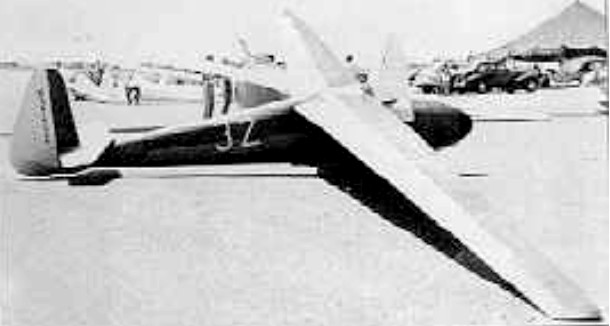
The original design was almost entirely that of Harland Ross, whom Dick Johnson commissioned to build it in 1948. Johnson took delivery of the semi-complete ship in 1950 and finished it at Mississippi State University, incorporated some changes of his own.
The RJ-5 became one of the world’s most famous sailplane when Dick Johnson flew it 861 km/ 535 miles in 1951 for a world sitance record that stood for 13 years. It was one of the first sailplanes to utilize a laminar airfoil and to archieve a glide ratio of 40 to 1. With it Dick Johnson won the 1950, 1951, 1952 and 1954 Nationals and set a 510/ 317 miles National goal record, a 584 km/ 363 miles National distance record, a 85.0 kph/ 45.9 kt/ 52.8 mph 100 km. Triangular speed course record as well as the world distance record.
The wood fuselage and tail were badly damaged later in an accident so the then owner had an-all metal fuselage and tail built, designed by Adnan Kisovec (thus the K in the later designation). The ship originally used a takeoff dolly, but the fuselage was later modified to incorporate a Schweizer 1-34 retractable landing gear and airbrakes.
It now belongs to the National Soaring Museum, which has a project under way to build a replacemant original fuselage and tail.
RHJ-5
Wing span: 16.76 m / 55 ft
Wing area: 11.61 sq.m / 125 sq.ft
Aspect ratio: 24.2
Airfoil: NACA 63 (2)-615
Empty Weight: 295 kg / 650 lb
Payload: 91 kg / 200 lb
Gross Weight: 386 kg / 850 lb
Wing Loading: 33.25 kg/sq.m / 6.8 lb/sq.ft
Water Ballast: 0
L/DMax: 37 85 kph / 37 kt / 53 mph
MinSink: 0.61 m/s / 2.0 fps / 1.18 kt
Seats: 1
No. Built: 1
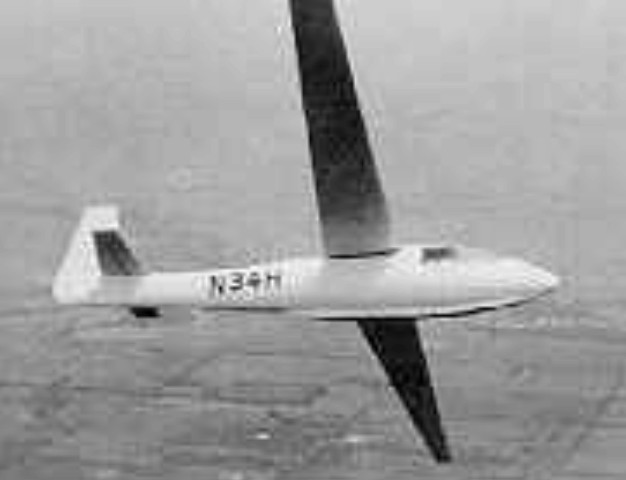
Harland Ross completed the all metal, two-place R-6 in 1956 with the same wing designed for the RJ-5, giving it one of the heaviest wing loading in the world at that time. The span was subsequently increased by five feet (to 18.29 m/ 60 ft).
The R-6 has a metal fuselage and is equipped with dive brakes. The original skid and takeoff dolly was subsequently replaced with a retractable gear. The passenger sits aft of the spar under a removable bubble. Only one was built.
In 1958 Ross used it to set world multi-place records in the 100 km, 300 km and 500 km triangle speed categories and a national out-and-return record of 377.6 km./ 234.66 miles, all set in a four-day period.
Wing span: 18.29 m / 60 ft
Wing area: 11.91 sq.m / 128.2 sq.ft
Aspect ratio: 28
Airfoil: NACA 63(2)-615
Empty Weight: 300 kg / 662 lb
Payload: 256 kg / 564 lb
Gross Weight: 556 kg / 1226 lb
Wing Loading: 46.43 kg/sq.m /9.6 lb/sq.ft
Water Ballast: 0
L/DMax: 40 106 kph / 57 kt / 66 mph
MinSink: 0.72 m/s / 2.35 fps / 1.39 kt
Seats: 2

