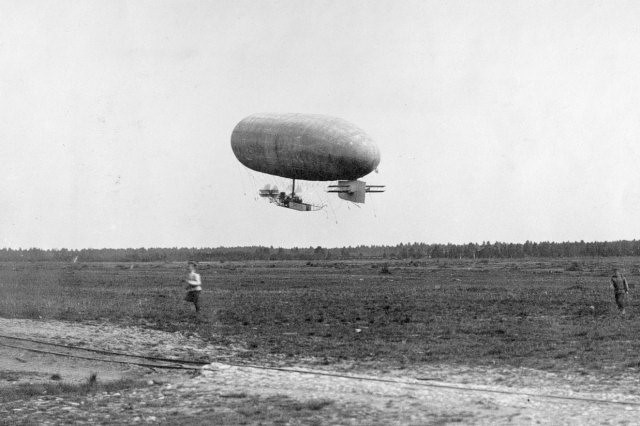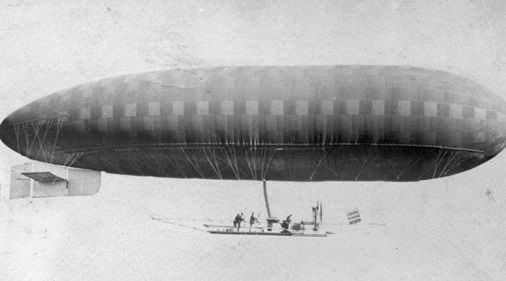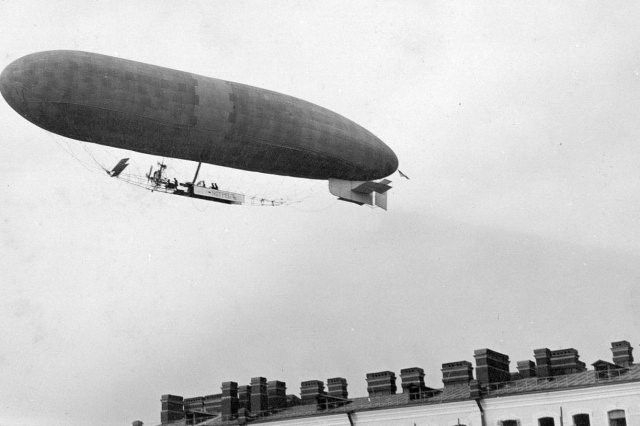
Russian Empire airship B-2 USSR Smolny

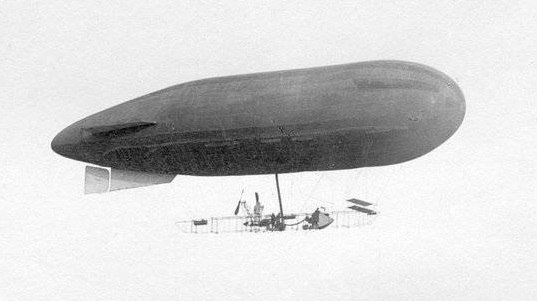
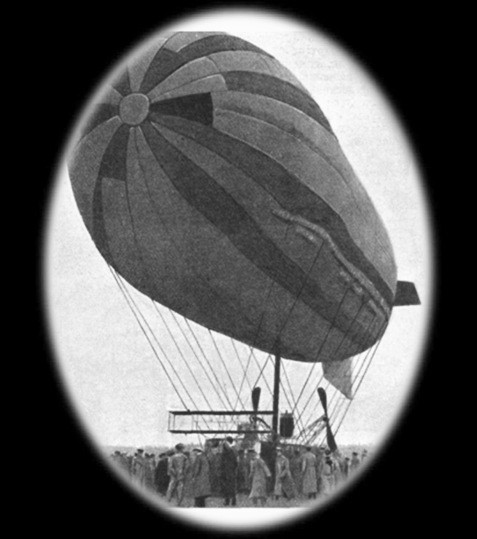
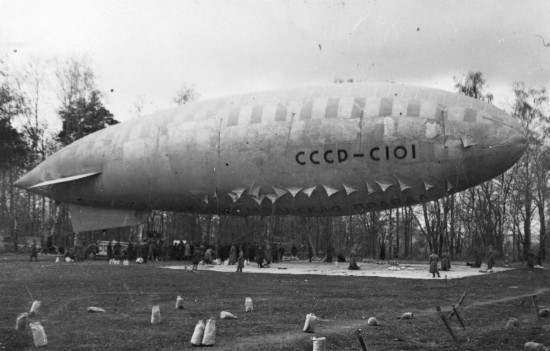
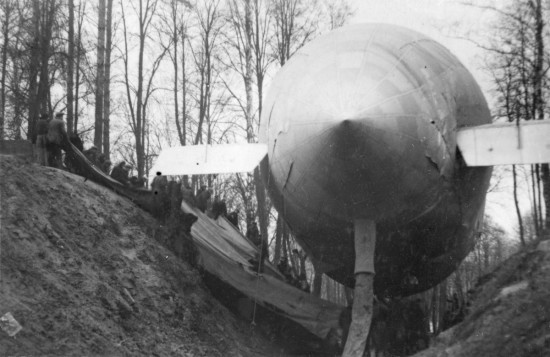
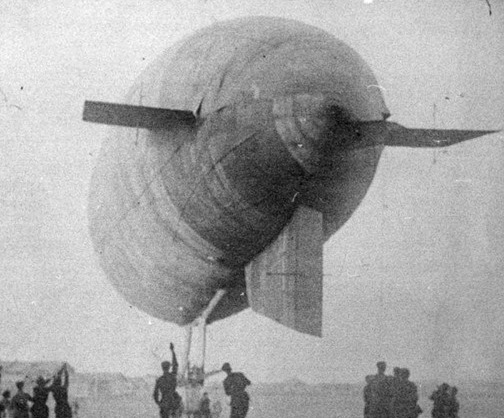
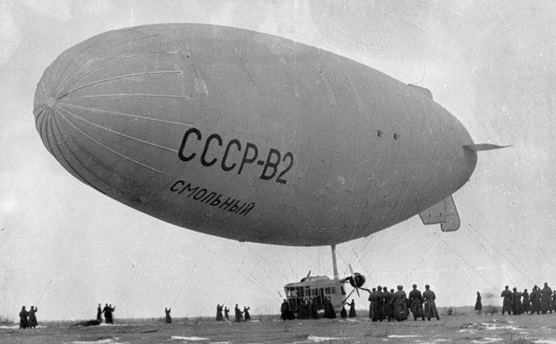
By May 1932, the Russian Empire had built three airship — the USSR B-1, B-2 USSR “Smolny” and the Soviet B-3 “Red Star”, which in the main have been set up to implement educational and propaganda operations. The B-1 envelope was 2200 cubic meters and B-2 5000 cubic meters. The airships had different engines. The V-2 had two 230 hp engines and could carry 8 passengers. The envelope of all 3 airships was made of three-layer rubberized material and had an inner wall that divided the volume of the two equal parts. This partition to reduced transfusion of gas along the envelope for trim of the craft.
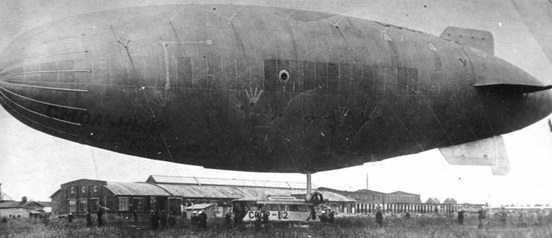
These three airships performed a series of successful flights on the routes of Leningrad — Moscow — Leningrad, Moscow — Kharkov, etc. The three airship were joined by USSR-4.
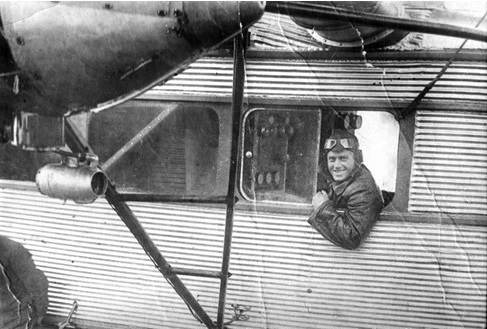
Senior flight mechanic in Smolny before another flight

On September 6, 1935 USSR-2 Smolny was at the Stalino (Donbass) airport, when wind pulled out of the ground all 60 anchors that held it. Have seized on one of the cables commander of dirigible NS Gudovantsev managed at an altitude of 120 meters to get to the gondola, in which at that time were 4 crew members and 11 tourists. At an altitude of 800 meters the engines were running. After that, having waited for the adverse weather conditions to decrease, the airship landed safely after 5 hours and 45 minutes. For this heroic act Gudovantsev was awarded the Order of the Red Star.

The airship crashed in the Novgorod Region in 1933 when its engines failed.

The airship was disassembled in 1939.
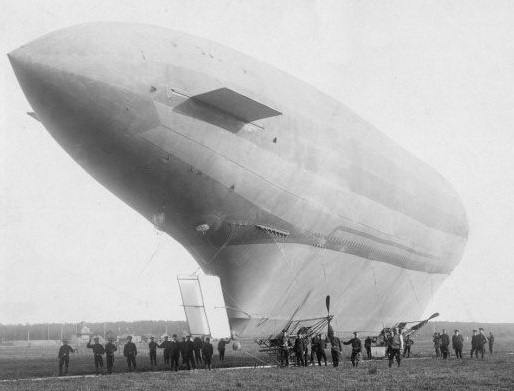
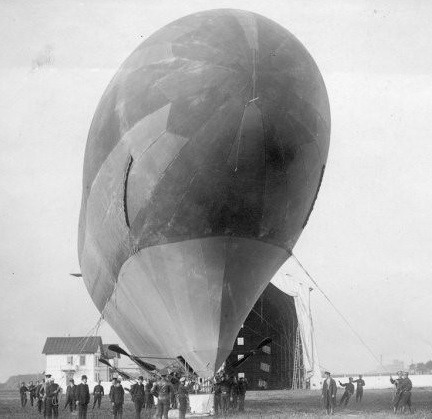
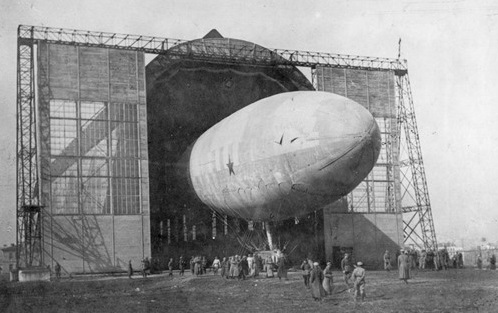
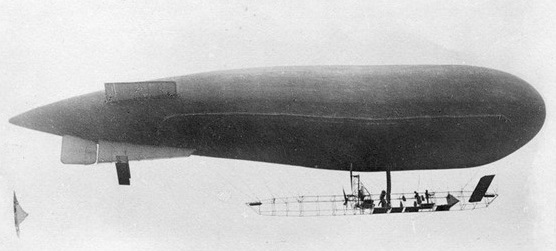
Russian Empire airship USSR B-1

By May 1932, the Russian Empire had built three airship — the USSR B-1, B-2 USSR “Smolny” and the Soviet B-3 “Red Star”, which in the main have been set up to implement educational and propaganda operations. The B-1 envelope was 2200 cubic meters / 78,000 cu ft and B-2 5000 cubic meters. The V-1 was designed to pick up passengers without landing. The airships had different engines. The envelope of all 3 airships was made of three-layer rubberized material and had an inner wall that divided the volume of the two equal parts. This partition to reduced transfusion of gas along the envelope for trim of the craft.

These three airships performed a series of successful flights on the routes of Leningrad — Moscow — Leningrad, Moscow — Kharkov, etc. The three airship were joined by USSR-4.

During The Second World war SSSR-V1 was used for carrying supplies for captive balloon units of Red Army, making more than 900 flights.

Engines: 2 x 75hp
Envelope: 2200 cu.m / 78,000 cu ft a
Top speed: 55 mph
Endurance 12 hr
Crew of 7

Russian Empire airship Golubj / Dove

Before WW 1, Russia had constructed about 10 non-rigid dirigibles. There were 3 small dirigibles including the 1910 non-rigid Golubj (Pigeon). These ships had arms, but were out-of-date.

Airship Голубь / Dove was built in 1910 in Russia at the Izhora plant, located in Kolpino near Petrograd, according to the design of professors Van der Fleet and Konstantin Petrovich Boklevsky (Константин Петрович Боклевский), as well as engineer V.F. Naidenov with the participation of captain B.V. Golubova.

Their ceiling and speed did not meet the requirements, for a military dirigible. During the war the Голубь made several reconnaissance flights, but never crossed the front lines. They were used for training.

In October 1914 the Голубь was transported to Lida, 160 km west of Minsk and was taken down. In the Summer of 1916 the Голубь was assembled but as the dirigible stood in the open it was destroyed during a storm, which ripped the envelope.

Envelope capacity: 2270 cu.m
Engine 74 hp
Length: 42 m
Diameter: 9.8 m
Max speed: 50 km / h

Russian Empire airship Komsomolskaya Pravda

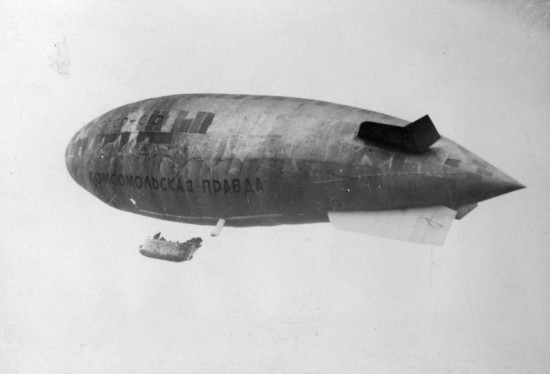
For the decade of the 1920s the Soviet state refrained from building airships. Neither the Red Army neither the Soviet Navy wished to order an airship for military purpose, nor was there interest by any civilian agency. With the decommissioning of the airship MHR the newspaper “Komsomolskaya Pravda” began raising money to build a new airship. Some 12,000 Soviet rubles were raised from Soviet and foreign donors to fund the construction. “Komsomol’skaya Pravda” — literally “Komsomol Truth” — was an official countrywide newspaper of Komsomol, the All-Union Leninist Young Communist League. The airship was named after the newspaper as its editorial board was a fundraiser for her construction and the majority of donations were received from the Komsomol members.

Work on its production were conducted by the students of the aeromechanical High School, under N. Fomin. The new airship was named the “Komsomolskaya Pravda”.

Komsomol’skaya Pravda was a simple non-rigid airship with a volume of 2500 cubic meters of hydrogen and a length of 46 meters. The ship carried one 185 hp BMW aircraft engine. The envelope was made of the fabric remaining from old Russian WWI observation balloons of the Parseval type, and a metal open car was rope-hanged beneath the envelope.

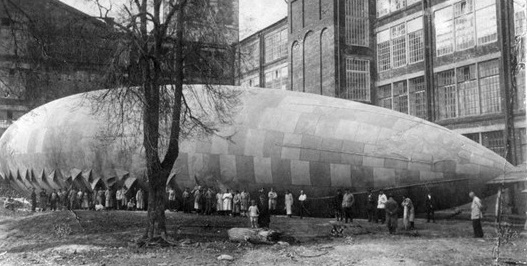
As there were no airship hangars around Moscow at the time, the Komsomolskaya Pravda’s units were fabricated in a former church building. The entire airship was finally assembled and filled with gas outdoor in a natural trough. The same place was used as a mooring in 1930 and 1931.

On July 25, 1930 the airship was filled with gas and on 29 August 1930, near Moscow, the Soviet airship “Komsomolskaya Pravda” (Комсомольская Правда) took off for her maiden flight. After a one-hour flight over Moscow she successfully landed.

Komsomolskaya Pravda’s first test flight.

The commander of the ship became E.M. Oppman and on 31 August 1930 “Komsomolskaya Pravda” flew over Moscow. In 1930 they made 30 flights, and the next year another 25.

Komsomolskaya Pravda was used as a training airship by aeronautics students as well as for propaganda flights. During 1930 and 1931, Komsomolskaya Pravda made 55 flights and covered 3555 km. She was sent for total reconstruction because of deterioration in 1932.

Komsomolskaya Pravda, 1930

In 1934, Komsomolskaya Pravda burnt after being struck with a lightning in the boathouse where it was kept together with its modernized versions.

Russian Empire airship Moscow chemist rezinschik / MHR

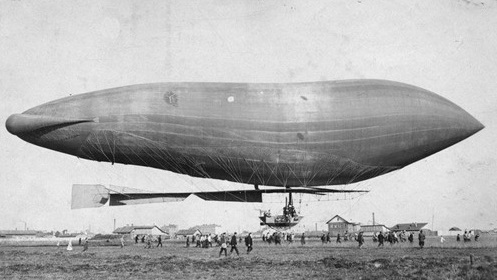
In the autumn of 1924 Vozduhsektsiyu Osoaviahima USSR completed the construction of another Myagenko airship named “Moscow chemist rezinschik” (MHR) under N. Fomin. It was made by voluntary contributions of chemical industry workers in and around Moscow.

The first flight of the airship was made On June 16, 1925, under the control of VL Nizhevskogo, in the air for 2 hours 5 minutes.

Flying from Leningrad to Moscow, it was mistakingly shot down by guards of a military factory in Tver.

Moskovsky Khimik-rezinschik airship, Gatchina, the Leningrad Region, 1928.

After its reconstruction, it had another crash and was disassembled.

This airship was operated until 1928, upgraded a couple of times and rebuilt. In total “Moscow chemist rezinschik” made 21 flights totaling 43 hours and 29 minutes.

Engine: 77 kW
Envelope volume: 2,458 cu.m
Length: 45.4 m
Width: 10.3 m
Maximum speed: 62 km / h
Payload: 900 kg

Russian Empire airship Hawk / Yastreb

The dirigible “Hawk” (“Yastreb”), designed by A.I. Shabskiy, was constructed in Russia in 1910 in Moscow by “Dooks” Ltd.

At some point there were alterations. Differences include no annular insert in the shell, and a slightly different design of the stabilizer.

Before WW1 in Russia there were 3 small non-rigid dirigible including the 1910 Jastreb (Hawk). These ships had arms, but were out-of-date. Their ceiling and speed did not meet the requirements, for a military dirigible. They were used for training.

Volume: 2,700 cu.m
Length: 46 m
Width: 10 m
Max speed: 47 km/h
Engine: 1 x 63 hp

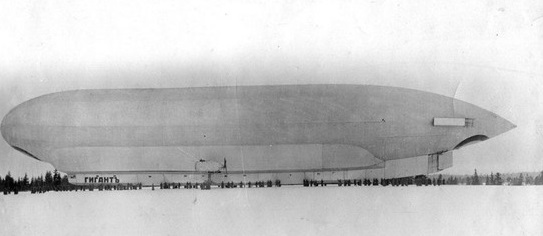
Russian Empire airship Giant / Gigant

The Gigant was built by engineers A.Kovanko and A.Shabskogo at the Russo-Baltic Wagon Works, Salizi, south-east of St.Petersburg, between 1912 and 1915. It was of 724,060 cu.ft capacity, measuring 374 ft long with a 56 ft diameter, giving a gross lift of 21 tons and a useful lift of 8.8 tons. As originally designed, power was four 215 hp Austro-Daimler eight-cylinder petrol engines, later reduced to two such units mounted in streamlined nacelles positioned amidships above the keel.

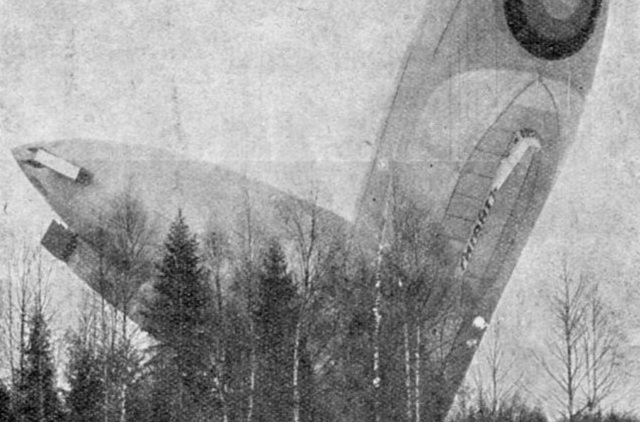
On the first flight, in February 1915, shortly after take-off at low altitude, the airship dipped in the middle, causing the propeller to cut one of the cable braces. The airship, breaking in half, fell to the ground. The crew was not injured.

The cause of the accident was because of the loads imposed by rearranging the engine cars.

The airship was rebuilt, but due to the lack of hydrogen, it was not filled and was scrapped in late 1916.

Engines: 4 x 212 hp
Volume: 20,500 cu.m
Length: 114 m
Diameter: 17 m
Max speed: 58 km / h