Sommer Type E Monoplane / Bathiat-Sanchez

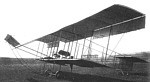
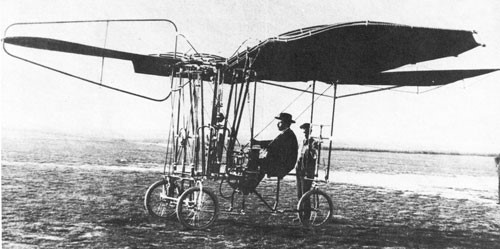
This Roger Sommer monoplane, a fabric covered fuselage version, was designed by Ingénieur Tonnet and flown circa 1911/1912. Léon Bathiat flew many variants of this fast monoplane in several competitions during 1910 and 1911, and in 1912 all interests were purchased by Bathiat who sold these monoplanes under the name Bathiat-Sanchez. Very similar to the Bathiat-Sanchez Type E, shown at the Paris Aero Salon of 1913.

Sommer, Roger

France

Roger Sommer had built an aircraft of his own design in 1908, achieving a few short straight-line flights in early 1909. This was housed at Châlons, where Sommer had a hangar between those occupied by Gabriel Voisin and Henri Farman. In May 1909 Sommer bought a Farman III aircraft, and on 7 August 1909 he gained fame in this by breaking the endurance record held by Wilbur Wright, making a flight lasting 2 hr 27 min 15 sec. Later that year he made a successful appearance at the Doncaster flight meeting, winning the prize for the greatest distance flown during the meeting. Meanwhile, he had started building an aircraft of his own design at Mouzon in the Ardennes, where his family had a felt-making business.

First began aeronautical work in 1904. Special Sommer biplane of 1911 lifted 13 persons. After a dormant period the company resumed aircraft construction 1915, and at the Armistice the Sommer works was claimed to have been producing up to 200 aircraft per month under subcontract.

Somers-Kendall S.K.1

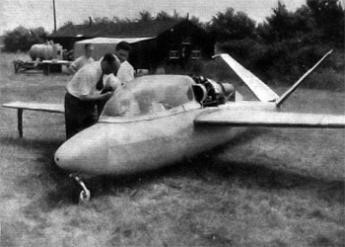
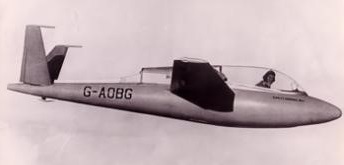
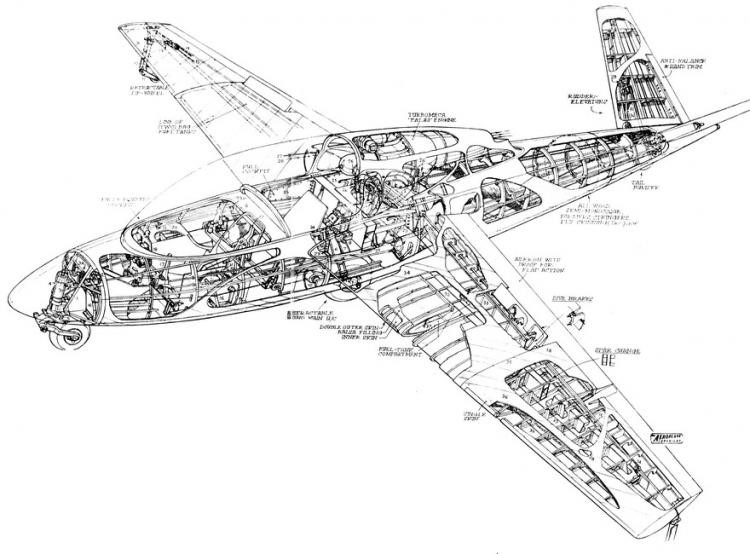
Funded by Nat Somers and designed by Hugh Kendall the Somers Kendal SK-1 was planned to win a Royal Aero Club prize for the design of a light aircraft, and to race, all with acrobatic abilities.

The tandem two-seat SK-1 is made of wood. The wings each hold a structural tank. Both tanks have a total capacity of 227 liters. The leading edge and wing tips are made of synthetic fiber impregnated fiberglass. The laminar wing has an aspect ratio of 8. The flaps extend over the entire span and contribute to the high lift by simultaneously operating down.

The only metal parts of the aircraft are the engine mounts, the landing gear and butterfly tail. The undercarriage front wheel was a Miles Gemini tail wheel, with a singe main wheel. Side outriggers fully retracted into the wing.

The butterfly tail is full flying and smaller trailing edge flaps act as servo trim tabs.

Built at Woodley, the first flight of the SK-1 was flown by Hugh Woodley Kendall, its designer, on Oct. 8, 1955, registered G-AOBC. It suffered a mid-air turbine failure on 11 July 1957.

The lack of market opportunity (either as aircraft race or as training aircraft for the RAF) terminated the project.

It went to the College of Aeronautics, Cranfield for use as a design example but departed in the mid-1960s.

It was found in 1974 under re-build at a farm near Dunstable.

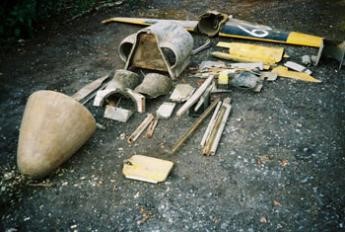
Circa 2010, the Somers-Kendall SK-1 was bought by Peter Bishop of Hamburg, Germany. The body is in good condition and it was transferred to Classic Aero Services in France for restoration.

Some other elements exist, but the wings and canopy were missing.

Engine: Turbomeca Palas, 160 Kp
Span 22 ft 9 in / 6.93 m
Wing area: 6.25 m²
Length 20 ft 10 in / 6.35 m
Height: 1.62 m
Fuselage weight: 217 Kg
Engine and accessories weight: 90 Kg
Equipment and oil weight; 35 Kg
Empty weight: 343 Kg
Aerobatic mauw 1300 lb
Fuel capacity: 228 lt
Vne: 645 km / h
Max speed: 332 mph / 535 Km / h (at sea level)
Max cruise: 450 km / h
Initial climb rate: 1850 ft / min
Range: 1160 km at 20,000 ft at 190 kts
Take-off (50 feet, 750 Kg): 685m
Landing dist (50 feet to 650 Kg): 595m
Load factor: + / – 6 g
Soltau Sturmvogel / Schwingenflieger

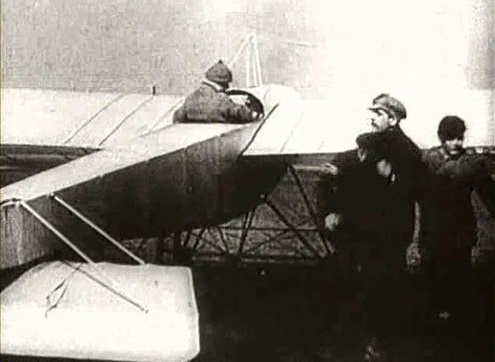
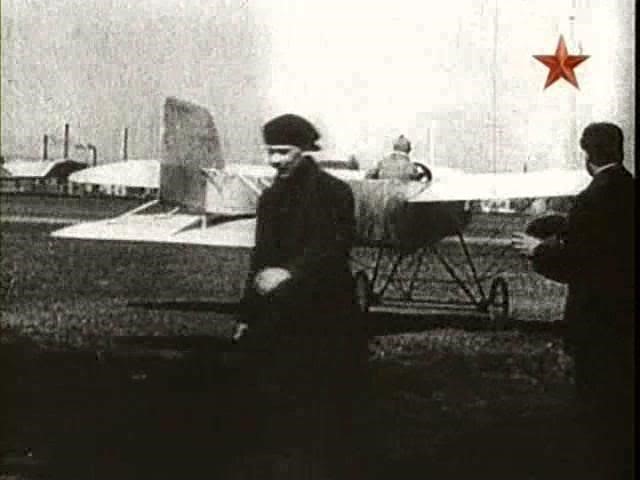
The “Sturmvogel” was an ornithopter designed by Austro-Hungarian engineer Andreas Soltau. It was powered by a carbonic acid engine. It was a relatively large machine, with a span of 11 meters and a wing area of 30 square meters. It had an elevator at the rear, a birdlike construction, and the rudder in front.

The machine was not successful, as the flapping had a too low frequency to lift it off. Tests were made at Linz on 16 August 1909, which were highly published in the contemporary Austro-Hungarian press. After his adventure with the Sturmvogel, Soltau left aeronautics, but he can still be traced in patents dating from the 1920s, one of which features a hot-air engine.

Soltau, Andreas

Austro-Hungarian engineer Andreas Soltau designed the “Sturmvogel” ornithopter. The machine was not successful, and after his adventure with the Sturmvogel, Soltau left aeronautics, but he can still be traced in patents dating from the 1920s, one of which features a hot-air engine.

Soloy Pathfinder 21

The first flight of Soloy Corporation’s modified Cessna 208B Cara¬van, Pathfinder 21, was successfully made on 30 April at Olympia, United States. Flying the aircraft was Soloy’s chief test pilot Paul Haggland and on board for the milestone was crew chief Dan Wright and company president Joe Soloy. The Pathfinder 21 is equipped with two Pratt & Whitney Canada PT6D-114A engines powering a single propeller. The arrangement incorporates a Soloy Dual Pac gearbox assembly, which was certified by the FAA on 18 November 1997. The aircraft’s wings, struts and landing gear have been reinforced to enable its gross ramp weight to be increased to 5,675 kgs (12,500 lbs). The aircraft’s fuselage length has also been increased to almost 2 m more than Cessna’s design.

Engines: 2 x Pratt & Whitney Canada PT6D-114A
Max ramp wt: 5,675 kgs (12,500 lbs)

Solo 2350

A two-stroke, two-cylinder, in-line air cooled light sport engine.

The Solo 2350 D features a mixture control via two diaphragm carburettors, CDI ignition. A crank-case pressure operated fuel pump and crankshaft mounted propeller. With no engine starter, the Solo 2350 D has Type Certificate LBA 4603.

2350 C

Engine: Solo 2350 D
Without Muffler
Cruise power: 19.6 kW at 5,500 1/min
Max rpm: 6,000 1/min
Recommended rpm: 5,000 1/min
Cylinder head temp: Max. 275°C (measured at spark plug)
Fuel consump. at cruise: Approx 2,24 US gal./hr (8,5 l/h)

Engine: Solo 2350 D
With Muffler
Cruise power:
15.3 kW at 5,500 1/min
Max rpm: 6,500 1/min
Recommended rpm: 5,000 1/min
Cylinder head temp: Max. 275°C (measured at spark plug)
Fuel consump. at cruise: Approx 2,24 US gal./hr (8,5 l/h)

Solirène and Son Le grand

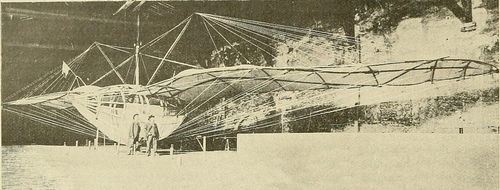
MM. Solirène, preparers at the Montpellier School of Pharmacy, undertook in 1903, the construction of the gigantic glider. Built during 1903/1904 by Solirène and son from Montpellier, the first was never flown due to financial problems.

A second, smaller glider was built.

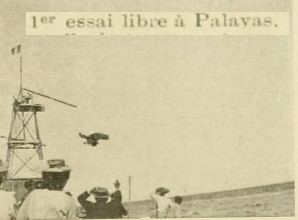
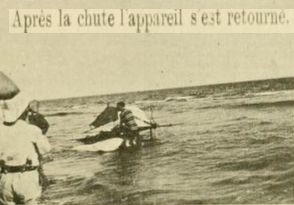
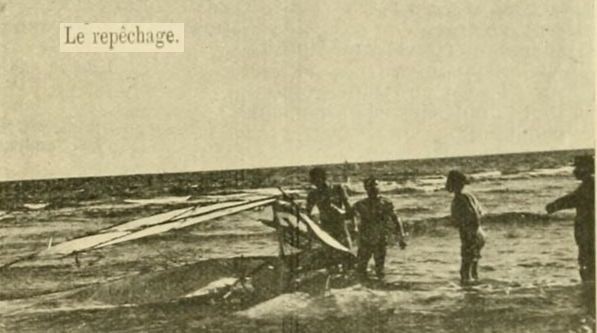
Around Montpellier, on a 12 meters high pylon by the sea in Palavas, the glider was launched.

The airplane gets up a bit but the right side where all the wires of the right wing are attached breaks and the airman falls roughly to the side, the depth of the water (0.30m) not being sufficient to cushion the fall.

The damage was repaired, Mr. Solirène beginning on August 23, 1905.