Amongst the early birds, Ewart Jones later went on to become manufacturers as Sophistikites.
Era
Sons Trainer
Built by John A Sons in 1929, the Sons Trainer was built with “parts purchased from local dealer.” A two-place open cockpit monoplane was registered NC3044 c/n S-8772. The registration was cancelled on 5 September 1930.
Wingspan: 34’6″
Length: 22’6″
Seats: 2
Sons, John A
Humble TX.
USA
Built the Sons Trainer in 1929.
Songbo Zeppelin
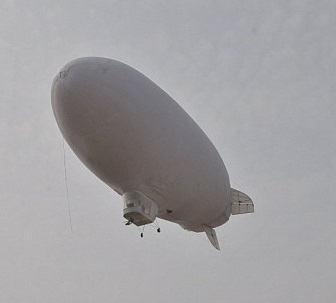
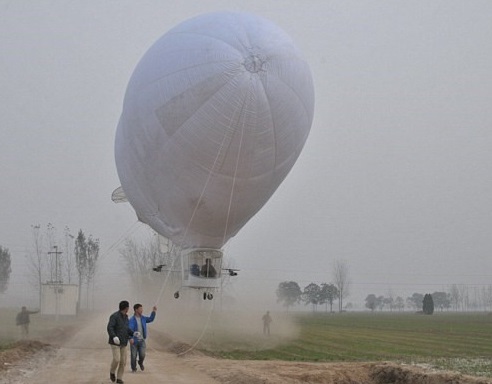
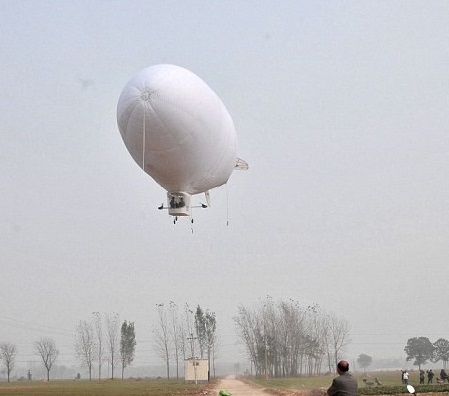
Shi Songbo from Ningling, central China, spent 300,000 Yuan (£30,000) on the Zeppelin, which successfully completed a two-hour test flight near his home in October 2015.
Although his family have been farmers for several generations, his brother attended the Aeronautical Engineering Institute in Xi’an, central China.
As a result of his studies, Shi’s brother always brought home aeronautical engineering magazines and reading material, which got Shi interested in the techniques involved in building an aircraft.
Eventually, Shi would go on to work for an aerial model company as a designer, which gave him greater understanding of the composition of a plane.
In June 2015, Shi was let go from his job, which prompted him to start building his ‘Songbo’ Zeppelin. Shi Songbo spent four months building a Zeppelin. The Zeppelin is about 33 feet tall and 75 feet long. The top portion is composed of a hydrogen-filled airbag while the bottom is made up of the seat and controls.
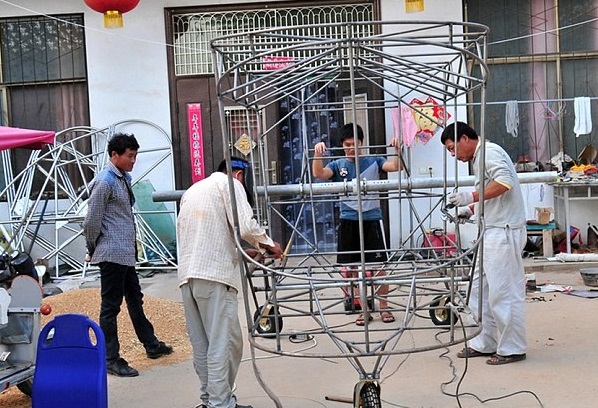
Shi spent around four months and 300,000 Yuan (£30,000) on the Zeppelin, with many of the components imported from Germany and the USA.
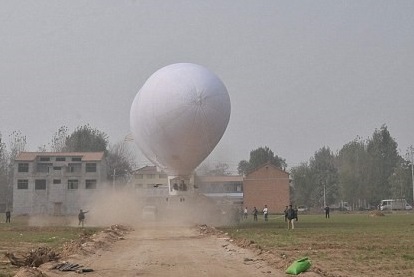
Shi Songbo conducted his first official flight on October 25 2015 in a field near his home under the direction of friend Shang Jianjun, who acted as a dispatcher.
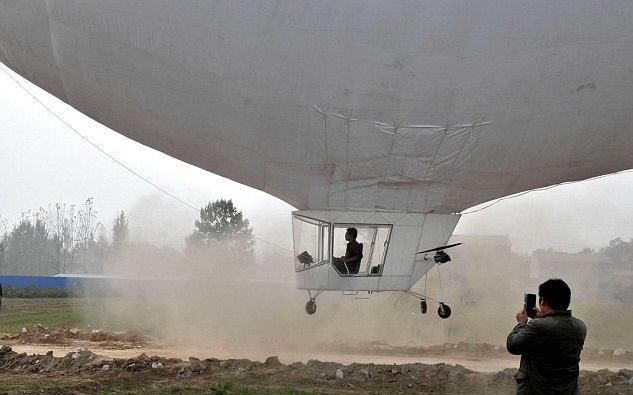
Along with his co-pilot Li Kai, the inventor made several different maneuvers and successfully took off and landed eight times over the space of two hours split between the morning and afternoon. Speaking of his first aerial experience, Shi said: ‘There were lots of low-hanging electricity cables.” ‘Because I was worried about bumping into the cables, everything had to be under the direction of the dispatcher.’ He added, ‘My co-pilot was my eyes and ears. He helped to monitor my surroundings.’
It is able to travel just over 30 miles per hour at 1,640 feet above the ground while carrying two people.
The Zeppelin prototype will need additional testing but Shi hoped that it could be used to distribute pesticide, aerial surveying or tourism in the future.
Sonex Aircraft
2009:
Sonex Aircraft, LLC
P.O. Box 2521
Oshkosh, WI 54903
LSA and glider builder
Somerville 1912 Biplane

The 1912 Somerville Biplane was an exhibition and sightseeing ship for Earl S Daughery, who relocated to Long Beach CA and founded its municipal airport.

Coal City’s Illinois Aero Construction Co (IAC) initials were on the plane and 51; most likely when it was used as a trainer at IAC’s flying school.
Somerville-Borel monoplane

Built by the Illinois Aero Construction Company and designed as an automatically stable machine by William E. (Billy) Somerville.
The 1910 Somerville-Borel was mentioned in the 27 September 1913 Aero and Hydro as a 50hp Gnôme-powered monoplane being flown at Rensselaer IN. Advertised as “automatically stable,” it might have been a copy, rather than a rebuild as thought, of the Morane-Borel.
Engine: 50hp Gnôme
Wingspan: 45’0″
Seats: 1
Somerville, William E
Coal City IL.
USA
Built aircraft circa 1910-12.
Sommer Hoch-Tief Doppeldecker

The “Hoch-Tief-Doppeldecker” built by the “Deutsche Sommer Flugzeugwerke GmbH” at Frankfurt-Rebstock in 1912. This machine was designed by Robert Sommer and had a circular fuselage, was powered by a 70 hp Hoffmann “Rotor” 7-cylinder engine. The lower wings were attached direct to the landing gear, therefore there was some space between wings and body.
Sommer 1910 biplane
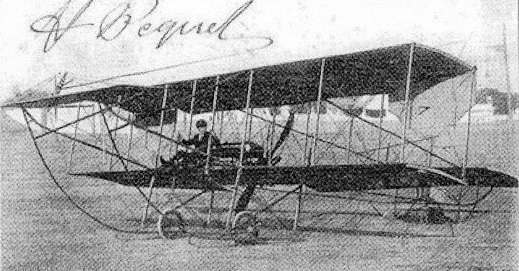
The Sommer 1910 Biplane was designed by Roger Sommer. It was a pusher configuration biplane resembling the successful Farman III, and was built in large numbers for the time. One was owned by Charles Rolls.
In May 1909 Sommer bought a Farman III aircraft, and on 7 August 1909 he gained fame in this by breaking the endurance record held by Wilbur Wright, making a flight lasting 2 hr 27 min 15 sec. Later that year he made a successful appearance at the Doncaster flight meeting, winning the prize for the greatest distance flown during the meeting. Meanwhile, he had started building an aircraft of his own design at Mouzon in the Ardennes, where his family had a felt-making business.
The design of the Sommer biplane was derived from that of the Farman III, the aircraft being a pusher configuration equal-span biplane powered by a 50 hp (37 kW) Gnome Omega. Lateral control was effected by D-shaped ailerons on the upper wing. A single elevator was mounted in front of the wings: behind the wings wire-braced wooden booms carried a horizontal surface which was operated independently of the front elevator and was used to adjust the aircraft’s trim rather than for control purposes. Early examples has a single large rudder mounted below this: this was later changed to four smaller rudders, two above it and two below, and subsequently changed again to one above and one below. The twin skids of the undercarriage were extended forwards to form part of the supporting structure for the elevator, and a single pair of wheels were mounted on an axle between the skids. A two-seat “Military” version with an extended upper wing was produced later.
The prototype was first flown by Sommer on 4 January 1910 at Mouzon, when he managed three flights of over 4 km (2.5 mi) This first machine was sold to a M. Viateaux within two weeks, and by the end of February he had built a replacement and established a flying school at Mouzon. A large number of examples were built: by spring 1910 Sommer had sixty aircraft on order. Sommer had established flying school at Douzy using his machines.
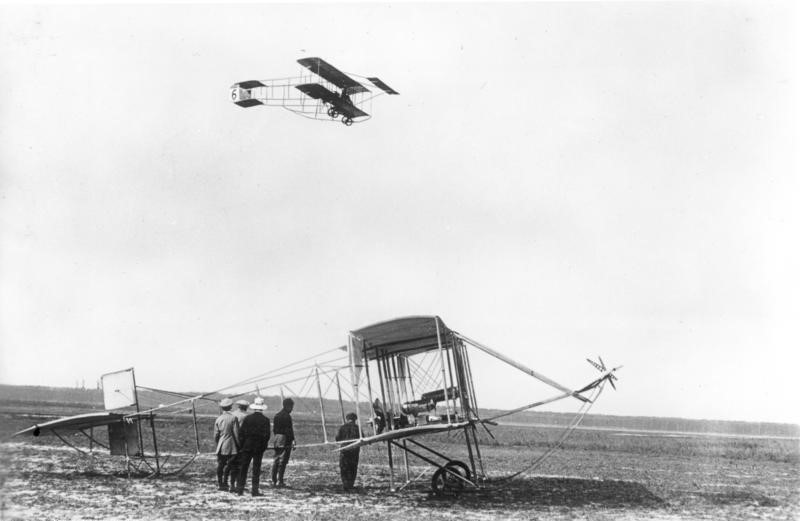
One example was bought by Charles Rolls, and was exhibited on the Royal Aero Society stand at the 1910 Aero Show at Olympia
A small number of license-built copies of the Sommer biplane were built in England by Humber. These were of mixed steel and wood construction, and one was used to carry out the world’s first official mail-carrying flight, when 6,500 letters were flown by Henri Pequet from the United Provinces Exhibition at Allahabad to Naini. The letters bore an official frank “First Aerial Post, U.P. Exhibition, Allahabad, 1911”, the text surrounding a drawing of the aircraft.
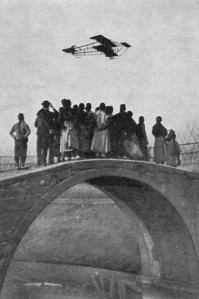
The first aeroplane flight in China was most likely on February 21, 1911, with René Vallon and his Sommer biplane flying over Shanghai. Like other entrepreneurial aviators, he was hoping to sell the concept to onlookers.
Powerplant: 1 × Gnome Omega 7, 37 kW (50 hp)
Wingspan: 10.36 m (34 ft 0 in)
Wing area: 36 m2 (390 sq ft)
Length: 12.5 m (41 ft 0 in)
Crew: 1
Capacity: 1

